Narrative Techniques in
Midnight’s Children
Presented by -Hinaba Sarvaiya
•Paper name:- Indian English Literature
(Post-independence)
•Roll number:- 09
•Submission by:- Department of English,
MKBU
•Email id:- hinabasarvaiya1711@gmail.com
Introduction:-
• Until the year 1980, no critic had dreamt of the magnitude of the
great tumaround that the Indian English novel would make with the
publication of Midnight’s Children in 1981.
• Midnight’s Children was published in 1981 and it took readers all over
the world, by storm.
• As the novel went on to be read in different quarters, it was clear that
a very different and original talent had indeed arrived.
• The novel not only made an impact as a presence but it also
influenced a number of writers who followed Rushdie.
About Author:-
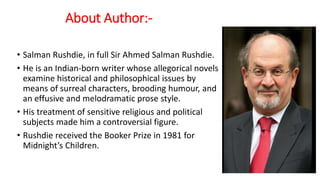
• Salman Rushdie, in full Sir Ahmed Salman Rushdie.
• He is an Indian-born writer whose allegorical novels
examine historical and philosophical issues by
means of surreal characters, brooding humour, and
an effusive and melodramatic prose style.
• His treatment of sensitive religious and political
subjects made him a controversial figure.
• Rushdie received the Booker Prize in 1981 for
Midnight’s Children.
Narrative Techniques in Midnight’s Children
• Unnatural Narrative:-
• Jan Alber and Monika Fludernik also observed how this new
focus of unnatural Narratilogy emerges out of a Combinationof
previous postmodern narratilogical “Cognitive turn” as
examplified by such theorists as David Herman and Liza
Zunshine(14).
• Unnatural Narrative is generally treated in broad term, using a
collection of predominantly postmodern texts, and falls under
the wider heading of “Postclassical Narratology”.
• Unnatural Narrative into dialogue with Salman Rushdie’s
Midnight’s Children.
• The novel Follows Saleem Sinai as he writes about his life
and explains his intimate connection with the evolution of
Indian as a nation from the very moment of his birth at the
precise movement of Indian Independence.
• Saleem strugglesvto tell his story on his own terms.
• His Narrative includes the history of his grandparents and
parents, a supernatural connection to other children born
between the hours of midnight and one that morning, and
rivalry with another Midnight’s child who rightfully should
have lived Saleem’s life.
Saleem as an Unnatural Narrator:-
• In the case of unnatural narration the theorists state that
this includes
• “Physically, logically, mnemonically or psychological
impossible enunciations”.(124)
• Third person omniscience that may draw the reader in all
the more intimately.
• Alber also suggest that use of the first person “I” should
not always be assumed to represent an ordinary human
subject.
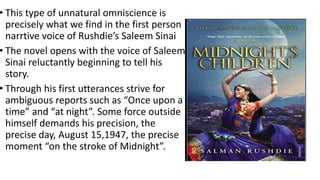
• This type of unnatural omniscience is
precisely what we find in the first person
narrtive voice of Rushdie’s Saleem Sinai
• The novel opens with the voice of Saleem
Sinai reluctantly beginning to tell his
story.
• Through his first utterances strive for
ambiguous reports such as “Once upon a
time” and “at night”. Some force outside
himself demands his precision, the
precise day, August 15,1947, the precise
moment “on the stroke of Midnight”.
The Use Oriental and Western Texts:-
• Rushdie has Cleverly used both Oriental and Western text in the
novel.
• He remains indebted to a few writers and their works, Laurence
Stern’s Tristram Shandy, Rudyard Kipling’s Kim ect.
• Midnight’s Children follows a technique that resembled Gabriel
Gaia Mquez’s style in One Hundred Years of Solitude.
• Saleem, in the novel, himself is truly cosmopolitan.
• He is partly Hindu, partly Musliam and partly Christian
intermixing of various religious and cultures that make of India.
• Midnight’s Children
do not agree with
the Hindu world
view of Indian
society as
homogenous one.
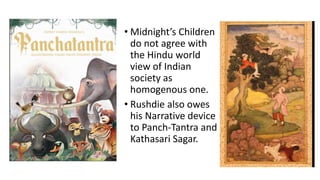
• Rushdie also owes
his Narrative device
to Panch-Tantra and
Kathasari Sagar.
Magic Realism:-
• Rushdie adopts the device of magic realism in Midnight’s
Children.
• Magic Realism is a term originally coined by German critic Frantz
Roh in 1925 to describe the tendencies in the work of certain
German painter in the early twenties.
• But the term was first applied to literature by Cuban Novelist
Alejo Carpentier in the Late 1940’s.
• Basically magic realism was a Latin American phenomenon
characterized by the incorporation of supernatural elements into
realistic fiction.
• Rushdie used the device of magic realism for the framework
of the novel.
• When we go through the novel, we find tha Saleem Sinai, the
protagonist, has the gift of having an incredible sence of
smell which allows him to determine other’s thoughts and
emotions.
Cornification of Various Languages:-
• Another interesting feature of Rushdie’s narrtive is the Bounteous
sprinking of English with Hindi and Urdu words which provides an
oriental flavor to the novel.
• This combination of various languages.
• He make use of number of Hindi and Urdu words like ekdum, nasbandi,
dhoban, firangee, garam, masala, baba etc.. Are used in flawless English.
• He also employes some expressions and phrases in the novel such as,
'baap-re baap’, 'hai-hai’, 'nimbu pani’ ect.
• Such compounds shows Rushdie’s innovation and mastry over English
language.
• These experiment with language make Midnight’s Children an
interesting text to read.
Conclusion:-
• To conclude one can say that Rushdie’s use of innovative
narrtive technique has made Midnight’s Children a complex
and highly challenging work of fiction.
• Along with the content and it’s marvelous treatment, this
new and innovative narrtive technique enabled rashdie to
capture the top most position among the winners of the
Booker Prize over the past twenty five years.
Thank you
References:-
• Ashok. Narrative Technique In Salman Rushdie’s Midnight’s Children,
IX, no. XVII, Jan. 2015, ipublisher.in/p/3314.
• Britannica, The Editors of Encyclopaedia. "Salman Rushdie".
Encyclopedia Britannica, 14 Aug. 2022,
https://www.britannica.com/biography/Salman-Rushdie. Accessed 3
October 2022.
• Buchholz, Laura. “Unnatural Narrative in Postcolonial Contexts: Re-
Reading Salman Rushdie’s ‘Midnight’s Children.’” Journal of Narrative
Theory, vol. 42, no. 3, 2012, pp. 332–51. JSTOR,
http://www.jstor.org/stable/24484776. Accessed 2 Oct. 2022.
“Magic Realism .” Literary Movements for Students:
Presenting Analysis, Context, and Criticism on Literary
Movements. . Encyclopedia.com. 27 Sep. 2022
https://www.encyclopedia.com.

Narrative techniques in Midnight's Children

  • 1.
    Narrative Techniques in Midnight’sChildren Presented by -Hinaba Sarvaiya
  • 2.
    •Paper name:- IndianEnglish Literature (Post-independence) •Roll number:- 09 •Submission by:- Department of English, MKBU •Email id:- hinabasarvaiya1711@gmail.com
  • 3.
    Introduction:- • Until theyear 1980, no critic had dreamt of the magnitude of the great tumaround that the Indian English novel would make with the publication of Midnight’s Children in 1981. • Midnight’s Children was published in 1981 and it took readers all over the world, by storm. • As the novel went on to be read in different quarters, it was clear that a very different and original talent had indeed arrived. • The novel not only made an impact as a presence but it also influenced a number of writers who followed Rushdie.
  • 4.
    About Author:- • SalmanRushdie, in full Sir Ahmed Salman Rushdie. • He is an Indian-born writer whose allegorical novels examine historical and philosophical issues by means of surreal characters, brooding humour, and an effusive and melodramatic prose style. • His treatment of sensitive religious and political subjects made him a controversial figure. • Rushdie received the Booker Prize in 1981 for Midnight’s Children.
  • 5.
    Narrative Techniques inMidnight’s Children • Unnatural Narrative:- • Jan Alber and Monika Fludernik also observed how this new focus of unnatural Narratilogy emerges out of a Combinationof previous postmodern narratilogical “Cognitive turn” as examplified by such theorists as David Herman and Liza Zunshine(14). • Unnatural Narrative is generally treated in broad term, using a collection of predominantly postmodern texts, and falls under the wider heading of “Postclassical Narratology”.
  • 6.
    • Unnatural Narrativeinto dialogue with Salman Rushdie’s Midnight’s Children. • The novel Follows Saleem Sinai as he writes about his life and explains his intimate connection with the evolution of Indian as a nation from the very moment of his birth at the precise movement of Indian Independence. • Saleem strugglesvto tell his story on his own terms. • His Narrative includes the history of his grandparents and parents, a supernatural connection to other children born between the hours of midnight and one that morning, and rivalry with another Midnight’s child who rightfully should have lived Saleem’s life.
  • 7.
    Saleem as anUnnatural Narrator:- • In the case of unnatural narration the theorists state that this includes • “Physically, logically, mnemonically or psychological impossible enunciations”.(124) • Third person omniscience that may draw the reader in all the more intimately. • Alber also suggest that use of the first person “I” should not always be assumed to represent an ordinary human subject.
  • 8.
    • This typeof unnatural omniscience is precisely what we find in the first person narrtive voice of Rushdie’s Saleem Sinai • The novel opens with the voice of Saleem Sinai reluctantly beginning to tell his story. • Through his first utterances strive for ambiguous reports such as “Once upon a time” and “at night”. Some force outside himself demands his precision, the precise day, August 15,1947, the precise moment “on the stroke of Midnight”.
  • 9.
    The Use Orientaland Western Texts:- • Rushdie has Cleverly used both Oriental and Western text in the novel. • He remains indebted to a few writers and their works, Laurence Stern’s Tristram Shandy, Rudyard Kipling’s Kim ect. • Midnight’s Children follows a technique that resembled Gabriel Gaia Mquez’s style in One Hundred Years of Solitude. • Saleem, in the novel, himself is truly cosmopolitan. • He is partly Hindu, partly Musliam and partly Christian intermixing of various religious and cultures that make of India.
  • 10.
    • Midnight’s Children donot agree with the Hindu world view of Indian society as homogenous one. • Rushdie also owes his Narrative device to Panch-Tantra and Kathasari Sagar.
  • 11.
    Magic Realism:- • Rushdieadopts the device of magic realism in Midnight’s Children. • Magic Realism is a term originally coined by German critic Frantz Roh in 1925 to describe the tendencies in the work of certain German painter in the early twenties. • But the term was first applied to literature by Cuban Novelist Alejo Carpentier in the Late 1940’s. • Basically magic realism was a Latin American phenomenon characterized by the incorporation of supernatural elements into realistic fiction.
  • 12.
    • Rushdie usedthe device of magic realism for the framework of the novel. • When we go through the novel, we find tha Saleem Sinai, the protagonist, has the gift of having an incredible sence of smell which allows him to determine other’s thoughts and emotions.
  • 13.
    Cornification of VariousLanguages:- • Another interesting feature of Rushdie’s narrtive is the Bounteous sprinking of English with Hindi and Urdu words which provides an oriental flavor to the novel. • This combination of various languages. • He make use of number of Hindi and Urdu words like ekdum, nasbandi, dhoban, firangee, garam, masala, baba etc.. Are used in flawless English. • He also employes some expressions and phrases in the novel such as, 'baap-re baap’, 'hai-hai’, 'nimbu pani’ ect. • Such compounds shows Rushdie’s innovation and mastry over English language. • These experiment with language make Midnight’s Children an interesting text to read.
  • 14.
    Conclusion:- • To concludeone can say that Rushdie’s use of innovative narrtive technique has made Midnight’s Children a complex and highly challenging work of fiction. • Along with the content and it’s marvelous treatment, this new and innovative narrtive technique enabled rashdie to capture the top most position among the winners of the Booker Prize over the past twenty five years. Thank you
  • 15.
    References:- • Ashok. NarrativeTechnique In Salman Rushdie’s Midnight’s Children, IX, no. XVII, Jan. 2015, ipublisher.in/p/3314. • Britannica, The Editors of Encyclopaedia. "Salman Rushdie". Encyclopedia Britannica, 14 Aug. 2022, https://www.britannica.com/biography/Salman-Rushdie. Accessed 3 October 2022. • Buchholz, Laura. “Unnatural Narrative in Postcolonial Contexts: Re- Reading Salman Rushdie’s ‘Midnight’s Children.’” Journal of Narrative Theory, vol. 42, no. 3, 2012, pp. 332–51. JSTOR, http://www.jstor.org/stable/24484776. Accessed 2 Oct. 2022.
  • 16.
    “Magic Realism .”Literary Movements for Students: Presenting Analysis, Context, and Criticism on Literary Movements. . Encyclopedia.com. 27 Sep. 2022 https://www.encyclopedia.com.