What is WCM ?
It is our
“Continuous
Improvement
System”
 Founded in TPM
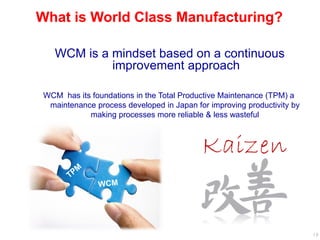
WCM has its foundations in the Total Productive Maintenance (TPM) a
maintenance process developed in Japan for improving productivity by
making processes more reliable & less wasteful
What is World Class Manufacturing?
WCM is a mindset based on a continuous
improvement approach
/ 2
What is TPM ?
Total Productive Maintenance
Origins. 1970s in Japan. Developed by JIPM
A System emphasizing complete Care (Maintaining) of machines
delivered dramatic results ...
TPM = WCM
Zero BDs, Zero Defect and Zero Accident.
4
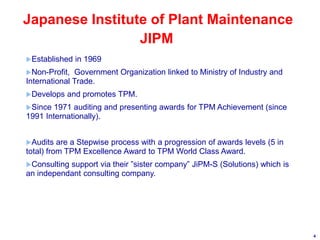
Japanese Institute of Plant Maintenance
Established in 1969
Non-Profit, Government Organization linked to Ministry of Industry and
International Trade.
Develops and promotes TPM.
Since 1971 auditing and presenting awards for TPM Achievement (since
1991 Internationally).
Audits are a Stepwise process with a progression of awards levels (5 in
total) from TPM Excellence Award to TPM World Class Award.
Consulting support via their ”sister company” JiPM-S (Solutions) which is
an independant consulting company.
JIPM
/ 5
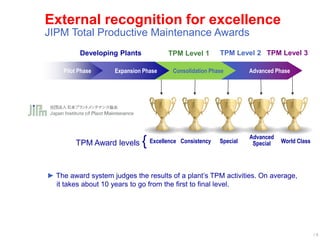
External recognition for excellence
JIPM Total Productive Maintenance Awards
Advanced PhaseConsolidation PhaseExpansion PhasePilot Phase
TPM Level 1 TPM Level 2 TPM Level 3
Excellence Consistency Special
Advanced
Special World Class
Developing Plants
TPM Award levels {
► The award system judges the results of a plant’s TPM activities. On average,
it takes about 10 years to go from the first to final level.
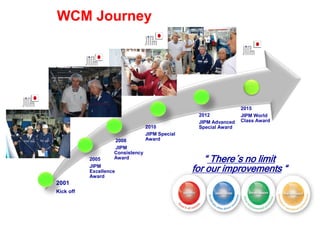
2005
JIPM
Excellence
Award
2008
JIPM
Consistency
Award
2010
JIPM Special
Award
2012
JIPM Advanced
Special Award
2015
JIPM World
Class Award
WCM Journey
2001
Kick off
“ There´s no limit
for our improvements “
WCM Principles
What makes WCM being different !
/ 7
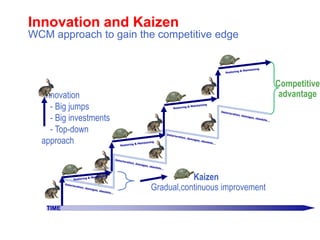
Competitive
advantage
TIME
Innovation
- Big jumps
- Big investments
- Top-down
approach
Kaizen
Gradual,continuous improvement
Innovation and Kaizen
WCM approach to gain the competitive edge
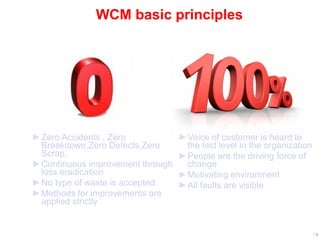
►Zero Accidents , Zero
Breakdown,Zero Defects,Zero
Scrap,
►Continuous improvement through
loss eradication
►No type of waste is accepted
►Methods for improvements are
applied strictly
WCM basic principles
►Voice of customer is heard to
the last level in the organization
►People are the driving force of
change
►Motivating environment
►All faults are visible
/ 9
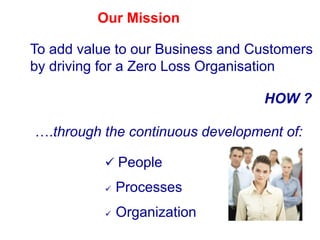
Our Mission
….through the continuous development of:
 People
 Processes
HOW ?
 Organization
To add value to our Business and Customers
by driving for a Zero Loss Organisation
Our Strategy
 Develop People
-Training
-Coaching
-Empowering people for self learn
 Develop Processes
-Standardize and align methods and tools
-Transfer WCM knowledge sharing best practices
 Develop Organization
-Promote WCM people integration
-Keep WCM community alive
/ 11
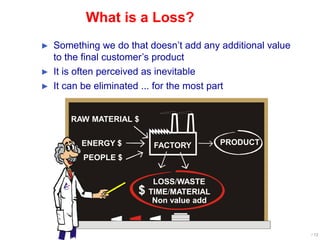
Non value add
FACTORYENERGY $
PEOPLE $
RAW MATERIAL $
PRODUCT
$ TIME/MATERIAL
LOSS/WASTE
► Something we do that doesn’t add any additional value
to the final customer’s product
► It is often perceived as inevitable
► It can be eliminated ... for the most part
What is a Loss?
/ 12
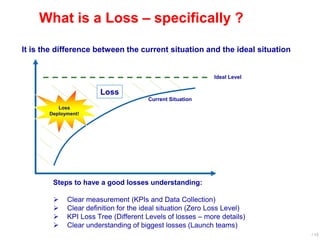
Steps to have a good losses understanding:
 Clear measurement (KPIs and Data Collection)
 Clear definition for the ideal situation (Zero Loss Level)
 KPI Loss Tree (Different Levels of losses – more details)
 Clear understanding of biggest losses (Launch teams)
Ideal Level
It is the difference between the current situation and the ideal situation
Loss
Deployment!
Loss
What is a Loss – specifically ?
Current Situation
/ 13
Losses
/ 14
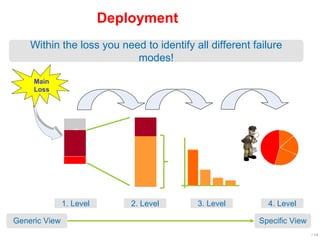
Within the loss you need to identify all different failure
modes!
Generic View Specific View
1. Level 2. Level 3. Level 4. Level
Main
Loss
Deployment
/ 15
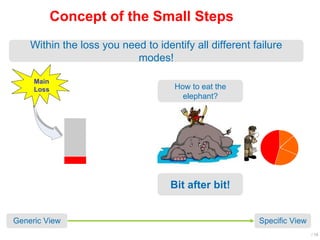
How to eat the
elephant?
Bit after bit!
Concept of the Small Steps
Main
Loss
Generic View Specific View
Within the loss you need to identify all different failure
modes!
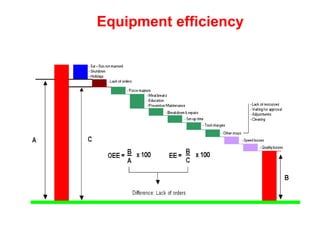
Equipment efficiency
17
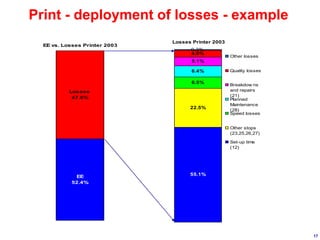
Print - deployment of losses - example
EE vs. Losses Printer 2003
EE
52.4%
Losses
47.6%
Losses Printer 2003
55.1%
22.5%
6.5%
6.4%
5.1%
4.0%
0.3%
Other losses
Quality losses
Breakdow ns
and repairs
(21)
Planned
Maintenance
(28)
Speed losses
Other stops
(23,25,26,27)
Set-up time
(12)
18
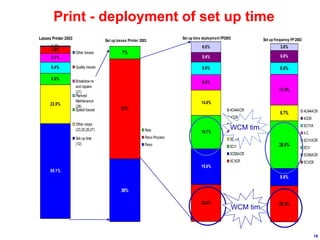
Set up losses Printer 2003
36%
57%
7%
Roto
Flexo Process
Flexo
Print - deployment of set up time
Losses Printer 2003
55.1%
22.5%
6.5%
6.4%
5.1%
4.0%
0.3%
Other losses
Quality losses
Breakdowns
and repairs
(21)
Planned
Maintenance
(28)
Speed losses
Other stops
(23,25,26,27)
Set-up time
(12)
Set up time deployment FP2003
20.5%
19.8%
18.7%
14.0%
8.6%
6.9%
5.4%
6.0%
4C4I4ACR
4CCR
5C1I1A
4 C
5C1I1ACR
5C1I
5C5I5ACR
5C1ICR
Set up frequency FP 2003
20.3%
9.6%
26.8%
8.7%
17.4%
6.6%
6.8%
3.8%
4C4I4ACR
4CCR
5C1I1A
4 C
5C1I1ACR
5C1I
5C5I5ACR
5C1ICR
WCM tim
WCM tim
ImproveEradicate
/ 19
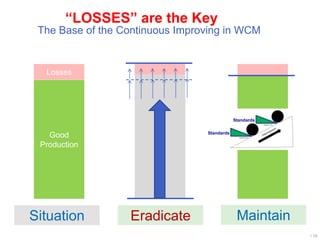
“LOSSES” are the Key
The Base of the Continuous Improving in WCM
Maintain
Good
Production
Losses
Situation
Standards
Standards
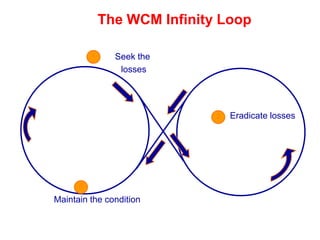
The WCM Infinity Loop
1
2
3
Maintain the condition
Eradicate losses
Seek the
losses
/ 21
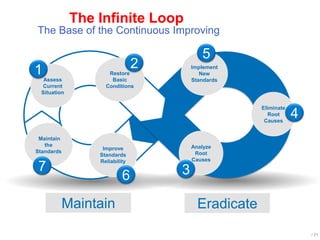
The Infinite Loop
The Base of the Continuous Improving
Maintain Eradicate
Assess
Current
Situation
Restore
Basic
Conditions
Analyze
Root
Causes
Eliminate
Root
Causes
Implement
New
Standards
Improve
Standards
Reliability
Maintain
the
Standards
1 2
3
4
5
6
7
/ 22
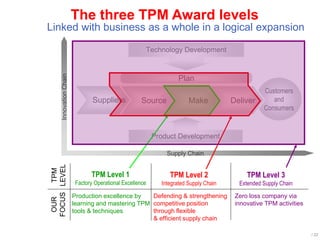
The three TPM Award levels
Linked with business as a whole in a logical expansion
Supply Chain
InnovationChain
Customers
and
Consumers
Suppliers Source Make Deliver
Plan
Technology Development
Product Development
OUR
FOCUS
TPM
LEVEL
TPM Level 1
Factory Operational Excellence
Production excellence by
learning and mastering TPM
tools & techniques
TPM Level 2
Integrated Supply Chain
Defending & strengthening
competitive position
through flexible
& efficient supply chain
TPM Level 3
Extended Supply Chain
Zero loss company via
innovative TPM activities
/ 23
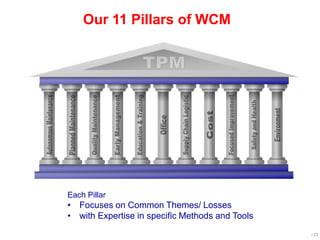
Our 11 Pillars of WCM
Each Pillar
• Focuses on Common Themes/ Losses
• with Expertise in specific Methods and Tools
TPM-osnovi
Beograd-Srbija
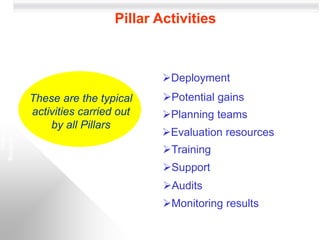
Pillar Activities
These are the typical
activities carried out
by all Pillars
Deployment
Evaluation resources
Potential gains
Training
Planning teams
Audits
Support
Monitoring results
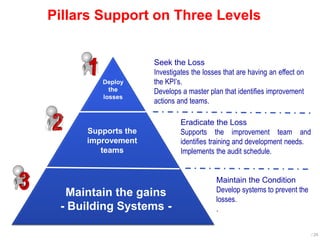
Pillars Support on Three Levels
Seek the Loss
Investigates the losses that are having an effect on
the KPI’s.
Develops a master plan that identifies improvement
actions and teams.
Eradicate the Loss
Supports the improvement team and
identifies training and development needs.
Implements the audit schedule.
Maintain the Condition
Develop systems to prevent the
losses.
.
Deploy
the
losses
Supports the
improvement
teams
Maintain the gains
- Building Systems -
/ 25
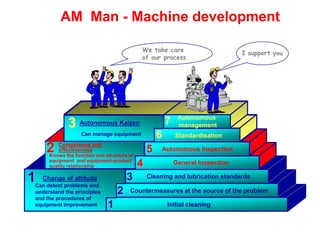
AM Man - Machine development
Initial cleaning
Countermeasures at the source of the problem
1
2
Cleaning and lubrication standards3
General Inspection4
Autonomous Inspection5
Standardisation
Autonomous
management
6
7
I support you
Can detect problems and
understand the principles
and the procedures of
equipment improvement
1 Change of attitude
Knows the function and structure of
equipment and equipment-product
quality relationship
2 Competence and
effectiveness
3
Can manage equipment
Autonomous Kaizen
We take care
of our process
4.27
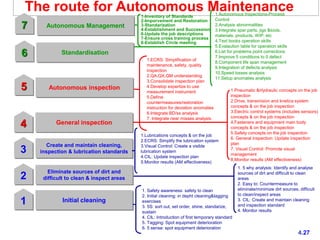
The route for Autonomous Maintenance
Initial cleaning1
Eliminate sources of dirt and
difficult to clean & inspect areas2
General inspection4
Create and maintain cleaning,
inspection & lubrication standards3
Autonomous inspection5
Standardisation6
Autonomous Management7
1. Safety awareness: safety to clean
2. Initial cleaning: in depht cleaning&tagging
exercises
3. 5S: sort out, set order, shine, standarize,
sustain
4. CIL: Introduction of first temporary standard
5. Tagging: Spot equipment deterioration
6. 5 sense: spot equipment deterioration
1. 5 why analysis: Identify and analyse
sources of dirt and difficult to clean
areas
2. Easy to: Countermeasure to
eliminate/minimize dirt sources, difficult
to clean/inspect areas
3. CIL: Create and maintain cleaning
and inspection standard
4. Monitor results
1.Lubrications concepts & on the job
2.ECRS: Simplify the lubrication system
3.Visual Control: Create a visible
lubrication system
4.CIL: Update inspection plan
5.Monitor results (AM effectiveness)
1.Pneumatic &Hydraulic concepts on the job
inspection
2.Drive, transmision and knetics system
concepts & on the job inspection
3.Electric control systems (includes sensors)
concepts & on the job inspection
4.Fasteners and equipment main body
concepts & on the job inspection
5.Safety concepts on the job inspection
6. General inspection: Update inspection
plan
7. Visual Control: Promote visual
management
8.Monitor results (AM effectiveness)
1.ECRS: Simplification of
maintenance, safety, quality
inspection
2.QA,QX,QM understanding
3.Consolidate inspection plan
4.Develop expertize to use
measurement instrument
5.Define
countermeasures/restoration
instruction for deviation anomalies
6.Integrate BD/ss analysis
7. Integrate near misses analysis
1.Autonomous Inspections-Process
Control
2.Analysis abnormalities
3.Integrate spar parts, jigs &tools,
materials, products, WIP, etc
4.Text books operation skills
5.Evalaution table for operation skills
6.List for problems point corrections
7.Improve 5 conditions to 0 defect
8.Component life span management
9.Integration of defects analysis
10.Speed losses analysis
11.Setup anomalies analysis
1-Inventory of Standards
2-Imporvement and Restoration
3-Standarization
4-Establishment and Succession
6-Update the job descriptions
7-Ensure cross training process
8-Establish Circle meeting
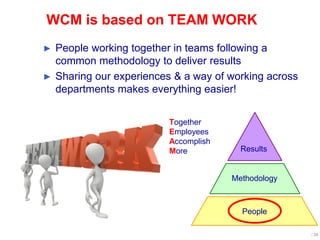
► People working together in teams following a
common methodology to deliver results
► Sharing our experiences & a way of working across
departments makes everything easier!
WCM is based on TEAM WORK
People
Results
Methodology
Together
Employees
Accomplish
More
/ 28
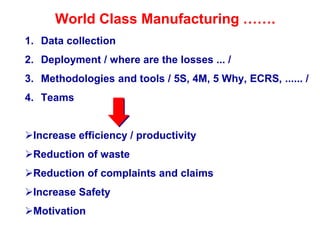
World Class Manufacturing …….
1. Data collection
2. Deployment / where are the losses ... /
3. Methodologies and tools / 5S, 4M, 5 Why, ECRS, ...... /
4. Teams
Increase efficiency / productivity
Reduction of waste
Reduction of complaints and claims
Increase Safety
Motivation
30
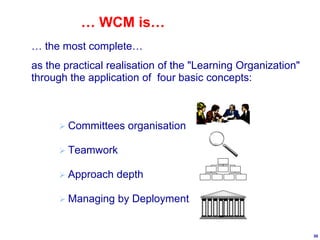
… WCM is…
… the most complete…
as the practical realisation of the "Learning Organization"
through the application of four basic concepts:
 Committees organisation
 Teamwork
 Approach depth
 Managing by Deployment
31
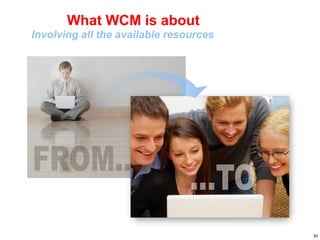
What WCM is about
Involving all the available resources
32
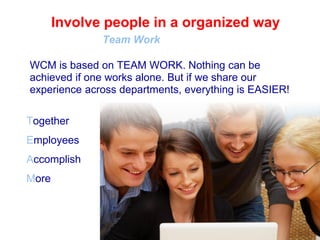
Involve people in a organized way
Team Work
WCM is based on TEAM WORK. Nothing can be
achieved if one works alone. But if we share our
experience across departments, everything is EASIER!
Together
Employees
Accomplish
More
33
Why Team work?
More EFFECTIVE Problem solving
Better decisions
Better Results
Through Teamwork we CREATE:
A sense of belonging
”Grow capability and skills” of
WCM System.
A STRONG FOUNDATION.
34
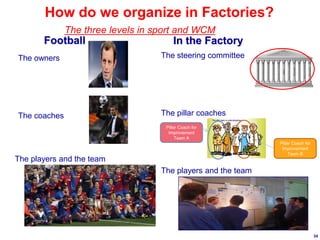
How do we organize in Factories?
The three levels in sport and WCM
The owners
The coaches
The players and the team
The steering committee
The pillar coaches
The players and the team
Football In the Factory
Pillar Coach for
Improvement
Team A
Pillar Coach for
Improvement
Team B
35
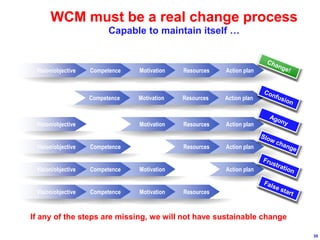
WCM must be a real change process
Capable to maintain itself …
Action planResourcesMotivationCompetenceVision/objective
If any of the steps are missing, we will not have sustainable change
36
World Class Manufacturing
Just common sense?
•World Class
Manufacturing opens
minds and doors to new
possibilities
It’s not always easy. Sometimes it’s even painful...but:
It works!
It makes the difference!
It changed the way we do business!
Moving toward World Class
WCM is a one-way journey
/ 37
WCM – World Class
Manufacturing
“World Class Organizations
need World Class People”
Radovan Vitkovic - World Class Manufacturing

Radovan Vitkovic - World Class Manufacturing

  • 1.
    What is WCM? It is our “Continuous Improvement System”  Founded in TPM
  • 2.
    WCM has itsfoundations in the Total Productive Maintenance (TPM) a maintenance process developed in Japan for improving productivity by making processes more reliable & less wasteful What is World Class Manufacturing? WCM is a mindset based on a continuous improvement approach / 2
  • 3.
    What is TPM? Total Productive Maintenance Origins. 1970s in Japan. Developed by JIPM A System emphasizing complete Care (Maintaining) of machines delivered dramatic results ... TPM = WCM Zero BDs, Zero Defect and Zero Accident.
  • 4.
    4 Japanese Institute ofPlant Maintenance Established in 1969 Non-Profit, Government Organization linked to Ministry of Industry and International Trade. Develops and promotes TPM. Since 1971 auditing and presenting awards for TPM Achievement (since 1991 Internationally). Audits are a Stepwise process with a progression of awards levels (5 in total) from TPM Excellence Award to TPM World Class Award. Consulting support via their ”sister company” JiPM-S (Solutions) which is an independant consulting company. JIPM
  • 5.
    / 5 External recognitionfor excellence JIPM Total Productive Maintenance Awards Advanced PhaseConsolidation PhaseExpansion PhasePilot Phase TPM Level 1 TPM Level 2 TPM Level 3 Excellence Consistency Special Advanced Special World Class Developing Plants TPM Award levels { ► The award system judges the results of a plant’s TPM activities. On average, it takes about 10 years to go from the first to final level.
  • 6.
    2005 JIPM Excellence Award 2008 JIPM Consistency Award 2010 JIPM Special Award 2012 JIPM Advanced SpecialAward 2015 JIPM World Class Award WCM Journey 2001 Kick off “ There´s no limit for our improvements “
  • 7.
    WCM Principles What makesWCM being different ! / 7
  • 8.
    Competitive advantage TIME Innovation - Big jumps -Big investments - Top-down approach Kaizen Gradual,continuous improvement Innovation and Kaizen WCM approach to gain the competitive edge
  • 9.
    ►Zero Accidents ,Zero Breakdown,Zero Defects,Zero Scrap, ►Continuous improvement through loss eradication ►No type of waste is accepted ►Methods for improvements are applied strictly WCM basic principles ►Voice of customer is heard to the last level in the organization ►People are the driving force of change ►Motivating environment ►All faults are visible / 9
  • 10.
    Our Mission ….through thecontinuous development of:  People  Processes HOW ?  Organization To add value to our Business and Customers by driving for a Zero Loss Organisation
  • 11.
    Our Strategy  DevelopPeople -Training -Coaching -Empowering people for self learn  Develop Processes -Standardize and align methods and tools -Transfer WCM knowledge sharing best practices  Develop Organization -Promote WCM people integration -Keep WCM community alive / 11
  • 12.
    Non value add FACTORYENERGY$ PEOPLE $ RAW MATERIAL $ PRODUCT $ TIME/MATERIAL LOSS/WASTE ► Something we do that doesn’t add any additional value to the final customer’s product ► It is often perceived as inevitable ► It can be eliminated ... for the most part What is a Loss? / 12
  • 13.
    Steps to havea good losses understanding:  Clear measurement (KPIs and Data Collection)  Clear definition for the ideal situation (Zero Loss Level)  KPI Loss Tree (Different Levels of losses – more details)  Clear understanding of biggest losses (Launch teams) Ideal Level It is the difference between the current situation and the ideal situation Loss Deployment! Loss What is a Loss – specifically ? Current Situation / 13
  • 14.
    Losses / 14 Within theloss you need to identify all different failure modes! Generic View Specific View 1. Level 2. Level 3. Level 4. Level Main Loss Deployment
  • 15.
    / 15 How toeat the elephant? Bit after bit! Concept of the Small Steps Main Loss Generic View Specific View Within the loss you need to identify all different failure modes!
  • 16.
  • 17.
    17 Print - deploymentof losses - example EE vs. Losses Printer 2003 EE 52.4% Losses 47.6% Losses Printer 2003 55.1% 22.5% 6.5% 6.4% 5.1% 4.0% 0.3% Other losses Quality losses Breakdow ns and repairs (21) Planned Maintenance (28) Speed losses Other stops (23,25,26,27) Set-up time (12)
  • 18.
    18 Set up lossesPrinter 2003 36% 57% 7% Roto Flexo Process Flexo Print - deployment of set up time Losses Printer 2003 55.1% 22.5% 6.5% 6.4% 5.1% 4.0% 0.3% Other losses Quality losses Breakdowns and repairs (21) Planned Maintenance (28) Speed losses Other stops (23,25,26,27) Set-up time (12) Set up time deployment FP2003 20.5% 19.8% 18.7% 14.0% 8.6% 6.9% 5.4% 6.0% 4C4I4ACR 4CCR 5C1I1A 4 C 5C1I1ACR 5C1I 5C5I5ACR 5C1ICR Set up frequency FP 2003 20.3% 9.6% 26.8% 8.7% 17.4% 6.6% 6.8% 3.8% 4C4I4ACR 4CCR 5C1I1A 4 C 5C1I1ACR 5C1I 5C5I5ACR 5C1ICR WCM tim WCM tim
  • 19.
    ImproveEradicate / 19 “LOSSES” arethe Key The Base of the Continuous Improving in WCM Maintain Good Production Losses Situation Standards Standards
  • 20.
    The WCM InfinityLoop 1 2 3 Maintain the condition Eradicate losses Seek the losses
  • 21.
    / 21 The InfiniteLoop The Base of the Continuous Improving Maintain Eradicate Assess Current Situation Restore Basic Conditions Analyze Root Causes Eliminate Root Causes Implement New Standards Improve Standards Reliability Maintain the Standards 1 2 3 4 5 6 7
  • 22.
    / 22 The threeTPM Award levels Linked with business as a whole in a logical expansion Supply Chain InnovationChain Customers and Consumers Suppliers Source Make Deliver Plan Technology Development Product Development OUR FOCUS TPM LEVEL TPM Level 1 Factory Operational Excellence Production excellence by learning and mastering TPM tools & techniques TPM Level 2 Integrated Supply Chain Defending & strengthening competitive position through flexible & efficient supply chain TPM Level 3 Extended Supply Chain Zero loss company via innovative TPM activities
  • 23.
    / 23 Our 11Pillars of WCM Each Pillar • Focuses on Common Themes/ Losses • with Expertise in specific Methods and Tools
  • 24.
    TPM-osnovi Beograd-Srbija Pillar Activities These arethe typical activities carried out by all Pillars Deployment Evaluation resources Potential gains Training Planning teams Audits Support Monitoring results
  • 25.
    Pillars Support onThree Levels Seek the Loss Investigates the losses that are having an effect on the KPI’s. Develops a master plan that identifies improvement actions and teams. Eradicate the Loss Supports the improvement team and identifies training and development needs. Implements the audit schedule. Maintain the Condition Develop systems to prevent the losses. . Deploy the losses Supports the improvement teams Maintain the gains - Building Systems - / 25
  • 26.
    AM Man -Machine development Initial cleaning Countermeasures at the source of the problem 1 2 Cleaning and lubrication standards3 General Inspection4 Autonomous Inspection5 Standardisation Autonomous management 6 7 I support you Can detect problems and understand the principles and the procedures of equipment improvement 1 Change of attitude Knows the function and structure of equipment and equipment-product quality relationship 2 Competence and effectiveness 3 Can manage equipment Autonomous Kaizen We take care of our process
  • 27.
    4.27 The route forAutonomous Maintenance Initial cleaning1 Eliminate sources of dirt and difficult to clean & inspect areas2 General inspection4 Create and maintain cleaning, inspection & lubrication standards3 Autonomous inspection5 Standardisation6 Autonomous Management7 1. Safety awareness: safety to clean 2. Initial cleaning: in depht cleaning&tagging exercises 3. 5S: sort out, set order, shine, standarize, sustain 4. CIL: Introduction of first temporary standard 5. Tagging: Spot equipment deterioration 6. 5 sense: spot equipment deterioration 1. 5 why analysis: Identify and analyse sources of dirt and difficult to clean areas 2. Easy to: Countermeasure to eliminate/minimize dirt sources, difficult to clean/inspect areas 3. CIL: Create and maintain cleaning and inspection standard 4. Monitor results 1.Lubrications concepts & on the job 2.ECRS: Simplify the lubrication system 3.Visual Control: Create a visible lubrication system 4.CIL: Update inspection plan 5.Monitor results (AM effectiveness) 1.Pneumatic &Hydraulic concepts on the job inspection 2.Drive, transmision and knetics system concepts & on the job inspection 3.Electric control systems (includes sensors) concepts & on the job inspection 4.Fasteners and equipment main body concepts & on the job inspection 5.Safety concepts on the job inspection 6. General inspection: Update inspection plan 7. Visual Control: Promote visual management 8.Monitor results (AM effectiveness) 1.ECRS: Simplification of maintenance, safety, quality inspection 2.QA,QX,QM understanding 3.Consolidate inspection plan 4.Develop expertize to use measurement instrument 5.Define countermeasures/restoration instruction for deviation anomalies 6.Integrate BD/ss analysis 7. Integrate near misses analysis 1.Autonomous Inspections-Process Control 2.Analysis abnormalities 3.Integrate spar parts, jigs &tools, materials, products, WIP, etc 4.Text books operation skills 5.Evalaution table for operation skills 6.List for problems point corrections 7.Improve 5 conditions to 0 defect 8.Component life span management 9.Integration of defects analysis 10.Speed losses analysis 11.Setup anomalies analysis 1-Inventory of Standards 2-Imporvement and Restoration 3-Standarization 4-Establishment and Succession 6-Update the job descriptions 7-Ensure cross training process 8-Establish Circle meeting
  • 28.
    ► People workingtogether in teams following a common methodology to deliver results ► Sharing our experiences & a way of working across departments makes everything easier! WCM is based on TEAM WORK People Results Methodology Together Employees Accomplish More / 28
  • 29.
    World Class Manufacturing……. 1. Data collection 2. Deployment / where are the losses ... / 3. Methodologies and tools / 5S, 4M, 5 Why, ECRS, ...... / 4. Teams Increase efficiency / productivity Reduction of waste Reduction of complaints and claims Increase Safety Motivation
  • 30.
    30 … WCM is… …the most complete… as the practical realisation of the "Learning Organization" through the application of four basic concepts:  Committees organisation  Teamwork  Approach depth  Managing by Deployment
  • 31.
    31 What WCM isabout Involving all the available resources
  • 32.
    32 Involve people ina organized way Team Work WCM is based on TEAM WORK. Nothing can be achieved if one works alone. But if we share our experience across departments, everything is EASIER! Together Employees Accomplish More
  • 33.
    33 Why Team work? MoreEFFECTIVE Problem solving Better decisions Better Results Through Teamwork we CREATE: A sense of belonging ”Grow capability and skills” of WCM System. A STRONG FOUNDATION.
  • 34.
    34 How do weorganize in Factories? The three levels in sport and WCM The owners The coaches The players and the team The steering committee The pillar coaches The players and the team Football In the Factory Pillar Coach for Improvement Team A Pillar Coach for Improvement Team B
  • 35.
    35 WCM must bea real change process Capable to maintain itself … Action planResourcesMotivationCompetenceVision/objective Action planResourcesMotivationCompetenceVision/objective Action planResourcesMotivationCompetenceVision/objective Action planResourcesMotivationCompetenceVision/objective Action planResourcesMotivationCompetenceVision/objective Action planResourcesMotivationCompetenceVision/objective If any of the steps are missing, we will not have sustainable change
  • 36.
    36 World Class Manufacturing Justcommon sense? •World Class Manufacturing opens minds and doors to new possibilities
  • 37.
    It’s not alwayseasy. Sometimes it’s even painful...but: It works! It makes the difference! It changed the way we do business! Moving toward World Class WCM is a one-way journey / 37
  • 38.
    WCM – WorldClass Manufacturing “World Class Organizations need World Class People”