1. Meaning & Scope
2. Criteria
3. How a WCM is Achieved ?
4.Characteristics of World-Class
Organizations
5.How to Make an Organization
World-Class?
6.World-Class Manufacturing:
What it takes?
7. Implementing WCM
8.Contrasting Mass Production &
WCM
9. The Grades for WCM
10. WCM Checklist
11.Types of Operation Which
Creates a WCM Units
12.Just In Time (JIT)
Manufacturing
13.JIT Improvements to
Manufacturing
14. CONWIP Control
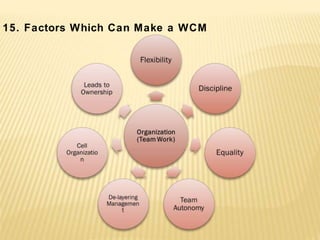
15.Factors Which Can Make a
WCM
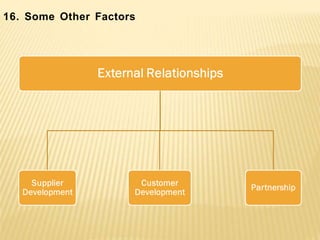
16. Some Other Factors
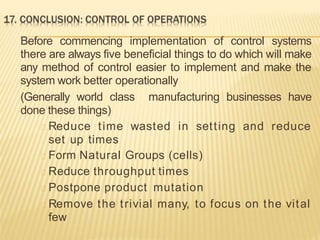
17.Conclusion: Control of
Operation
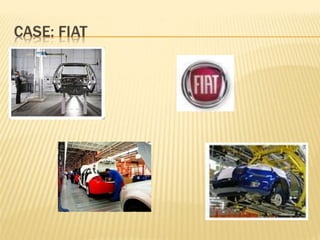
CASE: Fiat
It refers to the practice followed in a
manufacturing organizations, in order to
consistently deliver exceptional performance,
frequently in excess of expectations.
World Class Manufacturers are those that
demonstrate industry best practice.
There are two overriding
criteria when using this
checklist to judge whether
your company can be
regarded as World Class
1)How does the company
compare with its best
competition?
2)Has the company
increased its score since
last year?
Develop the awareness of the need to make the
transition to World Class Manufacturing
Develop the ability to search for relevant tools and to
apply them effectively
Monitor progress so that an improvement program can
be systematically utilized.
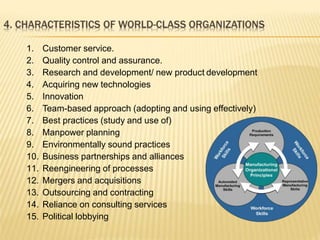
1. Customer service.
2. Quality control and assurance.
3. Research and development/ new product development
4. Acquiring new technologies
5. Innovation
6. Team-based approach (adopting and using effectively)
7. Best practices (study and use of)
8. Manpower planning
9. Environmentally sound practices
10. Business partnerships and alliances
11. Reengineering of processes
12. Mergers and acquisitions
13. Outsourcing and contracting
14. Reliance on consulting services
15. Political lobbying
1. Worker productivity (improvement)
2. Employee training and development
3. Open communication between management and employees
4. Employee benefits and perquisites
5. Codes of workplace conduct
6. Conflict resolution
7. Employee satisfaction
8. Flextime arrangements
9. Management-employee-union relations
10. Child care
1. Competitive analysis strategies (cost efficiencies in operations,
speed to market, research and development supremacy, zero
defects, real-time order management etc.)
2. Production and supply chain (collaborative planning, forecasting
and replenishment, collaborative manufacturing and product design,
supplier-managed inventory etc.)
3. Customization strategies (building to order, customized mass
production, global sourcing and manufacturing, etc.)
4. Electronic commerce strategies (supply management, Internet
ordering, status and availability tracking by Internet)
5. Compensation systems (product profitability, inventory levels,
manufactured/delivered costs per unit, worker productivity, employee
retention rates, etc.)
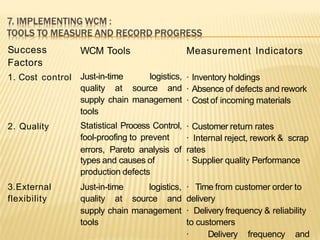
6. World-Class Manufacturing: What it
takes?
Success
Factors
WCM Tools Measurement Indicators
1. Cost control · Inventory holdings
· Absence of defects and rework
· Cost of incoming materials
2. Quality
Just-in-time logistics,
quality at source and
supply chain management
tools
Statistical Process Control,
fool-proofing to prevent
· Customer return rates
· Internal reject, rework & scrap
errors, Pareto analysis of rates
types and causes of · Supplier quality Performance
production defects
3.External Just-in-time logistics, · Time from customer order to
flexibility quality at source and delivery
supply chain management · Delivery frequency & reliability
tools to customers
· Delivery frequency and
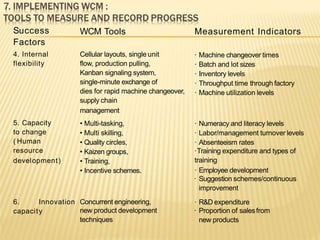
WCM Tools Measurement Indicators
Success
Factors
4. Internal
flexibility
· Machine changeover times
· Batch and lot sizes
· Inventory levels
· Throughput time through factory
· Machine utilization levels
5. Capacity
to change
( Human
resource
development)
Cellular layouts, single unit
flow, production pulling,
Kanban signaling system,
single-minute exchange of
dies for rapid machine changeover,
supply chain
management
• Multi-tasking,
• Multi skilling,
• Quality circles,
• Kaizen groups,
• Training,
• Incentive schemes.
capacity
6. Innovation Concurrent engineering,
new product development
techniques
· Numeracy and literacy levels
· Labor/management turnover levels
· Absenteeism rates
·Training expenditure and types of
training
· Employee development
· Suggestion schemes/continuous
improvement
· R&D expenditure
· Proportion of salesfrom
new products
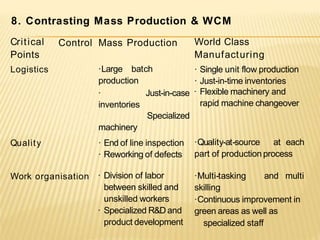
Critical
Points
Logistics
Control Mass Production
·Large batch
production
· Just-in-case
inventories
Specialized
World Class
Manufacturing
· Single unit flow production
· Just-in-time inventories
· Flexible machinery and
rapid machine changeover
Quality
machinery
· End of line inspection
· Reworking of defects
Work organisation · Division of labor
between skilled and
unskilled workers
· Specialized R&D and
product development
·Quality-at-source at each
part of production process
·Multi-tasking and multi
skilling
·Continuous improvement in
green areas as well as
specialized staff
8. Contrasting Mass Production & WCM
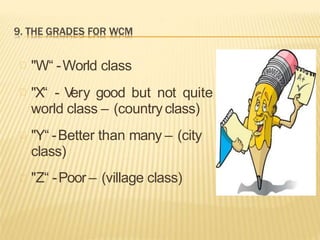
"W“ -World class
"X“ - V
ery good but not quite
world class – (countryclass)
"Y“ -Better than many – (city
class)
"Z“ -Poor – (village class)
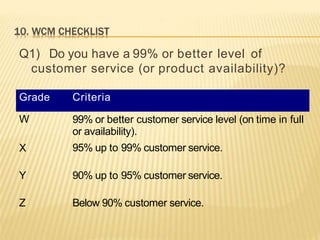
Q1) Do you have a 99% or better level of
customer service (or product availability)?
Grade Criteria
W
X
99% or better customer service level (on time in full
or availability).
95% up to 99% customer service.
Y 90% up to 95% customer service.
Z Below 90% customer service.
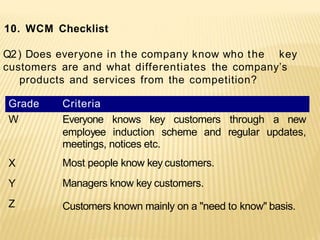
Q2) Does everyone in the company know who the key
customers are and what differentiates the company’s
products and services from the competition?
Grade Criteria
W Everyone knows key customers through a new
X
Y
Z
employee induction scheme and regular updates,
meetings, notices etc.
Most people know key customers.
Managers know key customers.
Customers known mainly on a "need to know" basis.
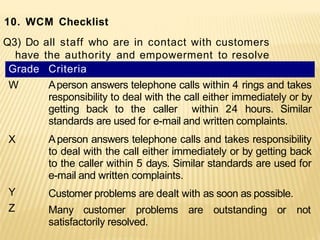
10. WCM Checklist
customer problems?
Grade Criteria
W
X
Aperson answers telephone calls within 4 rings and takes
responsibility to deal with the call either immediately or by
getting back to the caller within 24 hours. Similar
standards are used for e-mail and written complaints.
Aperson answers telephone calls and takes responsibility
to deal with the call either immediately or by getting back
to the caller within 5 days. Similar standards are used for
e-mail and written complaints.
Customer problems are dealt with as soon as possible.
Y
Z Many customer problems are outstanding or not
satisfactorily resolved.
10. WCM Checklist
Q3) Do all staff who are in contact with customers
have the authority and empowerment to resolve
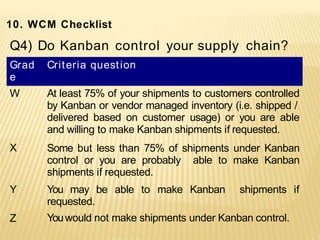
W
X
Y
Z
At least 75% of your shipments to customers controlled
by Kanban or vendor managed inventory (i.e. shipped /
delivered based on customer usage) or you are able
and willing to make Kanban shipments if requested.
Some but less than 75% of shipments under Kanban
control or you are probably able to make Kanban
shipments if requested.
You may be able to make Kanban shipments if
requested.
Youwould not make shipments under Kanban control.
Q4) Do Kanban control your supply chain?
Grad Criteria question
e
10. WCM Checklist
11. Types of Operation Which Creates a WCM Units
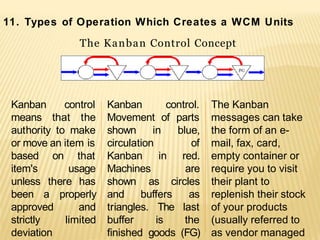
The Kanban Control Concept
control
Kanban
means that
authority to make
or move an item is
on that
usage
there
based
item's
unless
been a properly
and
limited
approved
strictly
deviation
Kanban control.
the Movement of parts
shown in
circulation
Kanban
Machines
blue,
of
in red.
are
as circles
has shown
and buffers
triangles.
buffer
finished goods (FG)
The Kanban
messages can take
the form of an e-
mail, fax, card,
empty container or
require you to visit
their plant to
as replenish their stock
The last of your products
is the (usually referred to
as vendor managed
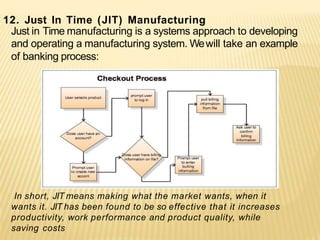
and operating a manufacturing system. Wewill take an example
of banking process:
In short, JIT means making what the market wants, when it
wants it. JIT has been found to be so effective that it increases
productivity, work performance and product quality, while
saving costs
12. Just In Time (JIT) Manufacturing
Just in Time manufacturing is a systems approach to developing
13. JIT Improvements to Manufacturing
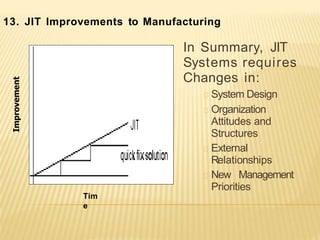
In Summary, JIT
Systems requires
Changes in:
System Design
Organization
Attitudes and
Structures
External
Relationships
New Management
Priorities
Tim
e
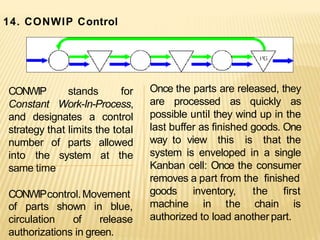
CONWIP stands for
Constant Work-In-Process,
and designates a control
strategy that limits the total
number of parts allowed
into the system at the
same time
CONWIPcontrol.Movement
of parts
circulation
shown in blue,
of release
authorizations in green.
14. CONWIP Control
Once the parts are released, they
are processed as quickly as
possible until they wind up in the
last buffer as finished goods. One
way to view this is that the
system is enveloped in a single
Kanban cell: Once the consumer
removes a part from the finished
goods inventory,
machine in the
the first
chain is
authorized to load another part.
15. Factors Which Can Make a WCM
16. Some Other Factors
Before commencing implementation of control systems
there are always five beneficial things to do which will make
any method of control easier to implement and make the
system work better operationally
(Generally world class manufacturing businesses have
done these things)
Reduce time wasted in setting and reduce
set up times
Form Natural Groups (cells)
Reduce throughput times
Postpone product mutation
Remove the trivial many, to focus on the vital
few
We have started a program designed to achieve the standards of excellence
associated with World Class Manufacturing (WCM) policies: a company
organization methodology that leads to excellence of the entire production
process through the continuous improvement of all performances and the
contribution of all company employees, at everylevel.
Our manufacturing facilities use the Fiat Advanced Production System
(FAPS),an integrated model that optimizes production and logistic
processes.
The program was launched two years ago but the plants of Tychy in Poland,
Melfi in Italy and Bursa in Turkey have already attained a competitive rating
according to World Class Manufacturing criteria
2. WORLD CLASS MANUFACTURING
World Class Manufacturing principles apply to all aspects of plant organization,
from the quality system to maintenance, from cost control to logistics, in a
perspective of continuous improvement.
World Class Manufacturing (WCM) in fact was born of the collaboration
between Fiat and the best European and Japanese experts, with the aim to
enhance the production standard to a recognized world standard.
The system is based on a systematic reduction of all types of loss and waste
through the contribution of everyone and the rigorous use of methods and
standards.
2. WORLD CLASS MANUFACTURING
Thesystem is based on a systematic reduction of all types of loss and waste through
the contribution of everyone and the rigorous use of methods and standards.
Care for the Environment is one of the pillars of the system, encompassing all the
people, regulations and rules of conduct making up our Environmental Management
System (EMS).
This is the management tool that will enable us to determine, reduce and control the
environmental impact of our manufacturing facilities, knowing that every activity has
repercussions on the environment.
The system specifies a number of actions geared to the reduction of the
environmental impact of manufacturing activities, both in order to ensure
compliance with the applicable regulations and in order to prevent the waste of
energy and natural resources
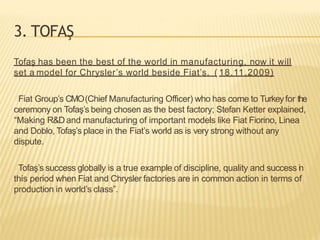
3. TOFAŞ
Tofaş has been the best of the world in manufacturing, now it
will set a model for Chrysler’s world beside Fiat’s. (
18.11.2009)
Tofaş who has been producing Fiat branded passenger cars and
commercial vehicles for 41 years in Turkeywith the cooperation of Fiat
S.P
.Aand Koç Holding and who has manufactured its 3 millionth vehicle in
2009 has received the “Silver Level” (World Class Manufacturing) award, it
has achieved in WCM,with a ceremony, organized in Turkey.
Being the first production center that has achieved “Silver” level in “World
Class Manufacturing” in Fiat’s world, Tofaş’s Bursa factory has been
chosen as the factory who has “the highest quality and who makes the
safest manufacturing” after the last audit, carried out byWCMteams last
week.
3. TOFAŞ
Tofaş has been the best of the world in manufacturing, now it will
set a model for Chrysler’s world beside Fiat’s. ( 18.11.2009)
Fiat Group’s CMO(Chief Manufacturing Officer) who has come to Turkeyfor the
ceremony on Tofaş’s being chosen as the best factory; Stefan Ketter explained,
“Making R&Dand manufacturing of important models like Fiat Fiorino, Linea
and Doblo, Tofaş’s place in the Fiat’s world as is very strong without any
dispute.
Tofaş’s success globally is a true example of discipline, quality and success in
this period when Fiat and Chrysler factories are in common action in terms of
production in world’s class”.
World Class Manufacturing
Stefan Ketter
Lingotto - November 8 & 9, 2006
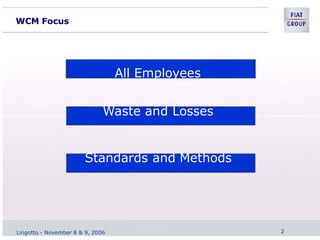
WCM Focus
All Employees
Waste and Losses
Standards and Methods
Lingotto - November 8 & 9, 2006 2
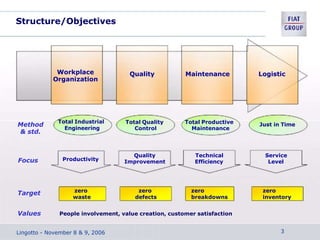
Structure/Objectives
Workplace
Organization
Quality Maintenance Logistic
Method
& std.
Focus
Target
Total Industrial
Engineering
Productivity
zero
waste
Just in Time
Total Quality
Control
Total Productive
Maintenance
Quality Technical Service
Improvement Efficiency Level
zero
defects
zero
breakdowns
zero
inventory
Values People involvement, value creation, customer satisfaction
Lingotto - November 8 & 9, 2006 3
WCM Principles
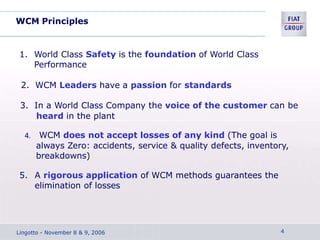
1. World Class Safety is the foundation of World Class
Performance
2. WCM Leaders have a passion for standards
3. In a World Class Company the voice of the customer can be
heard in the plant
4. WCM does not accept losses of any kind (The goal is
always Zero: accidents, service & quality defects, inventory,
breakdowns)
5. A rigorous application of WCM methods guarantees the
elimination of losses
Lingotto - November 8 & 9, 2006 4
WCM Principles
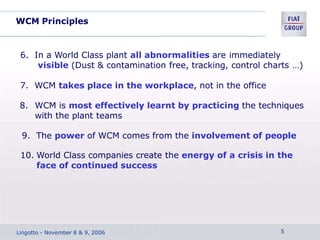
6. In a World Class plant all abnormalities are immediately
visible (Dust & contamination free, tracking, control charts …)
7. WCM takes place in the workplace, not in the office
8. WCM is most effectively learnt by practicing the techniques
with the plant teams
9. The power of WCM comes from the involvement of people
10. World Class companies create the energy of a crisis in the
face of continued success
Lingotto - November 8 & 9, 2006 5
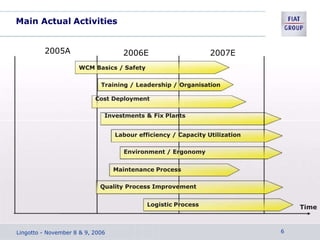
Main Actual Activities
2005A 2007E
2006E
WCM Basics / Safety
Training / Leadership / Organisation
Cost Deployment
Investments & Fix Plants
Labour efficiency / Capacity Utilization
Environment / Ergonomy
Maintenance Process
Quality Process Improvement
Logistic Process Time
Lingotto - November 8 & 9, 2006 6
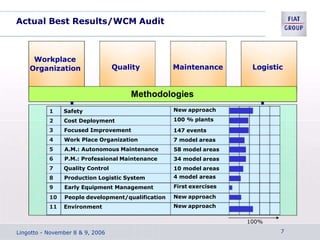
Actual Best Results/WCM Audit
Workplace
Organization Quality Maintenance Logistic
Methodologies
1 Safety
2 Cost Deployment
3 Focused Improvement
4 Work Place Organization
5 A.M.: Autonomous Maintenance
6 P.M.: Professional Maintenance
7 Quality Control
8 Production Logistic System
9 Early Equipment Management
10 People development/qualification
11 Environment
New approach
100 % plants
147 events
7 model areas
58 model areas
34 model areas
10 model areas
4 model areas
First exercises
New approach
New approach
100%
Lingotto - November 8 & 9, 2006 7
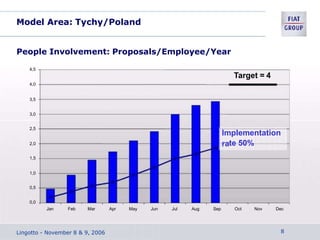
Model Area: Tychy/Poland
People Involvement: Proposals/Employee/Year
4,5
Target = 4
4,0
3,5
3,0
Jan Feb Mar Apr May Jun Jul Aug Sep
2,5
2,0 ra
1,5
1,0
0,5
0,0
Implementation
te 50%
Oct Nov Dec
Lingotto - November 8 & 9, 2006 8
Model Area: Melfi
Quality: Electric Check Defects - Grande Punto
- 50%
Lingotto - November 8 & 9, 2006 9
Model Area: Melfi
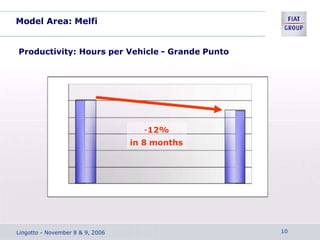
Productivity: Hours per Vehicle - Grande Punto
-12%
in 8 months
Lingotto - November 8 & 9, 2006 10
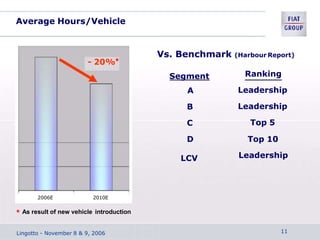
Average Hours/Vehicle
- 20%*
Segment
A
B
C
D
LCV
Vs. Benchmark (Harbour Report)
Ranking
Leadership
Leadership
Top 5
Top 10
Leadership
2006E 2010E
* As result of new vehicle introduction
Lingotto - November 8 & 9, 2006 11
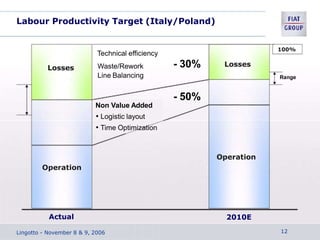
Labour Productivity Target (Italy/Poland)
100%
Losses
Operation
- 30%
Technical efficiency
Waste/Rework
Line Balancing
- 50%
Non Value Added
• Logistic layout
• Time Optimization
Losses
Operation
Range
Actual 2010E
Lingotto - November 8 & 9, 2006 12
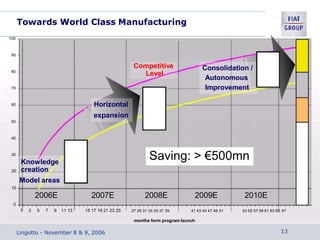
Towards World Class Manufacturing
100
90
80
70
60
50
40
30
Competitive
Level
Horizontal
expansion
Consolidation /
Autonomous
Improvement
20
Knowledge
creation
Model areas
Saving: > €500mn
10
2006E 2007E 2008E 2009E 2010E
0
1 3 5 7 9 11 13 15 17 19 21 23 25 27 29 31 33 35 37 39 41 43 45 47 49 51 53 55 57 59 61 63 65 67
months form program launch
Lingotto - November 8 & 9, 2006 13
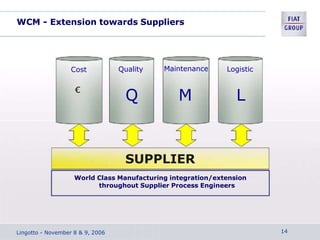
WCM - Extension towards Suppliers
Cost Quality Maintenance Logistic
€
Q M L
SUPPLIER
World Class Manufacturing integration/extension
throughout Supplier Process Engineers
Lingotto - November 8 & 9, 2006 14
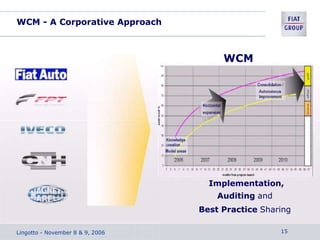
WCM - A Corporative Approach
WCM
Implementation,
Auditing and
Best Practice Sharing
Lingotto - November 8 & 9, 2006 15

World class manufacturing practices in the SCM-2.pptx

  • 2.
    1. Meaning &Scope 2. Criteria 3. How a WCM is Achieved ? 4.Characteristics of World-Class Organizations 5.How to Make an Organization World-Class? 6.World-Class Manufacturing: What it takes? 7. Implementing WCM 8.Contrasting Mass Production & WCM 9. The Grades for WCM 10. WCM Checklist 11.Types of Operation Which Creates a WCM Units 12.Just In Time (JIT) Manufacturing 13.JIT Improvements to Manufacturing 14. CONWIP Control 15.Factors Which Can Make a WCM 16. Some Other Factors 17.Conclusion: Control of Operation CASE: Fiat
  • 4.
    It refers tothe practice followed in a manufacturing organizations, in order to consistently deliver exceptional performance, frequently in excess of expectations. World Class Manufacturers are those that demonstrate industry best practice.
  • 5.
    There are twooverriding criteria when using this checklist to judge whether your company can be regarded as World Class 1)How does the company compare with its best competition? 2)Has the company increased its score since last year?
  • 6.
    Develop the awarenessof the need to make the transition to World Class Manufacturing Develop the ability to search for relevant tools and to apply them effectively Monitor progress so that an improvement program can be systematically utilized.
  • 7.
    1. Customer service. 2.Quality control and assurance. 3. Research and development/ new product development 4. Acquiring new technologies 5. Innovation 6. Team-based approach (adopting and using effectively) 7. Best practices (study and use of) 8. Manpower planning 9. Environmentally sound practices 10. Business partnerships and alliances 11. Reengineering of processes 12. Mergers and acquisitions 13. Outsourcing and contracting 14. Reliance on consulting services 15. Political lobbying
  • 8.
    1. Worker productivity(improvement) 2. Employee training and development 3. Open communication between management and employees 4. Employee benefits and perquisites 5. Codes of workplace conduct 6. Conflict resolution 7. Employee satisfaction 8. Flextime arrangements 9. Management-employee-union relations 10. Child care
  • 9.
    1. Competitive analysisstrategies (cost efficiencies in operations, speed to market, research and development supremacy, zero defects, real-time order management etc.) 2. Production and supply chain (collaborative planning, forecasting and replenishment, collaborative manufacturing and product design, supplier-managed inventory etc.) 3. Customization strategies (building to order, customized mass production, global sourcing and manufacturing, etc.) 4. Electronic commerce strategies (supply management, Internet ordering, status and availability tracking by Internet) 5. Compensation systems (product profitability, inventory levels, manufactured/delivered costs per unit, worker productivity, employee retention rates, etc.) 6. World-Class Manufacturing: What it takes?
  • 10.
    Success Factors WCM Tools MeasurementIndicators 1. Cost control · Inventory holdings · Absence of defects and rework · Cost of incoming materials 2. Quality Just-in-time logistics, quality at source and supply chain management tools Statistical Process Control, fool-proofing to prevent · Customer return rates · Internal reject, rework & scrap errors, Pareto analysis of rates types and causes of · Supplier quality Performance production defects 3.External Just-in-time logistics, · Time from customer order to flexibility quality at source and delivery supply chain management · Delivery frequency & reliability tools to customers · Delivery frequency and
  • 11.
    WCM Tools MeasurementIndicators Success Factors 4. Internal flexibility · Machine changeover times · Batch and lot sizes · Inventory levels · Throughput time through factory · Machine utilization levels 5. Capacity to change ( Human resource development) Cellular layouts, single unit flow, production pulling, Kanban signaling system, single-minute exchange of dies for rapid machine changeover, supply chain management • Multi-tasking, • Multi skilling, • Quality circles, • Kaizen groups, • Training, • Incentive schemes. capacity 6. Innovation Concurrent engineering, new product development techniques · Numeracy and literacy levels · Labor/management turnover levels · Absenteeism rates ·Training expenditure and types of training · Employee development · Suggestion schemes/continuous improvement · R&D expenditure · Proportion of salesfrom new products
  • 12.
    Critical Points Logistics Control Mass Production ·Largebatch production · Just-in-case inventories Specialized World Class Manufacturing · Single unit flow production · Just-in-time inventories · Flexible machinery and rapid machine changeover Quality machinery · End of line inspection · Reworking of defects Work organisation · Division of labor between skilled and unskilled workers · Specialized R&D and product development ·Quality-at-source at each part of production process ·Multi-tasking and multi skilling ·Continuous improvement in green areas as well as specialized staff 8. Contrasting Mass Production & WCM
  • 13.
    "W“ -World class "X“- V ery good but not quite world class – (countryclass) "Y“ -Better than many – (city class) "Z“ -Poor – (village class)
  • 14.
    Q1) Do youhave a 99% or better level of customer service (or product availability)? Grade Criteria W X 99% or better customer service level (on time in full or availability). 95% up to 99% customer service. Y 90% up to 95% customer service. Z Below 90% customer service.
  • 15.
    Q2) Does everyonein the company know who the key customers are and what differentiates the company’s products and services from the competition? Grade Criteria W Everyone knows key customers through a new X Y Z employee induction scheme and regular updates, meetings, notices etc. Most people know key customers. Managers know key customers. Customers known mainly on a "need to know" basis. 10. WCM Checklist
  • 16.
    customer problems? Grade Criteria W X Apersonanswers telephone calls within 4 rings and takes responsibility to deal with the call either immediately or by getting back to the caller within 24 hours. Similar standards are used for e-mail and written complaints. Aperson answers telephone calls and takes responsibility to deal with the call either immediately or by getting back to the caller within 5 days. Similar standards are used for e-mail and written complaints. Customer problems are dealt with as soon as possible. Y Z Many customer problems are outstanding or not satisfactorily resolved. 10. WCM Checklist Q3) Do all staff who are in contact with customers have the authority and empowerment to resolve
  • 17.
    W X Y Z At least 75%of your shipments to customers controlled by Kanban or vendor managed inventory (i.e. shipped / delivered based on customer usage) or you are able and willing to make Kanban shipments if requested. Some but less than 75% of shipments under Kanban control or you are probably able to make Kanban shipments if requested. You may be able to make Kanban shipments if requested. Youwould not make shipments under Kanban control. Q4) Do Kanban control your supply chain? Grad Criteria question e 10. WCM Checklist
  • 18.
    11. Types ofOperation Which Creates a WCM Units The Kanban Control Concept control Kanban means that authority to make or move an item is on that usage there based item's unless been a properly and limited approved strictly deviation Kanban control. the Movement of parts shown in circulation Kanban Machines blue, of in red. are as circles has shown and buffers triangles. buffer finished goods (FG) The Kanban messages can take the form of an e- mail, fax, card, empty container or require you to visit their plant to as replenish their stock The last of your products is the (usually referred to as vendor managed
  • 19.
    and operating amanufacturing system. Wewill take an example of banking process: In short, JIT means making what the market wants, when it wants it. JIT has been found to be so effective that it increases productivity, work performance and product quality, while saving costs 12. Just In Time (JIT) Manufacturing Just in Time manufacturing is a systems approach to developing
  • 20.
    13. JIT Improvementsto Manufacturing In Summary, JIT Systems requires Changes in: System Design Organization Attitudes and Structures External Relationships New Management Priorities Tim e
  • 21.
    CONWIP stands for ConstantWork-In-Process, and designates a control strategy that limits the total number of parts allowed into the system at the same time CONWIPcontrol.Movement of parts circulation shown in blue, of release authorizations in green. 14. CONWIP Control Once the parts are released, they are processed as quickly as possible until they wind up in the last buffer as finished goods. One way to view this is that the system is enveloped in a single Kanban cell: Once the consumer removes a part from the finished goods inventory, machine in the the first chain is authorized to load another part.
  • 22.
    15. Factors WhichCan Make a WCM
  • 23.
  • 24.
    Before commencing implementationof control systems there are always five beneficial things to do which will make any method of control easier to implement and make the system work better operationally (Generally world class manufacturing businesses have done these things) Reduce time wasted in setting and reduce set up times Form Natural Groups (cells) Reduce throughput times Postpone product mutation Remove the trivial many, to focus on the vital few
  • 27.
    We have starteda program designed to achieve the standards of excellence associated with World Class Manufacturing (WCM) policies: a company organization methodology that leads to excellence of the entire production process through the continuous improvement of all performances and the contribution of all company employees, at everylevel. Our manufacturing facilities use the Fiat Advanced Production System (FAPS),an integrated model that optimizes production and logistic processes. The program was launched two years ago but the plants of Tychy in Poland, Melfi in Italy and Bursa in Turkey have already attained a competitive rating according to World Class Manufacturing criteria
  • 28.
    2. WORLD CLASSMANUFACTURING World Class Manufacturing principles apply to all aspects of plant organization, from the quality system to maintenance, from cost control to logistics, in a perspective of continuous improvement. World Class Manufacturing (WCM) in fact was born of the collaboration between Fiat and the best European and Japanese experts, with the aim to enhance the production standard to a recognized world standard. The system is based on a systematic reduction of all types of loss and waste through the contribution of everyone and the rigorous use of methods and standards.
  • 29.
    2. WORLD CLASSMANUFACTURING Thesystem is based on a systematic reduction of all types of loss and waste through the contribution of everyone and the rigorous use of methods and standards. Care for the Environment is one of the pillars of the system, encompassing all the people, regulations and rules of conduct making up our Environmental Management System (EMS). This is the management tool that will enable us to determine, reduce and control the environmental impact of our manufacturing facilities, knowing that every activity has repercussions on the environment. The system specifies a number of actions geared to the reduction of the environmental impact of manufacturing activities, both in order to ensure compliance with the applicable regulations and in order to prevent the waste of energy and natural resources
  • 30.
    3. TOFAŞ Tofaş hasbeen the best of the world in manufacturing, now it will set a model for Chrysler’s world beside Fiat’s. ( 18.11.2009) Tofaş who has been producing Fiat branded passenger cars and commercial vehicles for 41 years in Turkeywith the cooperation of Fiat S.P .Aand Koç Holding and who has manufactured its 3 millionth vehicle in 2009 has received the “Silver Level” (World Class Manufacturing) award, it has achieved in WCM,with a ceremony, organized in Turkey. Being the first production center that has achieved “Silver” level in “World Class Manufacturing” in Fiat’s world, Tofaş’s Bursa factory has been chosen as the factory who has “the highest quality and who makes the safest manufacturing” after the last audit, carried out byWCMteams last week.
  • 31.
    3. TOFAŞ Tofaş hasbeen the best of the world in manufacturing, now it will set a model for Chrysler’s world beside Fiat’s. ( 18.11.2009) Fiat Group’s CMO(Chief Manufacturing Officer) who has come to Turkeyfor the ceremony on Tofaş’s being chosen as the best factory; Stefan Ketter explained, “Making R&Dand manufacturing of important models like Fiat Fiorino, Linea and Doblo, Tofaş’s place in the Fiat’s world as is very strong without any dispute. Tofaş’s success globally is a true example of discipline, quality and success in this period when Fiat and Chrysler factories are in common action in terms of production in world’s class”.
  • 32.
    World Class Manufacturing StefanKetter Lingotto - November 8 & 9, 2006
  • 33.
    WCM Focus All Employees Wasteand Losses Standards and Methods Lingotto - November 8 & 9, 2006 2
  • 34.
    Structure/Objectives Workplace Organization Quality Maintenance Logistic Method &std. Focus Target Total Industrial Engineering Productivity zero waste Just in Time Total Quality Control Total Productive Maintenance Quality Technical Service Improvement Efficiency Level zero defects zero breakdowns zero inventory Values People involvement, value creation, customer satisfaction Lingotto - November 8 & 9, 2006 3
  • 35.
    WCM Principles 1. WorldClass Safety is the foundation of World Class Performance 2. WCM Leaders have a passion for standards 3. In a World Class Company the voice of the customer can be heard in the plant 4. WCM does not accept losses of any kind (The goal is always Zero: accidents, service & quality defects, inventory, breakdowns) 5. A rigorous application of WCM methods guarantees the elimination of losses Lingotto - November 8 & 9, 2006 4
  • 36.
    WCM Principles 6. Ina World Class plant all abnormalities are immediately visible (Dust & contamination free, tracking, control charts …) 7. WCM takes place in the workplace, not in the office 8. WCM is most effectively learnt by practicing the techniques with the plant teams 9. The power of WCM comes from the involvement of people 10. World Class companies create the energy of a crisis in the face of continued success Lingotto - November 8 & 9, 2006 5
  • 37.
    Main Actual Activities 2005A2007E 2006E WCM Basics / Safety Training / Leadership / Organisation Cost Deployment Investments & Fix Plants Labour efficiency / Capacity Utilization Environment / Ergonomy Maintenance Process Quality Process Improvement Logistic Process Time Lingotto - November 8 & 9, 2006 6
  • 38.
    Actual Best Results/WCMAudit Workplace Organization Quality Maintenance Logistic Methodologies 1 Safety 2 Cost Deployment 3 Focused Improvement 4 Work Place Organization 5 A.M.: Autonomous Maintenance 6 P.M.: Professional Maintenance 7 Quality Control 8 Production Logistic System 9 Early Equipment Management 10 People development/qualification 11 Environment New approach 100 % plants 147 events 7 model areas 58 model areas 34 model areas 10 model areas 4 model areas First exercises New approach New approach 100% Lingotto - November 8 & 9, 2006 7
  • 39.
    Model Area: Tychy/Poland PeopleInvolvement: Proposals/Employee/Year 4,5 Target = 4 4,0 3,5 3,0 Jan Feb Mar Apr May Jun Jul Aug Sep 2,5 2,0 ra 1,5 1,0 0,5 0,0 Implementation te 50% Oct Nov Dec Lingotto - November 8 & 9, 2006 8
  • 40.
    Model Area: Melfi Quality:Electric Check Defects - Grande Punto - 50% Lingotto - November 8 & 9, 2006 9
  • 41.
    Model Area: Melfi Productivity:Hours per Vehicle - Grande Punto -12% in 8 months Lingotto - November 8 & 9, 2006 10
  • 42.
    Average Hours/Vehicle - 20%* Segment A B C D LCV Vs.Benchmark (Harbour Report) Ranking Leadership Leadership Top 5 Top 10 Leadership 2006E 2010E * As result of new vehicle introduction Lingotto - November 8 & 9, 2006 11
  • 43.
    Labour Productivity Target(Italy/Poland) 100% Losses Operation - 30% Technical efficiency Waste/Rework Line Balancing - 50% Non Value Added • Logistic layout • Time Optimization Losses Operation Range Actual 2010E Lingotto - November 8 & 9, 2006 12
  • 44.
    Towards World ClassManufacturing 100 90 80 70 60 50 40 30 Competitive Level Horizontal expansion Consolidation / Autonomous Improvement 20 Knowledge creation Model areas Saving: > €500mn 10 2006E 2007E 2008E 2009E 2010E 0 1 3 5 7 9 11 13 15 17 19 21 23 25 27 29 31 33 35 37 39 41 43 45 47 49 51 53 55 57 59 61 63 65 67 months form program launch Lingotto - November 8 & 9, 2006 13
  • 45.
    WCM - Extensiontowards Suppliers Cost Quality Maintenance Logistic € Q M L SUPPLIER World Class Manufacturing integration/extension throughout Supplier Process Engineers Lingotto - November 8 & 9, 2006 14
  • 46.
    WCM - ACorporative Approach WCM Implementation, Auditing and Best Practice Sharing Lingotto - November 8 & 9, 2006 15