PT 103 PHARMACEUTICAL INORGANIC
CHEMISTRY(THEORY)
KUNAL DATTA
UNIT V : Radiopharmaceuticals
Radiopharmaceuticals
Radioactivity
• The spontaneous emission of α particle or β particle and γ
waves from an unstable nuclei is called Radioactivity.
• Radioactive substance have a property of emitting rays or
particles which affect the photographic plate.
• The elements are known as radioactive because they are
unstable and undergo decomposition along with emission of
rays.
• The radiations or rays which are emitted are following:
Alpha particle , Beta particle and Gamma Rays
Alpha Particle (α)
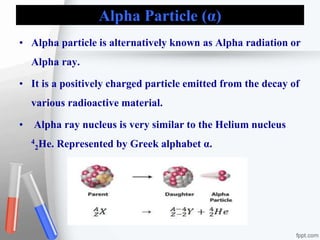
• Alpha particle is alternatively known as Alpha radiation or
Alpha ray.
• It is a positively charged particle emitted from the decay of
various radioactive material.
• Alpha ray nucleus is very similar to the Helium nucleus
4
2He. Represented by Greek alphabet α.
Beta Particle (β)
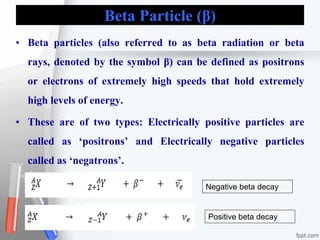
• Beta particles (also referred to as beta radiation or beta
rays, denoted by the symbol β) can be defined as positrons
or electrons of extremely high speeds that hold extremely
high levels of energy.
• These are of two types: Electrically positive particles are
called as ‘positrons’ and Electrically negative particles
called as ‘negatrons’.
Negative beta decay
Positive beta decay
γ -rays or γ Particle
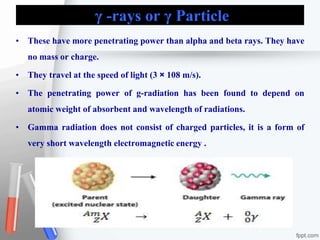
• These have more penetrating power than alpha and beta rays. They have
no mass or charge.
• They travel at the speed of light (3 × 10⁸ m/s).
• The penetrating power of g-radiation has been found to depend on
atomic weight of absorbent and wavelength of radiations.
• Gamma radiation does not consist of charged particles, it is a form of
very short wavelength electromagnetic energy .
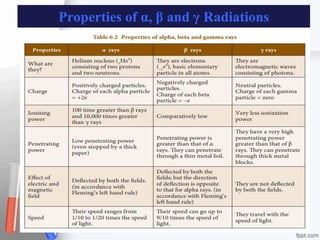
Properties of α, β and γ Radiations
Half-Life
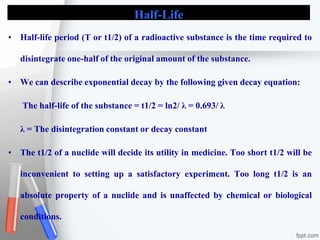
• Half-life period (T or t1/2) of a radioactive substance is the time required to
disintegrate one-half of the original amount of the substance.
• We can describe exponential decay by the following given decay equation:
The half-life of the substance = t1/2 = ln2/ λ = 0.693/ λ
λ = The disintegration constant or decay constant
• The t1/2 of a nuclide will decide its utility in medicine. Too short t1/2 will be
inconvenient to setting up a satisfactory experiment. Too long t1/2 is an
absolute property of a nuclide and is unaffected by chemical or biological
conditions.
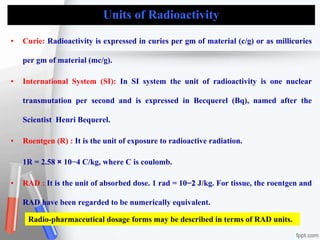
Units of Radioactivity
• Curie: Radioactivity is expressed in curies per gm of material (c/g) or as millicuries
per gm of material (mc/g).
• International System (SI): In SI system the unit of radioactivity is one nuclear
transmutation per second and is expressed in Becquerel (Bq), named after the
Scientist Henri Bequerel.
• Roentgen (R) : It is the unit of exposure to radioactive radiation.
1R = 2.58 × 10⁻⁴ C/kg, where C is coulomb.
• RAD : It is the unit of absorbed dose. 1 rad = 10−2 J/kg. For tissue, the roentgen and
RAD have been regarded to be numerically equivalent.
Radio-pharmaceutical dosage forms may be described in terms of RAD units.
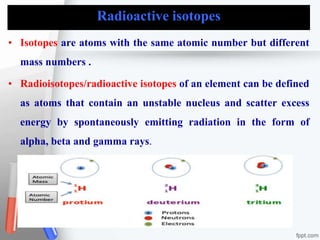
Radioactive isotopes
• Isotopes are atoms with the same atomic number but different
mass numbers .
• Radioisotopes/radioactive isotopes of an element can be defined
as atoms that contain an unstable nucleus and scatter excess
energy by spontaneously emitting radiation in the form of
alpha, beta and gamma rays.
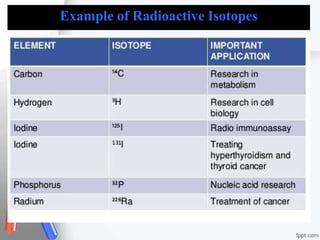
Example of Radioactive Isotopes
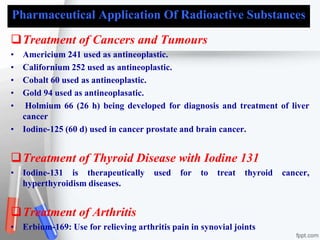
Pharmaceutical Application Of Radioactive Substances
Treatment of Cancers and Tumours
• Americium 241 used as antineoplastic.
• Californium 252 used as antineoplastic.
• Cobalt 60 used as antineoplastic.
• Gold 94 used as antineoplasatic.
• Holmium 66 (26 h) being developed for diagnosis and treatment of liver
cancer
• Iodine-125 (60 d) used in cancer prostate and brain cancer.
Treatment of Thyroid Disease with Iodine 131
• Iodine-131 is therapeutically used for to treat thyroid cancer,
hyperthyroidism diseases.
Treatment of Arthritis
• Erbium-169: Use for relieving arthritis pain in synovial joints
Pharmaceutical Application Of Radioactive Substances
Palliative Treatment of Bone Metastasis
 Various radioisotopes and pharmaceuticals are used to deliver palliative
treatment of bone metastases, including samarium-153 (Sm-153),
strontium-89 (Sr-89) chloride, and phosphorus-32 (P-32) sodium
phosphate.
 The two most common side effects occurring from radiopharmaceutical
therapy for metastatic bone disease are initial increased bone pain (flare)
and a decrease in WBC and platelet counts.
Storage of Radioactive Substances
Radiopharmaceuticals should be kept in well-closed
containers
 Radiopharmaceutical preparations that are
intended for parenteral use should be kept in a glass
vial, ampoule or syringe.
Precautions For Handling Radioactive Substances
• The radioactive substances used should comply with the following
characteristics:
 Radiotoxicity must be as low as possible.
 Short-living isotopes are preferred to long-living ones
 The amounts used must be kept to a minimum.
• Never work alone in a radioactive lab
• When handling radioactive materials, always wear the appropriate
protective clothing
• Use appropriate radiation shields. Return the stock solution to storage
immediately after removing the amount needed.
Precautions For Handling Radioactive Substances
• To avoid internal contamination, strict hygiene is essential when handling
radioactive materials .
 Eating, smoking, drinking, and applying cosmetics are prohibited in
radioactive labs.
 Never pipette by mouth. Use pipetting devices instead.
 Wash your hands thoroughly when you leave the lab.
• Regularly check the radiation level of your working area and all objects
used, or at least at the end of each working day.
• Replace contaminated absorption paper. Decontaminate contaminated
objects.
• Dispose of all radioactive waste in the appropriate containers.

Radiopharmaceuticals.ppt

  • 1.
    PT 103 PHARMACEUTICALINORGANIC CHEMISTRY(THEORY) KUNAL DATTA UNIT V : Radiopharmaceuticals
  • 2.
  • 3.
    Radioactivity • The spontaneousemission of α particle or β particle and γ waves from an unstable nuclei is called Radioactivity. • Radioactive substance have a property of emitting rays or particles which affect the photographic plate. • The elements are known as radioactive because they are unstable and undergo decomposition along with emission of rays. • The radiations or rays which are emitted are following: Alpha particle , Beta particle and Gamma Rays
  • 4.
    Alpha Particle (α) •Alpha particle is alternatively known as Alpha radiation or Alpha ray. • It is a positively charged particle emitted from the decay of various radioactive material. • Alpha ray nucleus is very similar to the Helium nucleus 4 2He. Represented by Greek alphabet α.
  • 5.
    Beta Particle (β) •Beta particles (also referred to as beta radiation or beta rays, denoted by the symbol β) can be defined as positrons or electrons of extremely high speeds that hold extremely high levels of energy. • These are of two types: Electrically positive particles are called as ‘positrons’ and Electrically negative particles called as ‘negatrons’. Negative beta decay Positive beta decay
  • 6.
    γ -rays orγ Particle • These have more penetrating power than alpha and beta rays. They have no mass or charge. • They travel at the speed of light (3 × 10⁸ m/s). • The penetrating power of g-radiation has been found to depend on atomic weight of absorbent and wavelength of radiations. • Gamma radiation does not consist of charged particles, it is a form of very short wavelength electromagnetic energy .
  • 7.
    Properties of α,β and γ Radiations
  • 8.
    Half-Life • Half-life period(T or t1/2) of a radioactive substance is the time required to disintegrate one-half of the original amount of the substance. • We can describe exponential decay by the following given decay equation: The half-life of the substance = t1/2 = ln2/ λ = 0.693/ λ λ = The disintegration constant or decay constant • The t1/2 of a nuclide will decide its utility in medicine. Too short t1/2 will be inconvenient to setting up a satisfactory experiment. Too long t1/2 is an absolute property of a nuclide and is unaffected by chemical or biological conditions.
  • 9.
    Units of Radioactivity •Curie: Radioactivity is expressed in curies per gm of material (c/g) or as millicuries per gm of material (mc/g). • International System (SI): In SI system the unit of radioactivity is one nuclear transmutation per second and is expressed in Becquerel (Bq), named after the Scientist Henri Bequerel. • Roentgen (R) : It is the unit of exposure to radioactive radiation. 1R = 2.58 × 10⁻⁴ C/kg, where C is coulomb. • RAD : It is the unit of absorbed dose. 1 rad = 10−2 J/kg. For tissue, the roentgen and RAD have been regarded to be numerically equivalent. Radio-pharmaceutical dosage forms may be described in terms of RAD units.
  • 10.
    Radioactive isotopes • Isotopesare atoms with the same atomic number but different mass numbers . • Radioisotopes/radioactive isotopes of an element can be defined as atoms that contain an unstable nucleus and scatter excess energy by spontaneously emitting radiation in the form of alpha, beta and gamma rays.
  • 11.
  • 12.
    Pharmaceutical Application OfRadioactive Substances Treatment of Cancers and Tumours • Americium 241 used as antineoplastic. • Californium 252 used as antineoplastic. • Cobalt 60 used as antineoplastic. • Gold 94 used as antineoplasatic. • Holmium 66 (26 h) being developed for diagnosis and treatment of liver cancer • Iodine-125 (60 d) used in cancer prostate and brain cancer. Treatment of Thyroid Disease with Iodine 131 • Iodine-131 is therapeutically used for to treat thyroid cancer, hyperthyroidism diseases. Treatment of Arthritis • Erbium-169: Use for relieving arthritis pain in synovial joints
  • 13.
    Pharmaceutical Application OfRadioactive Substances Palliative Treatment of Bone Metastasis  Various radioisotopes and pharmaceuticals are used to deliver palliative treatment of bone metastases, including samarium-153 (Sm-153), strontium-89 (Sr-89) chloride, and phosphorus-32 (P-32) sodium phosphate.  The two most common side effects occurring from radiopharmaceutical therapy for metastatic bone disease are initial increased bone pain (flare) and a decrease in WBC and platelet counts.
  • 14.
    Storage of RadioactiveSubstances Radiopharmaceuticals should be kept in well-closed containers  Radiopharmaceutical preparations that are intended for parenteral use should be kept in a glass vial, ampoule or syringe.
  • 15.
    Precautions For HandlingRadioactive Substances • The radioactive substances used should comply with the following characteristics:  Radiotoxicity must be as low as possible.  Short-living isotopes are preferred to long-living ones  The amounts used must be kept to a minimum. • Never work alone in a radioactive lab • When handling radioactive materials, always wear the appropriate protective clothing • Use appropriate radiation shields. Return the stock solution to storage immediately after removing the amount needed.
  • 16.
    Precautions For HandlingRadioactive Substances • To avoid internal contamination, strict hygiene is essential when handling radioactive materials .  Eating, smoking, drinking, and applying cosmetics are prohibited in radioactive labs.  Never pipette by mouth. Use pipetting devices instead.  Wash your hands thoroughly when you leave the lab. • Regularly check the radiation level of your working area and all objects used, or at least at the end of each working day. • Replace contaminated absorption paper. Decontaminate contaminated objects. • Dispose of all radioactive waste in the appropriate containers.