 RX
 Power
 Reception
 Selection
 Demodulation
 Reproduction
 Types
 CW
 AM (SSB)
 FM
 Crystal
 Tuned Radio Receiver
 Superhet
 Functions
 Reception
 Selection
 Demodulation
 Reproduction
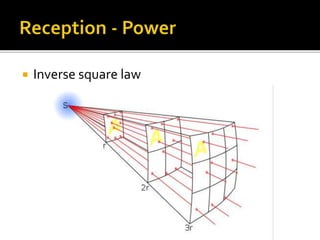
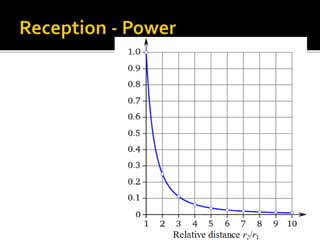
 Inverse square law
 Aerial / antenna
 Polarisation
 Direction
 Yagi array
 Sensitivity
 Weak signal
 noise
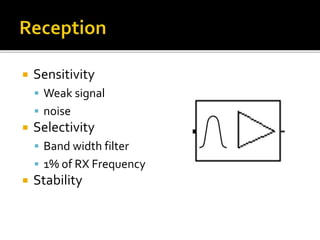
 Selectivity
 Band width filter
 1% of RX Frequency
 Stability
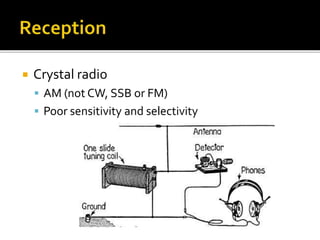
 Crystal radio
 AM (not CW, SSB or FM)
 Poor sensitivity and selectivity
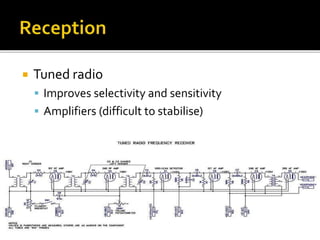
 Tuned radio
 Improves selectivity and sensitivity
 Amplifiers (difficult to stabilise)
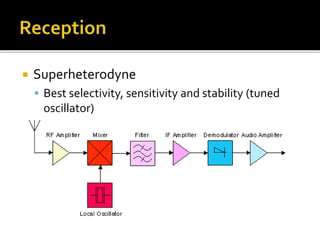
 Superheterodyne
 Best selectivity, sensitivity and stability (tuned
oscillator)
▪ CW, AM, SSB, FM
 1st stage
 Buffer
 Amplifier
 Filter
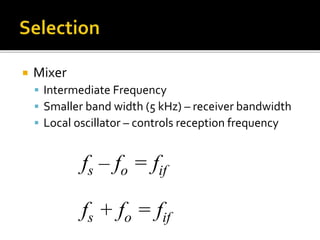
 Mixer
 Intermediate Frequency
 Smaller band width (5 kHz) – receiver bandwidth
 Local oscillator – controls reception frequency
fs – fo = fif
fs + fo = fif
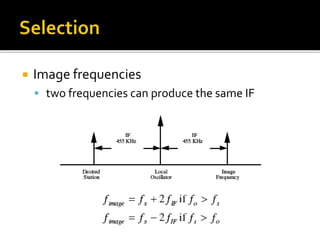
 Image frequencies
 two frequencies can produce the same IF
 CW and SSB
 AM
 FM
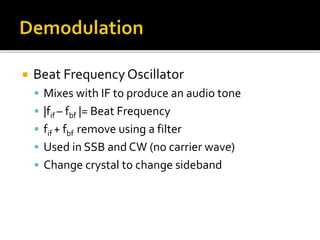
 Beat Frequency Oscillator
 Mixes with IF to produce an audio tone
 |fif – fbf |= Beat Frequency
 fif + fbf remove using a filter
 Used in SSB and CW (no carrier wave)
 Change crystal to change sideband
 AM RX
 Detector
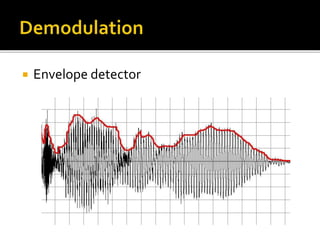
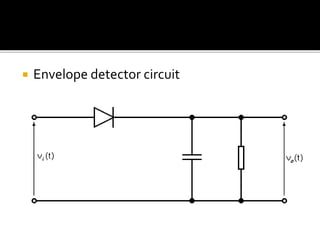
 Envelope detector
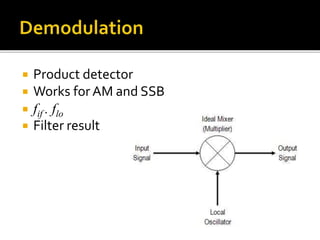
 Product detector
 Envelope detector
 Envelope detector circuit
 Product detector
 Works for AM and SSB
 fif . flo
 Filter result
 FM RX
 Quadrature detector
▪ Multiply with signal phase shifted 90o
 Phase Lock Loop (PLL)
▪ Error signal
 Digital Signal Processor
 FM RX
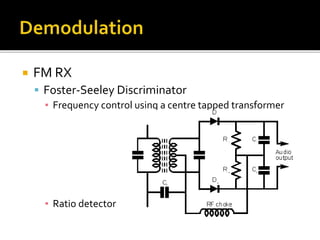
 Foster-Seeley Discriminator
▪ Frequency control using a centre tapped transformer
▪ Ratio detector
 Low Frequency amplifier
Radio recivers
Radio recivers

Radio recivers