

Radiation Protection  Standard Pawitra  Masa-at  4937092  SIRS/M March 2, 2007
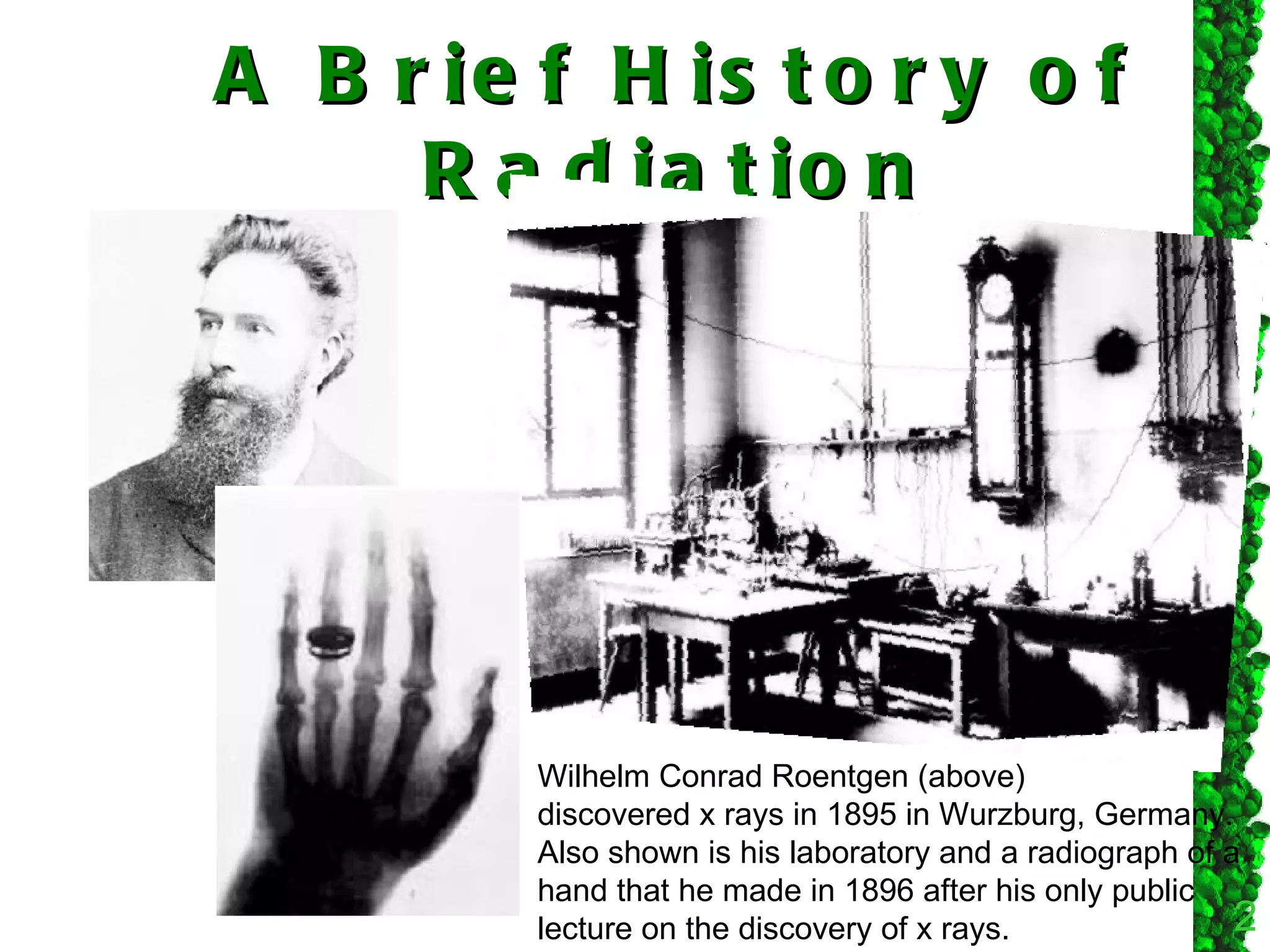
A Brief History of Radiation Wilhelm Conrad Roentgen (above) discovered x rays in 1895 in Wurzburg, Germany.  Also shown is his laboratory and a radiograph of a hand that he made in 1896 after his only public lecture on the discovery of x rays.
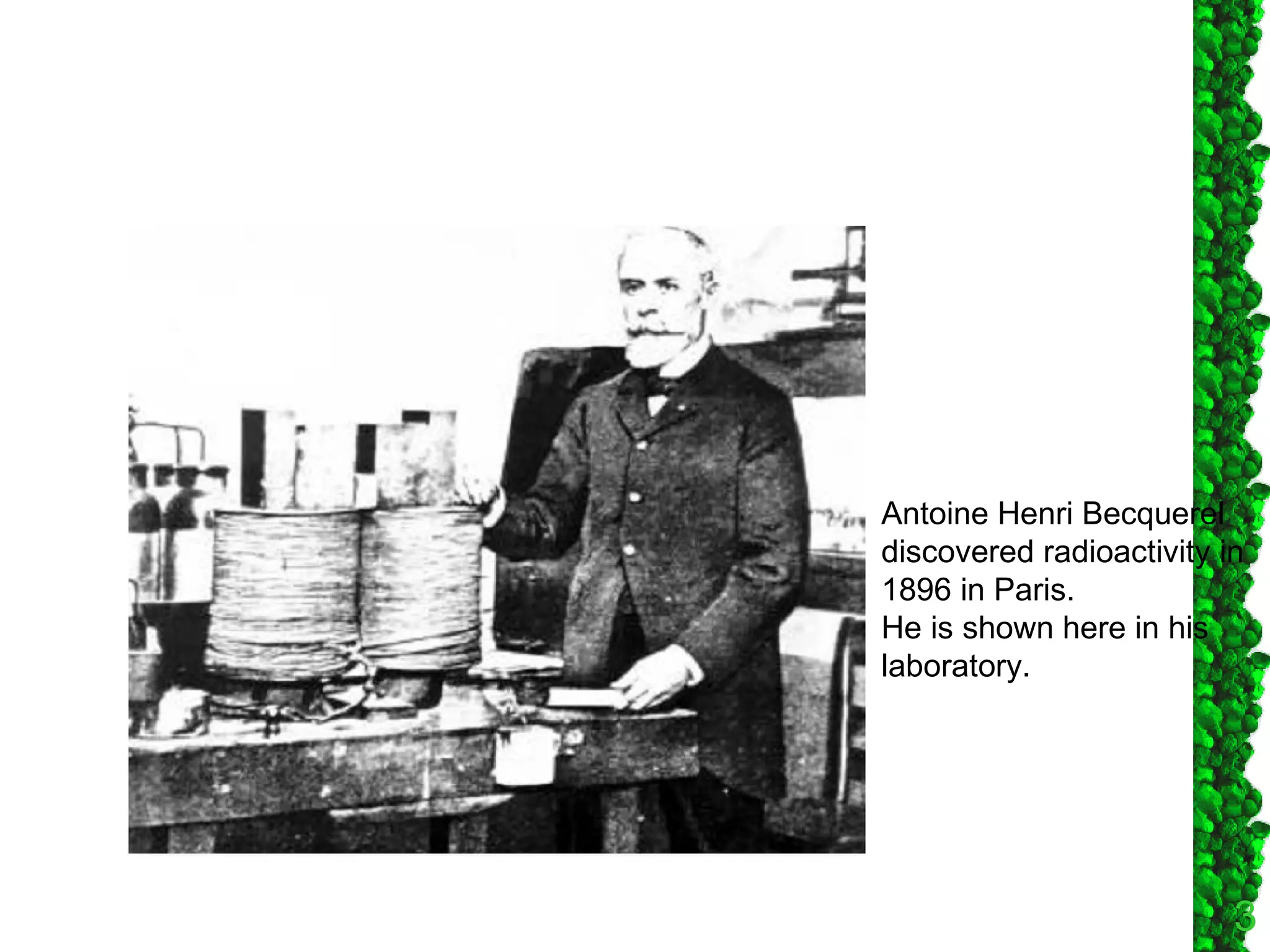
Antoine Henri Becquerel discovered radioactivity in 1896 in Paris.  He is shown here in his laboratory.
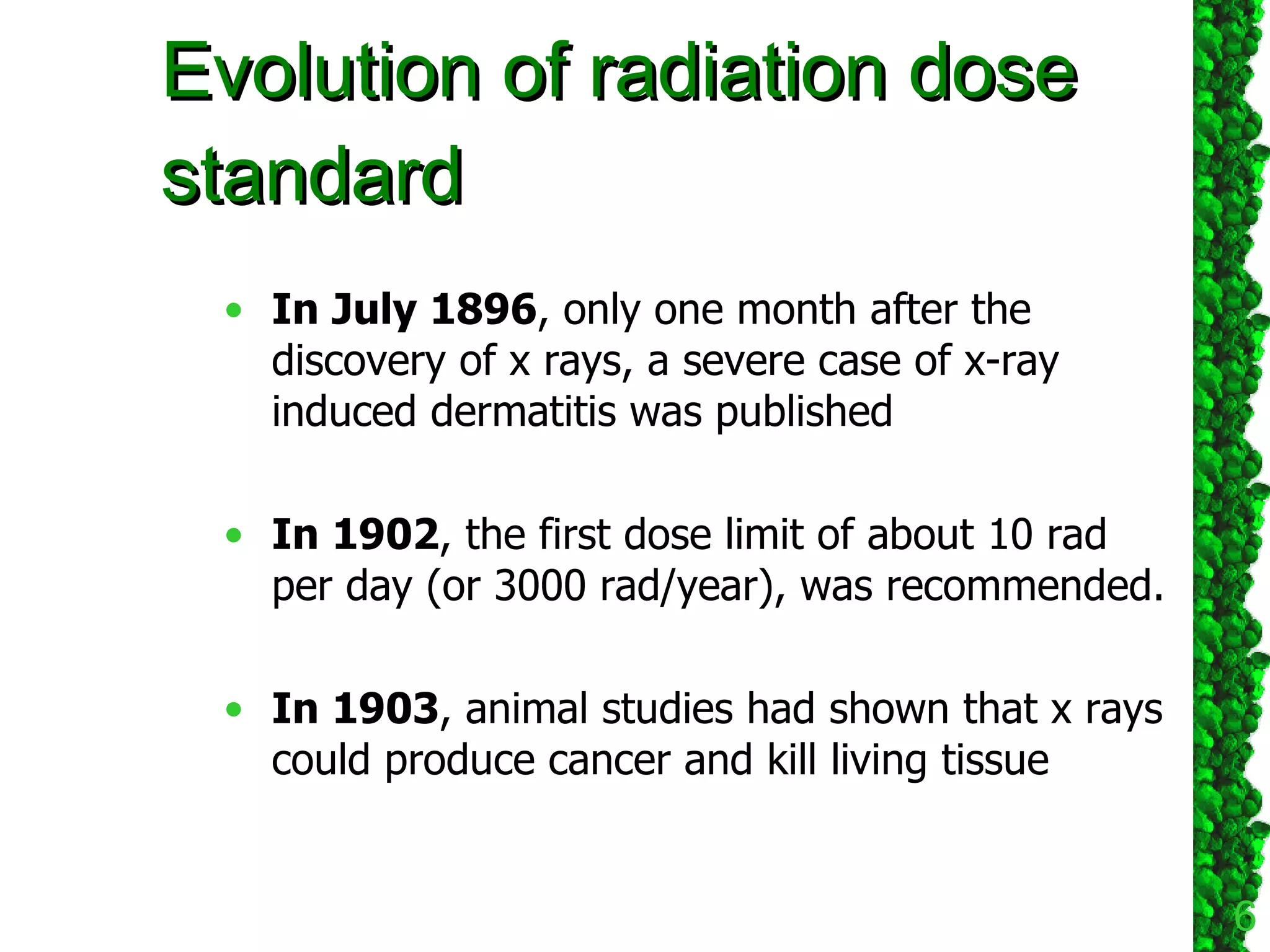
A Brief History of Radiation  In 1896, x-ray devices and radioactive materials were applied in physics, chemistry, and medicine.  In the very early days,  the users of x-rays were unaware  That large radiation doses could cause serious biological effects They also had no instruments to measure the strength of the radiation fields.   Instead, the calibration of x-ray tubes were based on the amount of skin reddening (erythema) produced when the operator placed a hand directly in the x-ray beam
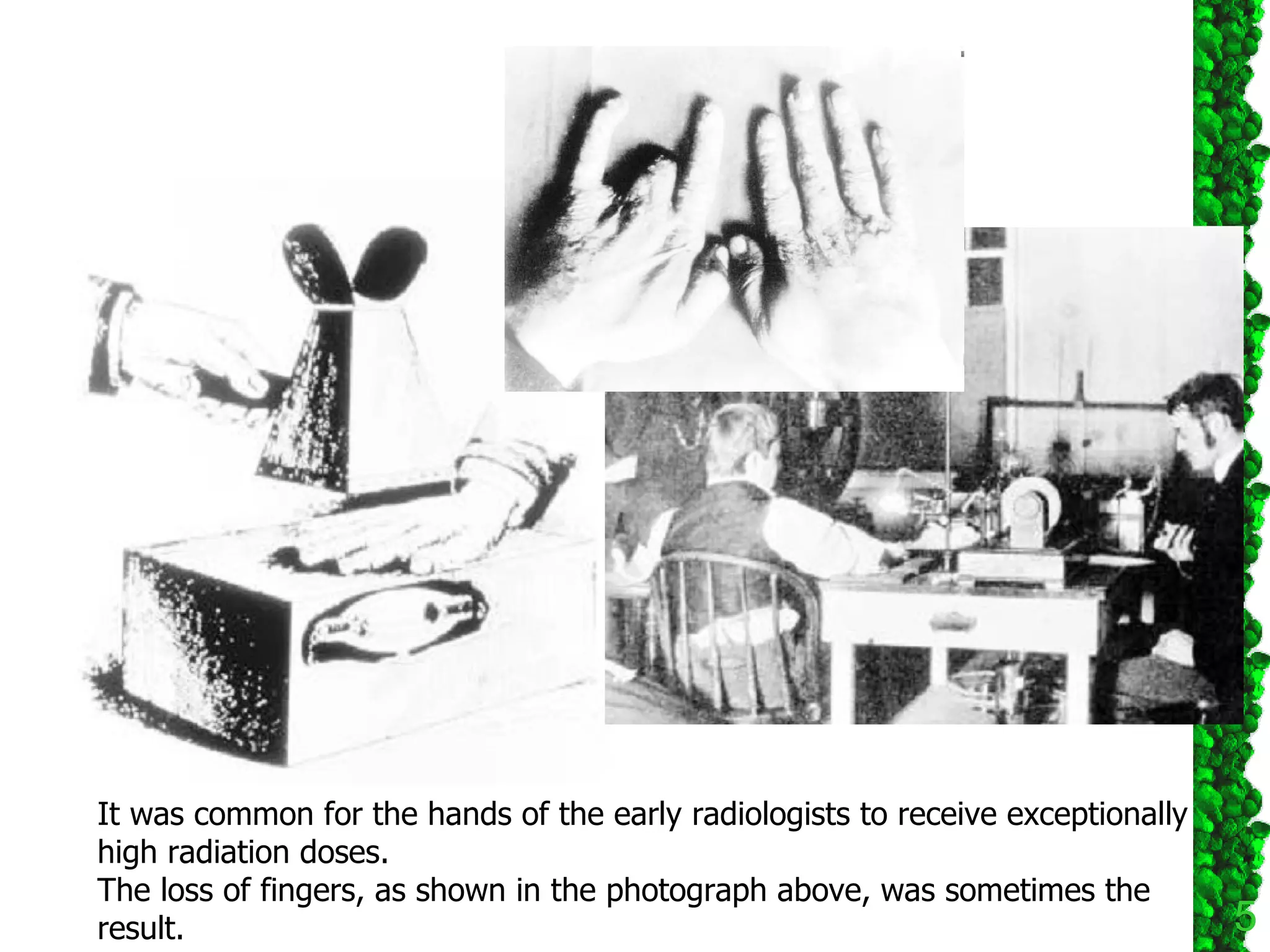
It was common for the hands of the early radiologists to receive exceptionally high radiation doses.  The loss of fingers, as shown in the photograph above, was sometimes the result.
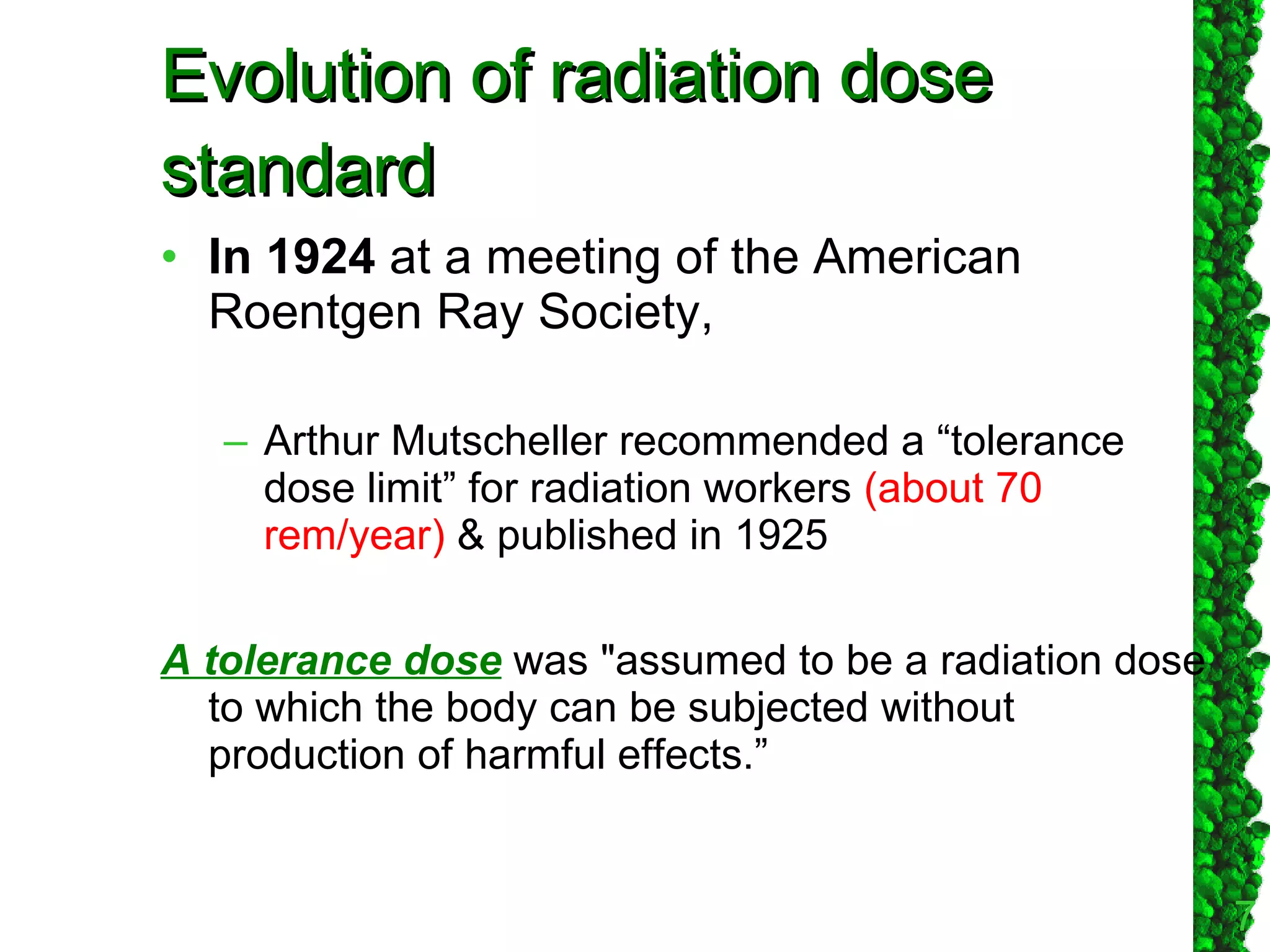
Evolution of radiation dose standard  In July 1896 , only one month after the discovery of x rays, a severe case of x-ray induced dermatitis was published  In 1902 , the first dose limit of about 10 rad per day (or 3000 rad/year), was recommended.  In 1903 , animal studies had shown that x rays could produce cancer and kill living tissue
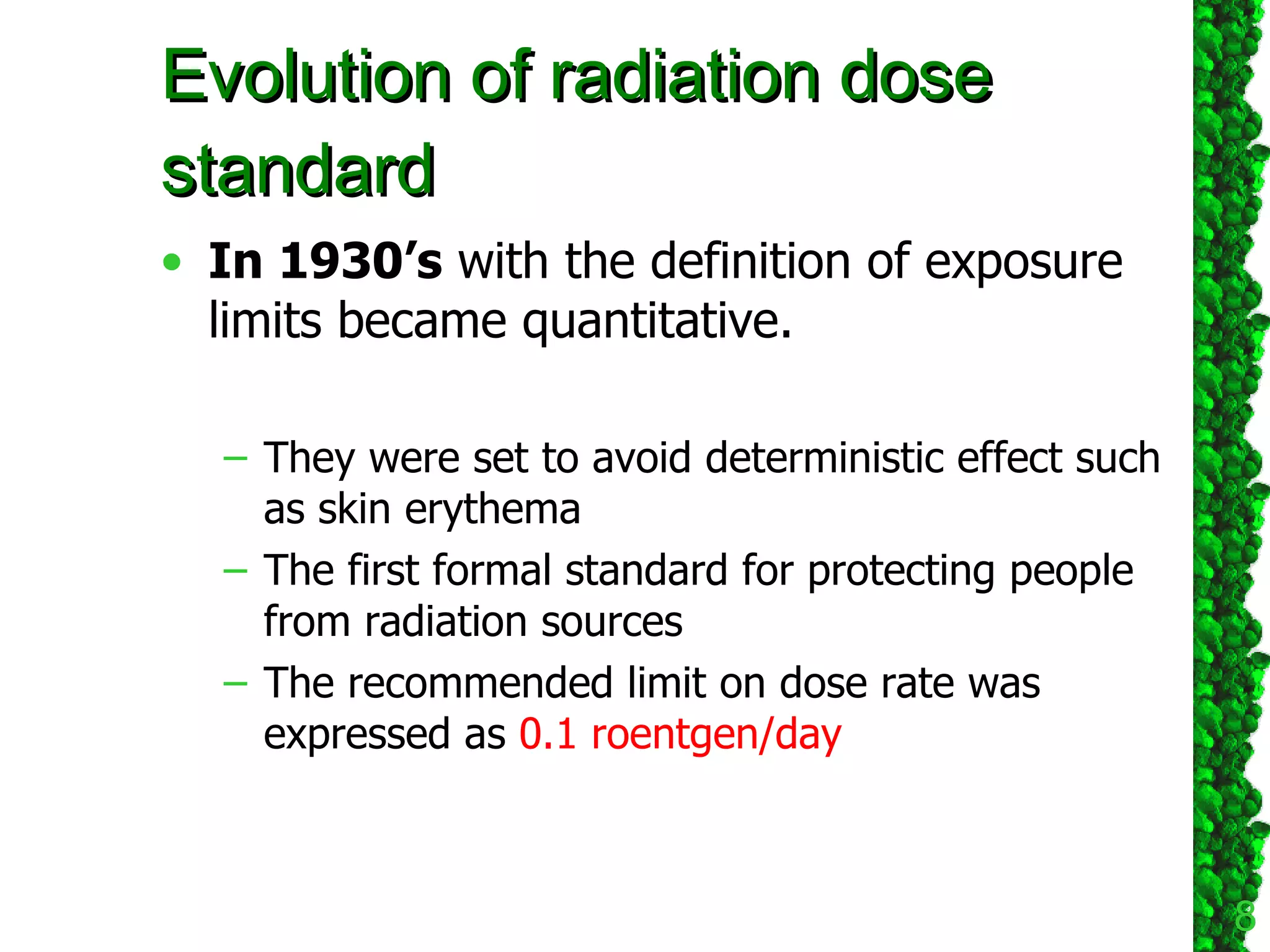
Evolution of radiation dose standard In 1924  at a meeting of the American Roentgen Ray Society,  Arthur Mutscheller recommended a “tolerance dose limit” for radiation workers  (about 70 rem/year)  & published in 1925  A tolerance dose  was "assumed to be a radiation dose to which the body can be subjected without production of harmful effects.”
Evolution of radiation dose standard In 1930’s  with the definition of exposure limits became quantitative. They were set to avoid deterministic effect   such as skin erythema The first formal standard for protecting people from radiation sources The recommended limit on dose rate was expressed as  0.1 roentgen/day
Evolution of radiation dose standard In 1940’s  The dose limits for radiation sources outside of the body (external sources) were augmented  by a limit on the amount of radium a person could tolerate inside the body
Evolution of radiation dose standard After World War II   In 1949 the United States, Canada, and Great Britain held a conference at Chalk River, and then published  the Tripartite report   A number of new concepts concerning the measurement of dose had been developed through animal studies.  absorbed dose  (rad) dose-equivalent  (rem), relative biological effectiveness  (RBE),
The Tripartite report  also recommended standards for internal and external radiation protection, including  A dose limit on…  the bone-marrow    about 15 rem/year  the skin      about 30rem/year   Evolution of radiation dose standard
In 1950’s  report of excess leukemia’s in Japan atom bomb   survivors began to emerge established possibility of stochastic effects. in the early 1950s recommended standards for annual dose limits to the public.  occupational dose limit = 5 rem/year public dose limit = 500 mrem/year Evolution of radiation dose standard
Evolution of radiation dose standard In 1960 , the Federal Radiation Council recommended an annual general public dose limit of  500 mrem/year In 1961 , The ICRP defined a system of dose control consisting of three parts : Justification  of practices & expose situations.  Optimization  of protection of exposed persons. Limitation  of individual dose and risk.
Evolution of radiation dose standard In 1977  ICRP (in report # 26) established dose limit for radiation protection based on risk assesment. In 1991  ICRP (in report # 60) revised these limit (based on analysis in BEIR V report 1990, UNSCEAR 1988)
Evolution of radiation dose standard
Estimates of Probability for cancer death Estimates of Probability for cancer death for period 1950-1985 changed for 4 reasons. The new dosimetry of Japanese data. More cancers observed over the year. Different radiation effects modeling. Different risk modeling accounting foe age.
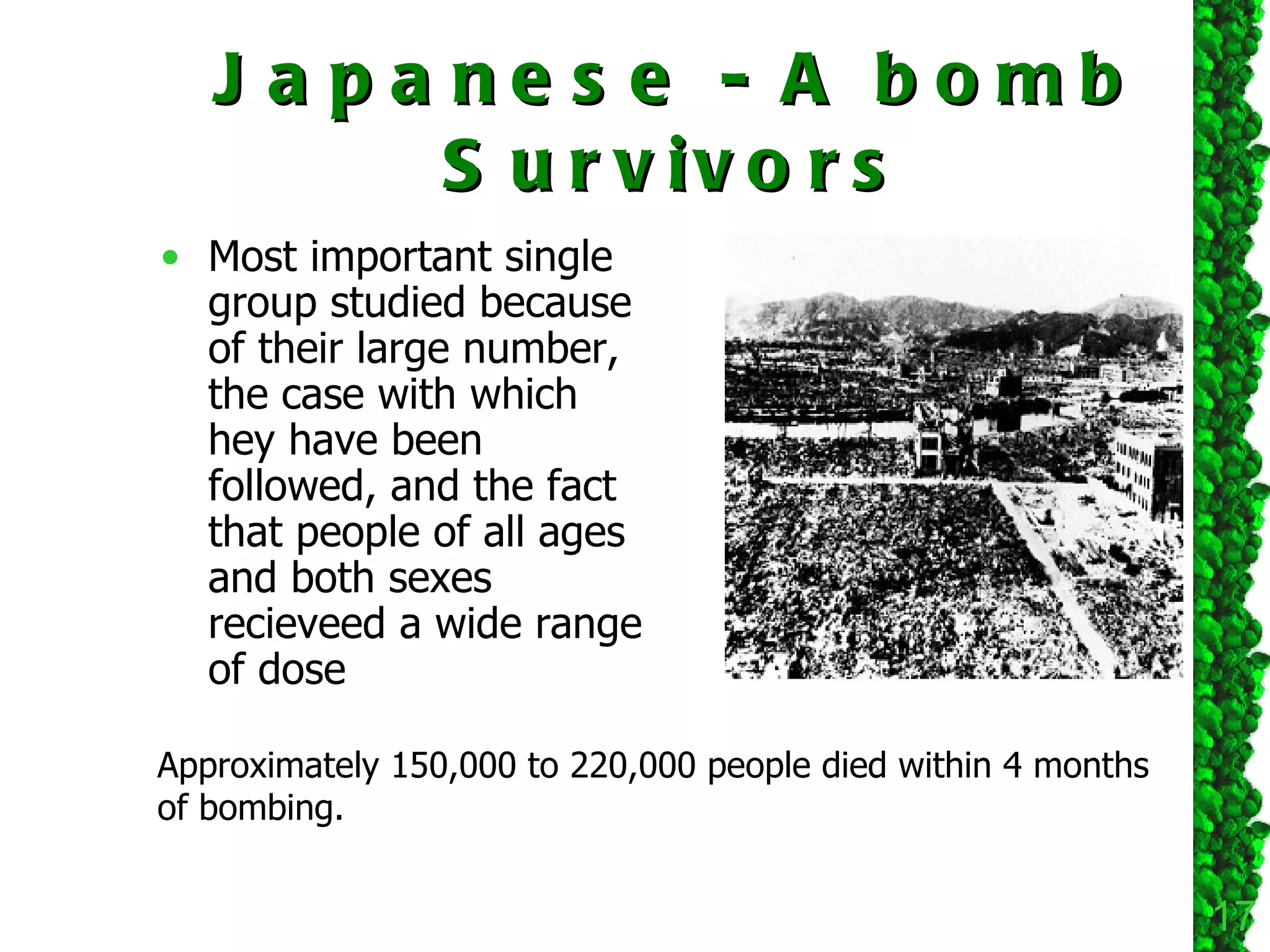
Japanese - A bomb Survivors Most important single group studied because of their large number, the case with which hey have been followed, and the fact that people of all ages and both sexes recieveed a wide range of dose Approximately 150,000 to 220,000 people died within 4 months of bombing.
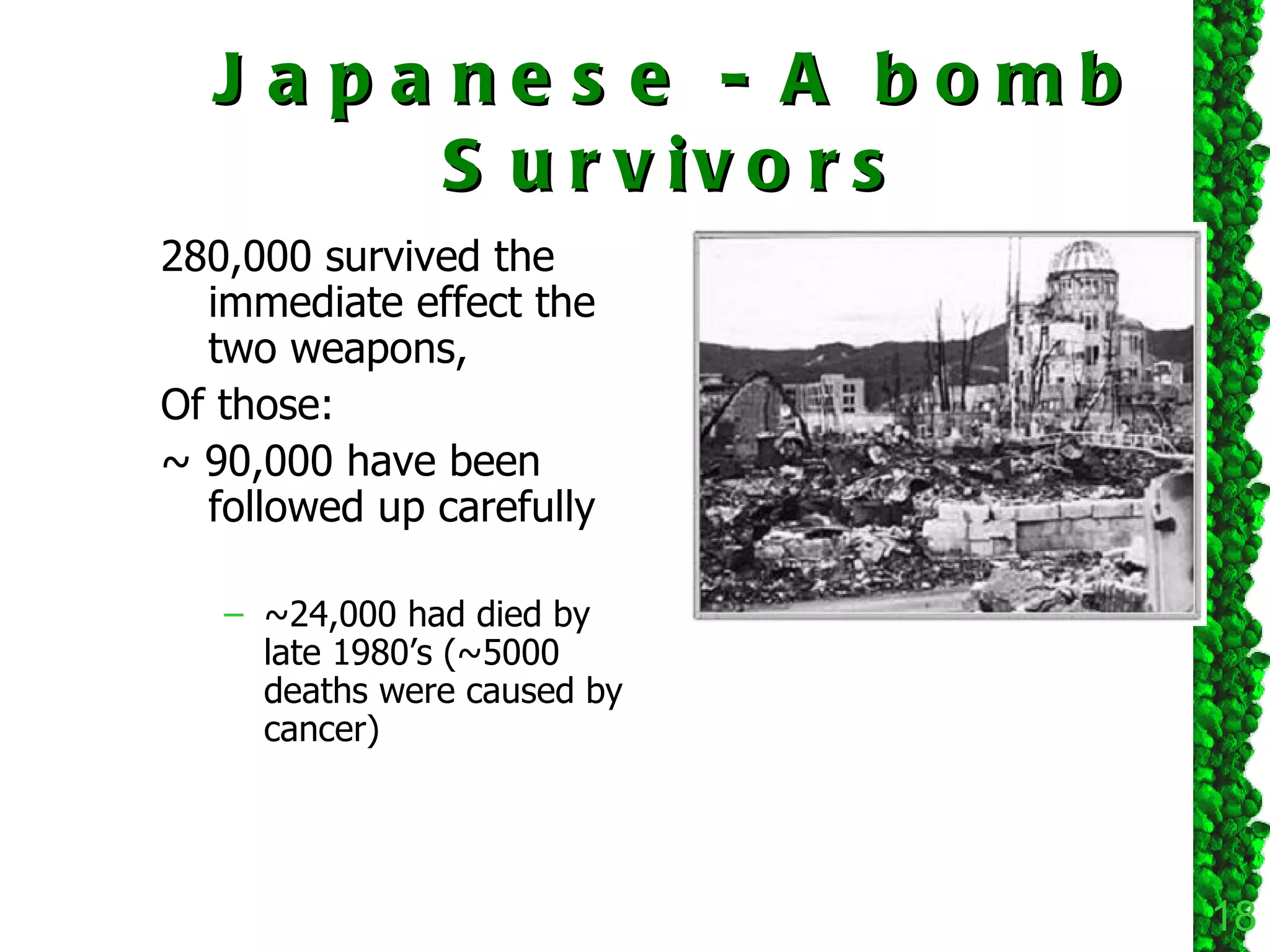
Japanese - A bomb Survivors 280,000 survived the immediate effect the two weapons, Of those: ~ 90,000 have been followed up carefully ~24,000 had died by late 1980’s (~5000 deaths were caused by cancer)
Type of Exposure Occupational exposure Medical exposure Public exposure Potential exposure
Type of Exposure Occupational exposure All exposures of workers incurred in the course of their work with the exception of exposures excluded from the Standards and exposures from practices or sources  exempted by the Standards.
Type of Exposure Medical exposure Exposure incurred by patients as part of their own medical or dental diagnosis or treatment  by persons voluntarily helping in the support and comfort of patients  by volunteers in a programme of biomedical research involving their exposure.
Type of Exposure Public exposure Exposure incurred by members of the public from radiation sources,  excluding any occupational or medical exposure and the normal local natural background radiation but including exposure from authorized sources and practices and from intervention situations.
Type of Exposure Potential exposure Exposure that is not expected to be delivered with certainty but that may result from an accident at a source or owing to an event or sequence of events of a probabilistic nature, including equipment failures and operating errors.
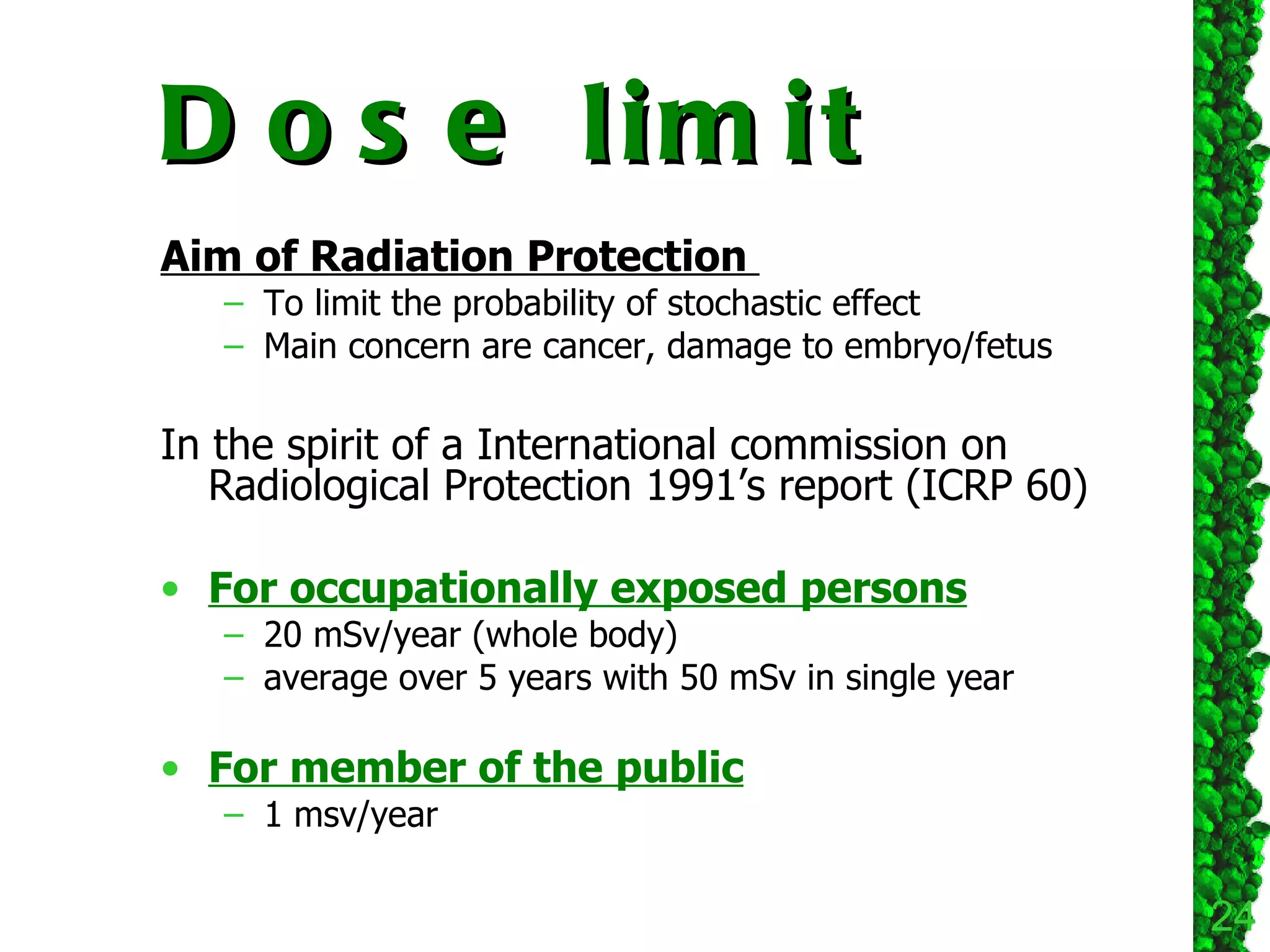
Dose limit Aim of Radiation Protection  To limit the probability of stochastic effect Main concern are cancer, damage to embryo/fetus In the spirit of a International commission on Radiological Protection 1991’s report (ICRP 60)  For occupationally exposed persons 20 mSv/year (whole body)  average over 5 years with 50 mSv in single year For member of the public 1 msv/year
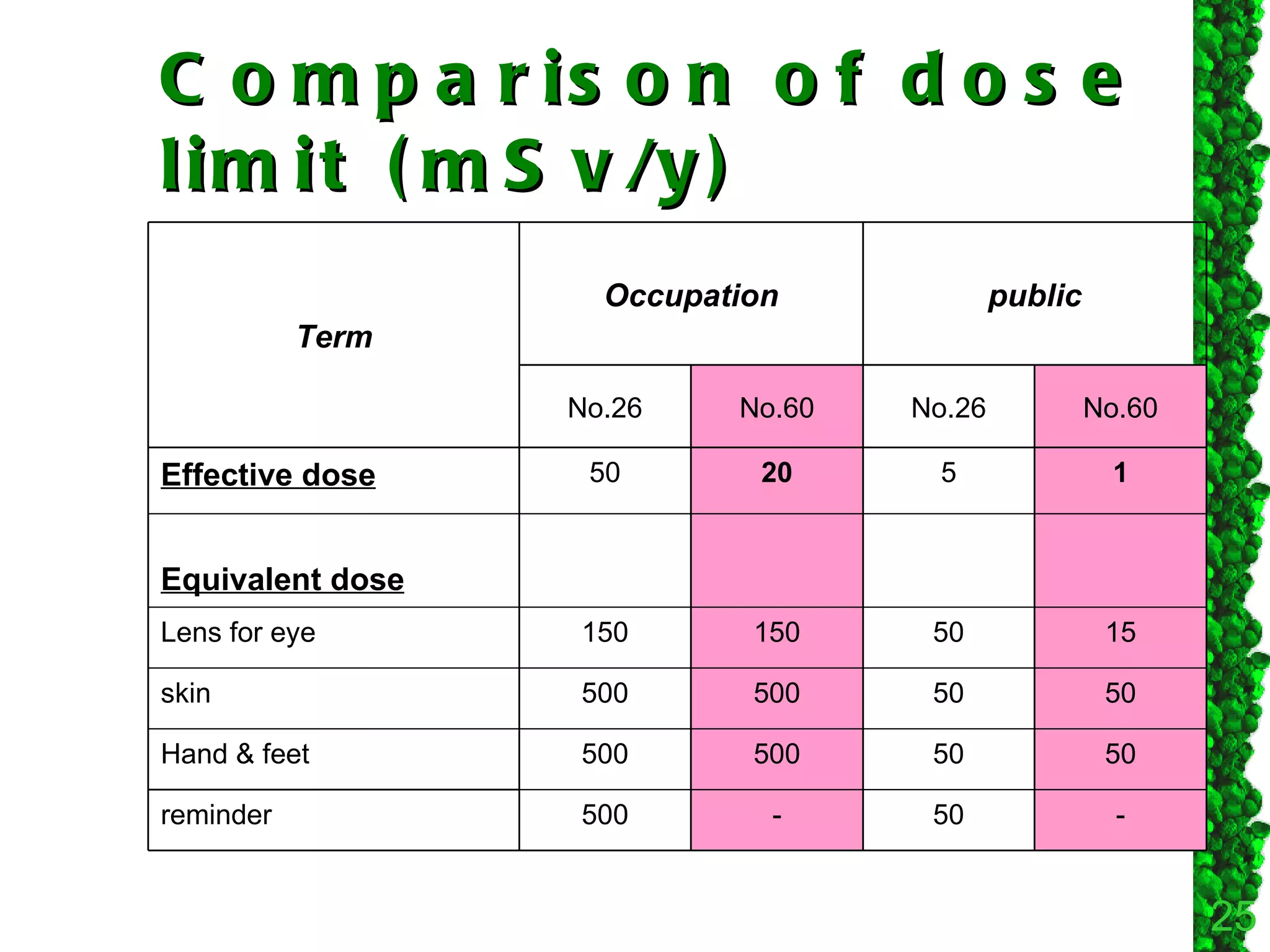
Comparison of dose limit (mSv/y) - 50 - 500 reminder 50 50 500 500 Hand & feet 50 50 500 500 skin 15 50 150 150 Lens for eye Equivalent dose 1 5 20 50 Effective dose No.60 No.26 No.60 No.26 public Occupation Term
   Thank you    Pawitra  Masa-at

Radiation protection Standard

  • 1.
    Radiation Protection Standard Pawitra Masa-at 4937092 SIRS/M March 2, 2007
  • 2.
    A Brief Historyof Radiation Wilhelm Conrad Roentgen (above) discovered x rays in 1895 in Wurzburg, Germany. Also shown is his laboratory and a radiograph of a hand that he made in 1896 after his only public lecture on the discovery of x rays.
  • 3.
    Antoine Henri Becquereldiscovered radioactivity in 1896 in Paris. He is shown here in his laboratory.
  • 4.
    A Brief Historyof Radiation In 1896, x-ray devices and radioactive materials were applied in physics, chemistry, and medicine. In the very early days, the users of x-rays were unaware That large radiation doses could cause serious biological effects They also had no instruments to measure the strength of the radiation fields. Instead, the calibration of x-ray tubes were based on the amount of skin reddening (erythema) produced when the operator placed a hand directly in the x-ray beam
  • 5.
    It was commonfor the hands of the early radiologists to receive exceptionally high radiation doses. The loss of fingers, as shown in the photograph above, was sometimes the result.
  • 6.
    Evolution of radiationdose standard In July 1896 , only one month after the discovery of x rays, a severe case of x-ray induced dermatitis was published In 1902 , the first dose limit of about 10 rad per day (or 3000 rad/year), was recommended. In 1903 , animal studies had shown that x rays could produce cancer and kill living tissue
  • 7.
    Evolution of radiationdose standard In 1924 at a meeting of the American Roentgen Ray Society, Arthur Mutscheller recommended a “tolerance dose limit” for radiation workers (about 70 rem/year) & published in 1925 A tolerance dose was "assumed to be a radiation dose to which the body can be subjected without production of harmful effects.”
  • 8.
    Evolution of radiationdose standard In 1930’s with the definition of exposure limits became quantitative. They were set to avoid deterministic effect such as skin erythema The first formal standard for protecting people from radiation sources The recommended limit on dose rate was expressed as 0.1 roentgen/day
  • 9.
    Evolution of radiationdose standard In 1940’s The dose limits for radiation sources outside of the body (external sources) were augmented by a limit on the amount of radium a person could tolerate inside the body
  • 10.
    Evolution of radiationdose standard After World War II In 1949 the United States, Canada, and Great Britain held a conference at Chalk River, and then published the Tripartite report A number of new concepts concerning the measurement of dose had been developed through animal studies. absorbed dose (rad) dose-equivalent (rem), relative biological effectiveness (RBE),
  • 11.
    The Tripartite report also recommended standards for internal and external radiation protection, including A dose limit on… the bone-marrow  about 15 rem/year the skin  about 30rem/year Evolution of radiation dose standard
  • 12.
    In 1950’s report of excess leukemia’s in Japan atom bomb survivors began to emerge established possibility of stochastic effects. in the early 1950s recommended standards for annual dose limits to the public. occupational dose limit = 5 rem/year public dose limit = 500 mrem/year Evolution of radiation dose standard
  • 13.
    Evolution of radiationdose standard In 1960 , the Federal Radiation Council recommended an annual general public dose limit of 500 mrem/year In 1961 , The ICRP defined a system of dose control consisting of three parts : Justification of practices & expose situations. Optimization of protection of exposed persons. Limitation of individual dose and risk.
  • 14.
    Evolution of radiationdose standard In 1977 ICRP (in report # 26) established dose limit for radiation protection based on risk assesment. In 1991 ICRP (in report # 60) revised these limit (based on analysis in BEIR V report 1990, UNSCEAR 1988)
  • 15.
  • 16.
    Estimates of Probabilityfor cancer death Estimates of Probability for cancer death for period 1950-1985 changed for 4 reasons. The new dosimetry of Japanese data. More cancers observed over the year. Different radiation effects modeling. Different risk modeling accounting foe age.
  • 17.
    Japanese - Abomb Survivors Most important single group studied because of their large number, the case with which hey have been followed, and the fact that people of all ages and both sexes recieveed a wide range of dose Approximately 150,000 to 220,000 people died within 4 months of bombing.
  • 18.
    Japanese - Abomb Survivors 280,000 survived the immediate effect the two weapons, Of those: ~ 90,000 have been followed up carefully ~24,000 had died by late 1980’s (~5000 deaths were caused by cancer)
  • 19.
    Type of ExposureOccupational exposure Medical exposure Public exposure Potential exposure
  • 20.
    Type of ExposureOccupational exposure All exposures of workers incurred in the course of their work with the exception of exposures excluded from the Standards and exposures from practices or sources exempted by the Standards.
  • 21.
    Type of ExposureMedical exposure Exposure incurred by patients as part of their own medical or dental diagnosis or treatment by persons voluntarily helping in the support and comfort of patients by volunteers in a programme of biomedical research involving their exposure.
  • 22.
    Type of ExposurePublic exposure Exposure incurred by members of the public from radiation sources, excluding any occupational or medical exposure and the normal local natural background radiation but including exposure from authorized sources and practices and from intervention situations.
  • 23.
    Type of ExposurePotential exposure Exposure that is not expected to be delivered with certainty but that may result from an accident at a source or owing to an event or sequence of events of a probabilistic nature, including equipment failures and operating errors.
  • 24.
    Dose limit Aimof Radiation Protection To limit the probability of stochastic effect Main concern are cancer, damage to embryo/fetus In the spirit of a International commission on Radiological Protection 1991’s report (ICRP 60) For occupationally exposed persons 20 mSv/year (whole body) average over 5 years with 50 mSv in single year For member of the public 1 msv/year
  • 25.
    Comparison of doselimit (mSv/y) - 50 - 500 reminder 50 50 500 500 Hand & feet 50 50 500 500 skin 15 50 150 150 Lens for eye Equivalent dose 1 5 20 50 Effective dose No.60 No.26 No.60 No.26 public Occupation Term
  • 26.
    Thank you  Pawitra Masa-at

Editor's Notes

  • #6 The doses needed to produce erythema are very high indeed—if the skin is exposed to 200-kilovolt x rays at a high dose rate of 30 rad per minute, then erythema appears after about 20 minutes (or 600 rad) of exposure, and moist desquamation (equivalent to a third-degree burn) occurs after about 110 minutes (or about 2000 rad) of exposure. The loss of fingers, as shown in the photographabove, was sometimes the result. Such conditions are ultimately caused by outright killing of many cells. In the case above, dermal basal cells and blood vessels were critically injured in the fingers, scar tissue probably plugged the blood vessels and stopped the flow of blood. The loss of blood supply ultimately led to the death of tissue in the fingers and the loss of those extremities.
  • #7 ในเดือน กรกฎาคม 1896 เพียงหนึ่งเดือนหลังค้นพบ x-rays ก็มีการตีพิมพ์เผยแพร่รายงานความรุนแรงของ x-rays ที่ก่อให้เกิดผลต่อผิวหนัง และต่อมาในปี 1902 ก็ได้มีการกำหนด dose limit เป็นครั้งแรก คือ 10 rad/day ( หรือ 3000 rad/year) ซึ่ง dose ที่กำหนดนี้ไม่ได้มาจากการพิจาณาข้อมูลทาง biological แต่ประมาณจากปริมาต่ำสุดที่สามารถ detect ได้ ( โดยวิธีง่าย ๆ ) นั่นคือเป็นปริมาณรังสีน้อยที่สุดที่จะเห็นการ expose ( เกิดรอยบนฟิล์ม ) ในปี 1903 จากการใช้สัตว์ศึกษา (animal studies) พบว่า x-ray ทำให้เกิดมะเร็ง ทำลาย living tissue และ organ พบว่าส่วนที่ส่วนที่ทนต่อความเสียหายของรังสีน้อยที่สุดคือ skin, blood forming organ, และ reproductive organs Table 1 แสดงประมาณ dose rate
  • #8 ในเดือน กันยายน 1924 ในงาน meeting ของสมาคม American roentgen ray, Authur Mutscheller คือบุคคลที่ได้มีการ recommended dose rate ที่สามารถทนได้ “ tolerance dose rate” สำหรับผู้ปฏิบัติงานทางรังสี รายงานของเขาได้จากการ observation แพทย์ และ technician ซึ่งทำงานในบริเวณที่มีการกำบังรังสี (shielding) เขาได้ประเมินจากผู้ปฏิบัติงานจะได้รับปริมาณรังสีในปริมาณ 1/10 ของ dose ที่ก่อให้เกิด (erythema) บวมแดงที่ผิวหนัง คือประมาณ 60 rem/month โดยการตรวจวัด current, voltage ของหลอด x-ray โดยพิจารณาการกรองรังสี (filtration of the beam) ระยะห่างของผู้ปฏิบัติงานกับหลอก x-ray และ exposure time เขายังได้ทำการ observe พบว่า ไม่พบอาการบาดเจ็บจากรังสีแม้แต่คนเดียว จึงได้ทำการสรุปว่าระดับ dose rate ในบริเวณที่มีกำบังรังสีเป็นที่ยอมรับ แต่ข้อแนะนำกรณี tolerance เขาได้นำ safety factor of ten ไปใช้ และแนะนำไว้ว่า tolerance limit ไว้ที่ 1/100 ของ erythema dose/month ( เทียบเท่ากับ 70 rem/year) tolerance dose ได้ถูก assume ให้เป็น radiation dose โดยไม่เกิดอันตรายต่อร่างกาย Mutscheller ออกบทความที่มีหัวข้อว่า “ Physical standard of protection Against Roentgen Ray danger” มาตรฐานการป้องกันอันตรายจากรังสี ซึ่งได้ถูกตีพิมพ์เผยแพร่ ในปี 1925 เป็นที่น่ายินดีที่ F.M Sievert ได้ออกเผยแพร่ dose limit ที่มีค่าใกล้เคียงกัน
  • #9 ในปี 1934 the U.S advisory committee on x-ray and radiation protection ได้เสนอ standard ของการป้องกันผู้คนจาก radiation source อย่างเป็นทางการขึ้น โดยมาจากการวัดปริมาณ ionization radiation ในหน่วย roentgen และจากนั้นก็ได้มีการ recommend limit ในหน่วย dose rate ก็ประกาศที่ 0.1 roentgen/day ซึ่งก็สอดคล้องกับที่ของ Mutscheller ได้เสนอไว้ ซึ่งความต่างอยู่ที่ factor หรือเทคนิคการตรวจวัดที่ต่างกันของ U.S กับ Europe เป็นความผิดพลาดที่ในยุคแรก ของการออกค่า exposure limit ที่ไม่ได้มีการพิจารณาความเสียหายที่เกิดขึ้นทาง biological ทำเพียงการ observe ความเปลี่ยนแปลงทาง biological แต่ไม่ค่อยได้มีการศึกษา อันตรายที่จะเกิดขึ้นในทาง biological Dose limit ของ radiation source ที่อยู่นอกร่างกาย (external source) เกิดขึ้นเมื่อปี 1941 จากการศึกษา dose limit ของ radium ในร่างกายที่คนสามารถรับได้ งาน clinical observation ที่ใช้เวลาติดตามยาวนานเป็นสิบปี โดยศึกษาจาก คนที่ได้รับ internal expose จาก radium 27 คน โดยมีการตรวจวัดปริมาณ radium ที่ได้รับเข้าไป ซึ่งเป็นพื้นฐานของการหา radium standard
  • #13 ในระหว่างศตวรรษ 1950 ก็ได้มีการลด standard ของ external radiation ซึ่งเป็นผมาจากการศึกษาจากผู้รอดชีวิตจากระเบิดนิวเคลียร์ที่ญี่ปุ่น และจากผู้ป่วยที่ได้รับ high dose จากการรักษา โดยเฉพาะในช่วงแรก ๆ ของการวิเคราะห์ข้อมูลผู้รอดชีวิตจารระเบิดปรมาณูปรากฎของมูลที่บ่งบอกว่าเกิดการเปลี่ยนแปลงของสัดส่วนของผู้ชายต่อผู้หญิง ในจำนวนเด็กทารกเกิดใหม่ที่รอดชีวิต ในขณะเดียวกัน จากข้อมูลของการทดลองในสัตว์เลี้ยงลูกด้วยนม และแมลงผลไม้ปรากฏว่าเกิดการเปลี่ยนแปลงทางพันธุกรรมขึ้น เป็นผลการเหนี่ยวนำจากการได้รับ high exposure ทำให้มีการศึกษาทางด้านรังสี ที่จะเป็นตัวเหนี่ยวนำให้เกิดผลต่อพันธุกรรมอย่างจริงจัง ในช่วงต้นศตวรรษที่ 1950 นำมาซึ่งการ recommend standard ของ limit ที่ประชาชนได้รับใน 1 ปี (standard for annual dose limit in public) ผลการวิเคราะห์ต่อมาพบว่ารายงานที่ได้ออกในช่วงแรกเป็นรายงานที่ผิด ปัจจุบันก็สรุปผลใหม่ที่ถูกต้องว่ารังสีไม่ส่งผลต่อพันธุกรรมแต่อย่างใด แต่อย่างไรก็ตาม ก็ยังคงมีความกลัวว่าจะเกิดผลต่อพันธุกรรมขึ้นในอนาคต ซึ่งมาจากภาพยนตร์หลายเรื่องเช่น Godzilla, Incredible Shrinking Man, Spiderman, The incredible Hulk และอื่น ๆ อีก ความหวาดกลัวของประชาชนนี้เองนำมาซึ่งการลดค่า radiation protection standard
  • #14 ปี 1961 เป็นที่ทราบโดยทั่วไปแล้วว่าความเสี่ยงของการเกิด genetic effect ในการศึกษาที่ผ่านมานั้นผิดพลาดคือไม่ปรากฏให้เห็น แต่การศึกษาเกี่ยวกับการเกิดมะเร็งและทารกที่เสียชีวิตในกลุ่มผู้รอดชีวิตจากระเบิดก็เริ่มขึ้น แสดงออกมาในรูปของอัตราการเกิดลูคีเมียที่เพิ่มขึ้นเมื่อเวลาผ่านไป อัตราการเกิดมะเร็งแบบ solid-tumor ก็ถูกพบด้วยเช่นกัน จากการศึกษาอีกมากมายทำให้ค้นพบว่ามะเร็งมะเร็งต่าางชนิดกันก็มีระยะแฝงที่ต่างกัน จากการศึกษาเหล่านี้พบว่า Solid tumor มีระยะแฝงอยู่ที่ 25-40 ปี ลูคีเมีย 2-25 ปี
  • #15 ในปี 1977 ICRP ก็ได้มีการปรับปรุงการตั้งค่า standard และพบว่าความเสี่ยงของการเสียชีวิตของผู้ปฏิบัติงานจากรังสียังน้อยกว่าความเสี่ยงของการเสียชีวิตจาก trauma ด้วยซ้ำไป มีการพิสูจน์พบความเสียงของการเสียชีวิตจากรังสีเพียง 1 ใน 1000 ต่อปี จากผลการศึกษาของผู้รอดชีวิตจากระเบิดปรมาณูแสดงสัมประสิทธ์ความเสี่ยงที่จะทำให้เกิดมะเร็งนั้นมีค่าประมาณ 10-4 rem-1 และจาก risk coefficient นี้เอง ICRP จึงได้มีการ recommend dose สูงสุดของผู้ปฏิบัติงานเท่ากับ 5 rem/year และ dose limit ค่านี้ถูกตั้งมาจากการ assume ว่า dose เฉลี่ยจะน้อยกว่า 1 rem/year ต่อมาในปี 1977 ก็ไม่ได้มีการเปลี่ยนค่า limit ไปจากปี 1957 แต่มีการให้เหตุผลเพิ่มเติมในเทอมของ risk เข้าไป ในช่วงปี 1980 การประเมิน dose มาจากผู้รอดชีวิตจากระเบิดปรมาณู โดยมีการคำนวนประมาณค่าแบบใหม่ คือพิจารณาสัดส่วนของ neutron ต่อ gamma-ray ซึ่งเป็นผลผลิตจากระเบิดและยังมีข้อมูลการเกิดมะเร็งและการเสียชีวิตของทารก ในกลุ่มผู้รอดชีวิตจากระเบิดบอกว่าพบมะเร็งบางชนิดเกิดมากกว่าที่เคยคิดไว้ นั่นหมายความว่า ค่าเฉลี่ยของความเสี่ยงต่อ unit dose สูงขึ้น และเหตุจากค่าที่เพิ่มขึ้นนี้เอง ICRP ได้ทำการออกเป็น international recommendation ในปี 1990 โดยที่ตั้ง exposure dose limit เท่ากับ 10 rem ในตลอดเวลา 5 ปี และเท่ากับ 5 rem ในแต่ละปี อีกทั้งได้มีการกำหนด public limit ที่ 100 mrem/year เฉลี่ยจากเวลา 5 ปี