RadiationSafetyPrinciples
BY
Mr.S.DINESH.,BSCRADIOLOGY
Outlines
- Introduction to Radiation
- Unitsof Activity
- Alpha,Beta, Gamma Radiation
- Definitions
- Background Radiation
- Doselimits
- ALARA
- Radiation safety equipment
- Summary
Introduction to radiation
Radiation: is energy in the form of moving particles or
electromagnetic waves.
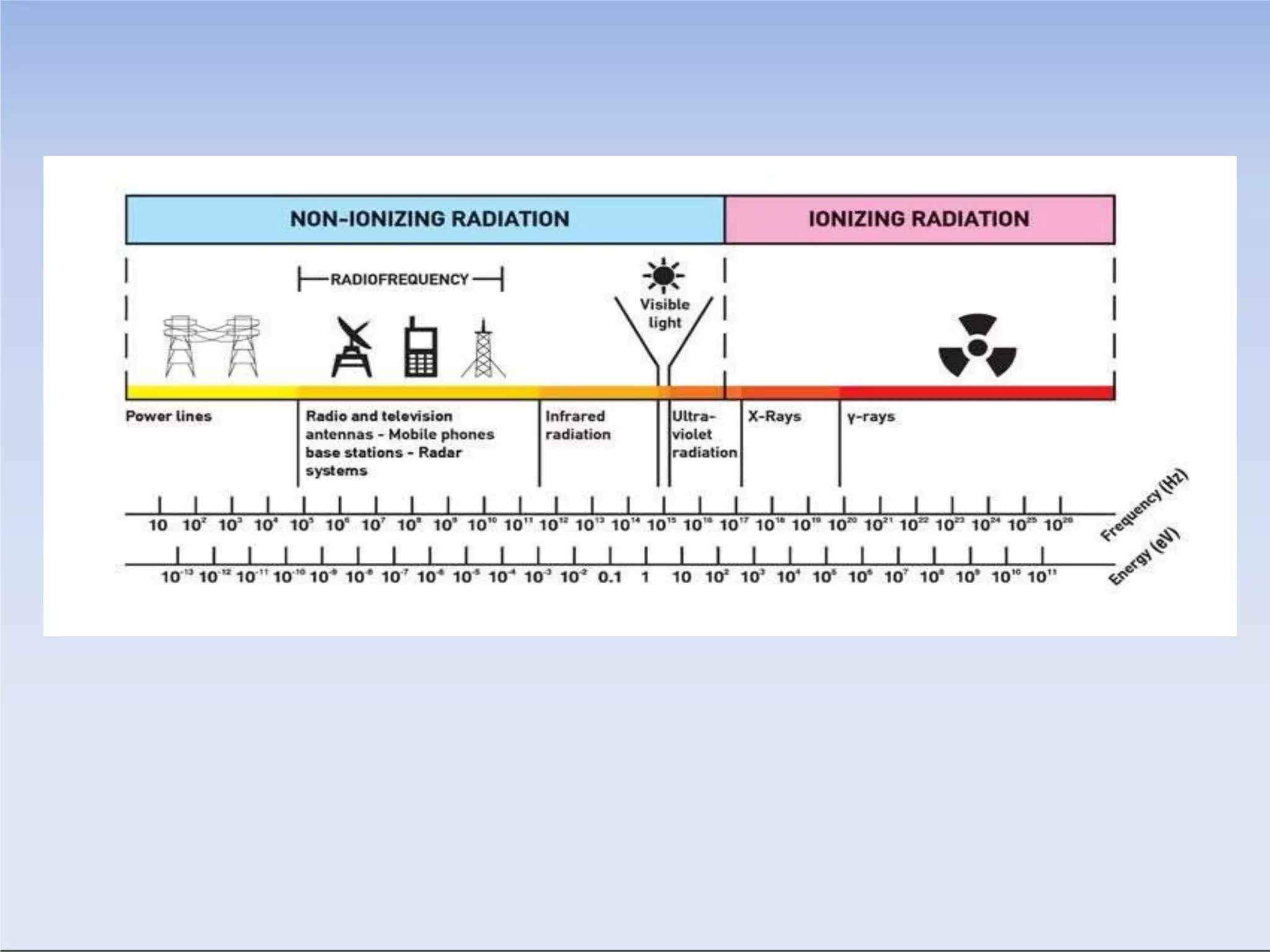
Thereare two typesof radiation:
- Non-ionizing radiation:does not have enough energy
to remove an electron from the atom or molecule.
Microwave, radiowave,…
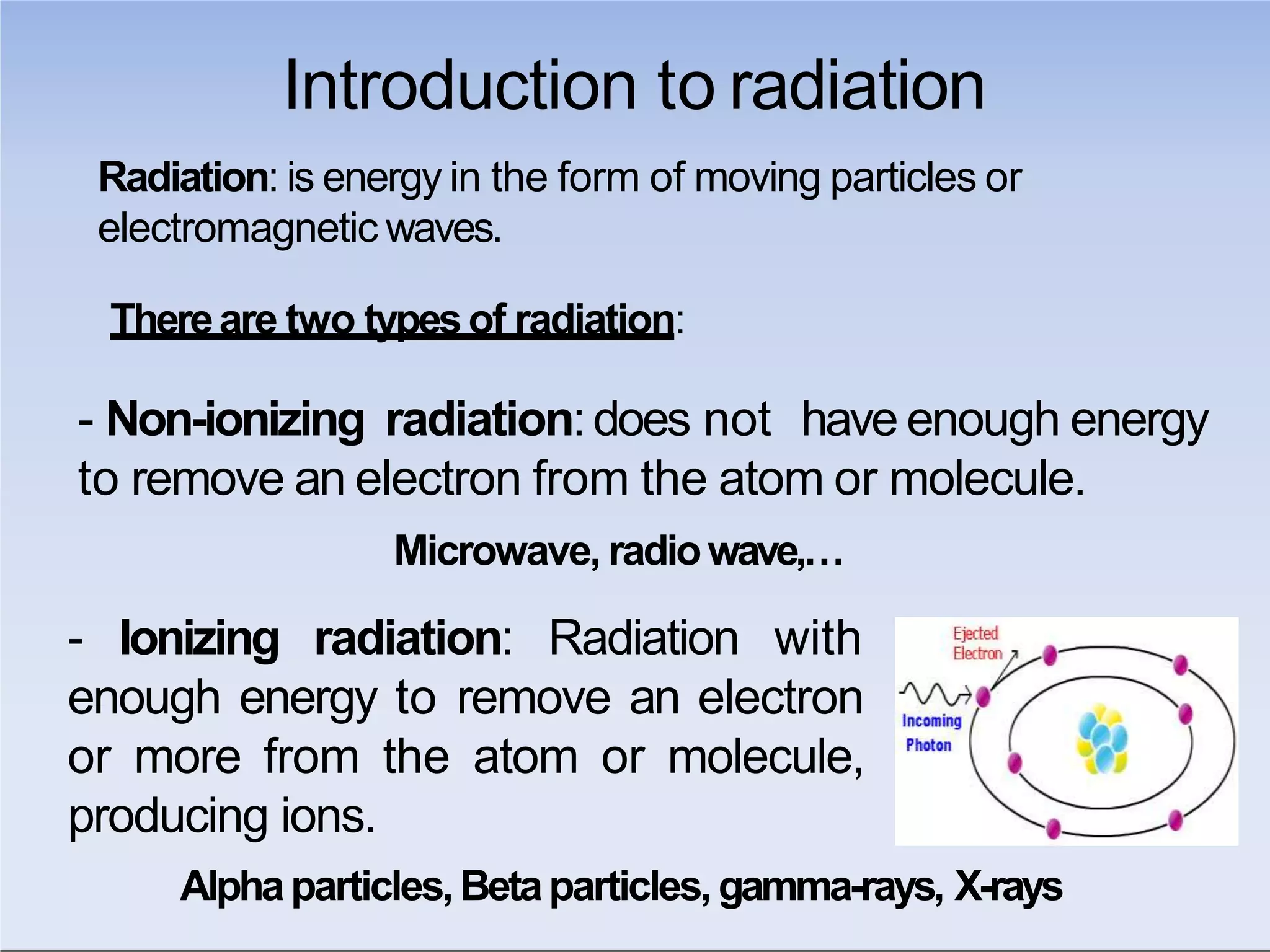
- Ionizing radiation: Radiation with
enough energy to remove an electron
or more from the atom or molecule,
producing ions.
Alphaparticles,Betaparticles,gamma-rays, X-rays
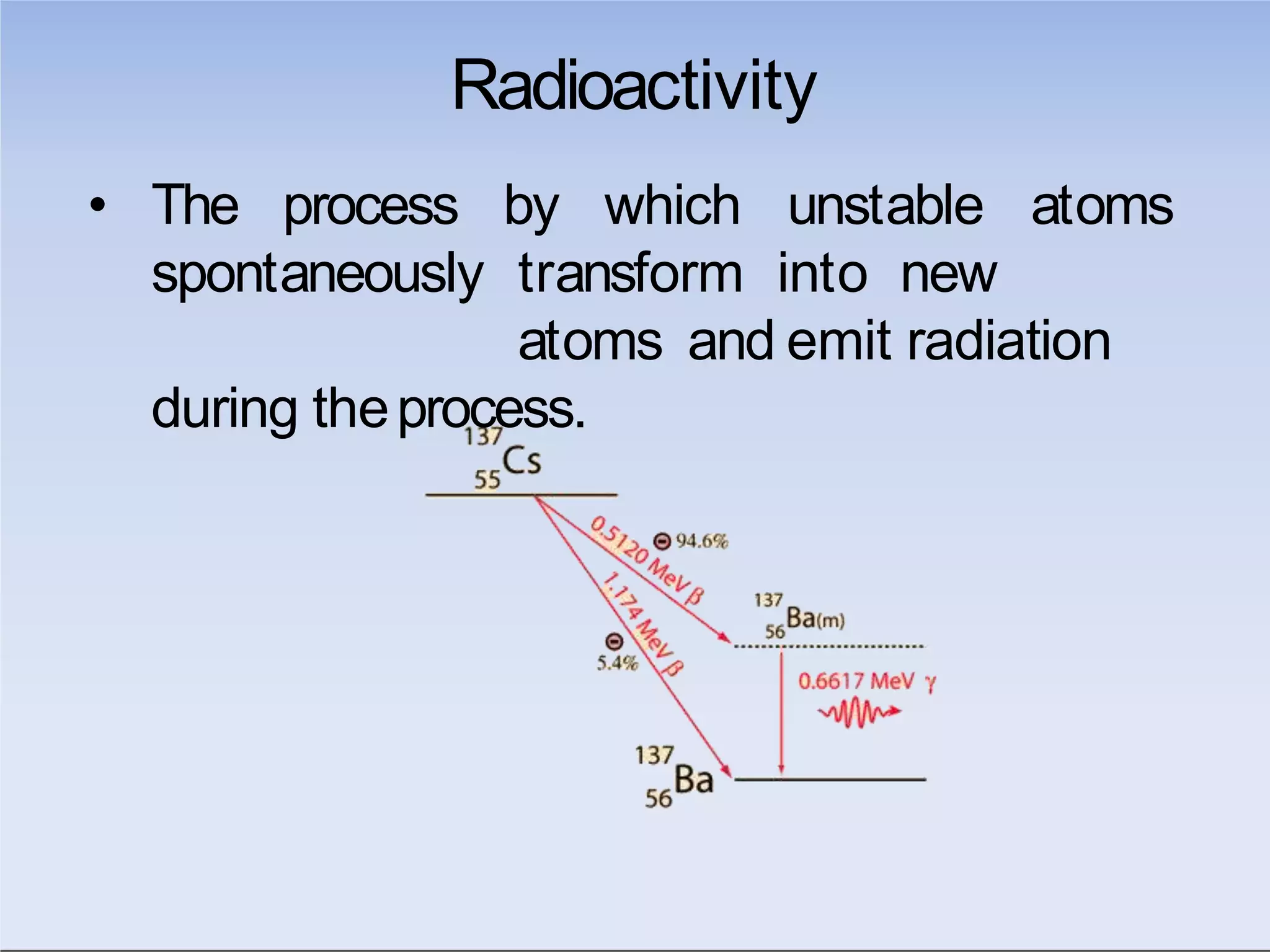
Radioactivity
• The process by which unstable atoms
spontaneously transform into new
atoms and emit radiation
during theprocess.
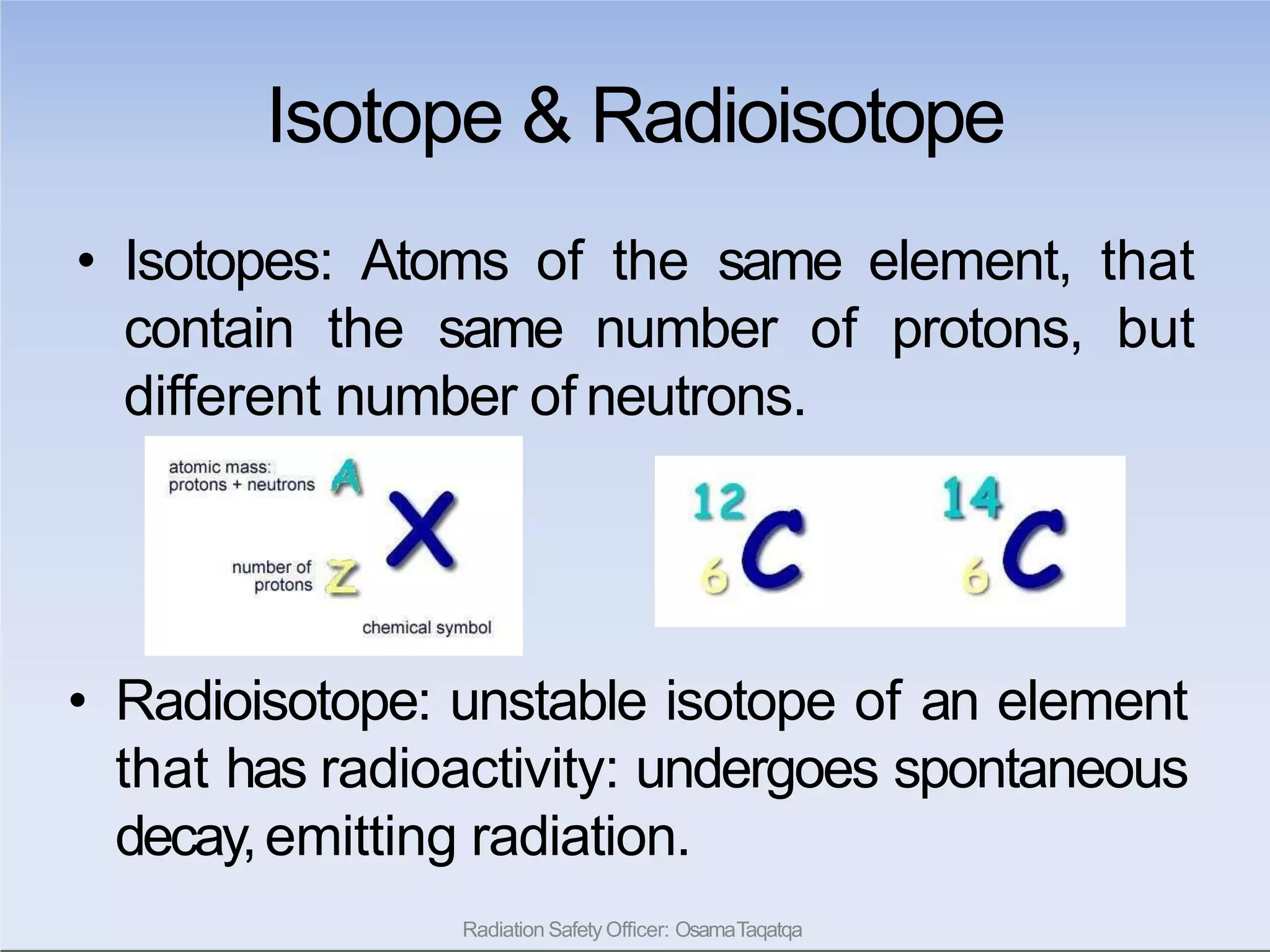
Isotope & Radioisotope
• Isotopes: Atoms of the same element, that
contain the same number of protons, but
different number of neutrons.
• Radioisotope: unstable isotope of an element
that has radioactivity: undergoes spontaneous
decay,emitting radiation.
Radiation Safety Officer: OsamaTaqatqa
Units of Activity
•
Henri Becquerel,FrenchPhysicist (1852-1908)
Marie Curie,PolishPhysicist(1867–1934)
Curie(Ci):3.7X10¹⁰disintegration per
second.
• Becquerel(Bq): 1 disintegration persecond.
1mCi=37MBq
Half-Life
requiredThe time
for the activity to
reach one half of its
original value.
AlphaRadiation
• Helium Nucleus.
• Most massivetype of radiation.
• Alpha particles have a relatively
large electric charge, thus a very
strong interaction with matter.
Because of this they have a short
range.
• Hazardous only via ingestion or inhalation of alpha emitters
(Internal Hazard).
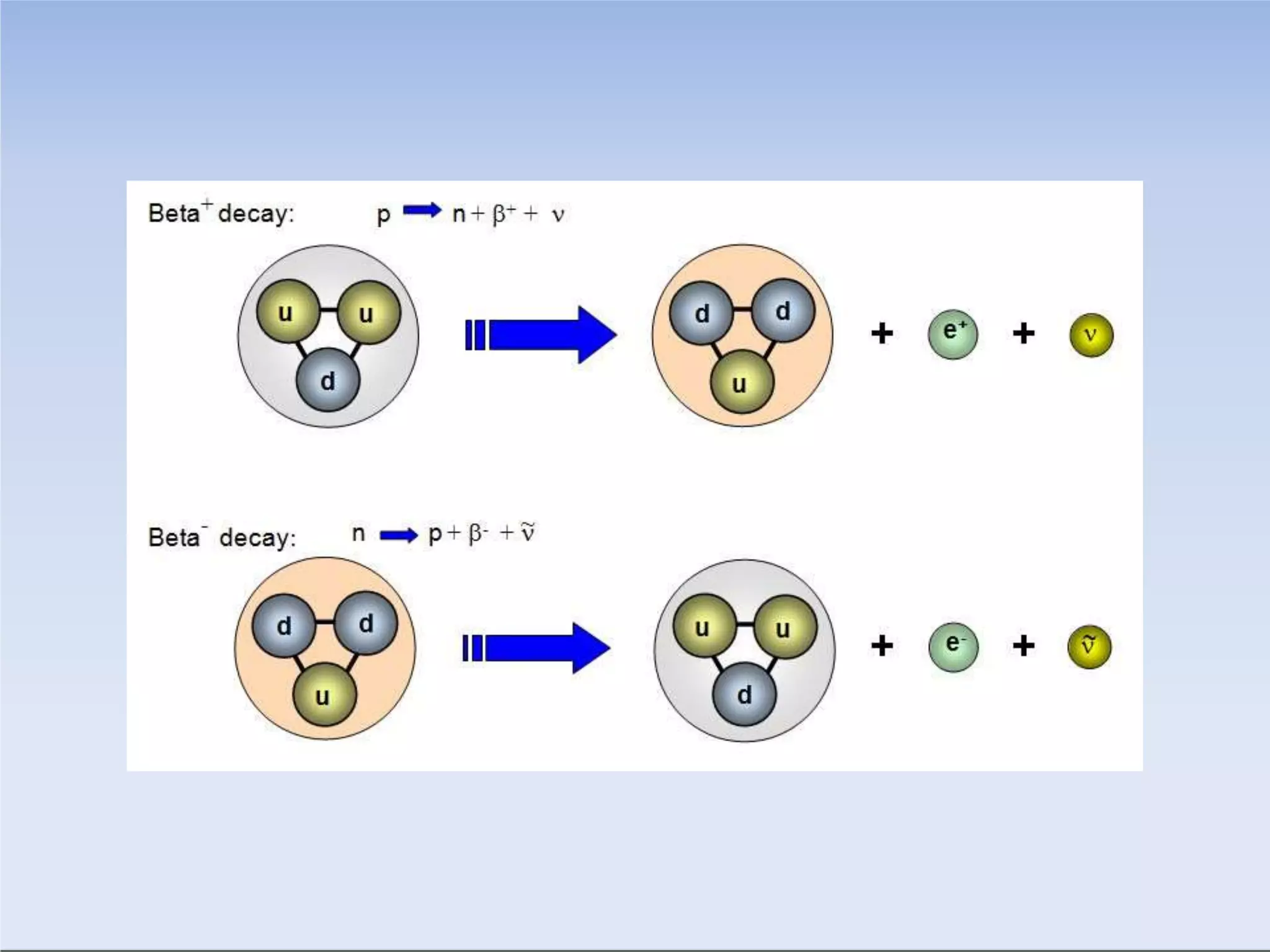
BetaRadiation
Positivelychargedbeta particles
(Positrons)
• Annihilation of radiation: The
interaction beta particle
and the from the
surrounding
between
electrons
atoms, producing 2
gammarays.
Negativelychargedbeta particles
(Electrons)
There are 2 main mechanisms
of interaction:
1- Ionization: The interaction
between the beta particle and the
orbital electrons of surrounding
atoms.
2- Bremsstrahlung
• Externalhazardto skinand eyes.
e
-
e
-
X-ray
Bremsstrahlung: Bremsen-Strahlung
- Conservationof Energy:Someof the kinetic energyof the movingelectron isconverted
into aphoton.
bremsen "to brake" andStrahlung"radiation
- Bremsstrahlungiscausedbythe deflectionof high-energyelectron bythe electric
field of anatomicnucleus.
K1
K2
K1-K2=hv
Gammaraysand X-rays
- External hazardto deep organsand tissues.
- Photons
- No charge
- No mass
- Highly Penetrating
Definitions (1)
• Exposure (R): Amount of charge
produced per unit mass of air
from ionizedradiation.
(1905–1965) British Physicist
• Absorbed Dose (Gy): Amount of
energy deposited per unit mass of
material (J/kg).
Wilhelm Röntgen (1845–1923) German
Physicist
1 Gy=100rad
1 R=2.58X10⁻⁴ C/kg
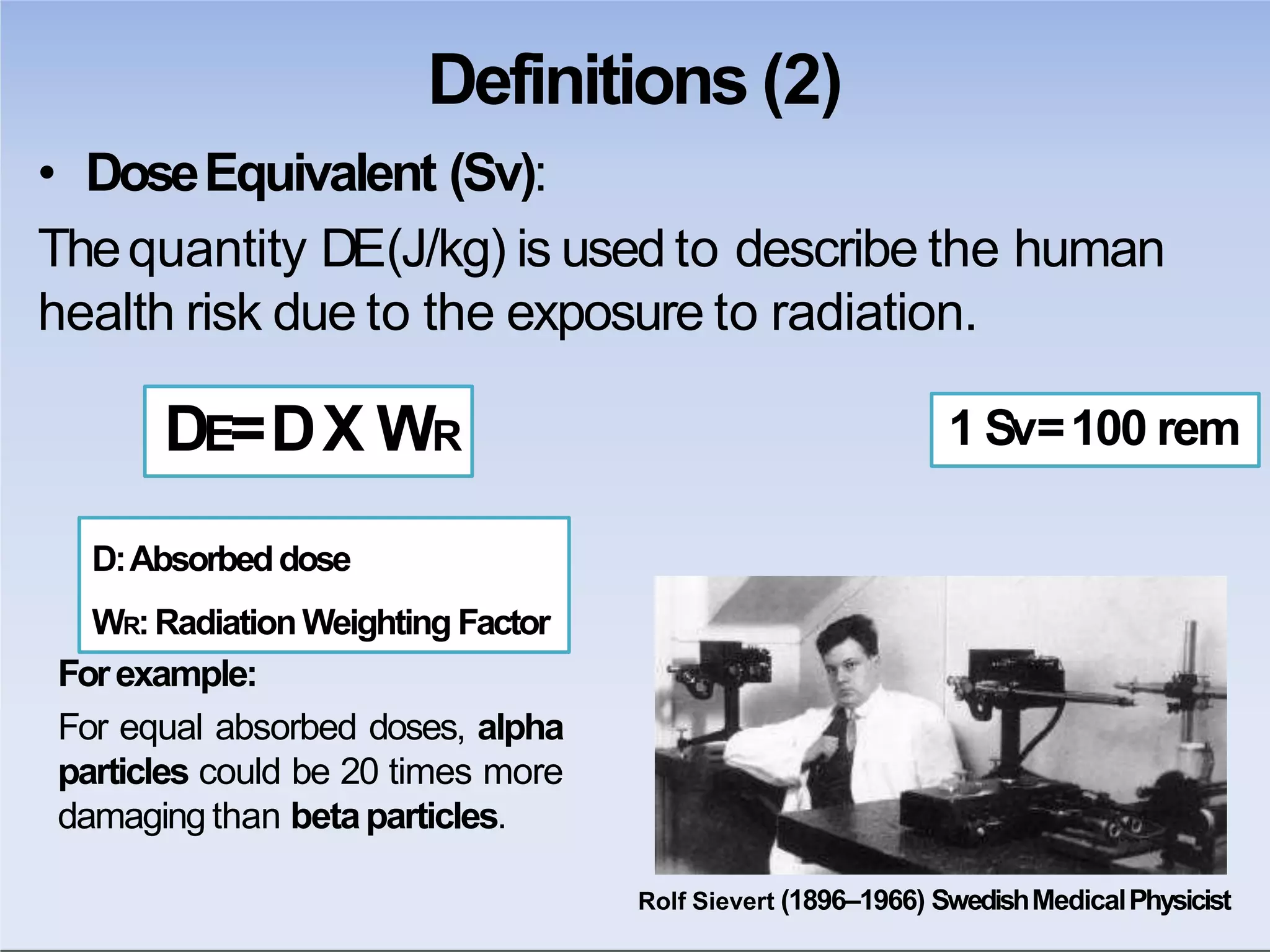
Definitions (2)
• DoseEquivalent (Sv):
Thequantity DE(J/kg) is used to describe the human
health risk due to the exposure to radiation.
Forexample:
For equal absorbed doses, alpha
particles could be 20 times more
damaging than betaparticles.
Rolf Sievert (1896–1966) SwedishMedicalPhysicist
1 Sv=100 remDE=DX WR
D:Absorbeddose
WR:RadiationWeighting Factor
EffectiveDose (Sv):
Takingrelative Radiosensitivity of each organ and
tissue.
Definitions (3)
E=DEXWT
DE:Dose Equivalent
WT: TissueWeighting Factor
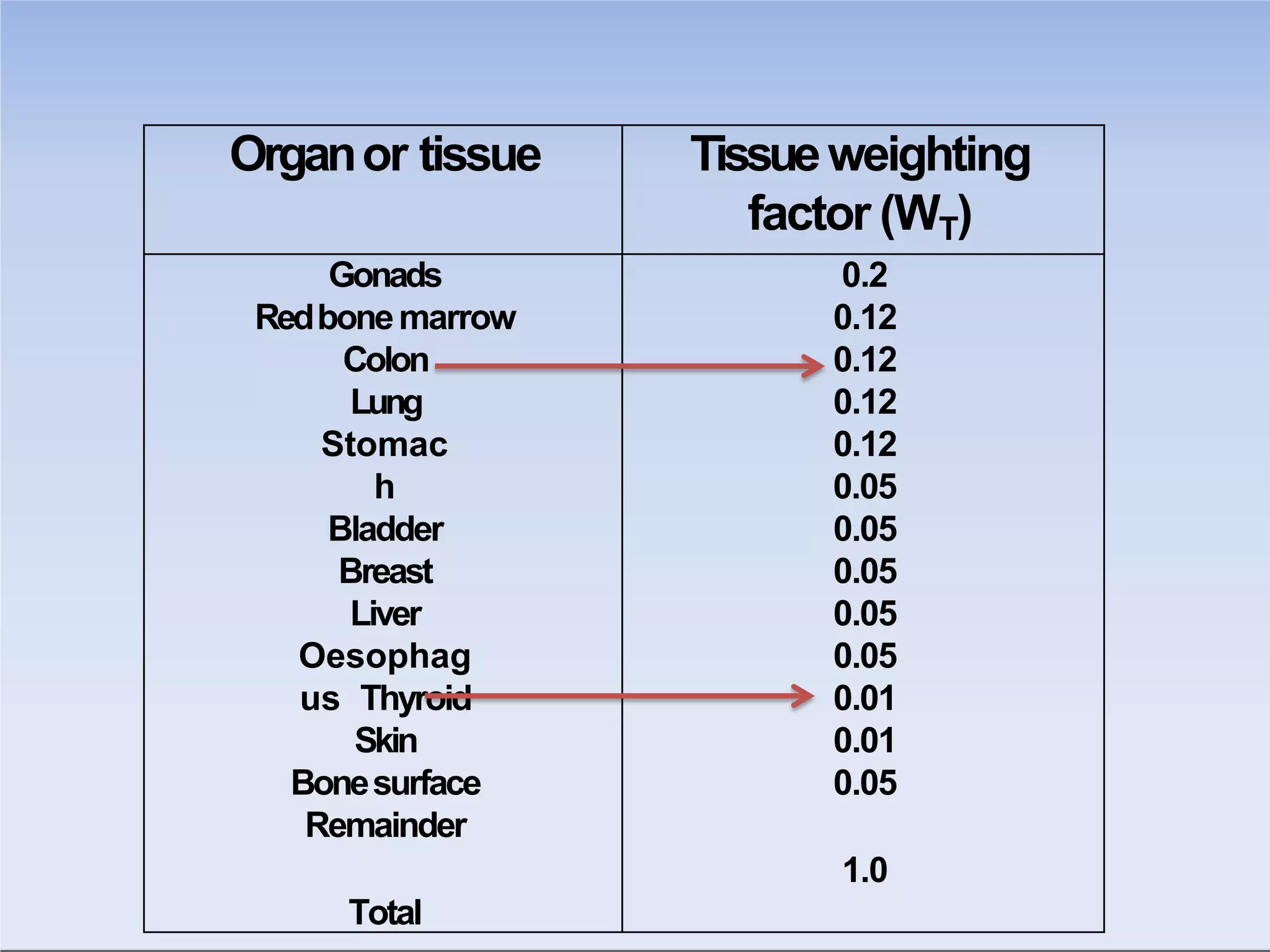
Organor tissue Tissueweighting
factor (WT)
Gonads
Redbonemarrow
Colon
Lung
Stomac
h
Bladder
Breast
Liver
Oesophag
us Thyroid
Skin
Bonesurface
Remainder
Total
0.2
0.12
0.12
0.12
0.12
0.05
0.05
0.05
0.05
0.05
0.01
0.01
0.05
1.0
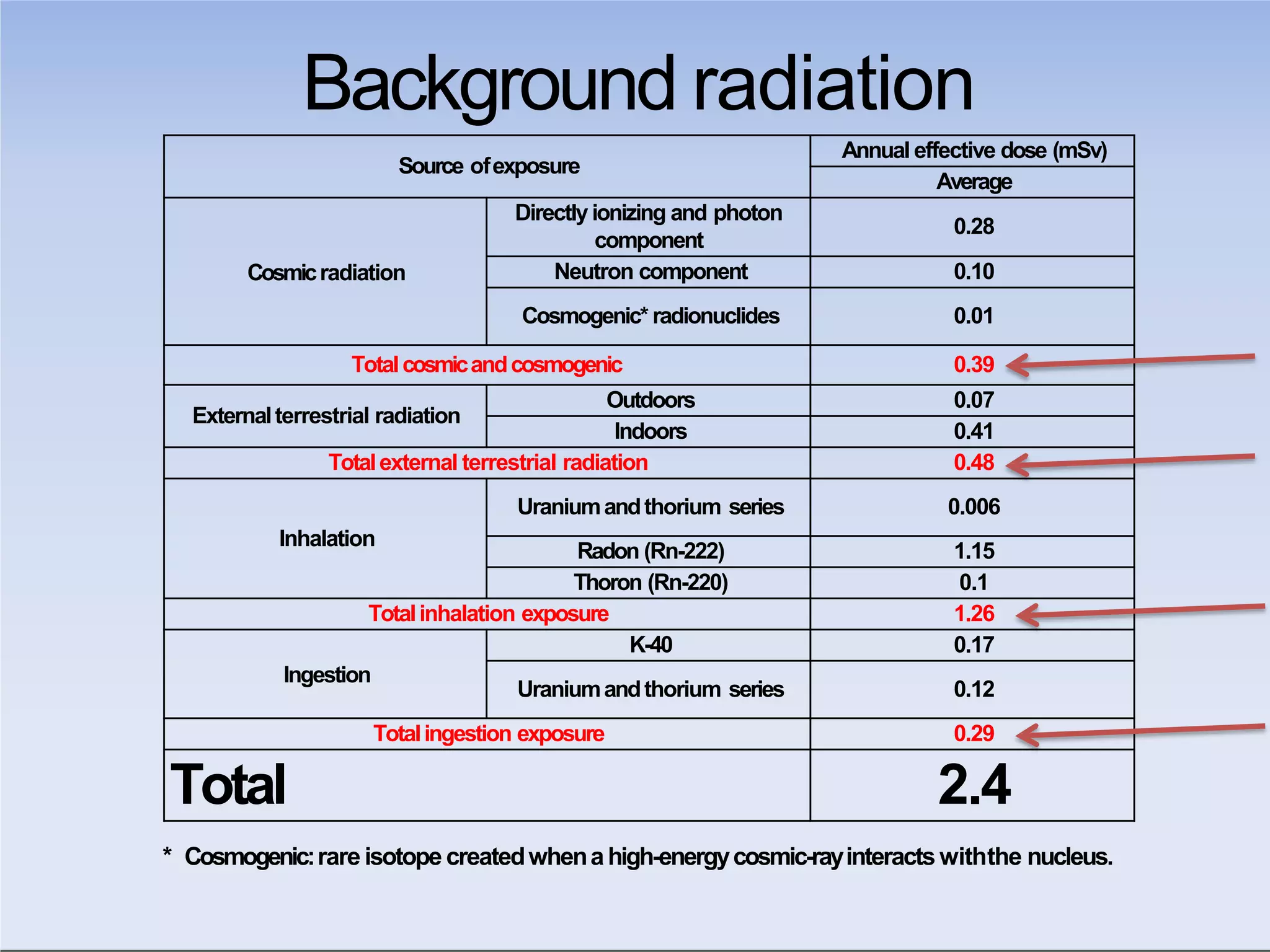
Source ofexposure
Annual effective dose (mSv)
Average
Cosmicradiation
Directly ionizing and photon
component
0.28
Neutron component 0.10
Cosmogenic* radionuclides 0.01
Totalcosmicandcosmogenic 0.39
Externalterrestrial radiation
Outdoors 0.07
Indoors 0.41
Totalexternal terrestrial radiation 0.48
Inhalation
Uraniumandthorium series 0.006
Radon (Rn-222) 1.15
Thoron (Rn-220) 0.1
Totalinhalation exposure 1.26
Ingestion
K-40 0.17
Uraniumandthorium series 0.12
Totalingestion exposure 0.29
Total 2.4
Background radiation
* Cosmogenic:rare isotope createdwhenahigh-energycosmic-rayinteractswiththe nucleus.
Food Radioactivelevels (Bq/kg)
Dailyintake
(g/d)
Ra-226 Th-228 Pb-210 K-40
Rice 150 0.126 0.267 0.133 62.4
Wheat 270 0.296 0.270 0.133 142.2
Pulses 60 0.233 0.093 0.115 397.0
Other
Vegetable
s
70 0.126 0.167 -- 135.2
Leafy
Vegetable
s
15 0.267 0.326 -- 89.1
Milk 90 -- -- -- 38.1
Composit
e Diet
1370 0.067 0.089 0.063 65.0
Radioactive levels (Intake)
ToUSA=5µSv/h X14 h=70 µSv
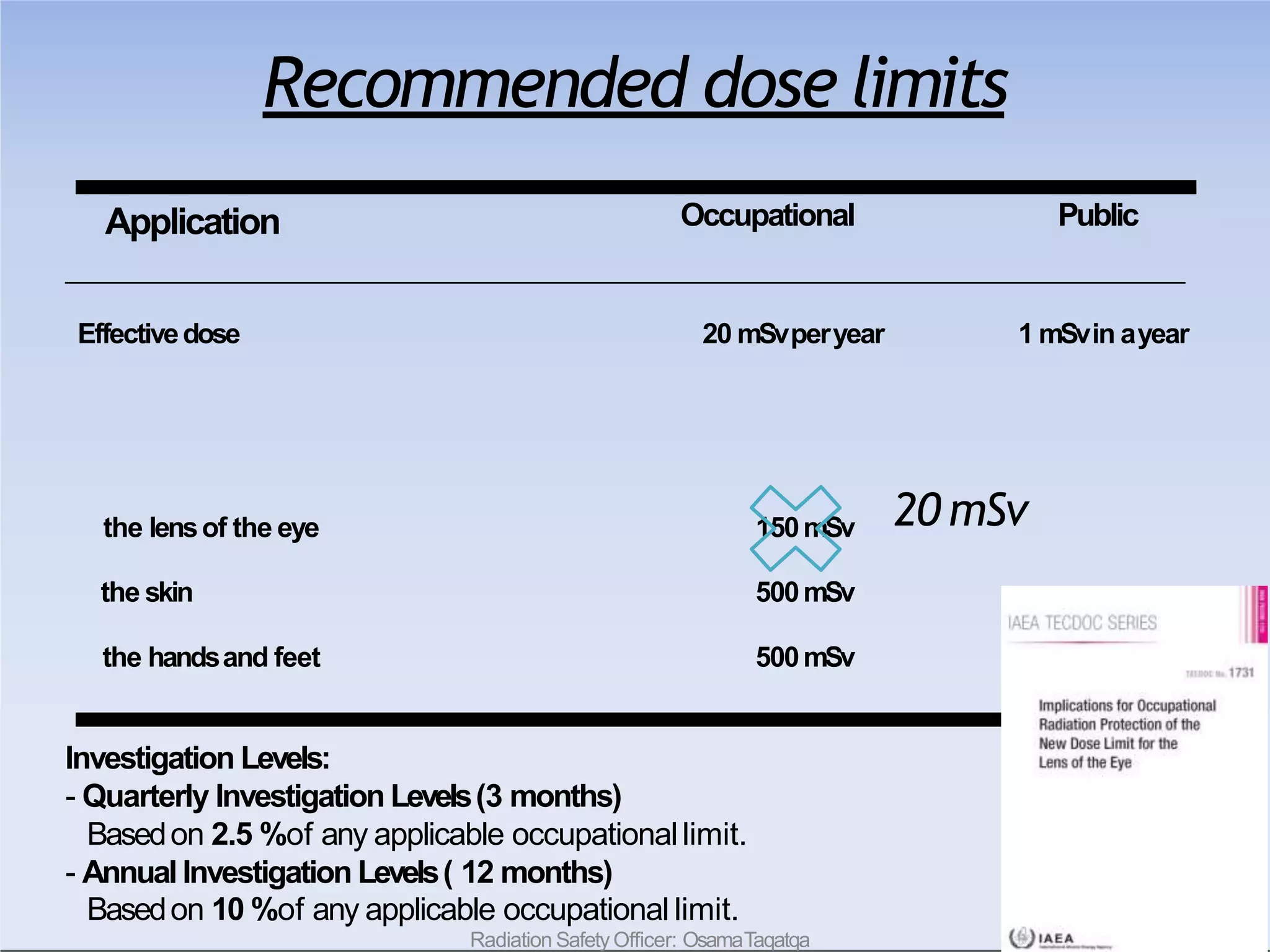
Recommended dose limits
Application Occupational Public
Effectivedose 20 mSvperyear 1 mSvin ayear
the lensof the eye 150mSv
the skin 500mSv
the handsand feet 500mSv
20 mSv
Investigation Levels:
- Quarterly Investigation Levels(3 months)
Basedon 2.5 %of any applicable occupationallimit.
- Annual Investigation Levels( 12 months)
Basedon 10 %of any applicable occupational limit.
Radiation SafetyOfficer: OsamaTaqatqa
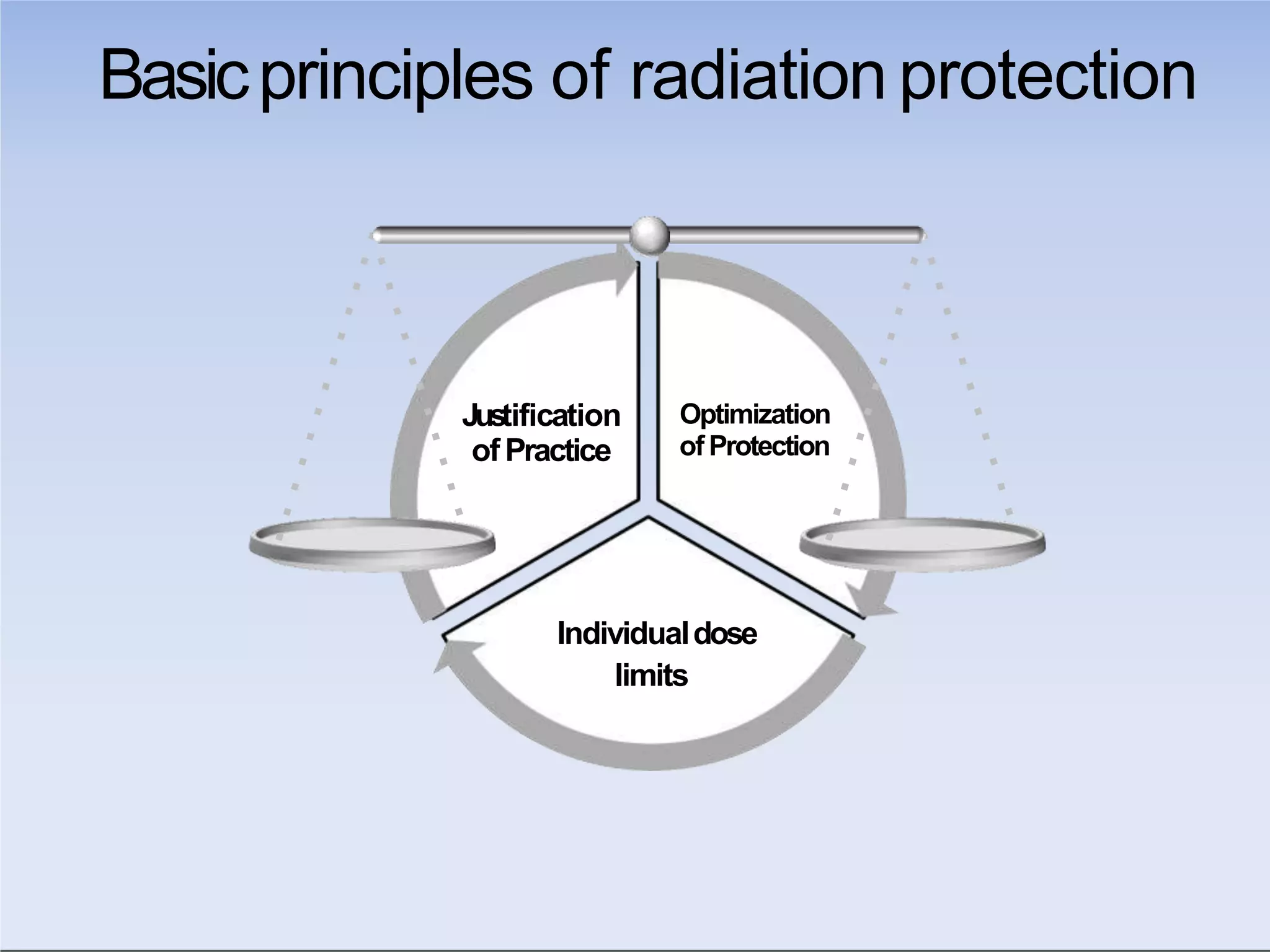
Basicprinciples of radiation protection
Optimization
ofProtection
Individualdose
limits
Justification
of Practice
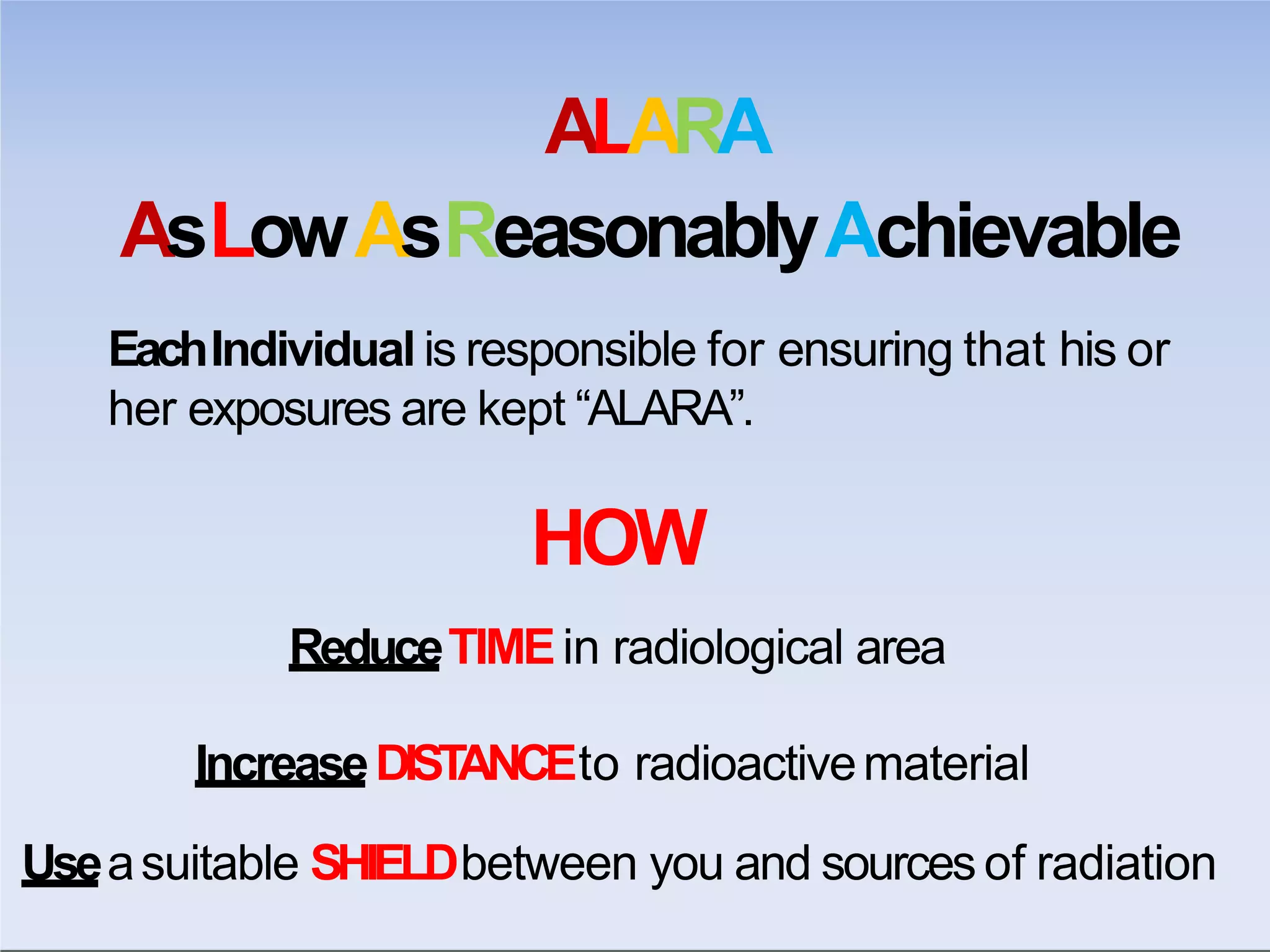
ALARA
AsLowAsReasonablyAchievable
EachIndividual is responsible for ensuring that his or
her exposures are kept “ALARA”.
HOW
ReduceTIMEin radiological area
IncreaseDISTANCEto radioactivematerial
Useasuitable SHIELDbetween you and sources of radiation
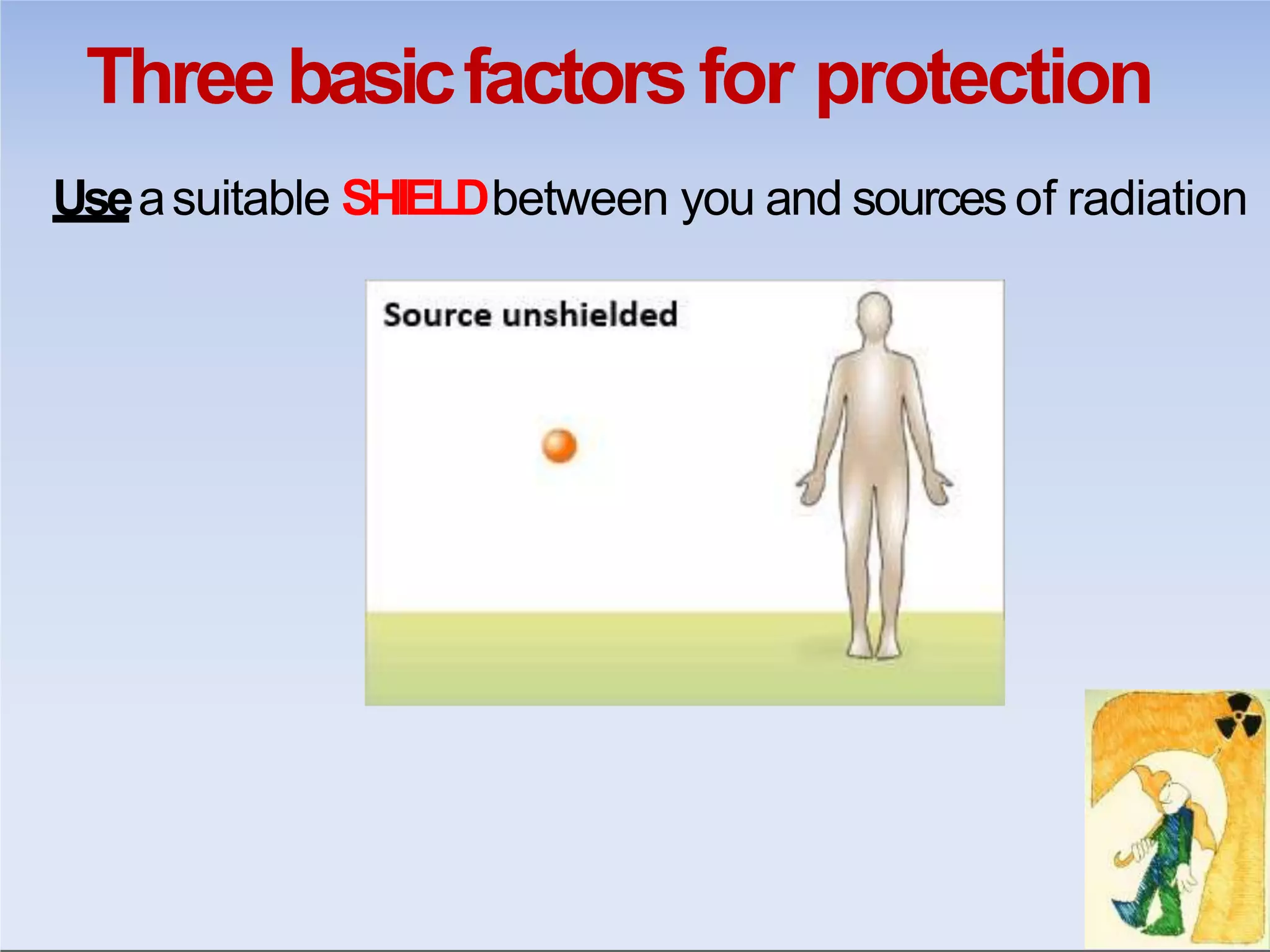
Threebasicfactorsfor protection
Useasuitable SHIELDbetween you and sources of radiation
BetaSource
plastic Lead
Theintensity of Bremsstrahlungx-raysincreaseswith increasing
atomic number of absorber.
Bremsstrahlung x-ray
Gammaor x-ray
Lead
Because of its high density, and large
number or electrons, LEADis a very good
medium for scattering x-rays and
gamma-rays.
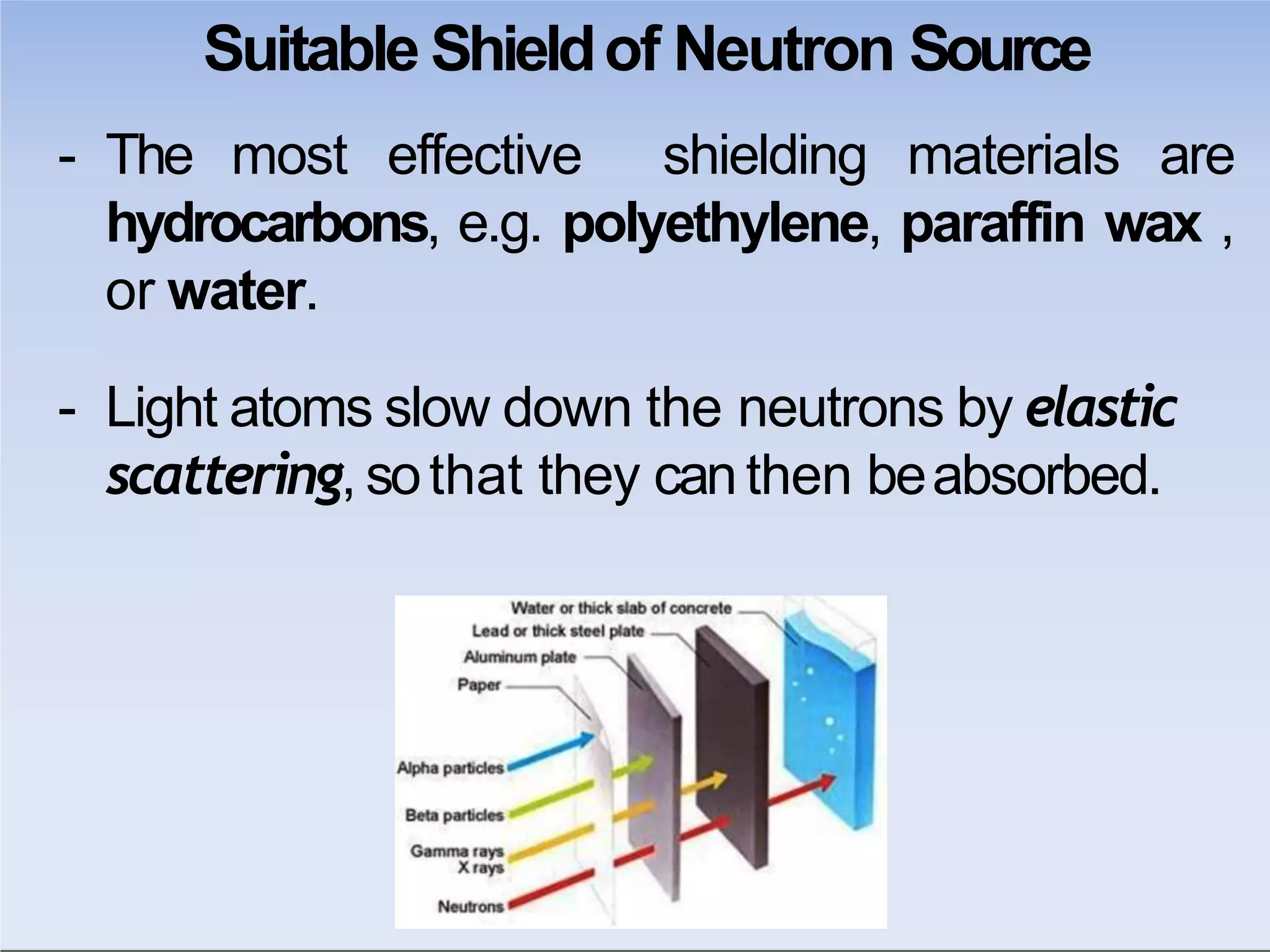
- The most effective shielding materials are
hydrocarbons, e.g. polyethylene, paraffin wax ,
or water.
- Light atoms slow down the neutrons by elastic
scattering, sothat they canthen beabsorbed.
Suitable Shieldof Neutron Source
TotalDose=Exposurerate X Time
10mGy/h
1hour
2hour
=10mGy/h X 1 h =10mGy
=10mGy/h X 2 h =20mGy
ReduceTIMEin radiological area
40mSv
50 cm
150cm
????mSv
E1X(d1)2 =E2X(d2)2
40 X(50)2 =E2X(150)2
E2= 4.4 mSv
IncreaseDISTANCEto radioactivematerial
E2=E1X(d1)2
(d2)2
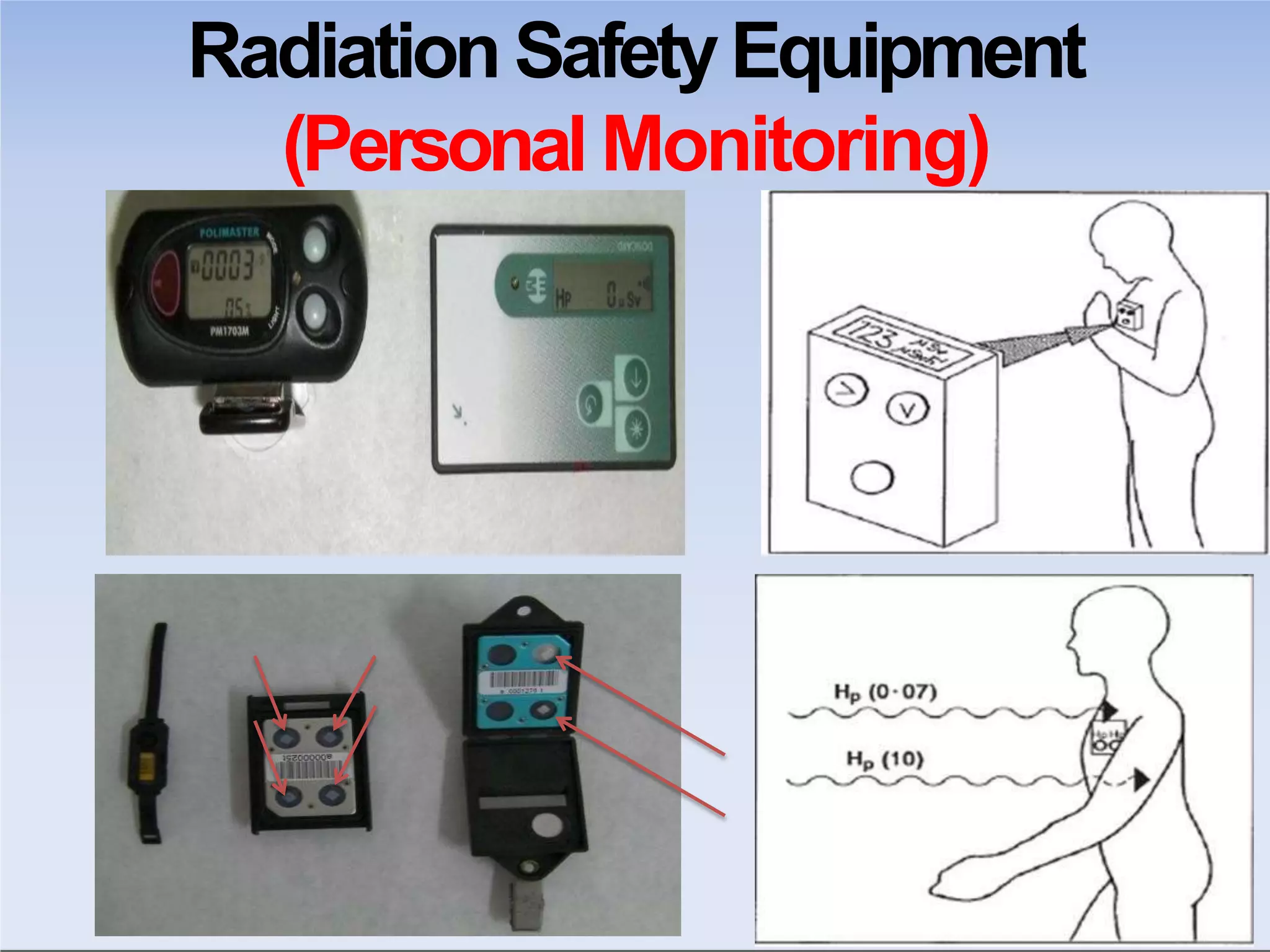
Radiation SafetyEquipment
(Personal Monitoring)
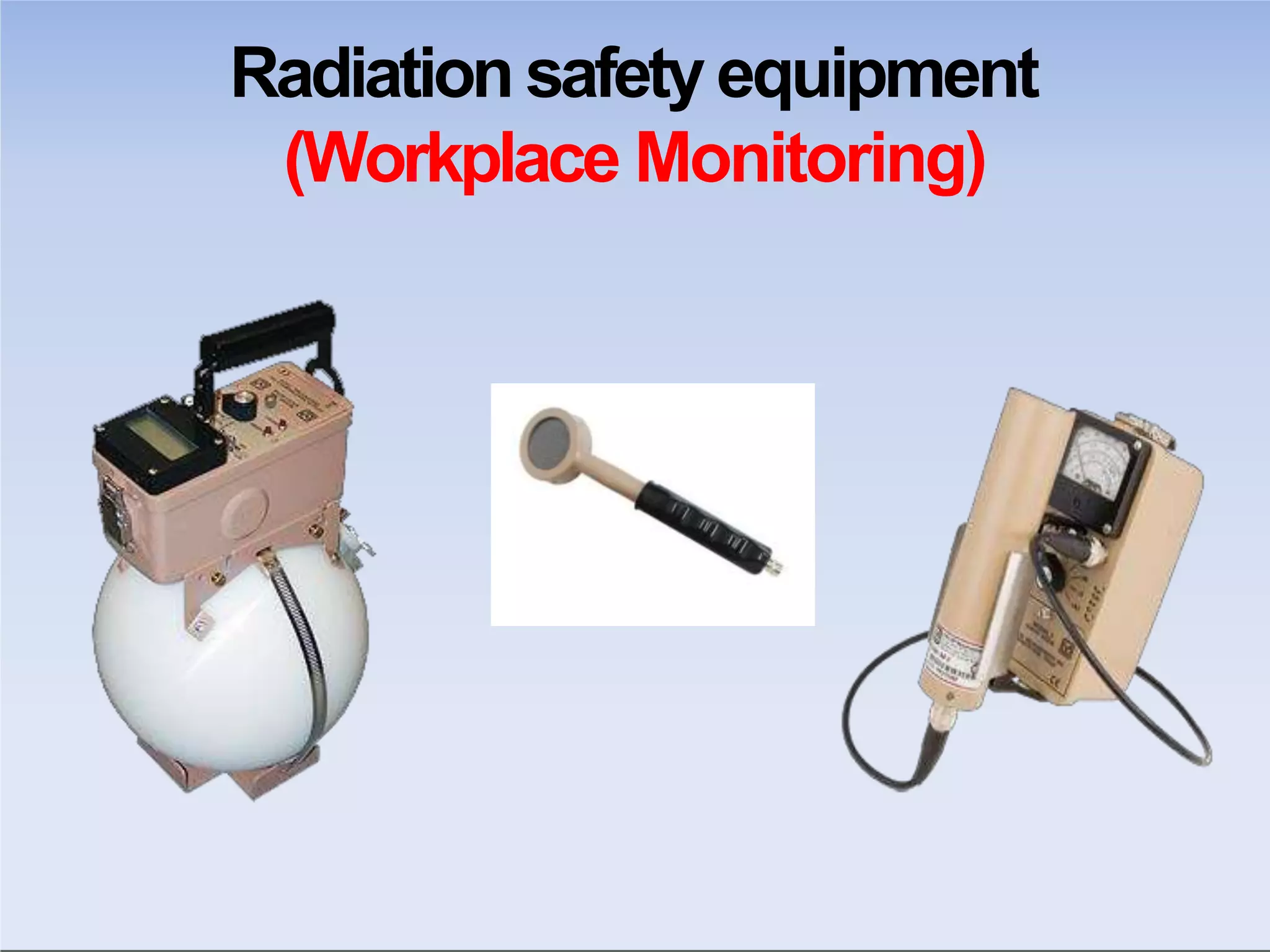
Radiation safety equipment
(Workplace Monitoring)
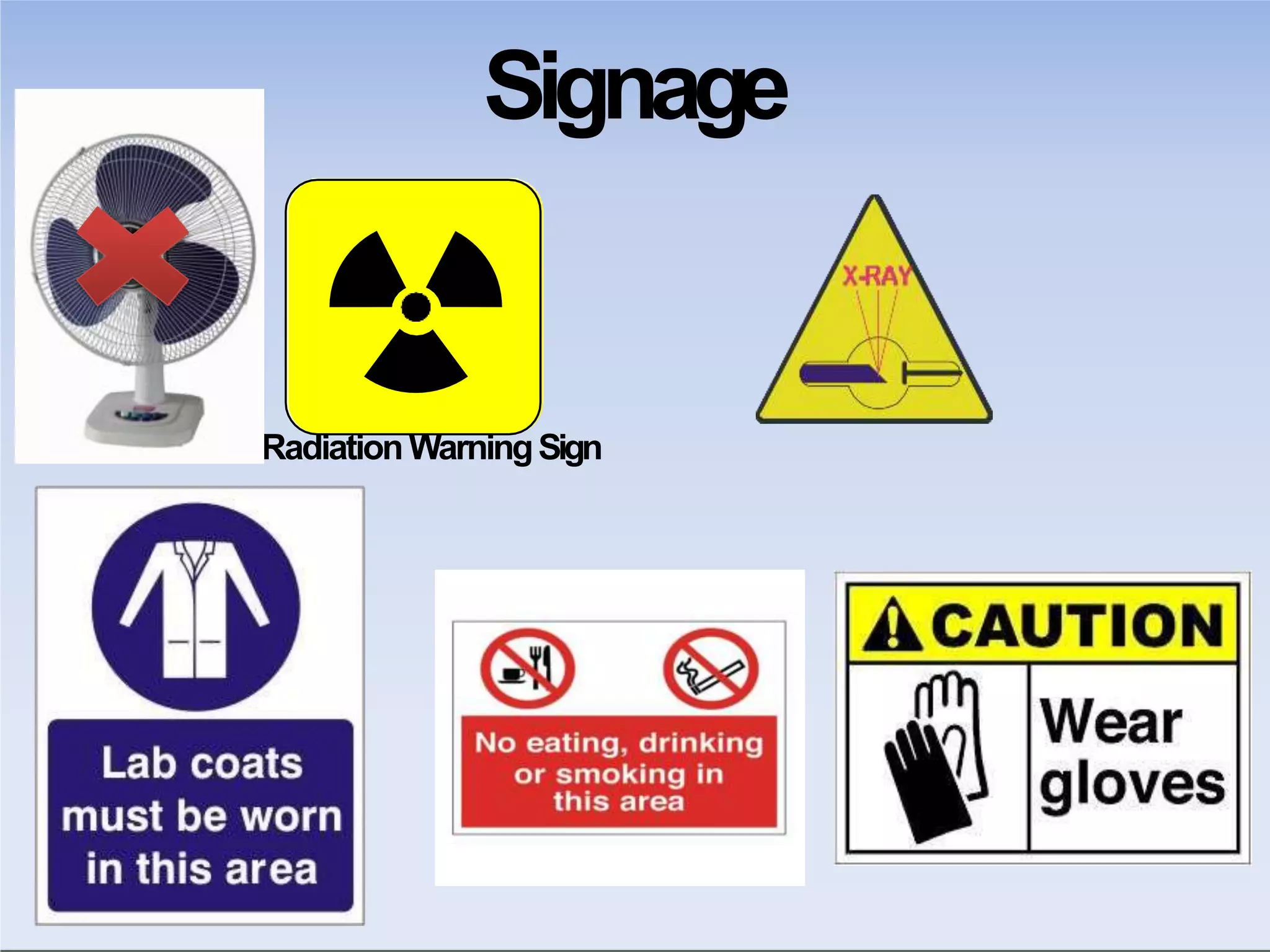
Signage
RadiationWarningSign
Summary
-RadiationWorkers& NEstudentsare required to reviewand
understandIAEASafety Standards.
- Youshouldkeepyour exposures“ALARA”.
-Tounderstandthe basicsof safety, you
mustknowhow to useUNITS.
- Alwaysuseradiation safety equipment,
andcomplywith the approveddoselimits.
- AlwaysmakeSAFETYyour No.1 onthe list.
- Beready for training in fall,2014.
Thankyoufor yourverykind
attention
http://www.safetypostershop.com/
Radiation Safety Officer: OsamaTaqatqa

Radiation safety principles

  • 1.
  • 2.
    Outlines - Introduction toRadiation - Unitsof Activity - Alpha,Beta, Gamma Radiation - Definitions - Background Radiation - Doselimits - ALARA - Radiation safety equipment - Summary
  • 3.
    Introduction to radiation Radiation:is energy in the form of moving particles or electromagnetic waves. Thereare two typesof radiation: - Non-ionizing radiation:does not have enough energy to remove an electron from the atom or molecule. Microwave, radiowave,… - Ionizing radiation: Radiation with enough energy to remove an electron or more from the atom or molecule, producing ions. Alphaparticles,Betaparticles,gamma-rays, X-rays
  • 5.
    Radioactivity • The processby which unstable atoms spontaneously transform into new atoms and emit radiation during theprocess.
  • 6.
    Isotope & Radioisotope •Isotopes: Atoms of the same element, that contain the same number of protons, but different number of neutrons. • Radioisotope: unstable isotope of an element that has radioactivity: undergoes spontaneous decay,emitting radiation. Radiation Safety Officer: OsamaTaqatqa
  • 7.
    Units of Activity • HenriBecquerel,FrenchPhysicist (1852-1908) Marie Curie,PolishPhysicist(1867–1934) Curie(Ci):3.7X10¹⁰disintegration per second. • Becquerel(Bq): 1 disintegration persecond. 1mCi=37MBq
  • 8.
    Half-Life requiredThe time for theactivity to reach one half of its original value.
  • 9.
    AlphaRadiation • Helium Nucleus. •Most massivetype of radiation. • Alpha particles have a relatively large electric charge, thus a very strong interaction with matter. Because of this they have a short range. • Hazardous only via ingestion or inhalation of alpha emitters (Internal Hazard).
  • 10.
    BetaRadiation Positivelychargedbeta particles (Positrons) • Annihilationof radiation: The interaction beta particle and the from the surrounding between electrons atoms, producing 2 gammarays. Negativelychargedbeta particles (Electrons) There are 2 main mechanisms of interaction: 1- Ionization: The interaction between the beta particle and the orbital electrons of surrounding atoms. 2- Bremsstrahlung • Externalhazardto skinand eyes.
  • 12.
    e - e - X-ray Bremsstrahlung: Bremsen-Strahlung - ConservationofEnergy:Someof the kinetic energyof the movingelectron isconverted into aphoton. bremsen "to brake" andStrahlung"radiation - Bremsstrahlungiscausedbythe deflectionof high-energyelectron bythe electric field of anatomicnucleus. K1 K2 K1-K2=hv
  • 13.
    Gammaraysand X-rays - Externalhazardto deep organsand tissues. - Photons - No charge - No mass - Highly Penetrating
  • 15.
    Definitions (1) • Exposure(R): Amount of charge produced per unit mass of air from ionizedradiation. (1905–1965) British Physicist • Absorbed Dose (Gy): Amount of energy deposited per unit mass of material (J/kg). Wilhelm Röntgen (1845–1923) German Physicist 1 Gy=100rad 1 R=2.58X10⁻⁴ C/kg
  • 16.
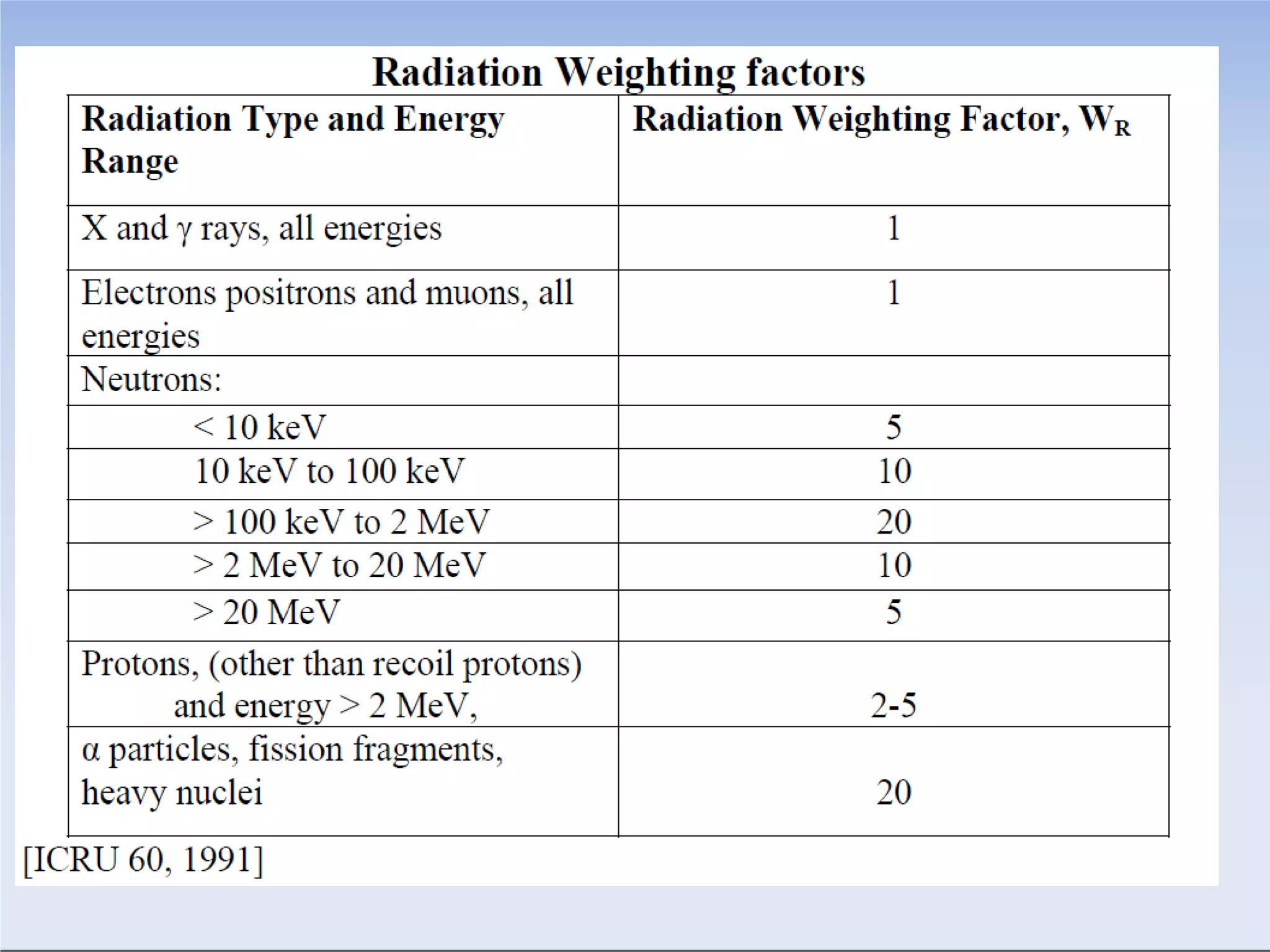
    Definitions (2) • DoseEquivalent(Sv): Thequantity DE(J/kg) is used to describe the human health risk due to the exposure to radiation. Forexample: For equal absorbed doses, alpha particles could be 20 times more damaging than betaparticles. Rolf Sievert (1896–1966) SwedishMedicalPhysicist 1 Sv=100 remDE=DX WR D:Absorbeddose WR:RadiationWeighting Factor
  • 17.
    EffectiveDose (Sv): Takingrelative Radiosensitivityof each organ and tissue. Definitions (3) E=DEXWT DE:Dose Equivalent WT: TissueWeighting Factor
  • 19.
    Organor tissue Tissueweighting factor(WT) Gonads Redbonemarrow Colon Lung Stomac h Bladder Breast Liver Oesophag us Thyroid Skin Bonesurface Remainder Total 0.2 0.12 0.12 0.12 0.12 0.05 0.05 0.05 0.05 0.05 0.01 0.01 0.05 1.0
  • 20.
    Source ofexposure Annual effectivedose (mSv) Average Cosmicradiation Directly ionizing and photon component 0.28 Neutron component 0.10 Cosmogenic* radionuclides 0.01 Totalcosmicandcosmogenic 0.39 Externalterrestrial radiation Outdoors 0.07 Indoors 0.41 Totalexternal terrestrial radiation 0.48 Inhalation Uraniumandthorium series 0.006 Radon (Rn-222) 1.15 Thoron (Rn-220) 0.1 Totalinhalation exposure 1.26 Ingestion K-40 0.17 Uraniumandthorium series 0.12 Totalingestion exposure 0.29 Total 2.4 Background radiation * Cosmogenic:rare isotope createdwhenahigh-energycosmic-rayinteractswiththe nucleus.
  • 21.
    Food Radioactivelevels (Bq/kg) Dailyintake (g/d) Ra-226Th-228 Pb-210 K-40 Rice 150 0.126 0.267 0.133 62.4 Wheat 270 0.296 0.270 0.133 142.2 Pulses 60 0.233 0.093 0.115 397.0 Other Vegetable s 70 0.126 0.167 -- 135.2 Leafy Vegetable s 15 0.267 0.326 -- 89.1 Milk 90 -- -- -- 38.1 Composit e Diet 1370 0.067 0.089 0.063 65.0 Radioactive levels (Intake)
  • 23.
  • 24.
    Recommended dose limits ApplicationOccupational Public Effectivedose 20 mSvperyear 1 mSvin ayear the lensof the eye 150mSv the skin 500mSv the handsand feet 500mSv 20 mSv Investigation Levels: - Quarterly Investigation Levels(3 months) Basedon 2.5 %of any applicable occupationallimit. - Annual Investigation Levels( 12 months) Basedon 10 %of any applicable occupational limit. Radiation SafetyOfficer: OsamaTaqatqa
  • 25.
    Basicprinciples of radiationprotection Optimization ofProtection Individualdose limits Justification of Practice
  • 26.
    ALARA AsLowAsReasonablyAchievable EachIndividual is responsiblefor ensuring that his or her exposures are kept “ALARA”. HOW ReduceTIMEin radiological area IncreaseDISTANCEto radioactivematerial Useasuitable SHIELDbetween you and sources of radiation
  • 27.
  • 28.
    BetaSource plastic Lead Theintensity ofBremsstrahlungx-raysincreaseswith increasing atomic number of absorber. Bremsstrahlung x-ray
  • 29.
    Gammaor x-ray Lead Because ofits high density, and large number or electrons, LEADis a very good medium for scattering x-rays and gamma-rays.
  • 30.
    - The mosteffective shielding materials are hydrocarbons, e.g. polyethylene, paraffin wax , or water. - Light atoms slow down the neutrons by elastic scattering, sothat they canthen beabsorbed. Suitable Shieldof Neutron Source
  • 31.
    TotalDose=Exposurerate X Time 10mGy/h 1hour 2hour =10mGy/hX 1 h =10mGy =10mGy/h X 2 h =20mGy ReduceTIMEin radiological area
  • 32.
    40mSv 50 cm 150cm ????mSv E1X(d1)2 =E2X(d2)2 40X(50)2 =E2X(150)2 E2= 4.4 mSv IncreaseDISTANCEto radioactivematerial E2=E1X(d1)2 (d2)2
  • 33.
  • 35.
  • 36.
  • 37.
    Summary -RadiationWorkers& NEstudentsare requiredto reviewand understandIAEASafety Standards. - Youshouldkeepyour exposures“ALARA”. -Tounderstandthe basicsof safety, you mustknowhow to useUNITS. - Alwaysuseradiation safety equipment, andcomplywith the approveddoselimits. - AlwaysmakeSAFETYyour No.1 onthe list. - Beready for training in fall,2014.
  • 38.