
Radionuclide production methods Cyclotron Nuclear reactor Radionuclide generator
CYCLOTRON Pawitra Masa-at 4937092  SIRS/M January 31, 2007
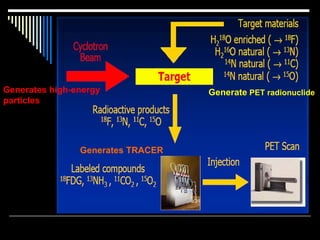
Basics of PET Tracer Production
Generates high-energy particles Generate  PET radionuclide Generates TRACER
Particle  Accelerators   CYCLOTRON One of the earliest types of particle accelerators Cyclotron are source of a large number of high-energy (MeV) range charged particle .
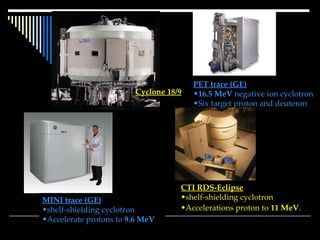
CTI RDS-Eclipse shelf-shielding cyclotron Accelerations proton to  11 MeV . MINI trace (GE) shelf-shielding cyclotron Accelerate protons to  9.6 MeV Cyclone 18/9 PET trace (GE) 16.5 MeV  negative ion cyclotron Six target proton and deuteron
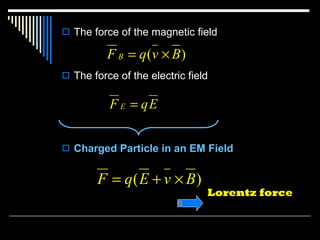
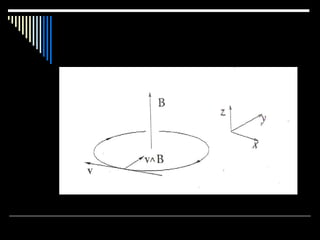
Physics of cyclotron A device invented by E .  O .  Lawrence and M .  S .  Livingston at Berkeley in 1931  that is used to accelerate  charged   particles  by means of a  magnetic   field .  A particle of  mass  (m )  and  charge  (q )  moving with a  velocity ( v )  will interact with a  magnetic field of strength ( B )  whose direction is perpendicular to the plane of its travel with force
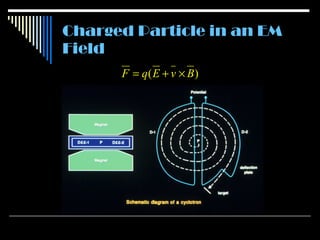
The force of the magnetic field  The force of the electric field  Charged Particle in an EM Field Lorentz force
 
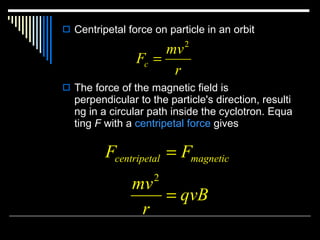
Centripetal force on particle in an orbit The force of the magnetic field is perpendicular to the particle's direction, resulting in a circular path inside the cyclotron. Equating  F  with a  centripetal force  gives
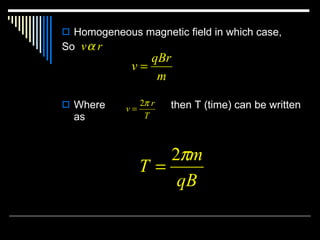
Homogeneous magnetic field in which case,  So  Where  then T (time) can be written as
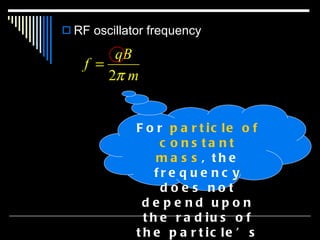
RF oscillator frequency For  particle of constant mass , the frequency does not depend upon the radius of the particle’s orbit.
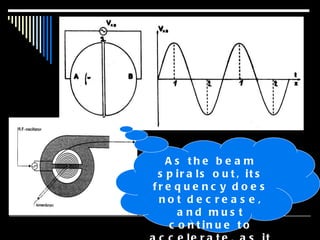
As the beam spirals out, its frequency does not decrease, and must continue to accelerate, as it travelling more distance in the same time.
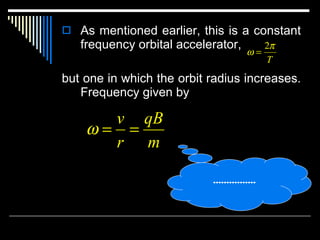
As mentioned earlier, this is a constant frequency orbital accelerator,  but one in which the orbit radius increases. Frequency given by …………… .
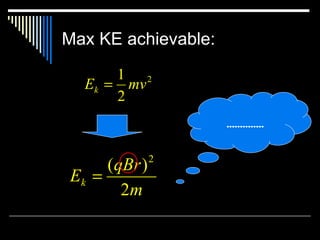
Max KE achievable: ………… ..
Cyclotron Component Major Exterior Component Shielding Major Interior Component Vacuum system Ion Source Magnetic system Radiofrequency system Dees Beam extraction Targets
Vacuum  System High vacuum (10 -6 , 10-8) needed to reduce interaction of accelerated particles with air molecules. prevents the creation of other unwanted nuclides. Electrical insulation of the DEEs. All material needs to be compatible with level of vacuum .
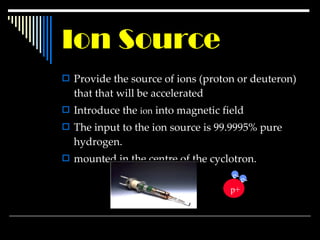
Ion Source Provide the source of ions (proton or deuteron) that  that will be accelerated   Introduce the  ion  into magnetic field The input to the ion source is 99.9995% pure hydrogen. mounted in the centre of the cyclotron. p+ e- e-
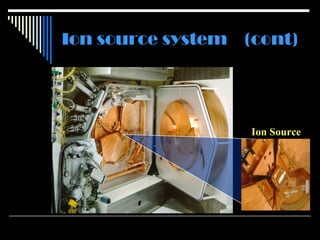
Ion source system   (cont) Ion Source
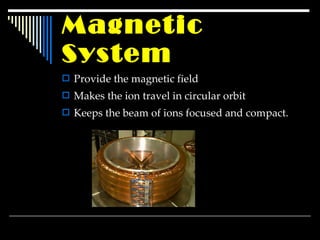
Magnetic System Provide the magnetic field Makes the ion travel in circular orbit Keeps the beam of ions focused and compact.
Charged Particle in an EM Field
Radiofrequency  System  (RF) Pulls the ions out of the ion source. The RF oscillates about the two Des at high frequency and voltage. Push and Pull particles around the cyclotron Accelerates the ions to the specified energy prior to its bombardment.
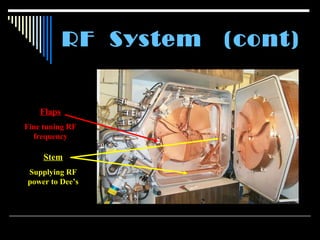
RF  System   (cont) Flaps Fine tuning RF frequency Stem Supplying RF power to Dee’s
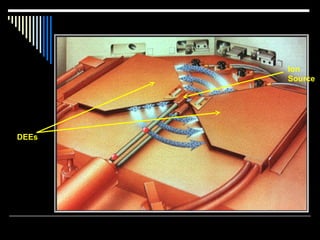
Dees Electrode inside the cyclotron. Pulse with fluctuating   negative and positive charges. to “push” and “pull” the ions through the circular acceleration.
DEEs Ion Source
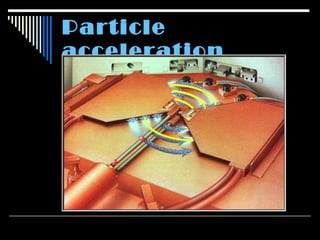
Particle acceleration
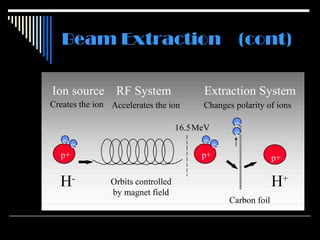
Beam Extraction Thin carbon foil placed at the extraction radius Electron are tripped off  Ion become Positron. Remove the “-” e -  in the case of F-18 production No beam losses here.
 
Beam Extraction   (cont) H - Ion source Creates the ion Orbits controlled by magnet field RF System Accelerates the ion Carbon foil H + Extraction System Changes polarity of ions 16.5 MeV p+ e- e- p+ e- e- p+ e- e-
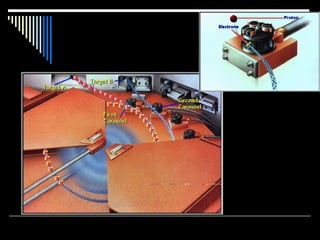
Target Targets are located outside the cyclotron  The high energy particle  beam of protons hit the nucleus (of the target material)  & cause a nuclear reaction. The target material can be a gas, liquid or solid.
Radionuclide Production Reactions with different particles    need to accelerate  different particles Different reaction thresholds    need to accelerate to  different energies
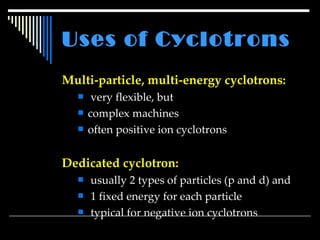
Uses of Cyclotrons   Multi-particle, multi-energy cyclotrons: very flexible, but complex machines often positive ion cyclotrons Dedicated cyclotron:   usually 2 types of particles (p and d) and 1 fixed energy for each particle typical for negative ion cyclotrons
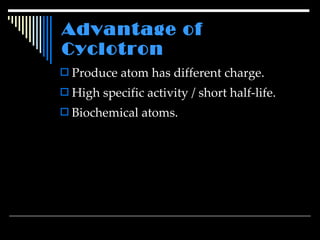
Advantage of Cyclotron Produce atom has different charge. High specific activity / short half-life. Biochemical atoms.
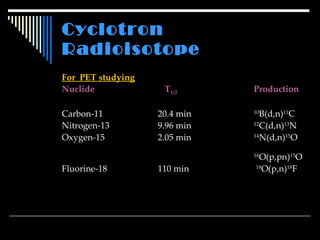
Cyclotron  Radioisotope For  PET studying Nuclide   T 1/2 Production Carbon-11 20.4 min  10 B(d,n) 11 C  Nitrogen-13 9.96 min  12 C(d,n) 13 N Oxygen-15 2.05 min  14 N(d,n) 15 O     16 O(p,pn) 15 O Fluorine-18 110 min    18 O(p,n) 18 F
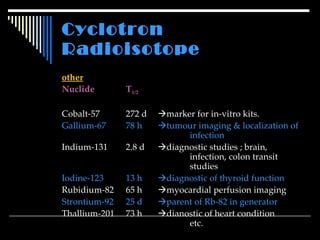
Cyclotron  Radioisotope other Nuclide T 1/2 Cobalt-57 272 d  marker for in-vitro kits. Gallium-67 78 h  tumour imaging & localization of  infection Indium-131 2.8 d  diagnostic studies ; brain,  infection, colon transit  studies Iodine-123 13 h  diagnostic of thyroid function Rubidium-82 65 h   myocardial perfusion imaging Strontium-92 25 d  parent of Rb-82 in generator  Thallium-201 73 h  dianostic of heart condition  etc.
Thank You   

PET Cyclotron

  • 1.
    Radionuclide production methodsCyclotron Nuclear reactor Radionuclide generator
  • 2.
    CYCLOTRON Pawitra Masa-at4937092 SIRS/M January 31, 2007
  • 3.
    Basics of PETTracer Production
  • 4.
    Generates high-energy particlesGenerate PET radionuclide Generates TRACER
  • 5.
    Particle Accelerators CYCLOTRON One of the earliest types of particle accelerators Cyclotron are source of a large number of high-energy (MeV) range charged particle .
  • 6.
    CTI RDS-Eclipse shelf-shieldingcyclotron Accelerations proton to 11 MeV . MINI trace (GE) shelf-shielding cyclotron Accelerate protons to 9.6 MeV Cyclone 18/9 PET trace (GE) 16.5 MeV negative ion cyclotron Six target proton and deuteron
  • 7.
    Physics of cyclotronA device invented by E .  O .  Lawrence and M .  S .  Livingston at Berkeley in 1931 that is used to accelerate charged particles by means of a magnetic field . A particle of mass (m ) and charge (q ) moving with a velocity ( v ) will interact with a magnetic field of strength ( B ) whose direction is perpendicular to the plane of its travel with force
  • 8.
    The force ofthe magnetic field The force of the electric field Charged Particle in an EM Field Lorentz force
  • 9.
  • 10.
    Centripetal force onparticle in an orbit The force of the magnetic field is perpendicular to the particle's direction, resulting in a circular path inside the cyclotron. Equating F with a centripetal force gives
  • 11.
    Homogeneous magnetic fieldin which case, So Where then T (time) can be written as
  • 12.
    RF oscillator frequencyFor particle of constant mass , the frequency does not depend upon the radius of the particle’s orbit.
  • 13.
    As the beamspirals out, its frequency does not decrease, and must continue to accelerate, as it travelling more distance in the same time.
  • 14.
    As mentioned earlier,this is a constant frequency orbital accelerator, but one in which the orbit radius increases. Frequency given by …………… .
  • 15.
    Max KE achievable:………… ..
  • 16.
    Cyclotron Component MajorExterior Component Shielding Major Interior Component Vacuum system Ion Source Magnetic system Radiofrequency system Dees Beam extraction Targets
  • 17.
    Vacuum SystemHigh vacuum (10 -6 , 10-8) needed to reduce interaction of accelerated particles with air molecules. prevents the creation of other unwanted nuclides. Electrical insulation of the DEEs. All material needs to be compatible with level of vacuum .
  • 18.
    Ion Source Providethe source of ions (proton or deuteron) that that will be accelerated Introduce the ion into magnetic field The input to the ion source is 99.9995% pure hydrogen. mounted in the centre of the cyclotron. p+ e- e-
  • 19.
    Ion source system (cont) Ion Source
  • 20.
    Magnetic System Providethe magnetic field Makes the ion travel in circular orbit Keeps the beam of ions focused and compact.
  • 21.
  • 22.
    Radiofrequency System (RF) Pulls the ions out of the ion source. The RF oscillates about the two Des at high frequency and voltage. Push and Pull particles around the cyclotron Accelerates the ions to the specified energy prior to its bombardment.
  • 23.
    RF System (cont) Flaps Fine tuning RF frequency Stem Supplying RF power to Dee’s
  • 24.
    Dees Electrode insidethe cyclotron. Pulse with fluctuating negative and positive charges. to “push” and “pull” the ions through the circular acceleration.
  • 25.
  • 26.
  • 27.
    Beam Extraction Thincarbon foil placed at the extraction radius Electron are tripped off Ion become Positron. Remove the “-” e - in the case of F-18 production No beam losses here.
  • 28.
  • 29.
    Beam Extraction (cont) H - Ion source Creates the ion Orbits controlled by magnet field RF System Accelerates the ion Carbon foil H + Extraction System Changes polarity of ions 16.5 MeV p+ e- e- p+ e- e- p+ e- e-
  • 30.
    Target Targets arelocated outside the cyclotron The high energy particle beam of protons hit the nucleus (of the target material) & cause a nuclear reaction. The target material can be a gas, liquid or solid.
  • 31.
    Radionuclide Production Reactionswith different particles  need to accelerate different particles Different reaction thresholds  need to accelerate to different energies
  • 32.
    Uses of Cyclotrons Multi-particle, multi-energy cyclotrons: very flexible, but complex machines often positive ion cyclotrons Dedicated cyclotron: usually 2 types of particles (p and d) and 1 fixed energy for each particle typical for negative ion cyclotrons
  • 33.
    Advantage of CyclotronProduce atom has different charge. High specific activity / short half-life. Biochemical atoms.
  • 34.
    Cyclotron RadioisotopeFor PET studying Nuclide T 1/2 Production Carbon-11 20.4 min 10 B(d,n) 11 C Nitrogen-13 9.96 min 12 C(d,n) 13 N Oxygen-15 2.05 min 14 N(d,n) 15 O 16 O(p,pn) 15 O Fluorine-18 110 min 18 O(p,n) 18 F
  • 35.
    Cyclotron Radioisotopeother Nuclide T 1/2 Cobalt-57 272 d  marker for in-vitro kits. Gallium-67 78 h  tumour imaging & localization of infection Indium-131 2.8 d  diagnostic studies ; brain, infection, colon transit studies Iodine-123 13 h  diagnostic of thyroid function Rubidium-82 65 h  myocardial perfusion imaging Strontium-92 25 d  parent of Rb-82 in generator Thallium-201 73 h  dianostic of heart condition etc.
  • 36.