Radioactive Contamination Research Pawitra  Masa-at 4937092 SIRS/M March 16, 2007
Natural background radiation comes from two primary sources :  Cosmic Radiation This radiation  from the sun  and from other sources outside our solar system .  This radiation interacts with atoms in the atmosphere to  create secondary radiation , including  x-rays, muons, protons, alpha particles, pion, electron,  Cosmic rays also cause elemental  transmutation  in the atmosphere, in which secondary radiation generated by the cosmic rays combine with  atomic nuclei  in the atmosphere to generate different radioactive  isotope . the most notable is  carbon-14 ,
Natural background radiation Terrestrial sources Radioactive material is  found throughout nature .  It occurs naturally  in the  soi l, rocks, water, air, and vegetation .  The major  radionuclides  of concern for  terrestrial radiation  are common elements with low - abundance radioactive isotopes, like   potassium  and  carbon ,  or rare but intensely radioactive elements like  uranium ,  thorium ,  radium  and  radon.  Most of these sources have been decreasing, due to  radioactive decay  since the formation of the Earth.
High level natural radiation areas  HLNRAs Classification scheme for high natural radiation areas  depending on the annual effective dose.  low  (<5 mSv),  medium  (5-20 mSv),  high  (20-50 mSv)  Ramsar in Iran,  Lake Miri in Sudan and  the Chavara-Neendakara coastal belt in Kerala, India.  very high  (>50 mSv)  Umhausen in the Austrian Tyrol,  Tuwa in India and  two metal mining areas of the former East Germany.
Environmental Radiation The earth's crust contains natural radionuclides, most of which are members of the radioactive decay chains beginning with  uranium-238  ( 238 U ) , uranium-235  ( 235 U )  and thorium-232  ( 232 Th ).  In addition,  there are many human activities which can enhance naturally occurring radioactive material  ( NORM )  levels,  including mining, milling and processing of uranium ores and mineral sands, phosphate and fertilizer manufacture and use, burning fossil fuels, metal refining, etc .
Radium-226 Half-life   :   1,603 years Mode of decay : Alpha & Gamma radiation Target organ : bone Where dose it come from  ? from uranium series radionuclide. In nature : rock & soil.
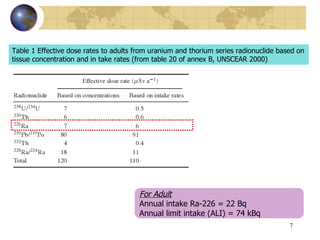
Table 1 Effective dose rates to adults from uranium and thorium series radionuclide based on tissue concentration and in take rates (from table 20 of annex B, UNSCEAR 2000) For Adult Annual intake Ra-226 = 22 Bq Annual limit intake (ALI) = 74 kBq
Cesium -137 Half-life   :   30.174 years Mode of decay : Beta & Gamma radiation Target organ : whole body Where dose it come from  ? Produced by nuclear fission of uranium and plutonium, occurs in nuclear reactor, nuclear weapon testing, atomic bomb. Small quantities of Cs-137 can be found in the environment from nuclear weapon tests that occurred in 1950s and from nuclear accident in 1986
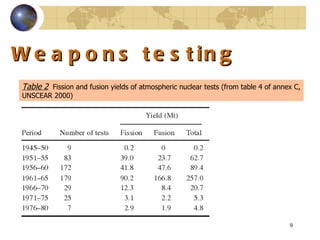
Weapons testing Table 2   Fission and fusion yields of atmospheric nuclear tests (from table 4 of annex C, UNSCEAR 2000)
Worldwide average effective dose Worldwide average effective dose rate from fallout radionuclide have been estimated in UNSCEAR (2000). For external irradiation, In 1999 the worldwide average was 2.90 uSv.a-1, almost entirely from  137 Cs. The worldwide average annual effective dose  from natural background is 2.4 mSv,   while that for all man - made sources  include from nuclear accidentis about 0.8 mSv  [ 1 ]
Radionuclide concentrations in the diet of residents in  a high level natural radiation area in Iran   H .  Samavat , M. R. D. Seaward , S .  M .  R .  Aghamiri and F .  Reza - Nejad (1)  Department of Medical Physics, Hamadan University of Medical Sciences, Hamadan, Iran (2)  Department of Geography and Environmental Science, University of Bradford, Bradford, BD7   1DP, UK (3)  Department of Physics, Shahid Beheshti University, Tehran, Iran (4)  Department of Physics, University of Sistan and Balouchestan, Zahedan, Iran
Introduction  In some areas of the world,  the average annual effective dose  is considerably more than  the world average   [ 2 ]
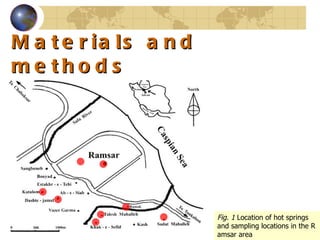
Introduction  In  Ramsar,  a well-known high level natural radiation area (HLNRA) in northern Iran,  Talesh Mahalleh  is one of the districts of the northern coastal city of Ramsar .  The origin of HLNR in this area is mainly due to presence of natural radionuclides,  especially Ra-226 and its decay product, in hot springs  flowing into the region  [ 10 ].  Radioactivity levels in local soils and the food grown in them are also high since these soils are derived from the local bedrock  [ 11 ].
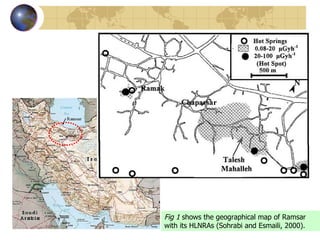
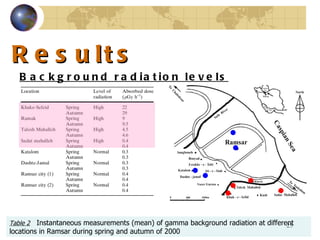
Fig 1  shows the geographical map of Ramsar with its HLNRAs  (Sohrabi and Esmaili, 2000).
Introduction  The release of radionuclides into the environment contaminates food  according to The type of soil,  The chemical characteristics of soil,  The physical and chemical forms of the radionuclides in the soil,  Radionuclide uptake by particular plants,  The level of accumulation by particular foodstuffs .  Previous studies did not show any evidence of significant increase in health problems compared with that in normal background areas  [ 2 ,  8 ,  10 ,  12 ,  13 ].
The main objective in order to... assess the effective dose due to normal diet  evaluate actual radiation risks  establish baseline information for future epidemiological studies  determine the degree of radiation protection to be applied for the critical group of residents of the area under study  To estimate the level of  Ra-226  and  Cs-137  in the local diet.
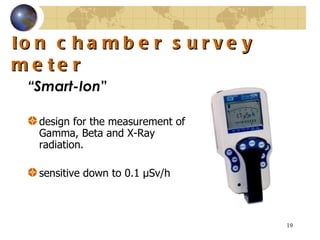
Materials and methods  Detection of background radiation levels Direct measurements  by portable dosimeters   “ Smart Ion” ion chamber survey meter  ( Canberra, USA ) .   Randomly selected points at 8  selected sites .  at ground  level and  at a height of 1 m  above the ground.  5  min  in the  morning  and  afternoon . D uring  spring  and  autumn  of  2000.
Materials and methods Fig .  1   Location of hot springs and sampling locations in the Ramsar area
Ion chamber survey meter “ Smart - Ion ” design for the measurement of Gamma, Beta and X - Ray radiation .  sensitive down to 0.1  μ Sv/h
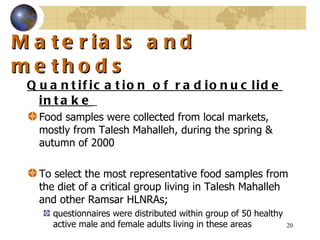
Materials and methods Quantification of radionuclide intake   Food samples were collected from local markets, mostly from Talesh Mahalleh, during the spring & autumn of 2000   To select the most representative food samples from the diet of a critical group living in Talesh Mahalleh and other Ramsar HLNRAs;  questionnaires were distributed within group of 50 healthy active male and female adults living in these areas
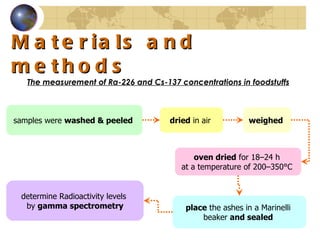
Materials and methods The measurement of Ra-226 and Cs-137 concentrations in foodstuffs   samples were  washed &  peeled   dried  in air  weighed   oven dried  for 18–24 h  at a temperature of 200–350°C  place   the ashes  in a Marinelli  beaker  and sealed  determine  Radioactivity levels  by  gamma spectrometry
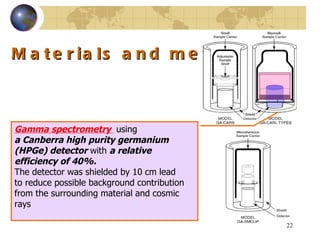
Materials and methods Gamma spectrometry   using  a Canberra high purity germanium  ( HPGe )  detector  with  a relative efficiency of 40% .  The detector was shielded by 10 cm lead  to reduce possible background contribution  from the surrounding material and cosmic rays
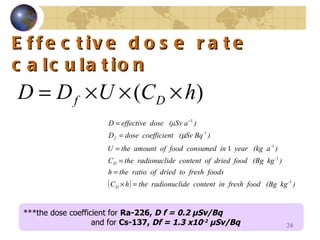
Materials and methods Calculation of effective dose from the diet   The consumption rates calculated for different types of vegetables and other foodstuffs  By using the following equation, effective dose from radionuclides in food and daily diet can be calculated
Effective dose rate  calculation ***the dose coefficient for  Ra-226,  D f   =  0.2  μ Sv/Bq and for  Cs-137,  Df  =  1.3 x10 -2   μ Sv/Bq
Results Background radiation levels   Table 2     Instantaneous measurements (mean) of gamma background radiation at different locations in Ramsar during spring and autumn of 2000
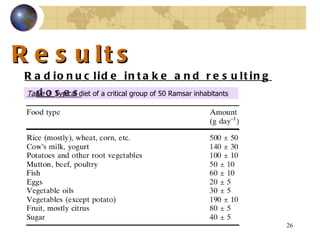
Results Radionuclide intake and resulting doses   Table 3    Typical diet of a critical group of 50 Ramsar inhabitants
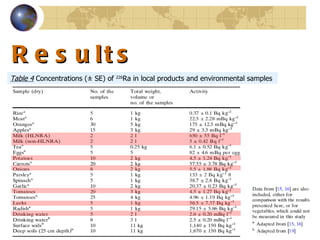
Results Table 4   Concentrations (± SE) of  226 Ra in local products and environmental samples
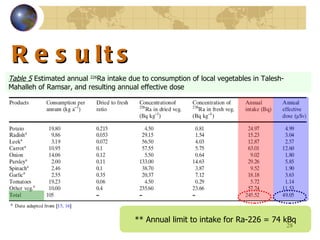
Results Table 5   Estimated annual  226 Ra intake due to consumption of local vegetables in Talesh-Mahalleh of Ramsar, and resulting annual effective dose  ** Annual limit to intake for Ra-226 = 74 kBq
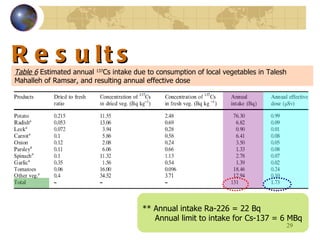
Results Table 6   Estimated annual  137 Cs intake due to consumption of local vegetables in Talesh Mahalleh of Ramsar, and resulting annual effective dose  ** Annual intake Ra-226 = 22 Bq Annual limit to intake for Cs-137 = 6 MBq
Discussion The uptake of  226 Ra by food grown in the area under study is governed by the radium in local soil and water .  Soil samples collected from the area show a high level of radionuclides  [ 19 ].  A very high level of  226 Ra was also detected in milk of a sheep fed from locally obtained food and water in comparison with one fed from imported food and water from a normal area  ( Table  4) ;  There is evidence to support the fact that in most cases human intake of milk in the HNLRA of Ramsar is derived from cows which are fed mainly on import food and uncontaminated   water; under such circumstances, it is estimated that the annual human intake of  226 Ra intake is about 250 Bq  ( a figure similar to that derived from local vegetables  —Table  5 ).
Discussion Among plant products analyzed,  the highest concentration was found in parsley .  The reasons for the different rates of  226 Ra uptake in vegetables should be the type of vegetables, availability of  226 Ra in soil, and uptake capacity .  Radionuclides present near the root zone enter the plant along with essential elements and contaminate the foodstuff .  A higher concentration of  226 Ra also occurred in milk  ( Table  4) , which is associated with higher concentrations of  226 Ra in Ramsar soil .
Discussion The differences between radionuclides in food from Ramsar and the world average are astounding .  Obviously, there are other sources of radionuclides such as  radon ,  which make Ramsar HLBRA even more remarkable .  Due to geographical and geological factors, natural radionuclide concentrations in environmental samples can be very different, even within one area,
Conclusions Contamination by  226 Ra of non - vegetable food consumed via local products, especially in Talesh Mahaleh, is  about ten times higher than the world average   [ 1 ].  Deposition  of  137 Cs  depends on the type of foodstuff and meteorological conditions, such as rainfall, which more effectively contaminates leafy vegetables.  Since radionuclides of Cs may be spread over long distances and because of its relatively long half-life,  it is likely that the concentration of  137 Cs in the study area is mainly as a result of Chernobyl accident,  and to a lesser extent from operating nuclear reactors or nuclear weapons testing.
Conclusions The estimated annual dietary intakes of  137 Cs and  226 Ra were  130  Bq and  245  Bq, respectively.  Although the effective dose values calculated for natural and artificial radionuclides derived from ingested food and drinks are higher in Ramsar inhabitants, compared to the global average, it would appear that they have had no detectable risk to the health of the Ramsar population .
Thank you… Pawitra  Masa-at March 16, 2007

Radioactive Contamination Research

  • 1.
    Radioactive Contamination ResearchPawitra Masa-at 4937092 SIRS/M March 16, 2007
  • 2.
    Natural background radiationcomes from two primary sources : Cosmic Radiation This radiation from the sun and from other sources outside our solar system . This radiation interacts with atoms in the atmosphere to create secondary radiation , including x-rays, muons, protons, alpha particles, pion, electron, Cosmic rays also cause elemental transmutation in the atmosphere, in which secondary radiation generated by the cosmic rays combine with atomic nuclei in the atmosphere to generate different radioactive isotope . the most notable is carbon-14 ,
  • 3.
    Natural background radiationTerrestrial sources Radioactive material is found throughout nature . It occurs naturally in the soi l, rocks, water, air, and vegetation . The major radionuclides of concern for terrestrial radiation are common elements with low - abundance radioactive isotopes, like potassium and carbon , or rare but intensely radioactive elements like uranium , thorium , radium and radon. Most of these sources have been decreasing, due to radioactive decay since the formation of the Earth.
  • 4.
    High level naturalradiation areas HLNRAs Classification scheme for high natural radiation areas depending on the annual effective dose. low (<5 mSv), medium (5-20 mSv), high (20-50 mSv) Ramsar in Iran, Lake Miri in Sudan and the Chavara-Neendakara coastal belt in Kerala, India. very high (>50 mSv) Umhausen in the Austrian Tyrol, Tuwa in India and two metal mining areas of the former East Germany.
  • 5.
    Environmental Radiation Theearth's crust contains natural radionuclides, most of which are members of the radioactive decay chains beginning with uranium-238 ( 238 U ) , uranium-235 ( 235 U ) and thorium-232 ( 232 Th ). In addition, there are many human activities which can enhance naturally occurring radioactive material ( NORM ) levels, including mining, milling and processing of uranium ores and mineral sands, phosphate and fertilizer manufacture and use, burning fossil fuels, metal refining, etc .
  • 6.
    Radium-226 Half-life : 1,603 years Mode of decay : Alpha & Gamma radiation Target organ : bone Where dose it come from ? from uranium series radionuclide. In nature : rock & soil.
  • 7.
    Table 1 Effectivedose rates to adults from uranium and thorium series radionuclide based on tissue concentration and in take rates (from table 20 of annex B, UNSCEAR 2000) For Adult Annual intake Ra-226 = 22 Bq Annual limit intake (ALI) = 74 kBq
  • 8.
    Cesium -137 Half-life : 30.174 years Mode of decay : Beta & Gamma radiation Target organ : whole body Where dose it come from ? Produced by nuclear fission of uranium and plutonium, occurs in nuclear reactor, nuclear weapon testing, atomic bomb. Small quantities of Cs-137 can be found in the environment from nuclear weapon tests that occurred in 1950s and from nuclear accident in 1986
  • 9.
    Weapons testing Table2 Fission and fusion yields of atmospheric nuclear tests (from table 4 of annex C, UNSCEAR 2000)
  • 10.
    Worldwide average effectivedose Worldwide average effective dose rate from fallout radionuclide have been estimated in UNSCEAR (2000). For external irradiation, In 1999 the worldwide average was 2.90 uSv.a-1, almost entirely from 137 Cs. The worldwide average annual effective dose from natural background is 2.4 mSv, while that for all man - made sources include from nuclear accidentis about 0.8 mSv [ 1 ]
  • 11.
    Radionuclide concentrations inthe diet of residents in a high level natural radiation area in Iran H .  Samavat , M. R. D. Seaward , S .  M .  R .  Aghamiri and F .  Reza - Nejad (1)  Department of Medical Physics, Hamadan University of Medical Sciences, Hamadan, Iran (2)  Department of Geography and Environmental Science, University of Bradford, Bradford, BD7 1DP, UK (3)  Department of Physics, Shahid Beheshti University, Tehran, Iran (4)  Department of Physics, University of Sistan and Balouchestan, Zahedan, Iran
  • 12.
    Introduction Insome areas of the world, the average annual effective dose is considerably more than the world average [ 2 ]
  • 13.
    Introduction In Ramsar, a well-known high level natural radiation area (HLNRA) in northern Iran, Talesh Mahalleh is one of the districts of the northern coastal city of Ramsar . The origin of HLNR in this area is mainly due to presence of natural radionuclides, especially Ra-226 and its decay product, in hot springs flowing into the region [ 10 ]. Radioactivity levels in local soils and the food grown in them are also high since these soils are derived from the local bedrock [ 11 ].
  • 14.
    Fig 1 shows the geographical map of Ramsar with its HLNRAs (Sohrabi and Esmaili, 2000).
  • 15.
    Introduction Therelease of radionuclides into the environment contaminates food according to The type of soil, The chemical characteristics of soil, The physical and chemical forms of the radionuclides in the soil, Radionuclide uptake by particular plants, The level of accumulation by particular foodstuffs . Previous studies did not show any evidence of significant increase in health problems compared with that in normal background areas [ 2 , 8 , 10 , 12 , 13 ].
  • 16.
    The main objectivein order to... assess the effective dose due to normal diet evaluate actual radiation risks establish baseline information for future epidemiological studies determine the degree of radiation protection to be applied for the critical group of residents of the area under study To estimate the level of Ra-226 and Cs-137 in the local diet.
  • 17.
    Materials and methods Detection of background radiation levels Direct measurements by portable dosimeters “ Smart Ion” ion chamber survey meter ( Canberra, USA ) . Randomly selected points at 8 selected sites . at ground level and at a height of 1 m above the ground. 5 min in the morning and afternoon . D uring spring and autumn of 2000.
  • 18.
    Materials and methodsFig .  1   Location of hot springs and sampling locations in the Ramsar area
  • 19.
    Ion chamber surveymeter “ Smart - Ion ” design for the measurement of Gamma, Beta and X - Ray radiation . sensitive down to 0.1  μ Sv/h
  • 20.
    Materials and methodsQuantification of radionuclide intake Food samples were collected from local markets, mostly from Talesh Mahalleh, during the spring & autumn of 2000 To select the most representative food samples from the diet of a critical group living in Talesh Mahalleh and other Ramsar HLNRAs; questionnaires were distributed within group of 50 healthy active male and female adults living in these areas
  • 21.
    Materials and methodsThe measurement of Ra-226 and Cs-137 concentrations in foodstuffs samples were washed & peeled dried in air weighed oven dried for 18–24 h at a temperature of 200–350°C place the ashes in a Marinelli beaker and sealed determine Radioactivity levels by gamma spectrometry
  • 22.
    Materials and methodsGamma spectrometry using a Canberra high purity germanium ( HPGe ) detector with a relative efficiency of 40% . The detector was shielded by 10 cm lead to reduce possible background contribution from the surrounding material and cosmic rays
  • 23.
    Materials and methodsCalculation of effective dose from the diet The consumption rates calculated for different types of vegetables and other foodstuffs By using the following equation, effective dose from radionuclides in food and daily diet can be calculated
  • 24.
    Effective dose rate calculation ***the dose coefficient for Ra-226, D f   =  0.2 μ Sv/Bq and for Cs-137, Df  =  1.3 x10 -2   μ Sv/Bq
  • 25.
    Results Background radiationlevels Table 2   Instantaneous measurements (mean) of gamma background radiation at different locations in Ramsar during spring and autumn of 2000
  • 26.
    Results Radionuclide intakeand resulting doses Table 3  Typical diet of a critical group of 50 Ramsar inhabitants
  • 27.
    Results Table 4  Concentrations (± SE) of 226 Ra in local products and environmental samples
  • 28.
    Results Table 5  Estimated annual 226 Ra intake due to consumption of local vegetables in Talesh-Mahalleh of Ramsar, and resulting annual effective dose ** Annual limit to intake for Ra-226 = 74 kBq
  • 29.
    Results Table 6  Estimated annual 137 Cs intake due to consumption of local vegetables in Talesh Mahalleh of Ramsar, and resulting annual effective dose ** Annual intake Ra-226 = 22 Bq Annual limit to intake for Cs-137 = 6 MBq
  • 30.
    Discussion The uptakeof 226 Ra by food grown in the area under study is governed by the radium in local soil and water . Soil samples collected from the area show a high level of radionuclides [ 19 ]. A very high level of 226 Ra was also detected in milk of a sheep fed from locally obtained food and water in comparison with one fed from imported food and water from a normal area ( Table  4) ; There is evidence to support the fact that in most cases human intake of milk in the HNLRA of Ramsar is derived from cows which are fed mainly on import food and uncontaminated water; under such circumstances, it is estimated that the annual human intake of 226 Ra intake is about 250 Bq ( a figure similar to that derived from local vegetables —Table  5 ).
  • 31.
    Discussion Among plantproducts analyzed, the highest concentration was found in parsley . The reasons for the different rates of 226 Ra uptake in vegetables should be the type of vegetables, availability of 226 Ra in soil, and uptake capacity . Radionuclides present near the root zone enter the plant along with essential elements and contaminate the foodstuff . A higher concentration of 226 Ra also occurred in milk ( Table  4) , which is associated with higher concentrations of 226 Ra in Ramsar soil .
  • 32.
    Discussion The differencesbetween radionuclides in food from Ramsar and the world average are astounding . Obviously, there are other sources of radionuclides such as radon , which make Ramsar HLBRA even more remarkable . Due to geographical and geological factors, natural radionuclide concentrations in environmental samples can be very different, even within one area,
  • 33.
    Conclusions Contamination by 226 Ra of non - vegetable food consumed via local products, especially in Talesh Mahaleh, is about ten times higher than the world average [ 1 ]. Deposition of 137 Cs depends on the type of foodstuff and meteorological conditions, such as rainfall, which more effectively contaminates leafy vegetables. Since radionuclides of Cs may be spread over long distances and because of its relatively long half-life, it is likely that the concentration of 137 Cs in the study area is mainly as a result of Chernobyl accident, and to a lesser extent from operating nuclear reactors or nuclear weapons testing.
  • 34.
    Conclusions The estimatedannual dietary intakes of 137 Cs and 226 Ra were 130 Bq and 245 Bq, respectively. Although the effective dose values calculated for natural and artificial radionuclides derived from ingested food and drinks are higher in Ramsar inhabitants, compared to the global average, it would appear that they have had no detectable risk to the health of the Ramsar population .
  • 35.
    Thank you… Pawitra Masa-at March 16, 2007