PATIENT RADIATION
DOSE
MANAGEMENT
Nadella Neeraj krishna
Group– 9
Semester – 9
Guided by : Skorobogatova madam
PATIENT DOSE DESCRIPTIONS
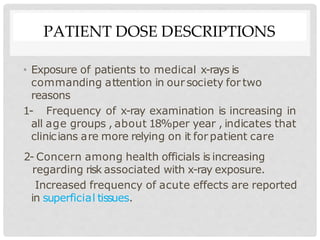
• Exposure of patients to medical x-rays is
commanding attention in our society for two
reasons
1- Frequency of x-ray examination is increasing in
all age groups , about 18%per year , indicates that
clinicians are more relying on it for patient care
2- Concern among health officials is increasing
regarding risk associated with x-ray exposure.
Increased frequency of acute effects are reported
in superficial tissues.
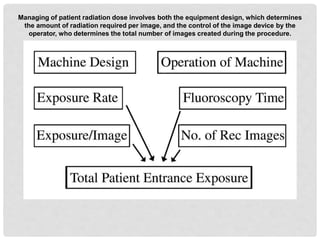
Managing of patient radiation dose involves both the equipment design, which determines
the amount of radiation required per image, and the control of the image device by the
operator, who determines the total number of images created during the procedure.
ESTIMATION OF PATIENT DOSE
• Usually reported in one of 3 ways
1- Entrance skin exposure
2- Gonadal dose
3- Dose to bone marrow
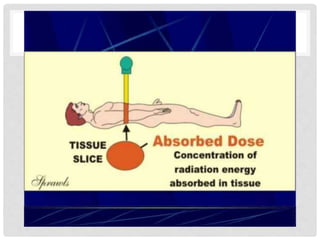
ENTRANCE SKIN EXPOSURE
• AKA aspatient dose
• Widely used due to accuracy and easy to measure
• Thermoluminiscence dosimeters ( TLDs )are used
• Measurementsare accurate to within 5%
• ESE in fluoroscopy is difficult to estimate because x-
ray field moves
BONE MARROW DOSE
• AKA mean marrow dose
• I
t isaverage radiation dose to entire active bone
marrow e-g if 50%of active bone marrow receives
25 mrad , then active mean marrow dose is25
mrad
• Depends on active sites of bone marrow
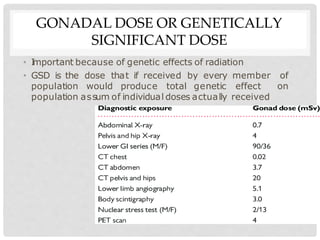
GONADAL DOSE OR GENETICALLY
SIGNIFICANT DOSE
• I
mportant because of genetic effects of radiation
• GSD is the dose that if received by every member of
population would produce total genetic effect on
population assum of individual doses actually received
PATIENT DOSE IN SPECIAL
EXAMINATIONS
Dose in mammography
• Screen film and digital mammography are the only
acceptable techniques
• An ESE of approximately 800 mrad/view isnormal
• Radiologic grids are used in most screen film
mammographic examinations
• Glandular dose is 15%
• Patient dose in mammography can be reduced if
the number of views are restricted
• T
he axillary views should not be done routinely
• For screening, no more than 2 views are advisable
DOSE IN CT IMAGING
• I
mportant consideration in CT imaging is not only the skin
dose but also itsdistribution to internal organs and tissues
• Skin dose is lighter in CTthan other diagnostic
• I
t accounts for 70%of total patient effective dose
• CT tissue dose isapproximately equal to average
flouroscopic dose
• CT dose isnearly uniform throughout the imaging volume
for head examinations
• Radiographic/flouroscopic doses are high at
entrance surface and low at exit surface
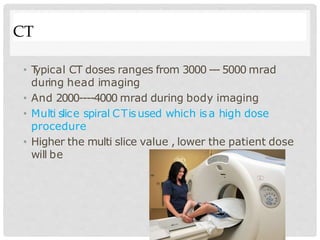
CT
• T
ypical CT doses ranges from 3000 --- 5000 mrad
during head imaging
• And 2000----4000 mrad during body imaging
• Multi slice spiral CTisused which isa high dose
procedure
• Higher the multi slice value , lower the patient dose
will be
REDUCTION OF UNNECESSARY DOSE
• Defined as any radiation dose that is not required
for patients well being or for proper management
and care
• Radiologic technologists has no control over largest
source of un necessary patient dose
• Its exclusively the radiologist or clinicians
responsibility
• Routine x-ray examinations should not be
performed when not indicated
REPEAT EXAMINATIONS
• One area of un necessary radiation is repeat
examinations
• It is estimated 10%of all examinations but not
exceed than 5%in busy hospitals
• Examinations with high repeat rates are lumbar
spine, thoracic spine and abdomen
• Some repeats are caused by equipment failure
• Most repeats are caused by radiologic technologist
error
• Also include improper positioning, poor
radiographic technique, improper collimation , dirty
screens, improper loaded cassettes, high leaks and
chemical fog
RADIOGRAPHIC TECHNIQUE
• Use of high kVp technique results in reduce patient
Dose (The kilovoltage peak )
• Slight increase in kVp results in low contrast images
• Proper collimation is essential for good radiographic
technique
• With use of collimation, not only effective dose
is reduced but image quality isimproved with
enhanced contrast resolution
IMAGE RECEPTOR
• I
mage receptor should first be selected for the type
of examination
• And 2nd for radiation dose necessary to produce a
good quality image
• Rare earth and other fast screens should be used
• Such screensare used in orthopedic and chest
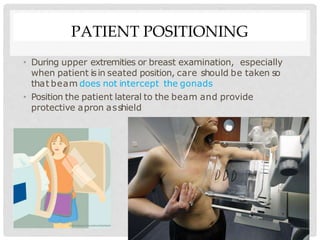
PATIENT POSITIONING
• During upper extremities or breast examination, especially
when patient isin seated position, care should be taken so
that beam does not intercept the gonads
• Position the patient lateral to the beam and provide
protective apron asshield
SPECIFIC AREA SHIELDING
• In partial exposure, x-ray examination is controlled
by proper collimation and specific area shielding
•T
wo types of shields are used
1- Contact shield
2- Shadow shield
• Lens shield and breast shield are of contact type
• Gonad shields are of both types
PREGNANT PATIENT
• The most sensitive period to radiation exposure
occurs before birth
• Fetusismore sensitive to radiation in early
pregnancy than late pregnancy
• I
t isboth time related and dose related
TIME RELATED
• The most critical is first 2 weeks because of
ignorance although thistime isleast hazardous
• Irradiation in first 2weeks results in embryo resorption
• Period from 2 to 10 weeks results in congenital
abnormalities
• Most likely congenital abnormalities in laterperiod
are neurologic deficiencies
DOSE RELATED
• Although no definite data in humans is available,
but in animals there are certain studies
• I
n utero radiation dose of 200 rad result in these
effects
• Reasonable risk suggest that 0.1%of all conceptions
would be resorbed after a dose of 10 rad
• 1%increase in congenital abnormalities is estimated
to follow a 10 rad fetal dose
• During first trimester, the relative risk of child hood
malignancy with radiation is5----10 and drops 1----4
in third trimester
PATIENT INFORMATION
• Early in pregnancy it isdifficult because patient is
usuallyignorant of her pregnancy
• After2 months , riskisreduced because patient is aware of
her pregnancy
• During pregnancy, x-rays should be avoided unless
required
• When required, should be done with extracare with proper
collimation and protective shields
• T
he protocols vary from complex ( Elective booking )
to simple ( Posting )
• Inelective booking, patients last menstrual cycle is
determined by radiologist and if early,pelvic shielding
would be done
• Thiscan be assessed by patients history
Thank you

neeraj radiation dosemanag.pptx

  • 1.
    PATIENT RADIATION DOSE MANAGEMENT Nadella Neerajkrishna Group– 9 Semester – 9 Guided by : Skorobogatova madam
  • 2.
    PATIENT DOSE DESCRIPTIONS •Exposure of patients to medical x-rays is commanding attention in our society for two reasons 1- Frequency of x-ray examination is increasing in all age groups , about 18%per year , indicates that clinicians are more relying on it for patient care 2- Concern among health officials is increasing regarding risk associated with x-ray exposure. Increased frequency of acute effects are reported in superficial tissues.
  • 3.
    Managing of patientradiation dose involves both the equipment design, which determines the amount of radiation required per image, and the control of the image device by the operator, who determines the total number of images created during the procedure.
  • 4.
    ESTIMATION OF PATIENTDOSE • Usually reported in one of 3 ways 1- Entrance skin exposure 2- Gonadal dose 3- Dose to bone marrow
  • 5.
    ENTRANCE SKIN EXPOSURE •AKA aspatient dose • Widely used due to accuracy and easy to measure • Thermoluminiscence dosimeters ( TLDs )are used • Measurementsare accurate to within 5% • ESE in fluoroscopy is difficult to estimate because x- ray field moves
  • 6.
    BONE MARROW DOSE •AKA mean marrow dose • I t isaverage radiation dose to entire active bone marrow e-g if 50%of active bone marrow receives 25 mrad , then active mean marrow dose is25 mrad • Depends on active sites of bone marrow
  • 7.
    GONADAL DOSE ORGENETICALLY SIGNIFICANT DOSE • I mportant because of genetic effects of radiation • GSD is the dose that if received by every member of population would produce total genetic effect on population assum of individual doses actually received
  • 8.
    PATIENT DOSE INSPECIAL EXAMINATIONS Dose in mammography • Screen film and digital mammography are the only acceptable techniques • An ESE of approximately 800 mrad/view isnormal • Radiologic grids are used in most screen film mammographic examinations • Glandular dose is 15% • Patient dose in mammography can be reduced if the number of views are restricted • T he axillary views should not be done routinely • For screening, no more than 2 views are advisable
  • 9.
    DOSE IN CTIMAGING • I mportant consideration in CT imaging is not only the skin dose but also itsdistribution to internal organs and tissues • Skin dose is lighter in CTthan other diagnostic • I t accounts for 70%of total patient effective dose • CT tissue dose isapproximately equal to average flouroscopic dose • CT dose isnearly uniform throughout the imaging volume for head examinations • Radiographic/flouroscopic doses are high at entrance surface and low at exit surface
  • 10.
    CT • T ypical CTdoses ranges from 3000 --- 5000 mrad during head imaging • And 2000----4000 mrad during body imaging • Multi slice spiral CTisused which isa high dose procedure • Higher the multi slice value , lower the patient dose will be
  • 12.
    REDUCTION OF UNNECESSARYDOSE • Defined as any radiation dose that is not required for patients well being or for proper management and care • Radiologic technologists has no control over largest source of un necessary patient dose • Its exclusively the radiologist or clinicians responsibility • Routine x-ray examinations should not be performed when not indicated
  • 13.
    REPEAT EXAMINATIONS • Onearea of un necessary radiation is repeat examinations • It is estimated 10%of all examinations but not exceed than 5%in busy hospitals • Examinations with high repeat rates are lumbar spine, thoracic spine and abdomen • Some repeats are caused by equipment failure • Most repeats are caused by radiologic technologist error • Also include improper positioning, poor radiographic technique, improper collimation , dirty screens, improper loaded cassettes, high leaks and chemical fog
  • 14.
    RADIOGRAPHIC TECHNIQUE • Useof high kVp technique results in reduce patient Dose (The kilovoltage peak ) • Slight increase in kVp results in low contrast images • Proper collimation is essential for good radiographic technique • With use of collimation, not only effective dose is reduced but image quality isimproved with enhanced contrast resolution
  • 16.
    IMAGE RECEPTOR • I magereceptor should first be selected for the type of examination • And 2nd for radiation dose necessary to produce a good quality image • Rare earth and other fast screens should be used • Such screensare used in orthopedic and chest
  • 17.
    PATIENT POSITIONING • Duringupper extremities or breast examination, especially when patient isin seated position, care should be taken so that beam does not intercept the gonads • Position the patient lateral to the beam and provide protective apron asshield
  • 18.
    SPECIFIC AREA SHIELDING •In partial exposure, x-ray examination is controlled by proper collimation and specific area shielding •T wo types of shields are used 1- Contact shield 2- Shadow shield • Lens shield and breast shield are of contact type • Gonad shields are of both types
  • 19.
    PREGNANT PATIENT • Themost sensitive period to radiation exposure occurs before birth • Fetusismore sensitive to radiation in early pregnancy than late pregnancy • I t isboth time related and dose related
  • 20.
    TIME RELATED • Themost critical is first 2 weeks because of ignorance although thistime isleast hazardous • Irradiation in first 2weeks results in embryo resorption • Period from 2 to 10 weeks results in congenital abnormalities • Most likely congenital abnormalities in laterperiod are neurologic deficiencies
  • 21.
    DOSE RELATED • Althoughno definite data in humans is available, but in animals there are certain studies • I n utero radiation dose of 200 rad result in these effects • Reasonable risk suggest that 0.1%of all conceptions would be resorbed after a dose of 10 rad • 1%increase in congenital abnormalities is estimated to follow a 10 rad fetal dose • During first trimester, the relative risk of child hood malignancy with radiation is5----10 and drops 1----4 in third trimester
  • 22.
    PATIENT INFORMATION • Earlyin pregnancy it isdifficult because patient is usuallyignorant of her pregnancy • After2 months , riskisreduced because patient is aware of her pregnancy • During pregnancy, x-rays should be avoided unless required • When required, should be done with extracare with proper collimation and protective shields • T he protocols vary from complex ( Elective booking ) to simple ( Posting ) • Inelective booking, patients last menstrual cycle is determined by radiologist and if early,pelvic shielding would be done • Thiscan be assessed by patients history
  • 23.