Radiation Protection
Standards
Subhash Verma
skvif.youngindia@gmail.com
Dip.R.P. 57th Batch HBNI, BARC
Roll no. 01
International Commission on
Radiological Protection
(ICRP)
 Primary body in protection against ionizing radiation.
 Established in 1928.
 Location: Ottawa, Ontario, Canada
Aim of ICRP
In Publication 103 paragraph 26
Contribute to an appropriate level of protection for
people and the environment against the detrimental
effect of radiation exposure without unduly limiting the
desirable human action that may be associated with
such exposure.
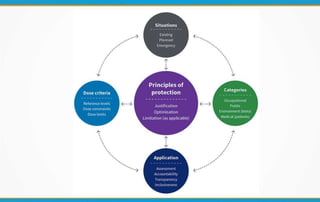
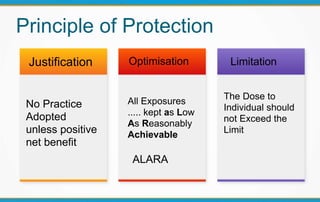
Principle of Protection
Justification Optimisation Limitation
No Practice
Adopted
unless positive
net benefit
All Exposures
..... kept as Low
As Reasonably
Achievable
ALARA
The Dose to
Individual should
not Exceed the
Limit
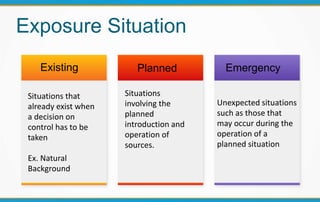
Exposure Situation
Existing Planned Emergency
Situations that
already exist when
a decision on
control has to be
taken
Ex. Natural
Background
Unexpected situations
such as those that
may occur during the
operation of a
planned situation
Situations
involving the
planned
introduction and
operation of
sources.
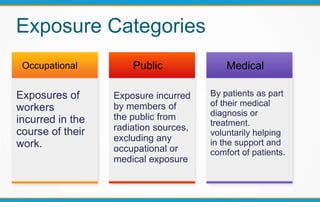
Exposure Categories
Occupational Public Medical
Exposures of
workers
incurred in the
course of their
work.
Exposure incurred
by members of
the public from
radiation sources,
excluding any
occupational or
medical exposure
By patients as part
of their medical
diagnosis or
treatment.
voluntarily helping
in the support and
comfort of patients.
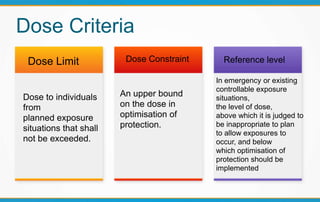
Dose Criteria
Dose Limit Dose Constraint Reference level
Dose to individuals
from
planned exposure
situations that shall
not be exceeded.
An upper bound
on the dose in
optimisation of
protection.
In emergency or existing
controllable exposure
situations,
the level of dose,
above which it is judged to
be inappropriate to plan
to allow exposures to
occur, and below
which optimisation of
protection should be
implemented
 One of the ways the ICRP ensures health and safety is
through setting regulations, including dose limits for workers
and members of the public.
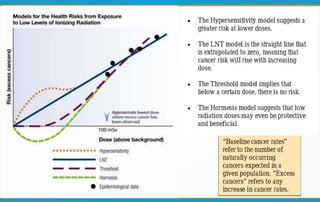
 To help set these limits, the ICRP relying on a radiation
protection risk model known as the Linear-Non-Threshold
(LNT) model.
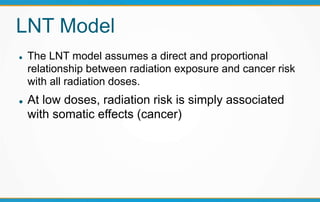
LNT Model
 The LNT model assumes a direct and proportional
relationship between radiation exposure and cancer risk
with all radiation doses.
 At low doses, radiation risk is simply associated
with somatic effects (cancer)
Background
incidence
background
annual dose
Probability of Stochastic Effects, p
Dose, D
increment of p
increment of D
average 2.4 mSv
typical 10 mSv
high 100 mSv
risk
factor
12
Risk At HD & HDR Data Comes
From
 Survivors of Atomic Bomb Explosions in Hiroshima &
Nagasaki.
 Inhabitants of Marshall island, Who were Exposed to
fallout from thermonuclear devices.
 Uranium miner.
 Radium Dial Painters.
 Pioneer X-ray Technicians and radiologists.
 Patients Exposed to radiation for Medical reasons.
 Victims of Nuclear accidents.
Atomic Bomb Survivors
Risk=
Total Number of ExcessCancer Cases
Total Dose
▶ Total Collective Dose for exposed persons in atomic bomb Study Was ≈ 10,000 Sv
▶ Excess number of cancer cases which were observed after subtracting natural cases
number was ≈ 1000.
% cancer Risk/Dose = 100*1000/10,000 = 10% /Sv
At low dose and Dose Rate, (DDREF = 2) % cancer Risk = 5% /Sv
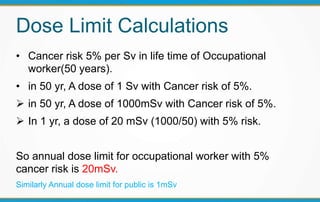
Dose Limit Calculations
• Cancer risk 5% per Sv in life time of Occupational
worker(50 years).
• in 50 yr, A dose of 1 Sv with Cancer risk of 5%.
 in 50 yr, A dose of 1000mSv with Cancer risk of 5%.
 In 1 yr, a dose of 20 mSv (1000/50) with 5% risk.
So annual dose limit for occupational worker with 5%
cancer risk is 20mSv.
Similarly Annual dose limit for public is 1mSv
Meaning of 5% risk ?
* AERB Limits
Justification for the LNT model
 Even a small amount of radiation increases DNA
damage and mutations.
 Increased mutations imply increased cancers,
based on the somatic mutation model of cancer
Are these concepts valid ?
Even, their are models against LNT model that considers
the effect of radiation at low doses on the basis of
available data and their own research.
But
LNT model is the only acceptable model by ICRP because
The ICRP Consider that LNT remains a pragmatic, realistic
and conservative tool for radiation protection.
“Respect the Radiation with Proper shielding at proper
Distance in minimum time.”

Radiation Protection Standards

  • 1.
  • 2.
    International Commission on RadiologicalProtection (ICRP)  Primary body in protection against ionizing radiation.  Established in 1928.  Location: Ottawa, Ontario, Canada
  • 3.
    Aim of ICRP InPublication 103 paragraph 26 Contribute to an appropriate level of protection for people and the environment against the detrimental effect of radiation exposure without unduly limiting the desirable human action that may be associated with such exposure.
  • 5.
    Principle of Protection JustificationOptimisation Limitation No Practice Adopted unless positive net benefit All Exposures ..... kept as Low As Reasonably Achievable ALARA The Dose to Individual should not Exceed the Limit
  • 6.
    Exposure Situation Existing PlannedEmergency Situations that already exist when a decision on control has to be taken Ex. Natural Background Unexpected situations such as those that may occur during the operation of a planned situation Situations involving the planned introduction and operation of sources.
  • 7.
    Exposure Categories Occupational PublicMedical Exposures of workers incurred in the course of their work. Exposure incurred by members of the public from radiation sources, excluding any occupational or medical exposure By patients as part of their medical diagnosis or treatment. voluntarily helping in the support and comfort of patients.
  • 8.
    Dose Criteria Dose LimitDose Constraint Reference level Dose to individuals from planned exposure situations that shall not be exceeded. An upper bound on the dose in optimisation of protection. In emergency or existing controllable exposure situations, the level of dose, above which it is judged to be inappropriate to plan to allow exposures to occur, and below which optimisation of protection should be implemented
  • 9.
     One ofthe ways the ICRP ensures health and safety is through setting regulations, including dose limits for workers and members of the public.  To help set these limits, the ICRP relying on a radiation protection risk model known as the Linear-Non-Threshold (LNT) model.
  • 11.
    LNT Model  TheLNT model assumes a direct and proportional relationship between radiation exposure and cancer risk with all radiation doses.  At low doses, radiation risk is simply associated with somatic effects (cancer)
  • 12.
    Background incidence background annual dose Probability ofStochastic Effects, p Dose, D increment of p increment of D average 2.4 mSv typical 10 mSv high 100 mSv risk factor 12
  • 13.
    Risk At HD& HDR Data Comes From  Survivors of Atomic Bomb Explosions in Hiroshima & Nagasaki.  Inhabitants of Marshall island, Who were Exposed to fallout from thermonuclear devices.  Uranium miner.  Radium Dial Painters.  Pioneer X-ray Technicians and radiologists.  Patients Exposed to radiation for Medical reasons.  Victims of Nuclear accidents.
  • 14.
  • 15.
    Risk= Total Number ofExcessCancer Cases Total Dose ▶ Total Collective Dose for exposed persons in atomic bomb Study Was ≈ 10,000 Sv ▶ Excess number of cancer cases which were observed after subtracting natural cases number was ≈ 1000. % cancer Risk/Dose = 100*1000/10,000 = 10% /Sv At low dose and Dose Rate, (DDREF = 2) % cancer Risk = 5% /Sv
  • 16.
    Dose Limit Calculations •Cancer risk 5% per Sv in life time of Occupational worker(50 years). • in 50 yr, A dose of 1 Sv with Cancer risk of 5%.  in 50 yr, A dose of 1000mSv with Cancer risk of 5%.  In 1 yr, a dose of 20 mSv (1000/50) with 5% risk. So annual dose limit for occupational worker with 5% cancer risk is 20mSv. Similarly Annual dose limit for public is 1mSv
  • 17.
  • 18.
  • 19.
    Justification for theLNT model  Even a small amount of radiation increases DNA damage and mutations.  Increased mutations imply increased cancers, based on the somatic mutation model of cancer Are these concepts valid ?
  • 20.
    Even, their aremodels against LNT model that considers the effect of radiation at low doses on the basis of available data and their own research. But LNT model is the only acceptable model by ICRP because The ICRP Consider that LNT remains a pragmatic, realistic and conservative tool for radiation protection.
  • 21.
    “Respect the Radiationwith Proper shielding at proper Distance in minimum time.”