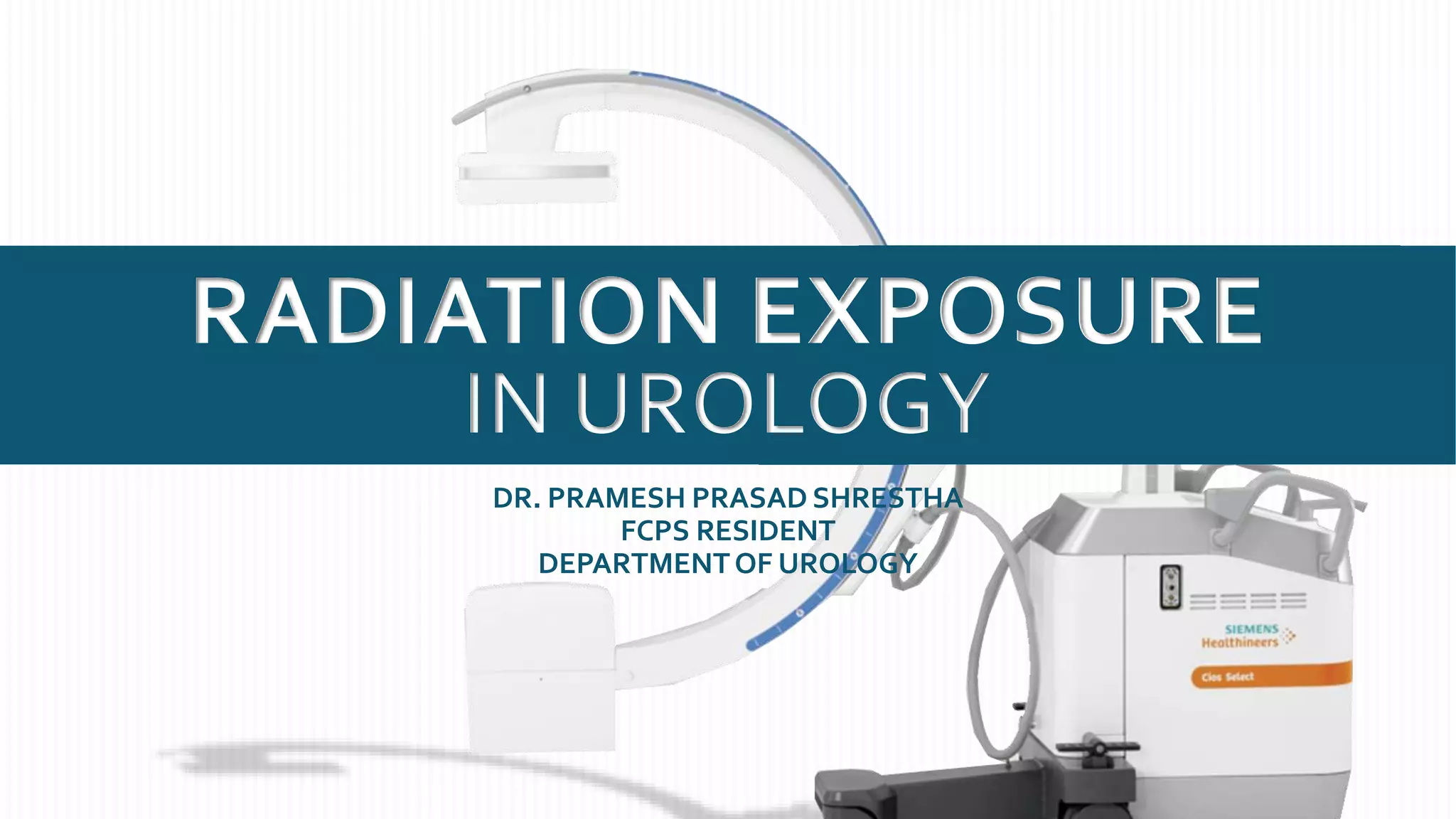
RADIATION EXPOSURE
IN UROLOGY
DR. PRAMESH PRASAD SHRESTHA
FCPS RESIDENT
DEPARTMENTOF UROLOGY
WHAT IS RADIATION?
 Emission or transmission of energy in the form of waves or particles through
space or through a material medium.
SO,WHY AREWEWORRIED?
 Types of Radiation:
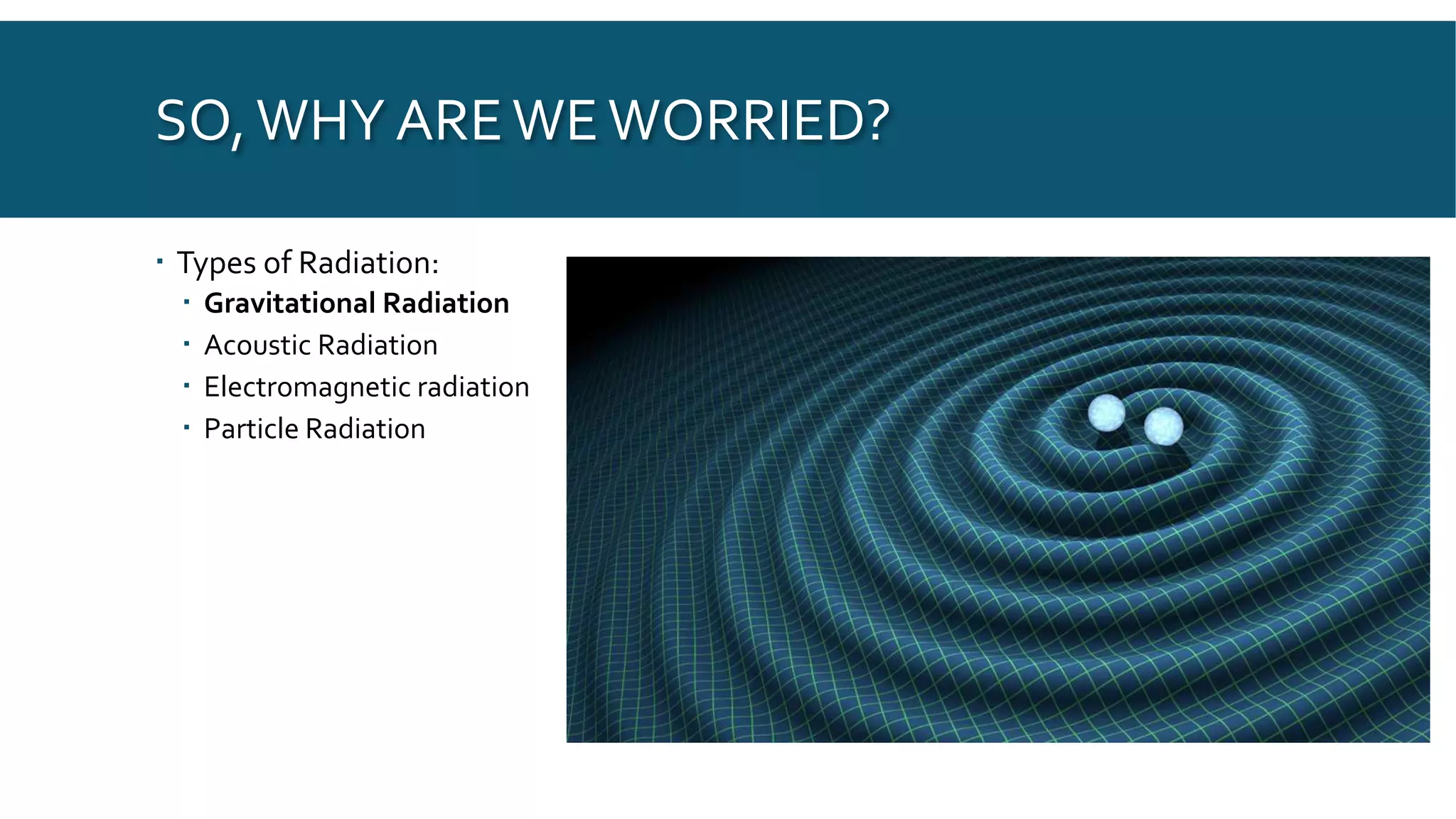
 Gravitational Radiation
 Acoustic Radiation
 Particle Radiation
 Electromagnetic radiation
SO,WHY AREWEWORRIED?
 Types of Radiation:
 Gravitational Radiation
 Acoustic Radiation
 Electromagnetic radiation
 Particle Radiation
SO,WHY AREWEWORRIED?
 Types of Radiation:
 Gravitational Radiation
 Acoustic Radiation
 Electromagnetic radiation
 Particle Radiation
SO,WHY AREWEWORRIED?
 Types of Radiation:
 Gravitational Radiation
 Acoustic Radiation
 Electromagnetic radiation
 Particle Radiation
SO,WHY AREWEWORRIED?
 Types of Radiation:
 Gravitational Radiation
 Acoustic Radiation
 Electromagnetic radiation
 Particle Radiation
β
SO,WHY AREWEWORRIED?
 When exposed to Ionizing radiation
 Causes changes in the cell division process of the body by affecting DNA structure
 Damages protein structure of cells
 Direct damage to tissues
 The generic term for the detrimental effects of Radiation is termed as
ACUTE RADIATION SYNDROME
RADIATION SICKNESS
TERMINOLOGY
 Ionizing Radiation:
 Radiation from an source with enough energy to separate the subatomic particles and is
a known Carcinogen
 Deterministic effect:
 Describes the cause and effect relationship of Ionizing Radiation
 Also known as Non-Stochastic Effect,
 Dependent upon dose, dose rate, dose fractionation, irradiated volume and type of
radiation
Skin Erythema 2-5 Gy Irreversible Skin Damage 20-40Gy
Hair loss 2-5 Gy Sterility 2-3 Gy
Cataracts 0.5 -5Gy Lethality 3-5GyWhole body
Fetal Abnormality 0.1-0.5 Gy
TERMINOLOGY
 Stochastic Effect:
 Effect the occurs by chance
 No threshold, not dependent upon dose
 Caused by Mutational changes in cell DNA, Cell still remains viable after radiation effect
 Increased level of exposure does not effect severity of disease but affect the probability
of development
 Example:Cancer Induction
TERMINOLOGY
 Absorbed Dose: Amount of radiation in theTissues
 Measured in Gray (Gy)
 Equivalent dose: Absorbed dose in a specific organ or tissue
 Exposure: Number of ions produced by X-rays per Kilogram of air
 Measured in Roentgen (R)
 Effective Dose: Reflects whole body exposure/Radiation present in the
environment
 Measured in rem or Sievert (Sv)
 Dose area product (DAP): Radiation dose to air multipled by the are of X-ray field
 Measured in Gy*cm2
THRESHOLD
 European Union
 Effective Dose limit is 100mSv over 5 years
 No more than 50mSv in any one year
 United States of America
 Effective dose limit of 50mSv in one year
 Lifetime limit of 10mSv x Age (Years)
 International Commission on Radiological Protection
 No more than 20mSv/yr over 5 years
 No more than 50mSv in one year
BACKGROUND
 X rays has been used to diagnosed diseases in the kidney and urinary tract for
about a century
 However, use of Fluoroscopy is relatively new
 Since the advent of Lithotripsy, use of CT has been increasing for mapping the
anatomy, diagnosis of diseases
 A number of procedures, like PCNL, RIRS, Stent placement, ESWL,Tumor
ablation require fluoroscopy or other form of ionizing radiation.
 In the United states; Per capita exposure to radiation has increased from
0.54mSv in 1980 TO 3.0mSv in 2006
600% increase
RISKS IN UROLOGY - PATIENTS
 Mainly in stone patients
 Ranging from 1.18 to 37.66 mSv
 Acute Stone episode patients undergo 1 – 4 radiographic studies in 1 year period
after stone event
 Obesity increases mean Effective Dose by 177%
 BMI 30-39.9 Kg/m2 = twofold increase in Effective Dose
 BMI >40 kg/m2 =Threefold increase in Effective Dose
ChenTT, et al. J Urol, 194:878; 2015.
SURGICAL MANAGEMENT - URS
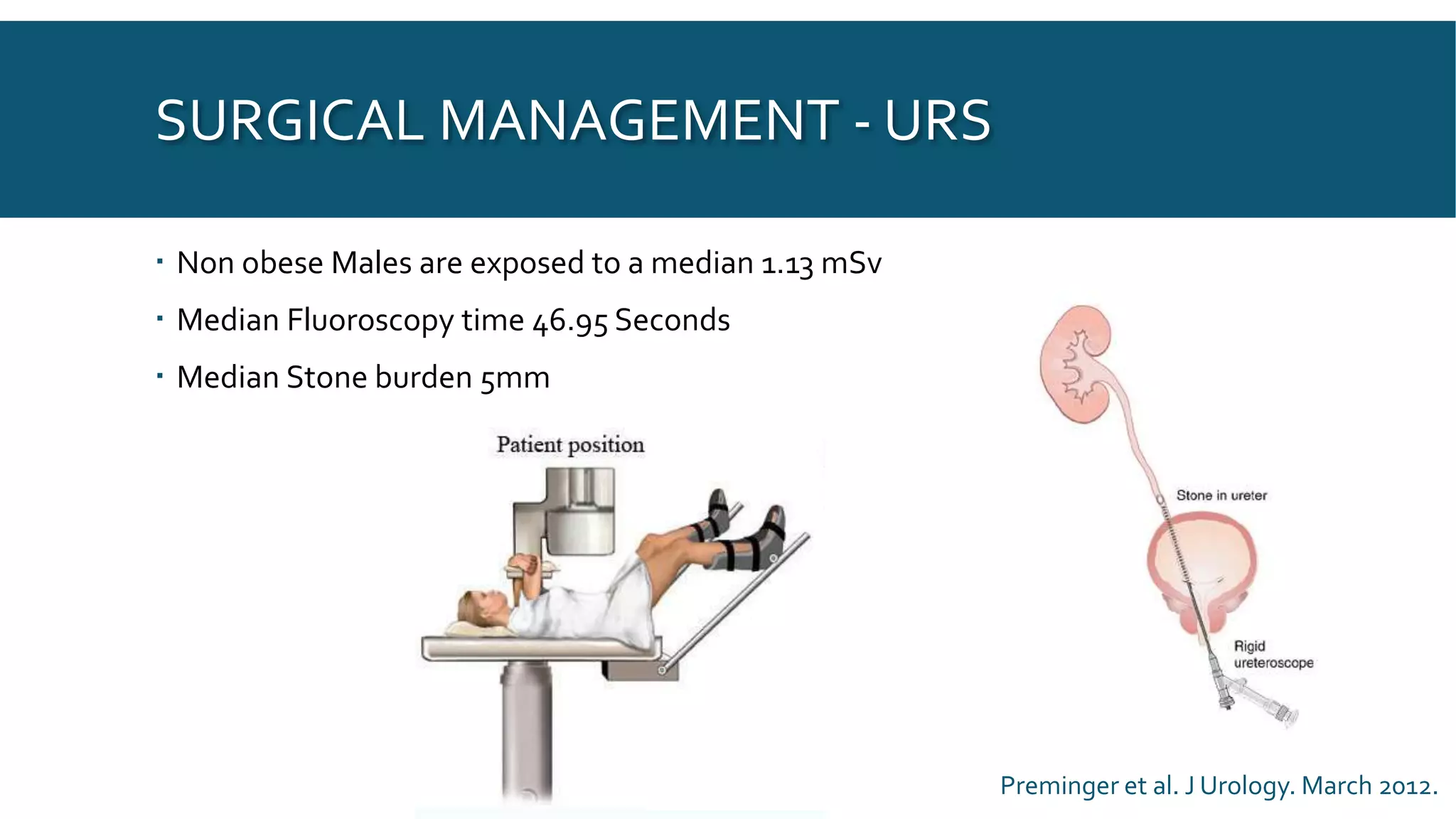
 Non obese Males are exposed to a median 1.13 mSv
 Median Fluoroscopy time 46.95 Seconds
 Median Stone burden 5mm
Preminger et al. J Urology. March 2012.
SURGICAL MANAGEMENT - PCNL
 Mean Effective Dose for Right PCNL: 7.63 mSv
 Mean Effective Dose for Left PCNL: 8.11 mSv
 Risks for increased Exposure:
 High BMI,
 Increased Stone Burden
 Increased number of access tracts
Preminger et al. J Urology. March 2012.
SURGICAL MANAGEMENT - ESWL
 Mean total effective dose: 1.71 mSv in males
 Mean total effective dose: 1.82 mSv in females
Lipkin et al. J Urol 2015; 194: 878 885
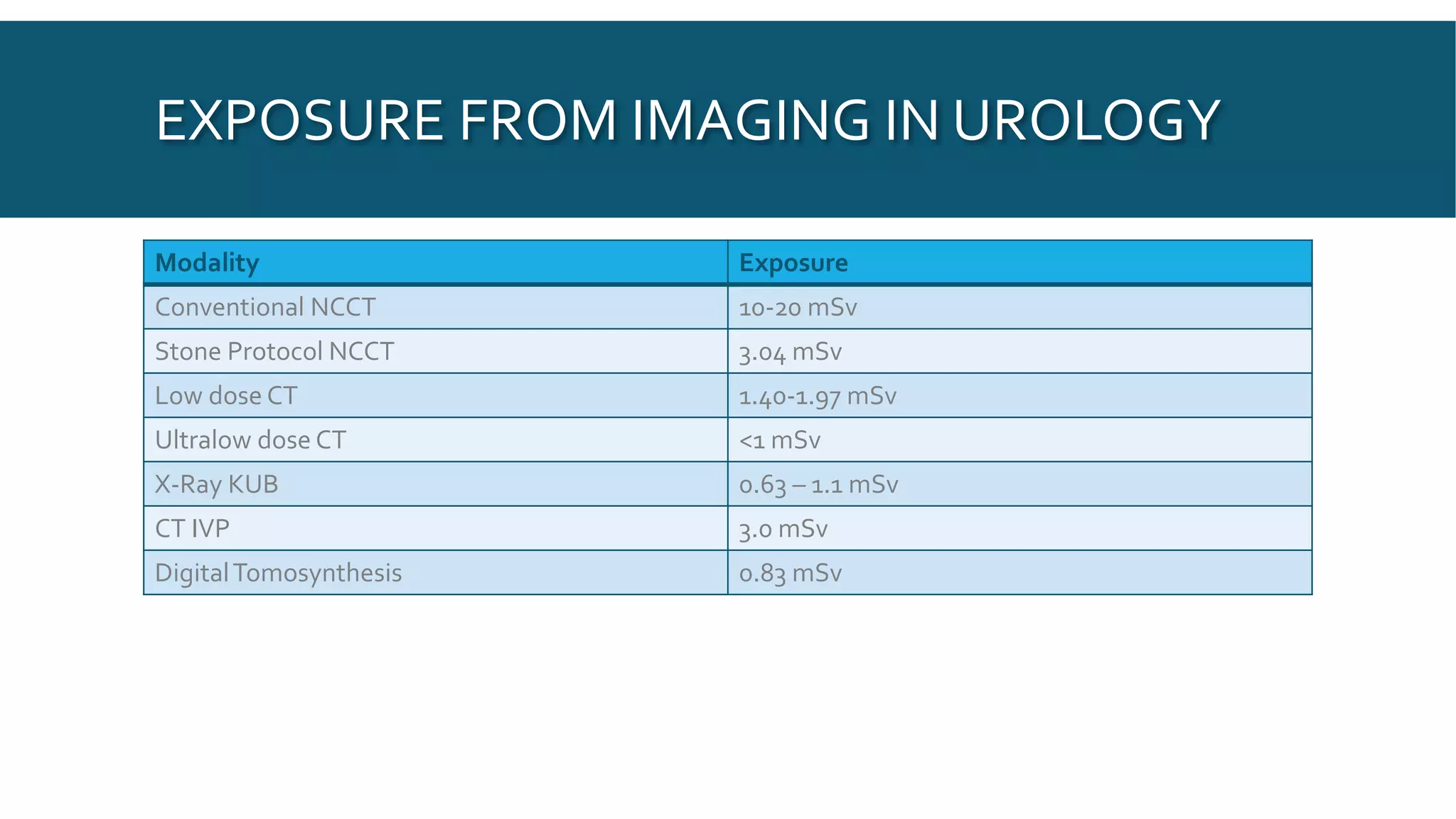
EXPOSURE FROM IMAGING IN UROLOGY
Modality Exposure
Conventional NCCT 10-20 mSv
Stone Protocol NCCT 3.04 mSv
Low dose CT 1.40-1.97 mSv
Ultralow dose CT <1 mSv
X-Ray KUB 0.63 – 1.1 mSv
CT IVP 3.0 mSv
DigitalTomosynthesis 0.83 mSv
RISKS IN UROLOGY - SURGEONS
 Radiation exposure: arises due to scatter from the beam, patient and operating
table
 Lens of the eye is most radiosensitive
 >10mSv of exposure (cumulative) in 1 year increases lifetime risk of fatal cancer by
3%
 >20mSV of exposure in 1 year increases risk of fatal cancer between 1:1000 and
1: 10000
 Risk of fatal malignancy in general population is 1:500000
Hanna L, et al. J Endo, 29: 526; 2015.
WHAT CANYOU DO?
 ALARA
 Protect yourself
 Know your equipment
 Procedural control
 Alternative imaging
 Adjunctive techniques
ALARA
 AS LOW AS REASONABLY ACHIEVABLE
 Reduce Radiation exposure
 Time: minimize “Beam-On”Time
 Distance: Double the distance from the
source, exposure dose is 1/4th
 Shielding: lightweight, radioprotective
clothing
 Scatter
 Affected by patient size, position, settings on
the machine, shielding, filtration, angulation.
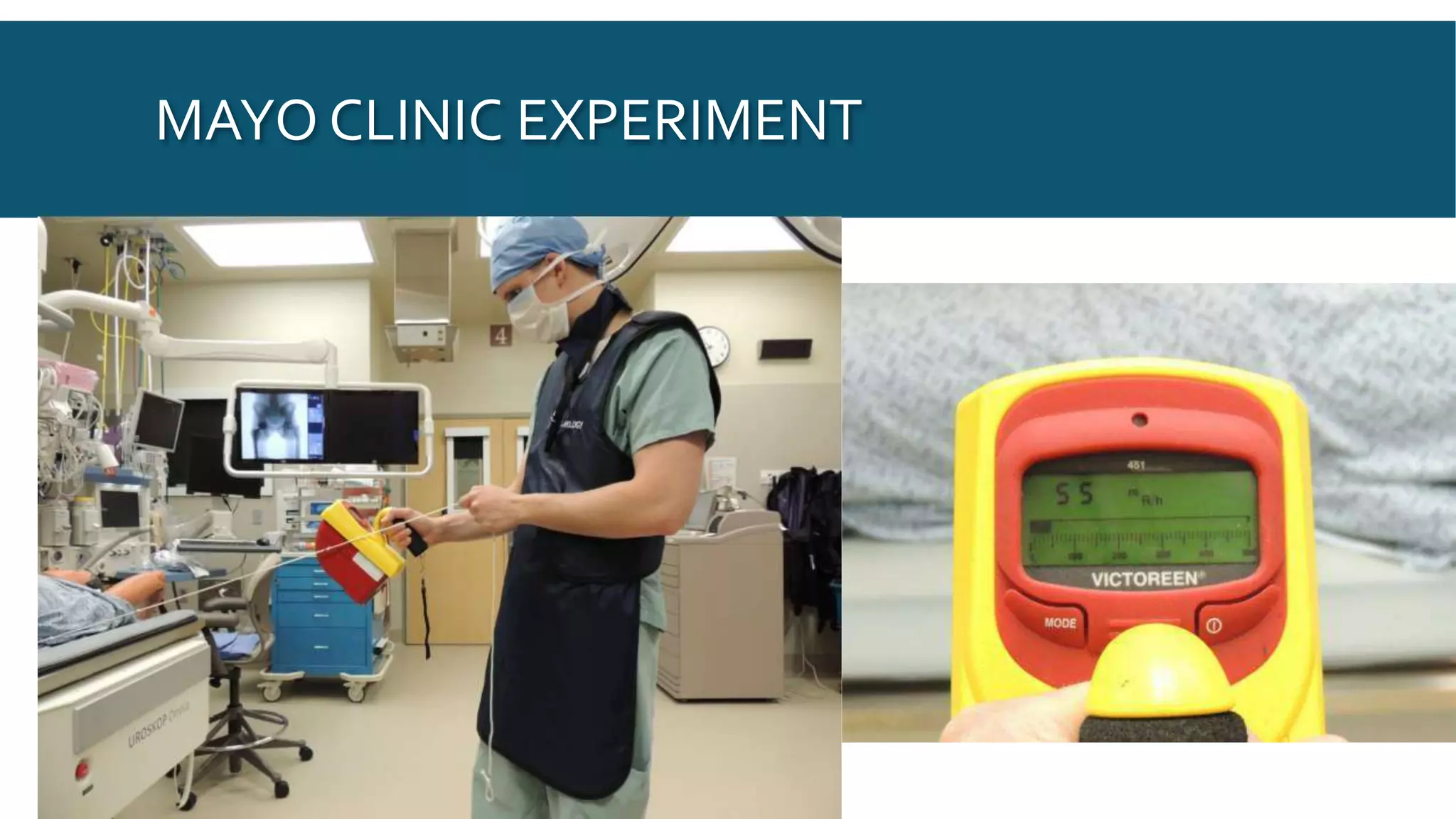
MAYO CLINIC EXPERIMENT
SCATTER
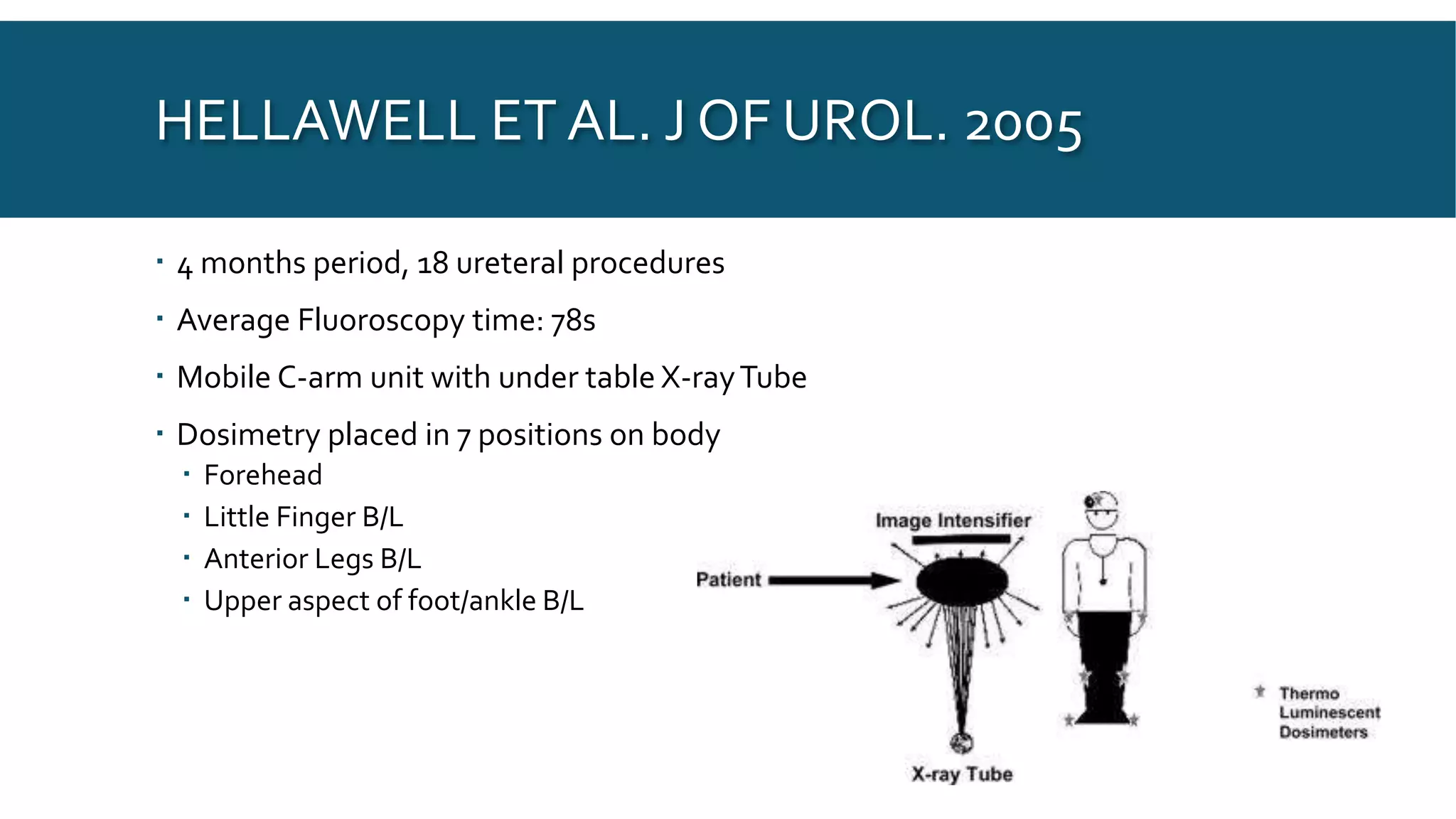
HELLAWELL ET AL. J OF UROL. 2005
 4 months period, 18 ureteral procedures
 Average Fluoroscopy time: 78s
 Mobile C-arm unit with under table X-rayTube
 Dosimetry placed in 7 positions on body
 Forehead
 Little Finger B/L
 Anterior Legs B/L
 Upper aspect of foot/ankle B/L
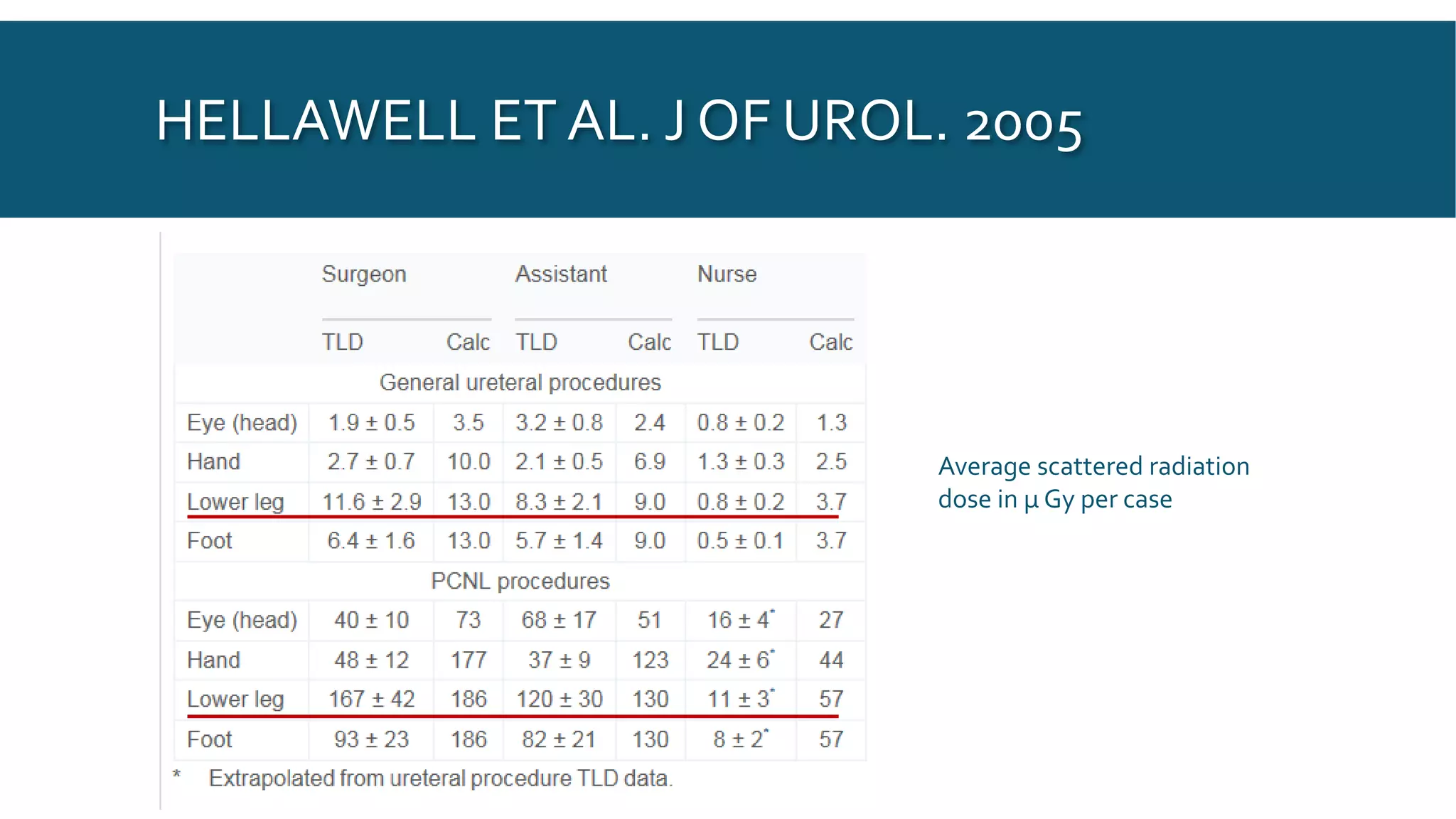
HELLAWELL ET AL. J OF UROL. 2005
Average scattered radiation
dose in μ Gy per case
PROTECTIONS
 Standard Lead jacket requires 0.35mm thickness
 Does not prevent absolutely
 But
 Reduces transmission by up to 100 fold
 0.25mm allow 10% radiation transmission
 0.5mm allows 2% of radiation transmission
 Leaded eyewear
 Leaded Gloves
 Wear Dosimeters
Hellawell G, et al. J Urol 174, 948; 2005.
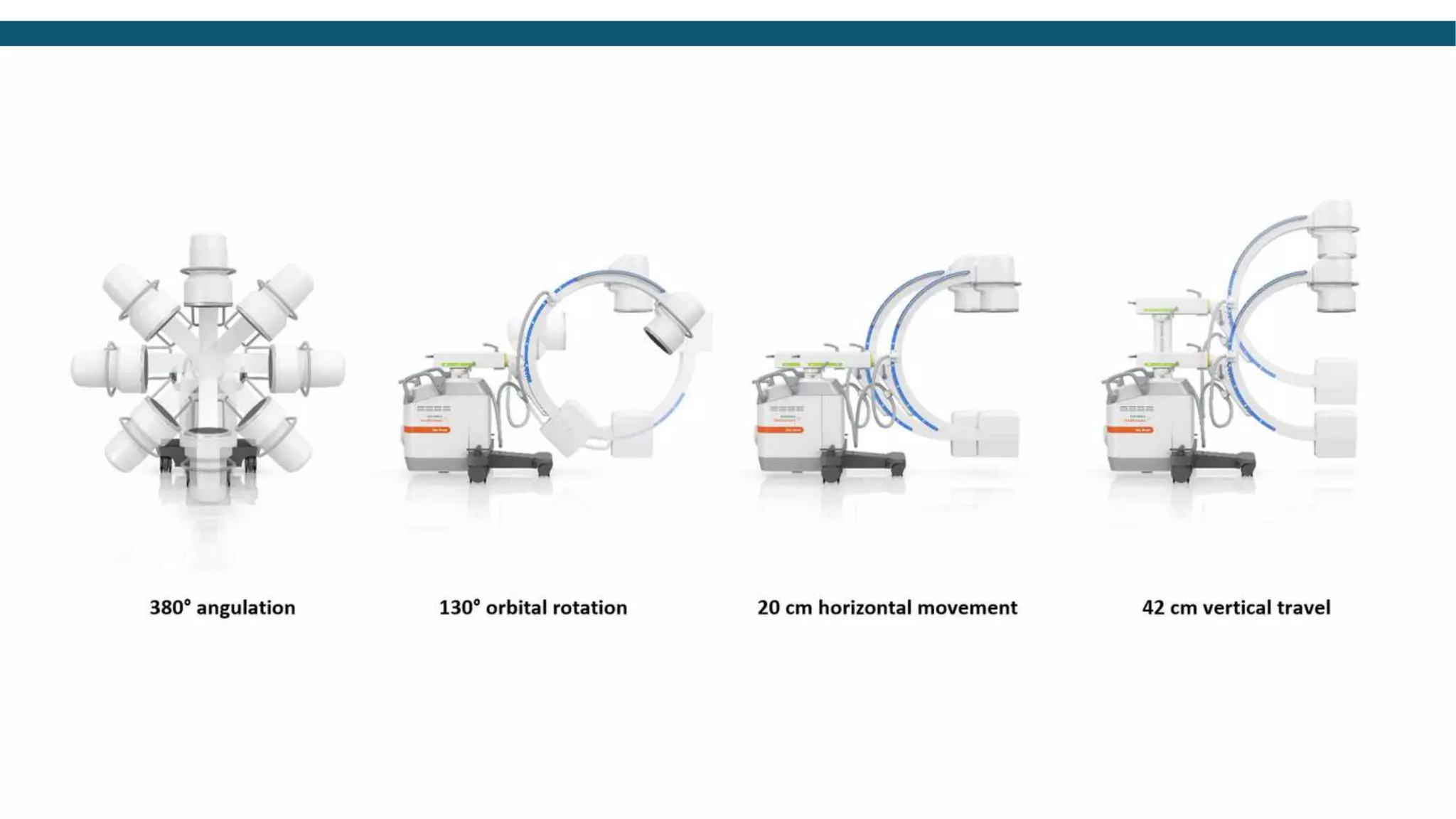
KNOWYOUR EQUIPMENT
 Low dose rate setting
 Minimize use of Cine mode
 Collimate the beam
 Use magnification as little as possible
 Image intensifier as close to patient as possible
 Keep field clean of radiodense objects, such as metallic objects, as these increases
scatter by reflection.
Image Intensifier
X ray Source
Collimator
Filter
4 Axis Direction Control
Monitor
Exposure Indicator Light
X ray Generator
Control Panels
PROCEDURAL CONTROL
 Mark Body surface forTargetting
 Coning of radiation field
 Radioprotective draping of patient
 Laser guided C-arm
ALTERNATIVE IMAGING
 Air Nephrogram V/S Contrast
 50% decrease in radiation exposure
 Ultrasonography
 Less costs
 Sensitivity: 48%
 Specificity: 88%
 PCNL Guidance: reduced Fluoroscopy time from 28.6s to 14.4s
BasiriA, et al. J Endourol , 22:281;
Alan C, et al. Urol Res, 39:205; 2011.
TAKE HOME MESSAGE
 Urologist are at a significant risk of exposure to radiation
 But risks can be reduced by taking appropriate precautions
 Ionizing radiation mainly used in stone removing procedures
 Wearing lead jacket is just a part of preventive measures to be taken
Radiation exposure in urology

Radiation exposure in urology

  • 1.
    RADIATION EXPOSURE IN UROLOGY DR.PRAMESH PRASAD SHRESTHA FCPS RESIDENT DEPARTMENTOF UROLOGY
  • 2.
    WHAT IS RADIATION? Emission or transmission of energy in the form of waves or particles through space or through a material medium.
  • 4.
    SO,WHY AREWEWORRIED?  Typesof Radiation:  Gravitational Radiation  Acoustic Radiation  Particle Radiation  Electromagnetic radiation
  • 5.
    SO,WHY AREWEWORRIED?  Typesof Radiation:  Gravitational Radiation  Acoustic Radiation  Electromagnetic radiation  Particle Radiation
  • 6.
    SO,WHY AREWEWORRIED?  Typesof Radiation:  Gravitational Radiation  Acoustic Radiation  Electromagnetic radiation  Particle Radiation
  • 7.
    SO,WHY AREWEWORRIED?  Typesof Radiation:  Gravitational Radiation  Acoustic Radiation  Electromagnetic radiation  Particle Radiation
  • 8.
    SO,WHY AREWEWORRIED?  Typesof Radiation:  Gravitational Radiation  Acoustic Radiation  Electromagnetic radiation  Particle Radiation β
  • 9.
    SO,WHY AREWEWORRIED?  Whenexposed to Ionizing radiation  Causes changes in the cell division process of the body by affecting DNA structure  Damages protein structure of cells  Direct damage to tissues  The generic term for the detrimental effects of Radiation is termed as ACUTE RADIATION SYNDROME RADIATION SICKNESS
  • 10.
    TERMINOLOGY  Ionizing Radiation: Radiation from an source with enough energy to separate the subatomic particles and is a known Carcinogen  Deterministic effect:  Describes the cause and effect relationship of Ionizing Radiation  Also known as Non-Stochastic Effect,  Dependent upon dose, dose rate, dose fractionation, irradiated volume and type of radiation Skin Erythema 2-5 Gy Irreversible Skin Damage 20-40Gy Hair loss 2-5 Gy Sterility 2-3 Gy Cataracts 0.5 -5Gy Lethality 3-5GyWhole body Fetal Abnormality 0.1-0.5 Gy
  • 11.
    TERMINOLOGY  Stochastic Effect: Effect the occurs by chance  No threshold, not dependent upon dose  Caused by Mutational changes in cell DNA, Cell still remains viable after radiation effect  Increased level of exposure does not effect severity of disease but affect the probability of development  Example:Cancer Induction
  • 12.
    TERMINOLOGY  Absorbed Dose:Amount of radiation in theTissues  Measured in Gray (Gy)  Equivalent dose: Absorbed dose in a specific organ or tissue  Exposure: Number of ions produced by X-rays per Kilogram of air  Measured in Roentgen (R)  Effective Dose: Reflects whole body exposure/Radiation present in the environment  Measured in rem or Sievert (Sv)  Dose area product (DAP): Radiation dose to air multipled by the are of X-ray field  Measured in Gy*cm2
  • 13.
    THRESHOLD  European Union Effective Dose limit is 100mSv over 5 years  No more than 50mSv in any one year  United States of America  Effective dose limit of 50mSv in one year  Lifetime limit of 10mSv x Age (Years)  International Commission on Radiological Protection  No more than 20mSv/yr over 5 years  No more than 50mSv in one year
  • 14.
    BACKGROUND  X rayshas been used to diagnosed diseases in the kidney and urinary tract for about a century  However, use of Fluoroscopy is relatively new  Since the advent of Lithotripsy, use of CT has been increasing for mapping the anatomy, diagnosis of diseases  A number of procedures, like PCNL, RIRS, Stent placement, ESWL,Tumor ablation require fluoroscopy or other form of ionizing radiation.  In the United states; Per capita exposure to radiation has increased from 0.54mSv in 1980 TO 3.0mSv in 2006 600% increase
  • 16.
    RISKS IN UROLOGY- PATIENTS  Mainly in stone patients  Ranging from 1.18 to 37.66 mSv  Acute Stone episode patients undergo 1 – 4 radiographic studies in 1 year period after stone event  Obesity increases mean Effective Dose by 177%  BMI 30-39.9 Kg/m2 = twofold increase in Effective Dose  BMI >40 kg/m2 =Threefold increase in Effective Dose ChenTT, et al. J Urol, 194:878; 2015.
  • 17.
    SURGICAL MANAGEMENT -URS  Non obese Males are exposed to a median 1.13 mSv  Median Fluoroscopy time 46.95 Seconds  Median Stone burden 5mm Preminger et al. J Urology. March 2012.
  • 18.
    SURGICAL MANAGEMENT -PCNL  Mean Effective Dose for Right PCNL: 7.63 mSv  Mean Effective Dose for Left PCNL: 8.11 mSv  Risks for increased Exposure:  High BMI,  Increased Stone Burden  Increased number of access tracts Preminger et al. J Urology. March 2012.
  • 19.
    SURGICAL MANAGEMENT -ESWL  Mean total effective dose: 1.71 mSv in males  Mean total effective dose: 1.82 mSv in females Lipkin et al. J Urol 2015; 194: 878 885
  • 20.
    EXPOSURE FROM IMAGINGIN UROLOGY Modality Exposure Conventional NCCT 10-20 mSv Stone Protocol NCCT 3.04 mSv Low dose CT 1.40-1.97 mSv Ultralow dose CT <1 mSv X-Ray KUB 0.63 – 1.1 mSv CT IVP 3.0 mSv DigitalTomosynthesis 0.83 mSv
  • 21.
    RISKS IN UROLOGY- SURGEONS  Radiation exposure: arises due to scatter from the beam, patient and operating table  Lens of the eye is most radiosensitive  >10mSv of exposure (cumulative) in 1 year increases lifetime risk of fatal cancer by 3%  >20mSV of exposure in 1 year increases risk of fatal cancer between 1:1000 and 1: 10000  Risk of fatal malignancy in general population is 1:500000 Hanna L, et al. J Endo, 29: 526; 2015.
  • 22.
    WHAT CANYOU DO? ALARA  Protect yourself  Know your equipment  Procedural control  Alternative imaging  Adjunctive techniques
  • 23.
    ALARA  AS LOWAS REASONABLY ACHIEVABLE  Reduce Radiation exposure  Time: minimize “Beam-On”Time  Distance: Double the distance from the source, exposure dose is 1/4th  Shielding: lightweight, radioprotective clothing  Scatter  Affected by patient size, position, settings on the machine, shielding, filtration, angulation.
  • 24.
  • 25.
  • 26.
  • 27.
  • 28.
    HELLAWELL ET AL.J OF UROL. 2005  4 months period, 18 ureteral procedures  Average Fluoroscopy time: 78s  Mobile C-arm unit with under table X-rayTube  Dosimetry placed in 7 positions on body  Forehead  Little Finger B/L  Anterior Legs B/L  Upper aspect of foot/ankle B/L
  • 29.
    HELLAWELL ET AL.J OF UROL. 2005 Average scattered radiation dose in μ Gy per case
  • 30.
    PROTECTIONS  Standard Leadjacket requires 0.35mm thickness  Does not prevent absolutely  But  Reduces transmission by up to 100 fold  0.25mm allow 10% radiation transmission  0.5mm allows 2% of radiation transmission  Leaded eyewear  Leaded Gloves  Wear Dosimeters Hellawell G, et al. J Urol 174, 948; 2005.
  • 31.
    KNOWYOUR EQUIPMENT  Lowdose rate setting  Minimize use of Cine mode  Collimate the beam  Use magnification as little as possible  Image intensifier as close to patient as possible  Keep field clean of radiodense objects, such as metallic objects, as these increases scatter by reflection.
  • 32.
    Image Intensifier X raySource Collimator Filter 4 Axis Direction Control Monitor Exposure Indicator Light X ray Generator Control Panels
  • 35.
    PROCEDURAL CONTROL  MarkBody surface forTargetting  Coning of radiation field  Radioprotective draping of patient  Laser guided C-arm
  • 36.
    ALTERNATIVE IMAGING  AirNephrogram V/S Contrast  50% decrease in radiation exposure  Ultrasonography  Less costs  Sensitivity: 48%  Specificity: 88%  PCNL Guidance: reduced Fluoroscopy time from 28.6s to 14.4s BasiriA, et al. J Endourol , 22:281; Alan C, et al. Urol Res, 39:205; 2011.
  • 37.
    TAKE HOME MESSAGE Urologist are at a significant risk of exposure to radiation  But risks can be reduced by taking appropriate precautions  Ionizing radiation mainly used in stone removing procedures  Wearing lead jacket is just a part of preventive measures to be taken

Editor's Notes

  • #6 Gravitational radiation is generated, when a particle has enough energy be expelled form the source at the speed of light, and is able to change the fabric of time and space. This was previously though to be theoretical and was proposed by albert Einstein on 1916, and was only recently proven by the Hadron Collider and the discovery of the higgs boson particle. It is createdin small amounts by planets and star, and are largely created by black holes
  • #7 Acoustic Radiation includes Sound wave released by objects because of their specific vibration. Also included sound emitted by speakers, ultrasounds and seismic waves and requires a medium for transmission Particle radiation are formed when an object receives enough energy for breaking up of the atom and formation of subatomic particles. Includes Alpha waves, when 2 Neutron and 2 protons expelled from the atom. These are low energy radiation, which is even blocked by the cloth fabric, but may cause detrimental effects if it is inhaled or ingested. Beta waves are a type of particle radiation when an electron is expelled form an atom. These are high energy radiation, which is 8000 times higher than alpha particles, it is blocked by most solid objects, but travels through skin and may cause radiation sickness. Electromagnetic radiation are energy radiation, in forms of waves and includes a variety of forms.
  • #8 Electromagnetic radiation are energy radiation, in forms of waves and includes a variety of forms. These are divided into ionizing and non ionizing radiations.
  • #9 Particle radiation are a type of ionizing radiation, other than electromagnetic radiation formed when an object receives enough energy for breaking up of the atom and formation of subatomic particles. Includes Alpha waves, when 2 Neutron and 2 protons expelled from the atom. These are low energy radiation, which is even blocked by the cloth fabric, but may cause detrimental effects if it is inhaled or ingested. Beta waves are a type of particle radiation when an electron is expelled form an atom. These are high energy radiation, which is 8000 times higher than alpha particles, it is blocked by most solid objects, but travels through skin and may cause radiation sickness. Gamma Rays are a type of electromagnetic radiation, which propel in form of waves of Photons and does not have any mass therefore, is able to pass through most solid structure including the human body.
  • #10 So, to answer the Question, “Why are we worried?”
  • #25 This was an experiment was done in the mayo clinic to measure the exposure in relation to the distance from the source. At 50cm distance, exposure was found to be 220 milliroentgen per hour
  • #26 At 100cm distance, exposure was found to be reduced to 55 milliroentgen per hour
  • #27 At 200cm distance, exposure was found to be 12.8 milliroentgen per hour
  • #28 All beams of electromagnetic waves, including visible light and and lionizing radiation likewise, has 3 methods of scattering. Reflection: has the highest dose of ionizing radiation, which is present under the table Refraction: and lower than those reflected doses, as part of the refracted dose is absorbed by the patient and the operating table.