URETHRAL CATHETERIZATION
DR. PRAMESH PRASAD SHRESTHA
FCPS (UROL) RESIDENT
DEPARTMENTOF UROLOGY
NEPAL MEDICITI
OVERVIEW
 WHAT – DEFINITION,TYPES
 WHERE – ANATOMY
 WHY, WHEN – INDICATIONS AND CONTRAINDICATIONS
 WHO – STAFFS
 HOW –
 PREREQUISITES
 TECHNIQUES
 POST REQUISITES
 COMPLICATIONS
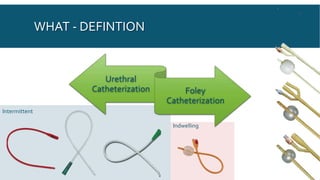
WHAT - DEFINTION
Urethral
Catheterization Foley
Catheterization
WHAT - DEFINTION
Intermittent
Indwelling
Urethral
Catheterization Foley
Catheterization
WHAT - DEFINTION
Urethral
Catheterization Foley
Catheterization
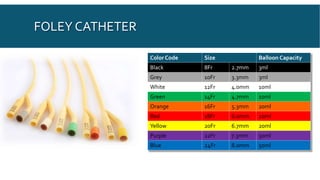
FOLEY CATHETER
Color Code Size Balloon Capacity
Black 8Fr 2.7mm 3ml
Grey 10Fr 3.3mm 3ml
White 12Fr 4.0mm 10ml
Green 14Fr 4.7mm 10ml
Orange 16Fr 5.3mm 20ml
Red 18Fr 6.0mm 20ml
Yellow 20Fr 6.7mm 20ml
Purple 22Fr 7.3mm 50ml
Blue 24Fr 8.0mm 50ml
ANATOMY
Bladder
Urethra
External
Urethral
Meatus
Vaginal
Opening
Prostate
Gland
WHEN
Indications
 Acute or Chronic Urinary Retention
 Prostatomegaly
 Urethral strictures
 Urinary Incontinence
 Neurogenic Bladder
 Long / Major Surgeries
 Comatose Patients
 Instill intravesical medications
 Imaging purposes
 Bladder irrigation
Contraindications
 Urethral Injury
 “No Actual Indication”
WHO?
There is no greater satisfaction
to a human than to pass urine
when it is urgent!
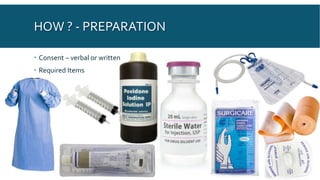
HOW ? - PREPARATION
 Consent – verbal or written
 Required Items
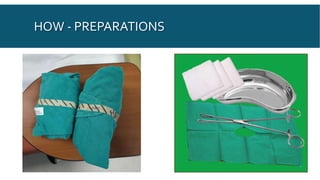
HOW - PREPARATIONS
HOW - PREPARATIONS
HOW - PREPARATIONS
TECHNIQUE
Step 1 CONSENT
EXPLAINTHE
PROCEDURE
Step 2 Wash
Hands
Step 3 Don Clean
Gloves
Clean
Genitalia
With
Normal
Saline
Non Sterile
Technique
Step 4 Wash
Hands
TECHNIQUE
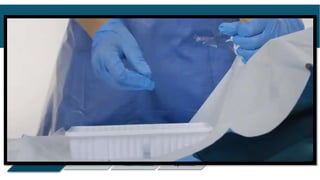
Step 5 Set up
Sterile field
Lay down
Equipment
Take SWFI
adequate
amount
Take
Betadine
Take Jelly in
sterile
method
Step 6 Don Sterile
Gown
Don Sterile
Gloves
Step 7 Test
Equipment
Inflate
Foley
balloon
Step 8 Painting
(3 swabs)
From
umbilicus
To mid
thighs
Retract
foreskin
Step 9 Draping EYETOWEL
TECHNIQUE
Step 10 Lubricate
urethra
Use a full tube of
2% lignocaine
jelly in males
Or at least 10 ml in a
syringe without a
needle
1ml per
cm of
Urethra
Step 11 WAIT
Use Penile
Clamp
Or, Grab the penis
anterio-posteriorly
Prevent
spillage
For at
least 2-5
minutes
TECHNIQUE
Step 12 Lubricate
Foley
Step 13 Hold the
penis at 90°
Straighten and
stretch the penis
slightly
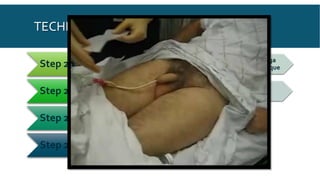
Step 14 Introduce the
catheter
Gentle
pressure
Step 15 Advance
Until theY-
shaped ports
reach meatus
Resistance
may be felt at
Sphincter
TECHNIQUE
Step 16
Wait for
urine to
drain
May be
delayed by
jelly
Aspirate with
syringe with
minimal force
Step 17
Once flow
of urine is
observed
Inflate
balloon
WITH SWFI
Should be
pain free
Step 18 Connect Urine
collection bag
Step 19 Retract
catheter
Until
resistance
Step 20 Fix
catheter
To medial or
anterior surface
of thigh
No tension
on the
catheter
Omega
Technique
Step 21 ROLLBACK FORESKIN
Step 22 Measure the urine
drained immediately
Step 23 Documentation
TECHNIQUE
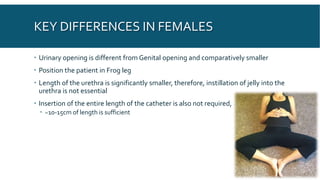
KEY DIFFERENCES IN FEMALES
 Urinary opening is different from Genital opening and comparatively smaller
 Position the patient in Frog leg
 Length of the urethra is significantly smaller, therefore, instillation of jelly into the
urethra is not essential
 Insertion of the entire length of the catheter is also not required,
 ~10-15cm of length is sufficient
TECHNIQUE
 Tips for Good Catheterization
 ALWAYS PROVIDE PROPER PRIVACYTO PATIENT
 Watch the patient’s face during each step
 Communicate with the patient and explain what you are doing
 DO NOT USE EXCESSIVE FORCE, EVER
REMOVAL OF CATHETER
COMPLICATIONS
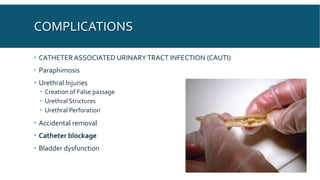
 CATHETER ASSOCIATED URINARY TRACT INFECTION (CAUTI)
 Paraphimosis
 Urethral Injuries
 Creation of False passage
 Urethral Strictures
 Urethral Perforation
 Accidental removal
 Catheter blockage
 Bladder dysfunction
COMPLICATIONS
 CATHETER ASSOCIATED URINARYTRACT INFECTION (CAUTI)
 Paraphimosis
 Urethral Injuries
 Creation of False passage
 Urethral Strictures
 Urethral Perforation
 Accidental removal
 Catheter blockage
 Bladder dysfunction
COMPLICATIONS
 CATHETER ASSOCIATED URINARYTRACT INFECTION (CAUTI)
 Paraphimosis
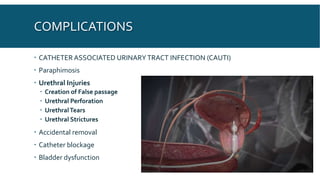
 Urethral Injuries
 Creation of False passage
 Urethral Perforation
 UrethralTears
 Urethral Strictures
 Accidental removal
 Catheter blockage
 Bladder dysfunction
COMPLICATIONS
 CATHETER ASSOCIATED URINARYTRACT INFECTION (CAUTI)
 Paraphimosis
 Urethral Injuries
 Creation of False passage
 Urethral Strictures
 Urethral Perforation
 Accidental removal
 Catheter blockage
 Bladder dysfunction
COMPLICATIONS
 CATHETER ASSOCIATED URINARYTRACT INFECTION (CAUTI)
 Paraphimosis
 Urethral Injuries
 Creation of False passage
 Urethral Strictures
 Urethral Perforation
 Accidental removal
 Catheter blockage
 Bladder dysfunction
COMPLICATIONS
 CATHETER ASSOCIATED URINARYTRACT INFECTION (CAUTI)
 Paraphimosis
 Urethral Injuries
 Creation of False passage
 Urethral Strictures
 Urethral Perforation
 Accidental removal
 Catheter blockage
 Bladder dysfunction
POST CATHETERIZATION CARE
 Clean the catheter with Normal Saline from EUM up to the Ports of the
catheter
 Clean Genitalia with Normal Saline
 Retract the Foreskin and remove all smegma,Then roll back the foreskin
again
 Wash penis and scrotum as well
 In females, wash the entire introitus including labial folds
 Keep the drainage system closed
POST CATHETERIZATION CARE
 Adequate hydration should be done to keep the urine dilute
 2-3L of oral water intake in normal adults unless contraindicated
 Patients can be allowed to shower with a catheter in place
 Always keep the Urobag below the level of the bladder to prevent reflux
 Keep the Urobag off the floor
 Catheter should not come below the patient’s body or legs
RED FLAGS
 Accidental removal of the catheter with an inflated balloon
 DO NOT REPLACE CATHETER
 Fever >101°F or 38.3 ° C
 No urine draining in the bag
 Foul smelling urine
 Bright red-coloured urine or large volume of clots
 Persistent Supra-pubic pain
THANKYOU!!

Foley catheterization

  • 1.
    URETHRAL CATHETERIZATION DR. PRAMESHPRASAD SHRESTHA FCPS (UROL) RESIDENT DEPARTMENTOF UROLOGY NEPAL MEDICITI
  • 2.
    OVERVIEW  WHAT –DEFINITION,TYPES  WHERE – ANATOMY  WHY, WHEN – INDICATIONS AND CONTRAINDICATIONS  WHO – STAFFS  HOW –  PREREQUISITES  TECHNIQUES  POST REQUISITES  COMPLICATIONS
  • 3.
  • 4.
  • 5.
  • 6.
    FOLEY CATHETER Color CodeSize Balloon Capacity Black 8Fr 2.7mm 3ml Grey 10Fr 3.3mm 3ml White 12Fr 4.0mm 10ml Green 14Fr 4.7mm 10ml Orange 16Fr 5.3mm 20ml Red 18Fr 6.0mm 20ml Yellow 20Fr 6.7mm 20ml Purple 22Fr 7.3mm 50ml Blue 24Fr 8.0mm 50ml
  • 7.
  • 8.
    WHEN Indications  Acute orChronic Urinary Retention  Prostatomegaly  Urethral strictures  Urinary Incontinence  Neurogenic Bladder  Long / Major Surgeries  Comatose Patients  Instill intravesical medications  Imaging purposes  Bladder irrigation Contraindications  Urethral Injury  “No Actual Indication”
  • 9.
    WHO? There is nogreater satisfaction to a human than to pass urine when it is urgent!
  • 10.
    HOW ? -PREPARATION  Consent – verbal or written  Required Items
  • 11.
  • 12.
  • 13.
  • 14.
    TECHNIQUE Step 1 CONSENT EXPLAINTHE PROCEDURE Step2 Wash Hands Step 3 Don Clean Gloves Clean Genitalia With Normal Saline Non Sterile Technique Step 4 Wash Hands
  • 15.
    TECHNIQUE Step 5 Setup Sterile field Lay down Equipment Take SWFI adequate amount Take Betadine Take Jelly in sterile method Step 6 Don Sterile Gown Don Sterile Gloves Step 7 Test Equipment Inflate Foley balloon Step 8 Painting (3 swabs) From umbilicus To mid thighs Retract foreskin Step 9 Draping EYETOWEL
  • 16.
    TECHNIQUE Step 10 Lubricate urethra Usea full tube of 2% lignocaine jelly in males Or at least 10 ml in a syringe without a needle 1ml per cm of Urethra Step 11 WAIT Use Penile Clamp Or, Grab the penis anterio-posteriorly Prevent spillage For at least 2-5 minutes
  • 17.
    TECHNIQUE Step 12 Lubricate Foley Step13 Hold the penis at 90° Straighten and stretch the penis slightly Step 14 Introduce the catheter Gentle pressure Step 15 Advance Until theY- shaped ports reach meatus Resistance may be felt at Sphincter
  • 18.
    TECHNIQUE Step 16 Wait for urineto drain May be delayed by jelly Aspirate with syringe with minimal force Step 17 Once flow of urine is observed Inflate balloon WITH SWFI Should be pain free Step 18 Connect Urine collection bag Step 19 Retract catheter Until resistance
  • 19.
    Step 20 Fix catheter Tomedial or anterior surface of thigh No tension on the catheter Omega Technique Step 21 ROLLBACK FORESKIN Step 22 Measure the urine drained immediately Step 23 Documentation TECHNIQUE
  • 20.
    KEY DIFFERENCES INFEMALES  Urinary opening is different from Genital opening and comparatively smaller  Position the patient in Frog leg  Length of the urethra is significantly smaller, therefore, instillation of jelly into the urethra is not essential  Insertion of the entire length of the catheter is also not required,  ~10-15cm of length is sufficient
  • 21.
    TECHNIQUE  Tips forGood Catheterization  ALWAYS PROVIDE PROPER PRIVACYTO PATIENT  Watch the patient’s face during each step  Communicate with the patient and explain what you are doing  DO NOT USE EXCESSIVE FORCE, EVER
  • 22.
  • 23.
    COMPLICATIONS  CATHETER ASSOCIATEDURINARY TRACT INFECTION (CAUTI)  Paraphimosis  Urethral Injuries  Creation of False passage  Urethral Strictures  Urethral Perforation  Accidental removal  Catheter blockage  Bladder dysfunction
  • 24.
    COMPLICATIONS  CATHETER ASSOCIATEDURINARYTRACT INFECTION (CAUTI)  Paraphimosis  Urethral Injuries  Creation of False passage  Urethral Strictures  Urethral Perforation  Accidental removal  Catheter blockage  Bladder dysfunction
  • 25.
    COMPLICATIONS  CATHETER ASSOCIATEDURINARYTRACT INFECTION (CAUTI)  Paraphimosis  Urethral Injuries  Creation of False passage  Urethral Perforation  UrethralTears  Urethral Strictures  Accidental removal  Catheter blockage  Bladder dysfunction
  • 26.
    COMPLICATIONS  CATHETER ASSOCIATEDURINARYTRACT INFECTION (CAUTI)  Paraphimosis  Urethral Injuries  Creation of False passage  Urethral Strictures  Urethral Perforation  Accidental removal  Catheter blockage  Bladder dysfunction
  • 27.
    COMPLICATIONS  CATHETER ASSOCIATEDURINARYTRACT INFECTION (CAUTI)  Paraphimosis  Urethral Injuries  Creation of False passage  Urethral Strictures  Urethral Perforation  Accidental removal  Catheter blockage  Bladder dysfunction
  • 28.
    COMPLICATIONS  CATHETER ASSOCIATEDURINARYTRACT INFECTION (CAUTI)  Paraphimosis  Urethral Injuries  Creation of False passage  Urethral Strictures  Urethral Perforation  Accidental removal  Catheter blockage  Bladder dysfunction
  • 29.
    POST CATHETERIZATION CARE Clean the catheter with Normal Saline from EUM up to the Ports of the catheter  Clean Genitalia with Normal Saline  Retract the Foreskin and remove all smegma,Then roll back the foreskin again  Wash penis and scrotum as well  In females, wash the entire introitus including labial folds  Keep the drainage system closed
  • 30.
    POST CATHETERIZATION CARE Adequate hydration should be done to keep the urine dilute  2-3L of oral water intake in normal adults unless contraindicated  Patients can be allowed to shower with a catheter in place  Always keep the Urobag below the level of the bladder to prevent reflux  Keep the Urobag off the floor  Catheter should not come below the patient’s body or legs
  • 31.
    RED FLAGS  Accidentalremoval of the catheter with an inflated balloon  DO NOT REPLACE CATHETER  Fever >101°F or 38.3 ° C  No urine draining in the bag  Foul smelling urine  Bright red-coloured urine or large volume of clots  Persistent Supra-pubic pain
  • 32.

Editor's Notes

  • #2 Good afternoon everyone and welcome to today’s talk on a topic that is so simple that it is performed on a daily basis in all wards but equally complex, that if something goes wrong, it can even lead to a permanent disability in a patient
  • #3 Today, we will be talking about what- that is the definition and types of catheterization, Where, the brief anatomy of relevant organs Why and when, that is the indications and contraindication of the procedure Who can perform the procedure and finally how and how not to perform the procedure.
  • #4 First things first, Urethral catheterization and foley catheterization are used synonymously, but are they the same?? Actually, they are not Urethral catheterization is the insertion of any catheter through the urethra for draining urine, washing the bladder or to instill medications in the bladder. Whereas Foley catheterization in insertion of specific type of catheter, that is the Foley catheter in some part of the body. Apart from Urethra, it can be used for cervical ripening during induction of labour, washing extradural hemorrahges in burrhole surgeries and also to stop epistaxis. Though not recommended, it can also be used as a Tourniquet.
  • #5 Urethral catheterization can be intermittent type, where the catheter is removed after the completion of the procedure. Commonly call in and out procedure. It can performed with Robinson’s catheter also known as the red rubber catheter The Nelaton’s catheter and the tiemann catheter. The second type is the indwelling type, where the catheter is left in situ after the procedure is completed for some time maximum of 2 weeks to 3 months, depending upon the type of material the catheter is made up of. It is most commonly done by using a Foley catheter
  • #6 The foley catheter is a self-retaining multi-lumen catheter, made from Natural latex rubber, polyurethane, Silver alloys and Silicone. It may be double-lumen and up to four lumens. In a double lumen catheter, one of the lumens is used for draining the bladder and the other one is used for inflating the balloon. The extra lumen in the triple lumen catheter is for connecting the irrigating fluid for washing the bladder. Recently there has been the development of various types of Foley catheters such as premedicated and silver-coated catheters to decrease the incidence of CAUTI, temperature sensing catheters to measure the temperature of the body through the bladder and also catheters with a drainage bag attached to it.
  • #7 These catheters come in different sizes. And like with all tubes whose sizes are measured in French, these catheters are also colour code labelled. The most commonly used foley catheters are labelled with green or orange, that is of 14Fr and 16Fr catheters.
  • #8 The knowledge of anatomy required for proper foley catheterization is what sets the male and female sexes apart. In both males and females, urethral catheterization involves the introduction of a catheter from the External urethral meatus through the urethra up to the bladder but. There are some key differences The urethra for one is around 4cm long in females whereas it is more than 6 times the length in males. The urinary and genital tracts open separately in females but are the same in males The urethra is essentially straight in females but the male urethra is S-shaped. The identification of the external opening may be difficult to an untrained eye in females but can be easily identified in males. Resistance can be felt in various location while catheterization in males but it is not so in females
  • #10 Who is entitled to perform urethral catheterization. Does he/she need to be an urologist? Normally NO A paramedic, A Nurse or Any doctor can perform this procedure. When they do this at the right time in the right place, they become superheroes in the eyes of the patient Because in the words of Wise Birbal, “there is no greater satisfaction to a human than to pass urine when it is urgent!”
  • #12 There are two sets that can be seen in the picture
  • #13 The first one is Dressing set It has a kidney tray, hemostat and toothed forceps with some gauze It has a one extra thing and a piece of essential equipment that is missing
  • #14 This is now a catheter set It has a sponge holding forceps, a kidney tray with some gauzes and an eye towel.
  • #24 Complications of catheterization include CAUTI or Catheter-associated urinary tract infection is one of the most common complications of catheterization. It can be prevented by using sterile techniques during catheterization, and in modern times, the use of pre-medicated catheters though not available in our set-up. Next is Iatrogenic Paraphimosis, which usually occurs due to failure or negligence of the person performing the procedure to roll back the foreskin after completion of the procedure. Simple rolling back of the foreskin will prevent this, however if paraphimosis does occur, manual reduction of the foreskin can be attempted in the ward, and if not successful, can be done under anesthesia. If that is still not successful, a dorsal slit will have to be made followed by circumcision once the swelling subsides.
  • #25 Next is Iatrogenic Paraphimosis, which usually occurs due to failure or negligence of the person performing the procedure to roll back the foreskin after completion of the procedure. The simple rolling back of the foreskin will prevent this, however, if paraphimosis does occur, manual reduction of the foreskin can be attempted in the ward, and if not successful, can be done under anaesthesia. If that is still not successful, a dorsal slit will have to be made followed by circumcision once the swelling subsides. Rarely Glans amputation or Penile amputation may be required if the distal penile tip is necrosed because of paraphimosis, usually seen in comatose patients.
  • #26 Urethral injury can occur during the course of the procedure or may develop as a reaction of the insult of the catheter some months later. False passages and urethral perforation are can occur when excessive force is exerted upon the catheter in a mechanically obstructed urethra Urethral tears can occur if the balloon is inflated within the lumen of the urethra Urethral strictures can form months later even with a clean procedure because of tissue reactions to micro insults that are bound to occur during catheterization. Patients usually have hematuria or scrotal swelling may occur due to urine leakage into the surrounding area. Treatment can be done for minor injuries by cystoscopy guided foley catheterization and prolonged catheterization. Some patients may even require urethroplasty or even lifelong urinary diversions. Urethral strictures can be treated effectively by urethral dilatations.
  • #27 Accidental removal or pulling the catheter is usually seen in mentally differently-abled patients with psychiatric disorders. Or it can happen if the balloon is punctured, which can be due to a manufacturing defect. If there is an accidental withdrawal of the catheter with an inflated balloon, it will result in urethral injuries, which may lead to the patient requiring urethroplasty or life-long urinary diversion. Therefore, one of the primary ways of preventing accidental removal is testing the equipment before insertion, using adequate anaesthetic and lubricating agents to avoid irritation to the urethra and fixing the catheter properly.
  • #28 Catheter blockage can be because of hematuria or Sediments. If the catheter is blocked, the blockage can be attempted to be removed by flushing the catheter with Irrigation syringe with NS. Or the catheter can be changed altogether Formation of sediments is only natural in patient with long term foley catheter can does not require taking any actions unless the patient is symptomatic for UTI or if the catheter is blocked.
  • #29 Bladder dysfunction may occur in a patient who has undergone catheterization for a long time. The bladder literally forgets how to do its job, hence the bladder needs to be trained to regain the function Bladder training can be done by removing the catheter of more than 7 days by clamping the catheter for 2 hours and releasing the clamp for 10 minutes and repeating the cycle for 24 hours or more as required except at night. Sometimes bladder training may be required even up to 7 days. However, in rare cases, bladder dysfunction may be prolonged and not relived by training alone. These cases can be diagnosed with Cystometrogram and can be attempted to be treated with CISC or clean intermittent self-catheterization. And just for your information, our institution has one of the most advanced Cystometrogram in the country and is a referral centre for the procedure.