DAMAGE CONTROL
ORTHOPEDICS
DR. PRAMESH PRASAD SHRESTHA
FCPS RESIDENT
DEPARTMENTOF ORTHOPEDICS
NOMENCLATURE
 NavyTerm
UNITED STATES NAVY
Emergency control of situations that may
cause the sinking of a warship.
INTRODUCTION
 Polytrauma
 Changed over the last decades
 Early 70s long bone fractures were mainly stabilized by traction.
 Numerous complications:
 pulmonary infections,
 atrophy of the musculature
 thromboembolic complications
1. Bone LB, Johnson KD,Weigelt J, Scheinberg R. Early versus delayed
stabilization of femoral fractures. A prospective randomized study. J
Bone Joint SurgAm. 1989;71(3):336-40
2. D'Alleyrand JC, O'Toole RV.The evolution of damage control
orthopedics: current evidence and practical applications of early
appropriate care. Orthop Clin North Am. 2013;44(4):499-507
INTRODUCTION
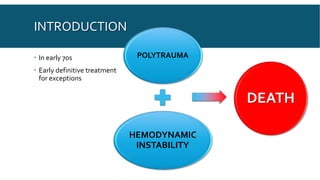
 In early 70s
 Early definitive treatment
for exceptions
POLYTRAUMA
HEMODYNAMIC
INSTABILITY
DEATH
INTRODUCTION
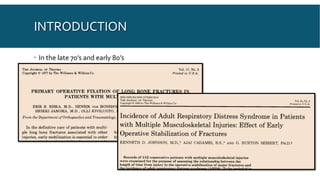
 In the late 70’s and early 80’s
INTRODUCTION
THOU SHALT
IMMEDIATELY FIX ALL
FRACTURES!
IT SHALL BE CALLED
EARLY TOTAL CARE
INTRODUCTION
 Draw backs of the study:
 Not appropriately randomized
 Cohorts too small
 Only significant finding was total cost of care
INTRODUCTION
 90’s era
 Challenging the dogma
Early fixation might be detrimental for several patient groups.
1. Giannoudis PV, Smith RM, Bellamy MC, Morrison JF, Dickson RA, Guillou PJ. Stimulation
of the inflammatory system by reamed and unreamed nailing of femoral fractures. An
analysis of the second hit. J Bone Joint Surg Br. 1999;81(2):356-61.
2. Rotondo MF, Schwab CW, McGonigal MD, PhillipsGR, 3rd, FruchtermanTM, Kauder DR,
et al. 'Damage control': an approach for improved survival in exsanguinating
penetrating abdominal injury. JTrauma. 1993;35(3):375-82; discussion 82-3
POLYTRAUMA
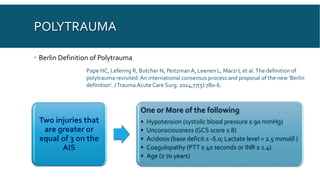
 Berlin Definition of Polytrauma
Pape HC, Lefering R, Butcher N, Peitzman A, Leenen L, Marzi I, et al.The definition of
polytrauma revisited: An international consensus process and proposal of the new 'Berlin
definition'. JTrauma Acute Care Surg. 2014;77(5):780-6.
Two injuries that
are greater or
equal of 3 on the
AIS
One or More of the following
• Hypotension (systolic blood pressure ≤ 90 mmHg)
• Unconsciousness (GCS score ≤ 8)
• Acidosis (base deficit ≤ -6.0; Lactate level > 2.5 mmol/l )
• Coagulopathy (PTT ≥ 40 seconds or INR ≥ 1.4)
• Age (≥ 70 years)
DAMAGE CONTROL ORTHOPEDICS
 The principle of DCO is to avoid worsening of the unstable polytraumatized
patient's condition that can result from the "second hit“
 Widely accepted for treatment of severely injured patients
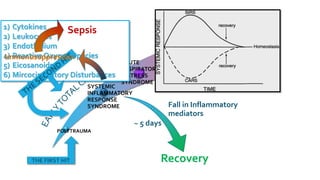
THE FIRST HIT
POLYTRAUMA
SYSTEMIC
INFLAMMATORY
RESPONSE
SYNDROME
ACUTE
RESPIRATORY
DISTRESS
SYNDROME
MULTI-ORGAN
FAILURE
DEATH
Fall in Inflammatory
mediators
~ 5 days
Recovery
1) Cytokines
2) Leukocytes
3) Endothelium
4) Reactive Oxygen Species
5) Eicosanoids
6) Mircocirculatory Disturbances
Immunosuppression
Sepsis
MARKERS OF IMMUNE AND
INFLAMMATORY REACTIONS
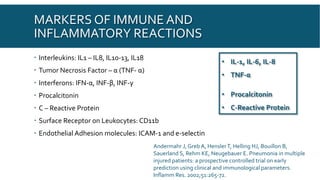
 Interleukins: IL1 – IL8, IL10-13, IL18
 Tumor Necrosis Factor – α (TNF- α)
 Interferons: IFN-α, INF-β, INF-γ
 Procalcitonin
 C – Reactive Protein
 Surface Receptor on Leukocytes: CD11b
 Endothelial Adhesion molecules: ICAM-1 and e-selectin
• IL-1, IL-6, IL-8
• TNF-α
• Procalcitonin
• C-Reactive Protein
Andermahr J, Greb A, HenslerT, Helling HJ, Bouillon B,
Sauerland S, Rehm KE, Neugebauer E. Pneumonia in multiple
injured patients: a prospective controlled trial on early
prediction using clinical and immunological parameters.
Inflamm Res. 2002;51:265-72.
GENETIC PREDISPOSITION
 “Preprogrammed” to have a hyperreaction to a traumatic insult.
 Polymorphism of the neutrophil receptor
 Mutations in cytokine genes
 Microsatellites polymorphism
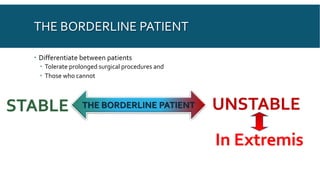
THE BORDERLINE PATIENT
 Differentiate between patients
 Tolerate prolonged surgical procedures and
 Those who cannot
STABLE UNSTABLE
THE BORDERLINE PATIENT
In Extremis
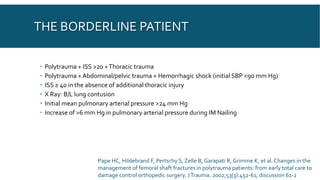
THE BORDERLINE PATIENT
 Polytrauma + ISS >20 +Thoracic trauma
 Polytrauma + Abdominal/pelvic trauma + Hemorrhagic shock (initial SBP <90 mm Hg)
 ISS ≥ 40 in the absence of additional thoracic injury
 X Ray: B/L lung contusion
 Initial mean pulmonary arterial pressure >24 mm Hg
 Increase of >6 mm Hg in pulmonary arterial pressure during IM Nailing
Pape HC, Hildebrand F, Pertschy S, Zelle B, Garapati R, Grimme K, et al. Changes in the
management of femoral shaft fractures in polytrauma patients: from early total care to
damage control orthopedic surgery. JTrauma. 2002;53(3):452-61; discussion 61-2
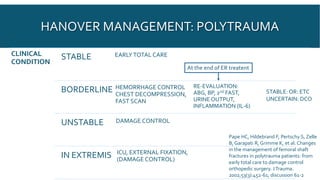
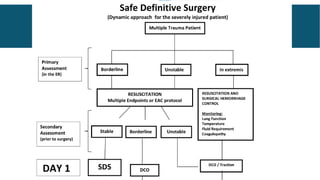
HANOVER MANAGEMENT: POLYTRAUMA
CLINICAL
CONDITION
STABLE EARLYTOTAL CARE
BORDERLINE HEMORRHAGE CONTROL
CHEST DECOMPRESSION,
FAST SCAN
RE-EVALUATION:
ABG, BP, 2nd FAST,
URINE OUTPUT,
INFLAMMATION (IL-6)
UNSTABLE DAMAGE CONTROL
IN EXTREMIS ICU, EXTERNAL FIXATION,
(DAMAGE CONTROL)
STABLE:OR: ETC
UNCERTAIN: DCO
Pape HC, Hildebrand F, Pertschy S, Zelle
B, Garapati R, Grimme K, et al. Changes
in the management of femoral shaft
fractures in polytrauma patients: from
early total care to damage control
orthopedic surgery. JTrauma.
2002;53(3):452-61; discussion 61-2
At the end of ER treatent
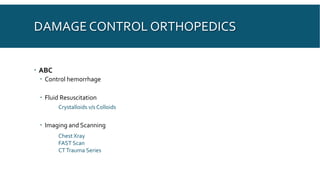
DAMAGE CONTROL ORTHOPEDICS
 ABC
 Control hemorrhage
 Fluid Resuscitation
 Imaging and Scanning
Chest Xray
FAST Scan
CTTrauma Series
Crystalloids v/s Colloids
DAMAGE CONTROL ORTHOPEDICS
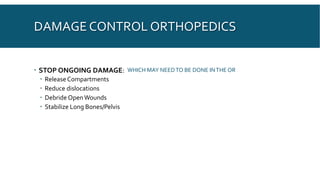
 STOP ONGOING DAMAGE:
 Release Compartments
 Reduce dislocations
 Debride OpenWounds
 Stabilize Long Bones/Pelvis
WHICH MAY NEEDTO BE DONE INTHE OR
DAMAGE CONTROL ORTHOPEDICS
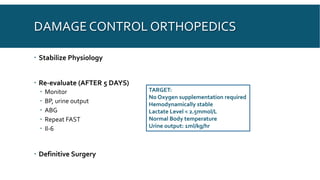
 Stabilize Physiology
 Re-evaluate (AFTER 5 DAYS)
 Monitor
 BP, urine output
 ABG
 Repeat FAST
 Il-6
 Definitive Surgery
TARGET:
No Oxygen supplementation required
Hemodynamically stable
Lactate Level < 2.5mmol/L
Normal Body temperature
Urine output: 1ml/kg/hr
TIMING OF DEFINITIVE PROCEDURE
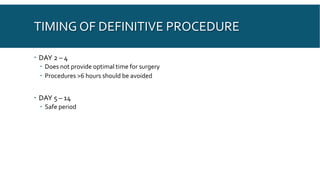
 DAY 2 – 4
 Does not provide optimal time for surgery
 Procedures >6 hours should be avoided
 DAY 5 – 14
 Safe period
WHY DAMAGE CONTROL?
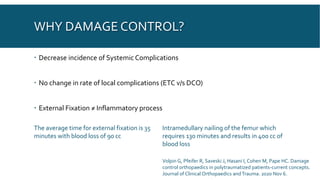
 Decrease incidence of Systemic Complications
 No change in rate of local complications (ETC v/s DCO)
 External Fixation ≠ Inflammatory process
The average time for external fixation is 35
minutes with blood loss of 90 cc
Intramedullary nailing of the femur which
requires 130 minutes and results in 400 cc of
blood loss
Volpin G, Pfeifer R, Saveski J, Hasani I, Cohen M, Pape HC. Damage
control orthopaedics in polytraumatized patients-current concepts.
Journal of Clinical Orthopaedics and Trauma. 2020 Nov 6.
DAMAGE CONTROL ORTHOPEDICS
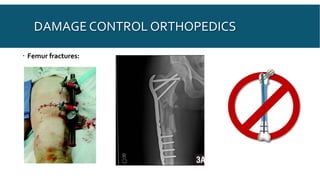
 Femur fractures:
DAMAGE CONTROL ORTHOPEDICS
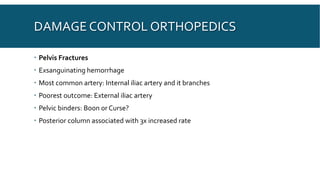
 Pelvis Fractures
 Exsanguinating hemorrhage
 Most common artery: Internal iliac artery and it branches
 Poorest outcome: External iliac artery
 Pelvic binders: Boon or Curse?
 Posterior column associated with 3x increased rate
DAMAGE CONTROL ORTHOPEDICS
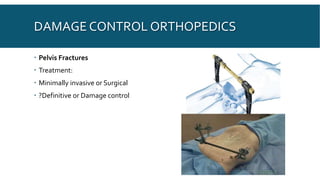
 Pelvis Fractures
 Treatment:
 Minimally invasive or Surgical
 ?Definitive or Damage control
DAMAGE CONTROL ORTHOPEDICS
 Geriatric Trauma
 Higher Mortality
 Threshold for Damage control should be low.
SPECIAL SITUATIONS
 Chest Injury
 Still controversial since 80’s
 No RCTs available
 A comparision of available study found no difference between ETC within 48 hours and
DCO and Definitive surgery later.
 Each patient should be individualized
 Decision should be based on other clinical parameters.
Dunham CM, et al; EAST Practice Management GuidelinesWork
Group. Practice guidelines for the optimal timing of long-bone
fracture stabilization in polytrauma patients: the EAST Practice
Management GuidelinesWork Group. JTrauma. 2001;50:958-67.
SPECIAL SITUATIONS
 Head Injury
 No Randomized clinical trials
 Out comes similar between ETC within 48 hours and DCO
 Conclusion:
 No compelling evidence that early long-bone stabilization either enhances or worsens
the patients neurological status, in head injury.
SPECIAL SITUATIONS
 Mangled Extremities
 LEAP Study
 A prospective, longitudinal, observational, outcomes study
 The LEAP data suggest an increasing trend toward limb salvage rather than
immediate amputation for complex open lower-extremity injuries
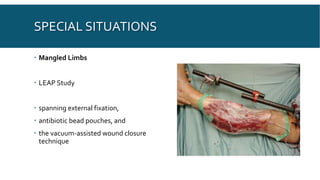
 The use of spanning external fixation, antibiotic bead pouches, and the vacuum-
assisted wound closure technique may provide a bridge to staged osseous
reconstruction and soft-tissue coverage procedures
SPECIAL SITUATIONS
 Mangled Limbs
 LEAP Study
 spanning external fixation,
 antibiotic bead pouches, and
 the vacuum-assisted wound closure
technique
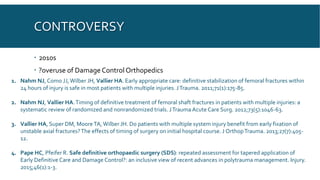
CONTROVERSY
 2010s
 ?overuse of Damage Control Orthopedics
1. Nahm NJ, Como JJ,Wilber JH, Vallier HA. Early appropriate care: definitive stabilization of femoral fractures within
24 hours of injury is safe in most patients with multiple injuries. JTrauma. 2011;71(1):175-85.
2. Nahm NJ, Vallier HA.Timing of definitive treatment of femoral shaft fractures in patients with multiple injuries: a
systematic review of randomized and nonrandomized trials. JTrauma Acute Care Surg. 2012;73(5):1046-63.
3. Vallier HA, Super DM, MooreTA,Wilber JH. Do patients with multiple system injury benefit from early fixation of
unstable axial fractures?The effects of timing of surgery on initial hospital course. J OrthopTrauma. 2013;27(7):405-
12.
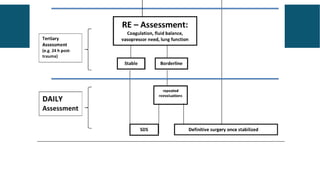
4. Pape HC, Pfeifer R. Safe definitive orthopaedic surgery (SDS): repeated assessment for tapered application of
Early Definitive Care and Damage Control?: an inclusive view of recent advances in polytrauma management. Injury.
2015;46(1):1-3.
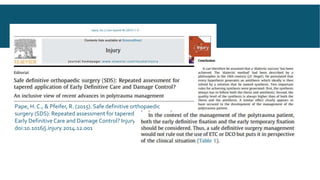
Pape, H. C., & Pfeifer, R. (2015). Safe definitive orthopaedic
surgery (SDS): Repeated assessment for tapered application of
Early Definitive Care and Damage Control? Injury, 46(1), 1–3.
doi:10.1016/j.injury.2014.12.001
TAKE HOME MESSAGE
 FRACTURE ALWAYS HAS A PATIENT ATTACHEDTO IT!
 Damage Control Orthopedics is a highly evolving topic, that has been changing
the management of polytrauma patients throughout the decades.
 Damage Control Orthopedics is a part of the Resuscitation process
 It has been shown to save lives
 Safe definitive surgery is a new concept, that puts both ETC and DCO in
prospective of the clinical condition of the patient.
FOR LISTENINGAND
FOR
GIVING ME AND
OPPURTUNITYTO
LEARN FROMTHIS
WONDERFUL
DEPARTMENT!

Damage control orthopedics

  • 1.
    DAMAGE CONTROL ORTHOPEDICS DR. PRAMESHPRASAD SHRESTHA FCPS RESIDENT DEPARTMENTOF ORTHOPEDICS
  • 2.
    NOMENCLATURE  NavyTerm UNITED STATESNAVY Emergency control of situations that may cause the sinking of a warship.
  • 3.
    INTRODUCTION  Polytrauma  Changedover the last decades  Early 70s long bone fractures were mainly stabilized by traction.  Numerous complications:  pulmonary infections,  atrophy of the musculature  thromboembolic complications 1. Bone LB, Johnson KD,Weigelt J, Scheinberg R. Early versus delayed stabilization of femoral fractures. A prospective randomized study. J Bone Joint SurgAm. 1989;71(3):336-40 2. D'Alleyrand JC, O'Toole RV.The evolution of damage control orthopedics: current evidence and practical applications of early appropriate care. Orthop Clin North Am. 2013;44(4):499-507
  • 4.
    INTRODUCTION  In early70s  Early definitive treatment for exceptions POLYTRAUMA HEMODYNAMIC INSTABILITY DEATH
  • 5.
    INTRODUCTION  In thelate 70’s and early 80’s
  • 6.
    INTRODUCTION THOU SHALT IMMEDIATELY FIXALL FRACTURES! IT SHALL BE CALLED EARLY TOTAL CARE
  • 7.
    INTRODUCTION  Draw backsof the study:  Not appropriately randomized  Cohorts too small  Only significant finding was total cost of care
  • 8.
    INTRODUCTION  90’s era Challenging the dogma Early fixation might be detrimental for several patient groups. 1. Giannoudis PV, Smith RM, Bellamy MC, Morrison JF, Dickson RA, Guillou PJ. Stimulation of the inflammatory system by reamed and unreamed nailing of femoral fractures. An analysis of the second hit. J Bone Joint Surg Br. 1999;81(2):356-61. 2. Rotondo MF, Schwab CW, McGonigal MD, PhillipsGR, 3rd, FruchtermanTM, Kauder DR, et al. 'Damage control': an approach for improved survival in exsanguinating penetrating abdominal injury. JTrauma. 1993;35(3):375-82; discussion 82-3
  • 9.
    POLYTRAUMA  Berlin Definitionof Polytrauma Pape HC, Lefering R, Butcher N, Peitzman A, Leenen L, Marzi I, et al.The definition of polytrauma revisited: An international consensus process and proposal of the new 'Berlin definition'. JTrauma Acute Care Surg. 2014;77(5):780-6. Two injuries that are greater or equal of 3 on the AIS One or More of the following • Hypotension (systolic blood pressure ≤ 90 mmHg) • Unconsciousness (GCS score ≤ 8) • Acidosis (base deficit ≤ -6.0; Lactate level > 2.5 mmol/l ) • Coagulopathy (PTT ≥ 40 seconds or INR ≥ 1.4) • Age (≥ 70 years)
  • 10.
    DAMAGE CONTROL ORTHOPEDICS The principle of DCO is to avoid worsening of the unstable polytraumatized patient's condition that can result from the "second hit“  Widely accepted for treatment of severely injured patients
  • 11.
    THE FIRST HIT POLYTRAUMA SYSTEMIC INFLAMMATORY RESPONSE SYNDROME ACUTE RESPIRATORY DISTRESS SYNDROME MULTI-ORGAN FAILURE DEATH Fallin Inflammatory mediators ~ 5 days Recovery 1) Cytokines 2) Leukocytes 3) Endothelium 4) Reactive Oxygen Species 5) Eicosanoids 6) Mircocirculatory Disturbances Immunosuppression Sepsis
  • 12.
    MARKERS OF IMMUNEAND INFLAMMATORY REACTIONS  Interleukins: IL1 – IL8, IL10-13, IL18  Tumor Necrosis Factor – α (TNF- α)  Interferons: IFN-α, INF-β, INF-γ  Procalcitonin  C – Reactive Protein  Surface Receptor on Leukocytes: CD11b  Endothelial Adhesion molecules: ICAM-1 and e-selectin • IL-1, IL-6, IL-8 • TNF-α • Procalcitonin • C-Reactive Protein Andermahr J, Greb A, HenslerT, Helling HJ, Bouillon B, Sauerland S, Rehm KE, Neugebauer E. Pneumonia in multiple injured patients: a prospective controlled trial on early prediction using clinical and immunological parameters. Inflamm Res. 2002;51:265-72.
  • 13.
    GENETIC PREDISPOSITION  “Preprogrammed”to have a hyperreaction to a traumatic insult.  Polymorphism of the neutrophil receptor  Mutations in cytokine genes  Microsatellites polymorphism
  • 14.
    THE BORDERLINE PATIENT Differentiate between patients  Tolerate prolonged surgical procedures and  Those who cannot STABLE UNSTABLE THE BORDERLINE PATIENT In Extremis
  • 15.
    THE BORDERLINE PATIENT Polytrauma + ISS >20 +Thoracic trauma  Polytrauma + Abdominal/pelvic trauma + Hemorrhagic shock (initial SBP <90 mm Hg)  ISS ≥ 40 in the absence of additional thoracic injury  X Ray: B/L lung contusion  Initial mean pulmonary arterial pressure >24 mm Hg  Increase of >6 mm Hg in pulmonary arterial pressure during IM Nailing Pape HC, Hildebrand F, Pertschy S, Zelle B, Garapati R, Grimme K, et al. Changes in the management of femoral shaft fractures in polytrauma patients: from early total care to damage control orthopedic surgery. JTrauma. 2002;53(3):452-61; discussion 61-2
  • 16.
    HANOVER MANAGEMENT: POLYTRAUMA CLINICAL CONDITION STABLEEARLYTOTAL CARE BORDERLINE HEMORRHAGE CONTROL CHEST DECOMPRESSION, FAST SCAN RE-EVALUATION: ABG, BP, 2nd FAST, URINE OUTPUT, INFLAMMATION (IL-6) UNSTABLE DAMAGE CONTROL IN EXTREMIS ICU, EXTERNAL FIXATION, (DAMAGE CONTROL) STABLE:OR: ETC UNCERTAIN: DCO Pape HC, Hildebrand F, Pertschy S, Zelle B, Garapati R, Grimme K, et al. Changes in the management of femoral shaft fractures in polytrauma patients: from early total care to damage control orthopedic surgery. JTrauma. 2002;53(3):452-61; discussion 61-2 At the end of ER treatent
  • 17.
    DAMAGE CONTROL ORTHOPEDICS ABC  Control hemorrhage  Fluid Resuscitation  Imaging and Scanning Chest Xray FAST Scan CTTrauma Series Crystalloids v/s Colloids
  • 18.
    DAMAGE CONTROL ORTHOPEDICS STOP ONGOING DAMAGE:  Release Compartments  Reduce dislocations  Debride OpenWounds  Stabilize Long Bones/Pelvis WHICH MAY NEEDTO BE DONE INTHE OR
  • 19.
    DAMAGE CONTROL ORTHOPEDICS Stabilize Physiology  Re-evaluate (AFTER 5 DAYS)  Monitor  BP, urine output  ABG  Repeat FAST  Il-6  Definitive Surgery TARGET: No Oxygen supplementation required Hemodynamically stable Lactate Level < 2.5mmol/L Normal Body temperature Urine output: 1ml/kg/hr
  • 20.
    TIMING OF DEFINITIVEPROCEDURE  DAY 2 – 4  Does not provide optimal time for surgery  Procedures >6 hours should be avoided  DAY 5 – 14  Safe period
  • 21.
    WHY DAMAGE CONTROL? Decrease incidence of Systemic Complications  No change in rate of local complications (ETC v/s DCO)  External Fixation ≠ Inflammatory process The average time for external fixation is 35 minutes with blood loss of 90 cc Intramedullary nailing of the femur which requires 130 minutes and results in 400 cc of blood loss Volpin G, Pfeifer R, Saveski J, Hasani I, Cohen M, Pape HC. Damage control orthopaedics in polytraumatized patients-current concepts. Journal of Clinical Orthopaedics and Trauma. 2020 Nov 6.
  • 22.
  • 23.
    DAMAGE CONTROL ORTHOPEDICS Pelvis Fractures  Exsanguinating hemorrhage  Most common artery: Internal iliac artery and it branches  Poorest outcome: External iliac artery  Pelvic binders: Boon or Curse?  Posterior column associated with 3x increased rate
  • 24.
    DAMAGE CONTROL ORTHOPEDICS Pelvis Fractures  Treatment:  Minimally invasive or Surgical  ?Definitive or Damage control
  • 25.
    DAMAGE CONTROL ORTHOPEDICS Geriatric Trauma  Higher Mortality  Threshold for Damage control should be low.
  • 26.
    SPECIAL SITUATIONS  ChestInjury  Still controversial since 80’s  No RCTs available  A comparision of available study found no difference between ETC within 48 hours and DCO and Definitive surgery later.  Each patient should be individualized  Decision should be based on other clinical parameters. Dunham CM, et al; EAST Practice Management GuidelinesWork Group. Practice guidelines for the optimal timing of long-bone fracture stabilization in polytrauma patients: the EAST Practice Management GuidelinesWork Group. JTrauma. 2001;50:958-67.
  • 27.
    SPECIAL SITUATIONS  HeadInjury  No Randomized clinical trials  Out comes similar between ETC within 48 hours and DCO  Conclusion:  No compelling evidence that early long-bone stabilization either enhances or worsens the patients neurological status, in head injury.
  • 28.
    SPECIAL SITUATIONS  MangledExtremities  LEAP Study  A prospective, longitudinal, observational, outcomes study  The LEAP data suggest an increasing trend toward limb salvage rather than immediate amputation for complex open lower-extremity injuries  The use of spanning external fixation, antibiotic bead pouches, and the vacuum- assisted wound closure technique may provide a bridge to staged osseous reconstruction and soft-tissue coverage procedures
  • 29.
    SPECIAL SITUATIONS  MangledLimbs  LEAP Study  spanning external fixation,  antibiotic bead pouches, and  the vacuum-assisted wound closure technique
  • 31.
    CONTROVERSY  2010s  ?overuseof Damage Control Orthopedics 1. Nahm NJ, Como JJ,Wilber JH, Vallier HA. Early appropriate care: definitive stabilization of femoral fractures within 24 hours of injury is safe in most patients with multiple injuries. JTrauma. 2011;71(1):175-85. 2. Nahm NJ, Vallier HA.Timing of definitive treatment of femoral shaft fractures in patients with multiple injuries: a systematic review of randomized and nonrandomized trials. JTrauma Acute Care Surg. 2012;73(5):1046-63. 3. Vallier HA, Super DM, MooreTA,Wilber JH. Do patients with multiple system injury benefit from early fixation of unstable axial fractures?The effects of timing of surgery on initial hospital course. J OrthopTrauma. 2013;27(7):405- 12. 4. Pape HC, Pfeifer R. Safe definitive orthopaedic surgery (SDS): repeated assessment for tapered application of Early Definitive Care and Damage Control?: an inclusive view of recent advances in polytrauma management. Injury. 2015;46(1):1-3.
  • 32.
    Pape, H. C.,& Pfeifer, R. (2015). Safe definitive orthopaedic surgery (SDS): Repeated assessment for tapered application of Early Definitive Care and Damage Control? Injury, 46(1), 1–3. doi:10.1016/j.injury.2014.12.001
  • 35.
    TAKE HOME MESSAGE FRACTURE ALWAYS HAS A PATIENT ATTACHEDTO IT!  Damage Control Orthopedics is a highly evolving topic, that has been changing the management of polytrauma patients throughout the decades.  Damage Control Orthopedics is a part of the Resuscitation process  It has been shown to save lives  Safe definitive surgery is a new concept, that puts both ETC and DCO in prospective of the clinical condition of the patient.
  • 36.
    FOR LISTENINGAND FOR GIVING MEAND OPPURTUNITYTO LEARN FROMTHIS WONDERFUL DEPARTMENT!

Editor's Notes

  • #3 The Term “Damage Control” was derived from the US NAVY term, which was used during the end of WWII, when the Japanese airforce bombed the pearl harbour. It meant…(click)
  • #4 Polytraumatic conditions are frequently life-threatening situations that require a special approach. The management of severely injured patient with fractures has changed over the last decades In the early 70s long bone fractures were mainly stabilized by traction (1). This concept was associated with numerous complications such as pulmonary infections, atrophy of the musculature and thromboembolic complications due to prolonged immobilization
  • #5 During that time, most patients who had poly trauma, usually had hemodynamic instability and eventually die And Early definitive treatment was performed on those few exceptions who did not die.
  • #6 In the late 70s and early 80, the First meaningful study was published in 1977, showing that early, definitive stabilization of long bone fractures reduced the incidence of the fat embolism syndrome compared to traditional non-surgical treatment And also in 1985, another article concluded that there was A significant increase in ARDS associated with a delay in fracture stabilization in patients with multiple injuries.
  • #7 Bone ET AL published a prospective randomized study and compared the clinical outcome after early (< 24 hours) and delayed (> 48 hours) femoral fracture fixation. This was a land-mark publication FOR early total care strategy. Which showed that Early total care was associated with less pulmonary complications and reduced lCU and hospital stay and And Early fracture fixation resulted in early mobilization, avoided nutritional depletion and long drug therapy and reduced wound infections Thus, ETC had become a standard approach in polytrauma in the 80s and early 90s. This strategy was further stimulated by advances of osteosynthesis techniques and implants over these decades. (click) Hence, the surgeons at the time, religiously followed the principal of Thou shalt immediately FIX ALL fractures, AND IT WAS CALL EARLY TOTAL CARE
  • #9 THEN CAME THE 90S ERA: Several authors, challenged the Dogma and criticized that early fixation might be detrimental for several patient groups. This method of combined surgical procedures may lead to development of an additional, secondary life-threatening inflammatory response reaction, which can cause an excessive inflammatory reaction known as the <click> "second hit" Then the damage control orthopedics was born.
  • #10 Damage control orthopedics which deals with poly trauma has a specific definition, known as the berlin definition, which was proposed in 2014 According to this, polytrauma is defined as..
  • #11 THE PRINCIPLE…
  • #12 In a patient with polytrauma, because of the <click> actions of the cytokines, leukocytes, endothelial changes, FREE OXYGEN RADICALS, eicosanoidsand and microcircularatory disturbances with the sub-sequent leukocyte-endothelial cell interactions there is inevitably a <click> Systemic inflammatory response syndrome, going on in the body. Naturally, <click> there is a gradual recovery of the normal physiology of the body after around 5 days with the fall in level of inflammatory mediators, mainly the IL-6 and IL-8, because of the Counter regulatory anti inflammatory response syndrome.<click> The balance between Counter regulatory anti inflammatory response and Systemic inflammatory response maintains the homeostasis of the body. When the effects of inflammation increases, the SIR is high which needs to brought back to normal by the action of Counter regulatory anti inflammatory response, which takes some time depending upon the severity of the injury. If the first hit itself is severe enough, the CARS may not be able to bring back homeostasis eventually leading to multi organ failure, even without second hit. However, in most cases, homeostasis is eventually maintained. <click> Several authors have demonstrated the immunosuppressive effect of trauma. Where there is decrease in the production of immunoglobulins and interferon and many patients thus have an increased risk of infections and of posttraumatic sepsis With these physiological and pathological changes happening in the body<click> with Early Total Care in these unstable patients, there may be a significant increase the severity of this systemic inflammatory response (SIRS) and may lead to <click> development of acute respiratory distress syndrome (ARDS) and <click> subsequently multiple organ failure (MOF), carrying a relatively high incidence of morbidity and <click> mortality
  • #13 IL-1, IL-6, IL-8, TNF-α, Procalcitonin and C-reactive protein, has been frequenty used for evaluating the inflammatory reaction in the body however, markers other than IL6 has not been shown to be reliable markers.
  • #14 There may also be genetic predisposition to development of complications following trauma Polymorphism of the neutrophil receptor, mainly for IgG and CD16 Mutations of Cytokine genes, mainly of TNF ,IL6 and IL10 And Microsatellites polymorphism has been found to be related to hyperreactivity to trauma If these gene mutations could be identified early, it may indicate the patient at risk of complications and help in clinical decision making
  • #15 Damage control orthopedics is widely accepted for the treatment of severely injured patients. However, there is a need to differentiate between those who can withstand prolonged surgical procedures and the following body response and those who cannot There are many scoring scales for trauma patients, like Abbreviated Injury scale, ISS, GCS., that help in stratifying these patients. And patient are classified in 4 categories Stable, unstable and in Extremis patients are fairly easy to be differentiated, however, there may be a large gap between stable and unstable categories, within which lies the borderline patients
  • #16 The borderline patient is defined as patients with either one
  • #17 The hanover management protocol has been proposed for the management of patients in different categories.
  • #18 Coming to the management of patients, Damage control orthopedics should be considered as the part of the resuscitation process. ABC of the patient is examined and managed as required Fluid resuscitation is usually required, However, there is controversy between infusion of Crystalloids and colloids. Infusion of Crystalloids has been associated with high volume requirement for replenishment and associated with development of ARDS in the future, whereas colloids are associated with more immediate complications such as allergic and incompatibility reactions. Imaging is done if necessary once the patient is hemodynamically stable
  • #21 DOES NOT PROVIDE optimal time for surgery as the body is undergoing intense response to primary trauma, AS MARKED IMMUNE AND INFLAMMATORY REACTIONS ARE GOING ON IN THE BODY Day 5-14 is the safe period for procedure, provided that the patient is hemodynamically stable.
  • #22 Even if patient has high ISS there is a significant reduction in the incidence of general systemic complications (ARDS, MOF) DCO was not associated with any increased rate of local complications such as pintract infections, delayed unions or non-unions. The external fixation used to stabilize the fracture does not induce significant inflammatory response
  • #23 Femur fractures with Polytrauma are automatically not treated with IM Nails because of its association with multiple complications and bilateral femoral nailing has even higher rate mobidity and mortality to its credit. Waiting for a few days ideal in these patients and until then, fractures can be stabilized with External fixating devices, followed by ORIF with Plating or if patient is then stable enough , <click> IMIL can be considered
  • #24 Fractures of the Pelvis is frequently associated with excessive hemorrhages, therefore damage control surgery for control of hemorrhage may be needed. Bleeding can be osseous, venous, arterial or a combination of any. Pelvic binders used in the ER, helps in stabilizing the pelvis, however, it may give a false picture producing a misleading Xray, by decreasing pelvic volume, realigning pelvis and producing benign looking Xray
  • #25 For treatment, control of hemorrhage: can be minimally invasive by interventional radiology and embolization or by open surgery. Some author advocate definitive surgery by plating if open surgery is required for controlling hemorrhage Otherwise pelvis can be stabilized with use of Ganz Pelvis Clamp, External fixator
  • #26 Geriatric patient require specialized care because of higher mortality associated with age in trauma.
  • #27 The choice between ETC and DCO in patient with thoracic injury is still controversial. However, it has been noted that there has been no RCTs available for the treatment of polytrauma with chest injury A comparision of available study found similar rates of mortality, ARDS, mechanical ventilator requirements, length of ICU stay and hospital stay between patient undergoing ETC within 48 hours and patient undergoing DCO and definitive surgery later
  • #28 NO RCT available regarding treatment in cases of head injury Based on the available studies, outcomes were found to be similar in polytrauma cases with long bone fracture along with mild, moderate or severe head injury undergoing early total care within the first 48 hours and definitive surgery later on.
  • #29 Low extremity assessment project or LEAP study
  • #30  The use of spanning external fixation, antibiotic bead pouches, and the vacuum-assisted wound closure technique may provide a bridge to staged osseous reconstruction and soft-tissue coverage procedures
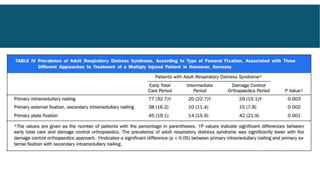
  • #31 This table shows the number of patients who developed ARDS amongst those who underwent different modalities of definitive management in different time period. ETC time period is from time of trauma to 48 hours. Intermediate period is from 2 to 4 days and DCO period is from 5 to 14 days You can see that the least percentage of ARDS in all three time period, is found in patient who undergo Primary external fixation and secondary IM nailing
  • #33 This article, published by Pape, in 2015. gives the concept of Safe definitive orthopedic surgery. The author was one of the strongest advocate of DCO in the 2000s era with multiple articles supporting DCO was published. this article, concludes that…<click>