Radiation
Radiation
Dr. Rasha Salama
PhD Community Medicine
Suez Canal University
Egypt
Definition of Radiation
“
“Radiation is an energy in the form of
Radiation is an energy in the form of
electro-magnetic waves or particulate
matter, traveling in the air.”
Forces: There are many interactions
among nuclei. It turns out that there are
forces other than the electromagnetic
force and the gravitational force which
govern the interactions among nuclei.
Einstein in 1905m showed 2 more laws:
energy/mass, and binding energy
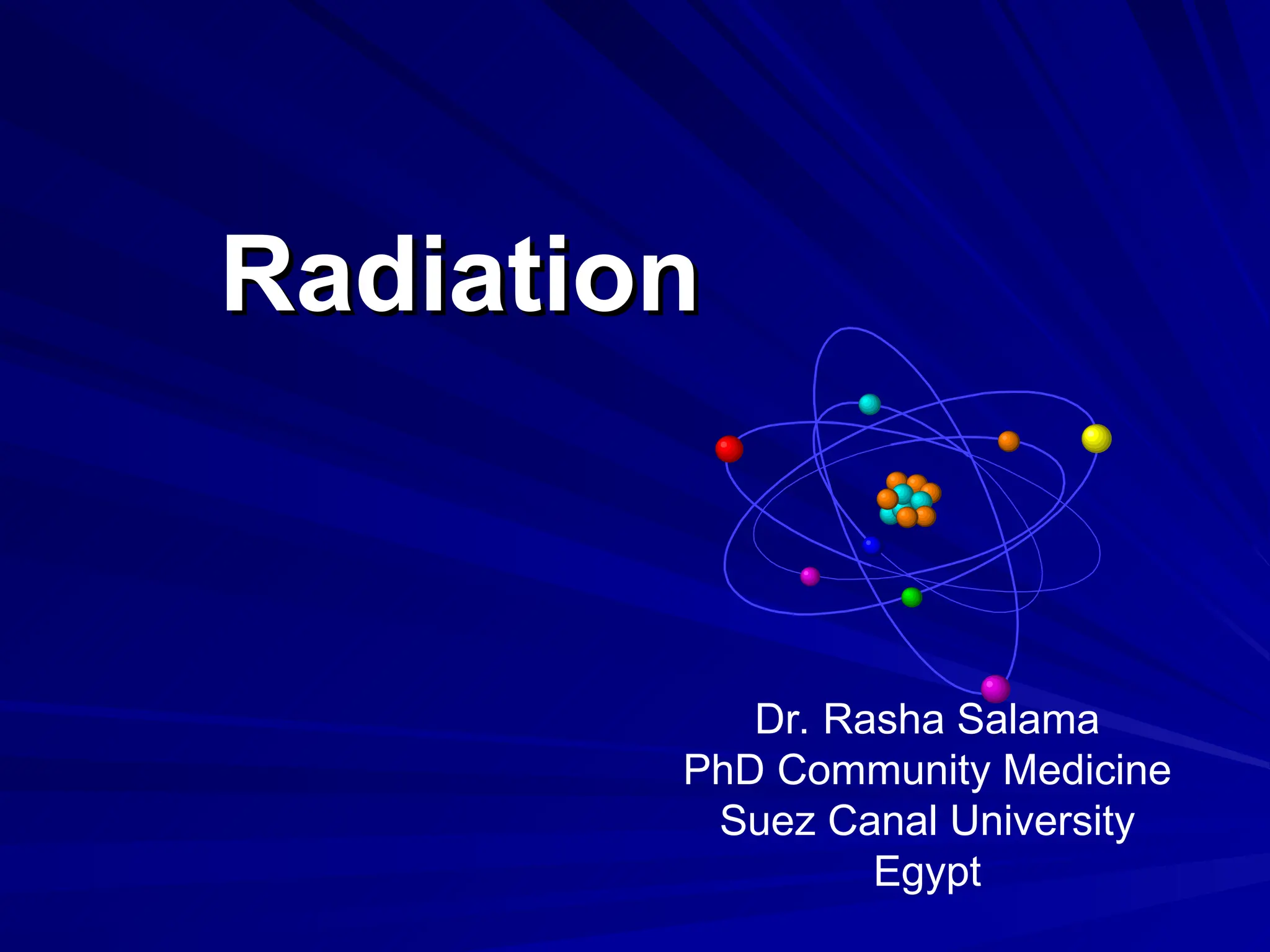
Radioactivity: Elements & Atoms
Atoms are composed of smaller
particles referred to as:
– Protons
Protons
– Neutrons
Neutrons
– Electrons
Electrons
Basic Model of a Neutral Atom.
Electrons
Electrons (-)
(-) orbiting nucleus of protons
orbiting nucleus of protons
(+)
(+) and neutrons. Same number of
and neutrons. Same number of
electrons as protons; net charge = 0.
Atomic number
Atomic number (number of protons)
(number of protons)
determines element.
determines element.
Mass number
Mass number (protons + neutrons)
(protons + neutrons)
Radioactivity
If a nucleus is unstable for any reason, it
will emit and absorb particles. There are
many types of radiation and they are all
pertinent to everyday life and health as
well as nuclear physical applications.
Ionization
Ionization
Ionizing radiation is produced by unstable
atoms. Unstable atoms differ from stable
atoms because they have an excess of
energy or mass or both.
Unstable atoms are said to be radioactive. In
order to reach stability, these atoms give off,
or emit, the excess energy or mass. These
emissions are called radiation.
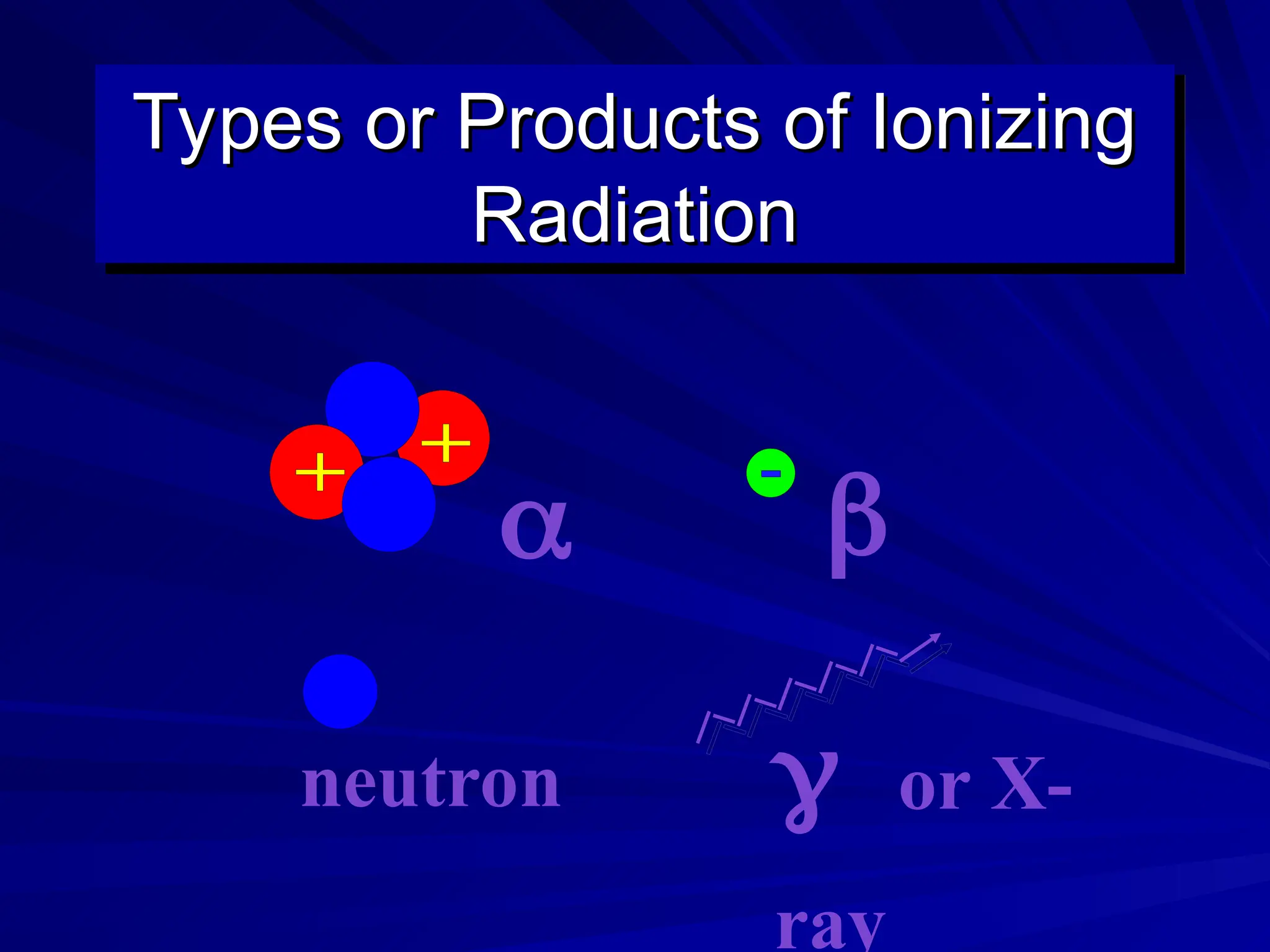
Types or Products of Ionizing
Radiation
Radiation


or X-
ray
neutron
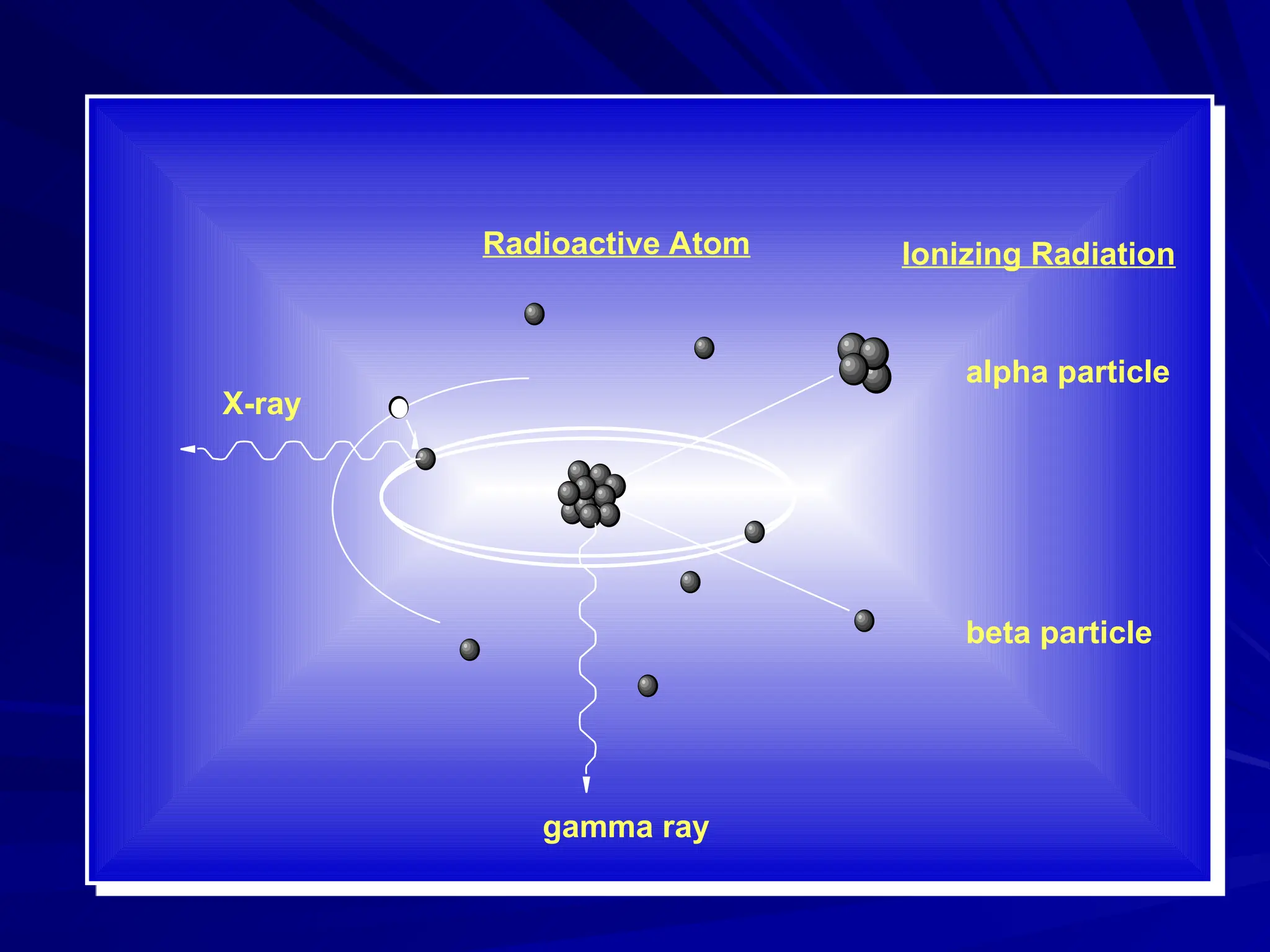
Ionizing Radiation
alpha particle
beta particle
Radioactive Atom
X-ray
gamma ray
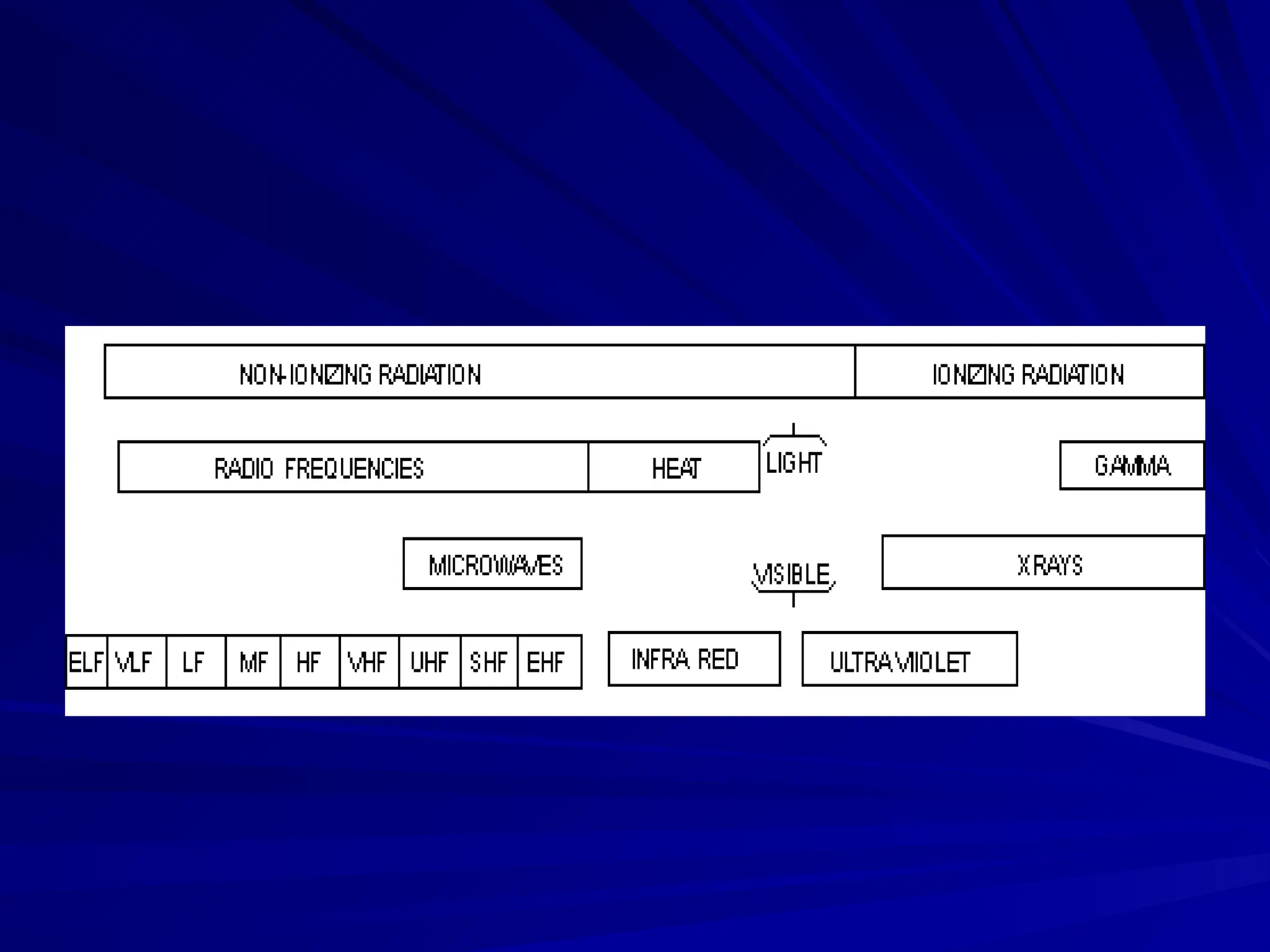
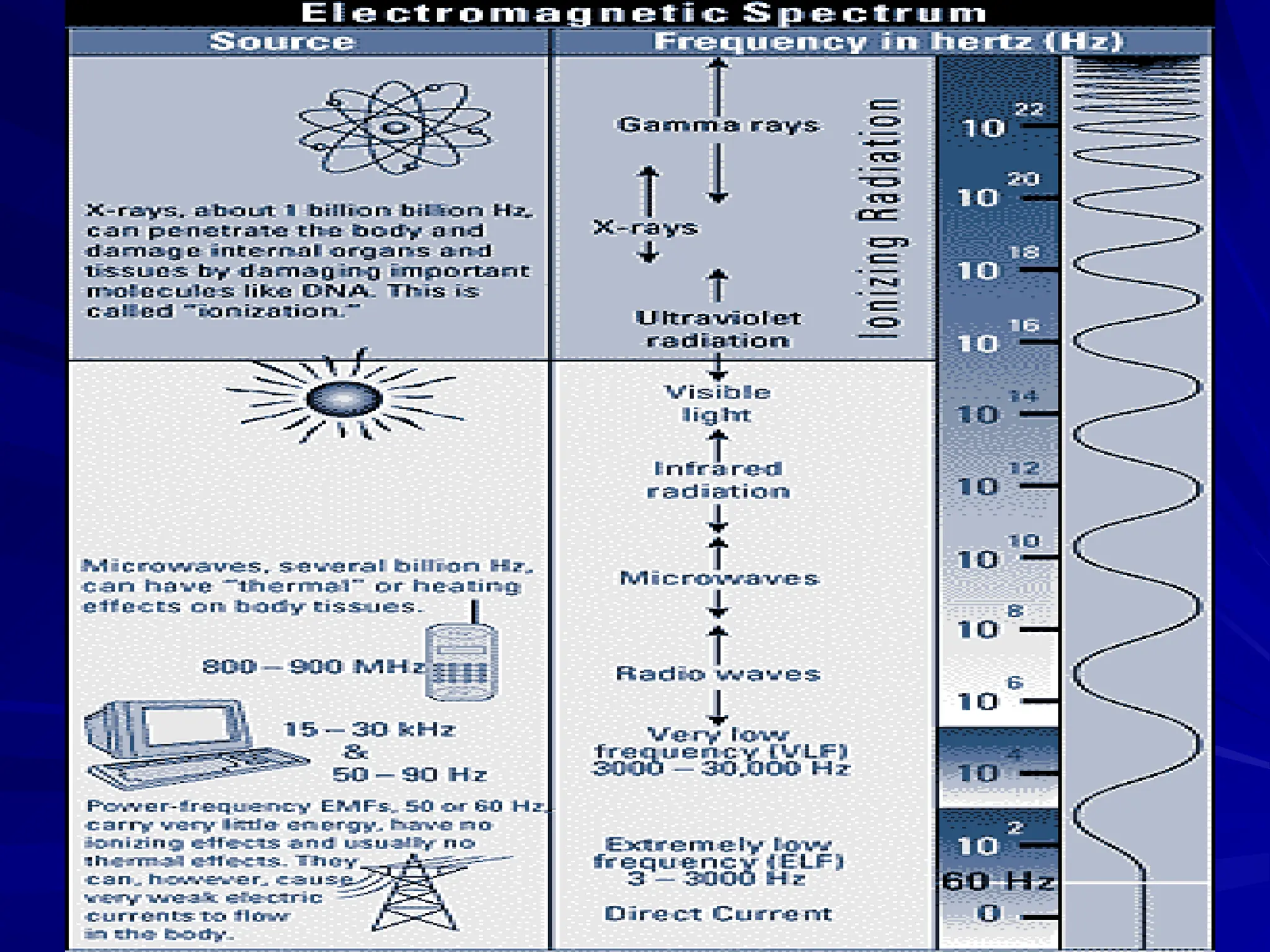
The electro-magnetic waves vary in their
length and frequency along a very wide
spectrum.
spectrum.
Types of Radiation
Types of Radiation
Radiation is classified into:
–Ionizing radiation
Ionizing radiation
–Non-ionizing radiation
Non-ionizing radiation
Ionizing Versus Non-ionizing
Radiation
Radiation
Ionizing Radiation
Ionizing Radiation
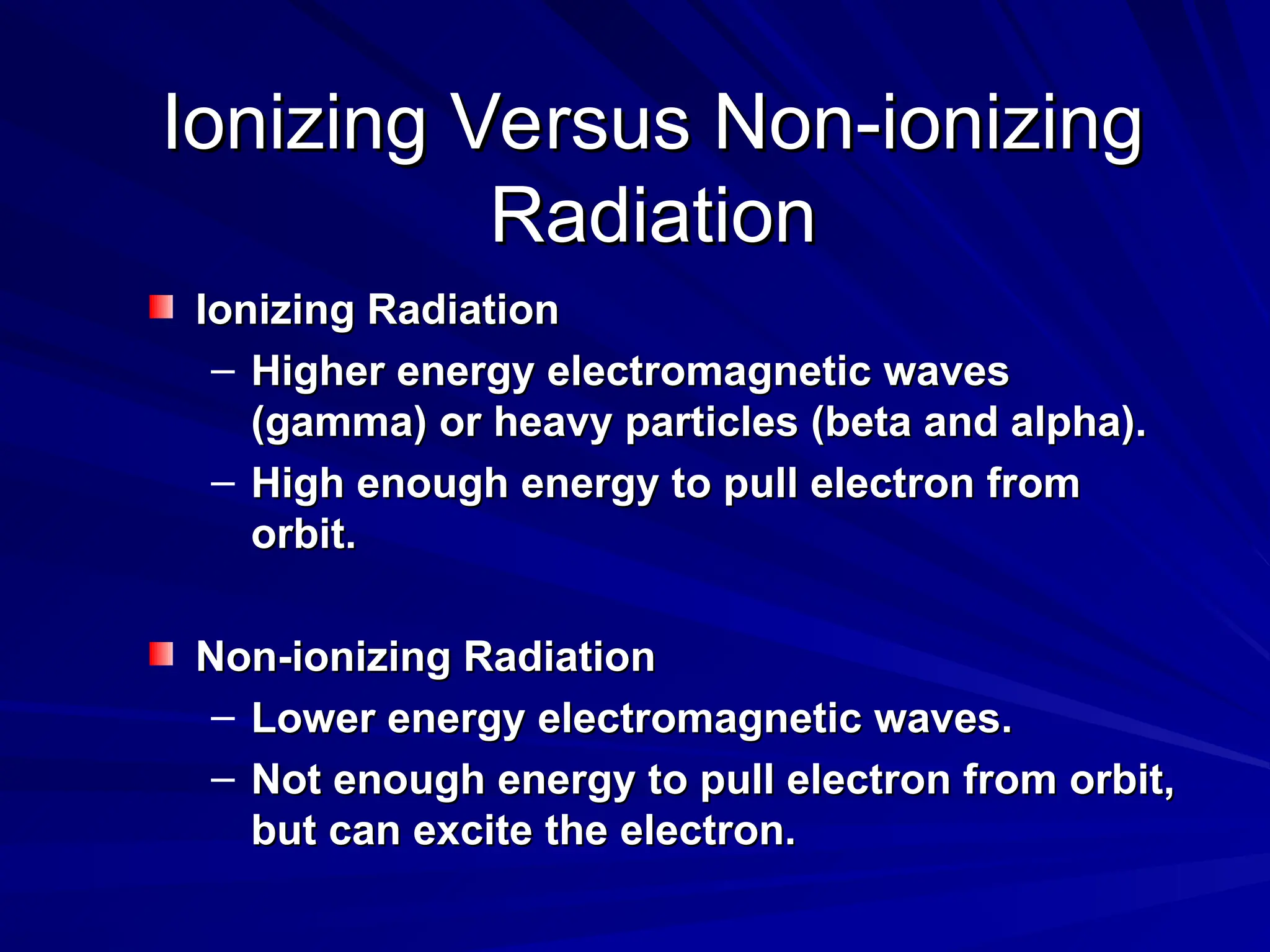
– Higher energy electromagnetic waves
Higher energy electromagnetic waves
(gamma) or heavy particles (beta and alpha).
– High enough energy to pull electron from
High enough energy to pull electron from
orbit.
orbit.
Non-ionizing Radiation
– Lower energy electromagnetic waves.
Lower energy electromagnetic waves.
– Not enough energy to pull electron from orbit,
Not enough energy to pull electron from orbit,
but can excite the electron.
Ionizing Radiation
Ionizing Radiation
Definition:
Definition:
“
“ It is a type of radiation that is able to
It is a type of radiation that is able to
disrupt atoms and molecules on which
they pass through, giving rise to ions and
free radicals”.
free radicals”.
Another Definition
Another Definition
Ionizing radiation
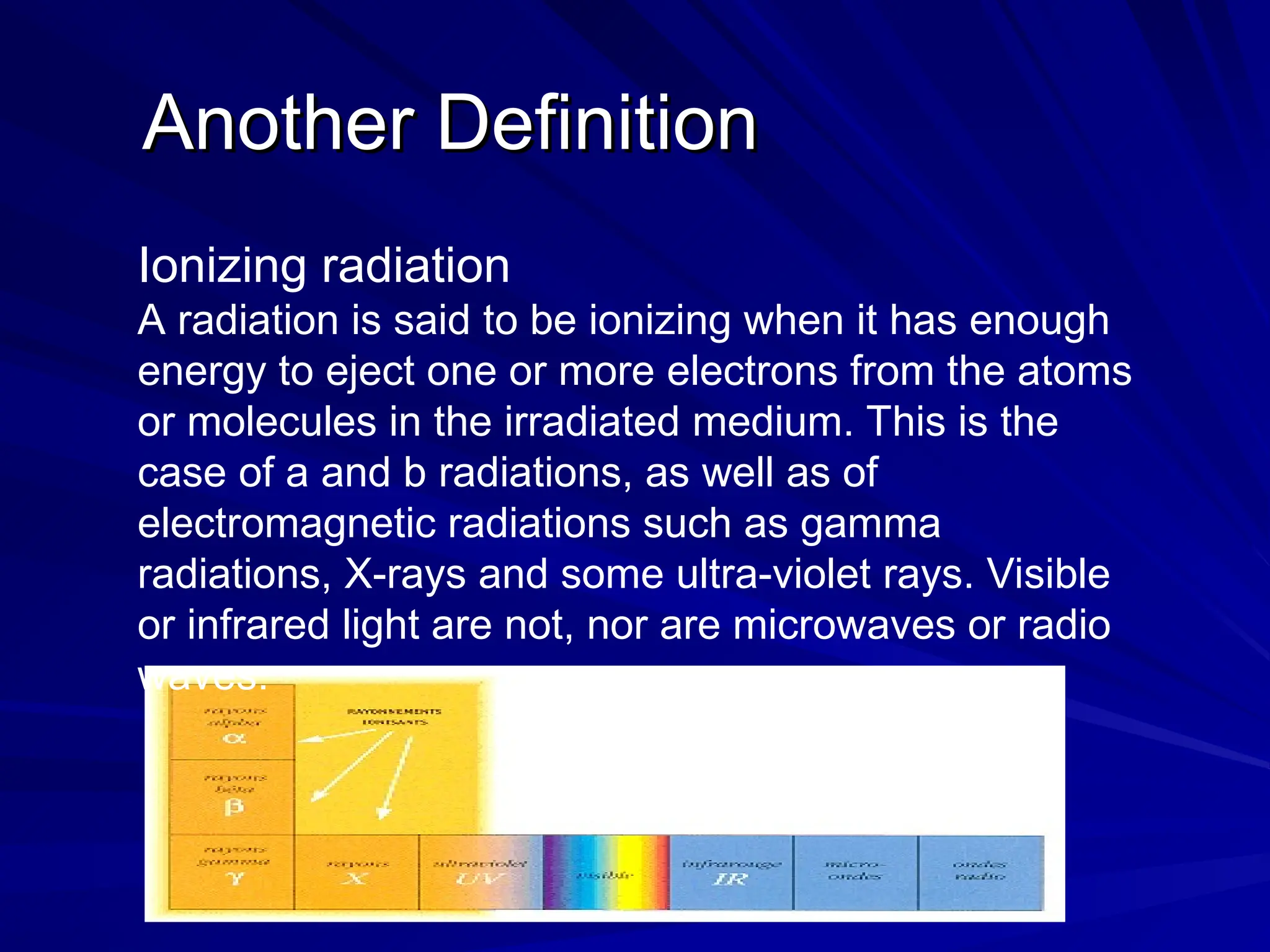
A radiation is said to be ionizing when it has enough
energy to eject one or more electrons from the atoms
or molecules in the irradiated medium. This is the
case of a and b radiations, as well as of
electromagnetic radiations such as gamma
radiations, X-rays and some ultra-violet rays. Visible
or infrared light are not, nor are microwaves or radio
waves.
Primary Types of Ionizing
Radiation
Radiation
Alpha particles
Alpha particles
Beta particles
Beta particles
Gamma rays (or photons)
X-Rays (or photons)
X-Rays (or photons)
Neutrons
Neutrons
Alpha Particles: 2 neutrons and 2 protons
They travel short distances, have large mass
Only a hazard when inhaled
Types and Characteristics of
Ionizing Radiation
Ionizing Radiation
Alpha Particles
Alpha Particles
Alpha Particles
Alpha Particles (or Alpha Radiation)
(or Alpha Radiation):
:
Helium nucleus
Helium nucleus (2 neutrons and 2
(2 neutrons and 2
protons); +2 charge; heavy (4 AMU).
Typical Energy = 4-8 MeV;
Typical Energy = 4-8 MeV; Limited range
Limited range
(<10cm in air; 60µm in tissue); High LET
(
(QF=20
QF=20) causing
) causing heavy damage
heavy damage (4K-9K
(4K-9K
ion pairs/µm in tissue).
ion pairs/µm in tissue). Easily shielded
Easily shielded
(e.g., paper, skin) so an
(e.g., paper, skin) so an internal radiation
internal radiation
hazard. Eventually lose too much energy
to ionize; become He.
Beta Particles
Beta Particles
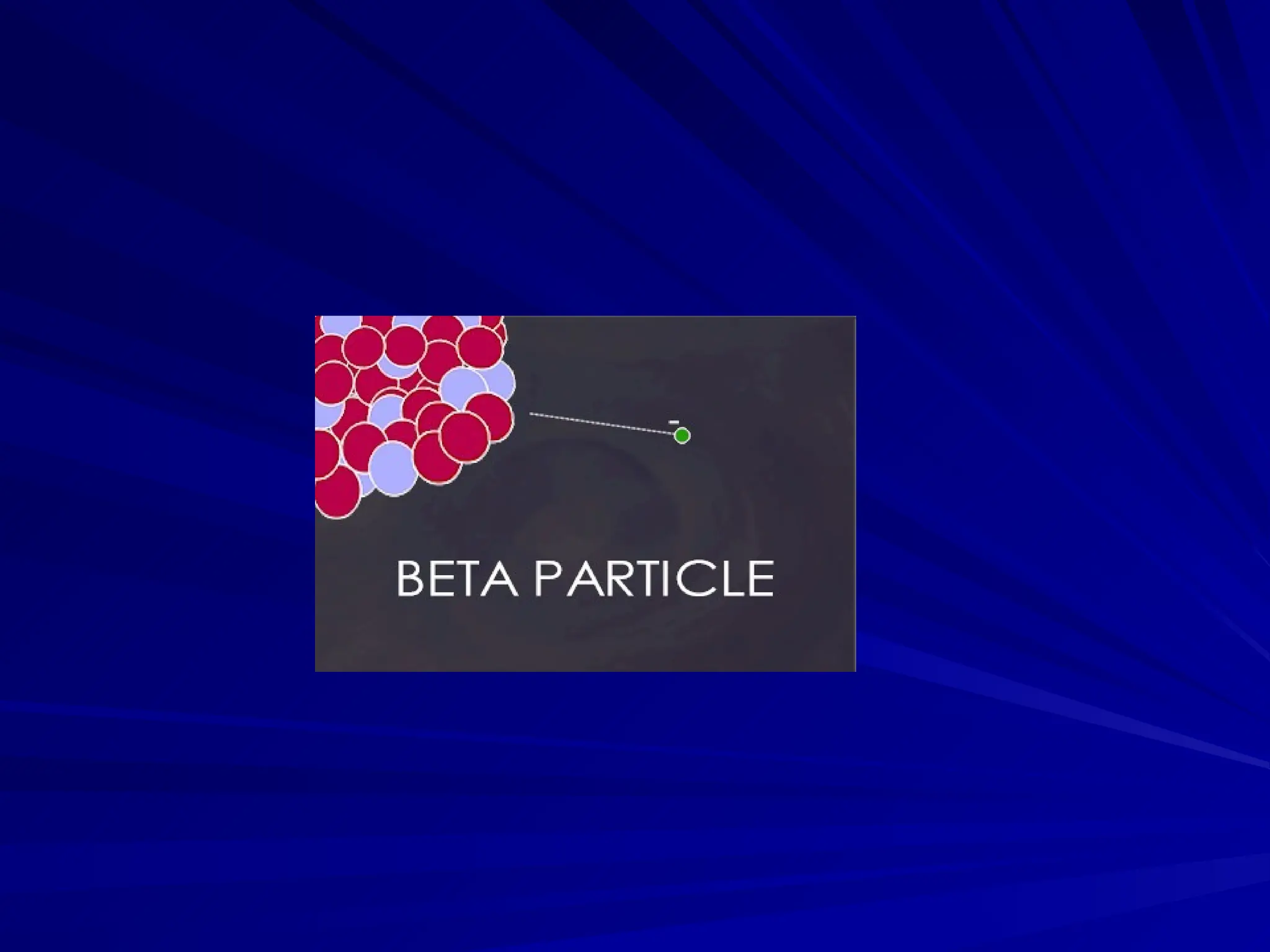
Beta Particles: Electrons or positrons having small mass and
variable energy. Electrons form when a neutron transforms
into a proton and an electron or:
Beta Particles
Beta Particles:
: High speed
High speed electron ejected from
electron ejected from
nucleus
nucleus; -1 charge, light
; -1 charge, light 0.00055 AMU; Typical
0.00055 AMU; Typical
Energy = several KeV to 5 MeV; Range approx.
12'/MeV in air, a few mm in tissue; Low LET (
12'/MeV in air, a few mm in tissue; Low LET (QF=1
QF=1)
)
causing
causing light damage
light damage (6-8 ion pairs/µm in tissue).
(6-8 ion pairs/µm in tissue).
Primarily an internal hazard, but high beta can be an
external hazard to skin. In addition, the high speed
electrons may lose energy in the form of X-rays when
they quickly decelerate upon striking a heavy
material. This is called
material. This is called Bremsstralung
Bremsstralung (or Breaking)
(or Breaking)
Radiation.
Radiation. Aluminum and other light (<14)
Aluminum and other light (<14)
materials are used for shielding
materials are used for shielding.
.
Gamma Rays
Gamma Rays
Gamma Rays (or photons): Result when the
nucleus releases energy, usually after an alpha,
beta or positron transition
X-Rays
X-Rays
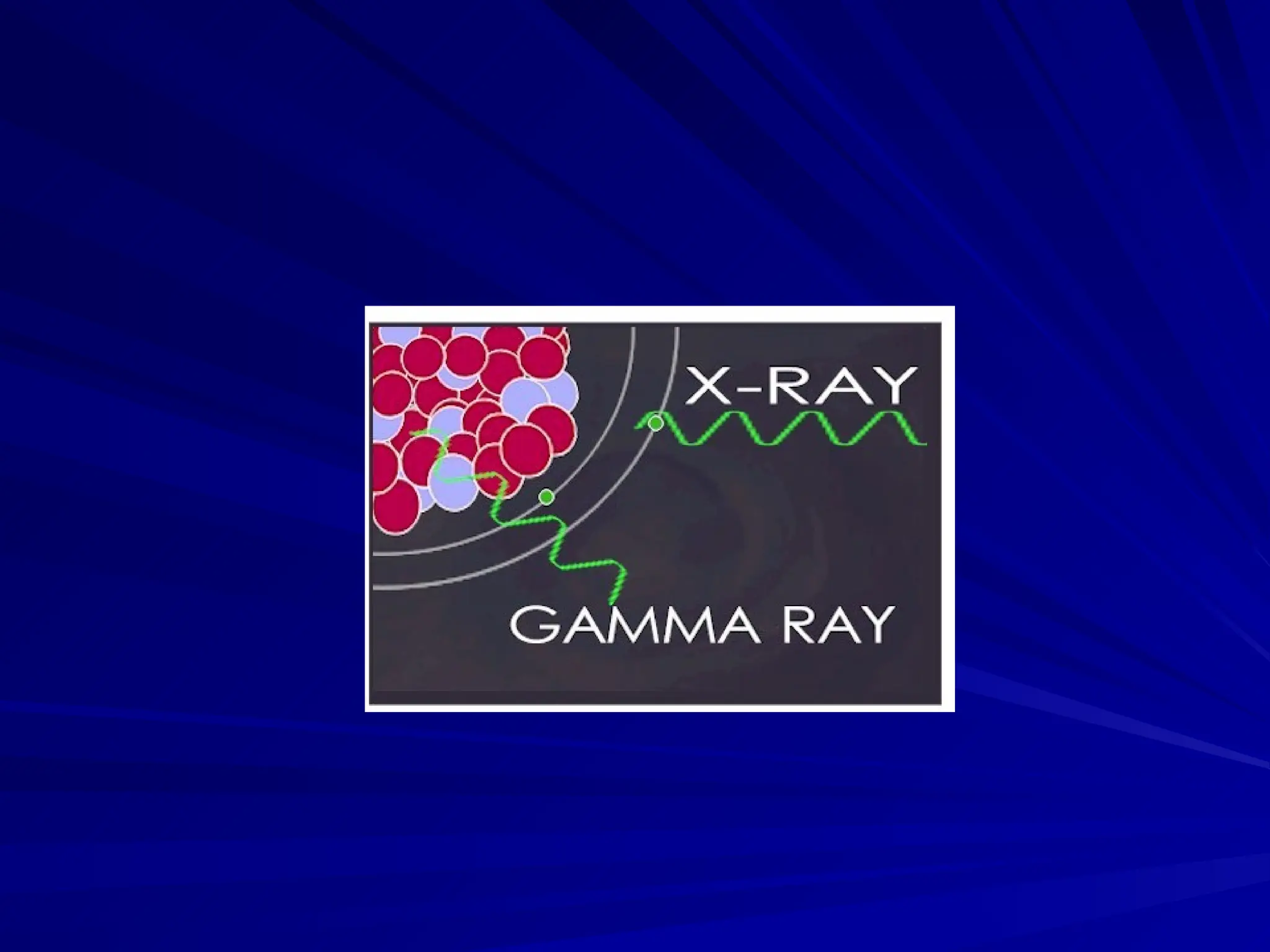
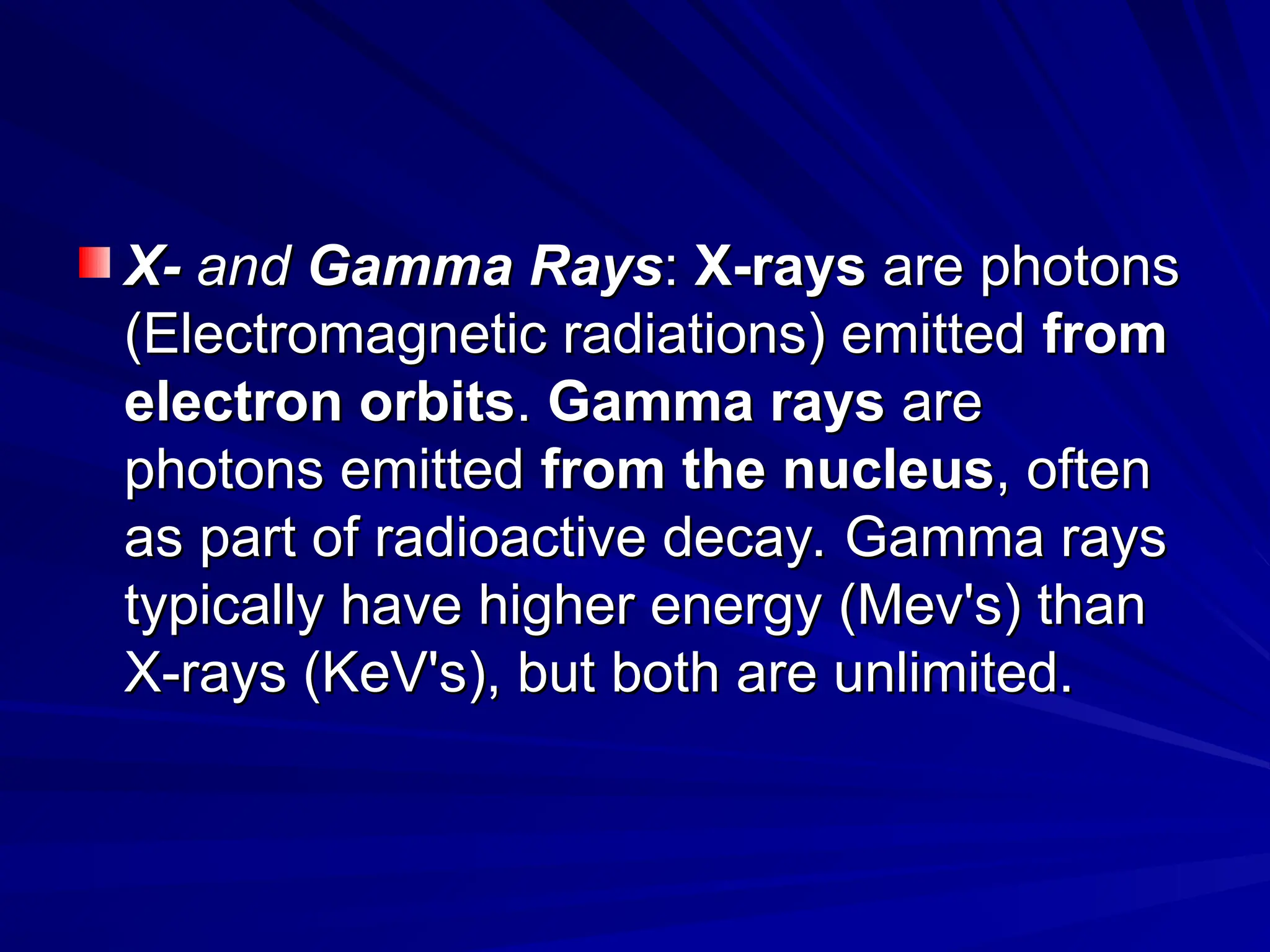
X-Rays: Occur whenever an inner shell
orbital electron is removed and
rearrangement of the atomic electrons
results with the release of the elements
characteristic X-Ray energy
X-
X- and
and Gamma Rays
Gamma Rays:
: X-rays
X-rays are photons
are photons
(Electromagnetic radiations) emitted
(Electromagnetic radiations) emitted from
from
electron orbits
electron orbits.
. Gamma rays
Gamma rays are
are
photons emitted
photons emitted from
from the nucleus
the nucleus, often
, often
as part of radioactive decay. Gamma rays
typically have higher energy (Mev's) than
X-rays (KeV's), but both are unlimited.
Neutrons
Neutrons
Neutrons: Have the same mass as
protons but are uncharged
QUANTIFICATION OF RADIATION
A. Quantifying Radioactive Decay
B. Quantifying Exposure and Dose
A. Quantifying Radioactive Decay
Measurement of
Measurement of Activity
Activity in disintegrations
in disintegrations
per second (dps);
per second (dps);
1
1 Becquerel
Becquerel (Bq) = 1 dps;
(Bq) = 1 dps;
1
1 Curie
Curie (Ci) = 3.7 x 10¹⁰ dps;
(Ci) = 3.7 x 10¹⁰ dps;
Activity of substances are expressed as
activity per weight or volume (e.g., Bq/gm
or Ci/l).
or Ci/l).
B. Quantifying Exposure and Dose
Exposure:
Exposure: Roentgen
Roentgen 1 Roentgen (R) = amount of
1 Roentgen (R) = amount of X or
X or
gamma
gamma radiation that produces ionization resulting in 1
radiation that produces ionization resulting in 1
electrostatic unit of charge in 1 cm3 of dry
electrostatic unit of charge in 1 cm3 of dry air
air.
.
Instruments often measure exposure rate in mR/hr.
Absorbed Dose
Absorbed Dose:
: rad
rad (Roentgen absorbed dose) =
(Roentgen absorbed dose) =
absorption of 100 ergs of energy from
absorption of 100 ergs of energy from any radiation
any radiation in 1
in 1
gram of
gram of any material
any material; 1
; 1 Gray
Gray (Gy) = 100 rads = 1
(Gy) = 100 rads = 1
Joule/kg; Exposure to 1 Roentgen approximates 0.9 rad
in air.
in air.
Biologically Equivalent Dose
Biologically Equivalent Dose:
: Rem (Roentgen equivalent
Rem (Roentgen equivalent
man) = dose in rads x QF
man) = dose in rads x QF, where QF = quality factor. 1
, where QF = quality factor. 1
Sievert
Sievert (Sv) = 100 rems.
(Sv) = 100 rems.
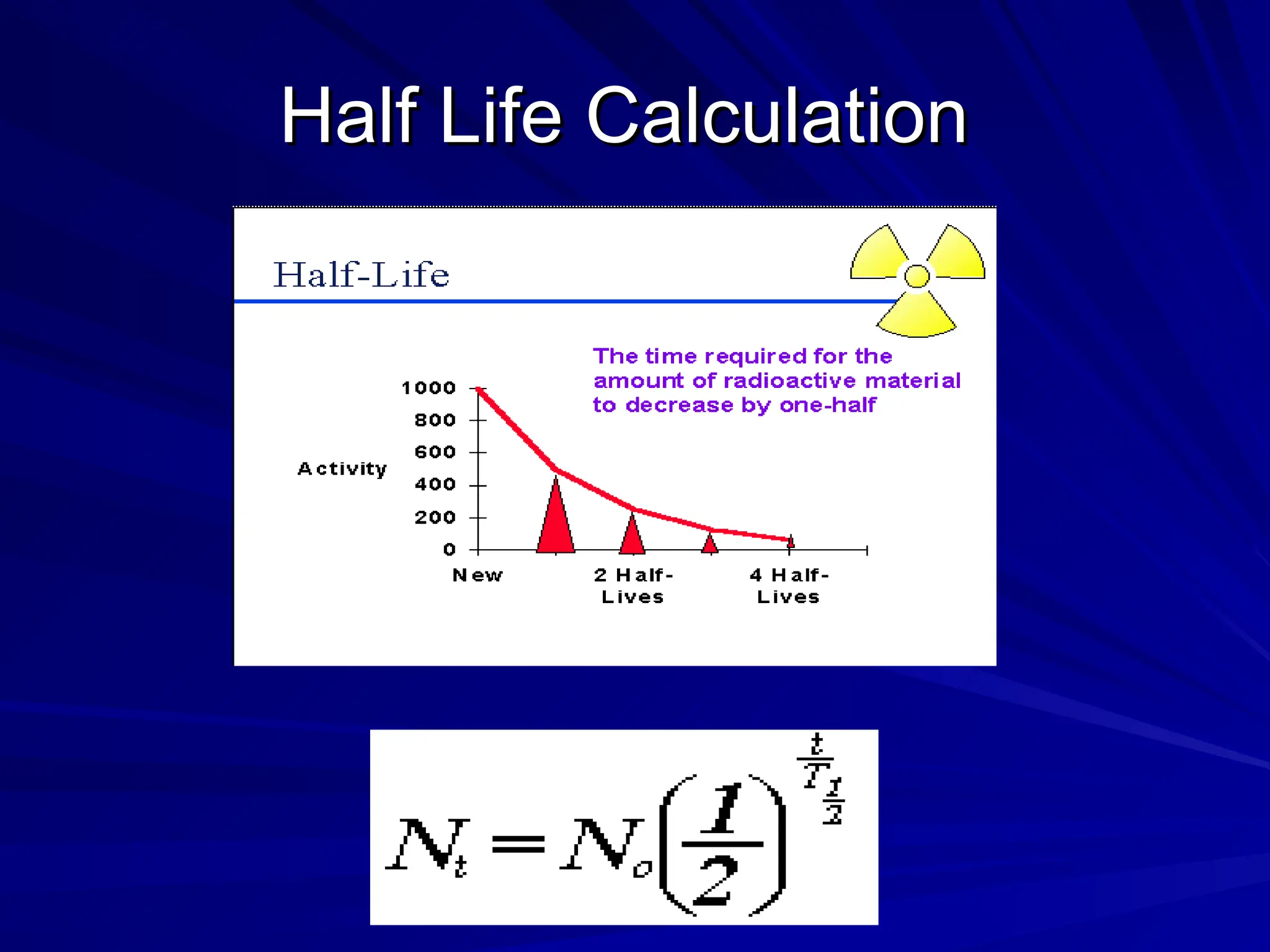
Half Life Calculation
Ionizing Radiation at the
Cellular Level
Cellular Level
Causes breaks in
Causes breaks in
one or both DNA
one or both DNA
strands or;
strands or;
Causes
Causes Free
Free
Radical
Radical formation
formation
Exposure Limits
Exposure Limits
OSHA Limits:
OSHA Limits: Whole body limit = 1.25
Whole body limit = 1.25
rem/qtr or
rem/qtr or 5 rem (50 mSv) per year.
5 rem (50 mSv) per year.
Hands and feet limit = 18.75 rem/qtr.
Skin of whole body limit = 7.5 rem/qtr.
Total
Total life accumulation
life accumulation = 5 x (N-18) rem
= 5 x (N-18) rem
where N = age
where N = age. Can have 3 rem/qtr if total
. Can have 3 rem/qtr if total
life accumulation not exceeded.
Note: New recommendations reduce the 5
rem to 2 rem.
rem to 2 rem.
External/Internal Exposure Limits for
Occupationally Exposed Individuals
Annual Dose Limits
Annual Dose Limits
Adult (>18 yrs) Minor (< 18 yrs)
Whole body* 5000 mrem/yr 500 mrem/yr
Lens of eye 15000 mrem/yr 1500 mrem/yr
Extremities 50000 mrem/yr 5000 mrem/yr
Skin 50000 mrem/yr 5000 mrem/yr
Organ 50000 mrem/yr 5000 mrem/yr
Maximum Permissible Dos Equivalent for Occupational Exposure
Combined whole body occupational
exposure
Prospective annual limit 5 rems in any 1 yr
Retrospective annual limit 10-15 rems in any 1 yr
Long-term accumulation
(N-18) x5 rems. where N is age in
yr
Skin 15 rems in any 1 yr
Hands 75 rems in any 1 yr (25/qtr)
Forearms 30 rems in any 1 yr (10/qtr)
Other organs, tissues and organ
systems
Fertile women (with respect to fetus) 0.5 rem in gestation period
Population dose limits 0.17 rem average per yr
(Reprinted from NCRP Publication No. 43, Review of the Current
State of Radiation Protection Philosophy, 1975)
Community Emergency Radiation
Hazardous Waste Sites:
Radiation above background (0.01-0.02 m
rem/hr) signifies possible presence which
must be monitored. Radiation above 2 m
rem/hr indicates potential hazard.
Evacuate site until controlled.
Your Annual Exposure
Activity Typical Dose
Smoking 280 millirem/year
Radioactive materials use
in a UM lab
<10 millirem/year
Dental x-ray
10 millirem per x-
ray
Chest x-ray
8 millirem per x-
ray
Drinking water 5 millirem/year
Cross country round trip by
air
5 millirem per trip
Coal Burning power plant
0.165
millirem/year
HEALTH EFFECTS
HEALTH EFFECTS
Generalizations:
Generalizations: Biological effects are due to the
Biological effects are due to the
ionization process that destroys the capacity for cell
reproduction or division or causes cell mutation. A given
total dose will cause more damage if received in a
shorter time period. A
shorter time period. A fatal dose is (600 R)
fatal dose is (600 R)
Acute Somatic Effects
Acute Somatic Effects: Relatively immediate effects to a
: Relatively immediate effects to a
person acutely exposed. Severity depends on dose.
Death usually results from damage to bone marrow or
intestinal wall. Acute
intestinal wall. Acute radio-dermatitis
radio-dermatitis is common in
is common in
radiotherapy; chronic cases occur mostly in industry.
0-25
0-25 No observable effect.
25-50
25-50 Minor temporary blood changes.
50-100
50-100 Possible nausea and vomiting and
reduced WBC.
150-300
150-300 Increased severity of above and diarrhea,
malaise, loss of appetite.
300-500
300-500 Increased severity of above and
hemorrhaging, depilation. Death may
occur
> 500
> 500 Symptoms appear immediately, then
Symptoms appear immediately, then
death has to occur.
death has to occur.
ACUTE DOSE(RAD) EFFECT
Delayed Somatic Effects
Delayed Somatic Effects: Delayed effects to exposed
: Delayed effects to exposed
person include: Cancer, leukemia, cataracts, life
shortening from organ failure, and abortion. Probability
of an effect is proportional to dose (no threshold).
Severity is independent of dose. Doubling dose for
cancer is approximately 10-100 rems.
Genetic Effects
Genetic Effects: Genetic effects to off-spring of exposed
: Genetic effects to off-spring of exposed
persons are irreversible and nearly always harmful.
Doubling dose for mutation rate is approximately 50-80
rems. (Spontaneous mutation rate is approx. 10-100
mutations per million population per generation.)
Critical Organs: Organs generally most
susceptible to radiation damage include:
Lymphocytes, bone marrow, gastro-intestinal,
gonads, and other fast-growing cells. The
central nervous system is relatively resistant.
Many nuclides concentrate in certain organs
rather than being uniformly distributed over the
body, and the organs may be particularly
sensitive to radiation damage, e.g., isotopes of
iodine concentrate in the thyroid gland. These
organs are considered "critical" for the specific
nuclide.
Non-ionizing Radiation
Definition:
Definition:
“
“ They are electromagnetic waves incapable
They are electromagnetic waves incapable
of producing ions while passing through
matter, due to their lower energy.”
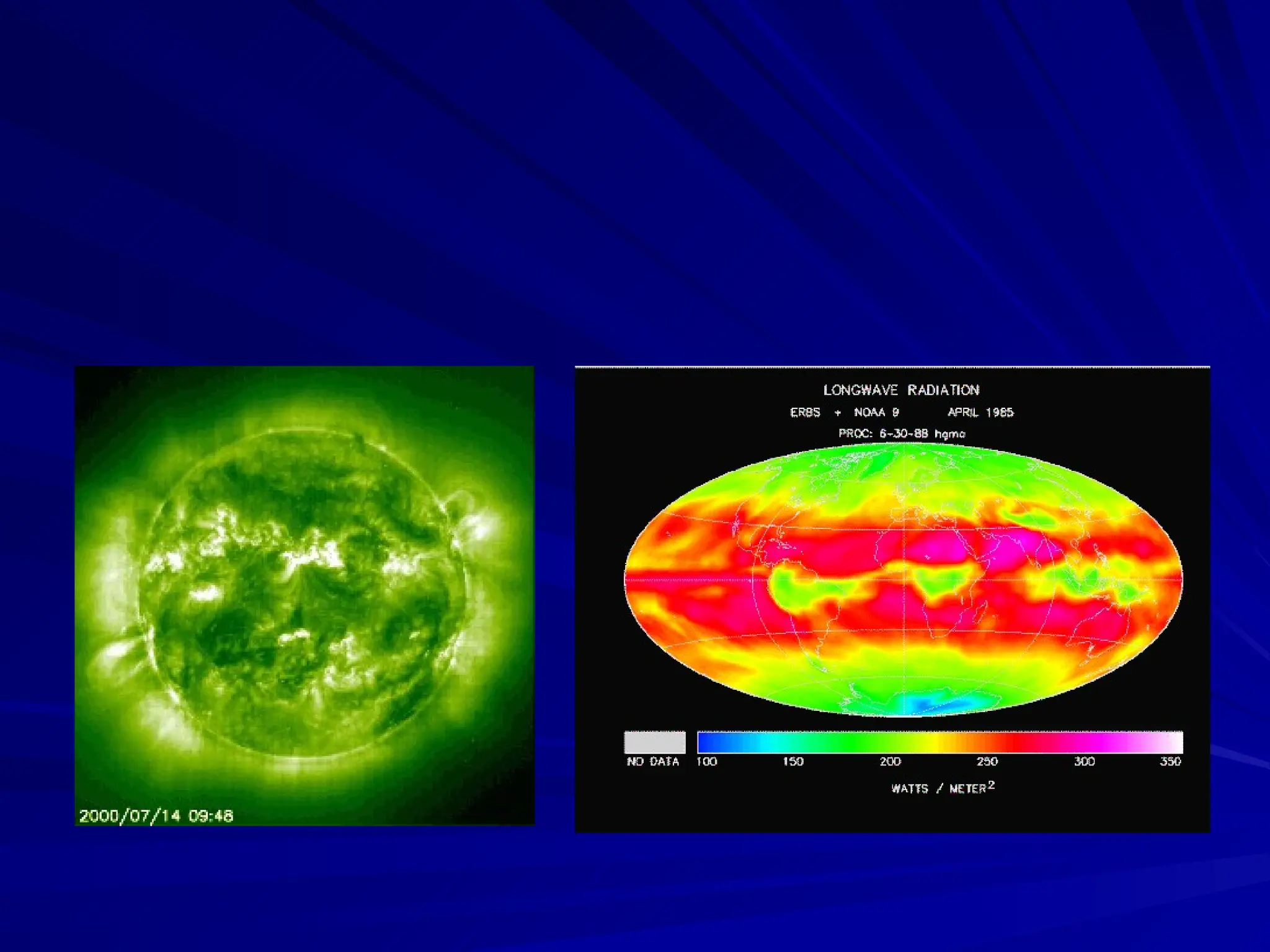
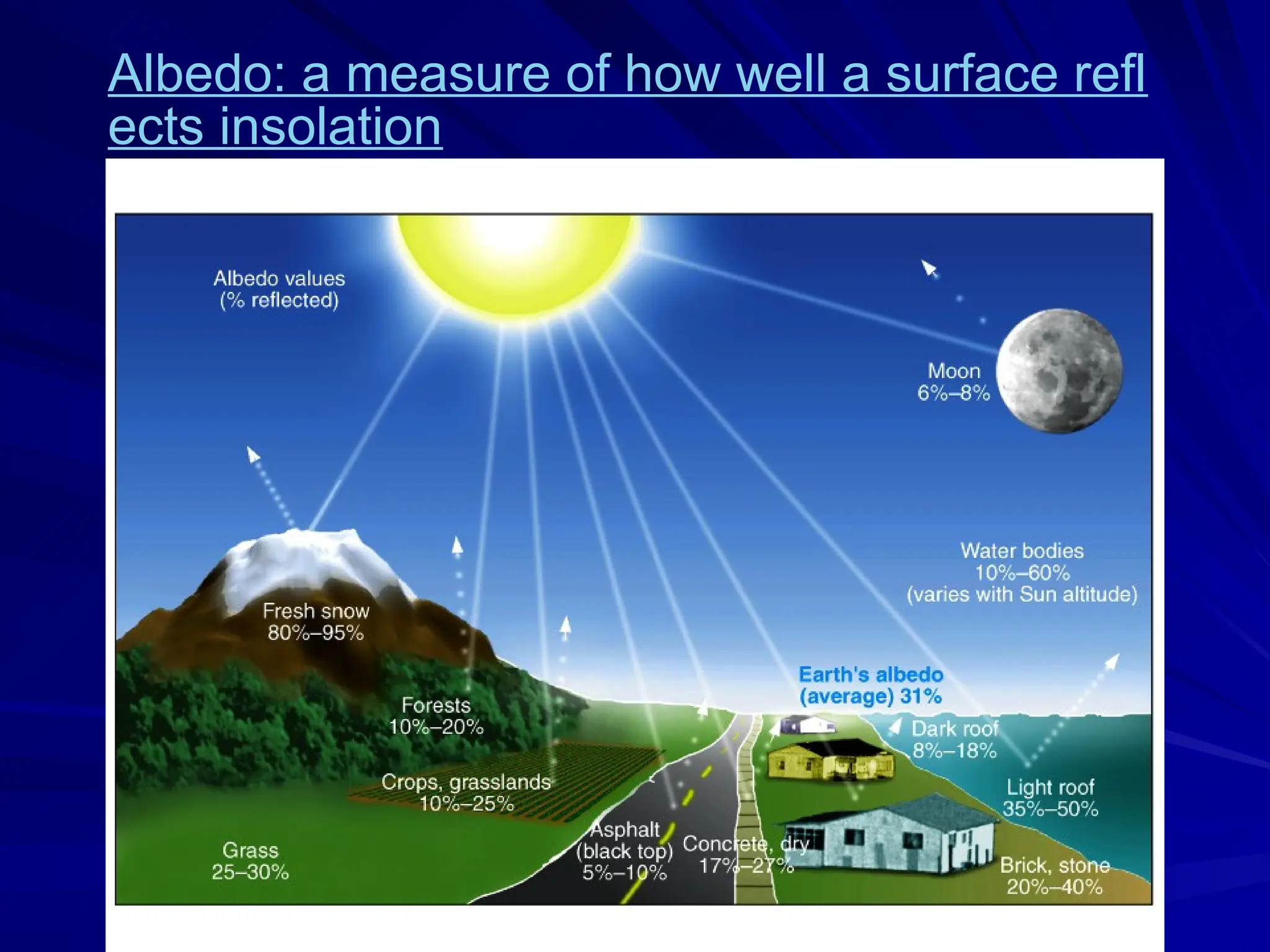
– All earth surface system components emit radiation---
the sun and the earth are the components we are
most interested in
– The sun emits radiation composed of high energy
infrared radiation, visible light, and ultraviolet radiation
collectively known as shortwave radiation (SW)
– The earth emits radiation composed of lower energy
infrared radiation collectively known as long-wave
radiation (LW)
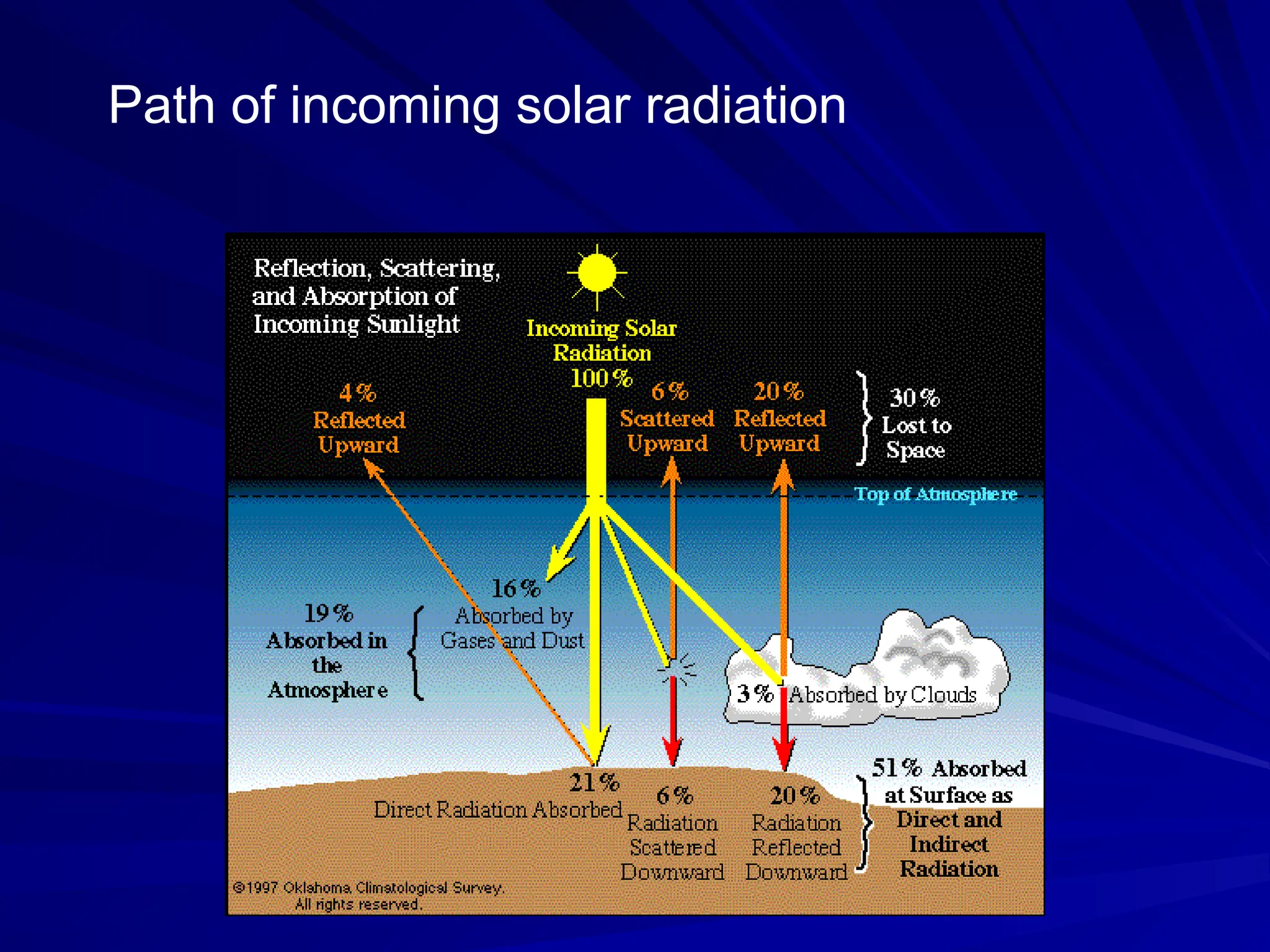
Path of incoming solar radiation
Albedo: a measure of how well a surface refl
ects insolation
Examples on Non-ionizing
Radiation Sources
Radiation Sources
Visible light
Visible light
Microwaves
Microwaves
Radios
Radios
Video Display Terminals
Power lines
Power lines
Radiofrequency Diathermy (Physical
Therapy)
Therapy)
Lasers
Lasers
MICROWAVE
GAMMA
ULTRA V
VISIBLE
INFRARED
TV
AM
RF
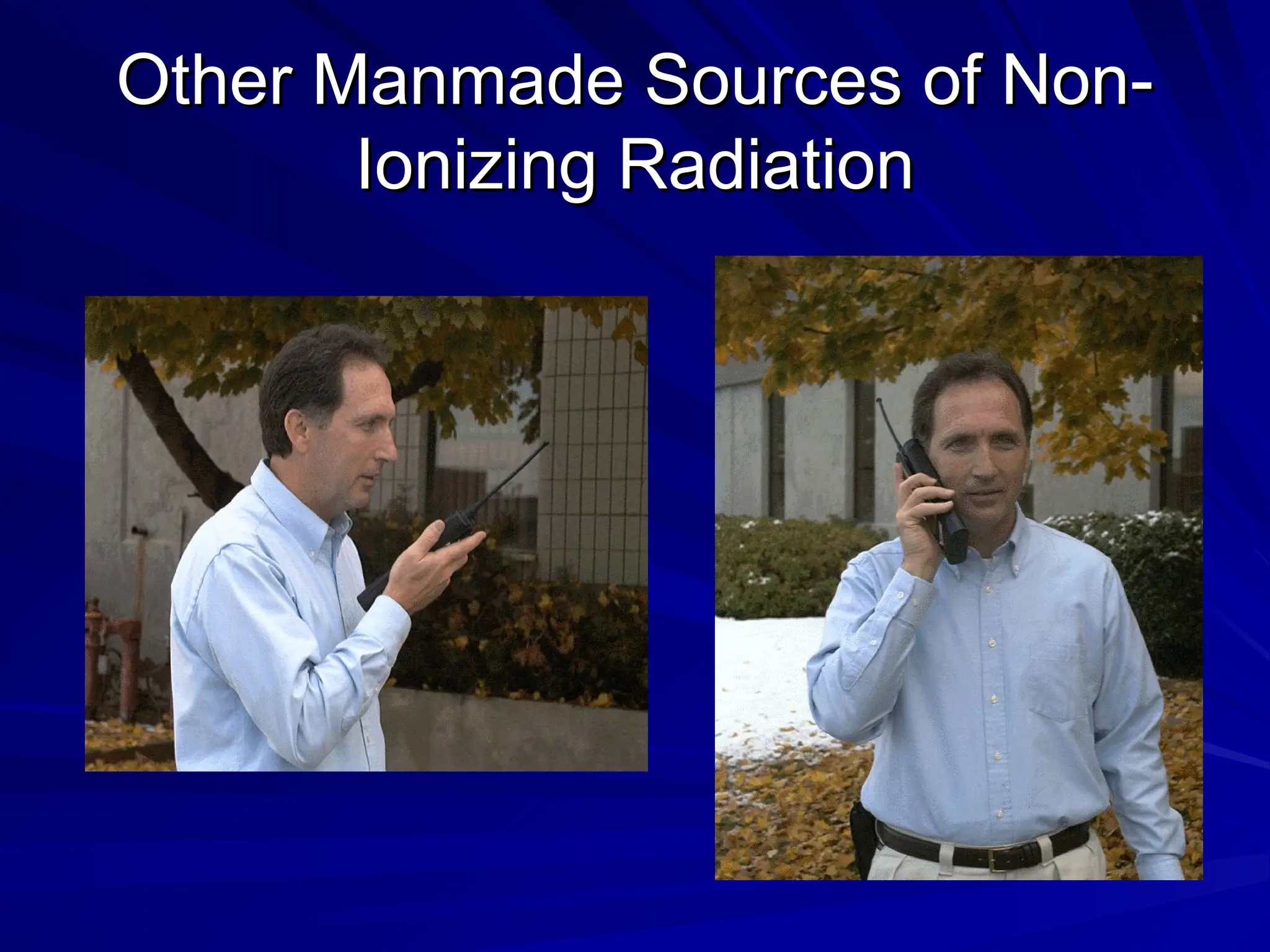
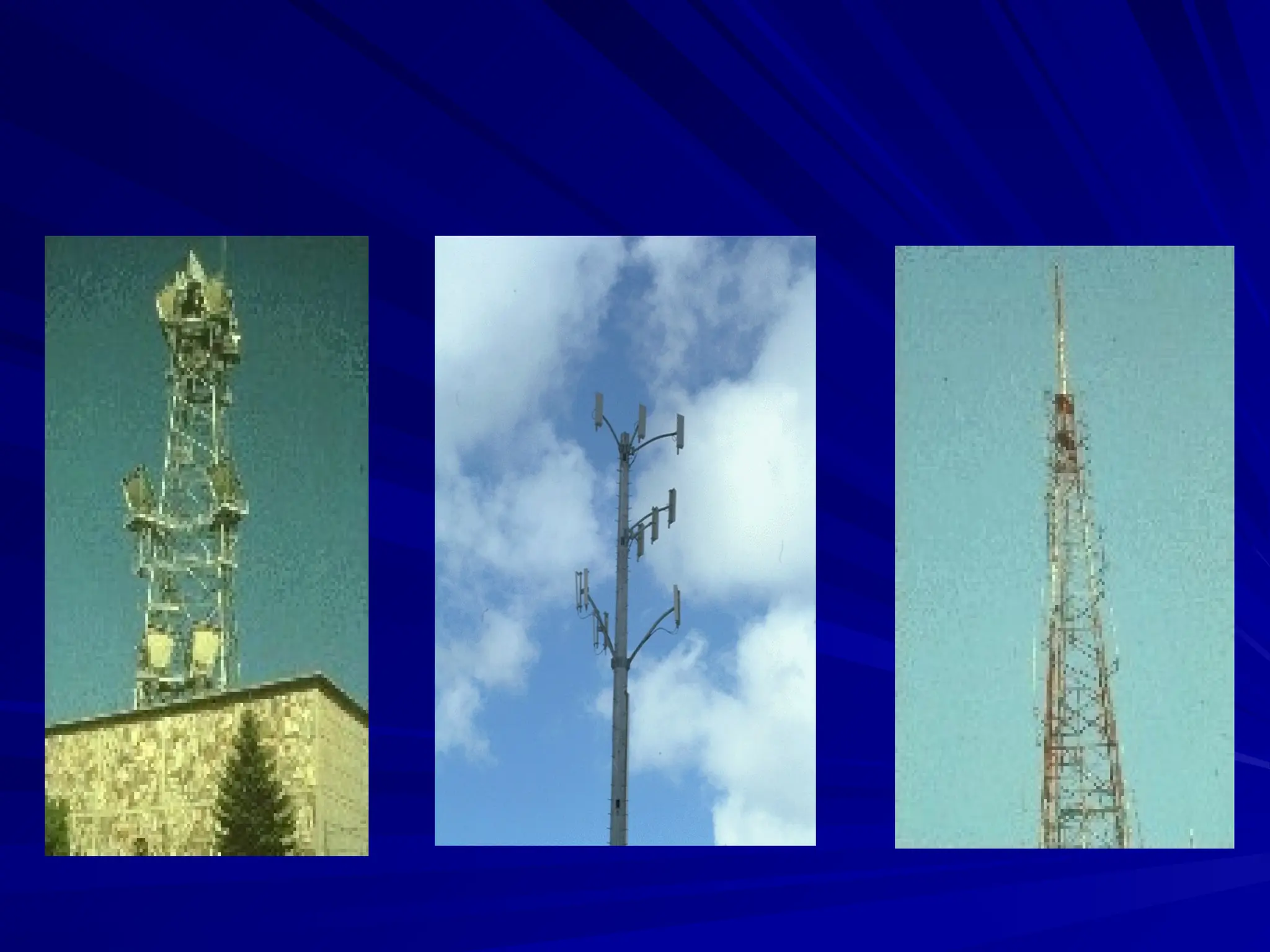
Other Manmade Sources of Non-
Ionizing Radiation
Ionizing Radiation
Effects
Effects
 Radiofrequency Ranges (10 kHz to 300 GHz)
– Effects only possible at ten times the permissible
exposure limit
– Heating of the body (thermal effect)
– Cataracts
– Some studies show effects of teratoginicity and
carcinogenicity.
RADIATION CONTROLS
RADIATION CONTROLS
A.
A. Basic Control Methods for External
Basic Control Methods for External
Radiation
Radiation
Decrease Time
 Increase Distance
 Increase Shielding
Time
Time: Minimize time of exposure to minimize
: Minimize time of exposure to minimize
total dose. Rotate employees to restrict
individual dose.
individual dose.
Distance
Distance: Maximize distance to source to
: Maximize distance to source to
maximize attenuation in air. The effect of
distance can be estimated from equations.
Shielding
Shielding: Minimize exposure by placing
: Minimize exposure by placing
absorbing shield between worker and source.
B. Monitoring
B. Monitoring
Personal Dosimeters
Personal Dosimeters: Normally they do
: Normally they do
not prevent exposures (no alarm), just
record it. They can provide a record of
accumulated exposure
accumulated exposure for an individual
for an individual
worker over extended periods of time
(hours, days or weeks), and are small
enough for measuring localized exposures
Common types: Film badges;
Thermoluminescence detectors (TLD);
and pocket dosimeters.
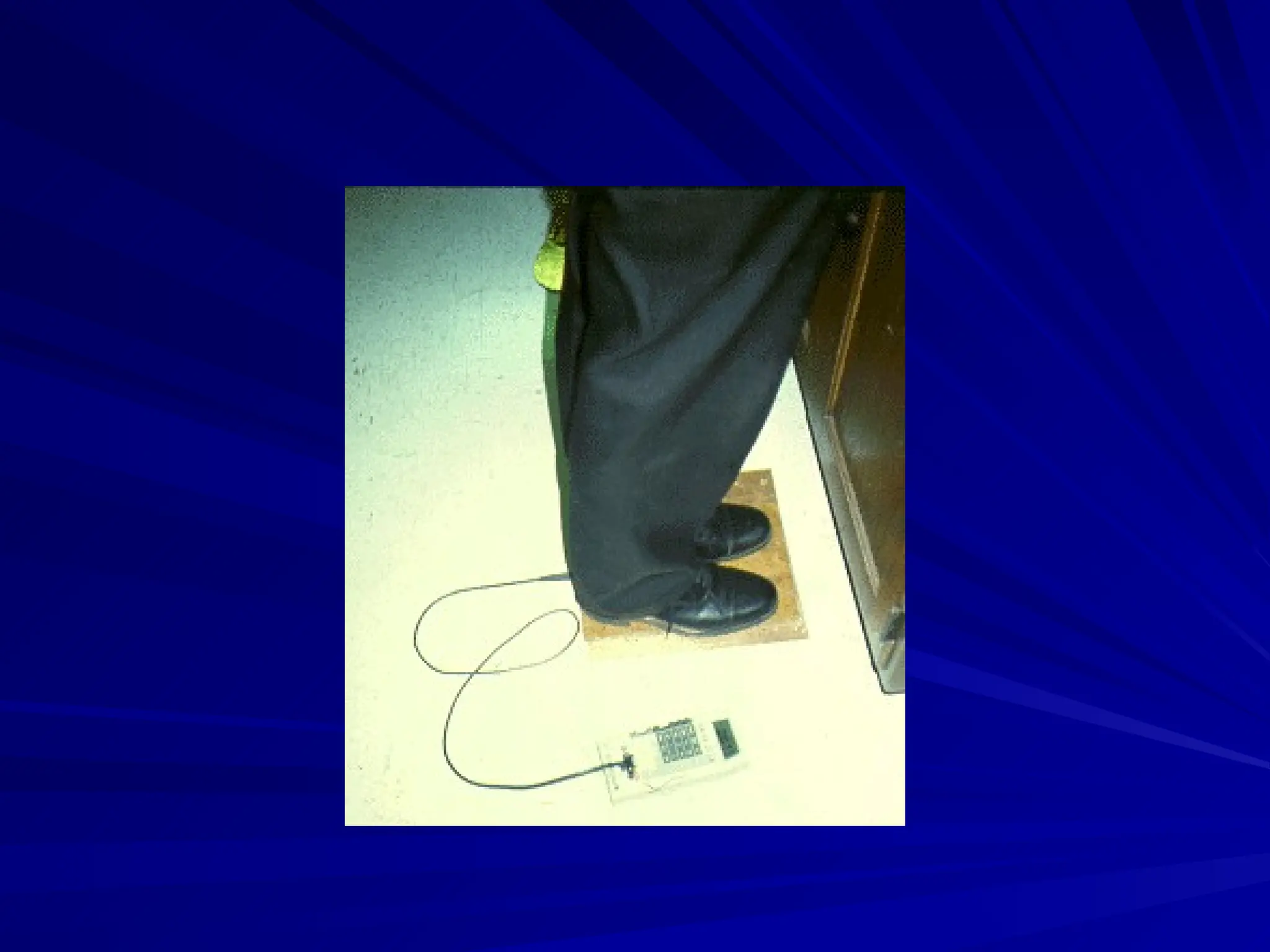
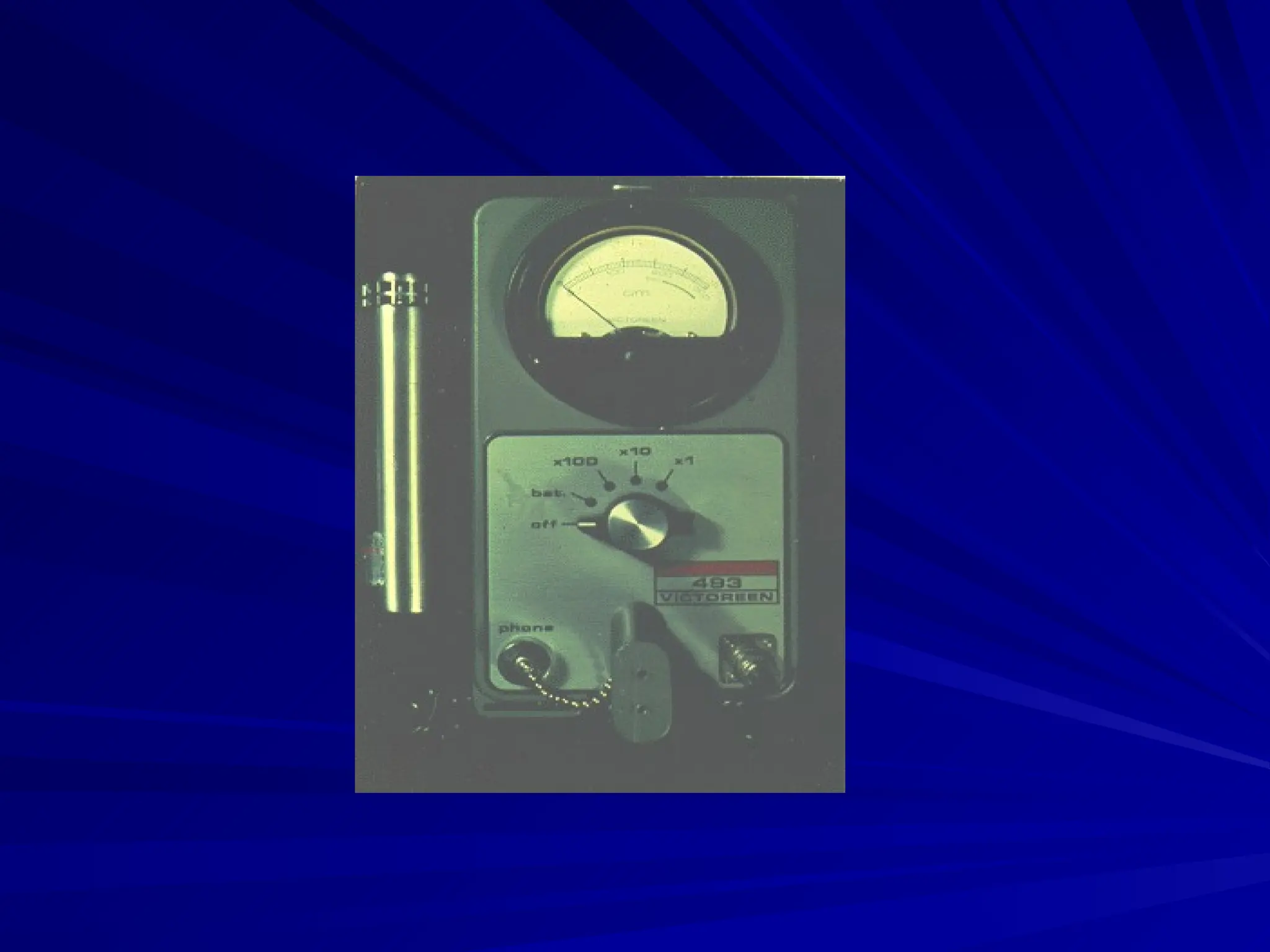
Direct Reading Survey Meters and Counters
Direct Reading Survey Meters and Counters: Useful in
: Useful in
identifying source
identifying source of exposures recorded by personal
of exposures recorded by personal
dosimeters, and in
dosimeters, and in evaluating potential sources,
evaluating potential sources, such
such
as surface or sample contamination, source leakage,
inadequate decontamination procedures, background
radiation.
radiation.
Common types:
Common types:
Alpha
Alpha 
 Proportional or Scintillation counters
Proportional or Scintillation counters
Beta, gamma
Beta, gamma 
 Geiger-Mueller or Proportional
Geiger-Mueller or Proportional
counters
counters
X-ray, Gamma
X-ray, Gamma 
 Ionization chambers
Ionization chambers
Neutrons
Neutrons 
 Proportional counters
Proportional counters
Continuous Monitors
Continuous Monitors: Continuous direct reading
: Continuous direct reading
ionization detectors (same detectors as above)
can provide read-out and/or alarm to monitor
hazardous locations and alert workers to
leakage, thereby
leakage, thereby preventing exposures
preventing exposures.
.
Long-Term Samplers
Long-Term Samplers: Used to measure average
: Used to measure average
exposures over a longer time period. For
example, charcoal canisters or electrets are set
out for days to months to measure radon in
basements (should be <4 pCi/L).
Elements of Radiation Protection Program
Monitoring of exposures
Monitoring of exposures: Personal, area, and screening
: Personal, area, and screening
measurements; Medical/biologic monitoring.
Task-Specific Procedures and Controls
Task-Specific Procedures and Controls: Initial, periodic,
: Initial, periodic,
and post-maintenance or other non-scheduled events.
Engineering (shielding) vs. PPE vs. administrative
controls. Including management and employee
commitment and authority to enforce procedures and
controls.
controls.
Emergency procedures
Emergency procedures: Response, "clean-up", post
: Response, "clean-up", post
clean-up testing and spill control.
Training and Hazard Communications
Training and Hazard Communications including signs,
including signs,
warning lights, lockout/tagout, etc. Criteria for need,
design, and information given.
Material Handling
Material Handling: Receiving, inventory control, storage,
: Receiving, inventory control, storage,
and disposal.
and disposal.
Thank You
Thank You

Alpha radiation intraction with matter.ppt

  • 1.
    Radiation Radiation Dr. Rasha Salama PhDCommunity Medicine Suez Canal University Egypt
  • 2.
    Definition of Radiation Definitionof Radiation “ “Radiation is an energy in the form of Radiation is an energy in the form of electro-magnetic waves or particulate electro-magnetic waves or particulate matter, traveling in the air.” matter, traveling in the air.”
  • 3.
    Forces: There aremany interactions among nuclei. It turns out that there are forces other than the electromagnetic force and the gravitational force which govern the interactions among nuclei. Einstein in 1905m showed 2 more laws: energy/mass, and binding energy
  • 4.
    Radioactivity: Elements &Atoms Radioactivity: Elements & Atoms Atoms are composed of smaller Atoms are composed of smaller particles referred to as: particles referred to as: – Protons Protons – Neutrons Neutrons – Electrons Electrons
  • 5.
    Basic Model ofa Neutral Atom. Basic Model of a Neutral Atom. Electrons Electrons (-) (-) orbiting nucleus of protons orbiting nucleus of protons (+) (+) and neutrons. Same number of and neutrons. Same number of electrons as protons; net charge = 0. electrons as protons; net charge = 0. Atomic number Atomic number (number of protons) (number of protons) determines element. determines element. Mass number Mass number (protons + neutrons) (protons + neutrons)
  • 7.
    Radioactivity If a nucleusis unstable for any reason, it will emit and absorb particles. There are many types of radiation and they are all pertinent to everyday life and health as well as nuclear physical applications.
  • 8.
    Ionization Ionization Ionizing radiation isproduced by unstable Ionizing radiation is produced by unstable atoms. Unstable atoms differ from stable atoms. Unstable atoms differ from stable atoms because they have an excess of atoms because they have an excess of energy or mass or both. energy or mass or both. Unstable atoms are said to be radioactive. In Unstable atoms are said to be radioactive. In order to reach stability, these atoms give off, order to reach stability, these atoms give off, or emit, the excess energy or mass. These or emit, the excess energy or mass. These emissions are called radiation. emissions are called radiation.
  • 13.
    Types or Productsof Ionizing Types or Products of Ionizing Radiation Radiation   or X- ray neutron
  • 14.
    Ionizing Radiation alpha particle betaparticle Radioactive Atom X-ray gamma ray
  • 15.
    The electro-magnetic wavesvary in their The electro-magnetic waves vary in their length and frequency along a very wide length and frequency along a very wide spectrum. spectrum.
  • 19.
    Types of Radiation Typesof Radiation Radiation is classified into: Radiation is classified into: –Ionizing radiation Ionizing radiation –Non-ionizing radiation Non-ionizing radiation
  • 20.
    Ionizing Versus Non-ionizing IonizingVersus Non-ionizing Radiation Radiation Ionizing Radiation Ionizing Radiation – Higher energy electromagnetic waves Higher energy electromagnetic waves (gamma) or heavy particles (beta and alpha). (gamma) or heavy particles (beta and alpha). – High enough energy to pull electron from High enough energy to pull electron from orbit. orbit. Non-ionizing Radiation Non-ionizing Radiation – Lower energy electromagnetic waves. Lower energy electromagnetic waves. – Not enough energy to pull electron from orbit, Not enough energy to pull electron from orbit, but can excite the electron. but can excite the electron.
  • 21.
    Ionizing Radiation Ionizing Radiation Definition: Definition: “ “It is a type of radiation that is able to It is a type of radiation that is able to disrupt atoms and molecules on which disrupt atoms and molecules on which they pass through, giving rise to ions and they pass through, giving rise to ions and free radicals”. free radicals”.
  • 22.
    Another Definition Another Definition Ionizingradiation A radiation is said to be ionizing when it has enough energy to eject one or more electrons from the atoms or molecules in the irradiated medium. This is the case of a and b radiations, as well as of electromagnetic radiations such as gamma radiations, X-rays and some ultra-violet rays. Visible or infrared light are not, nor are microwaves or radio waves.
  • 23.
    Primary Types ofIonizing Primary Types of Ionizing Radiation Radiation Alpha particles Alpha particles Beta particles Beta particles Gamma rays (or photons) Gamma rays (or photons) X-Rays (or photons) X-Rays (or photons) Neutrons Neutrons
  • 24.
    Alpha Particles: 2neutrons and 2 protons They travel short distances, have large mass Only a hazard when inhaled Types and Characteristics of Types and Characteristics of Ionizing Radiation Ionizing Radiation Alpha Particles Alpha Particles
  • 25.
    Alpha Particles Alpha Particles(or Alpha Radiation) (or Alpha Radiation): : Helium nucleus Helium nucleus (2 neutrons and 2 (2 neutrons and 2 protons); +2 charge; heavy (4 AMU). protons); +2 charge; heavy (4 AMU). Typical Energy = 4-8 MeV; Typical Energy = 4-8 MeV; Limited range Limited range (<10cm in air; 60µm in tissue); High LET (<10cm in air; 60µm in tissue); High LET ( (QF=20 QF=20) causing ) causing heavy damage heavy damage (4K-9K (4K-9K ion pairs/µm in tissue). ion pairs/µm in tissue). Easily shielded Easily shielded (e.g., paper, skin) so an (e.g., paper, skin) so an internal radiation internal radiation hazard. Eventually lose too much energy hazard. Eventually lose too much energy to ionize; become He. to ionize; become He.
  • 26.
    Beta Particles Beta Particles BetaParticles: Electrons or positrons having small mass and variable energy. Electrons form when a neutron transforms into a proton and an electron or:
  • 27.
    Beta Particles Beta Particles: :High speed High speed electron ejected from electron ejected from nucleus nucleus; -1 charge, light ; -1 charge, light 0.00055 AMU; Typical 0.00055 AMU; Typical Energy = several KeV to 5 MeV; Range approx. Energy = several KeV to 5 MeV; Range approx. 12'/MeV in air, a few mm in tissue; Low LET ( 12'/MeV in air, a few mm in tissue; Low LET (QF=1 QF=1) ) causing causing light damage light damage (6-8 ion pairs/µm in tissue). (6-8 ion pairs/µm in tissue). Primarily an internal hazard, but high beta can be an Primarily an internal hazard, but high beta can be an external hazard to skin. In addition, the high speed external hazard to skin. In addition, the high speed electrons may lose energy in the form of X-rays when electrons may lose energy in the form of X-rays when they quickly decelerate upon striking a heavy they quickly decelerate upon striking a heavy material. This is called material. This is called Bremsstralung Bremsstralung (or Breaking) (or Breaking) Radiation. Radiation. Aluminum and other light (<14) Aluminum and other light (<14) materials are used for shielding materials are used for shielding. .
  • 29.
    Gamma Rays Gamma Rays GammaRays (or photons): Result when the nucleus releases energy, usually after an alpha, beta or positron transition
  • 30.
    X-Rays X-Rays X-Rays: Occur wheneveran inner shell orbital electron is removed and rearrangement of the atomic electrons results with the release of the elements characteristic X-Ray energy
  • 31.
    X- X- and and GammaRays Gamma Rays: : X-rays X-rays are photons are photons (Electromagnetic radiations) emitted (Electromagnetic radiations) emitted from from electron orbits electron orbits. . Gamma rays Gamma rays are are photons emitted photons emitted from from the nucleus the nucleus, often , often as part of radioactive decay. Gamma rays as part of radioactive decay. Gamma rays typically have higher energy (Mev's) than typically have higher energy (Mev's) than X-rays (KeV's), but both are unlimited. X-rays (KeV's), but both are unlimited.
  • 32.
    Neutrons Neutrons Neutrons: Have thesame mass as protons but are uncharged
  • 35.
    QUANTIFICATION OF RADIATION QUANTIFICATIONOF RADIATION A. Quantifying Radioactive Decay A. Quantifying Radioactive Decay B. Quantifying Exposure and Dose B. Quantifying Exposure and Dose
  • 36.
    A. Quantifying RadioactiveDecay A. Quantifying Radioactive Decay Measurement of Measurement of Activity Activity in disintegrations in disintegrations per second (dps); per second (dps); 1 1 Becquerel Becquerel (Bq) = 1 dps; (Bq) = 1 dps; 1 1 Curie Curie (Ci) = 3.7 x 10¹⁰ dps; (Ci) = 3.7 x 10¹⁰ dps; Activity of substances are expressed as Activity of substances are expressed as activity per weight or volume (e.g., Bq/gm activity per weight or volume (e.g., Bq/gm or Ci/l). or Ci/l).
  • 37.
    B. Quantifying Exposureand Dose B. Quantifying Exposure and Dose Exposure: Exposure: Roentgen Roentgen 1 Roentgen (R) = amount of 1 Roentgen (R) = amount of X or X or gamma gamma radiation that produces ionization resulting in 1 radiation that produces ionization resulting in 1 electrostatic unit of charge in 1 cm3 of dry electrostatic unit of charge in 1 cm3 of dry air air. . Instruments often measure exposure rate in mR/hr. Instruments often measure exposure rate in mR/hr. Absorbed Dose Absorbed Dose: : rad rad (Roentgen absorbed dose) = (Roentgen absorbed dose) = absorption of 100 ergs of energy from absorption of 100 ergs of energy from any radiation any radiation in 1 in 1 gram of gram of any material any material; 1 ; 1 Gray Gray (Gy) = 100 rads = 1 (Gy) = 100 rads = 1 Joule/kg; Exposure to 1 Roentgen approximates 0.9 rad Joule/kg; Exposure to 1 Roentgen approximates 0.9 rad in air. in air. Biologically Equivalent Dose Biologically Equivalent Dose: : Rem (Roentgen equivalent Rem (Roentgen equivalent man) = dose in rads x QF man) = dose in rads x QF, where QF = quality factor. 1 , where QF = quality factor. 1 Sievert Sievert (Sv) = 100 rems. (Sv) = 100 rems.
  • 38.
  • 39.
    Ionizing Radiation atthe Ionizing Radiation at the Cellular Level Cellular Level Causes breaks in Causes breaks in one or both DNA one or both DNA strands or; strands or; Causes Causes Free Free Radical Radical formation formation
  • 40.
    Exposure Limits Exposure Limits OSHALimits: OSHA Limits: Whole body limit = 1.25 Whole body limit = 1.25 rem/qtr or rem/qtr or 5 rem (50 mSv) per year. 5 rem (50 mSv) per year. Hands and feet limit = 18.75 rem/qtr. Hands and feet limit = 18.75 rem/qtr. Skin of whole body limit = 7.5 rem/qtr. Skin of whole body limit = 7.5 rem/qtr. Total Total life accumulation life accumulation = 5 x (N-18) rem = 5 x (N-18) rem where N = age where N = age. Can have 3 rem/qtr if total . Can have 3 rem/qtr if total life accumulation not exceeded. life accumulation not exceeded. Note: New recommendations reduce the 5 Note: New recommendations reduce the 5 rem to 2 rem. rem to 2 rem.
  • 41.
    External/Internal Exposure Limitsfor Occupationally Exposed Individuals Annual Dose Limits Annual Dose Limits Adult (>18 yrs) Minor (< 18 yrs) Whole body* 5000 mrem/yr 500 mrem/yr Lens of eye 15000 mrem/yr 1500 mrem/yr Extremities 50000 mrem/yr 5000 mrem/yr Skin 50000 mrem/yr 5000 mrem/yr Organ 50000 mrem/yr 5000 mrem/yr
  • 42.
    Maximum Permissible DosEquivalent for Occupational Exposure Combined whole body occupational exposure Prospective annual limit 5 rems in any 1 yr Retrospective annual limit 10-15 rems in any 1 yr Long-term accumulation (N-18) x5 rems. where N is age in yr Skin 15 rems in any 1 yr Hands 75 rems in any 1 yr (25/qtr) Forearms 30 rems in any 1 yr (10/qtr) Other organs, tissues and organ systems Fertile women (with respect to fetus) 0.5 rem in gestation period Population dose limits 0.17 rem average per yr (Reprinted from NCRP Publication No. 43, Review of the Current State of Radiation Protection Philosophy, 1975)
  • 43.
    Community Emergency Radiation CommunityEmergency Radiation Hazardous Waste Sites: Hazardous Waste Sites: Radiation above background (0.01-0.02 m Radiation above background (0.01-0.02 m rem/hr) signifies possible presence which rem/hr) signifies possible presence which must be monitored. Radiation above 2 m must be monitored. Radiation above 2 m rem/hr indicates potential hazard. rem/hr indicates potential hazard. Evacuate site until controlled. Evacuate site until controlled.
  • 44.
    Your Annual Exposure YourAnnual Exposure Activity Typical Dose Smoking 280 millirem/year Radioactive materials use in a UM lab <10 millirem/year Dental x-ray 10 millirem per x- ray Chest x-ray 8 millirem per x- ray Drinking water 5 millirem/year Cross country round trip by air 5 millirem per trip Coal Burning power plant 0.165 millirem/year
  • 45.
    HEALTH EFFECTS HEALTH EFFECTS Generalizations: Generalizations:Biological effects are due to the Biological effects are due to the ionization process that destroys the capacity for cell ionization process that destroys the capacity for cell reproduction or division or causes cell mutation. A given reproduction or division or causes cell mutation. A given total dose will cause more damage if received in a total dose will cause more damage if received in a shorter time period. A shorter time period. A fatal dose is (600 R) fatal dose is (600 R) Acute Somatic Effects Acute Somatic Effects: Relatively immediate effects to a : Relatively immediate effects to a person acutely exposed. Severity depends on dose. person acutely exposed. Severity depends on dose. Death usually results from damage to bone marrow or Death usually results from damage to bone marrow or intestinal wall. Acute intestinal wall. Acute radio-dermatitis radio-dermatitis is common in is common in radiotherapy; chronic cases occur mostly in industry. radiotherapy; chronic cases occur mostly in industry.
  • 46.
    0-25 0-25 No observableeffect. 25-50 25-50 Minor temporary blood changes. 50-100 50-100 Possible nausea and vomiting and reduced WBC. 150-300 150-300 Increased severity of above and diarrhea, malaise, loss of appetite. 300-500 300-500 Increased severity of above and hemorrhaging, depilation. Death may occur > 500 > 500 Symptoms appear immediately, then Symptoms appear immediately, then death has to occur. death has to occur. ACUTE DOSE(RAD) EFFECT
  • 47.
    Delayed Somatic Effects DelayedSomatic Effects: Delayed effects to exposed : Delayed effects to exposed person include: Cancer, leukemia, cataracts, life person include: Cancer, leukemia, cataracts, life shortening from organ failure, and abortion. Probability shortening from organ failure, and abortion. Probability of an effect is proportional to dose (no threshold). of an effect is proportional to dose (no threshold). Severity is independent of dose. Doubling dose for Severity is independent of dose. Doubling dose for cancer is approximately 10-100 rems. cancer is approximately 10-100 rems. Genetic Effects Genetic Effects: Genetic effects to off-spring of exposed : Genetic effects to off-spring of exposed persons are irreversible and nearly always harmful. persons are irreversible and nearly always harmful. Doubling dose for mutation rate is approximately 50-80 Doubling dose for mutation rate is approximately 50-80 rems. (Spontaneous mutation rate is approx. 10-100 rems. (Spontaneous mutation rate is approx. 10-100 mutations per million population per generation.) mutations per million population per generation.)
  • 48.
    Critical Organs: Organsgenerally most susceptible to radiation damage include: Lymphocytes, bone marrow, gastro-intestinal, gonads, and other fast-growing cells. The central nervous system is relatively resistant. Many nuclides concentrate in certain organs rather than being uniformly distributed over the body, and the organs may be particularly sensitive to radiation damage, e.g., isotopes of iodine concentrate in the thyroid gland. These organs are considered "critical" for the specific nuclide.
  • 49.
    Non-ionizing Radiation Non-ionizing Radiation Definition: Definition: “ “They are electromagnetic waves incapable They are electromagnetic waves incapable of producing ions while passing through of producing ions while passing through matter, due to their lower energy.” matter, due to their lower energy.”
  • 50.
    – All earthsurface system components emit radiation--- the sun and the earth are the components we are most interested in – The sun emits radiation composed of high energy infrared radiation, visible light, and ultraviolet radiation collectively known as shortwave radiation (SW) – The earth emits radiation composed of lower energy infrared radiation collectively known as long-wave radiation (LW)
  • 52.
    Path of incomingsolar radiation
  • 53.
    Albedo: a measureof how well a surface refl ects insolation
  • 54.
    Examples on Non-ionizing Exampleson Non-ionizing Radiation Sources Radiation Sources Visible light Visible light Microwaves Microwaves Radios Radios Video Display Terminals Video Display Terminals Power lines Power lines Radiofrequency Diathermy (Physical Radiofrequency Diathermy (Physical Therapy) Therapy) Lasers Lasers MICROWAVE GAMMA ULTRA V VISIBLE INFRARED TV AM RF
  • 55.
    Other Manmade Sourcesof Non- Other Manmade Sources of Non- Ionizing Radiation Ionizing Radiation
  • 58.
    Effects Effects  Radiofrequency Ranges(10 kHz to 300 GHz) – Effects only possible at ten times the permissible exposure limit – Heating of the body (thermal effect) – Cataracts – Some studies show effects of teratoginicity and carcinogenicity.
  • 59.
    RADIATION CONTROLS RADIATION CONTROLS A. A.Basic Control Methods for External Basic Control Methods for External Radiation Radiation Decrease Time  Increase Distance  Increase Shielding
  • 60.
    Time Time: Minimize timeof exposure to minimize : Minimize time of exposure to minimize total dose. Rotate employees to restrict total dose. Rotate employees to restrict individual dose. individual dose. Distance Distance: Maximize distance to source to : Maximize distance to source to maximize attenuation in air. The effect of maximize attenuation in air. The effect of distance can be estimated from equations. distance can be estimated from equations. Shielding Shielding: Minimize exposure by placing : Minimize exposure by placing absorbing shield between worker and source. absorbing shield between worker and source.
  • 62.
    B. Monitoring B. Monitoring PersonalDosimeters Personal Dosimeters: Normally they do : Normally they do not prevent exposures (no alarm), just not prevent exposures (no alarm), just record it. They can provide a record of record it. They can provide a record of accumulated exposure accumulated exposure for an individual for an individual worker over extended periods of time worker over extended periods of time (hours, days or weeks), and are small (hours, days or weeks), and are small enough for measuring localized exposures enough for measuring localized exposures Common types: Film badges; Common types: Film badges; Thermoluminescence detectors (TLD); Thermoluminescence detectors (TLD); and pocket dosimeters. and pocket dosimeters.
  • 66.
    Direct Reading SurveyMeters and Counters Direct Reading Survey Meters and Counters: Useful in : Useful in identifying source identifying source of exposures recorded by personal of exposures recorded by personal dosimeters, and in dosimeters, and in evaluating potential sources, evaluating potential sources, such such as surface or sample contamination, source leakage, as surface or sample contamination, source leakage, inadequate decontamination procedures, background inadequate decontamination procedures, background radiation. radiation. Common types: Common types: Alpha Alpha   Proportional or Scintillation counters Proportional or Scintillation counters Beta, gamma Beta, gamma   Geiger-Mueller or Proportional Geiger-Mueller or Proportional counters counters X-ray, Gamma X-ray, Gamma   Ionization chambers Ionization chambers Neutrons Neutrons   Proportional counters Proportional counters
  • 68.
    Continuous Monitors Continuous Monitors:Continuous direct reading : Continuous direct reading ionization detectors (same detectors as above) ionization detectors (same detectors as above) can provide read-out and/or alarm to monitor can provide read-out and/or alarm to monitor hazardous locations and alert workers to hazardous locations and alert workers to leakage, thereby leakage, thereby preventing exposures preventing exposures. . Long-Term Samplers Long-Term Samplers: Used to measure average : Used to measure average exposures over a longer time period. For exposures over a longer time period. For example, charcoal canisters or electrets are set example, charcoal canisters or electrets are set out for days to months to measure radon in out for days to months to measure radon in basements (should be <4 pCi/L). basements (should be <4 pCi/L).
  • 69.
    Elements of RadiationProtection Program Elements of Radiation Protection Program Monitoring of exposures Monitoring of exposures: Personal, area, and screening : Personal, area, and screening measurements; Medical/biologic monitoring. measurements; Medical/biologic monitoring. Task-Specific Procedures and Controls Task-Specific Procedures and Controls: Initial, periodic, : Initial, periodic, and post-maintenance or other non-scheduled events. and post-maintenance or other non-scheduled events. Engineering (shielding) vs. PPE vs. administrative Engineering (shielding) vs. PPE vs. administrative controls. Including management and employee controls. Including management and employee commitment and authority to enforce procedures and commitment and authority to enforce procedures and controls. controls. Emergency procedures Emergency procedures: Response, "clean-up", post : Response, "clean-up", post clean-up testing and spill control. clean-up testing and spill control. Training and Hazard Communications Training and Hazard Communications including signs, including signs, warning lights, lockout/tagout, etc. Criteria for need, warning lights, lockout/tagout, etc. Criteria for need, design, and information given. design, and information given. Material Handling Material Handling: Receiving, inventory control, storage, : Receiving, inventory control, storage, and disposal. and disposal.
  • 70.