• Radiation is energy that comes
from a source and travels through
space at the speed of light. This
energy has an electric field and a
magnetic field associated with it,
and has wave-like properties.
Radiation can be called
as.“electromagnetic waves”.
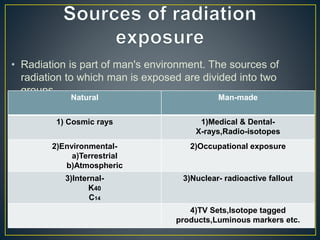
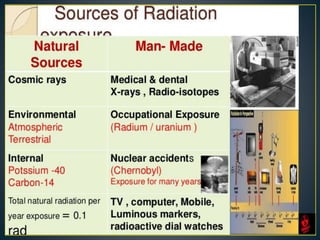
• Radiation is part of man's environment. The sources of
radiation to which man is exposed are divided into two
groups-
Natural Man-made
1) Cosmic rays 1)Medical & Dental-
X-rays,Radio-isotopes
2)Environmental-
a)Terrestrial
b)Atmospheric
2)Occupational exposure
3)Internal-
K40
C14
3)Nuclear- radioactive fallout
4)TV Sets,Isotope tagged
products,Luminous markers etc.
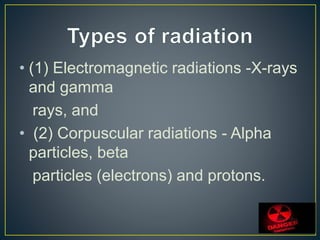
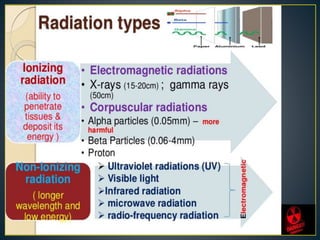
• (1) Electromagnetic radiations -X-rays
and gamma
rays, and
• (2) Corpuscular radiations - Alpha
particles, beta
particles (electrons) and protons.
• The biological response of high dose of radiation is as
follows :
< 5 rad : No immediate observable effects
- 5 rad to 50 rad : Slight blood changes may be detected
by medical evaluations.
- 50 rad to 150 rad : Slight blood changes will be noted
and symptoms of nausea, fatigue, vomiting etc. likely.
- 150 rad to 1, 10.0 rad : Severe blood changes will be
noted and symptoms appear immediately.Approximately 2
weeks later, some of those exposed may die.
- At about 300-500 rad, upto one half of the people
exposed will die within 60 days without intensive medical
attention. Death is due to destruction of the blood forming
organs.
• - 1, 100 rad to 2,000 rad : The probability of death
increases to 1003 within one to two weeks.
• >2,000 rad : Death is a certainity. At doses above 5,000
rad, the central nervous system (brain and muscles) can
no longer control the body functions, including breathing
and blood circulation.
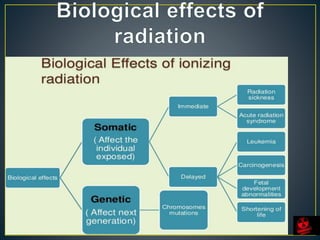
• GENETIC EFFECTS : While somatic effects are
recognizable within the life span of the irradiated person,
genetic effects would be manifest in the more or less
remote offspring. Genetic effects result from injury to
chromosomes chromosome mutations and point
mutations. Chromosome mutation is associated with
sterility. Pointmutation affects the genes.
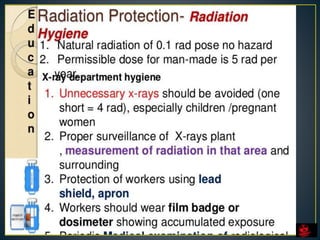
• The amount of radiation received from outer space and
background radiation has been estimated to be 0.1 rad a year.
• Apparently, this does not at present constitute a hazard.
• The additional permissible dose from man-made sources
should not exceed 5 rad a year.
• Unnecessary X-ray examinations should be avoided,
especially in the case of children and pregnant women.
• Adequate control and surveillance of X-ray installations,
protection of workers, improvement in techniques and
improvements leading to dose reduction.
• Effective Protective measures include proper use of lead
shields and lead rubber aprons. Lead aprons (0.5 mm of lead)
will reduce the intensity of scattered X-rays over 90 per cent
and should be worn by all workers regularly associated with
X-ray procedures.
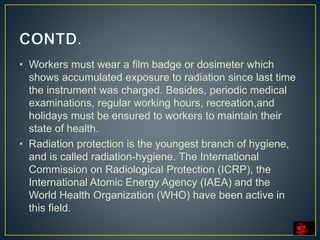
• Workers must wear a film badge or dosimeter which
shows accumulated exposure to radiation since last time
the instrument was charged. Besides, periodic medical
examinations, regular working hours, recreation,and
holidays must be ensured to workers to maintain their
state of health.
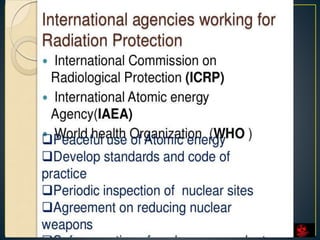
• Radiation protection is the youngest branch of hygiene,
and is called radiation-hygiene. The International
Commission on Radiological Protection (ICRP), the
International Atomic Energy Agency (IAEA) and the
World Health Organization (WHO) have been active in
this field.
Radiation lecture ppt

Radiation lecture ppt

  • 2.
    • Radiation isenergy that comes from a source and travels through space at the speed of light. This energy has an electric field and a magnetic field associated with it, and has wave-like properties. Radiation can be called as.“electromagnetic waves”.
  • 3.
    • Radiation ispart of man's environment. The sources of radiation to which man is exposed are divided into two groups- Natural Man-made 1) Cosmic rays 1)Medical & Dental- X-rays,Radio-isotopes 2)Environmental- a)Terrestrial b)Atmospheric 2)Occupational exposure 3)Internal- K40 C14 3)Nuclear- radioactive fallout 4)TV Sets,Isotope tagged products,Luminous markers etc.
  • 5.
    • (1) Electromagneticradiations -X-rays and gamma rays, and • (2) Corpuscular radiations - Alpha particles, beta particles (electrons) and protons.
  • 9.
    • The biologicalresponse of high dose of radiation is as follows : < 5 rad : No immediate observable effects - 5 rad to 50 rad : Slight blood changes may be detected by medical evaluations. - 50 rad to 150 rad : Slight blood changes will be noted and symptoms of nausea, fatigue, vomiting etc. likely. - 150 rad to 1, 10.0 rad : Severe blood changes will be noted and symptoms appear immediately.Approximately 2 weeks later, some of those exposed may die. - At about 300-500 rad, upto one half of the people exposed will die within 60 days without intensive medical attention. Death is due to destruction of the blood forming organs.
  • 10.
    • - 1,100 rad to 2,000 rad : The probability of death increases to 1003 within one to two weeks. • >2,000 rad : Death is a certainity. At doses above 5,000 rad, the central nervous system (brain and muscles) can no longer control the body functions, including breathing and blood circulation. • GENETIC EFFECTS : While somatic effects are recognizable within the life span of the irradiated person, genetic effects would be manifest in the more or less remote offspring. Genetic effects result from injury to chromosomes chromosome mutations and point mutations. Chromosome mutation is associated with sterility. Pointmutation affects the genes.
  • 11.
    • The amountof radiation received from outer space and background radiation has been estimated to be 0.1 rad a year. • Apparently, this does not at present constitute a hazard. • The additional permissible dose from man-made sources should not exceed 5 rad a year. • Unnecessary X-ray examinations should be avoided, especially in the case of children and pregnant women. • Adequate control and surveillance of X-ray installations, protection of workers, improvement in techniques and improvements leading to dose reduction. • Effective Protective measures include proper use of lead shields and lead rubber aprons. Lead aprons (0.5 mm of lead) will reduce the intensity of scattered X-rays over 90 per cent and should be worn by all workers regularly associated with X-ray procedures.
  • 12.
    • Workers mustwear a film badge or dosimeter which shows accumulated exposure to radiation since last time the instrument was charged. Besides, periodic medical examinations, regular working hours, recreation,and holidays must be ensured to workers to maintain their state of health. • Radiation protection is the youngest branch of hygiene, and is called radiation-hygiene. The International Commission on Radiological Protection (ICRP), the International Atomic Energy Agency (IAEA) and the World Health Organization (WHO) have been active in this field.