By
Mir Abrar
University of Kashmir, Srinagar ,J&k
1
 Introduction
 Basal plant defenses
 Signal transduction
 Mechanism of PAMPs
 Case study
 Conclusion
2
 Pathogen-associated molecular patterns, or PAMPs, are molecules
associated with groups of pathogens, that are recognized by cells of
the innate immune system.
 The term "PAMP" has been criticized on the grounds that most
microbes, not only pathogens, express the molecules detected; the
term microbe-associated molecular patternor MAMP, has
therefore been proposed.
 A virulence signal capable of binding to a pathogen receptor, in
combination with a MAMP, has been proposed as one way to
constitute a (pathogen-specific) PAMP.
3
 immunology frequently treats the terms "PAMP" and "MAMP"
interchangeably, considering their recognition to be the first step in plant
immunity, PTI (PAMP-triggered immunity), a relatively weak immune
response that occurs when the host plant does not also recognize pathogenic
effectors which damage it or modulate its immune response.
 These molecules can be referred to as small molecular motifs conserved within
a class of microbes. They are recognized by Toll-like receptors (TLRs) and
other pattern recognition receptors(PRRs) in both plants and animals.
 Bacterial Lipopolysaccharide (LPS), an endotoxin found on the bacterial cell
membrane of a bacterium, is considered to be the prototypical PAMP.
4
Plant basal defenses
1. Pre-existing
2. Induced
5
 Physical barriers involve properties of the plant surface,
that is, the cuticle, stomata and cell walls.
 Chemical barriers include compounds, such as
phytoanticipins that have antimicrobial activity, and
defensins, which interfere with pathogen nutrition and
retard their development.
6
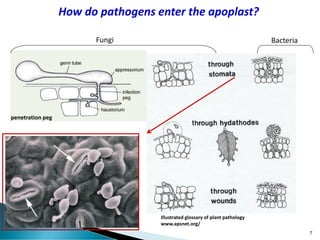
How do pathogens enter the apoplast?
Illustrated glossary of plant pathology
www.apsnet.org/
penetration peg
Fungi Bacteria
7
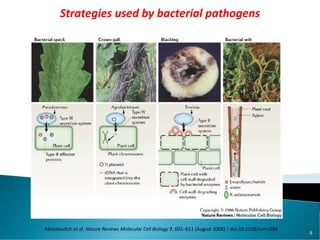
Abramovitch et al. Nature Reviews Molecular Cell Biology 7, 601–611 (August 2006) | doi:10.1038/nrm1984
Strategies used by bacterial pathogens
8
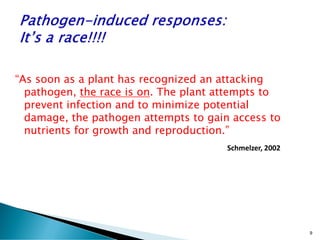
“As soon as a plant has recognized an attacking
pathogen, the race is on. The plant attempts to
prevent infection and to minimize potential
damage, the pathogen attempts to gain access to
nutrients for growth and reproduction.”
9
Schmelzer, 2002
 A relatively recent concept
 Plants can recognize certain broadly-conserved molecules
associated with pathogens- PAMPs (pathogen-associated
molecular patterns)
 Also known as MAMPs (microbe-associated…)
 Examples include flagellin, elongation factor-Tu,etc.
10
Espinosa, Avelina & Alfano
Disabling surveillance: bacterial type III secretion system effectors that
suppress innate immunity.
Cellular Microbiology 6 (11), 1027-1040.
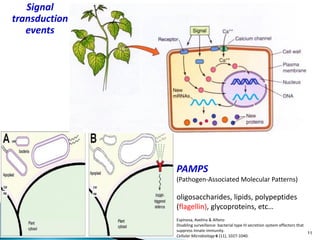
PAMPS
(Pathogen-Associated Molecular Patterns)
oligosaccharides, lipids, polypeptides
(flagellin), glycoproteins, etc…
Signal
transduction
events
11
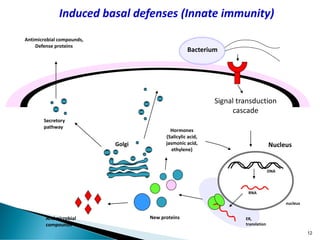
Signal transduction
cascade
Antimicrobial
compounds
Hormones
(Salicylic acid,
jasmonic acid,
ethylene)
Induced basal defenses (Innate immunity)
New proteins
Bacterium
DNA
RNA
nucleus
ER,
translation
Nucleus
Secretory
pathway
Golgi
Antimicrobial compounds,
Defense proteins
12
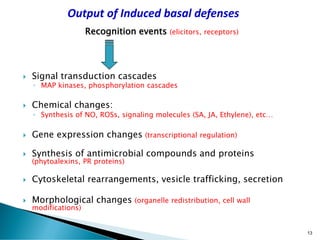
Output of Induced basal defenses
Recognition events (elicitors, receptors)
 Signal transduction cascades
◦ MAP kinases, phosphorylation cascades
 Chemical changes:
◦ Synthesis of NO, ROSs, signaling molecules (SA, JA, Ethylene), etc…
 Gene expression changes (transcriptional regulation)
 Synthesis of antimicrobial compounds and proteins
(phytoalexins, PR proteins)
 Cytoskeletal rearrangements, vesicle trafficking, secretion
 Morphological changes (organelle redistribution, cell wall
modifications)
13
Espinosa & Alfano
Cellular Microbiology 6 (11), 1027-1040.
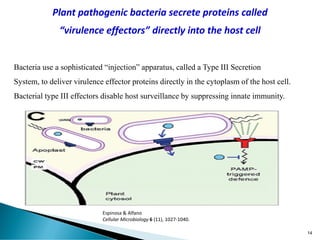
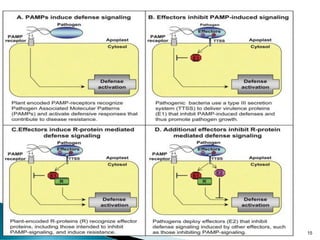
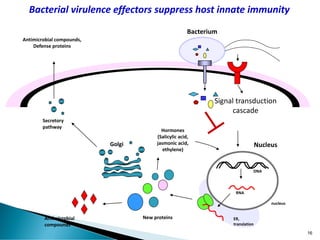
Plant pathogenic bacteria secrete proteins called
“virulence effectors” directly into the host cell
Bacteria use a sophisticated “injection” apparatus, called a Type III Secretion
System, to deliver virulence effector proteins directly in the cytoplasm of the host cell.
Bacterial type III effectors disable host surveillance by suppressing innate immunity.
14
15
Signal transduction
cascade
Bacterium
Antimicrobial
compounds
Hormones
(Salicylic acid,
jasmonic acid,
ethylene)
New proteins
DNA
RNA
nucleus
ER,
translation
Nucleus
Secretory
pathway
Golgi
Antimicrobial compounds,
Defense proteins
Bacterial virulence effectors suppress host innate immunity
16
17
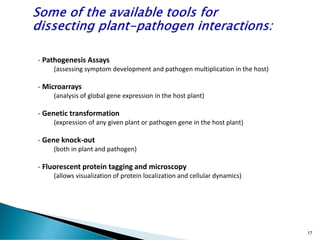
- Pathogenesis Assays
(assessing symptom development and pathogen multiplication in the host)
- Microarrays
(analysis of global gene expression in the host plant)
- Genetic transformation
(expression of any given plant or pathogen gene in the host plant)
- Gene knock-out
(both in plant and pathogen)
- Fluorescent protein tagging and microscopy
(allows visualization of protein localization and cellular dynamics)
 With the identified PRRs(encoded PAMP receptors, or pattern-recognition
receptors (PRRs) it finally became feasible to address the importance of
PAMP perception in plants. Treatment with PAMPs induces local and
systemic resistances to several unrelated virulent pathogens. For example,
flg22 treatment induced resistance to the bacterium Pseudomonas
syringae pv tomato DC3000, as well as to the fungus Botrytis
cinerea (Zipfel, 2009).
 The best manifestation that recognition of PAMPs is key to plant immunity
is the fact that pathogens must suppress this level of resistance to cause
disease.
 As a result, pathogenic microbes evolved mechanisms to avoid recognition
or to suppress defense responses through secreted virulence effectors.
18
19
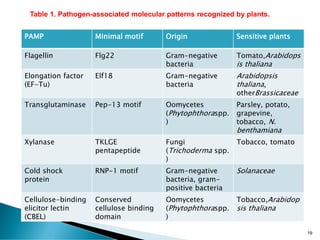
PAMP Minimal motif Origin Sensitive plants
Flagellin Flg22 Gram-negative
bacteria
Tomato,Arabidops
is thaliana
Elongation factor
(EF-Tu)
Elf18 Gram-negative
bacteria
Arabidopsis
thaliana,
otherBrassicaceae
Transglutaminase Pep-13 motif Oomycetes
(Phytophthoraspp.
)
Parsley, potato,
grapevine,
tobacco, N.
benthamiana
Xylanase TKLGE
pentapeptide
Fungi
(Trichoderma spp.
)
Tobacco, tomato
Cold shock
protein
RNP-1 motif Gram-negative
bacteria, gram-
positive bacteria
Solanaceae
Cellulose-binding
elicitor lectin
(CBEL)
Conserved
cellulose binding
domain
Oomycetes
(Phytophthoraspp.
)
Tobacco,Arabidop
sis thaliana
Table 1. Pathogen-associated molecular patterns recognized by plants.
20
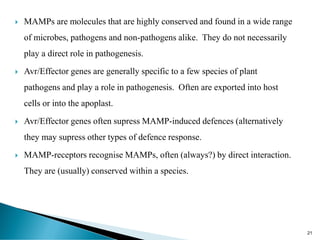
 MAMPs are molecules that are highly conserved and found in a wide range
of microbes, pathogens and non-pathogens alike. They do not necessarily
play a direct role in pathogenesis.
 Avr/Effector genes are generally specific to a few species of plant
pathogens and play a role in pathogenesis. Often are exported into host
cells or into the apoplast.
 Avr/Effector genes often supress MAMP-induced defences (alternatively
they may supress other types of defence response.
 MAMP-receptors recognise MAMPs, often (always?) by direct interaction.
They are (usually) conserved within a species.
21
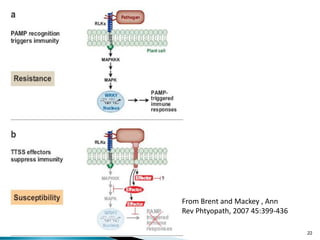
From Brent and Mackey , Ann
Rev Phtyopath, 2007 45:399-436
22
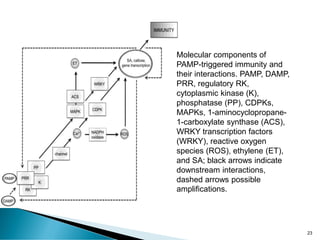
Molecular components of
PAMP-triggered immunity and
their interactions. PAMP, DAMP,
PRR, regulatory RK,
cytoplasmic kinase (K),
phosphatase (PP), CDPKs,
MAPKs, 1-aminocyclopropane-
1-carboxylate synthase (ACS),
WRKY transcription factors
(WRKY), reactive oxygen
species (ROS), ethylene (ET),
and SA; black arrows indicate
downstream interactions,
dashed arrows possible
amplifications.
23
 PAMPs trigger early responses (seconds to minutes; e.g. ion fluxes, oxidative
burst), intermediate responses (minutes to hours; e.g. MAPK/CDPK activation,
ethylene production, stomatal closure, transcriptional reprogramming), and late
responses (hours to days; e.g. salicylic acid [SA] accumulation, callose deposition).
 Intriguingly, many of these responses include the production of molecules that
potentially can act as second messengers (calcium, reactive oxygen species,
ethylene, SA) and we may predict roles for each of the signaling pathways in
PAMP-triggered immunity .
 Like in animals, host endogenous molecules released upon wounding and infection,
called damage-associated molecular patterns (DAMPs), are capable of inducing
immune reactions in plants .
 Only recently, the first plant DAMP receptor has been identified. The LRR-RKs
PEPR1 and PEPR2 are responsible for the detection of the peptidic DAMP AtPep1
(Krol et al., 2010; Yamaguchi et al., 2010). 24
 Not every microbe displays all PAMPs and not every plant recognizes all PAMPs.
For example, flg22 is detected by most plant species, but some pathogens evade
recognition through mutation of key residues
 In addition, EF-Tu is only sensed by Brassicaceae, and recognition of Ax21 is
restricted to specific rice cultivars. However, EF-Tu perception can be transferred
across plant families and importantly confers resistance to bacteria belonging to
several classes, indicating that all necessary components downstream of EFR are
conserved (Lacombe et al., 2010).
 These examples suggest that there is a dynamic evolution in the display of PAMPs
by microbes and in the recognition of PAMPs by plants (Boller and Felix, 2009),
 Novel PRRs will provide useful tools for engineering sustainable quantitative
broad-spectrum disease resistance in the field.
25
26
THANK YOU

PAMP's

  • 1.
    By Mir Abrar University ofKashmir, Srinagar ,J&k 1
  • 2.
     Introduction  Basalplant defenses  Signal transduction  Mechanism of PAMPs  Case study  Conclusion 2
  • 3.
     Pathogen-associated molecularpatterns, or PAMPs, are molecules associated with groups of pathogens, that are recognized by cells of the innate immune system.  The term "PAMP" has been criticized on the grounds that most microbes, not only pathogens, express the molecules detected; the term microbe-associated molecular patternor MAMP, has therefore been proposed.  A virulence signal capable of binding to a pathogen receptor, in combination with a MAMP, has been proposed as one way to constitute a (pathogen-specific) PAMP. 3
  • 4.
     immunology frequentlytreats the terms "PAMP" and "MAMP" interchangeably, considering their recognition to be the first step in plant immunity, PTI (PAMP-triggered immunity), a relatively weak immune response that occurs when the host plant does not also recognize pathogenic effectors which damage it or modulate its immune response.  These molecules can be referred to as small molecular motifs conserved within a class of microbes. They are recognized by Toll-like receptors (TLRs) and other pattern recognition receptors(PRRs) in both plants and animals.  Bacterial Lipopolysaccharide (LPS), an endotoxin found on the bacterial cell membrane of a bacterium, is considered to be the prototypical PAMP. 4
  • 5.
    Plant basal defenses 1.Pre-existing 2. Induced 5
  • 6.
     Physical barriersinvolve properties of the plant surface, that is, the cuticle, stomata and cell walls.  Chemical barriers include compounds, such as phytoanticipins that have antimicrobial activity, and defensins, which interfere with pathogen nutrition and retard their development. 6
  • 7.
    How do pathogensenter the apoplast? Illustrated glossary of plant pathology www.apsnet.org/ penetration peg Fungi Bacteria 7
  • 8.
    Abramovitch et al.Nature Reviews Molecular Cell Biology 7, 601–611 (August 2006) | doi:10.1038/nrm1984 Strategies used by bacterial pathogens 8
  • 9.
    “As soon asa plant has recognized an attacking pathogen, the race is on. The plant attempts to prevent infection and to minimize potential damage, the pathogen attempts to gain access to nutrients for growth and reproduction.” 9 Schmelzer, 2002
  • 10.
     A relativelyrecent concept  Plants can recognize certain broadly-conserved molecules associated with pathogens- PAMPs (pathogen-associated molecular patterns)  Also known as MAMPs (microbe-associated…)  Examples include flagellin, elongation factor-Tu,etc. 10
  • 11.
    Espinosa, Avelina &Alfano Disabling surveillance: bacterial type III secretion system effectors that suppress innate immunity. Cellular Microbiology 6 (11), 1027-1040. PAMPS (Pathogen-Associated Molecular Patterns) oligosaccharides, lipids, polypeptides (flagellin), glycoproteins, etc… Signal transduction events 11
  • 12.
    Signal transduction cascade Antimicrobial compounds Hormones (Salicylic acid, jasmonicacid, ethylene) Induced basal defenses (Innate immunity) New proteins Bacterium DNA RNA nucleus ER, translation Nucleus Secretory pathway Golgi Antimicrobial compounds, Defense proteins 12
  • 13.
    Output of Inducedbasal defenses Recognition events (elicitors, receptors)  Signal transduction cascades ◦ MAP kinases, phosphorylation cascades  Chemical changes: ◦ Synthesis of NO, ROSs, signaling molecules (SA, JA, Ethylene), etc…  Gene expression changes (transcriptional regulation)  Synthesis of antimicrobial compounds and proteins (phytoalexins, PR proteins)  Cytoskeletal rearrangements, vesicle trafficking, secretion  Morphological changes (organelle redistribution, cell wall modifications) 13
  • 14.
    Espinosa & Alfano CellularMicrobiology 6 (11), 1027-1040. Plant pathogenic bacteria secrete proteins called “virulence effectors” directly into the host cell Bacteria use a sophisticated “injection” apparatus, called a Type III Secretion System, to deliver virulence effector proteins directly in the cytoplasm of the host cell. Bacterial type III effectors disable host surveillance by suppressing innate immunity. 14
  • 15.
  • 16.
    Signal transduction cascade Bacterium Antimicrobial compounds Hormones (Salicylic acid, jasmonicacid, ethylene) New proteins DNA RNA nucleus ER, translation Nucleus Secretory pathway Golgi Antimicrobial compounds, Defense proteins Bacterial virulence effectors suppress host innate immunity 16
  • 17.
    17 - Pathogenesis Assays (assessingsymptom development and pathogen multiplication in the host) - Microarrays (analysis of global gene expression in the host plant) - Genetic transformation (expression of any given plant or pathogen gene in the host plant) - Gene knock-out (both in plant and pathogen) - Fluorescent protein tagging and microscopy (allows visualization of protein localization and cellular dynamics)
  • 18.
     With theidentified PRRs(encoded PAMP receptors, or pattern-recognition receptors (PRRs) it finally became feasible to address the importance of PAMP perception in plants. Treatment with PAMPs induces local and systemic resistances to several unrelated virulent pathogens. For example, flg22 treatment induced resistance to the bacterium Pseudomonas syringae pv tomato DC3000, as well as to the fungus Botrytis cinerea (Zipfel, 2009).  The best manifestation that recognition of PAMPs is key to plant immunity is the fact that pathogens must suppress this level of resistance to cause disease.  As a result, pathogenic microbes evolved mechanisms to avoid recognition or to suppress defense responses through secreted virulence effectors. 18
  • 19.
    19 PAMP Minimal motifOrigin Sensitive plants Flagellin Flg22 Gram-negative bacteria Tomato,Arabidops is thaliana Elongation factor (EF-Tu) Elf18 Gram-negative bacteria Arabidopsis thaliana, otherBrassicaceae Transglutaminase Pep-13 motif Oomycetes (Phytophthoraspp. ) Parsley, potato, grapevine, tobacco, N. benthamiana Xylanase TKLGE pentapeptide Fungi (Trichoderma spp. ) Tobacco, tomato Cold shock protein RNP-1 motif Gram-negative bacteria, gram- positive bacteria Solanaceae Cellulose-binding elicitor lectin (CBEL) Conserved cellulose binding domain Oomycetes (Phytophthoraspp. ) Tobacco,Arabidop sis thaliana Table 1. Pathogen-associated molecular patterns recognized by plants.
  • 20.
  • 21.
     MAMPs aremolecules that are highly conserved and found in a wide range of microbes, pathogens and non-pathogens alike. They do not necessarily play a direct role in pathogenesis.  Avr/Effector genes are generally specific to a few species of plant pathogens and play a role in pathogenesis. Often are exported into host cells or into the apoplast.  Avr/Effector genes often supress MAMP-induced defences (alternatively they may supress other types of defence response.  MAMP-receptors recognise MAMPs, often (always?) by direct interaction. They are (usually) conserved within a species. 21
  • 22.
    From Brent andMackey , Ann Rev Phtyopath, 2007 45:399-436 22
  • 23.
    Molecular components of PAMP-triggeredimmunity and their interactions. PAMP, DAMP, PRR, regulatory RK, cytoplasmic kinase (K), phosphatase (PP), CDPKs, MAPKs, 1-aminocyclopropane- 1-carboxylate synthase (ACS), WRKY transcription factors (WRKY), reactive oxygen species (ROS), ethylene (ET), and SA; black arrows indicate downstream interactions, dashed arrows possible amplifications. 23
  • 24.
     PAMPs triggerearly responses (seconds to minutes; e.g. ion fluxes, oxidative burst), intermediate responses (minutes to hours; e.g. MAPK/CDPK activation, ethylene production, stomatal closure, transcriptional reprogramming), and late responses (hours to days; e.g. salicylic acid [SA] accumulation, callose deposition).  Intriguingly, many of these responses include the production of molecules that potentially can act as second messengers (calcium, reactive oxygen species, ethylene, SA) and we may predict roles for each of the signaling pathways in PAMP-triggered immunity .  Like in animals, host endogenous molecules released upon wounding and infection, called damage-associated molecular patterns (DAMPs), are capable of inducing immune reactions in plants .  Only recently, the first plant DAMP receptor has been identified. The LRR-RKs PEPR1 and PEPR2 are responsible for the detection of the peptidic DAMP AtPep1 (Krol et al., 2010; Yamaguchi et al., 2010). 24
  • 25.
     Not everymicrobe displays all PAMPs and not every plant recognizes all PAMPs. For example, flg22 is detected by most plant species, but some pathogens evade recognition through mutation of key residues  In addition, EF-Tu is only sensed by Brassicaceae, and recognition of Ax21 is restricted to specific rice cultivars. However, EF-Tu perception can be transferred across plant families and importantly confers resistance to bacteria belonging to several classes, indicating that all necessary components downstream of EFR are conserved (Lacombe et al., 2010).  These examples suggest that there is a dynamic evolution in the display of PAMPs by microbes and in the recognition of PAMPs by plants (Boller and Felix, 2009),  Novel PRRs will provide useful tools for engineering sustainable quantitative broad-spectrum disease resistance in the field. 25
  • 26.