



Immunity Against infectious
diseases by Bacteria
NOIDA INSTITUTE OF ENGINEERING AND TECHNOLOGY, GREATER NOIDA
By: Rohit Satyam, 2nd Year, Department of Biotechnology
Group Members
1. Aqueel Haider
2.Nishtha Singh
3.Rohit Satyam
4.Srishti Singh
5.Rohit Panchal
Bac . teria: The Back door
of cafeteria.
.
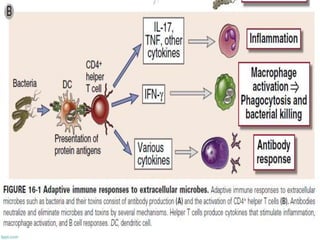
IMMUNITY TO EXTRACELLULAR BACTERIA
Extracellular bacteria are capable of replicating outside host
cells, for example, in the blood, in connective tissues, and in
tissue spaces such as the lumens of the airways and
gastrointestinal tract
Disease is caused by two principal mechanisms.
1. First, these bacteria induce inflammation, which results in
tissue destruction at the site of infection.
2. Second, bacteria produce toxins, which have diverse
pathologic effects. The toxins may be endotoxins, which are
components of bacterial cell walls, or exotoxins, which are
secreted by the bacteria. The endotoxin of gram-negative
bacteria, also called lipopolysaccharide (LPS) is a potent
activator of macrophages, dendritic cells, and endothelial
cells
For instance
1. Diphtheria toxin shuts down protein synthesis
in infected cells.
2. cholera toxin interferes with ion and water
transport.
3. tetanus toxin inhibits neuromuscular
transmission.
4. Anthrax toxin disrupts several critical
biochemical signalling pathways in infected
cells.
Innate Immunity to
Extracellular
Bacteria
The principal mechanisms of
innate immunity to
extracellular bacteria are
complement activation,
phagocytosis, and the
inflammatory response.
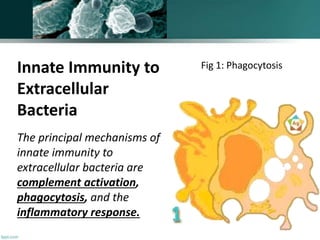
Fig 1: Phagocytosis
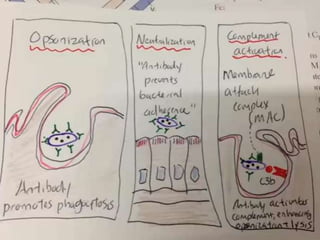
1. Opsonization is a term that refers to an immune
process where particles such as bacteria are targeted
for destruction by an immune cell known as a
phagocyte .
The process of opsonization is a means of identifying
the invading particle to the phagocyte.
Eg: opsonin include: C3b, Antibodies
Know the Technical Jargons First
2. What is the complement system?
Ans: The complement system is a set of over 20 different
protein molecules always found in the blood. There are no
cells in the system. With an infection, this system of
molecules is activated, leading to a sequence of events on
the surface of the pathogen that helps destroy the
pathogen and eliminate the infection.
It activates immune system, kill cells and participate in
opsonisation
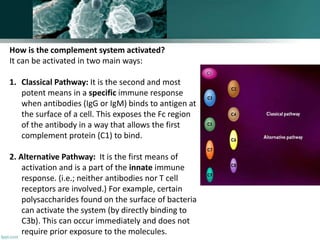
How is the complement system activated?
It can be activated in two main ways:
1. Classical Pathway: It is the second and most
potent means in a specific immune response
when antibodies (IgG or IgM) binds to antigen at
the surface of a cell. This exposes the Fc region
of the antibody in a way that allows the first
complement protein (C1) to bind.
2. Alternative Pathway: It is the first means of
activation and is a part of the innate immune
response. (i.e.; neither antibodies nor T cell
receptors are involved.) For example, certain
polysaccharides found on the surface of bacteria
can activate the system (by directly binding to
C3b). This can occur immediately and does not
require prior exposure to the molecules.
Neutralised bacteria feels like this
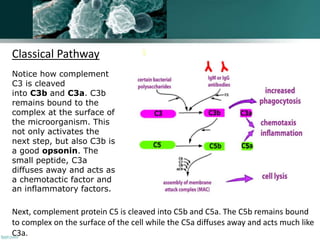
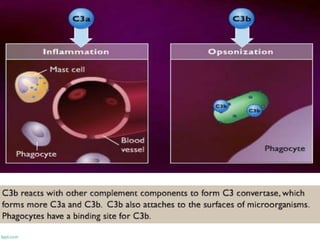
Notice how complement
C3 is cleaved
into C3b and C3a. C3b
remains bound to the
complex at the surface of
the microorganism. This
not only activates the
next step, but also C3b is
a good opsonin. The
small peptide, C3a
diffuses away and acts as
a chemotactic factor and
an inflammatory factors.
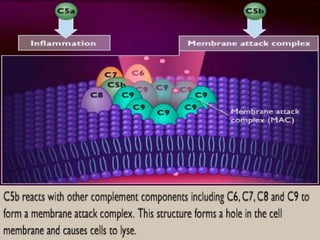
Next, complement protein C5 is cleaved into C5b and C5a. The C5b remains bound
to complex on the surface of the cell while the C5a diffuses away and acts much like
C3a.
Classical Pathway
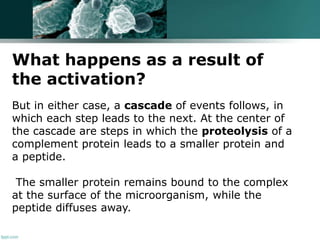
What happens as a result of
the activation?
But in either case, a cascade of events follows, in
which each step leads to the next. At the center of
the cascade are steps in which the proteolysis of a
complement protein leads to a smaller protein and
a peptide.
The smaller protein remains bound to the complex
at the surface of the microorganism, while the
peptide diffuses away.
3. What is neutralisation?
Covering an antigen in antibodies make it less
infectious and less pathogenic. Neutralisation
or neutralization in the immunological sense refers
to the ability of specific antibodies to block the
site(s) on bacteria and their toxins or viruses that
they use to enter their target cell.
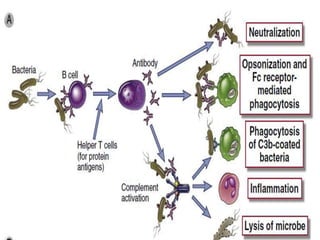
Neutralization is mediated by high-affinity IgG, IgM,
and IgA isotypes, the latter mainly in the lumens of
mucosal organs.
Opsonization is mediated by some subclasses of
IgG, and complement activation is initiated by IgM
and subclasses of IgG.
4. Interleukins
•These are a group of cytokines (secreted proteins and signal molecules) that
were first seen to be expressed by white blood cells (leukocytes).
•The function of the immune system depends in a large part on interleukins,
and rare deficiencies of a number of them have been described, all
featuring autoimmune diseases or immune deficiency. The majority of
interleukins are synthesized by helper CD4 T lymphocytes, as well as
through monocytes, macrophages, and endothelial cells. They promote the
development and differentiation of T and B lymphocytes,
and hematopoietic cells.
•There are IL1……IL17 families of IL
NOTE: IL-17: differentiation and proliferation of lymphoid progenitor cells,
involved in B, T, and NK cell survival, development, and homeostasis, ↑pro-
inflammatory cytokines
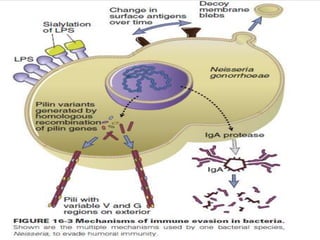
•Some surface antigens of bacteria such as gonococci and Escherichia coli are
contained in their pili, which are the structures responsible for bacterial
adhesion to host cells.
•The major antigen of the pili is a protein called pilin. The pilin genes of
gonococci undergo extensive gene conversion, because of which the progeny
of one organism can produce up to 106 antigenically distinct pilin molecules.
•This ability to alter antigens helps the bacteria evade attack by pilin-specific
antibodies, although its principal significance for the bacteria may be to
select for pili that are more adherent to host cells so that the bacteria are
more virulent.
•Changes in the production of glycosidases lead to chemical alterations in
surface LPS and other polysaccharides, which enable the bacteria to evade
humoral immune responses against these antigens.
Injurious Effects of Immune Responses to
Extracellular Bacteria
The principal injurious consequences of host responses to
extracellular bacteria are inflammation and septic shock.
Septic shock is a serious medical condition that occurs
when sepsis, which is organ injury or damage in response
to infection, leads to dangerously low blood pressure and
abnormalities in cellular metabolism
Sepsis is a life-threatening condition that arises when the body's response
to infection injures its own tissues and organs.Common signs and
symptoms include fever, increased heart rate, increased breathing rate,
and confusion
The early phase of septic shock is caused by cytokines produced by
macrophages that are activated by bacterial cell wall components,
including LPS (Lipo-Polysaccharide) and peptidoglycans.
Tumor necrosis factor (TNF), IL-6, and IL-1 are the principal cytokine
mediators of septic shock, but IFN-γ (Interferon Gama) and IL-12 may
also contribute.
This early burst of large amounts of cytokines is sometimes called a
cytokine storm.
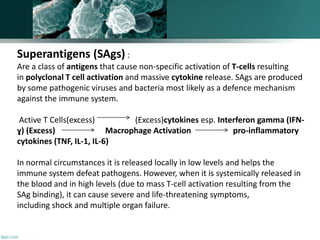
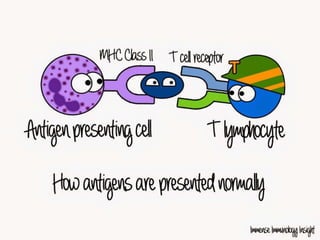
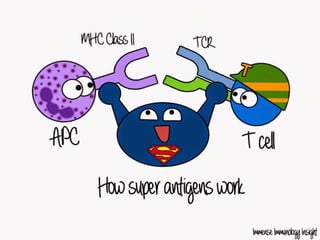
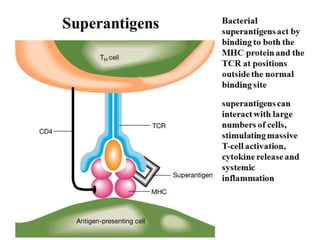
Superantigens (SAgs) :
Are a class of antigens that cause non-specific activation of T-cells resulting
in polyclonal T cell activation and massive cytokine release. SAgs are produced
by some pathogenic viruses and bacteria most likely as a defence mechanism
against the immune system.
Active T Cells(excess) (Excess)cytokines esp. Interferon gamma (IFN-
ɣ) (Excess) Macrophage Activation pro-inflammatory
cytokines (TNF, IL-1, IL-6)
In normal circumstances it is released locally in low levels and helps the
immune system defeat pathogens. However, when it is systemically released in
the blood and in high levels (due to mass T-cell activation resulting from the
SAg binding), it can cause severe and life-threatening symptoms,
including shock and multiple organ failure.
There is some evidence that the progression of septic shock is
associated with defective immune responses, perhaps related to
depletion or suppression of T cells, resulting in unchecked
microbial spread.
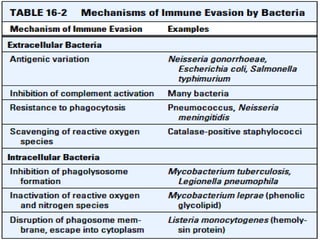
Immune Evasion by Extracellular Bacteria
They know how to befool your Security System
Bacteria with polysaccharide-rich capsules resist phagocytosis
and are therefore much more virulent than strains lacking a
capsule. The capsules of many pathogenic Gram-positive and
Gram-negative bacteria contain sialic acid residues that inhibit
complement activation by the alternative pathway.
A mechanism used by bacteria to evade humoral immunity is
variation of surface antigens.
The innate immune response to intracellular bacteria
is mediated mainly by phagocytes and natural killer
(NK) cells.
Phagocytes, initially neutrophils and later macrophages,
ingest and attempt to destroy these microbes, but
pathogenic intracellular bacteria are resistant to degradation
within phagocytes.
Innate Immunity against Intracellular
Bacteria
Toll-like receptors (TLRs) are a class of proteins that play a
key role in the innate immune system. They are single,
membrane-spanning, non-catalytic receptors usually
expressed in APCs such as macrophages and dendritic cells
.
Once these microbes have breached physical barriers such
as the skin or intestinal tract mucosa, they are recognized
by TLRs, which activate immune cellresponses.
TLRs
Bacteria may enter mammalian cells by phagocytosis or
by facilitating their own uptake, termed invasion. During
the process of phagocytosis or invasion, innate immune
sensors like the Toll-like receptors (TLRs) or Nod-like
receptors (NLRs) may be triggered by bacterial ligands.
The signalling pathways activated by TLRs and NLRs have
been extensively reviewed elsewhere and predominantly
lead to expression and activation of pro-inflammatory
cytokines
Intracellular bacteria activate NK cells by inducing expression of
NK cell–activating ligands on infected cells and by stimulating
dendritic cell and macrophage production of IL-12 and IL-15,
both of which are NK cell– activating cytokines.
The NK cells produce IFN-γ, which in turn activates
macrophages and promotes killing of the phagocytosed
bacteria.
Thus, NK cells provide an early defense against these microbes,
before the development of adaptive immunity.
Adaptive Immunity to Intracellular Bacteria
The major protective immune response against intracellular
bacteria is T cell–mediated recruitment and activation of
phagocytes (cell-mediated immunity).
Individuals with deficient cell-mediated immunity, such as
patients with AIDS, are extremely susceptible to infections with
intracellular bacteria (as well as intracellular fungi and viruses).
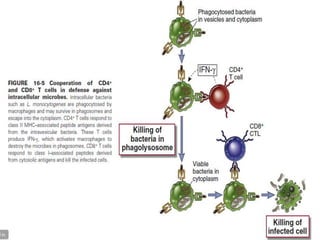
As we know, T cells provide defence against infections by two
types of reactions:
1. CD4+ T cells activate phagocytes IFN-γ and other factors,
resulting in killing of microbes that are ingested by and
survive within phagocytes. These stimuli activate
macrophages to produce several microbicidal substances,
including reactive oxygen species, nitric oxide, and
lysosomal enzymes. CD4+ T cells differentiate into TH1
effectors under the influence of IL, which is produced by
macrophages and dendritic cells.
2. CD8+ cytotoxic T lymphocytes (CTLs) kill infected cells,
eliminating microbes that escape the killing mechanisms of
phagocytes.
Phagocytosed bacteria stimulate CD8+ T cell responses if
bacterial antigens are transported from phagosomes into the
cytosol or if the bacteria escape from phagosomes and enter
the cytoplasm of infected cells.
In the cytosol, the microbes are no longer susceptible to the
microbicidal mechanisms of phagocytes, and for eradication of
the infection, the infected cells have to be killed by Cytotoxic
TLs.
Thus, the effectors of cell-mediated immunity, namely, CD4+ T
cells that activate macrophages and CD8+ Cytotoxic TLs,
function cooperatively in defense against intracellular bacteria
Immune Evasion by Intracellular Bacteria
Intracellular bacteria have developed various strategies to resist
elimination by phagocytes. These include
1. Inhibiting phagolysosome fusion
2. Escaping into the cytosol, thus hiding from the microbicidal
mechanisms of lysosomes, and directly inactivating microbicidal
substances such as reactive oxygen species.
Resistance to phagocyte-mediated elimination is also the reason that
such bacteria tend to cause chronic infections that may last for years,
often recur after apparent cure, and are difficult to eradicate.
Refrences:
1.Wikepedia
2.Abul K. Abbas Andrew H. H. Lichtman Shiv
Pillai-Cellular and Molecular Immunology
3.NCBI
4. McGraw-Hill Global Education Holdings, LLC
Thank You

Immunisation against bacteria

  • 1.
    Immunity Against infectious diseasesby Bacteria NOIDA INSTITUTE OF ENGINEERING AND TECHNOLOGY, GREATER NOIDA By: Rohit Satyam, 2nd Year, Department of Biotechnology
  • 2.
    Group Members 1. AqueelHaider 2.Nishtha Singh 3.Rohit Satyam 4.Srishti Singh 5.Rohit Panchal Bac . teria: The Back door of cafeteria.
  • 3.
    . IMMUNITY TO EXTRACELLULARBACTERIA Extracellular bacteria are capable of replicating outside host cells, for example, in the blood, in connective tissues, and in tissue spaces such as the lumens of the airways and gastrointestinal tract Disease is caused by two principal mechanisms. 1. First, these bacteria induce inflammation, which results in tissue destruction at the site of infection. 2. Second, bacteria produce toxins, which have diverse pathologic effects. The toxins may be endotoxins, which are components of bacterial cell walls, or exotoxins, which are secreted by the bacteria. The endotoxin of gram-negative bacteria, also called lipopolysaccharide (LPS) is a potent activator of macrophages, dendritic cells, and endothelial cells
  • 4.
    For instance 1. Diphtheriatoxin shuts down protein synthesis in infected cells. 2. cholera toxin interferes with ion and water transport. 3. tetanus toxin inhibits neuromuscular transmission. 4. Anthrax toxin disrupts several critical biochemical signalling pathways in infected cells.
  • 5.
    Innate Immunity to Extracellular Bacteria Theprincipal mechanisms of innate immunity to extracellular bacteria are complement activation, phagocytosis, and the inflammatory response. Fig 1: Phagocytosis
  • 6.
    1. Opsonization isa term that refers to an immune process where particles such as bacteria are targeted for destruction by an immune cell known as a phagocyte . The process of opsonization is a means of identifying the invading particle to the phagocyte. Eg: opsonin include: C3b, Antibodies Know the Technical Jargons First
  • 8.
    2. What isthe complement system? Ans: The complement system is a set of over 20 different protein molecules always found in the blood. There are no cells in the system. With an infection, this system of molecules is activated, leading to a sequence of events on the surface of the pathogen that helps destroy the pathogen and eliminate the infection. It activates immune system, kill cells and participate in opsonisation
  • 9.
    How is thecomplement system activated? It can be activated in two main ways: 1. Classical Pathway: It is the second and most potent means in a specific immune response when antibodies (IgG or IgM) binds to antigen at the surface of a cell. This exposes the Fc region of the antibody in a way that allows the first complement protein (C1) to bind. 2. Alternative Pathway: It is the first means of activation and is a part of the innate immune response. (i.e.; neither antibodies nor T cell receptors are involved.) For example, certain polysaccharides found on the surface of bacteria can activate the system (by directly binding to C3b). This can occur immediately and does not require prior exposure to the molecules.
  • 10.
  • 11.
    Notice how complement C3is cleaved into C3b and C3a. C3b remains bound to the complex at the surface of the microorganism. This not only activates the next step, but also C3b is a good opsonin. The small peptide, C3a diffuses away and acts as a chemotactic factor and an inflammatory factors. Next, complement protein C5 is cleaved into C5b and C5a. The C5b remains bound to complex on the surface of the cell while the C5a diffuses away and acts much like C3a. Classical Pathway
  • 13.
    What happens asa result of the activation? But in either case, a cascade of events follows, in which each step leads to the next. At the center of the cascade are steps in which the proteolysis of a complement protein leads to a smaller protein and a peptide. The smaller protein remains bound to the complex at the surface of the microorganism, while the peptide diffuses away.
  • 15.
    3. What isneutralisation? Covering an antigen in antibodies make it less infectious and less pathogenic. Neutralisation or neutralization in the immunological sense refers to the ability of specific antibodies to block the site(s) on bacteria and their toxins or viruses that they use to enter their target cell.
  • 16.
    Neutralization is mediatedby high-affinity IgG, IgM, and IgA isotypes, the latter mainly in the lumens of mucosal organs. Opsonization is mediated by some subclasses of IgG, and complement activation is initiated by IgM and subclasses of IgG.
  • 17.
    4. Interleukins •These area group of cytokines (secreted proteins and signal molecules) that were first seen to be expressed by white blood cells (leukocytes). •The function of the immune system depends in a large part on interleukins, and rare deficiencies of a number of them have been described, all featuring autoimmune diseases or immune deficiency. The majority of interleukins are synthesized by helper CD4 T lymphocytes, as well as through monocytes, macrophages, and endothelial cells. They promote the development and differentiation of T and B lymphocytes, and hematopoietic cells. •There are IL1……IL17 families of IL NOTE: IL-17: differentiation and proliferation of lymphoid progenitor cells, involved in B, T, and NK cell survival, development, and homeostasis, ↑pro- inflammatory cytokines
  • 20.
    •Some surface antigensof bacteria such as gonococci and Escherichia coli are contained in their pili, which are the structures responsible for bacterial adhesion to host cells. •The major antigen of the pili is a protein called pilin. The pilin genes of gonococci undergo extensive gene conversion, because of which the progeny of one organism can produce up to 106 antigenically distinct pilin molecules. •This ability to alter antigens helps the bacteria evade attack by pilin-specific antibodies, although its principal significance for the bacteria may be to select for pili that are more adherent to host cells so that the bacteria are more virulent. •Changes in the production of glycosidases lead to chemical alterations in surface LPS and other polysaccharides, which enable the bacteria to evade humoral immune responses against these antigens.
  • 22.
    Injurious Effects ofImmune Responses to Extracellular Bacteria The principal injurious consequences of host responses to extracellular bacteria are inflammation and septic shock. Septic shock is a serious medical condition that occurs when sepsis, which is organ injury or damage in response to infection, leads to dangerously low blood pressure and abnormalities in cellular metabolism
  • 23.
    Sepsis is alife-threatening condition that arises when the body's response to infection injures its own tissues and organs.Common signs and symptoms include fever, increased heart rate, increased breathing rate, and confusion The early phase of septic shock is caused by cytokines produced by macrophages that are activated by bacterial cell wall components, including LPS (Lipo-Polysaccharide) and peptidoglycans. Tumor necrosis factor (TNF), IL-6, and IL-1 are the principal cytokine mediators of septic shock, but IFN-γ (Interferon Gama) and IL-12 may also contribute. This early burst of large amounts of cytokines is sometimes called a cytokine storm.
  • 24.
    Superantigens (SAgs) : Area class of antigens that cause non-specific activation of T-cells resulting in polyclonal T cell activation and massive cytokine release. SAgs are produced by some pathogenic viruses and bacteria most likely as a defence mechanism against the immune system. Active T Cells(excess) (Excess)cytokines esp. Interferon gamma (IFN- ɣ) (Excess) Macrophage Activation pro-inflammatory cytokines (TNF, IL-1, IL-6) In normal circumstances it is released locally in low levels and helps the immune system defeat pathogens. However, when it is systemically released in the blood and in high levels (due to mass T-cell activation resulting from the SAg binding), it can cause severe and life-threatening symptoms, including shock and multiple organ failure.
  • 28.
    There is someevidence that the progression of septic shock is associated with defective immune responses, perhaps related to depletion or suppression of T cells, resulting in unchecked microbial spread.
  • 29.
    Immune Evasion byExtracellular Bacteria They know how to befool your Security System Bacteria with polysaccharide-rich capsules resist phagocytosis and are therefore much more virulent than strains lacking a capsule. The capsules of many pathogenic Gram-positive and Gram-negative bacteria contain sialic acid residues that inhibit complement activation by the alternative pathway. A mechanism used by bacteria to evade humoral immunity is variation of surface antigens.
  • 30.
    The innate immuneresponse to intracellular bacteria is mediated mainly by phagocytes and natural killer (NK) cells. Phagocytes, initially neutrophils and later macrophages, ingest and attempt to destroy these microbes, but pathogenic intracellular bacteria are resistant to degradation within phagocytes. Innate Immunity against Intracellular Bacteria
  • 31.
    Toll-like receptors (TLRs)are a class of proteins that play a key role in the innate immune system. They are single, membrane-spanning, non-catalytic receptors usually expressed in APCs such as macrophages and dendritic cells . Once these microbes have breached physical barriers such as the skin or intestinal tract mucosa, they are recognized by TLRs, which activate immune cellresponses. TLRs
  • 32.
    Bacteria may entermammalian cells by phagocytosis or by facilitating their own uptake, termed invasion. During the process of phagocytosis or invasion, innate immune sensors like the Toll-like receptors (TLRs) or Nod-like receptors (NLRs) may be triggered by bacterial ligands. The signalling pathways activated by TLRs and NLRs have been extensively reviewed elsewhere and predominantly lead to expression and activation of pro-inflammatory cytokines
  • 33.
    Intracellular bacteria activateNK cells by inducing expression of NK cell–activating ligands on infected cells and by stimulating dendritic cell and macrophage production of IL-12 and IL-15, both of which are NK cell– activating cytokines. The NK cells produce IFN-γ, which in turn activates macrophages and promotes killing of the phagocytosed bacteria. Thus, NK cells provide an early defense against these microbes, before the development of adaptive immunity.
  • 34.
    Adaptive Immunity toIntracellular Bacteria The major protective immune response against intracellular bacteria is T cell–mediated recruitment and activation of phagocytes (cell-mediated immunity). Individuals with deficient cell-mediated immunity, such as patients with AIDS, are extremely susceptible to infections with intracellular bacteria (as well as intracellular fungi and viruses).
  • 36.
    As we know,T cells provide defence against infections by two types of reactions: 1. CD4+ T cells activate phagocytes IFN-γ and other factors, resulting in killing of microbes that are ingested by and survive within phagocytes. These stimuli activate macrophages to produce several microbicidal substances, including reactive oxygen species, nitric oxide, and lysosomal enzymes. CD4+ T cells differentiate into TH1 effectors under the influence of IL, which is produced by macrophages and dendritic cells. 2. CD8+ cytotoxic T lymphocytes (CTLs) kill infected cells, eliminating microbes that escape the killing mechanisms of phagocytes.
  • 37.
    Phagocytosed bacteria stimulateCD8+ T cell responses if bacterial antigens are transported from phagosomes into the cytosol or if the bacteria escape from phagosomes and enter the cytoplasm of infected cells. In the cytosol, the microbes are no longer susceptible to the microbicidal mechanisms of phagocytes, and for eradication of the infection, the infected cells have to be killed by Cytotoxic TLs. Thus, the effectors of cell-mediated immunity, namely, CD4+ T cells that activate macrophages and CD8+ Cytotoxic TLs, function cooperatively in defense against intracellular bacteria
  • 38.
    Immune Evasion byIntracellular Bacteria Intracellular bacteria have developed various strategies to resist elimination by phagocytes. These include 1. Inhibiting phagolysosome fusion 2. Escaping into the cytosol, thus hiding from the microbicidal mechanisms of lysosomes, and directly inactivating microbicidal substances such as reactive oxygen species. Resistance to phagocyte-mediated elimination is also the reason that such bacteria tend to cause chronic infections that may last for years, often recur after apparent cure, and are difficult to eradicate.
  • 41.
    Refrences: 1.Wikepedia 2.Abul K. AbbasAndrew H. H. Lichtman Shiv Pillai-Cellular and Molecular Immunology 3.NCBI 4. McGraw-Hill Global Education Holdings, LLC
  • 42.