Quorum
Quenching
1
PRESENTED BY,
ARNAB GUPTA KABIRAJ
M.Sc. MICROBIOLOGY SEMESTER –
II
ROLL NO – BURMICRO 2016/002
REGISTRATION NO. – 001765 OF2013-
14
THE UNIVERSITY OF BURDWAN
Quorum
Usually refers to the minimum number of members in an
organisation, such as legislative body, needed to conduct
the business.
2
Quorum Sensing
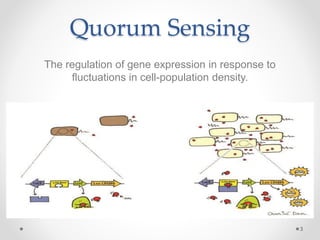
The regulation of gene expression in response to
fluctuations in cell-population density.
3
Quorum Sensing
 Cell to cell conversation
 A signalling mechanism in
microorganisms
 Control gene expression
 Cell density dependent
Example:
Bacteria and some social
insects (ants and honey bees
etc.)
4
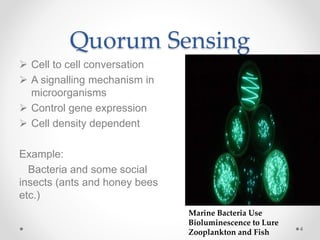
Marine Bacteria Use
Bioluminescence to Lure
Zooplankton and Fish
Decision Making Process
Quorum sensing can function as a decision-making
process in any decentralised system, as long as individual
components have:
a) A means of assessing the number of other components
they interact with
b) A standard response once a threshold number of
components is dtected
5
History
6
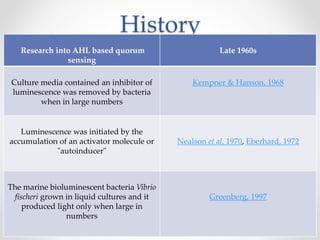
Research into AHL based quorum
sensing
Late 1960s
Culture media contained an inhibitor of
luminescence was removed by bacteria
when in large numbers
Kempner & Hanson, 1968
Luminescence was initiated by the
accumulation of an activator molecule or
"autoinducer"
Nealson et al, 1970, Eberhard, 1972
The marine bioluminescent bacteria Vibrio
fischeri grown in liquid cultures and it
produced light only when large in
numbers
Greenberg, 1997
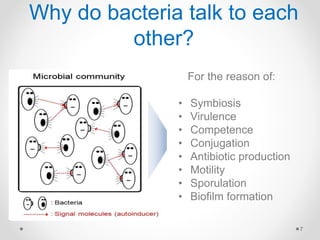
Why do bacteria talk to each
other?
7
For the reason of:
• Symbiosis
• Virulence
• Competence
• Conjugation
• Antibiotic production
• Motility
• Sporulation
• Biofilm formation
8
a) Within and between bacterial species.
Example –Pseudomonas aeruginosa,Aeromonas sp.,
Yersinia,etc.
b) Archaea
Example - Methanosaeta harundinacea 6Ac
c) Between prokaryotes and their eukaryotic host
a) Animal
b) Plant
d) Cross talk - Interspecies communication for antibiotic
resistance, virulence and biofilm formation
Where Quorum sensing
occurs?
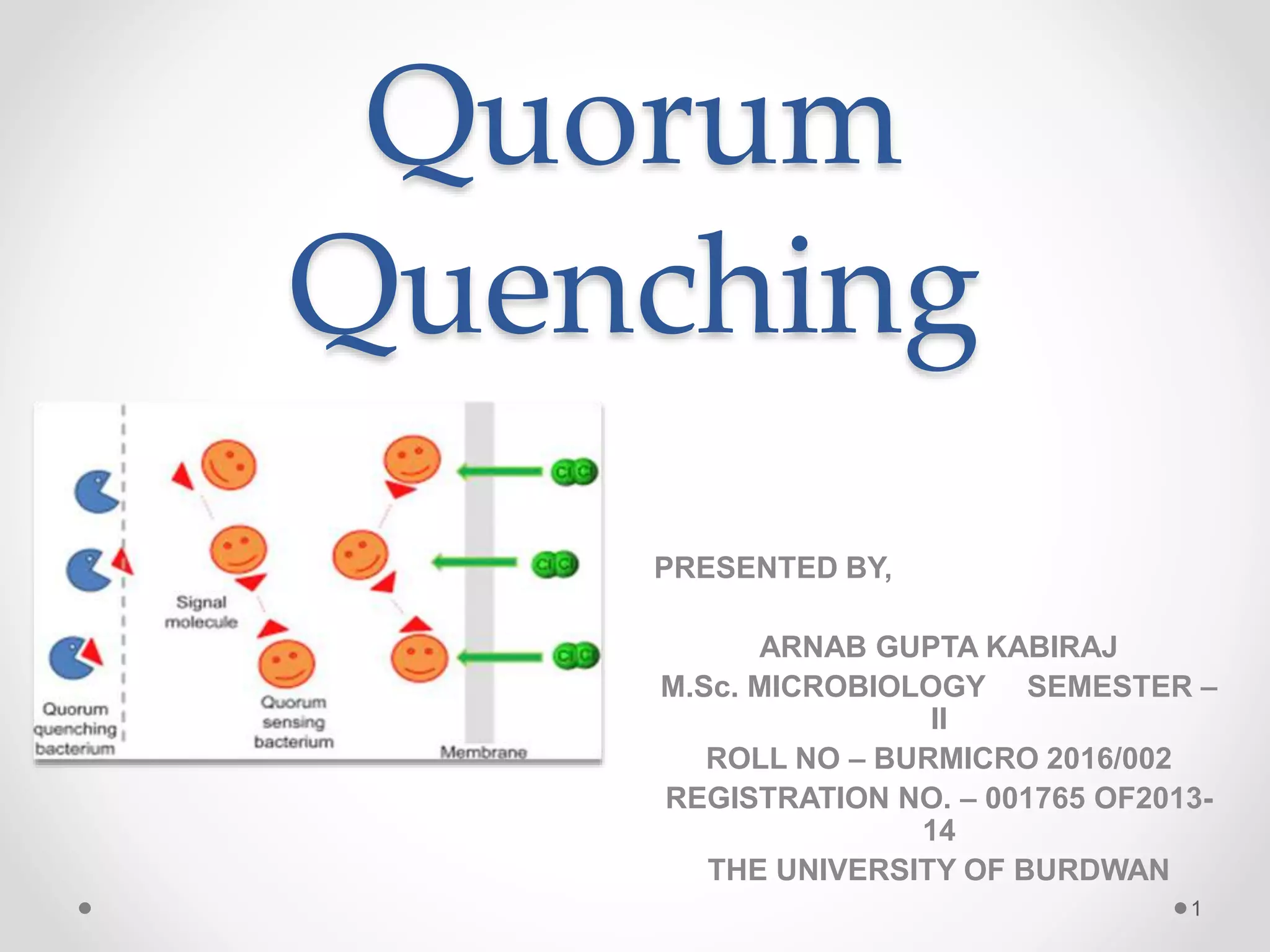
Quorum Quenching
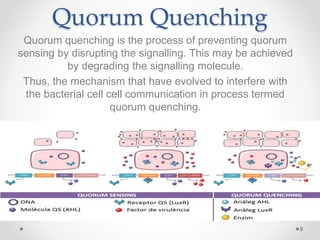
Quorum quenching is the process of preventing quorum
sensing by disrupting the signalling. This may be achieved
by degrading the signalling molecule.
Thus, the mechanism that have evolved to interfere with
the bacterial cell cell communication in process termed
quorum quenching.
9
Why Quorum
Quenching?
1. Bacterial Virulence:
QSI is a potential method for inhibition of bacterial virulence
both In-vitro & In-vivo
• Recent research into quorum sensing system has produced
compounds that can disrupt the bacteria’s ability to
communicate, thereby disabling or diminishing the bacteria’s
ability to become pathogen.
• Thus, the body is not compromised by any detrimental effects
of the bacteria and the body gets enough time to eradicate the
bacteria naturally through immune system functions.
10
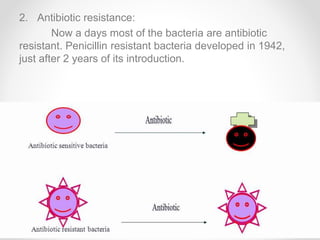
2. Antibiotic resistance:
Now a days most of the bacteria are antibiotic
resistant. Penicillin resistant bacteria developed in 1942,
just after 2 years of its introduction.
11
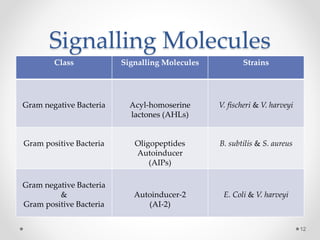
Signalling Molecules
Class Signalling Molecules Strains
Gram negative Bacteria Acyl-homoserine
lactones (AHLs)
V. fischeri & V. harveyi
Gram positive Bacteria Oligopeptides
Autoinducer
(AIPs)
B. subtilis & S. aureus
Gram negative Bacteria
&
Gram positive Bacteria
Autoinducer-2
(AI-2)
E. Coli & V. harveyi
12
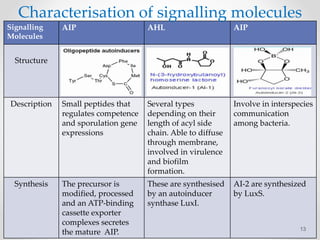
Signalling
Molecules
AIP AHL AIP
Structure
Description Small peptides that
regulates competence
and sporulation gene
expressions
Several types
depending on their
length of acyl side
chain. Able to diffuse
through membrane,
involved in virulence
and biofilm
formation.
Involve in interspecies
communication
among bacteria.
Synthesis The precursor is
modified, processed
and an ATP-binding
cassette exporter
complexes secretes
the mature AIP.
These are synthesised
by an autoinducer
synthase LuxI.
AI-2 are synthesized
by LuxS.
13
Characterisation of signalling molecules
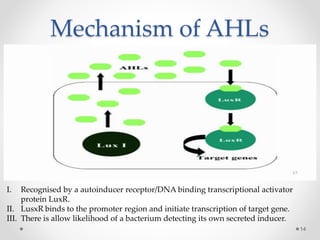
Mechanism of AHLs
14
I. Recognised by a autoinducer receptor/DNA binding transcriptional activator
protein LuxR.
II. LusxR binds to the promoter region and initiate transcription of target gene.
III. There is allow likelihood of a bacterium detecting its own secreted inducer.
Quorum Quenching
molecule
 A new class of quorum quenchers with the chemical
formula N-[2-(1H-indol-3-yl)ethyl]-urea and N-(2-
phenethyl)-urea, which we named yayurea A and B,
respectively.
 Small compounds inhibit both the expression of QS-
controlled toxins and other QS-regulated compounds as
well as growth in Gram-negative bacteria.
15
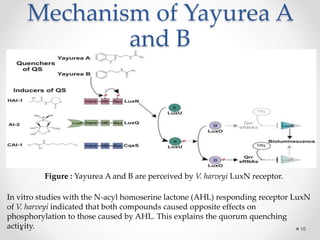
Mechanism of Yayurea A
and B
16
Figure : Yayurea A and B are perceived by V. harveyi LuxN receptor.
In vitro studies with the N-acyl homoserine lactone (AHL) responding receptor LuxN
of V. harveyi indicated that both compounds caused opposite effects on
phosphorylation to those caused by AHL. This explains the quorum quenching
activity.
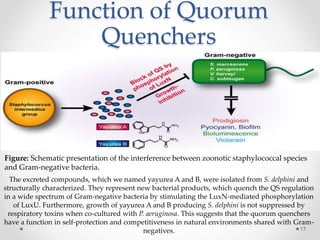
Function of Quorum
Quenchers
17
Figure: Schematic presentation of the interference between zoonotic staphylococcal species
and Gram-negative bacteria.
The excreted compounds, which we named yayurea A and B, were isolated from S. delphini and
structurally characterized. They represent new bacterial products, which quench the QS regulation
in a wide spectrum of Gram-negative bacteria by stimulating the LuxN-mediated phosphorylation
of LuxU. Furthermore, growth of yayurea A and B producing S. delphini is not suppressed by
respiratory toxins when co-cultured with P. aeruginosa. This suggests that the quorum quenchers
have a function in self-protection and competitiveness in natural environments shared with Gram-
negatives.
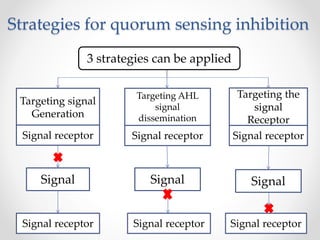
Strategies for quorum sensing inhibition
18
3 strategies can be applied
Targeting signal
Generation
Targeting AHL
signal
dissemination
Targeting the
signal
Receptor
Signal SignalSignal
Signal receptor Signal receptor Signal receptor
Signal receptorSignal receptorSignal receptor
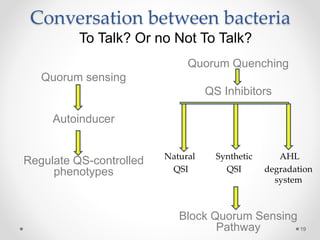
Conversation between bacteria
Quorum sensing
Autoinducer
Regulate QS-controlled
phenotypes
Quorum Quenching
QS Inhibitors
Block Quorum Sensing
Pathway 19
Natural
QSI
Synthetic
QSI
AHL
degradation
system
To Talk? Or no Not To Talk?
Applications
 Understanding bacteria.
 To develop new medicines to treat devastating bacterial
infection like Cystic fibrosis, Bacteria Endocarditis, etc.
 Quorum quenching (QQ) is a relevant approach to inhibit
bacterial virulence.
 QQ approaches do not kill bacteria, possibly limiting the
emergence of resistance.
 QQ enzymes, such as lactonases, are promising as they act
extracellularly in a catalytic way.
20
Advantage of Anti-
Quorum Sensing
o The advantage of this approach for controlling infection is that
there are few evolutionary forces that select for resistance.
o The compounds kill none of the bacteria, any resistant
mutations must compete with living, non-resistant individuals.
Hence, no survival advantage to the resistant mutations,
natural selection does not come into play and resistant strains
will be unlikely to occur.
o QS molecules have potential antimicrobial functionality and
are investigated in immunology and oncology.
21
Future Perspectives
• QS inhibitors have provided evidence of alternative method
for fighting bacterial infections.
• QS inhibitors, may replace the antibiotics.
• QS inhibitors can be isolated from the huge natural pool of
chemicals.
• Quorum quenching inhibit bacterial virulence and do not kill
bacteria, possibly limiting the emergence of resistance.
22
References
• Abdelnour, A., Arvidson, S., Bremell, T., Ryden, C. & Tarkowski, A. (1993).
The accessory gene regulator (agr) controls Staphylococcus aureus virulence in a
murine arthritis model. Infect Immun 61, 3879–3885.
• Thomas, G. Platt. & Clay Fuqua. (2010). Whats in a name? The semantics of
quorum Sensing. 18(9): Microbiol. 383-387.
• Antunes, L. C. & Ferreira, R. B. (2009). Intercellular communication in
bacteria. Crit Rev Microbiol 35, 69–80.
• Bendiak, G. N. & Ratjen, F. (2009). The approach to Pseudomonas aeruginosa
in cystic fibrosis. Semin Respir Crit Care Med 30, 587–595.
• Otto, M., Sussmuth, R., Jung, G. & Gotz, F. (1998). Structure of the
pheromone peptide of the Staphylococcus epidermidis agr system. FEBS Lett
424, 89–94.
• Smith, D., Wang, J. H., Swatton, J. E., Davenport, P., Price, B., Mikkelsen,
H., Stickland, H., Nishikawa, K., Gardiol, N. & other authors (2006).
Variations on a theme: diverse N-acyl homoserine lactone-mediated quorum
sensing mechanisms in Gram-negative bacteria. Sci Prog 89, 167–211.
• http://www.sciencedaily.com 23
Conclusion
Quorum sensing study help us to understand the
communication & virulence of certain bacteria and quorum
quenching helps us to inhibit the process without killing
bacteria & no occurrence of resistance. Hence, an
approach to use over antibiotic to fight bacterial infection.
24
25

Quorum Quenching

  • 1.
    Quorum Quenching 1 PRESENTED BY, ARNAB GUPTAKABIRAJ M.Sc. MICROBIOLOGY SEMESTER – II ROLL NO – BURMICRO 2016/002 REGISTRATION NO. – 001765 OF2013- 14 THE UNIVERSITY OF BURDWAN
  • 2.
    Quorum Usually refers tothe minimum number of members in an organisation, such as legislative body, needed to conduct the business. 2
  • 3.
    Quorum Sensing The regulationof gene expression in response to fluctuations in cell-population density. 3
  • 4.
    Quorum Sensing  Cellto cell conversation  A signalling mechanism in microorganisms  Control gene expression  Cell density dependent Example: Bacteria and some social insects (ants and honey bees etc.) 4 Marine Bacteria Use Bioluminescence to Lure Zooplankton and Fish
  • 5.
    Decision Making Process Quorumsensing can function as a decision-making process in any decentralised system, as long as individual components have: a) A means of assessing the number of other components they interact with b) A standard response once a threshold number of components is dtected 5
  • 6.
    History 6 Research into AHLbased quorum sensing Late 1960s Culture media contained an inhibitor of luminescence was removed by bacteria when in large numbers Kempner & Hanson, 1968 Luminescence was initiated by the accumulation of an activator molecule or "autoinducer" Nealson et al, 1970, Eberhard, 1972 The marine bioluminescent bacteria Vibrio fischeri grown in liquid cultures and it produced light only when large in numbers Greenberg, 1997
  • 7.
    Why do bacteriatalk to each other? 7 For the reason of: • Symbiosis • Virulence • Competence • Conjugation • Antibiotic production • Motility • Sporulation • Biofilm formation
  • 8.
    8 a) Within andbetween bacterial species. Example –Pseudomonas aeruginosa,Aeromonas sp., Yersinia,etc. b) Archaea Example - Methanosaeta harundinacea 6Ac c) Between prokaryotes and their eukaryotic host a) Animal b) Plant d) Cross talk - Interspecies communication for antibiotic resistance, virulence and biofilm formation Where Quorum sensing occurs?
  • 9.
    Quorum Quenching Quorum quenchingis the process of preventing quorum sensing by disrupting the signalling. This may be achieved by degrading the signalling molecule. Thus, the mechanism that have evolved to interfere with the bacterial cell cell communication in process termed quorum quenching. 9
  • 10.
    Why Quorum Quenching? 1. BacterialVirulence: QSI is a potential method for inhibition of bacterial virulence both In-vitro & In-vivo • Recent research into quorum sensing system has produced compounds that can disrupt the bacteria’s ability to communicate, thereby disabling or diminishing the bacteria’s ability to become pathogen. • Thus, the body is not compromised by any detrimental effects of the bacteria and the body gets enough time to eradicate the bacteria naturally through immune system functions. 10
  • 11.
    2. Antibiotic resistance: Nowa days most of the bacteria are antibiotic resistant. Penicillin resistant bacteria developed in 1942, just after 2 years of its introduction. 11
  • 12.
    Signalling Molecules Class SignallingMolecules Strains Gram negative Bacteria Acyl-homoserine lactones (AHLs) V. fischeri & V. harveyi Gram positive Bacteria Oligopeptides Autoinducer (AIPs) B. subtilis & S. aureus Gram negative Bacteria & Gram positive Bacteria Autoinducer-2 (AI-2) E. Coli & V. harveyi 12
  • 13.
    Signalling Molecules AIP AHL AIP Structure DescriptionSmall peptides that regulates competence and sporulation gene expressions Several types depending on their length of acyl side chain. Able to diffuse through membrane, involved in virulence and biofilm formation. Involve in interspecies communication among bacteria. Synthesis The precursor is modified, processed and an ATP-binding cassette exporter complexes secretes the mature AIP. These are synthesised by an autoinducer synthase LuxI. AI-2 are synthesized by LuxS. 13 Characterisation of signalling molecules
  • 14.
    Mechanism of AHLs 14 I.Recognised by a autoinducer receptor/DNA binding transcriptional activator protein LuxR. II. LusxR binds to the promoter region and initiate transcription of target gene. III. There is allow likelihood of a bacterium detecting its own secreted inducer.
  • 15.
    Quorum Quenching molecule  Anew class of quorum quenchers with the chemical formula N-[2-(1H-indol-3-yl)ethyl]-urea and N-(2- phenethyl)-urea, which we named yayurea A and B, respectively.  Small compounds inhibit both the expression of QS- controlled toxins and other QS-regulated compounds as well as growth in Gram-negative bacteria. 15
  • 16.
    Mechanism of YayureaA and B 16 Figure : Yayurea A and B are perceived by V. harveyi LuxN receptor. In vitro studies with the N-acyl homoserine lactone (AHL) responding receptor LuxN of V. harveyi indicated that both compounds caused opposite effects on phosphorylation to those caused by AHL. This explains the quorum quenching activity.
  • 17.
    Function of Quorum Quenchers 17 Figure:Schematic presentation of the interference between zoonotic staphylococcal species and Gram-negative bacteria. The excreted compounds, which we named yayurea A and B, were isolated from S. delphini and structurally characterized. They represent new bacterial products, which quench the QS regulation in a wide spectrum of Gram-negative bacteria by stimulating the LuxN-mediated phosphorylation of LuxU. Furthermore, growth of yayurea A and B producing S. delphini is not suppressed by respiratory toxins when co-cultured with P. aeruginosa. This suggests that the quorum quenchers have a function in self-protection and competitiveness in natural environments shared with Gram- negatives.
  • 18.
    Strategies for quorumsensing inhibition 18 3 strategies can be applied Targeting signal Generation Targeting AHL signal dissemination Targeting the signal Receptor Signal SignalSignal Signal receptor Signal receptor Signal receptor Signal receptorSignal receptorSignal receptor
  • 19.
    Conversation between bacteria Quorumsensing Autoinducer Regulate QS-controlled phenotypes Quorum Quenching QS Inhibitors Block Quorum Sensing Pathway 19 Natural QSI Synthetic QSI AHL degradation system To Talk? Or no Not To Talk?
  • 20.
    Applications  Understanding bacteria. To develop new medicines to treat devastating bacterial infection like Cystic fibrosis, Bacteria Endocarditis, etc.  Quorum quenching (QQ) is a relevant approach to inhibit bacterial virulence.  QQ approaches do not kill bacteria, possibly limiting the emergence of resistance.  QQ enzymes, such as lactonases, are promising as they act extracellularly in a catalytic way. 20
  • 21.
    Advantage of Anti- QuorumSensing o The advantage of this approach for controlling infection is that there are few evolutionary forces that select for resistance. o The compounds kill none of the bacteria, any resistant mutations must compete with living, non-resistant individuals. Hence, no survival advantage to the resistant mutations, natural selection does not come into play and resistant strains will be unlikely to occur. o QS molecules have potential antimicrobial functionality and are investigated in immunology and oncology. 21
  • 22.
    Future Perspectives • QSinhibitors have provided evidence of alternative method for fighting bacterial infections. • QS inhibitors, may replace the antibiotics. • QS inhibitors can be isolated from the huge natural pool of chemicals. • Quorum quenching inhibit bacterial virulence and do not kill bacteria, possibly limiting the emergence of resistance. 22
  • 23.
    References • Abdelnour, A.,Arvidson, S., Bremell, T., Ryden, C. & Tarkowski, A. (1993). The accessory gene regulator (agr) controls Staphylococcus aureus virulence in a murine arthritis model. Infect Immun 61, 3879–3885. • Thomas, G. Platt. & Clay Fuqua. (2010). Whats in a name? The semantics of quorum Sensing. 18(9): Microbiol. 383-387. • Antunes, L. C. & Ferreira, R. B. (2009). Intercellular communication in bacteria. Crit Rev Microbiol 35, 69–80. • Bendiak, G. N. & Ratjen, F. (2009). The approach to Pseudomonas aeruginosa in cystic fibrosis. Semin Respir Crit Care Med 30, 587–595. • Otto, M., Sussmuth, R., Jung, G. & Gotz, F. (1998). Structure of the pheromone peptide of the Staphylococcus epidermidis agr system. FEBS Lett 424, 89–94. • Smith, D., Wang, J. H., Swatton, J. E., Davenport, P., Price, B., Mikkelsen, H., Stickland, H., Nishikawa, K., Gardiol, N. & other authors (2006). Variations on a theme: diverse N-acyl homoserine lactone-mediated quorum sensing mechanisms in Gram-negative bacteria. Sci Prog 89, 167–211. • http://www.sciencedaily.com 23
  • 24.
    Conclusion Quorum sensing studyhelp us to understand the communication & virulence of certain bacteria and quorum quenching helps us to inhibit the process without killing bacteria & no occurrence of resistance. Hence, an approach to use over antibiotic to fight bacterial infection. 24
  • 25.