Cost Reduction and Avoidance Barry Hedrick, C.P.M [email_address]
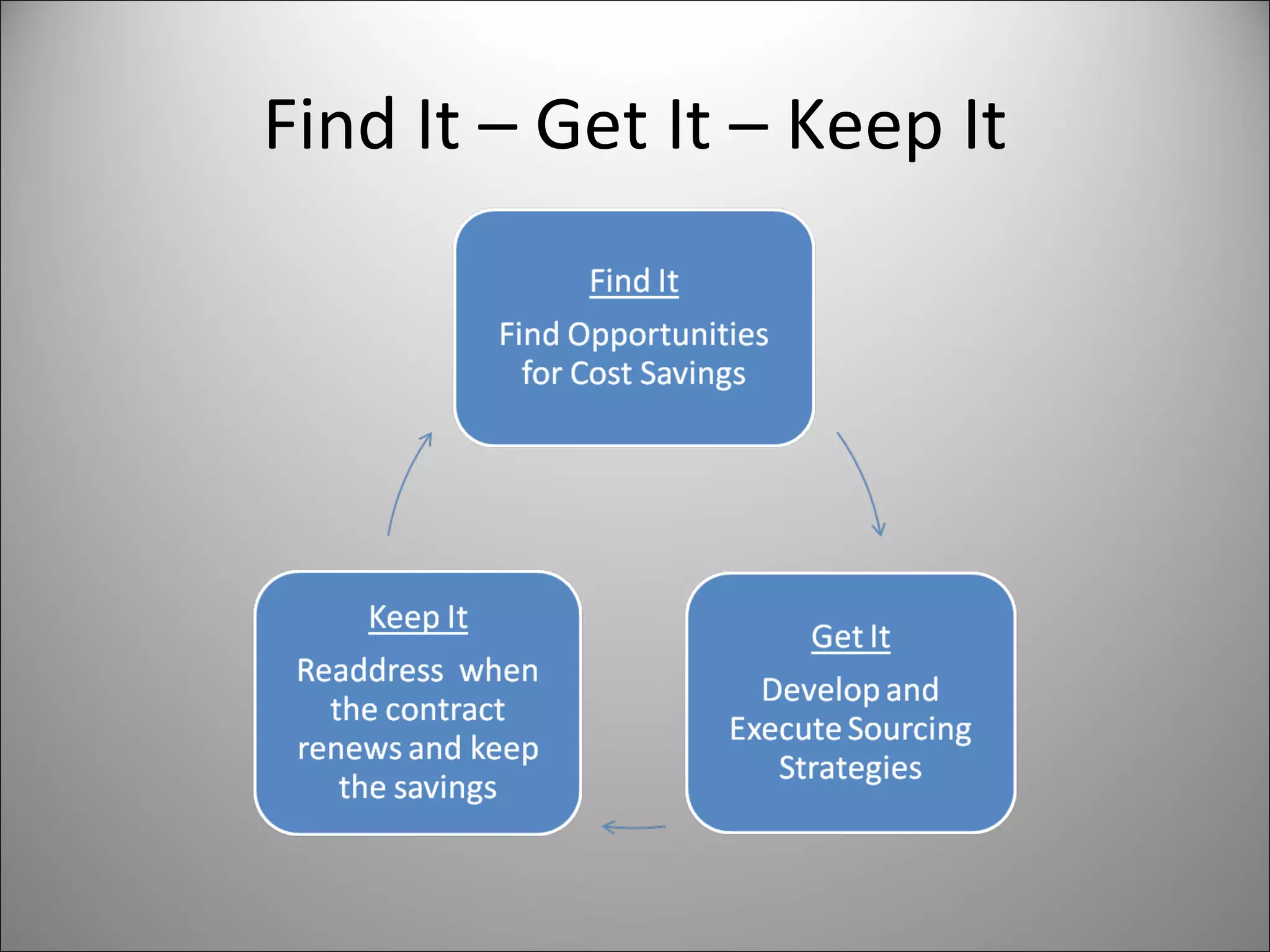
Find It – Get It – Keep It
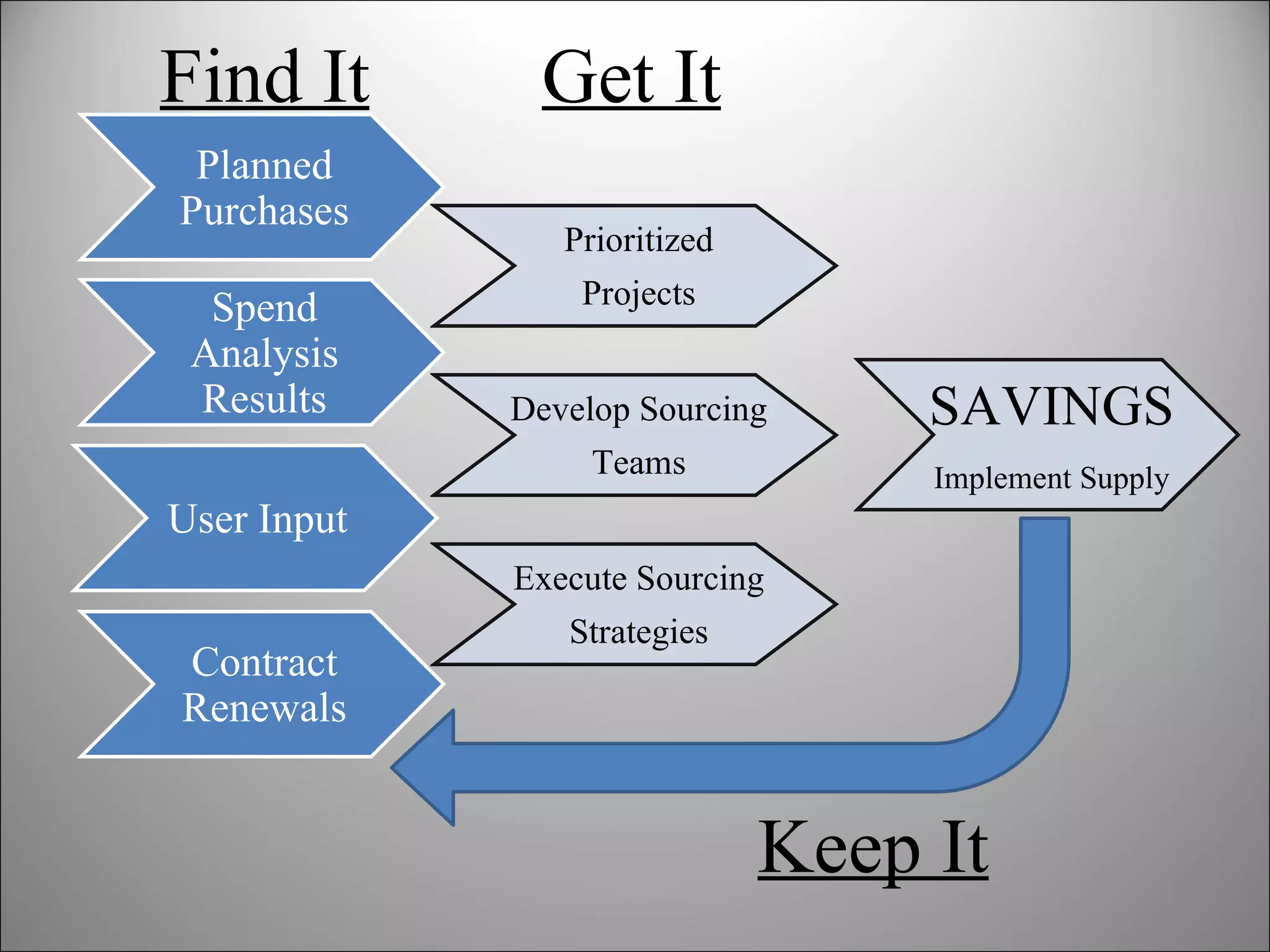
Find It Planned Purchases Spend Analysis Results Contract Renewals Prioritized Projects SAVINGS Implement Supply User Input Develop Sourcing Teams Execute Sourcing Strategies Get It Keep It
Ground Rules for All Savings To maintain credibility of results, and to assure uniformity in reporting savings, it is necessary for Purchasing to establish basic criteria for savings.  A savings is: An improvement in the cost of purchased materials or services that is initiated through planned or deliberate action by Purchasing, often in cooperation with other departments.  Purchasing savings should be: Based on a planned and deliberate action initiated by Purchasing which results in a cost reduction, a value improvement, or an avoidance of a higher cost that would occur had action not been taken. Verifiable and measurable. Validated as actual, not just potential. The following cost reductions do not qualify as purchasing savings: "Windfall" savings which occur without planned and deliberate action (e.g. the price of oil causes a reduction in gasoline purchased) Routine choice of the lower of two or more bids that results from routine RFQs  Savings generated solely by a group outside of the Purchasing Organization
Tracking/Reporting Tracking and reporting of cost reductions and avoidances in critical in showing the impact of the Purchasing Organization. I have found it best to implement a fairly simple database that documents and tracks the savings and then design reports to help communicate the aggregate impact. NOTE: I always stated that a decrease from the last total price paid is a “cost reduction” and an increase is a “cost increase” but should be tracked/reported as a “negative cost reduction” so the total savings calculates correctly.
Definitions Cost Reduction (Get It)  involves the comparison of prices of  existing  products or services to determine changes to the cost structure.  Basically in order to claim a cost reduction, you must compare the new price to an old price.  Cost Avoidance (Keep It)  is when certain proposed material or supplier increases are not incurred by the purchasing firm.  It involves avoiding a future cost increase by delaying or reducing the impact of a proposed price increase. I also used on additional for  Cost Recovery  - the reclamation of money previously spent by the company on items that have since been determined obsolete. This is usually in the form of Purchasing selling the items back to the supplier or other interested parties and was not used very often.
Cost Reduction (Get It) Categories To better understand the source of the savings and analyze the results, we implemented the following sub-categories: Cost Reduction CR1:  Substitution one purchased material for another  (i.e. Change in Specification but the same form, fit, and function) CR2:  Change of Source of Supply (i.e. same item from a  new supplier) CR3:  Change of character of the purchase  (i.e. purchasing used, refurbished or surplus items) CR4:  Change of method of purchasing (i.e. adopting blanket order type contracts, use of procurement cards, supplier websites that  result in a reduced price) CR5:  Long-term contracts with price protection provisions or  improvement in payment terms including early payment discounts. CR6:  Rebates from Suppliers CR7:  Reduction through negotiation (i.e. leveraging buying power, increase in discount from supplier)
Methods of Measuring Cost Reduction Preferred Method Nwe Total Delivered Price [minus] Previous Total Delivered Price  =  Reduction Amount Rules  -  The  Previous Total Delivered Price  should be no older than 18 months -  Reductions  are claimed on all purchases of that particular item for 1 year after the agreement is implemented or until the price is adjusted/renegotiated, whichever is shorter -  Increases in price will be reported as a  Negative Reduction  and will result in a negative effect on the Purchasing Savings
Methods of Measuring Cost Reduction Alternate Method New Total Delivered Price [minus]  Adjusted  Previous Total Delivered Price = Reduction Amount Rules If the  Previous Total Delivered Price  is more than 18 months old, an adjustment could be made using an approved index that legitimately reflects the fluctuations in cost. For North America, we used the  Producer Price Index  published by the Bureau of Labor and Statics and can be found at the website -->  http://data.bls.gov/cgi-bin/dsrv?pc  for Europe we used  http://epp.eurostat.ec.europa.eu/portal/page/portal/eurostat/home/
Special Rule  ONLY  for Capital Expenditures: Alternate 2 New Total Delivered Price [minus] Established Market Price = Reduction Amount Rules -  The  Established Market Price  is the total delivered price determined by the  lowest   of at least 3 legitimate, competitive bids . Reduction can occur when Purchasing negotiates a final price that is lower that the previously received low price offer.  Methods of Measuring Cost Reduction
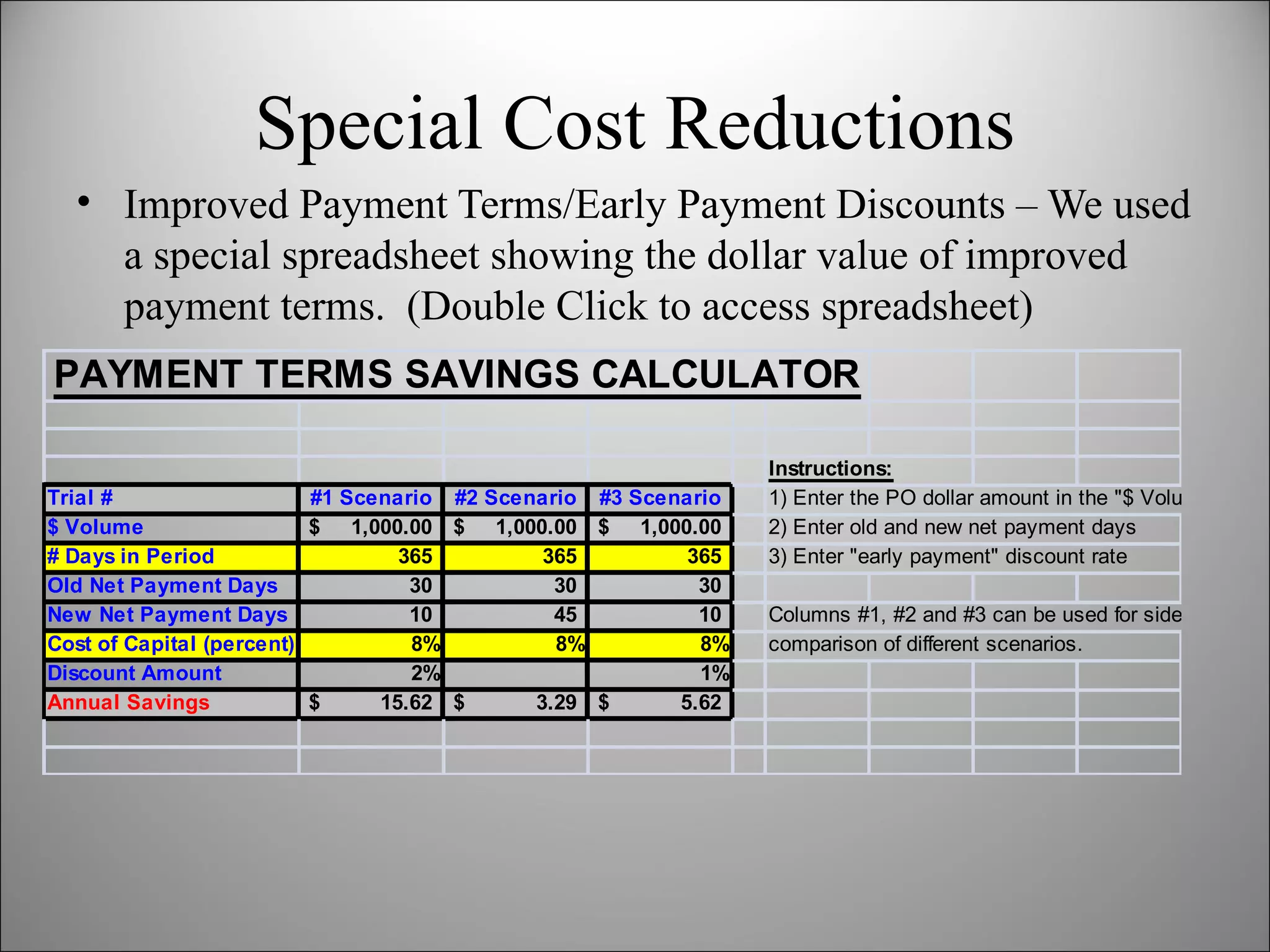
Special Cost Reductions Improved Payment Terms/Early Payment Discounts – We used a special spreadsheet showing the dollar value of improved payment terms.  (Double Click to access spreadsheet)
Cost Avoidance (Keep It) Categories We implemented the following sub-categories for cost avoidance items: Cost Avoidance CA1:  Buildup of inventory in advance of price increase CA2:  Arrangement of unusual shipments prior to price increase CA3:  Purchase price that is lower than original quoted price  (Used when there was no history on the “last price paid for an item. If we negotiated lower price than original proposal on an existing item, but it was not a cost “reduction”, we captured this under CA5 below) CA4:  No charge for items or services normally charged (i.e. spare parts, extended warranties, vendor managed inventory) CA5:  Reduction in proposed price increases from suppliers as a result of negotiation.
CA1:  Buildup of inventory in advance of price increase Future Total Delivered Price [minus] Current Total Delivered Price X Number of Units purchased in advance – inventory carrying costs = Avoidance Amount CA2:  Arrangement of unusual shipments prior to price increase Future Total Delivered Price [minus] Current Total Delivered Price (including special shipment charges as applicable) X Number of Units purchased in advance = Avoidance Amount CA3:  Purchase price that is lower than original quoted price  (Used when there was no history on the “last price paid” for an item. If we negotiated lower price than original proposal on an existing item, but it was not a cost “reduction”, we captured this under CA5 below) CA4:  No charge for items or services normally charged (i.e. spare parts, extended warranties, vendor managed inventory) Originally proposed price of  parts, warranty or value of applicable inventory carrying costs for VMI CA5:  Reduction in proposed price increases from suppliers as a result of negotiation.   Negotiated Total Delivered Price [minus] Originally Quoted Total Delivered Price Methods of Measuring Cost Reduction
Special Notes It is common to have a mixture of Cost Savings and Avoidance on the same purchase There are always special circumstances that may or may not justify savings. If the savings did not fit into a category, we required they be approved by the Purchasing Leadership Team prior to claiming/reporting them. This often involved consultation with Finance. The key is to get the Purchasing people to think hard about and document the savings.

Cost Reduction And Avoidance

  • 1.
    Cost Reduction andAvoidance Barry Hedrick, C.P.M [email_address]
  • 2.
    Find It –Get It – Keep It
  • 3.
    Find It PlannedPurchases Spend Analysis Results Contract Renewals Prioritized Projects SAVINGS Implement Supply User Input Develop Sourcing Teams Execute Sourcing Strategies Get It Keep It
  • 4.
    Ground Rules forAll Savings To maintain credibility of results, and to assure uniformity in reporting savings, it is necessary for Purchasing to establish basic criteria for savings. A savings is: An improvement in the cost of purchased materials or services that is initiated through planned or deliberate action by Purchasing, often in cooperation with other departments. Purchasing savings should be: Based on a planned and deliberate action initiated by Purchasing which results in a cost reduction, a value improvement, or an avoidance of a higher cost that would occur had action not been taken. Verifiable and measurable. Validated as actual, not just potential. The following cost reductions do not qualify as purchasing savings: "Windfall" savings which occur without planned and deliberate action (e.g. the price of oil causes a reduction in gasoline purchased) Routine choice of the lower of two or more bids that results from routine RFQs Savings generated solely by a group outside of the Purchasing Organization
  • 5.
    Tracking/Reporting Tracking andreporting of cost reductions and avoidances in critical in showing the impact of the Purchasing Organization. I have found it best to implement a fairly simple database that documents and tracks the savings and then design reports to help communicate the aggregate impact. NOTE: I always stated that a decrease from the last total price paid is a “cost reduction” and an increase is a “cost increase” but should be tracked/reported as a “negative cost reduction” so the total savings calculates correctly.
  • 6.
    Definitions Cost Reduction(Get It) involves the comparison of prices of existing products or services to determine changes to the cost structure. Basically in order to claim a cost reduction, you must compare the new price to an old price. Cost Avoidance (Keep It) is when certain proposed material or supplier increases are not incurred by the purchasing firm. It involves avoiding a future cost increase by delaying or reducing the impact of a proposed price increase. I also used on additional for Cost Recovery - the reclamation of money previously spent by the company on items that have since been determined obsolete. This is usually in the form of Purchasing selling the items back to the supplier or other interested parties and was not used very often.
  • 7.
    Cost Reduction (GetIt) Categories To better understand the source of the savings and analyze the results, we implemented the following sub-categories: Cost Reduction CR1: Substitution one purchased material for another (i.e. Change in Specification but the same form, fit, and function) CR2: Change of Source of Supply (i.e. same item from a new supplier) CR3: Change of character of the purchase (i.e. purchasing used, refurbished or surplus items) CR4: Change of method of purchasing (i.e. adopting blanket order type contracts, use of procurement cards, supplier websites that result in a reduced price) CR5: Long-term contracts with price protection provisions or improvement in payment terms including early payment discounts. CR6: Rebates from Suppliers CR7: Reduction through negotiation (i.e. leveraging buying power, increase in discount from supplier)
  • 8.
    Methods of MeasuringCost Reduction Preferred Method Nwe Total Delivered Price [minus] Previous Total Delivered Price = Reduction Amount Rules - The Previous Total Delivered Price should be no older than 18 months - Reductions are claimed on all purchases of that particular item for 1 year after the agreement is implemented or until the price is adjusted/renegotiated, whichever is shorter - Increases in price will be reported as a Negative Reduction and will result in a negative effect on the Purchasing Savings
  • 9.
    Methods of MeasuringCost Reduction Alternate Method New Total Delivered Price [minus] Adjusted Previous Total Delivered Price = Reduction Amount Rules If the Previous Total Delivered Price is more than 18 months old, an adjustment could be made using an approved index that legitimately reflects the fluctuations in cost. For North America, we used the Producer Price Index published by the Bureau of Labor and Statics and can be found at the website --> http://data.bls.gov/cgi-bin/dsrv?pc for Europe we used http://epp.eurostat.ec.europa.eu/portal/page/portal/eurostat/home/
  • 10.
    Special Rule ONLY for Capital Expenditures: Alternate 2 New Total Delivered Price [minus] Established Market Price = Reduction Amount Rules - The Established Market Price is the total delivered price determined by the lowest of at least 3 legitimate, competitive bids . Reduction can occur when Purchasing negotiates a final price that is lower that the previously received low price offer. Methods of Measuring Cost Reduction
  • 11.
    Special Cost ReductionsImproved Payment Terms/Early Payment Discounts – We used a special spreadsheet showing the dollar value of improved payment terms. (Double Click to access spreadsheet)
  • 12.
    Cost Avoidance (KeepIt) Categories We implemented the following sub-categories for cost avoidance items: Cost Avoidance CA1: Buildup of inventory in advance of price increase CA2: Arrangement of unusual shipments prior to price increase CA3: Purchase price that is lower than original quoted price (Used when there was no history on the “last price paid for an item. If we negotiated lower price than original proposal on an existing item, but it was not a cost “reduction”, we captured this under CA5 below) CA4: No charge for items or services normally charged (i.e. spare parts, extended warranties, vendor managed inventory) CA5: Reduction in proposed price increases from suppliers as a result of negotiation.
  • 13.
    CA1: Buildupof inventory in advance of price increase Future Total Delivered Price [minus] Current Total Delivered Price X Number of Units purchased in advance – inventory carrying costs = Avoidance Amount CA2: Arrangement of unusual shipments prior to price increase Future Total Delivered Price [minus] Current Total Delivered Price (including special shipment charges as applicable) X Number of Units purchased in advance = Avoidance Amount CA3: Purchase price that is lower than original quoted price (Used when there was no history on the “last price paid” for an item. If we negotiated lower price than original proposal on an existing item, but it was not a cost “reduction”, we captured this under CA5 below) CA4: No charge for items or services normally charged (i.e. spare parts, extended warranties, vendor managed inventory) Originally proposed price of parts, warranty or value of applicable inventory carrying costs for VMI CA5: Reduction in proposed price increases from suppliers as a result of negotiation. Negotiated Total Delivered Price [minus] Originally Quoted Total Delivered Price Methods of Measuring Cost Reduction
  • 14.
    Special Notes Itis common to have a mixture of Cost Savings and Avoidance on the same purchase There are always special circumstances that may or may not justify savings. If the savings did not fit into a category, we required they be approved by the Purchasing Leadership Team prior to claiming/reporting them. This often involved consultation with Finance. The key is to get the Purchasing people to think hard about and document the savings.