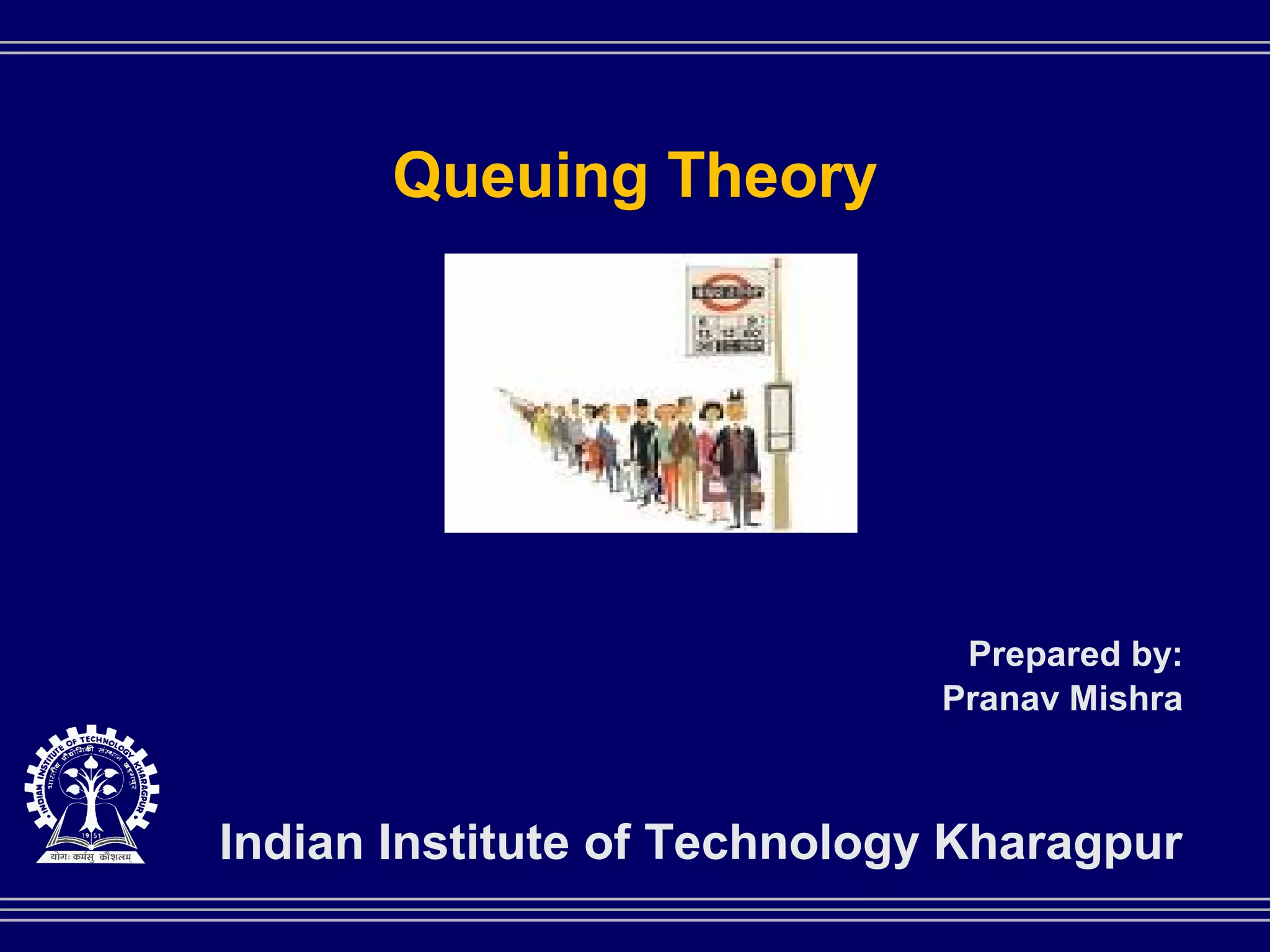
Queuing Theory


                                            Prepared by:
                                           Pranav Mishra


     Indian Institute of Technology Kharagpur
Indian Institute of Technology Kharagpur
Queuing Theory
 •Queuing theory is the mathematics of waiting lines.
 •A queue forms whenever existing demand exceeds the existing capacity of
 service facility.
 •It is extremely useful in predicting and evaluating system performance.

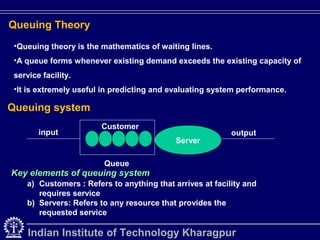
Queuing system
                        Customer
        input                                              output
                                            Server

                        Queue
Key elements of queuing system
    a) Customers : Refers to anything that arrives at facility and
       requires service
    b) Servers: Refers to any resource that provides the
       requested service

     Indian Institute of Technology Kharagpur
pplications of queuing theory
   •Telecommunications
   •Traffic control
   •Layout of manufacturing systems
   •Airport traffic
   •Ticket sales counter, etc.


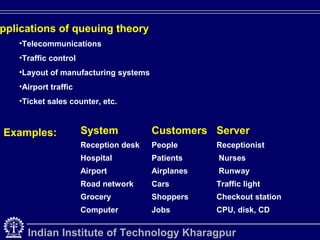
Examples:             System           Customers Server
                      Reception desk   People      Receptionist
                      Hospital         Patients    Nurses
                      Airport          Airplanes   Runway
                      Road network     Cars        Traffic light
                      Grocery          Shoppers    Checkout station
                      Computer         Jobs        CPU, disk, CD

     Indian Institute of Technology Kharagpur
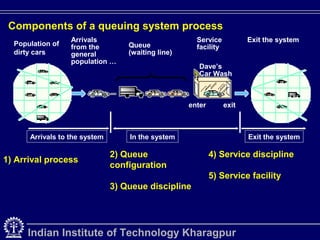
Components of a queuing system process
                  Arrivals                            Service           Exit the system
  Population of   from the         Queue              facility
  dirty cars      general          (waiting line)
                  population …
                                                       Dave’s
                                                       Car Wash


                                                    enter        exit


      Arrivals to the system       In the system                        Exit the system

                               2) Queue                     4) Service discipline
1) Arrival process
                               configuration
                                                            5) Service facility
                               3) Queue discipline


     Indian Institute of Technology Kharagpur
Components of a queuing system process
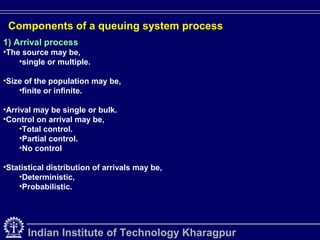
1) Arrival process
•The source may be,
    •single or multiple.

•Size of the population may be,
    •finite or infinite.

•Arrival may be single or bulk.
•Control on arrival may be,
     •Total control.
     •Partial control.
     •No control

•Statistical distribution of arrivals may be,
    •Deterministic,
    •Probabilistic.


      Indian Institute of Technology Kharagpur
Components of a queuing system process
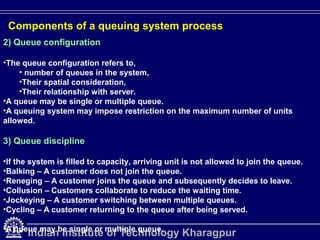
2) Queue configuration

•The queue configuration refers to,
    • number of queues in the system,
    •Their spatial consideration,
    •Their relationship with server.
•A queue may be single or multiple queue.
•A queuing system may impose restriction on the maximum number of units
allowed.

3) Queue discipline

•If the system is filled to capacity, arriving unit is not allowed to join the queue.
•Balking – A customer does not join the queue.
•Reneging – A customer joins the queue and subsequently decides to leave.
•Collusion – Customers collaborate to reduce the waiting time.
•Jockeying – A customer switching between multiple queues.
•Cycling – A customer returning to the queue after being served.

•A queue may be single or multiple queue.
      Indian Institute of Technology Kharagpur
Components of a queuing system process
4) Service discipline

•First In First Out (FIFO) a.k.a First Come First Serve (FCFS)
•Last In First Out (LIFO) a.k.a Last Come First Served (LCFS).
•Service In Random Order (SIRO).
•Priority Service
     •Preemptive
     •Non-preemptive


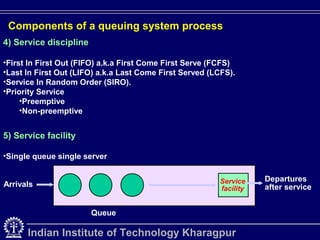
5) Service facility

•Single queue single server


                                                         Service    Departures
Arrivals                                                            after service
                                                         facility


                        Queue

      Indian Institute of Technology Kharagpur
Components of a queuing system process

5) Service facility

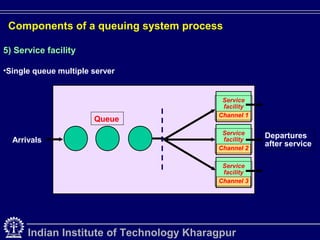
•Single queue multiple server


                                           Service
                                           facility
                                          Channel 1
                       Queue
                                           Service    Departures
  Arrivals                                 facility
                                                      after service
                                          Channel 2

                                           Service
                                           facility
                                          Channel 3


      Indian Institute of Technology Kharagpur
Components of a queuing system process

5) Service facility

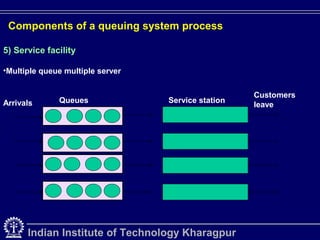
•Multiple queue multiple server


                                                    Customers
Arrivals      Queues              Service station
                                                    leave


      Indian Institute of Technology Kharagpur
Components of a queuing system process

5) Service facility

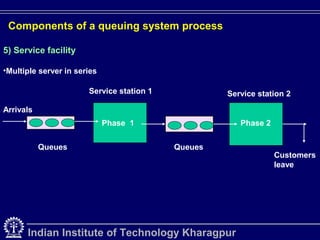
•Multiple server in series

                       Service station 1            Service station 2

Arrivals
                             Phase 1                   Phase 2


           Queues                          Queues
                                                                 Customers
                                                                 leave


      Indian Institute of Technology Kharagpur
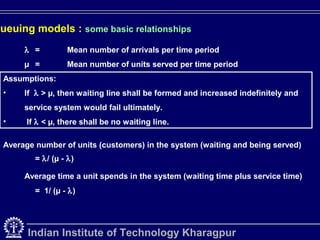
Queuing models : some basic relationships
       λ =         Mean number of arrivals per time period
       µ =         Mean number of units served per time period
  Assumptions:
  •    If λ > µ, then waiting line shall be formed and increased indefinitely and
       service system would fail ultimately.
  •     If λ < µ, there shall be no waiting line.

  Average number of units (customers) in the system (waiting and being served)
          = λ/ (µ - λ)

       Average time a unit spends in the system (waiting time plus service time)
          = 1/ (µ - λ)


        Indian Institute of Technology Kharagpur
Queuing models : some basic relationships

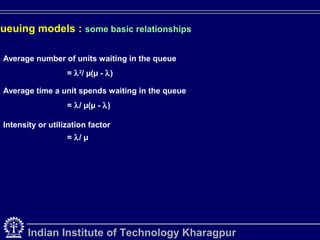
  Average number of units waiting in the queue
                    = λ 2/ µ(µ - λ)

  Average time a unit spends waiting in the queue
                    = λ/ µ(µ - λ)

  Intensity or utilization factor
                    = λ/ µ


         Indian Institute of Technology Kharagpur
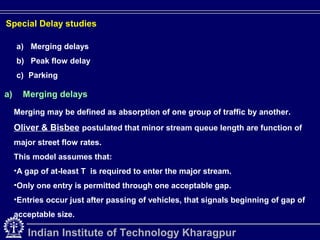
Special Delay studies

     a) Merging delays
     b) Peak flow delay
     c) Parking

a)     Merging delays
     Merging may be defined as absorption of one group of traffic by another.
     Oliver & Bisbee postulated that minor stream queue length are function of
     major street flow rates.
     This model assumes that:
     •A gap of at-least T is required to enter the major stream.
     •Only one entry is permitted through one acceptable gap.
     •Entries occur just after passing of vehicles, that signals beginning of gap of
     acceptable size.

        Indian Institute of Technology Kharagpur
Special Delay studies

  •   Appearance of gap in major stream is not affected by queue in minor
      stream; and,
  •   Arrivals into the minor stream queue are Poisson


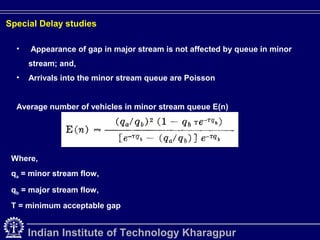
  Average number of vehicles in minor stream queue E(n)


 Where,
 qa = minor stream flow,

 qb = major stream flow,
 T = minimum acceptable gap


      Indian Institute of Technology Kharagpur
Special Delay studies

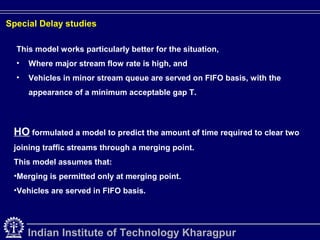
  This model works particularly better for the situation,
  •   Where major stream flow rate is high, and
  •   Vehicles in minor stream queue are served on FIFO basis, with the
      appearance of a minimum acceptable gap T.


 HO formulated a model to predict the amount of time required to clear two
 joining traffic streams through a merging point.
 This model assumes that:
 •Merging is permitted only at merging point.
 •Vehicles are served in FIFO basis.


      Indian Institute of Technology Kharagpur
Special Delay studies

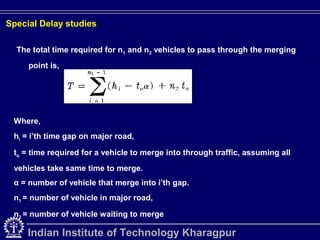
  The total time required for n1 and n2 vehicles to pass through the merging
     point is,


 Where,
 hi = i’th time gap on major road,

 to = time required for a vehicle to merge into through traffic, assuming all
 vehicles take same time to merge.
 α = number of vehicle that merge into i’th gap.
 n1 = number of vehicle in major road,

 n2 = number of vehicle waiting to merge

     Indian Institute of Technology Kharagpur
Special Delay studies


b) Peak flow delay

•    If traffic demand exceeds the capacity, there is a continuous buildup of
     traffic.
•    Mean service rate exceeds the mean rate of arrival.
•    Expected number of vehicle ‘n’, waiting in the system at any time ‘t’ can be
     represented as E[n(t)] and will grow indefinitely as ‘t’ increases.

                             E[n(t)] = E(n) + λ(t) - μ(t)

• E(n) = expected number of vehicles in system with initial traffic intensity ρo,

    where, ρo <1
• λ = mean arrival rate and, μ = mean service rate


       Indian Institute of Technology Kharagpur
Special Delay studies

•   Now, say traffic intensity ρo increases to ρ1 , where ρ1 >1

•   Therefore, ρ1 = λ / μ        [ initial λ0 increases to λ]

    or λ = μ . ρ1
•   So,                  E[n(t)] = E(n) - μ . ρ1 (t) - μ(t)

                          E[n(t)] = E(n) + (ρ1 - 1) μ . t

                    Or, E[n(t)] = ρ0 /(1 - ρ0 ) + (ρ1 - 1) μ . t


• When, service rate (μ) is constant,
                       E[n(t)] = (1/2) λ0 2 / μ(μ - λ0 ) + λ0/μ + (ρ1 - 1) μ


      Indian Institute of Technology Kharagpur
Special Delay studies

Numerical example:
•   A queue with random arrival rate 1 vehicle per minute and a mean service
    time of 45 seconds. In peak period, arrival rate suddenly doubles and this
    peak period rate is maintained for 1 hour. Find the average number of
    vehicles in the system at the end of peak hour.
Sol. – Given, λ0 = 1, μ = 4/3 Therefore, ρ0 = λ0 / μ = 3/4

    In peak period, λ = 2 and μ remains same. So, ρ1 = 3/2

Putting the values in eqn - , E[n(t)] = ρ0 /(1 - ρ0 ) + (ρ1 - 1) μ . t
    we get, E[n(60)] = 43
If the service rate μ were constant,
Putting the values in eqn - , E[n(t)] = (1/2) λ0 2 / μ(μ - λ0 ) + λ0/μ + (ρ1 - 1) μ
we get, E[n(60)] = 41.87~ 42

     Indian Institute of Technology Kharagpur
Special Delay studies

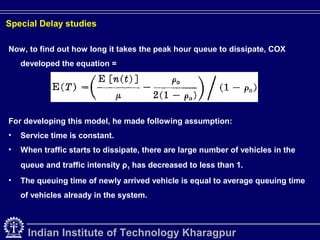
Now, to find out how long it takes the peak hour queue to dissipate, COX
    developed the equation =


For developing this model, he made following assumption:
•   Service time is constant.
•   When traffic starts to dissipate, there are large number of vehicles in the
    queue and traffic intensity ρ1 has decreased to less than 1.
•   The queuing time of newly arrived vehicle is equal to average queuing time
    of vehicles already in the system.


     Indian Institute of Technology Kharagpur
Special Delay studies

•   For the previous problem, find out the mean time it takes for queue to get
    dissipated.
Sol: putting the values in the equation
         E (t) = [ E(n)t /μ – ρo / 2(1- ρo ) ] / (1 – ρo )
We get, E(t) = 123 min.


     Indian Institute of Technology Kharagpur
Special Delay studies


c) Parking

•   The characteristics of queuing analysis dealing with length of queue and
    waiting time are not too meaningful for parking as potential parkers usually
    leave and seek another location rather than wait, if parking is full
•   Though there has been attempts to establish relationship between number
    of potential parkers turned away from parking of a specified capacity and
    various fractions of occupancy.


      Indian Institute of Technology Kharagpur

Introduction to queueing theory

  • 1.
    Queuing Theory Prepared by: Pranav Mishra Indian Institute of Technology Kharagpur Indian Institute of Technology Kharagpur
  • 2.
    Queuing Theory •Queuingtheory is the mathematics of waiting lines. •A queue forms whenever existing demand exceeds the existing capacity of service facility. •It is extremely useful in predicting and evaluating system performance. Queuing system Customer input output Server Queue Key elements of queuing system a) Customers : Refers to anything that arrives at facility and requires service b) Servers: Refers to any resource that provides the requested service Indian Institute of Technology Kharagpur
  • 3.
    pplications of queuingtheory •Telecommunications •Traffic control •Layout of manufacturing systems •Airport traffic •Ticket sales counter, etc. Examples: System Customers Server Reception desk People Receptionist Hospital Patients Nurses Airport Airplanes Runway Road network Cars Traffic light Grocery Shoppers Checkout station Computer Jobs CPU, disk, CD Indian Institute of Technology Kharagpur
  • 4.
    Components of aqueuing system process Arrivals Service Exit the system Population of from the Queue facility dirty cars general (waiting line) population … Dave’s Car Wash enter exit Arrivals to the system In the system Exit the system 2) Queue 4) Service discipline 1) Arrival process configuration 5) Service facility 3) Queue discipline Indian Institute of Technology Kharagpur
  • 5.
    Components of aqueuing system process 1) Arrival process •The source may be, •single or multiple. •Size of the population may be, •finite or infinite. •Arrival may be single or bulk. •Control on arrival may be, •Total control. •Partial control. •No control •Statistical distribution of arrivals may be, •Deterministic, •Probabilistic. Indian Institute of Technology Kharagpur
  • 6.
    Components of aqueuing system process 2) Queue configuration •The queue configuration refers to, • number of queues in the system, •Their spatial consideration, •Their relationship with server. •A queue may be single or multiple queue. •A queuing system may impose restriction on the maximum number of units allowed. 3) Queue discipline •If the system is filled to capacity, arriving unit is not allowed to join the queue. •Balking – A customer does not join the queue. •Reneging – A customer joins the queue and subsequently decides to leave. •Collusion – Customers collaborate to reduce the waiting time. •Jockeying – A customer switching between multiple queues. •Cycling – A customer returning to the queue after being served. •A queue may be single or multiple queue. Indian Institute of Technology Kharagpur
  • 7.
    Components of aqueuing system process 4) Service discipline •First In First Out (FIFO) a.k.a First Come First Serve (FCFS) •Last In First Out (LIFO) a.k.a Last Come First Served (LCFS). •Service In Random Order (SIRO). •Priority Service •Preemptive •Non-preemptive 5) Service facility •Single queue single server Service Departures Arrivals after service facility Queue Indian Institute of Technology Kharagpur
  • 8.
    Components of aqueuing system process 5) Service facility •Single queue multiple server Service facility Channel 1 Queue Service Departures Arrivals facility after service Channel 2 Service facility Channel 3 Indian Institute of Technology Kharagpur
  • 9.
    Components of aqueuing system process 5) Service facility •Multiple queue multiple server Customers Arrivals Queues Service station leave Indian Institute of Technology Kharagpur
  • 10.
    Components of aqueuing system process 5) Service facility •Multiple server in series Service station 1 Service station 2 Arrivals Phase 1 Phase 2 Queues Queues Customers leave Indian Institute of Technology Kharagpur
  • 11.
    Queuing models :some basic relationships λ = Mean number of arrivals per time period µ = Mean number of units served per time period Assumptions: • If λ > µ, then waiting line shall be formed and increased indefinitely and service system would fail ultimately. • If λ < µ, there shall be no waiting line. Average number of units (customers) in the system (waiting and being served) = λ/ (µ - λ) Average time a unit spends in the system (waiting time plus service time) = 1/ (µ - λ) Indian Institute of Technology Kharagpur
  • 12.
    Queuing models :some basic relationships Average number of units waiting in the queue = λ 2/ µ(µ - λ) Average time a unit spends waiting in the queue = λ/ µ(µ - λ) Intensity or utilization factor = λ/ µ Indian Institute of Technology Kharagpur
  • 13.
    Special Delay studies a) Merging delays b) Peak flow delay c) Parking a) Merging delays Merging may be defined as absorption of one group of traffic by another. Oliver & Bisbee postulated that minor stream queue length are function of major street flow rates. This model assumes that: •A gap of at-least T is required to enter the major stream. •Only one entry is permitted through one acceptable gap. •Entries occur just after passing of vehicles, that signals beginning of gap of acceptable size. Indian Institute of Technology Kharagpur
  • 14.
    Special Delay studies • Appearance of gap in major stream is not affected by queue in minor stream; and, • Arrivals into the minor stream queue are Poisson Average number of vehicles in minor stream queue E(n) Where, qa = minor stream flow, qb = major stream flow, T = minimum acceptable gap Indian Institute of Technology Kharagpur
  • 15.
    Special Delay studies This model works particularly better for the situation, • Where major stream flow rate is high, and • Vehicles in minor stream queue are served on FIFO basis, with the appearance of a minimum acceptable gap T. HO formulated a model to predict the amount of time required to clear two joining traffic streams through a merging point. This model assumes that: •Merging is permitted only at merging point. •Vehicles are served in FIFO basis. Indian Institute of Technology Kharagpur
  • 16.
    Special Delay studies The total time required for n1 and n2 vehicles to pass through the merging point is, Where, hi = i’th time gap on major road, to = time required for a vehicle to merge into through traffic, assuming all vehicles take same time to merge. α = number of vehicle that merge into i’th gap. n1 = number of vehicle in major road, n2 = number of vehicle waiting to merge Indian Institute of Technology Kharagpur
  • 17.
    Special Delay studies b)Peak flow delay • If traffic demand exceeds the capacity, there is a continuous buildup of traffic. • Mean service rate exceeds the mean rate of arrival. • Expected number of vehicle ‘n’, waiting in the system at any time ‘t’ can be represented as E[n(t)] and will grow indefinitely as ‘t’ increases. E[n(t)] = E(n) + λ(t) - μ(t) • E(n) = expected number of vehicles in system with initial traffic intensity ρo, where, ρo <1 • λ = mean arrival rate and, μ = mean service rate Indian Institute of Technology Kharagpur
  • 18.
    Special Delay studies • Now, say traffic intensity ρo increases to ρ1 , where ρ1 >1 • Therefore, ρ1 = λ / μ [ initial λ0 increases to λ] or λ = μ . ρ1 • So, E[n(t)] = E(n) - μ . ρ1 (t) - μ(t) E[n(t)] = E(n) + (ρ1 - 1) μ . t Or, E[n(t)] = ρ0 /(1 - ρ0 ) + (ρ1 - 1) μ . t • When, service rate (μ) is constant, E[n(t)] = (1/2) λ0 2 / μ(μ - λ0 ) + λ0/μ + (ρ1 - 1) μ Indian Institute of Technology Kharagpur
  • 19.
    Special Delay studies Numericalexample: • A queue with random arrival rate 1 vehicle per minute and a mean service time of 45 seconds. In peak period, arrival rate suddenly doubles and this peak period rate is maintained for 1 hour. Find the average number of vehicles in the system at the end of peak hour. Sol. – Given, λ0 = 1, μ = 4/3 Therefore, ρ0 = λ0 / μ = 3/4 In peak period, λ = 2 and μ remains same. So, ρ1 = 3/2 Putting the values in eqn - , E[n(t)] = ρ0 /(1 - ρ0 ) + (ρ1 - 1) μ . t we get, E[n(60)] = 43 If the service rate μ were constant, Putting the values in eqn - , E[n(t)] = (1/2) λ0 2 / μ(μ - λ0 ) + λ0/μ + (ρ1 - 1) μ we get, E[n(60)] = 41.87~ 42 Indian Institute of Technology Kharagpur
  • 20.
    Special Delay studies Now,to find out how long it takes the peak hour queue to dissipate, COX developed the equation = For developing this model, he made following assumption: • Service time is constant. • When traffic starts to dissipate, there are large number of vehicles in the queue and traffic intensity ρ1 has decreased to less than 1. • The queuing time of newly arrived vehicle is equal to average queuing time of vehicles already in the system. Indian Institute of Technology Kharagpur
  • 21.
    Special Delay studies • For the previous problem, find out the mean time it takes for queue to get dissipated. Sol: putting the values in the equation E (t) = [ E(n)t /μ – ρo / 2(1- ρo ) ] / (1 – ρo ) We get, E(t) = 123 min. Indian Institute of Technology Kharagpur
  • 22.
    Special Delay studies c)Parking • The characteristics of queuing analysis dealing with length of queue and waiting time are not too meaningful for parking as potential parkers usually leave and seek another location rather than wait, if parking is full • Though there has been attempts to establish relationship between number of potential parkers turned away from parking of a specified capacity and various fractions of occupancy. Indian Institute of Technology Kharagpur