How effective is the combinationof your
main product and ancillary texts?
Throughout the production of all documentary, radio trailer and double page
spread, we aimed to maintain a consistent house style and keep certain
elements of all three products similar so they are recurrent linking all three
forms of media.
Our main product and the ancillary tasks are all aimed at the same target
audience – this is teenagers to young adults, who are possibly considering body
modifications or already have them and want to see the impact it may have on
their lives. More specifically, the target audience would be around 15-21 years of
age, or young adults who are currently in the education system. We wanted to
target this age group, regardless of any other factors such as religion, race,
gender, or disability. We chose this target audience as we feel the young adults
are the most inclined to get tattoo’s, as they are reaching, or have reached the
legal age to have them. From our research, we have concluded that body
modifications are more popular within the working class citizens. As this group of
people a lot of the time have jobs involved with facing the general public, their
body modifications may affect their chances of getting a job as it may cause the
public to see the company in a different, perhaps more negative way if they
employ people with graphic art on their body. This is an idea which is presented
in our documentary. Although this is our target audience, we did not want to
restrict our three products to just young people, and so aimed to appeal to other
people such as the general public, teachers, and parents and so included these
people in our documentary. This avoided reducing the amount of people that our
products appeal to. Once we had chosen a topic, and a target audience for the
documentary, we revolved our two ancillary tasks around this, making sure that
each product was consistent with one another. This way, each product is clearly
connected to one another.
Overall, the magazine completes the objective to support the documentary as it
is both aesthetically pleasing and does it’s main job to advertise the product with
consistency. In terms of our planning, incorperating conventional features of our
chosen magazine and conventions of the topic, we chose to opt for a relatively
simple layout and colour scheme which didn’t contain too much distraction from
the overall message of the documentary and advertisement.
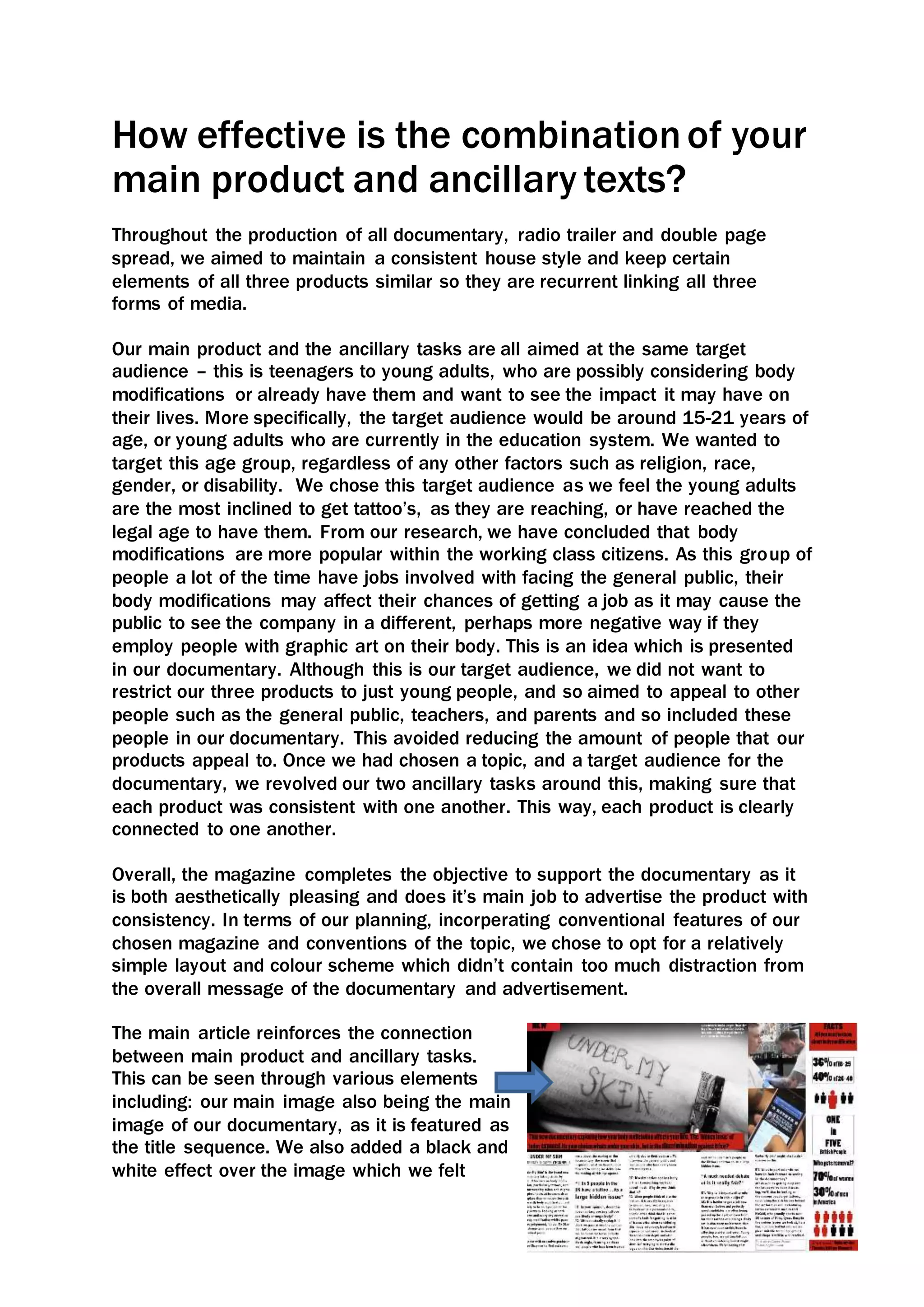
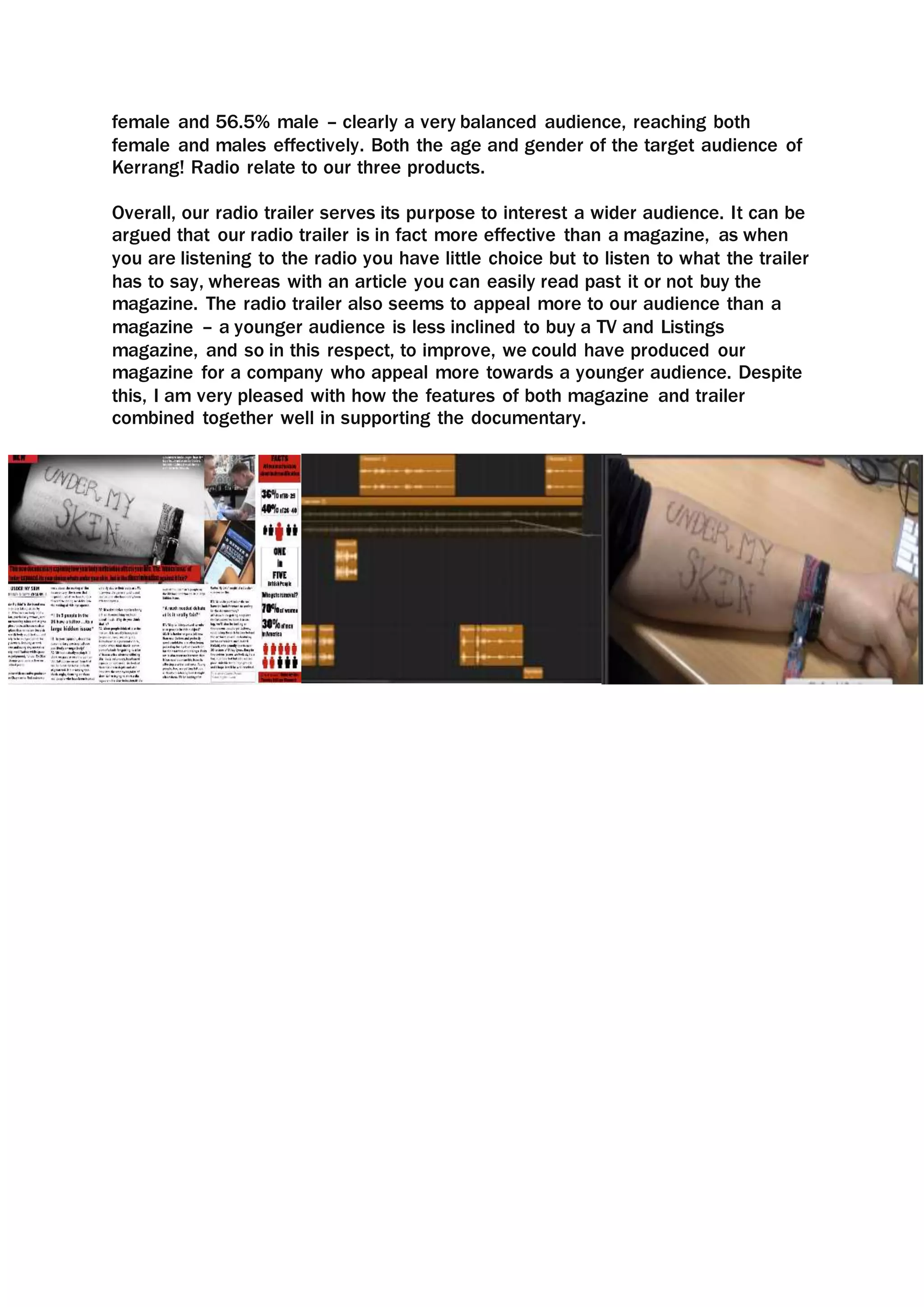
The main article reinforces the connection
between main product and ancillary tasks.
This can be seen through various elements
including: our main image also being the main
image of our documentary, as it is featured as
the title sequence. We also added a black and
white effect over the image which we felt
conveyed how stereotyping can often be
black and white. It portrays the dark side of
stereotyping, where the individual can feel
discriminated against and so isolated. we
planned to set up a house style which
consisted of basic elements that we could
replicate throughout each product. Also our
magazine article feaures real people from
our documentary, so advertises it well and adds an element of continuity. For
example, we used the colour scheme of black, white and red. This is because we
felt the colours were appropriate for our target audience and the topic, as they
would appeal to a younger audience. We also used the same font throughout
similarly to create an alement of consistency.
We included date, time and title in order to ensure
the reader knows exactly when the documentary is
showing. As the title is bold, and clear, the reader
can easily recognize when it is on. This supports the
main product and so increases the views.
Also, we included a pull quote straight from the
documentary which we felt advertised and
summarized the main points well. This
encourages the reader to watch the documentary,
as they receive a snipet from the voiceover which
is interesting and intruiging.
Although, what could have been improved in the article was that the colours
black and red clash together slightly. As the text is the most important feature of
the article, it needs to be
easy to read and clear. This
I feel is something we could
of improved upon, in retrospect, especially taking into account a younger target
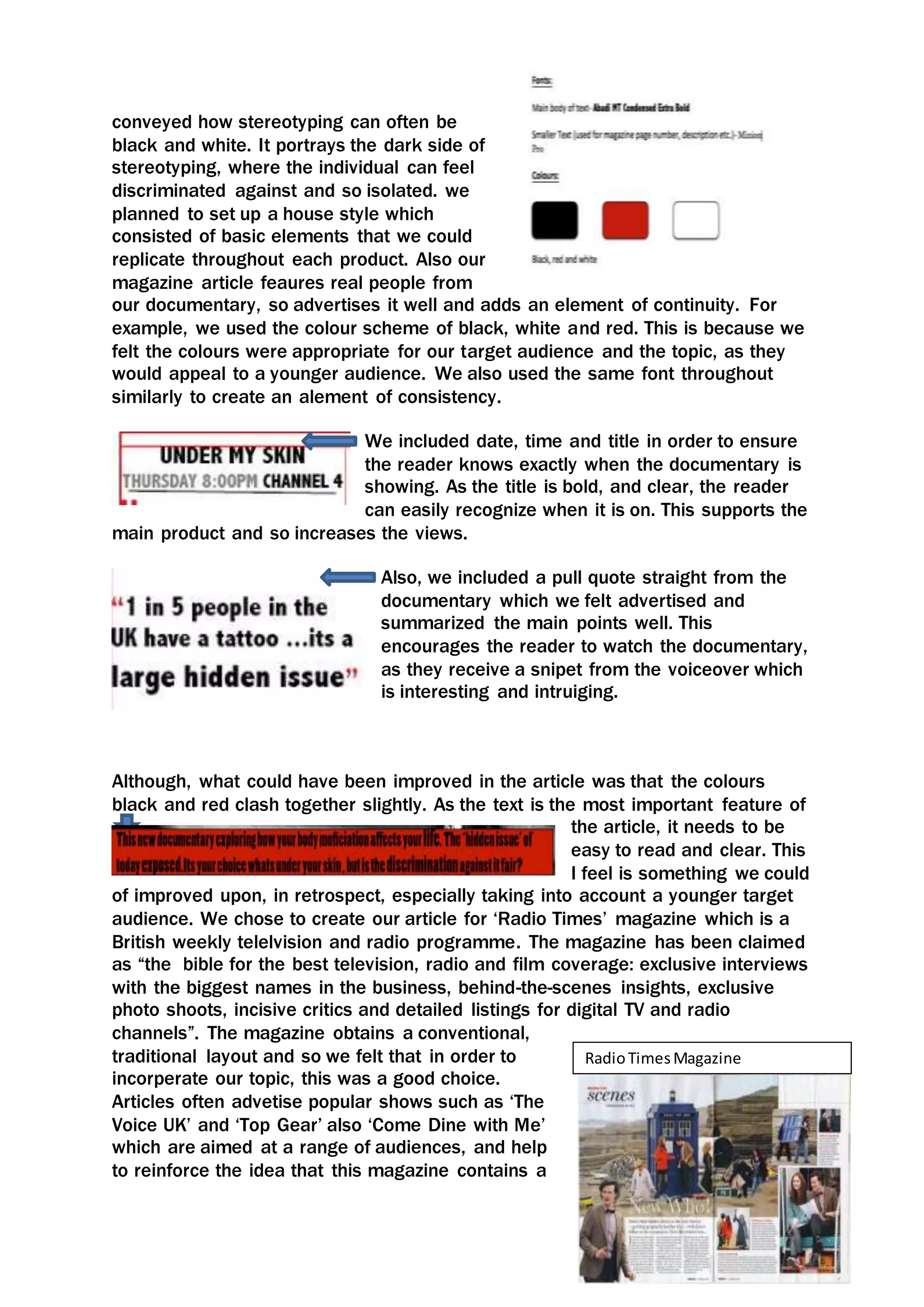
audience. We chose to create our article for ‘Radio Times’ magazine which is a
British weekly telelvision and radio programme. The magazine has been claimed
as “the bible for the best television, radio and film coverage: exclusive interviews
with the biggest names in the business, behind-the-scenes insights, exclusive
photo shoots, incisive critics and detailed listings for digital TV and radio
channels”. The magazine obtains a conventional,
traditional layout and so we felt that in order to
incorperate our topic, this was a good choice.
Articles often advetise popular shows such as ‘The
Voice UK’ and ‘Top Gear’ also ‘Come Dine with Me’
which are aimed at a range of audiences, and help
to reinforce the idea that this magazine contains a
RadioTimesMagazine
broad range of articles that appeal to a larger range of audiences. We also
aimed to make the radio trailer fit with the magazine article and documentary. I
feel that our article appeals to students, of around 15-21 age groups, however
the magazine as a whole reaches to all audiences, young and old, and this is
what I feel we have achieved through our production of all three tasks.
Secondly, my radio trailer is particularly effective in relating directly to both my
magazine to the documentary, it supports and combines with my other products
to appeal to the target audience.
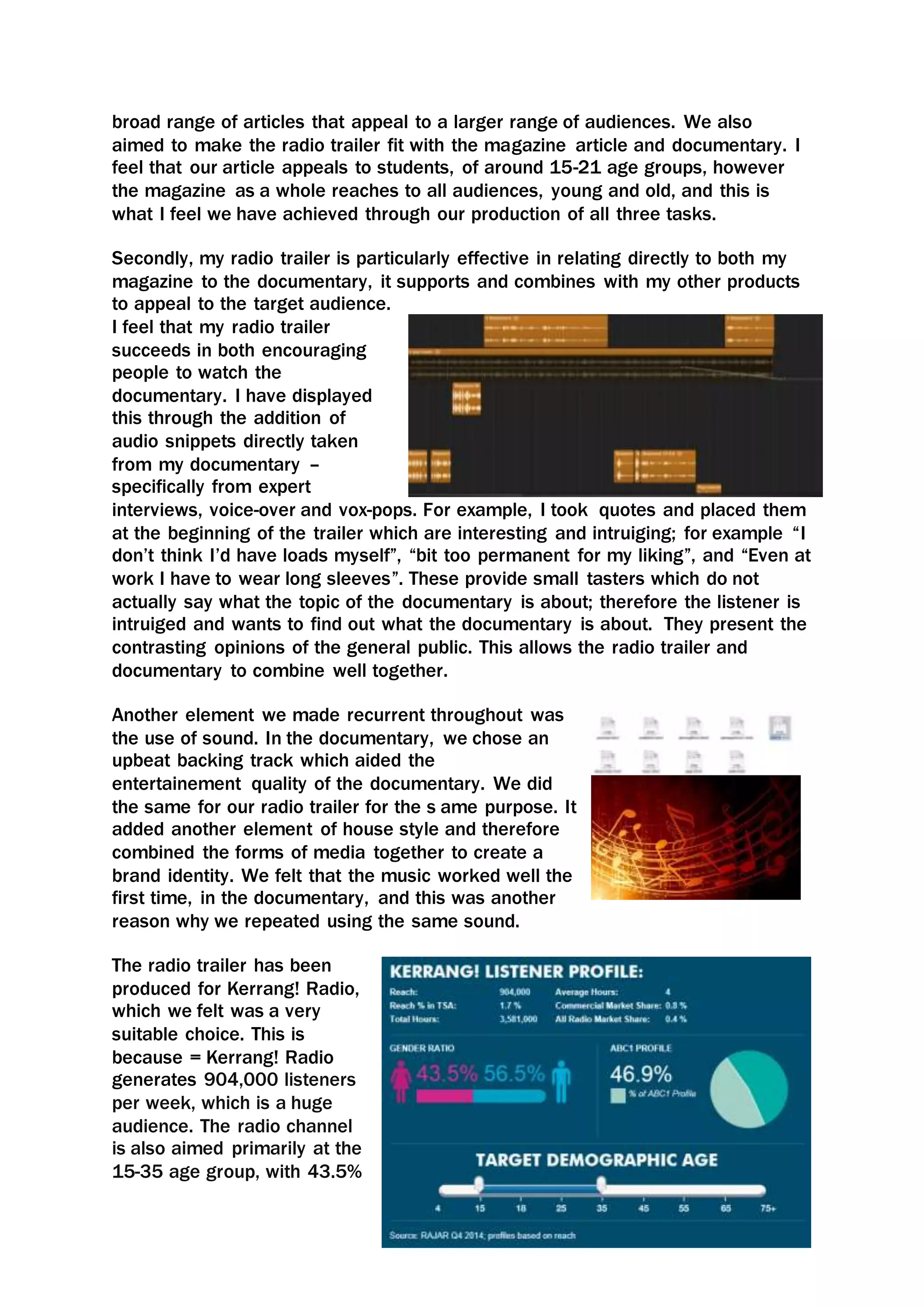
I feel that my radio trailer
succeeds in both encouraging
people to watch the
documentary. I have displayed
this through the addition of
audio snippets directly taken
from my documentary –
specifically from expert
interviews, voice-over and vox-pops. For example, I took quotes and placed them
at the beginning of the trailer which are interesting and intruiging; for example “I
don’t think I’d have loads myself”, “bit too permanent for my liking”, and “Even at
work I have to wear long sleeves”. These provide small tasters which do not
actually say what the topic of the documentary is about; therefore the listener is
intruiged and wants to find out what the documentary is about. They present the
contrasting opinions of the general public. This allows the radio trailer and
documentary to combine well together.
Another element we made recurrent throughout was
the use of sound. In the documentary, we chose an
upbeat backing track which aided the
entertainement quality of the documentary. We did
the same for our radio trailer for the s ame purpose. It
added another element of house style and therefore
combined the forms of media together to create a
brand identity. We felt that the music worked well the
first time, in the documentary, and this was another
reason why we repeated using the same sound.
The radio trailer has been
produced for Kerrang! Radio,
which we felt was a very
suitable choice. This is
because = Kerrang! Radio
generates 904,000 listeners
per week, which is a huge
audience. The radio channel
is also aimed primarily at the
15-35 age group, with 43.5%
female and 56.5% male – clearly a very balanced audience, reaching both
female and males effectively. Both the age and gender of the target audience of
Kerrang! Radio relate to our three products.
Overall, our radio trailer serves its purpose to interest a wider audience. It can be
argued that our radio trailer is in fact more effective than a magazine, as when
you are listening to the radio you have little choice but to listen to what the trailer
has to say, whereas with an article you can easily read past it or not buy the
magazine. The radio trailer also seems to appeal more to our audience than a
magazine – a younger audience is less inclined to buy a TV and Listings
magazine, and so in this respect, to improve, we could have produced our
magazine for a company who appeal more towards a younger audience. Despite
this, I am very pleased with how the features of both magazine and trailer
combined together well in supporting the documentary.

How effective is the combination of your main product and ancillary texts

  • 1.
    How effective isthe combinationof your main product and ancillary texts? Throughout the production of all documentary, radio trailer and double page spread, we aimed to maintain a consistent house style and keep certain elements of all three products similar so they are recurrent linking all three forms of media. Our main product and the ancillary tasks are all aimed at the same target audience – this is teenagers to young adults, who are possibly considering body modifications or already have them and want to see the impact it may have on their lives. More specifically, the target audience would be around 15-21 years of age, or young adults who are currently in the education system. We wanted to target this age group, regardless of any other factors such as religion, race, gender, or disability. We chose this target audience as we feel the young adults are the most inclined to get tattoo’s, as they are reaching, or have reached the legal age to have them. From our research, we have concluded that body modifications are more popular within the working class citizens. As this group of people a lot of the time have jobs involved with facing the general public, their body modifications may affect their chances of getting a job as it may cause the public to see the company in a different, perhaps more negative way if they employ people with graphic art on their body. This is an idea which is presented in our documentary. Although this is our target audience, we did not want to restrict our three products to just young people, and so aimed to appeal to other people such as the general public, teachers, and parents and so included these people in our documentary. This avoided reducing the amount of people that our products appeal to. Once we had chosen a topic, and a target audience for the documentary, we revolved our two ancillary tasks around this, making sure that each product was consistent with one another. This way, each product is clearly connected to one another. Overall, the magazine completes the objective to support the documentary as it is both aesthetically pleasing and does it’s main job to advertise the product with consistency. In terms of our planning, incorperating conventional features of our chosen magazine and conventions of the topic, we chose to opt for a relatively simple layout and colour scheme which didn’t contain too much distraction from the overall message of the documentary and advertisement. The main article reinforces the connection between main product and ancillary tasks. This can be seen through various elements including: our main image also being the main image of our documentary, as it is featured as the title sequence. We also added a black and white effect over the image which we felt
  • 2.
    conveyed how stereotypingcan often be black and white. It portrays the dark side of stereotyping, where the individual can feel discriminated against and so isolated. we planned to set up a house style which consisted of basic elements that we could replicate throughout each product. Also our magazine article feaures real people from our documentary, so advertises it well and adds an element of continuity. For example, we used the colour scheme of black, white and red. This is because we felt the colours were appropriate for our target audience and the topic, as they would appeal to a younger audience. We also used the same font throughout similarly to create an alement of consistency. We included date, time and title in order to ensure the reader knows exactly when the documentary is showing. As the title is bold, and clear, the reader can easily recognize when it is on. This supports the main product and so increases the views. Also, we included a pull quote straight from the documentary which we felt advertised and summarized the main points well. This encourages the reader to watch the documentary, as they receive a snipet from the voiceover which is interesting and intruiging. Although, what could have been improved in the article was that the colours black and red clash together slightly. As the text is the most important feature of the article, it needs to be easy to read and clear. This I feel is something we could of improved upon, in retrospect, especially taking into account a younger target audience. We chose to create our article for ‘Radio Times’ magazine which is a British weekly telelvision and radio programme. The magazine has been claimed as “the bible for the best television, radio and film coverage: exclusive interviews with the biggest names in the business, behind-the-scenes insights, exclusive photo shoots, incisive critics and detailed listings for digital TV and radio channels”. The magazine obtains a conventional, traditional layout and so we felt that in order to incorperate our topic, this was a good choice. Articles often advetise popular shows such as ‘The Voice UK’ and ‘Top Gear’ also ‘Come Dine with Me’ which are aimed at a range of audiences, and help to reinforce the idea that this magazine contains a RadioTimesMagazine
  • 3.
    broad range ofarticles that appeal to a larger range of audiences. We also aimed to make the radio trailer fit with the magazine article and documentary. I feel that our article appeals to students, of around 15-21 age groups, however the magazine as a whole reaches to all audiences, young and old, and this is what I feel we have achieved through our production of all three tasks. Secondly, my radio trailer is particularly effective in relating directly to both my magazine to the documentary, it supports and combines with my other products to appeal to the target audience. I feel that my radio trailer succeeds in both encouraging people to watch the documentary. I have displayed this through the addition of audio snippets directly taken from my documentary – specifically from expert interviews, voice-over and vox-pops. For example, I took quotes and placed them at the beginning of the trailer which are interesting and intruiging; for example “I don’t think I’d have loads myself”, “bit too permanent for my liking”, and “Even at work I have to wear long sleeves”. These provide small tasters which do not actually say what the topic of the documentary is about; therefore the listener is intruiged and wants to find out what the documentary is about. They present the contrasting opinions of the general public. This allows the radio trailer and documentary to combine well together. Another element we made recurrent throughout was the use of sound. In the documentary, we chose an upbeat backing track which aided the entertainement quality of the documentary. We did the same for our radio trailer for the s ame purpose. It added another element of house style and therefore combined the forms of media together to create a brand identity. We felt that the music worked well the first time, in the documentary, and this was another reason why we repeated using the same sound. The radio trailer has been produced for Kerrang! Radio, which we felt was a very suitable choice. This is because = Kerrang! Radio generates 904,000 listeners per week, which is a huge audience. The radio channel is also aimed primarily at the 15-35 age group, with 43.5%
  • 4.
    female and 56.5%male – clearly a very balanced audience, reaching both female and males effectively. Both the age and gender of the target audience of Kerrang! Radio relate to our three products. Overall, our radio trailer serves its purpose to interest a wider audience. It can be argued that our radio trailer is in fact more effective than a magazine, as when you are listening to the radio you have little choice but to listen to what the trailer has to say, whereas with an article you can easily read past it or not buy the magazine. The radio trailer also seems to appeal more to our audience than a magazine – a younger audience is less inclined to buy a TV and Listings magazine, and so in this respect, to improve, we could have produced our magazine for a company who appeal more towards a younger audience. Despite this, I am very pleased with how the features of both magazine and trailer combined together well in supporting the documentary.