Final Questionnaire
We asked 20 people from within our primary and secondary audience to fill in our 3 questionnaires:
one based on our main task, one based on the radio ancillary task and the final one based on our
poster ancillary task. From the questionnaire’s we have learnt a lot about how we can best connect
with our audience and attract the largest audience possible! The answers have given us an insight into
how best we can fulfil the demands of our target audience which will result in the suitable media
products for them and really help to break down the stigma of body image and appearance.
Main Task
Question 1:
• Would you rather the documentary:
• -Be Cinematic?: 1
• -Consist of only Interviews?: 3
• -A mixture between cinematic shots and interviews?: 16
• The majority of our target audience said that they would
rather see a mixture between cinematic shots and
interviewees in the documentary. We have decided to take
this idea forward as we believe a mixture will create a
balance between professionalism and relatability. By
including cinematic shots in our documentary it would
appeal to our audience as it would create an auteur
signature. This is when a film director influences their films
and includes recognisable elements.
• We are targeting millennials who aren’t stereotypically the
most intellectual or sophisticated and therefore they
wouldn’t necessarily want distinctive and challenging
products. Therefore by creating our own auteur signature it
will prevent our audiencefrom having to overcome any
enigmas as they will already expect what elements are to be
seen.
Question 1
Cinematic Interviews Mixture
Question 2:
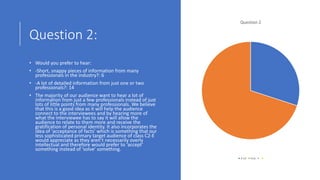
• Would you prefer to hear:
• -Short, snappy pieces of information from many
professionals in the industry?: 6
• -A lot of detailed information from just one or two
professionals?: 14
• The majority of our audience want to hear a lot of
information from just a few professionals instead of just
lots of little points from many professionals. We believe
that this is a good idea as it will help the audience
connect to the interviewees and by hearing more of
what the interviewee has to say it will allow the
audience to relate to them more and receive the
gratification of personal identity. It also incorporates the
idea of ‘acceptance of facts’ which is something that our
less sophisticated primary target audience of class C2-E
would appreciate as they aren’t necessarily overly
intellectual and therefore would prefer to ‘accept’
something instead of ‘solve’ something.
Question 2
A lot Few
Question 3:
• Would you prefer to see more:
• -Close up/medium close up shots of the interviewees?: 17
-Long shots of the interviewees?: 3
• The majority of our target audience wanted more close
up/medium close up shots. We will take this forward when
making our documentary as we believe that the close proximity
between the interviewee and the audience will help to create a
connection. By using direct address with the close range shots
we also believe that it will help to ‘break the wall between’ the
interviewee and the audience and seem as though the
interviewees are talking on a personal level with the audience
(face to face.) This will help the audience to relate more.
• By including many close up/medium close up shots and direct
address we are fulfilling a convention of short film
documentaries. When breaking this conversation and including
other shots such as long shots we are breaking this convention.
This incorporates Neales ‘repetition and difference’ theory
which states that films within a genre include recognisable
themes however each film also includes its own unique twist
that isn’t included in other films within the genre. This keeps the
audience excited and intrigued.
Question 3
Close Long
Question 4
• Would you prefer:
• -Low key Lighting?: 9
• -High key lighting ?: 11
• As you can see from the results our target audience
wasn’t entirely sure on specifically what type of
lighting they would prefer to see in our documentary.
We believe that this is because they may want to see
a mixture of both. For example low key lighting when
talking about serious points however high key
lighting when raising awareness as it creates
connotations of hope for the future, self-belief and
self-appreciation.
Question 4
Low High
Question 5:
• Would you prefer to see the use of:
• -A Handheld camera?: 3
• -A digital camera on a tripod/dolley?: 6
• -A Mixture of both?: 11
• The majority chose a mixture of both. The use of a hand held cameras when
tracking, tilting and peding etc in documentaries is common and this is because
it gives connotations of realism. However the use of a dolly/tripod creates
smooth and cinematic aesthetics which is also something we would like to
achieve as it provides professionalism and the idea that the documentary
subject is serious and something that needs to change. We believe that the
majority of our audience wanted a mixture of both as it gives the documentary
credibility but also through the use of handheld cameras realism is provided and
allows the audience to relate to what is being said.
• O’Sullivan, Dutton and Raynor stated that for something to be realistic it has to
include: surface realism, inner or emotional realism of the characters and their
motivation, an overall message that is realistic and finally the technical and
symbolic codes must be acceptable. By using a handheld camera with the
connotations being ‘realism’, the technical code of this theory is being fulfilled.
Question 5
Handheld Equipment Mixture
Poster
Question 1:
• Would you prefer our poster to be in:
• Colour?: 18
• Monochrome?: 2
• The majority of our target audience chose for our poster to
be in colour. We have decided to take this idea forward as
we believe colour is something which draws the eye and
entices people to pay attention.
• Colour functions as part of the AIDA scale. It makes the
audience ‘aware’ of the poster which then promotes an
‘interest’ in it. Subsequently it creates a ‘desire’ to see the
documentary and hence results in the audience taking
‘action’ and viewing our production.
• Therefore because of this we believe that by using colour in
our poster it will enable us to attract the largest audience
possible. However from our pilot questionnaire it was clear
that our target audience didn’t think really bright colours
would be suitable due to the serious nature of the
documentary and this is something we are considering
going forward.
Question 1
Colour Monochrome
Question 2
• Do you prefer the idea of :
• A woman looking into a mirror?: 9
• A woman pulling off half of her face? (half will be made up with makeup, the
other half will be natural): 11
• It is clear that our target audience were undecided as to which idea they
preferred. We are also undecided as we like both ideas for different reasons.
The first idea encapsulates our whole documentary. One of our title choices is
‘mirrored’ which therefore creates a link with the image but it also creates
awareness for a major issue present in the world today; it is evident that
people are trying to ‘mirror’ what society portrays as being ‘perfect.’ If we
chose the idea of a women looking into a mirror it would reinforce this issue
and incorporate the gratification of personal identity as the audience would
be able to think of times that they looked in the mirror and judged the way
they looked in some way. However, we also love the second idea as we
believe that by having a visual of a woman peeling off a made up face and
with it the stereotypical image of how she ‘should look.’ It reinforces how
societies perceptions really affect people today and how it pressurises them
into making different life choices.
• After analysing both ideas again we have come to the agreement that we are
going forward with the second idea. This is because we believe that it is more
progressive. As well as this a mirror could suggest Winship’s notion of
complicity: this is about us being prepared, for the reward of gratification, to
recognise the ideal version of ourselves despite the anxiety this may cause.
This isn’t really what we are aiming for as the whole documentary is trying to
prevent an anxiety caused by self-appearance.
Question2
Mirror Pulling half her face off
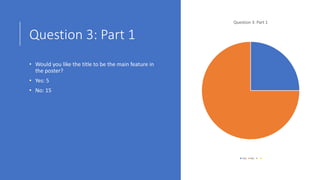
Question 3: Part 1
• Would you like the title to be the main feature in
the poster?
• Yes: 5
• No: 15
Question 3: Part 1
Yes No
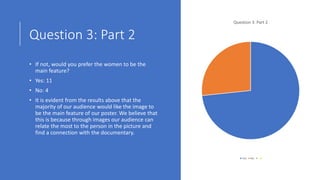
Question 3: Part 2
• If not, would you prefer the women to be the
main feature?
• Yes: 11
• No: 4
• It is evident from the results above that the
majority of our audience would like the image to
be the main feature of our poster. We believe that
this is because through images our audience can
relate the most to the person in the picture and
find a connection with the documentary.
Question 3: Part 2
Yes No
Question 4:
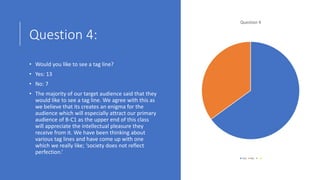
• Would you like to see a tag line?
• Yes: 13
• No: 7
• The majority of our target audience said that they
would like to see a tag line. We agree with this as
we believe that its creates an enigma for the
audience which will especially attract our primary
audience of B-C1 as the upper end of this class
will appreciate the intellectual pleasure they
receive from it. We have been thinking about
various tag lines and have come up with one
which we really like; ‘society does not reflect
perfection.’
Question 4
Yes No
Question 5:
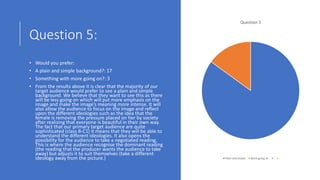
• Would you prefer:
• A plain and simple background?: 17
• Something with more going on?: 3
• From the results above it is clear that the majority of our
target audience would prefer to see a plain and simple
background. We believe that they want to see this as there
will be less going on which will put more emphasis on the
image and make the image’s meaning more intense. It will
also allow the audience to focus on the image and reflect
upon the different ideologies such as the idea that the
female is removing the pressure placed on her by society
after realising that everyone is beautiful in their own way.
The fact that our primary target audience are quite
sophisticated (class B-C1) it means that they will be able to
understand the different ideologies. It also opens the
possibility for the audience to take a negotiated reading.
This is where the audience recognise the dominant reading
(the reading that the producer wants the audience to take
away) but adjusts it to suit themselves (take a different
ideology away from the picture.)
Question 5
Plain and simple More going on
Radio
Question 1:
• Would you prefer:
• A male voice for the radio advert?: 4
• A female voice?: 16
• Our target audience decided that they would
prefer to hear a females voice. This is something
that we intend to do because a higher pitched,
happy voice is much more appealing especially for
our expository style of documentary. As well as
this our target audience are females and
therefore a female voice would appeal to them as
they will be able to relate.
Question 1
Male Female
Question 2: Part 1
• Do you normally get bored when listening to the
radio?
• Yes: 17
• No: 3
Question 2: Part 1
Yes No
Question 2: Part 2
• If so would you prefer if it were upbeat?
• Yes: 15
• No: 2
• It is clear that our target audience would like our
radio advert to be more upbeat, this can be
achieved by numerous ways however in particular
the voice chosen (females voice.)
• In order to make our radio advert upbeat it is also
vital that we position our radio advert correctly
e.g. making it available online and technologically
converging it in a pop-up, for example creating a
pop up for a website.
• If we were to do this it is even more important
that we ensure our radio advert is upbeat as we
will be competing against whatever else is on the
screen.
Question 2: Part 2
Yes No
Question 3:
• Would you like to hear snippets of the documentary within the
advert?
• Yes: 18
• No: 2
• The majority of our target audience would like to hear clips from
our documentary. This is conventional.
• We like this idea as it will help create a link between the actual
documentary and the advert. Therefore when our target
audience hear the radio advert they will get an insight into what
the documentary is about and hopefully compel them to watch
the documentary. We believe that by including clips from our
documentary it will grab the audience’s attention. This is
important as the challenge with radio adverts is that the time
slot is so small and so it is difficult to fit everything in. This is
why whatever is included in the advert must be exciting. Usually,
a disequilibrium is what catches peoples attention however in
radio adverts this isn’t really that necessary.
Question 3
Yes No
Question 4:
• Our documentary is fairly hard hitting and
important, would you prefer that we use:
• A music bed that fits this theme?: 15
• A music bed which is more uplifting?: 5
• The majority of our target audience said that they
would prefer a music bed which fits the theme of
the documentary. We agree with this as although
the modelling industry and plastic surgery
industry are diversifying we think that it is
important to stay away from more up-beat
melodic scores as we are focusing on the
negatives of both industries and therefore
uplifting music wouldn’t really be suitable.
Question 4
Fits the theme Uplifting
Question 5:
• Would you prefer:
• Instrumental music?: 14
• Lyrical music?: 6
• The majority of our target audience would prefer to hear
instrumental music. We like this idea as we believe that it would
allow the audience to focus more on what’s being said instead of
the lyrics. If the song was familiar it would be more likely to
distract the audience and prevent them from concentrating
entirely on what was being said.
• As well as this, instrumental music connotes a positive ending
and a new equilibrium which is something we desired. Orchestral
music helps to construct the narrative as it connotes a grand,
impressive and sophisticated subject.
• Although through our documentary we are trying to portray real
life, it is evident that this is never 100% captured as through the
editing process bits of what people say are cut out! Just like we
chose our type of music based on the connotations it provided,
documentary makers choose what to include in their production
based on the ideologies they want to release. This proves that
documentaries are a construct of the postmodern world.
Question 5
Instrumental Lyrical

Powerpoint

  • 1.
    Final Questionnaire We asked20 people from within our primary and secondary audience to fill in our 3 questionnaires: one based on our main task, one based on the radio ancillary task and the final one based on our poster ancillary task. From the questionnaire’s we have learnt a lot about how we can best connect with our audience and attract the largest audience possible! The answers have given us an insight into how best we can fulfil the demands of our target audience which will result in the suitable media products for them and really help to break down the stigma of body image and appearance.
  • 2.
  • 3.
    Question 1: • Wouldyou rather the documentary: • -Be Cinematic?: 1 • -Consist of only Interviews?: 3 • -A mixture between cinematic shots and interviews?: 16 • The majority of our target audience said that they would rather see a mixture between cinematic shots and interviewees in the documentary. We have decided to take this idea forward as we believe a mixture will create a balance between professionalism and relatability. By including cinematic shots in our documentary it would appeal to our audience as it would create an auteur signature. This is when a film director influences their films and includes recognisable elements. • We are targeting millennials who aren’t stereotypically the most intellectual or sophisticated and therefore they wouldn’t necessarily want distinctive and challenging products. Therefore by creating our own auteur signature it will prevent our audiencefrom having to overcome any enigmas as they will already expect what elements are to be seen. Question 1 Cinematic Interviews Mixture
  • 4.
    Question 2: • Wouldyou prefer to hear: • -Short, snappy pieces of information from many professionals in the industry?: 6 • -A lot of detailed information from just one or two professionals?: 14 • The majority of our audience want to hear a lot of information from just a few professionals instead of just lots of little points from many professionals. We believe that this is a good idea as it will help the audience connect to the interviewees and by hearing more of what the interviewee has to say it will allow the audience to relate to them more and receive the gratification of personal identity. It also incorporates the idea of ‘acceptance of facts’ which is something that our less sophisticated primary target audience of class C2-E would appreciate as they aren’t necessarily overly intellectual and therefore would prefer to ‘accept’ something instead of ‘solve’ something. Question 2 A lot Few
  • 5.
    Question 3: • Wouldyou prefer to see more: • -Close up/medium close up shots of the interviewees?: 17 -Long shots of the interviewees?: 3 • The majority of our target audience wanted more close up/medium close up shots. We will take this forward when making our documentary as we believe that the close proximity between the interviewee and the audience will help to create a connection. By using direct address with the close range shots we also believe that it will help to ‘break the wall between’ the interviewee and the audience and seem as though the interviewees are talking on a personal level with the audience (face to face.) This will help the audience to relate more. • By including many close up/medium close up shots and direct address we are fulfilling a convention of short film documentaries. When breaking this conversation and including other shots such as long shots we are breaking this convention. This incorporates Neales ‘repetition and difference’ theory which states that films within a genre include recognisable themes however each film also includes its own unique twist that isn’t included in other films within the genre. This keeps the audience excited and intrigued. Question 3 Close Long
  • 6.
    Question 4 • Wouldyou prefer: • -Low key Lighting?: 9 • -High key lighting ?: 11 • As you can see from the results our target audience wasn’t entirely sure on specifically what type of lighting they would prefer to see in our documentary. We believe that this is because they may want to see a mixture of both. For example low key lighting when talking about serious points however high key lighting when raising awareness as it creates connotations of hope for the future, self-belief and self-appreciation. Question 4 Low High
  • 7.
    Question 5: • Wouldyou prefer to see the use of: • -A Handheld camera?: 3 • -A digital camera on a tripod/dolley?: 6 • -A Mixture of both?: 11 • The majority chose a mixture of both. The use of a hand held cameras when tracking, tilting and peding etc in documentaries is common and this is because it gives connotations of realism. However the use of a dolly/tripod creates smooth and cinematic aesthetics which is also something we would like to achieve as it provides professionalism and the idea that the documentary subject is serious and something that needs to change. We believe that the majority of our audience wanted a mixture of both as it gives the documentary credibility but also through the use of handheld cameras realism is provided and allows the audience to relate to what is being said. • O’Sullivan, Dutton and Raynor stated that for something to be realistic it has to include: surface realism, inner or emotional realism of the characters and their motivation, an overall message that is realistic and finally the technical and symbolic codes must be acceptable. By using a handheld camera with the connotations being ‘realism’, the technical code of this theory is being fulfilled. Question 5 Handheld Equipment Mixture
  • 8.
  • 9.
    Question 1: • Wouldyou prefer our poster to be in: • Colour?: 18 • Monochrome?: 2 • The majority of our target audience chose for our poster to be in colour. We have decided to take this idea forward as we believe colour is something which draws the eye and entices people to pay attention. • Colour functions as part of the AIDA scale. It makes the audience ‘aware’ of the poster which then promotes an ‘interest’ in it. Subsequently it creates a ‘desire’ to see the documentary and hence results in the audience taking ‘action’ and viewing our production. • Therefore because of this we believe that by using colour in our poster it will enable us to attract the largest audience possible. However from our pilot questionnaire it was clear that our target audience didn’t think really bright colours would be suitable due to the serious nature of the documentary and this is something we are considering going forward. Question 1 Colour Monochrome
  • 10.
    Question 2 • Doyou prefer the idea of : • A woman looking into a mirror?: 9 • A woman pulling off half of her face? (half will be made up with makeup, the other half will be natural): 11 • It is clear that our target audience were undecided as to which idea they preferred. We are also undecided as we like both ideas for different reasons. The first idea encapsulates our whole documentary. One of our title choices is ‘mirrored’ which therefore creates a link with the image but it also creates awareness for a major issue present in the world today; it is evident that people are trying to ‘mirror’ what society portrays as being ‘perfect.’ If we chose the idea of a women looking into a mirror it would reinforce this issue and incorporate the gratification of personal identity as the audience would be able to think of times that they looked in the mirror and judged the way they looked in some way. However, we also love the second idea as we believe that by having a visual of a woman peeling off a made up face and with it the stereotypical image of how she ‘should look.’ It reinforces how societies perceptions really affect people today and how it pressurises them into making different life choices. • After analysing both ideas again we have come to the agreement that we are going forward with the second idea. This is because we believe that it is more progressive. As well as this a mirror could suggest Winship’s notion of complicity: this is about us being prepared, for the reward of gratification, to recognise the ideal version of ourselves despite the anxiety this may cause. This isn’t really what we are aiming for as the whole documentary is trying to prevent an anxiety caused by self-appearance. Question2 Mirror Pulling half her face off
  • 11.
    Question 3: Part1 • Would you like the title to be the main feature in the poster? • Yes: 5 • No: 15 Question 3: Part 1 Yes No
  • 12.
    Question 3: Part2 • If not, would you prefer the women to be the main feature? • Yes: 11 • No: 4 • It is evident from the results above that the majority of our audience would like the image to be the main feature of our poster. We believe that this is because through images our audience can relate the most to the person in the picture and find a connection with the documentary. Question 3: Part 2 Yes No
  • 13.
    Question 4: • Wouldyou like to see a tag line? • Yes: 13 • No: 7 • The majority of our target audience said that they would like to see a tag line. We agree with this as we believe that its creates an enigma for the audience which will especially attract our primary audience of B-C1 as the upper end of this class will appreciate the intellectual pleasure they receive from it. We have been thinking about various tag lines and have come up with one which we really like; ‘society does not reflect perfection.’ Question 4 Yes No
  • 14.
    Question 5: • Wouldyou prefer: • A plain and simple background?: 17 • Something with more going on?: 3 • From the results above it is clear that the majority of our target audience would prefer to see a plain and simple background. We believe that they want to see this as there will be less going on which will put more emphasis on the image and make the image’s meaning more intense. It will also allow the audience to focus on the image and reflect upon the different ideologies such as the idea that the female is removing the pressure placed on her by society after realising that everyone is beautiful in their own way. The fact that our primary target audience are quite sophisticated (class B-C1) it means that they will be able to understand the different ideologies. It also opens the possibility for the audience to take a negotiated reading. This is where the audience recognise the dominant reading (the reading that the producer wants the audience to take away) but adjusts it to suit themselves (take a different ideology away from the picture.) Question 5 Plain and simple More going on
  • 15.
  • 16.
    Question 1: • Wouldyou prefer: • A male voice for the radio advert?: 4 • A female voice?: 16 • Our target audience decided that they would prefer to hear a females voice. This is something that we intend to do because a higher pitched, happy voice is much more appealing especially for our expository style of documentary. As well as this our target audience are females and therefore a female voice would appeal to them as they will be able to relate. Question 1 Male Female
  • 17.
    Question 2: Part1 • Do you normally get bored when listening to the radio? • Yes: 17 • No: 3 Question 2: Part 1 Yes No
  • 18.
    Question 2: Part2 • If so would you prefer if it were upbeat? • Yes: 15 • No: 2 • It is clear that our target audience would like our radio advert to be more upbeat, this can be achieved by numerous ways however in particular the voice chosen (females voice.) • In order to make our radio advert upbeat it is also vital that we position our radio advert correctly e.g. making it available online and technologically converging it in a pop-up, for example creating a pop up for a website. • If we were to do this it is even more important that we ensure our radio advert is upbeat as we will be competing against whatever else is on the screen. Question 2: Part 2 Yes No
  • 19.
    Question 3: • Wouldyou like to hear snippets of the documentary within the advert? • Yes: 18 • No: 2 • The majority of our target audience would like to hear clips from our documentary. This is conventional. • We like this idea as it will help create a link between the actual documentary and the advert. Therefore when our target audience hear the radio advert they will get an insight into what the documentary is about and hopefully compel them to watch the documentary. We believe that by including clips from our documentary it will grab the audience’s attention. This is important as the challenge with radio adverts is that the time slot is so small and so it is difficult to fit everything in. This is why whatever is included in the advert must be exciting. Usually, a disequilibrium is what catches peoples attention however in radio adverts this isn’t really that necessary. Question 3 Yes No
  • 20.
    Question 4: • Ourdocumentary is fairly hard hitting and important, would you prefer that we use: • A music bed that fits this theme?: 15 • A music bed which is more uplifting?: 5 • The majority of our target audience said that they would prefer a music bed which fits the theme of the documentary. We agree with this as although the modelling industry and plastic surgery industry are diversifying we think that it is important to stay away from more up-beat melodic scores as we are focusing on the negatives of both industries and therefore uplifting music wouldn’t really be suitable. Question 4 Fits the theme Uplifting
  • 21.
    Question 5: • Wouldyou prefer: • Instrumental music?: 14 • Lyrical music?: 6 • The majority of our target audience would prefer to hear instrumental music. We like this idea as we believe that it would allow the audience to focus more on what’s being said instead of the lyrics. If the song was familiar it would be more likely to distract the audience and prevent them from concentrating entirely on what was being said. • As well as this, instrumental music connotes a positive ending and a new equilibrium which is something we desired. Orchestral music helps to construct the narrative as it connotes a grand, impressive and sophisticated subject. • Although through our documentary we are trying to portray real life, it is evident that this is never 100% captured as through the editing process bits of what people say are cut out! Just like we chose our type of music based on the connotations it provided, documentary makers choose what to include in their production based on the ideologies they want to release. This proves that documentaries are a construct of the postmodern world. Question 5 Instrumental Lyrical