POSTMODERNISM AND FILM
What makes films postmodern? 
• Postmodernism is late 20th-century style and concept in the arts, architecture, and 
criticism, which represents a departure from modernism and is characterized by the 
self-conscious use of earlier styles and conventions, a mixing of different artistic 
styles and media, and a general distrust of theories. 
• Postmodernist film are known to challenge the mainstream conventions of narrative 
structures and characterization, while also destroying the audiences suspension of 
disbelief in order to create a work in which a less recognizable internal logic forms 
the mediums means of representation and expression. For the film to convey their 
desired meaning, they are also known to maintain conventional elements to help 
orient the audience. Another example of where the film plays around with its 
narrative structure, is the film, The Time Travellers Wife, which plays around the 
narrative as Eric Bana's character goes back and forth in time, trying to reach 
different conclusions within his life with his family.
What are the conventions of postmodern 
films? 
Postmodernist films include concepts such as pastiche, flattening of affect, hyper reality, time bending, 
altered states and more human then human. 
• Pastiche - an artistic work in a style that imitates that of another work or artist 
Flattening of affect – this involves technology, violence, drugs and the media lead to detached, 
emotionless, unauthentic lives. 
• Hyper-reality – where technology creates realities which are original or more desirable than the real 
world. 
• Time bending – used to connote the importance of time travel, as it relates to how time travel provides 
another way to shape reality. 
Postmodern films are also known to include other key concepts. For example, postmodern films also 
include concepts like a pre-fabrication which is similar to how simulation is used in movies but this draws 
the audience closer to already existing and noticeable scenes, and these are basically reused in narratives, 
dialogue etc. A bricolage is also used, which is where a person such as a producer, editor or director usually 
builds a film like a collage of different film styles and genres. It also includes met fictional which is were 
someone within a film write someone writing within a film to demonstrate its functionality and is used for 
shifts in narrative, impossible jumps in time or to maintain emotional distance for the narrator. Historic 
met fictional is a technique referring to novels that fictionalise actual historical events and characters. 
Temporal distortion is the jumping of time backwards and forwards. Minimalism is a technique used to 
demonstrate characters that are unexceptional and events which usually occur. Postmodernist films are 
also known to use other characteristics such as techno culture, paranoia, maximalist, faction, participation 
and magical realism.
Examples of postmodern films 
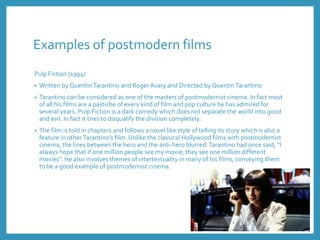
Pulp Fiction (1994) 
• Written by Quentin Tarantino and Roger Avary and Directed by Quentin Tarantino 
• Tarantino can be considered as one of the masters of postmodernist cinema. In fact most 
of all his films are a pastiche of every kind of film and pop culture he has admired for 
several years. Pulp Fiction is a dark comedy which does not separate the world into good 
and evil. In fact it tries to disqualify the division completely. 
• The film is told in chapters and follows a novel like style of telling its story which is also a 
feature in other Tarantino’s film. Unlike the classical Hollywood films with postmodernist 
cinema, the lines between the hero and the anti-hero blurred. Tarantino had once said, “I 
always hope that if one million people see my movie, they see one million different 
movies”. He also involves themes of intertextuality in many of his films, conveying them 
to be a good example of postmodernist cinema.
Examples of postmodern films 
Run Lola Run (1998) 
• Written and Directed by Tom Tykwer 
• The film ‘Run Lola Run’ is portrayed to be like a video game. It is non-linear and almost plays 
in a loop with mixing elements of live action and animation. The film is famous for its 
numerous jump-cuts and is categorised to be an ‘editing masterpiece’. The video game 
follows the story of the lead character as she enforces her strength and ability to rewind her 
life. The film breaks popular notions of cinema and uses the character ‘Paetsch’ as the 
narrator, the popular German children story voice. At various places the film has tried to 
bring together German popular culture together. 
• The film also has references to Alfred Hitchcock’s Vertigo. The spiral staircase through which 
Lola runs reminds of the spiral production design elements from Hitchcock’s film. Rhizome 
is a theory proposed by Deleuze which acknowledges different perspectives to a singular 
reality. This films goes on to compliment this theory by adapting a butterfly effect type 
storyline. The cause and effect relationship becomes extremely obscure in the film. The 
beginning, middle and end structure is completely broken when the film proposes multiple 
ends to the viewers.
Criticism to postmodern films 
• Philosopher Noam Chomsky has argued that postmodernism is meaningless because it 
adds nothing to analytical or empirical knowledge. He asks why postmodernist 
intellectuals won't respond like people in other fields when asked: “Seriously, what are the 
principles of their theories, on what evidence are they based, what do they explain that 
wasn't already obvious, etc? These are fair requests for anyone to make. If they can't be 
met, then I'd suggest recourse to Hume's advice in similar circumstances: to the flames.” 
• Many argue that the postmodern has infiltrated the narrative form of many films. Unlike 
in Hollywood's heyday, when the plot was transmitted in the most seamless fashion 
possible, many twenty-first century films, both Hollywood and independent, strive for a 
narrative that defies linear logic.

Postmodernism and film

  • 1.
  • 2.
    What makes filmspostmodern? • Postmodernism is late 20th-century style and concept in the arts, architecture, and criticism, which represents a departure from modernism and is characterized by the self-conscious use of earlier styles and conventions, a mixing of different artistic styles and media, and a general distrust of theories. • Postmodernist film are known to challenge the mainstream conventions of narrative structures and characterization, while also destroying the audiences suspension of disbelief in order to create a work in which a less recognizable internal logic forms the mediums means of representation and expression. For the film to convey their desired meaning, they are also known to maintain conventional elements to help orient the audience. Another example of where the film plays around with its narrative structure, is the film, The Time Travellers Wife, which plays around the narrative as Eric Bana's character goes back and forth in time, trying to reach different conclusions within his life with his family.
  • 3.
    What are theconventions of postmodern films? Postmodernist films include concepts such as pastiche, flattening of affect, hyper reality, time bending, altered states and more human then human. • Pastiche - an artistic work in a style that imitates that of another work or artist Flattening of affect – this involves technology, violence, drugs and the media lead to detached, emotionless, unauthentic lives. • Hyper-reality – where technology creates realities which are original or more desirable than the real world. • Time bending – used to connote the importance of time travel, as it relates to how time travel provides another way to shape reality. Postmodern films are also known to include other key concepts. For example, postmodern films also include concepts like a pre-fabrication which is similar to how simulation is used in movies but this draws the audience closer to already existing and noticeable scenes, and these are basically reused in narratives, dialogue etc. A bricolage is also used, which is where a person such as a producer, editor or director usually builds a film like a collage of different film styles and genres. It also includes met fictional which is were someone within a film write someone writing within a film to demonstrate its functionality and is used for shifts in narrative, impossible jumps in time or to maintain emotional distance for the narrator. Historic met fictional is a technique referring to novels that fictionalise actual historical events and characters. Temporal distortion is the jumping of time backwards and forwards. Minimalism is a technique used to demonstrate characters that are unexceptional and events which usually occur. Postmodernist films are also known to use other characteristics such as techno culture, paranoia, maximalist, faction, participation and magical realism.
  • 4.
    Examples of postmodernfilms Pulp Fiction (1994) • Written by Quentin Tarantino and Roger Avary and Directed by Quentin Tarantino • Tarantino can be considered as one of the masters of postmodernist cinema. In fact most of all his films are a pastiche of every kind of film and pop culture he has admired for several years. Pulp Fiction is a dark comedy which does not separate the world into good and evil. In fact it tries to disqualify the division completely. • The film is told in chapters and follows a novel like style of telling its story which is also a feature in other Tarantino’s film. Unlike the classical Hollywood films with postmodernist cinema, the lines between the hero and the anti-hero blurred. Tarantino had once said, “I always hope that if one million people see my movie, they see one million different movies”. He also involves themes of intertextuality in many of his films, conveying them to be a good example of postmodernist cinema.
  • 5.
    Examples of postmodernfilms Run Lola Run (1998) • Written and Directed by Tom Tykwer • The film ‘Run Lola Run’ is portrayed to be like a video game. It is non-linear and almost plays in a loop with mixing elements of live action and animation. The film is famous for its numerous jump-cuts and is categorised to be an ‘editing masterpiece’. The video game follows the story of the lead character as she enforces her strength and ability to rewind her life. The film breaks popular notions of cinema and uses the character ‘Paetsch’ as the narrator, the popular German children story voice. At various places the film has tried to bring together German popular culture together. • The film also has references to Alfred Hitchcock’s Vertigo. The spiral staircase through which Lola runs reminds of the spiral production design elements from Hitchcock’s film. Rhizome is a theory proposed by Deleuze which acknowledges different perspectives to a singular reality. This films goes on to compliment this theory by adapting a butterfly effect type storyline. The cause and effect relationship becomes extremely obscure in the film. The beginning, middle and end structure is completely broken when the film proposes multiple ends to the viewers.
  • 6.
    Criticism to postmodernfilms • Philosopher Noam Chomsky has argued that postmodernism is meaningless because it adds nothing to analytical or empirical knowledge. He asks why postmodernist intellectuals won't respond like people in other fields when asked: “Seriously, what are the principles of their theories, on what evidence are they based, what do they explain that wasn't already obvious, etc? These are fair requests for anyone to make. If they can't be met, then I'd suggest recourse to Hume's advice in similar circumstances: to the flames.” • Many argue that the postmodern has infiltrated the narrative form of many films. Unlike in Hollywood's heyday, when the plot was transmitted in the most seamless fashion possible, many twenty-first century films, both Hollywood and independent, strive for a narrative that defies linear logic.