Overview of Specification
Media Products, Industries & Audiences
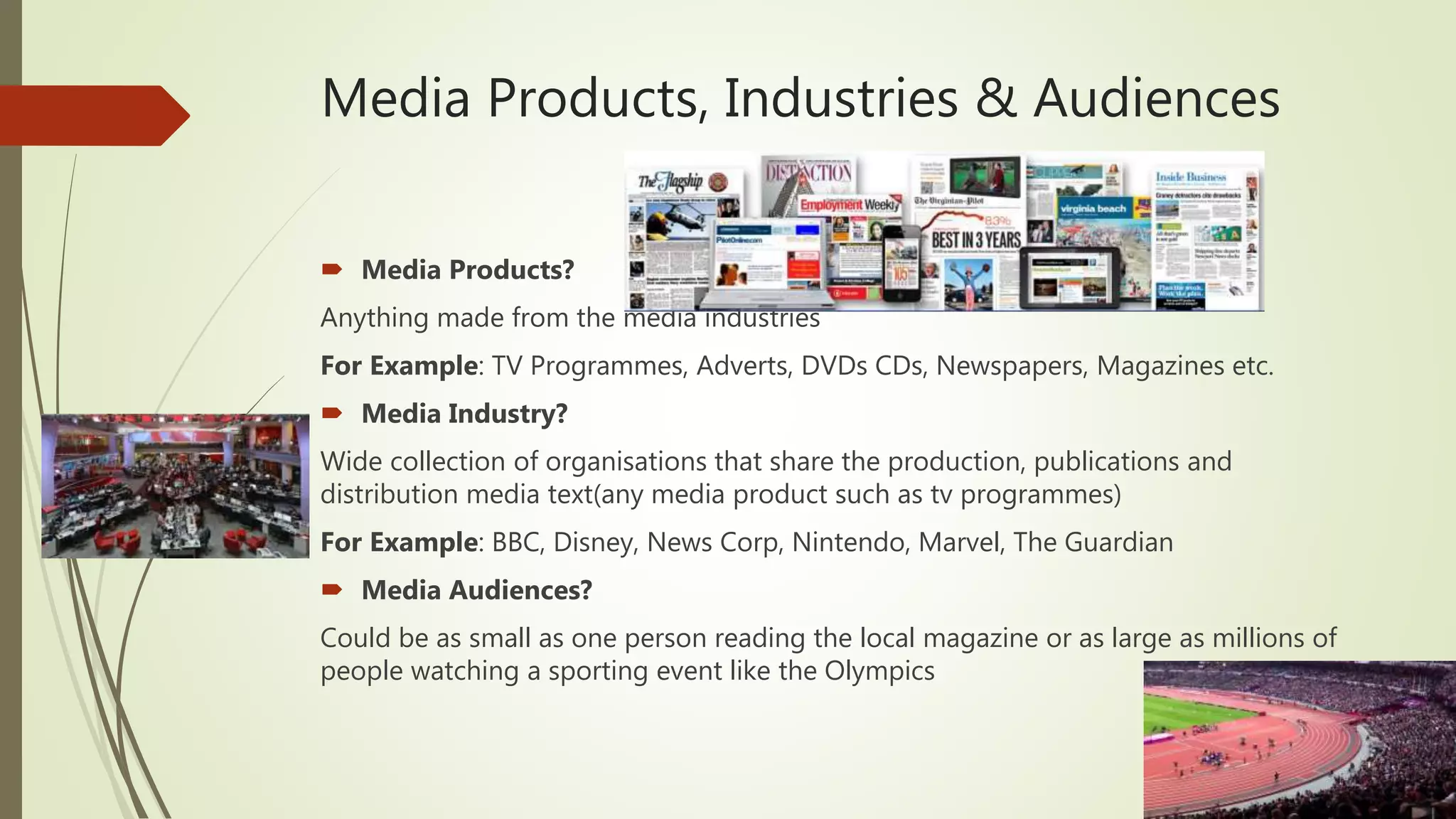
 Media Products?
Anything made from the media industries
For Example: TV Programmes, Adverts, DVDs CDs, Newspapers, Magazines etc.
 Media Industry?
Wide collection of organisations that share the production, publications and
distribution media text(any media product such as tv programmes)
For Example: BBC, Disney, News Corp, Nintendo, Marvel, The Guardian
 Media Audiences?
Could be as small as one person reading the local magazine or as large as millions of
people watching a sporting event like the Olympics
Media Forms and Products in Depth
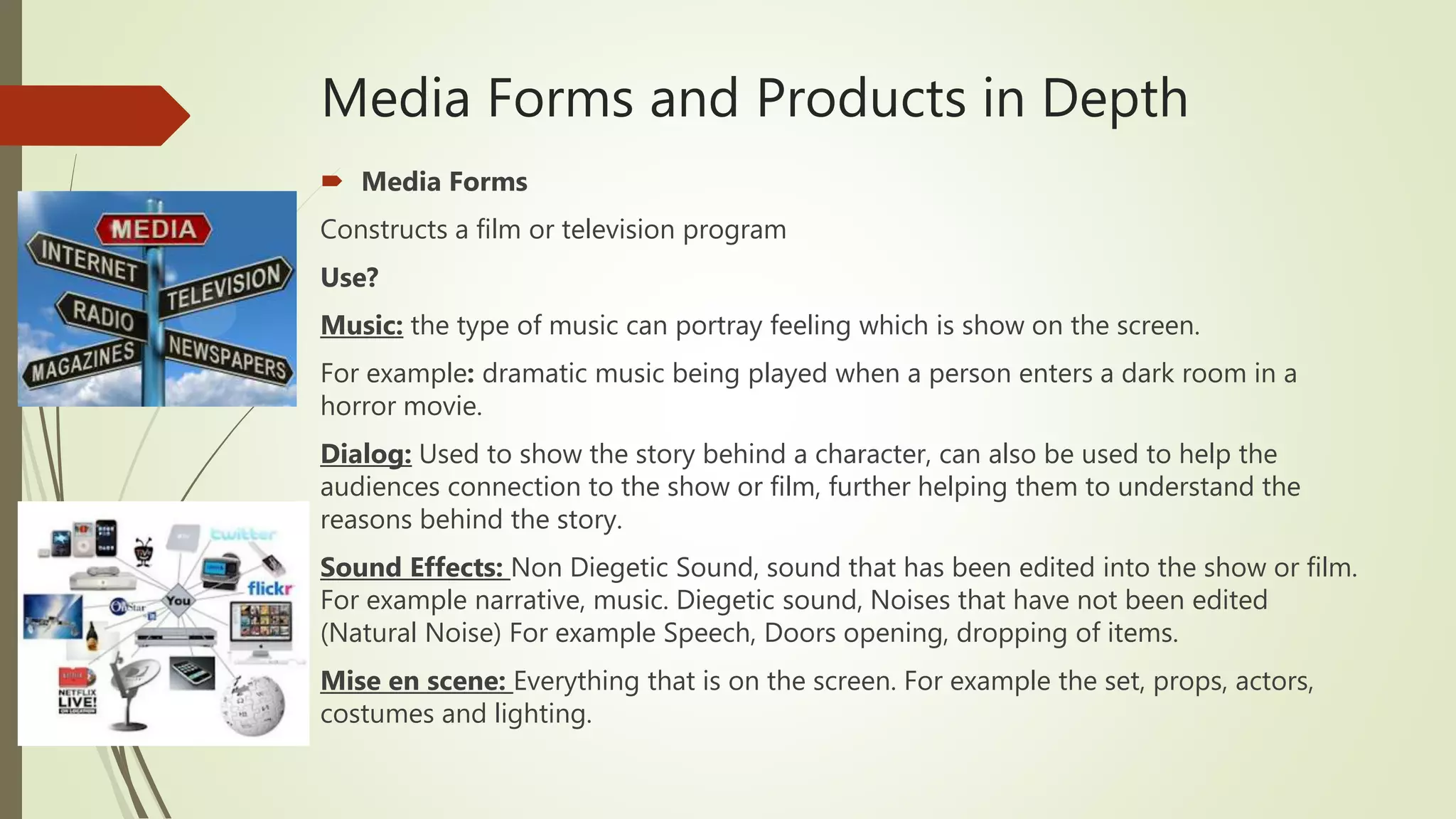
 Media Forms
Constructs a film or television program
Use?
Music: the type of music can portray feeling which is show on the screen.
For example: dramatic music being played when a person enters a dark room in a
horror movie.
Dialog: Used to show the story behind a character, can also be used to help the
audiences connection to the show or film, further helping them to understand the
reasons behind the story.
Sound Effects: Non Diegetic Sound, sound that has been edited into the show or film.
For example narrative, music. Diegetic sound, Noises that have not been edited
(Natural Noise) For example Speech, Doors opening, dropping of items.
Mise en scene: Everything that is on the screen. For example the set, props, actors,
costumes and lighting.
Theoretical Framework
Media Language
 What is it?
How the media communicates to the audience. There are different types of media
languages, including written, verbal, non-verbal, visual and aural.
Codes and Conventions?
A way of creating meaning in media texts in order to communicate ideas and
impressions for an audience.
Technical codes include camera angles, sound and lighting.
Symbolic codes include the language, clothing and actions of the character.
Media Representation
 What is it?
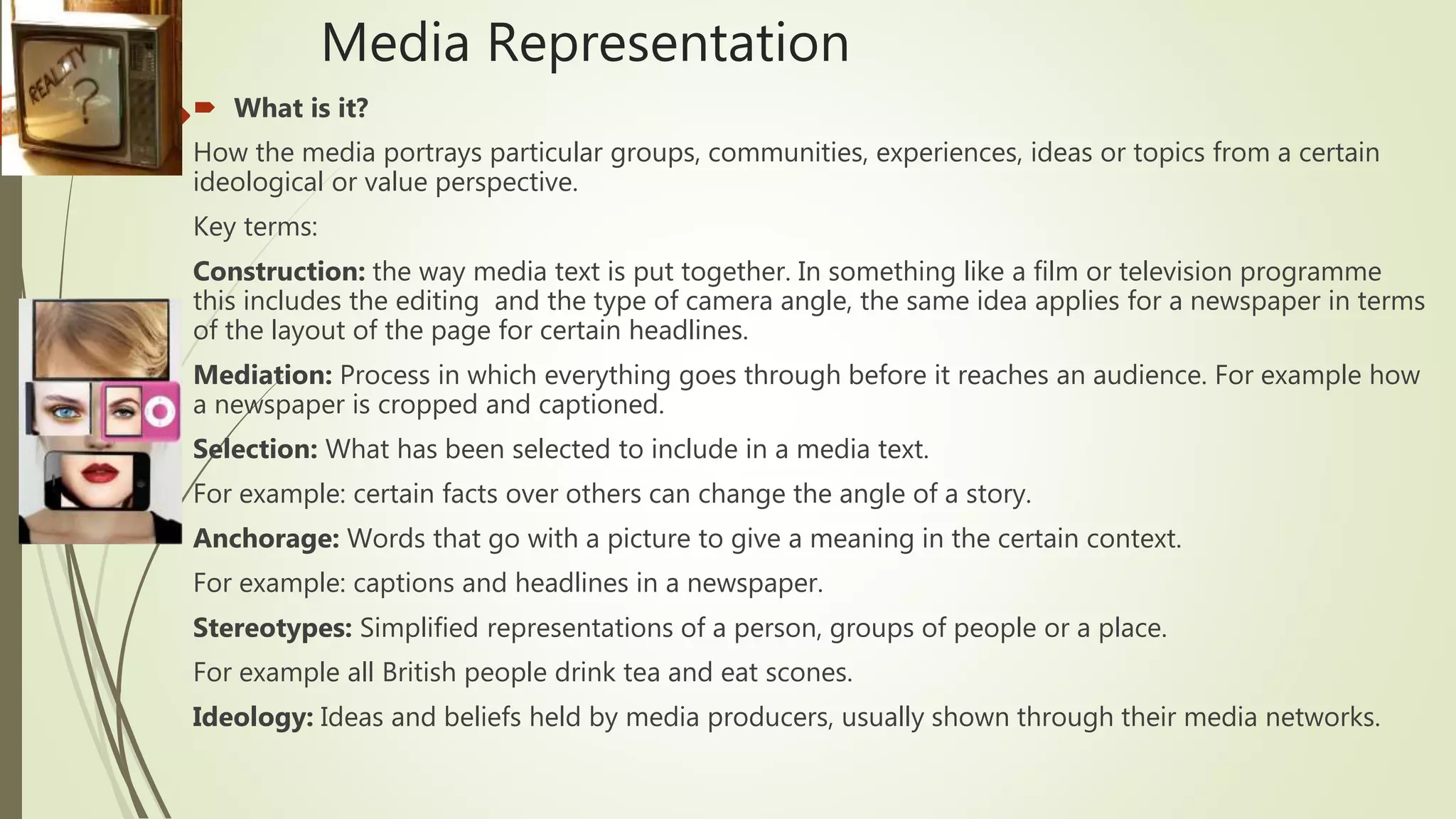
How the media portrays particular groups, communities, experiences, ideas or topics from a certain
ideological or value perspective.
Key terms:
Construction: the way media text is put together. In something like a film or television programme
this includes the editing and the type of camera angle, the same idea applies for a newspaper in terms
of the layout of the page for certain headlines.
Mediation: Process in which everything goes through before it reaches an audience. For example how
a newspaper is cropped and captioned.
Selection: What has been selected to include in a media text.
For example: certain facts over others can change the angle of a story.
Anchorage: Words that go with a picture to give a meaning in the certain context.
For example: captions and headlines in a newspaper.
Stereotypes: Simplified representations of a person, groups of people or a place.
For example all British people drink tea and eat scones.
Ideology: Ideas and beliefs held by media producers, usually shown through their media networks.
Media Industries
 What are they?
Wide collection of organisations that share the production, publications and
distribution media text(any media product such as TV programmes)
For Example: BBC
So How would the BBC the portray the news to you, what processes do they have to
go through and how does the new affect their delivery?
Media Audiences
 What are they?
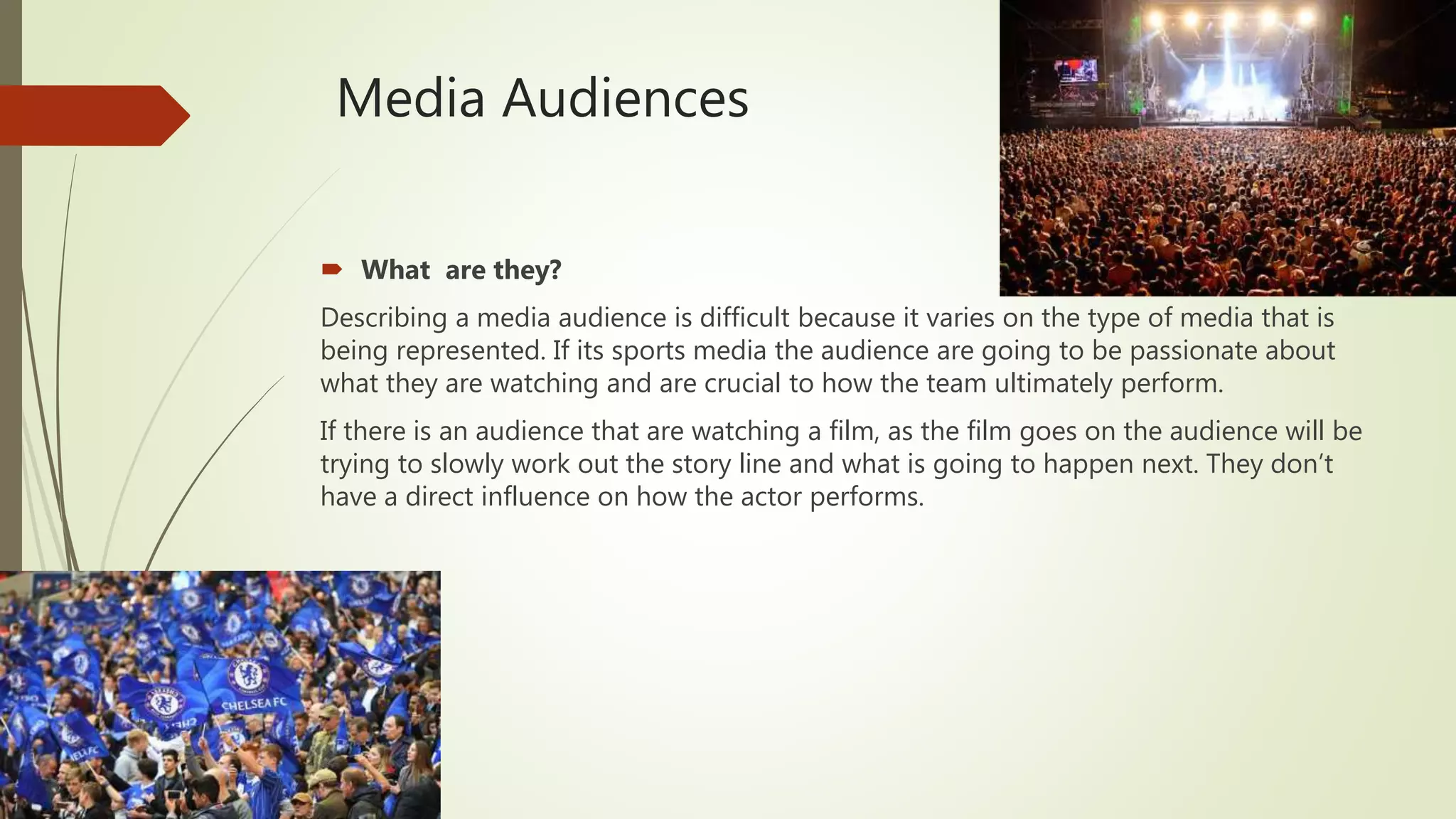
Describing a media audience is difficult because it varies on the type of media that is
being represented. If its sports media the audience are going to be passionate about
what they are watching and are crucial to how the team ultimately perform.
If there is an audience that are watching a film, as the film goes on the audience will be
trying to slowly work out the story line and what is going to happen next. They don’t
have a direct influence on how the actor performs.
Theories
Semiotics
What is it?
This is the study of signs and symbols and their use of interpretation.
It is the way of seeing the world and of understanding how the landscape and culture
in which we live has a massive impact on all of us unconsciously.
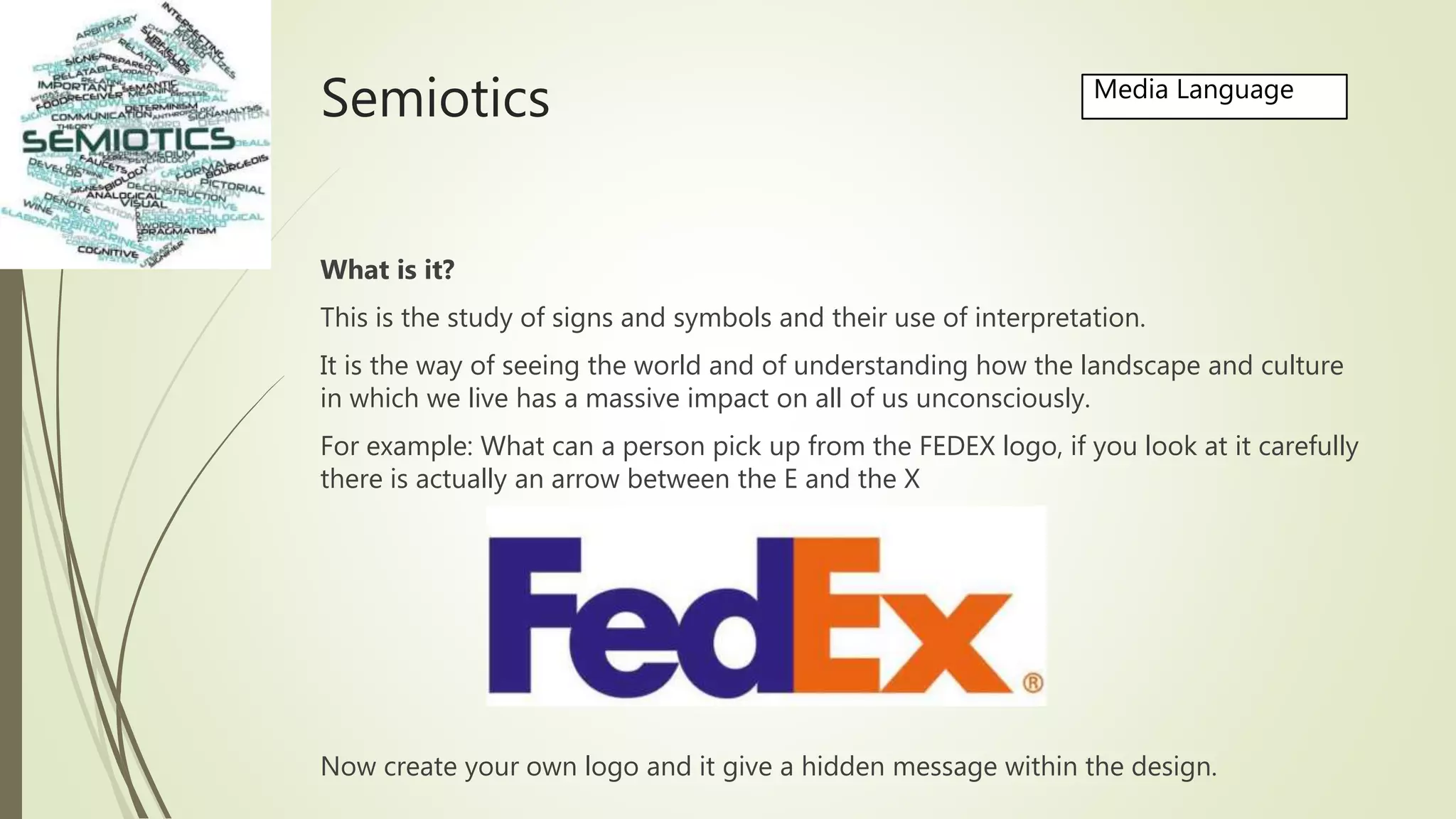
For example: What can a person pick up from the FEDEX logo, if you look at it carefully
there is actually an arrow between the E and the X
Now create your own logo and it give a hidden message within the design.
Media Language
Narratology
 What is it?
The study of narrative and narrative structure and the ways that these affect our
perception. While in principle the word may refer to any systematic study of narrative.
This theory was taken on by Todorov and he stated each plot line has a pattern and
there are 5 steps in the pattern.
1. Equilibrium (everything is balanced)
2. A Disruption
3. Realisation
4. Restored Order
5. Equilibrium (everything is balanced)
Media Language
Genre Theory
 What is it?
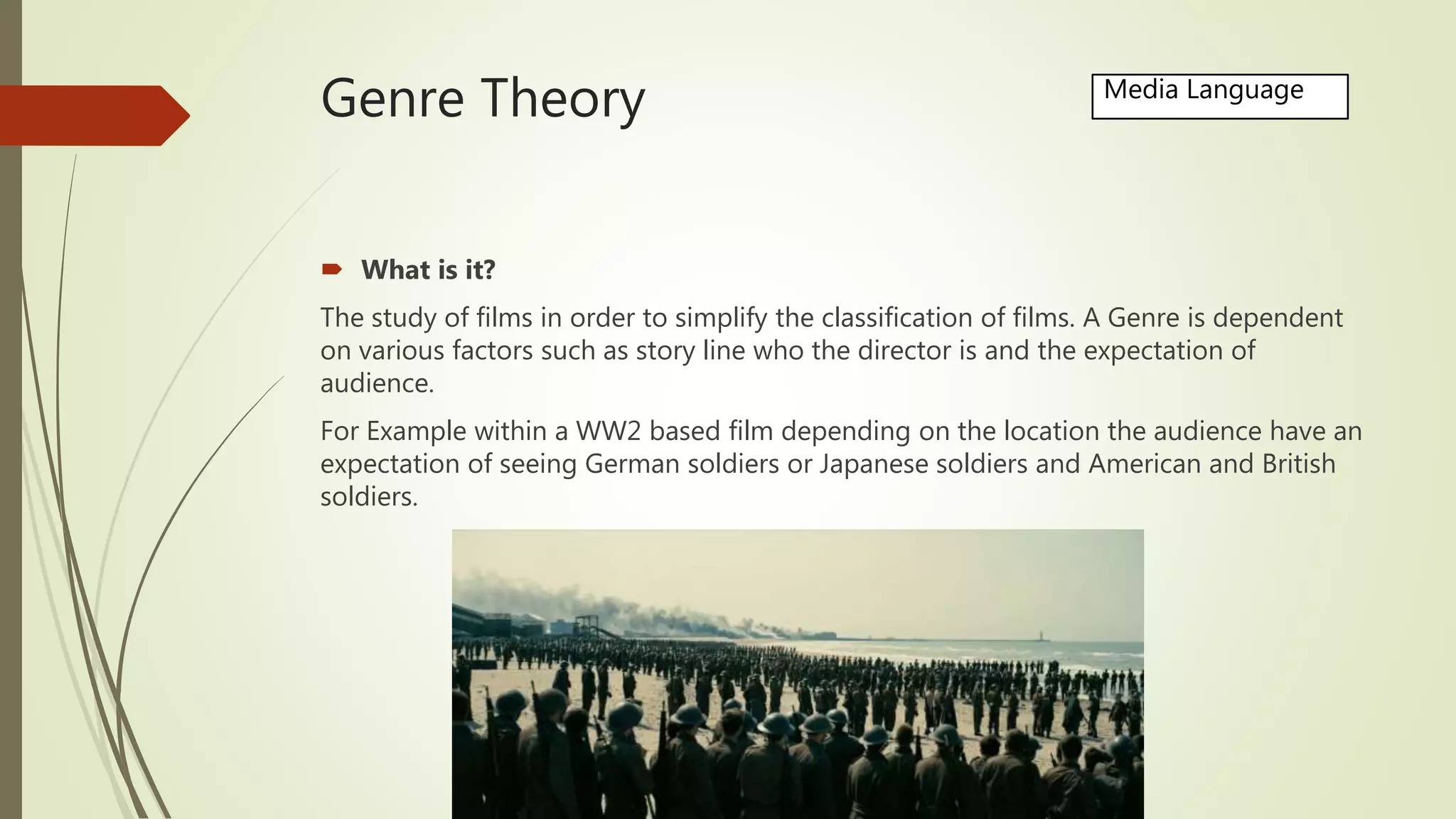
The study of films in order to simplify the classification of films. A Genre is dependent
on various factors such as story line who the director is and the expectation of
audience.
For Example within a WW2 based film depending on the location the audience have an
expectation of seeing German soldiers or Japanese soldiers and American and British
soldiers.
Media Language
Structuralism
 What is it?
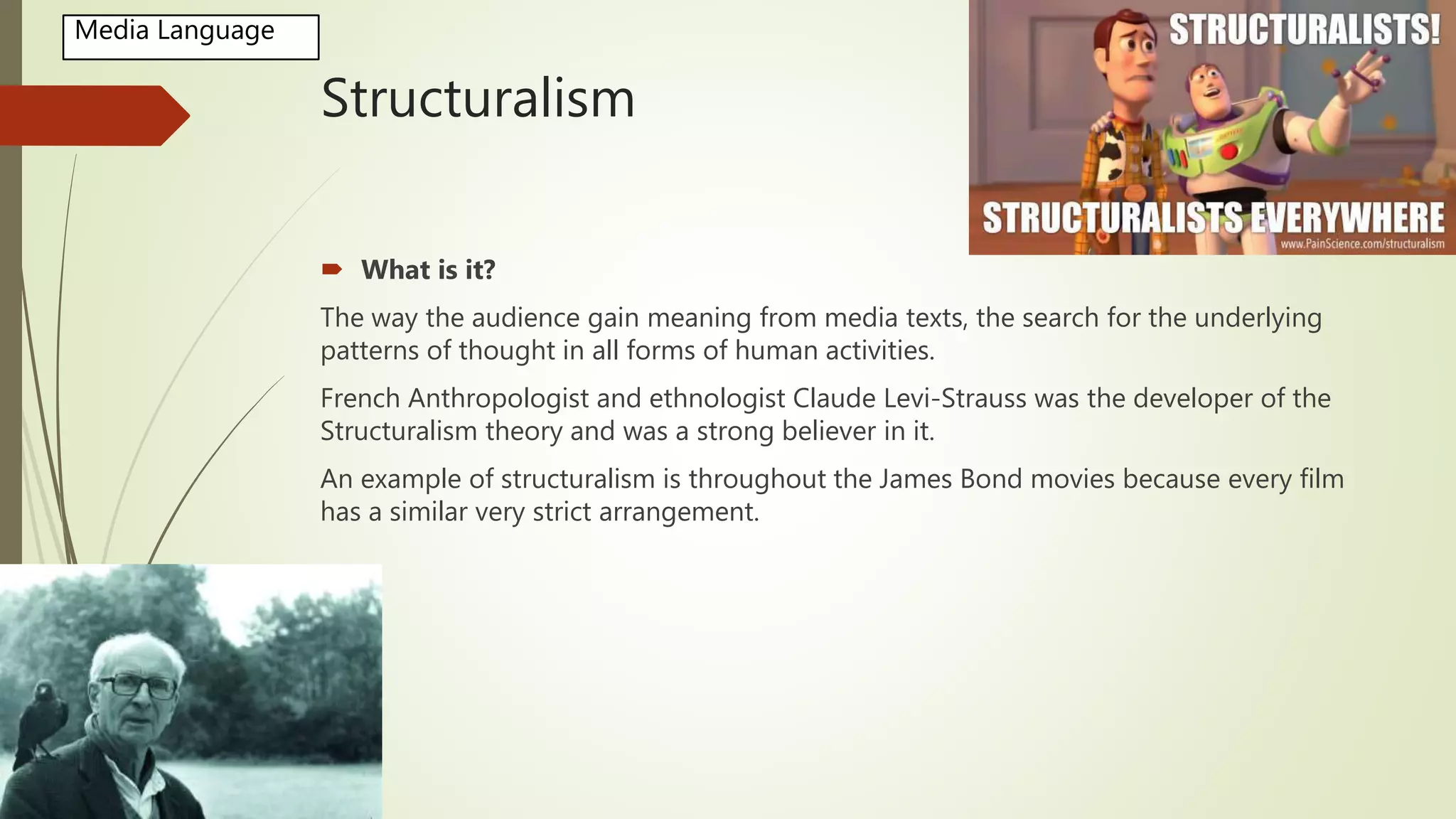
The way the audience gain meaning from media texts, the search for the underlying
patterns of thought in all forms of human activities.
French Anthropologist and ethnologist Claude Levi-Strauss was the developer of the
Structuralism theory and was a strong believer in it.
An example of structuralism is throughout the James Bond movies because every film
has a similar very strict arrangement.
Media Language
Postmodernism
 What is it?
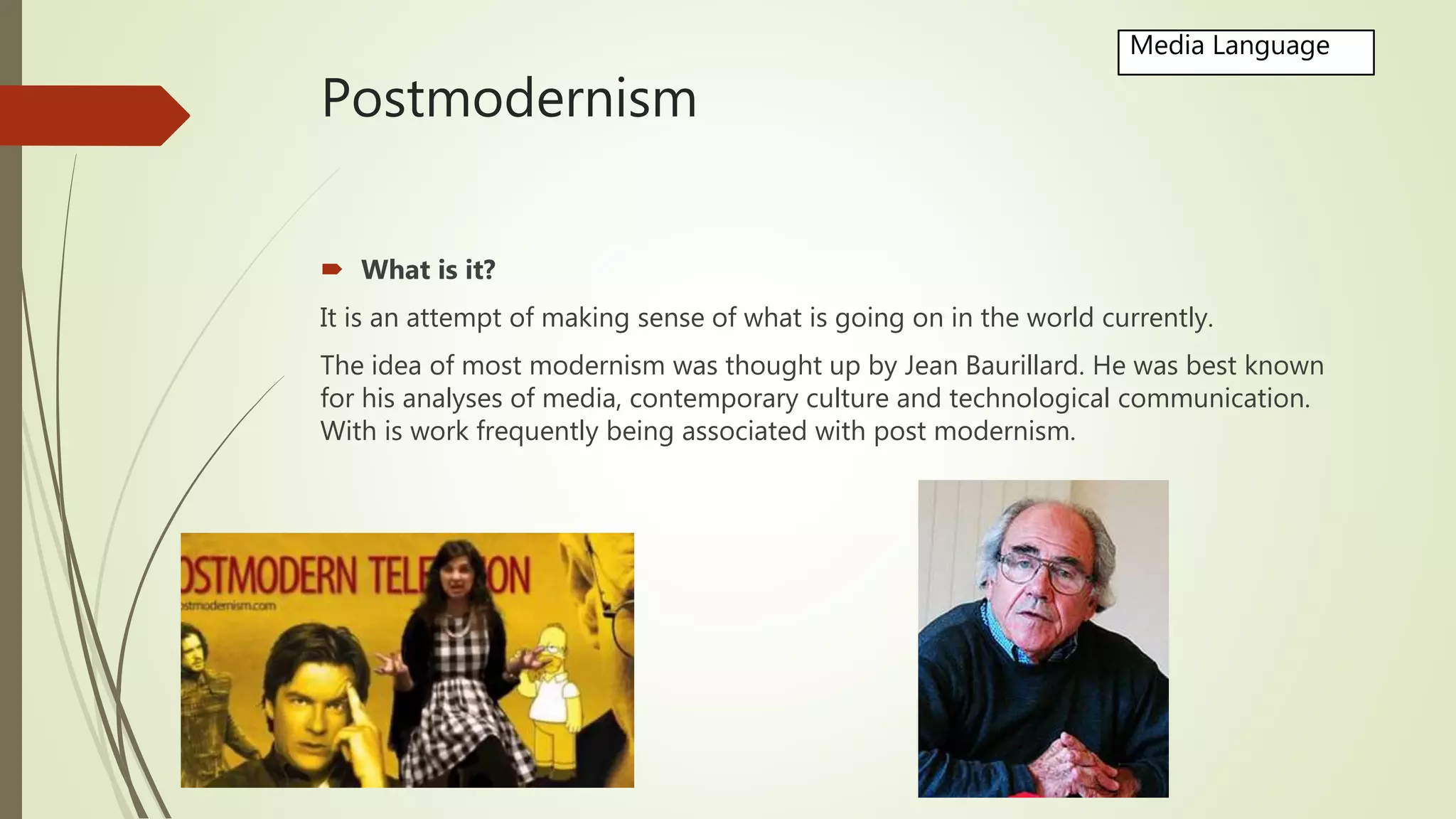
It is an attempt of making sense of what is going on in the world currently.
The idea of most modernism was thought up by Jean Baurillard. He was best known
for his analyses of media, contemporary culture and technological communication.
With is work frequently being associated with post modernism.
Media Language
Theories of representation
 What is it?
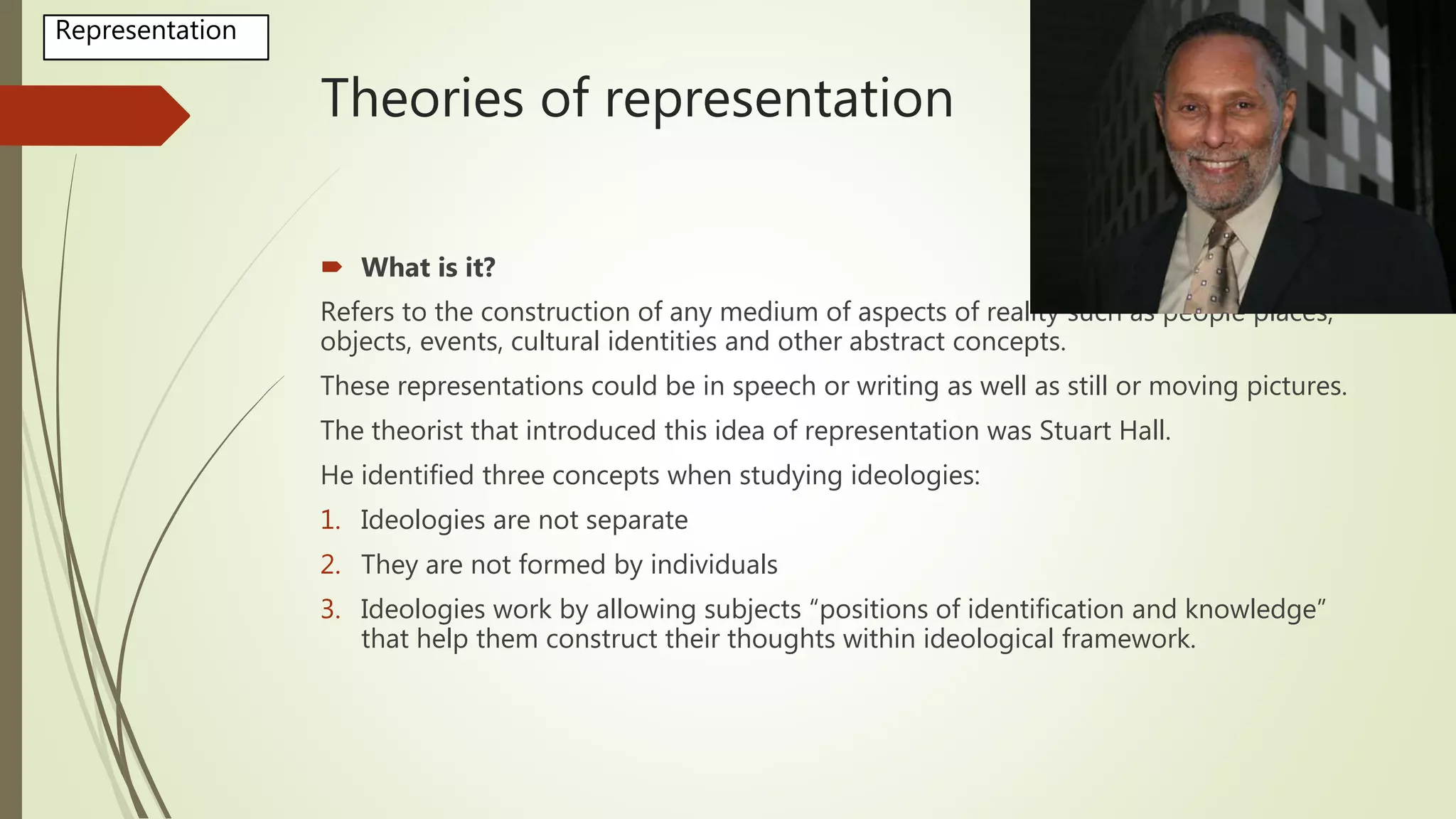
Refers to the construction of any medium of aspects of reality such as people places,
objects, events, cultural identities and other abstract concepts.
These representations could be in speech or writing as well as still or moving pictures.
The theorist that introduced this idea of representation was Stuart Hall.
He identified three concepts when studying ideologies:
1. Ideologies are not separate
2. They are not formed by individuals
3. Ideologies work by allowing subjects “positions of identification and knowledge”
that help them construct their thoughts within ideological framework.
Representation
Theories of Identity
 What are they?
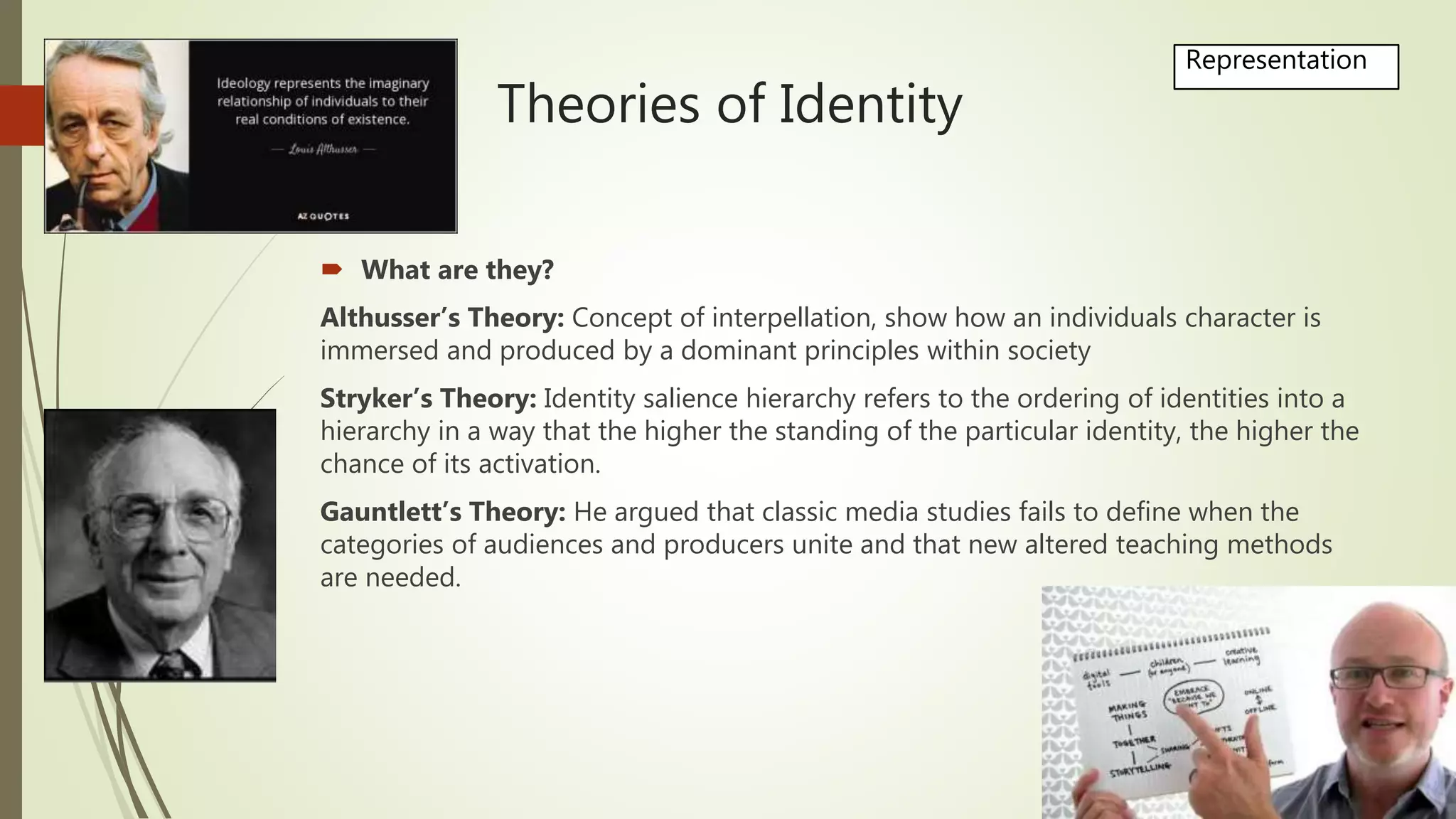
Althusser’s Theory: Concept of interpellation, show how an individuals character is
immersed and produced by a dominant principles within society
Stryker’s Theory: Identity salience hierarchy refers to the ordering of identities into a
hierarchy in a way that the higher the standing of the particular identity, the higher the
chance of its activation.
Gauntlett’s Theory: He argued that classic media studies fails to define when the
categories of audiences and producers unite and that new altered teaching methods
are needed.
Representation
Feminist Theory
What is it?
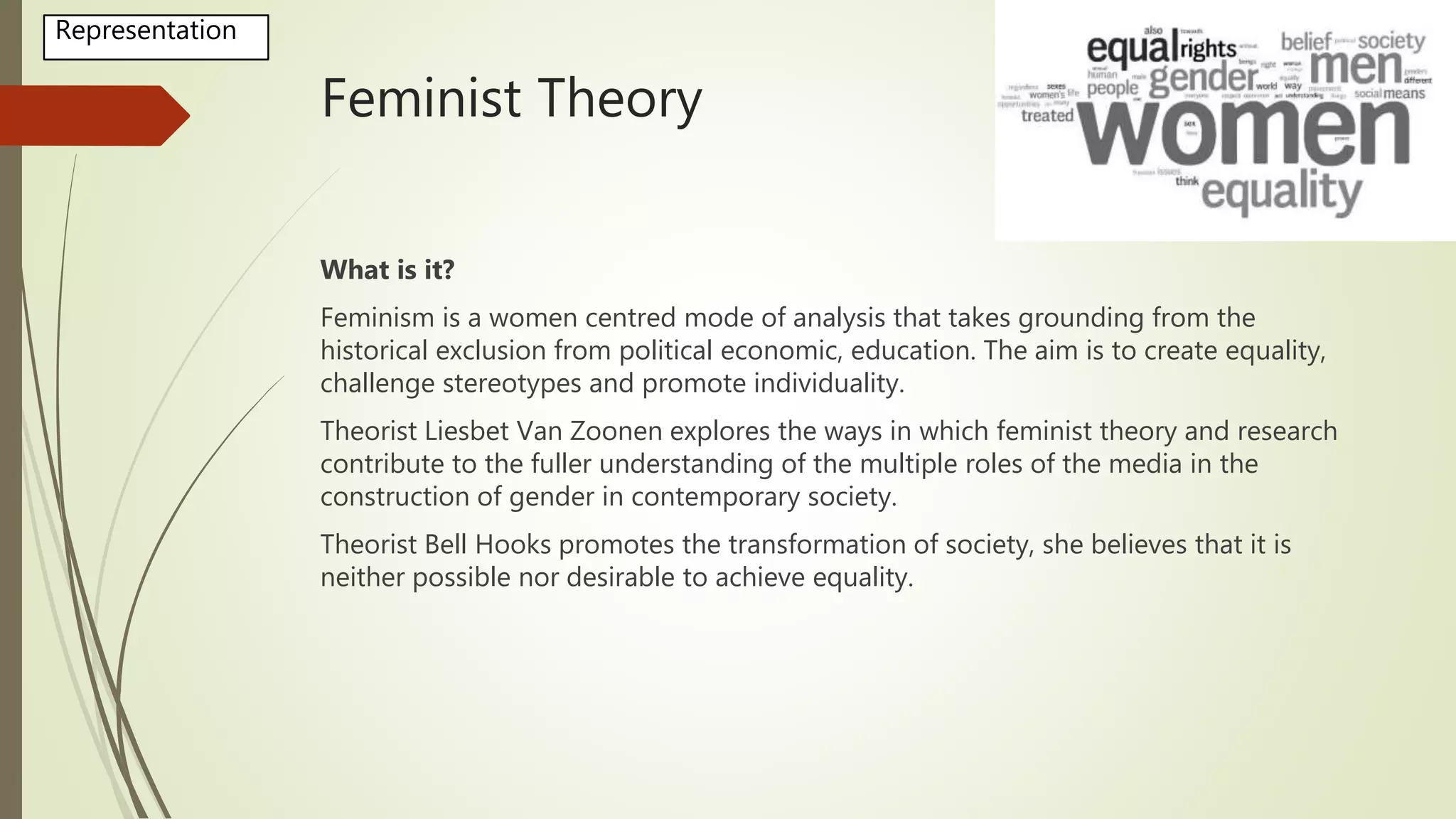
Feminism is a women centred mode of analysis that takes grounding from the
historical exclusion from political economic, education. The aim is to create equality,
challenge stereotypes and promote individuality.
Theorist Liesbet Van Zoonen explores the ways in which feminist theory and research
contribute to the fuller understanding of the multiple roles of the media in the
construction of gender in contemporary society.
Theorist Bell Hooks promotes the transformation of society, she believes that it is
neither possible nor desirable to achieve equality.
Representation
Theories of gender performativity
 What is it?
Build on the idea of destabilizing gender identities and categories.
Theorist Judith Butler wrote the book Gender Trouble, her idea originated from a wider
context of the feminist movement and discourse. She in fact moved away from the
essentialist and centralized ideology of feminism and moved toward the ‘queer
theory’.
Representation
Theories of around ethnicity and
postcolonial theory
 What is it?
Ethnicity Theory says race is a social category and is but one of several factors in
determining ethnicity. These categories include: Religion, language, nationality and
political identification.
Postcolonial Theory speaks about the human consequences of external control and
economic exploitation and native people and lands
Theorist Paul Gilroy work on the theory of race, racism and culture changed the lives of
black people during the 1990s.
Representation
Power and media industries
 What is it?
Over the years the media has had a greater and greater influence on the world today.
Their stories are made to make you buy their paper for example or for you to tune in
on their programme. Not everything the media says is true and is up for interpretation.
Theorist James Curran, he believes the media has a role in shaping modern society.
Jean Seaton is a professor of Media History and is an official historian of the BBC, she
has been involved in problems concerning public services content and freedom of
speech.
Media Industries
Regulation
 What is it?
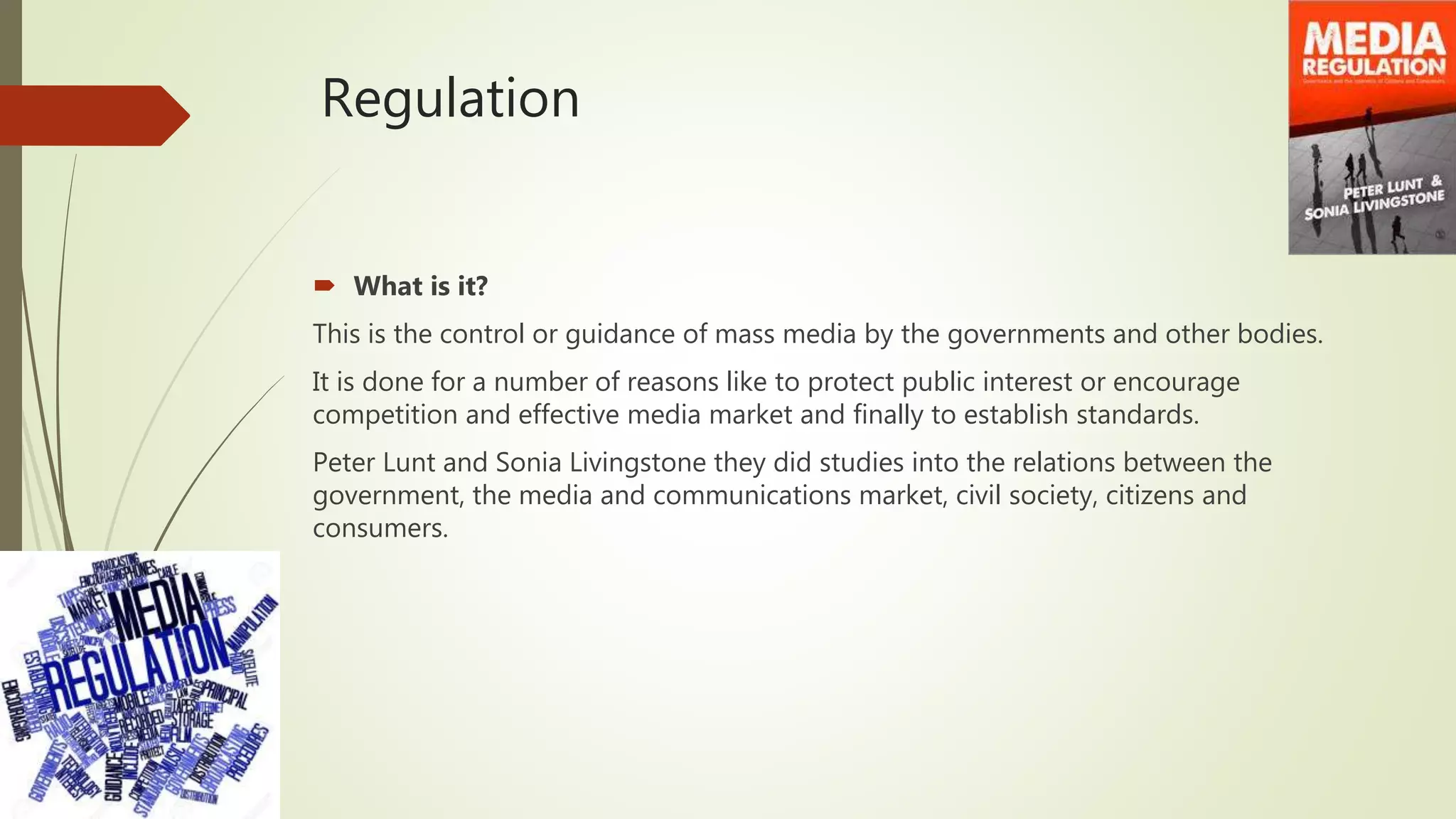
This is the control or guidance of mass media by the governments and other bodies.
It is done for a number of reasons like to protect public interest or encourage
competition and effective media market and finally to establish standards.
Peter Lunt and Sonia Livingstone they did studies into the relations between the
government, the media and communications market, civil society, citizens and
consumers.
Cultural Industries
 What are they?
The notion of cultural industries generally includes textual, music, television and film
productions and publishing, as well as crafts and design.
Cultural industries worldwide have adapted to new digital technology and to the
arrival of national, regional and international regulatory policies.
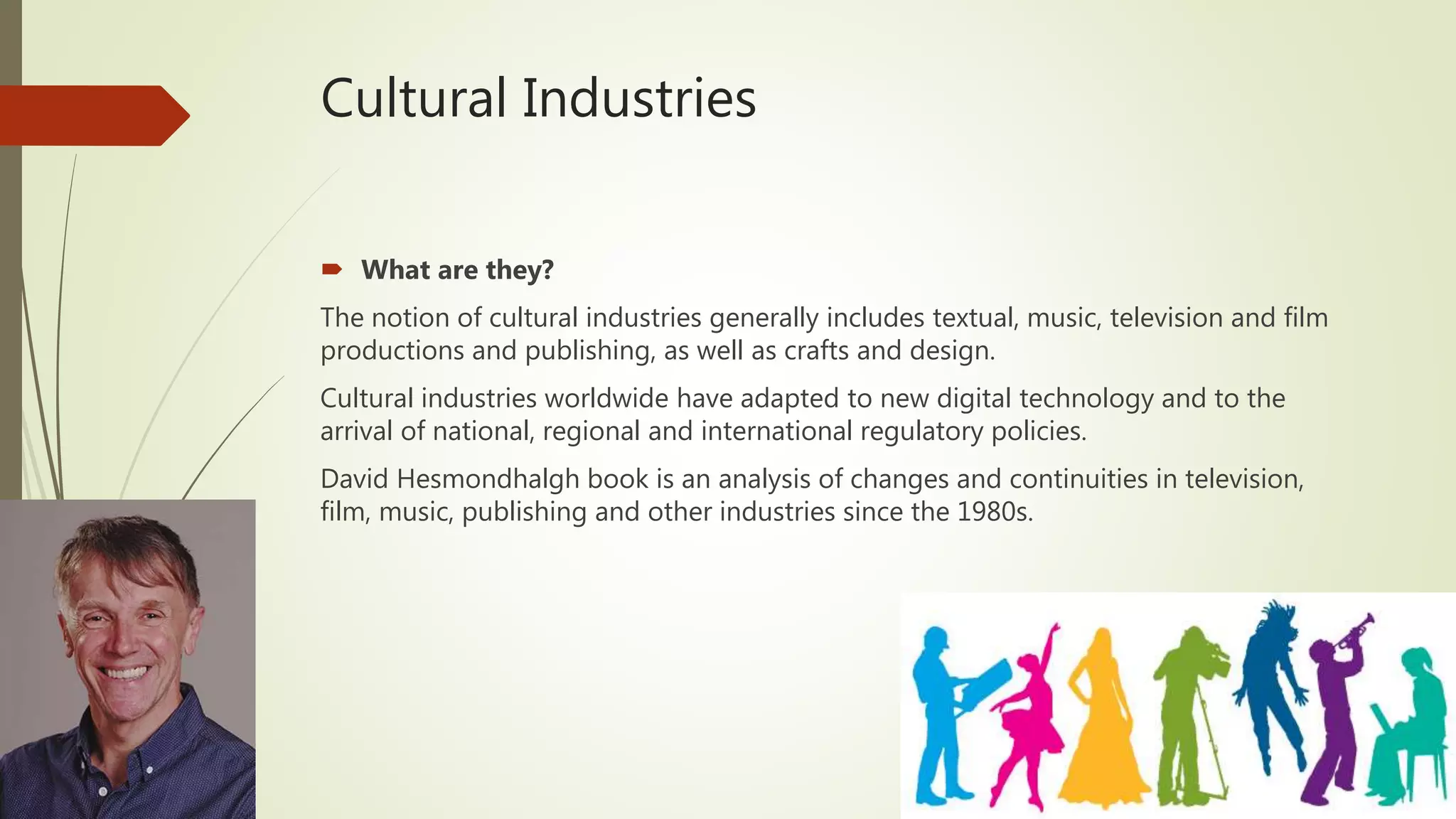
David Hesmondhalgh book is an analysis of changes and continuities in television,
film, music, publishing and other industries since the 1980s.
Media Effects
 What are it?
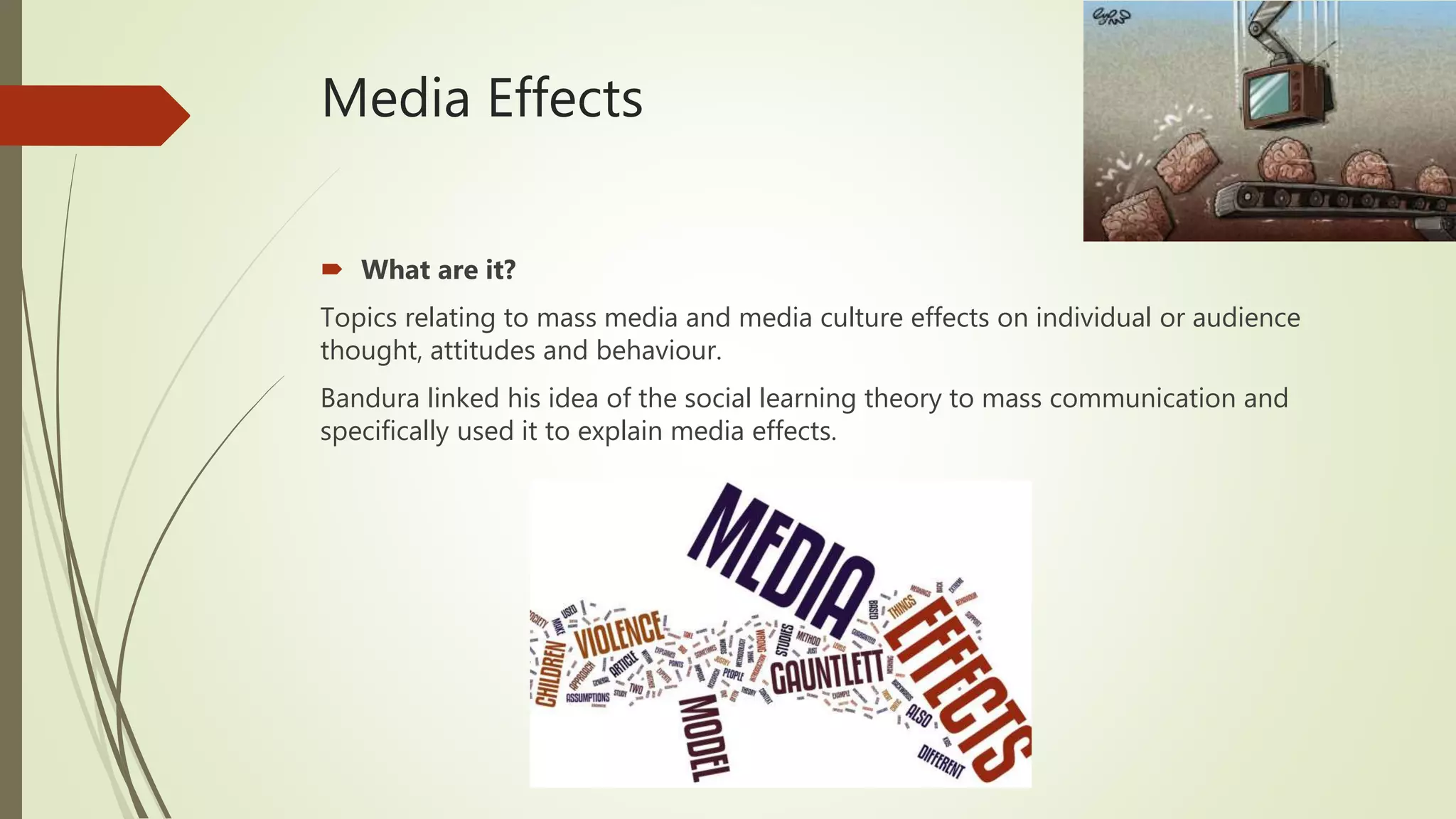
Topics relating to mass media and media culture effects on individual or audience
thought, attitudes and behaviour.
Bandura linked his idea of the social learning theory to mass communication and
specifically used it to explain media effects.
Cultivation Theory
 What is it?
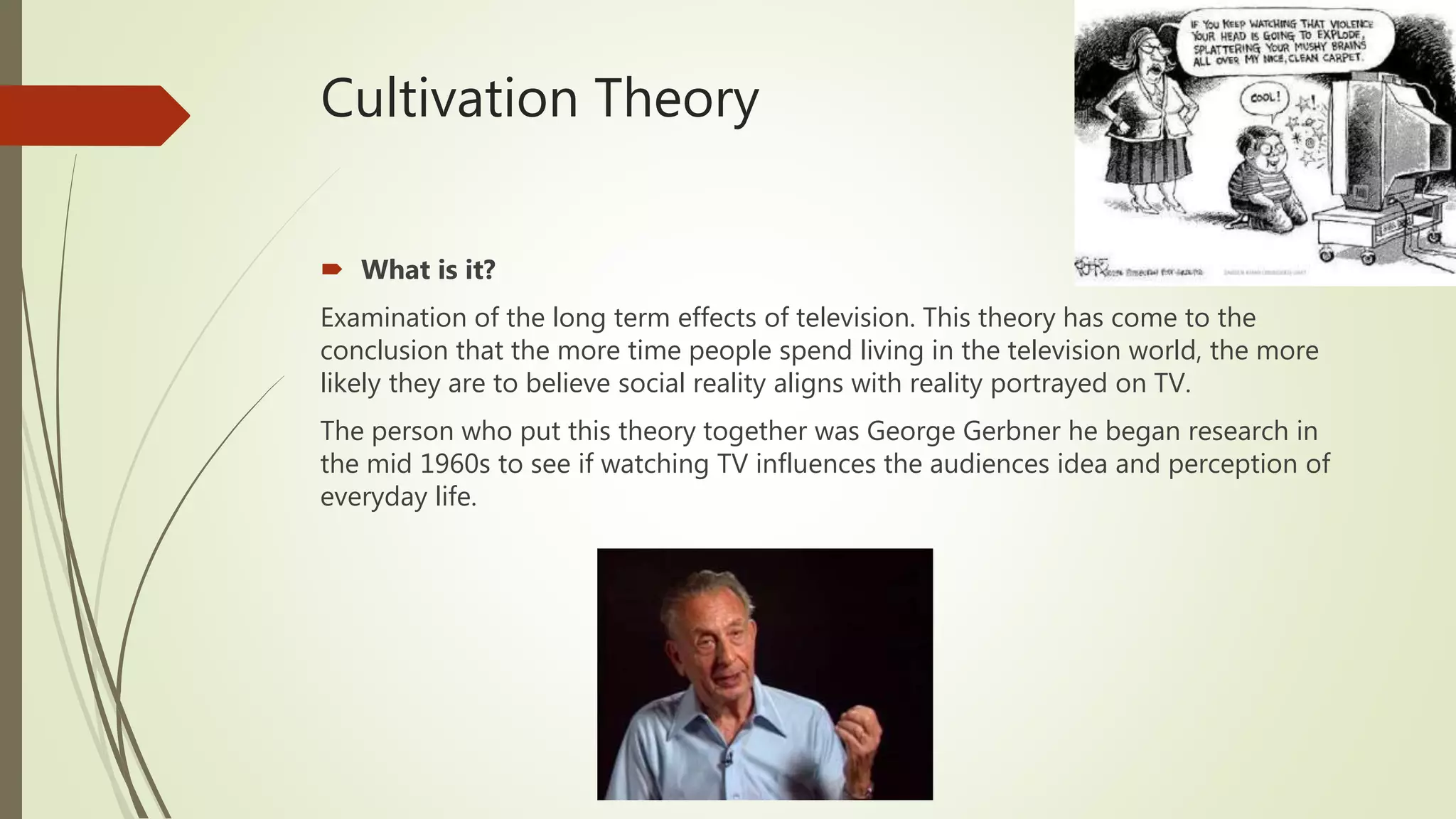
Examination of the long term effects of television. This theory has come to the
conclusion that the more time people spend living in the television world, the more
likely they are to believe social reality aligns with reality portrayed on TV.
The person who put this theory together was George Gerbner he began research in
the mid 1960s to see if watching TV influences the audiences idea and perception of
everyday life.
Reception Theory
 What is it?
It is often referred to as audience reception, it is used as a way of characterizing the
wave of audience research which occurred within communication.
Audience members adopt one of three positions when they decode the text:
Dominant, or preferred, Reading- How the producer wants the audience to view the
text.
Oppositional Reading- Own meaning behind the text.
Negotiated Reading- Compromise between the dominant and oppositional reading,
own ideas as well as producers ideas.
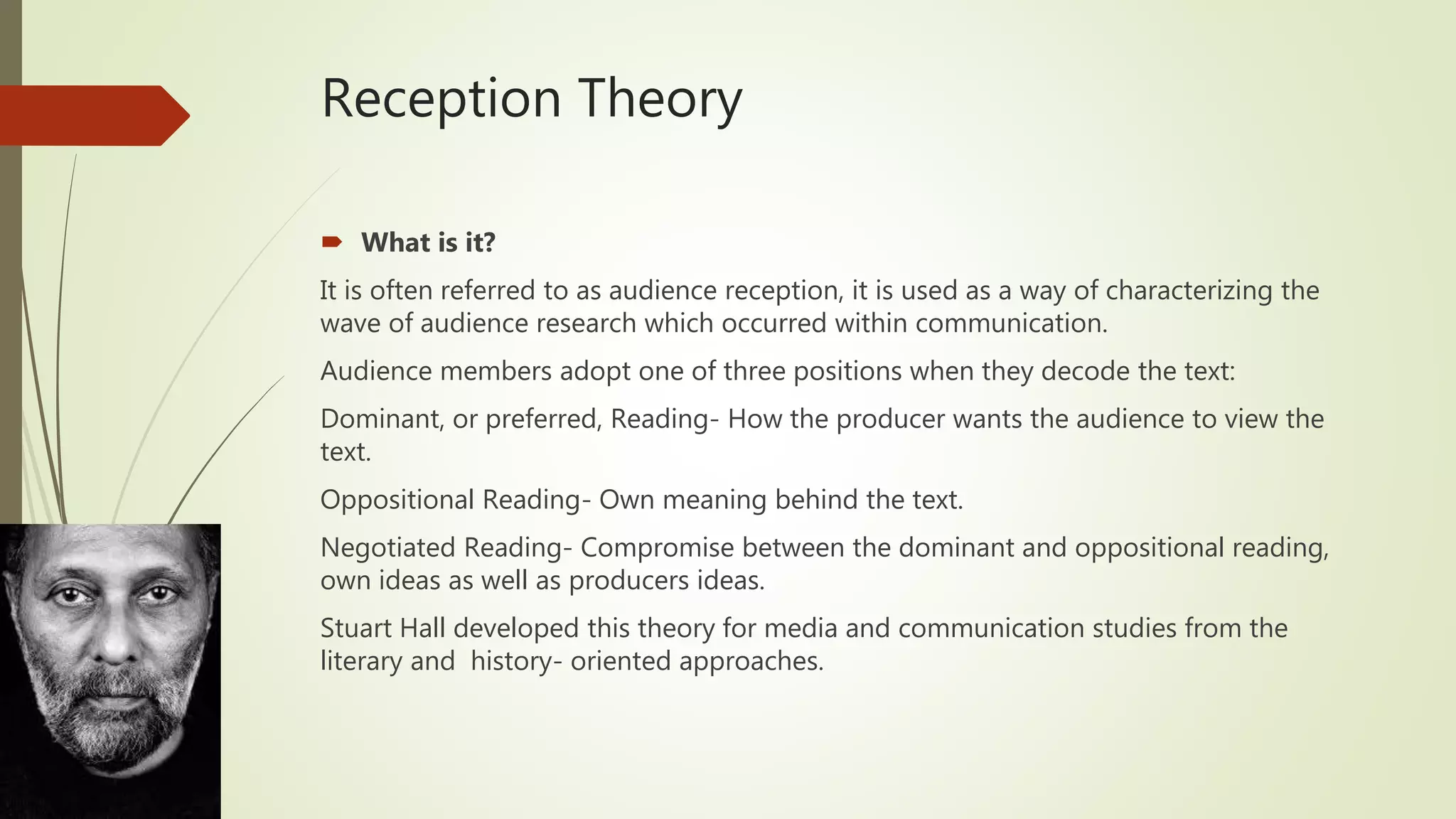
Stuart Hall developed this theory for media and communication studies from the
literary and history- oriented approaches.
Fandom
 What is it?
The fans of a particular person, team, fictional series, seen as a community or
subculture.
Continuum of Fandom
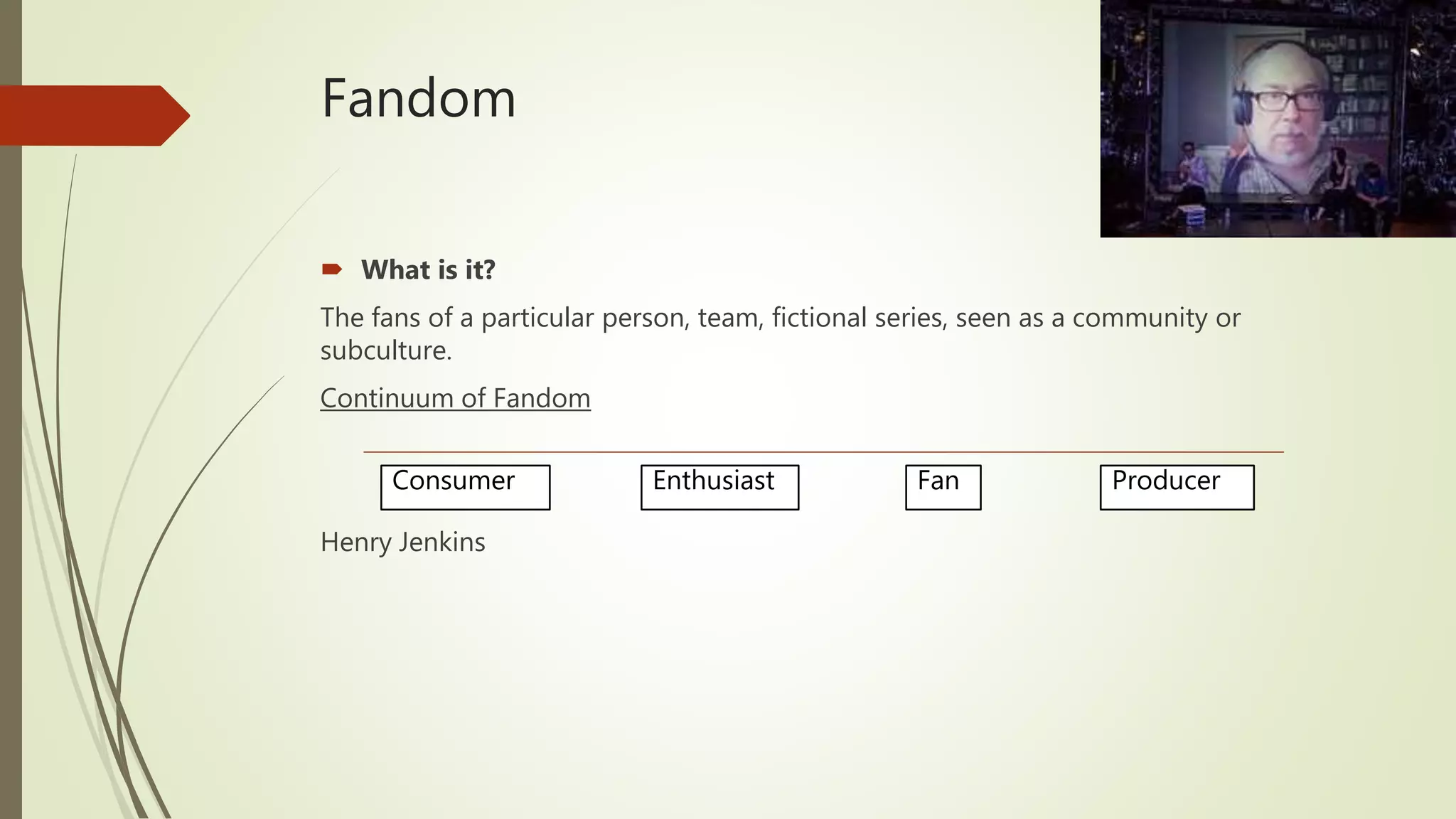
Henry Jenkins
Consumer Enthusiast Fan Producer
‘End of Audience’ Theories
 What is it?

A level media overview

  • 2.
  • 3.
    Media Products, Industries& Audiences  Media Products? Anything made from the media industries For Example: TV Programmes, Adverts, DVDs CDs, Newspapers, Magazines etc.  Media Industry? Wide collection of organisations that share the production, publications and distribution media text(any media product such as tv programmes) For Example: BBC, Disney, News Corp, Nintendo, Marvel, The Guardian  Media Audiences? Could be as small as one person reading the local magazine or as large as millions of people watching a sporting event like the Olympics
  • 4.
    Media Forms andProducts in Depth  Media Forms Constructs a film or television program Use? Music: the type of music can portray feeling which is show on the screen. For example: dramatic music being played when a person enters a dark room in a horror movie. Dialog: Used to show the story behind a character, can also be used to help the audiences connection to the show or film, further helping them to understand the reasons behind the story. Sound Effects: Non Diegetic Sound, sound that has been edited into the show or film. For example narrative, music. Diegetic sound, Noises that have not been edited (Natural Noise) For example Speech, Doors opening, dropping of items. Mise en scene: Everything that is on the screen. For example the set, props, actors, costumes and lighting.
  • 5.
  • 6.
    Media Language  Whatis it? How the media communicates to the audience. There are different types of media languages, including written, verbal, non-verbal, visual and aural. Codes and Conventions? A way of creating meaning in media texts in order to communicate ideas and impressions for an audience. Technical codes include camera angles, sound and lighting. Symbolic codes include the language, clothing and actions of the character.
  • 7.
    Media Representation  Whatis it? How the media portrays particular groups, communities, experiences, ideas or topics from a certain ideological or value perspective. Key terms: Construction: the way media text is put together. In something like a film or television programme this includes the editing and the type of camera angle, the same idea applies for a newspaper in terms of the layout of the page for certain headlines. Mediation: Process in which everything goes through before it reaches an audience. For example how a newspaper is cropped and captioned. Selection: What has been selected to include in a media text. For example: certain facts over others can change the angle of a story. Anchorage: Words that go with a picture to give a meaning in the certain context. For example: captions and headlines in a newspaper. Stereotypes: Simplified representations of a person, groups of people or a place. For example all British people drink tea and eat scones. Ideology: Ideas and beliefs held by media producers, usually shown through their media networks.
  • 8.
    Media Industries  Whatare they? Wide collection of organisations that share the production, publications and distribution media text(any media product such as TV programmes) For Example: BBC So How would the BBC the portray the news to you, what processes do they have to go through and how does the new affect their delivery?
  • 9.
    Media Audiences  Whatare they? Describing a media audience is difficult because it varies on the type of media that is being represented. If its sports media the audience are going to be passionate about what they are watching and are crucial to how the team ultimately perform. If there is an audience that are watching a film, as the film goes on the audience will be trying to slowly work out the story line and what is going to happen next. They don’t have a direct influence on how the actor performs.
  • 10.
  • 11.
    Semiotics What is it? Thisis the study of signs and symbols and their use of interpretation. It is the way of seeing the world and of understanding how the landscape and culture in which we live has a massive impact on all of us unconsciously. For example: What can a person pick up from the FEDEX logo, if you look at it carefully there is actually an arrow between the E and the X Now create your own logo and it give a hidden message within the design. Media Language
  • 12.
    Narratology  What isit? The study of narrative and narrative structure and the ways that these affect our perception. While in principle the word may refer to any systematic study of narrative. This theory was taken on by Todorov and he stated each plot line has a pattern and there are 5 steps in the pattern. 1. Equilibrium (everything is balanced) 2. A Disruption 3. Realisation 4. Restored Order 5. Equilibrium (everything is balanced) Media Language
  • 13.
    Genre Theory  Whatis it? The study of films in order to simplify the classification of films. A Genre is dependent on various factors such as story line who the director is and the expectation of audience. For Example within a WW2 based film depending on the location the audience have an expectation of seeing German soldiers or Japanese soldiers and American and British soldiers. Media Language
  • 14.
    Structuralism  What isit? The way the audience gain meaning from media texts, the search for the underlying patterns of thought in all forms of human activities. French Anthropologist and ethnologist Claude Levi-Strauss was the developer of the Structuralism theory and was a strong believer in it. An example of structuralism is throughout the James Bond movies because every film has a similar very strict arrangement. Media Language
  • 15.
    Postmodernism  What isit? It is an attempt of making sense of what is going on in the world currently. The idea of most modernism was thought up by Jean Baurillard. He was best known for his analyses of media, contemporary culture and technological communication. With is work frequently being associated with post modernism. Media Language
  • 16.
    Theories of representation What is it? Refers to the construction of any medium of aspects of reality such as people places, objects, events, cultural identities and other abstract concepts. These representations could be in speech or writing as well as still or moving pictures. The theorist that introduced this idea of representation was Stuart Hall. He identified three concepts when studying ideologies: 1. Ideologies are not separate 2. They are not formed by individuals 3. Ideologies work by allowing subjects “positions of identification and knowledge” that help them construct their thoughts within ideological framework. Representation
  • 17.
    Theories of Identity What are they? Althusser’s Theory: Concept of interpellation, show how an individuals character is immersed and produced by a dominant principles within society Stryker’s Theory: Identity salience hierarchy refers to the ordering of identities into a hierarchy in a way that the higher the standing of the particular identity, the higher the chance of its activation. Gauntlett’s Theory: He argued that classic media studies fails to define when the categories of audiences and producers unite and that new altered teaching methods are needed. Representation
  • 18.
    Feminist Theory What isit? Feminism is a women centred mode of analysis that takes grounding from the historical exclusion from political economic, education. The aim is to create equality, challenge stereotypes and promote individuality. Theorist Liesbet Van Zoonen explores the ways in which feminist theory and research contribute to the fuller understanding of the multiple roles of the media in the construction of gender in contemporary society. Theorist Bell Hooks promotes the transformation of society, she believes that it is neither possible nor desirable to achieve equality. Representation
  • 19.
    Theories of genderperformativity  What is it? Build on the idea of destabilizing gender identities and categories. Theorist Judith Butler wrote the book Gender Trouble, her idea originated from a wider context of the feminist movement and discourse. She in fact moved away from the essentialist and centralized ideology of feminism and moved toward the ‘queer theory’. Representation
  • 20.
    Theories of aroundethnicity and postcolonial theory  What is it? Ethnicity Theory says race is a social category and is but one of several factors in determining ethnicity. These categories include: Religion, language, nationality and political identification. Postcolonial Theory speaks about the human consequences of external control and economic exploitation and native people and lands Theorist Paul Gilroy work on the theory of race, racism and culture changed the lives of black people during the 1990s. Representation
  • 21.
    Power and mediaindustries  What is it? Over the years the media has had a greater and greater influence on the world today. Their stories are made to make you buy their paper for example or for you to tune in on their programme. Not everything the media says is true and is up for interpretation. Theorist James Curran, he believes the media has a role in shaping modern society. Jean Seaton is a professor of Media History and is an official historian of the BBC, she has been involved in problems concerning public services content and freedom of speech. Media Industries
  • 22.
    Regulation  What isit? This is the control or guidance of mass media by the governments and other bodies. It is done for a number of reasons like to protect public interest or encourage competition and effective media market and finally to establish standards. Peter Lunt and Sonia Livingstone they did studies into the relations between the government, the media and communications market, civil society, citizens and consumers.
  • 23.
    Cultural Industries  Whatare they? The notion of cultural industries generally includes textual, music, television and film productions and publishing, as well as crafts and design. Cultural industries worldwide have adapted to new digital technology and to the arrival of national, regional and international regulatory policies. David Hesmondhalgh book is an analysis of changes and continuities in television, film, music, publishing and other industries since the 1980s.
  • 24.
    Media Effects  Whatare it? Topics relating to mass media and media culture effects on individual or audience thought, attitudes and behaviour. Bandura linked his idea of the social learning theory to mass communication and specifically used it to explain media effects.
  • 25.
    Cultivation Theory  Whatis it? Examination of the long term effects of television. This theory has come to the conclusion that the more time people spend living in the television world, the more likely they are to believe social reality aligns with reality portrayed on TV. The person who put this theory together was George Gerbner he began research in the mid 1960s to see if watching TV influences the audiences idea and perception of everyday life.
  • 26.
    Reception Theory  Whatis it? It is often referred to as audience reception, it is used as a way of characterizing the wave of audience research which occurred within communication. Audience members adopt one of three positions when they decode the text: Dominant, or preferred, Reading- How the producer wants the audience to view the text. Oppositional Reading- Own meaning behind the text. Negotiated Reading- Compromise between the dominant and oppositional reading, own ideas as well as producers ideas. Stuart Hall developed this theory for media and communication studies from the literary and history- oriented approaches.
  • 27.
    Fandom  What isit? The fans of a particular person, team, fictional series, seen as a community or subculture. Continuum of Fandom Henry Jenkins Consumer Enthusiast Fan Producer
  • 28.
    ‘End of Audience’Theories  What is it?