MANUEL M MATHEW
 What is money?
 Legal tender money
 Base Money/High Power Money/Reserve
Money/Monetary Base
 Narrow Money
 Broad Money
 Money Multiplier
 Supply of Money
 Demand for Money
 Velocity of Circulation of Money
 Legal tender is legal status given to an
instrument like currency note that it
can be used as medium of payment. For
example, the Rs 2000 note has been
provided with a legal tender status.
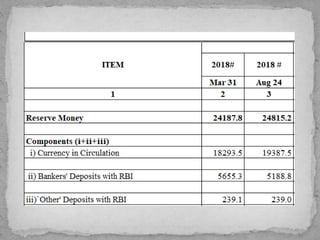
 Represents the outstanding money in
circulation in the economic system.
This is money in circulation with public
including currencies and coins
(RBI/Govt.).
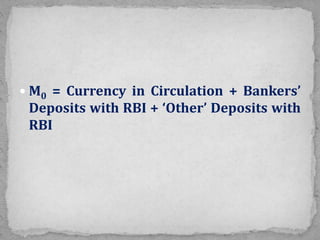
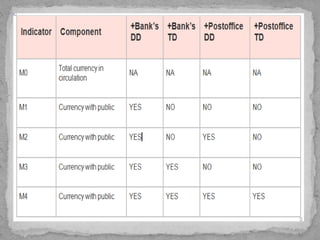
 M0 = Currency in Circulation + Bankers’
Deposits with RBI + ‘Other’ Deposits with
RBI
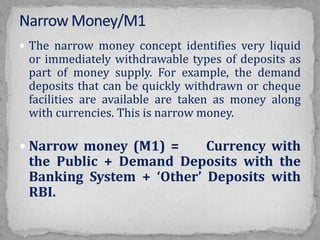
 The narrow money concept identifies very liquid
or immediately withdrawable types of deposits as
part of money supply. For example, the demand
deposits that can be quickly withdrawn or cheque
facilities are available are taken as money along
with currencies. This is narrow money.
 Narrow money (M1) = Currency with
the Public + Demand Deposits with the
Banking System + ‘Other’ Deposits with
RBI.
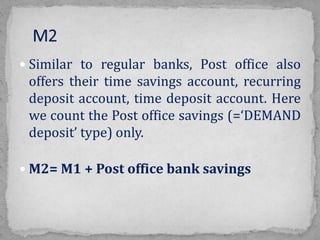
 Similar to regular banks, Post office also
offers their time savings account, recurring
deposit account, time deposit account. Here
we count the Post office savings (=‘DEMAND
deposit’ type) only.
 M2= M1 + Post office bank savings
 Broad money considers more types of bank
deposits and other assets which are less liquid.
Time deposits have a fixed maturity period and
hence cannot be withdrawn before expiry of
this period. When we add the time despots into
the narrow money, we get the broad money,
which is denoted by M3.
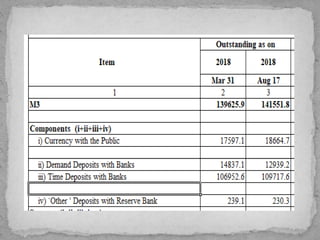
 M3 = Narrow money(M1) + Time
Deposits of public with banks
 M4= M3 + total post office deposits
 Both M2 and M4 include the Post office
Savings with narrow money and broad
money respectively.
In terms of size / quantity: M1 < M2 < M3 <M4
(because M4 will have maximum mall of all
types of bank & post-office deposits
combined)
 Difference between M3-M1 will provide us which
figure?
 Public’s Time deposits held in banks and post office
 Public’s Demand deposits held in banks and post office
 Public’s Time deposits held in banks
 Public’s Demand deposits held in banks
 The banking system as a whole can create
additional money impact through deposit
acceptance and loan disbursal. The multiple in
which the banking system can expand deposits
received in the form of base money into broad
money is called money multiplier. From a practical
sense, money multiplier shows what is the
proportion of broad money compared to base
money.
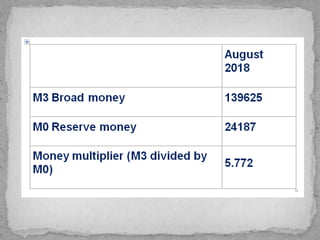
 Money Multiplier is the ratio of the Broad Money (M3)
to Reserve Money or Narrow Money (M1) .
 This concept shows the speed in which
money is exchanged during a period of time.
It is the number of times money is
exchanged or avg. number of times money
passes from one hand to another, during
given time period.
1.More people living below poverty line
2.Booming period
3.More people using EMI loans for purchase
4.Low financial inclusion
5.High Economic Development
Ans. Code
 A.2,3,5
 B.1,2,3,5
 C.2 and 5 only
 D.1 and 4 only
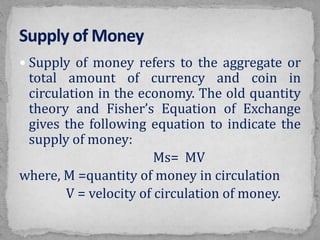
 Supply of money refers to the aggregate or
total amount of currency and coin in
circulation in the economy. The old quantity
theory and Fisher’s Equation of Exchange
gives the following equation to indicate the
supply of money:
Ms= MV
where, M =quantity of money in circulation
V = velocity of circulation of money.
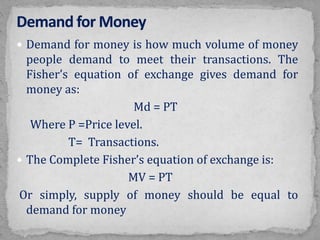
 Demand for money is how much volume of money
people demand to meet their transactions. The
Fisher’s equation of exchange gives demand for
money as:
Md = PT
Where P =Price level.
T= Transactions.
 The Complete Fisher’s equation of exchange is:
MV = PT
Or simply, supply of money should be equal to
demand for money
Liquidity means ready purchasing power or
availability of adequate cash. At the same
time, liquidity differs with the angles from
which it is presented.
 Liquidity for an individual
Liquidity for an individual is the state of having
adequate purchasing power or money with himself.
Here, liquidity simply is having enough cash to meet
our needs. This is liquidity from the viewpoint of an
individual.
Liquidity for an asset
Liquidity for an asset like gold is its ability to convert
itself into goods and services without loss of value
(when we pay gold to pay our transactions). Of all
assets, money is the most liquid.
Liquidity for the market/economy
Here, liquidity implies availability of
adequate cash (in digital as well) in the
financial system/economy.
Systemic liquidity
Refers to the situation where the whole
institutions together have adequate
liquidity ready cash.
What is Central bank liquidity
Central bank liquidity means the RBI injects newly
printed money or high-power money or reserve
money into the system. There are several ways like
LAF repo, buying of bonds etc to inject central bank
liquidity into the economy.
What is international liquidity?
International liquidity means availability of
adequate internationally available currencies or
hard currencies (like the US $) in the international
market.
A situation where banks and other financial
institutions may face difficulty of having
cash to meet their immediate transactions.
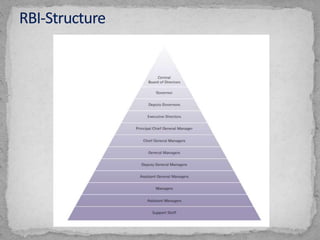
 Key institution in an economy that design and
implement policies related with money.
 Central banks
 issue currency
 manages money supply
 regulates banking system
 Ensures price stability
Central bank acts as the banker to the government
besides extending certain unique banking facilities to
the entire commercial banking system. Central banks
are now known for the most important function of
monetary policy implementation.
 1926: The Royal Commission on Indian Currency and
Finance (Hilton-Young Commission) recommended
creation of a central bank for India.
 1934:The Reserve Bank of India Act of 1934
established the Reserve Bank
 1935: The Reserve Bank commenced operations as
India’s central bank on April 1 as a private
shareholders’ bank with a paid up capital of rupees five
crore (rupees fifty million).
 1949: The Government of India nationalised the
Reserve Bank under the Reserve Bank (Transfer of
Public Ownership) Act, 1948.
 Osborne Arkhall Smith – First Governor,
 Sir CD Deshmukh - First Indian Governor
 Dr. Urjit Patel –Present Governor.
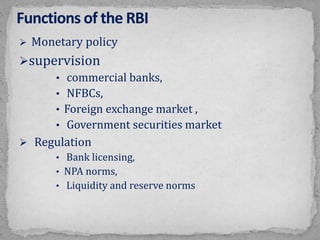
 Monetary policy
supervision
• commercial banks,
• NFBCs,
• Foreign exchange market ,
• Government securities market
 Regulation
• Bank licensing,
• NPA norms,
• Liquidity and reserve norms
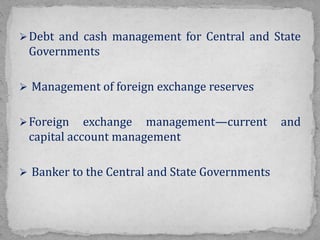
Debt and cash management for Central and State
Governments
 Management of foreign exchange reserves
Foreign exchange management—current and
capital account management
 Banker to the Central and State Governments
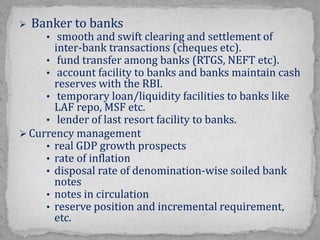
 Banker to banks
• smooth and swift clearing and settlement of
inter-bank transactions (cheques etc).
• fund transfer among banks (RTGS, NEFT etc).
• account facility to banks and banks maintain cash
reserves with the RBI.
• temporary loan/liquidity facilities to banks like
LAF repo, MSF etc.
• lender of last resort facility to banks.
 Currency management
• real GDP growth prospects
• rate of inflation
• disposal rate of denomination-wise soiled bank
notes
• notes in circulation
• reserve position and incremental requirement,
etc.
Oversight of the payment and settlement systems
• Core Banking Solution,
• RTGS,
• NEFT,
• Online banking,
• Aadhaar based payment systems,
• UPI,
• BHIM,
• Prepaid Payments Instruments
 Developmental role
 Research and statistics
 maintain price stability
ensuring adequate flow of credit to the productive
sectors (Economic growth)
maintaining orderly conditions in financial
markets
Cash Reserve Ratio (CRR) :
The average daily balance that a bank is required to
maintain with the Reserve Bank as a share of such per
cent of its Net demand and time liabilities (NDTL) that
the Reserve Bank may notify from time to time in the
Gazette of India.
Statutory Liquidity Ratio (SLR)
 The commercial banks have to keep a certain
proportion of the demand and time deposits as liquid
assets in their vault. This is called statutory liquidity
ratio. Liquid asset means assets in the form of cash,
gold and approved securities (government securities).
 Refinance Facilities
These are swap facilities, export credit
refinance facilities etc offered by the RBI to
different groups to support their activities.
The LAF or the Liquidity Adjustment Facility was
introduced by the RBI in 2000 to ensure smooth
liquidity situation in the financial system. Hence
the basic purpose of the LAF is to give temporary
funds or liquidity to banks when they don’t have
money (through repo). Similarly, when the banks
have excess cash, the RBI absorbs it by paying an
interest (reverse repo rate). LAF has provision for
overnight as well as term repo auctions.
Repo Rate
 Repo rate is the rate at which the RBI gives one-day
loans to the commercial banks by accepting eligible
securities under LAF. Practically, repo (Repurchasing
Option) is a contract in which the commercial banks
mortgages securities such as Treasury bills with the
RBI while availing an overnight loan.
 Term Repo under LAF
A term repo is a repo of more than one-day
duration. The word term denotes longer period.
Hence it is a way for banks to avail money from the
RBI for more than one-day duration. As in the case
of repo, the loan seeking bank should submit
securities to the RBI. Since the loan is for more
duration, the bank should give higher interest than
repo.
 Reverse Repo Rate
Reverse repo is a term used to describe the
opposite side of repo transaction. Under LAF,
commercial banks can give their excess cash to the
RBI for one day and can avail an interest. The
interest rate given by the RBI when a commercial
bank parks its excess cash under the reverse repo
facility is called reverse repo rate. Unlike in the
case of repo, there is no collateral under reverse
repo.
 Open Market Operations (OMO’s)
Open Market Operations refers to buying and
selling of eligible securities or first-class bills (govt.
securities) by the RBI. Buying of securities in the
open market increases the supply of money. On the
other hand, selling of securities reduces the
volume of money with the public. To reduce the
inflationary pressure, the RBI sells securities in the
open market.
 Bank Rate?
Bank Rate (BR) is the rate at which the RBI
rediscounts the first-class bills of exchange.
Effectively, it is also the rate at which the central
bank gives loans to the commercial banks. BR
affects both the cost and availability of credit. It is
through the Bank Rate that the RBI influences the
overall interest rate in the economy. To counter
inflation, the RBI raises BR and vice versa.
 Marginal Standing Facility (MSF)
 MSF allows banks to borrow overnight from the RBI
by submitting a prescribed amount of securities
with the RBI when they don’t have any eligible
securities . It was introduced in 2011. Under MSF,
banks could borrow funds from RBI at 1% above the
liquidity adjustment facility-repo rate against
pledging government securities. But banks should
give a higher interest rate of 1% above the repo rate
while MSF funds.
 Hence, MSF is a liquidity facility that can be availed
by banks during exceptional circumstances.
 Market Stabilization Scheme (MSS)
This instrument for monetary management was
introduced in 2004. Surplus liquidity of a more
enduring nature arising from large capital inflows is
absorbed through sale of short-dated government
securities and treasury bills. The cash so mobilised is
held in a separate government account with the
Reserve Bank without spending it .
Market Stabilisation Bonds (MSBs)
Under MSS the RBI issues Market Stabilization Bonds
(MSBs) to withdraw excess liquidity (called
sterilisation). Bonds are obtained by the RBI from the
government and sells them in the financial market
 Inflation targeting is a monetary policy framework
or strategy in which central bank sets a target
inflation rate and then, attempts to guide actual
inflation towards the target through the use of its
key policy rate. Though Inflation Targeting can be
casually described as an approach or strategy;
technically it is a Monetary Policy Framework
(MPF). The MPF constitute the arrangement
behind monetary policy implementation.
Inflation targeting as a monetary policy framework
prescribes:
 How the inflation target is to be set and modified?
 What is the instrument to be used to target inflation?
 Who should administer the inflation target and
evaluation of inflation fighting exercise? (level of
participation/cooperation of other institutions like
government)
 What should be the remedial action if inflation go
beyond the set limits?
Basic features of India’s Inflation Targeting
Framework
 The Central Government in consultation with the RBI
will set inflation target in every five years based on
headline CPI (CPI combined of SCSO). The set target
would be notified in the Official Gazette. First five years
will be 2016-21.
 CPI inflation of 4% will be the target. This target is
allowed with a flexibility of 2%. This means that
inflation can’t go beyond 6% and blow 2%.
 If it goes beyond the limits set for three consecutive
quarters, it will be interpreted as a monetary policy
failure. Here, the RBI should give an explanation about
the failure and the action taken to correct it.
 A Monetary Policy Committee (MPC) comprised of six
members (three each from the government and the RBI)
will administer the IT regime.
 Repo rate will the single instrument to target inflation
and thus to realize price stability.
 The Monetary Policy Committee (MPC) is the body of
the RBI, headed by the Governor, responsible for taking
the important monetary policy decision about setting
the repo rate.
 The MPC replaces the previous arrangement of
Technical Advisory Committee.

MONEY SUPPLY AND MONETARY POLICY

  • 1.
  • 2.
     What ismoney?  Legal tender money  Base Money/High Power Money/Reserve Money/Monetary Base  Narrow Money  Broad Money  Money Multiplier  Supply of Money  Demand for Money  Velocity of Circulation of Money
  • 3.
     Legal tenderis legal status given to an instrument like currency note that it can be used as medium of payment. For example, the Rs 2000 note has been provided with a legal tender status.
  • 4.
     Represents theoutstanding money in circulation in the economic system. This is money in circulation with public including currencies and coins (RBI/Govt.).
  • 5.
     M0 =Currency in Circulation + Bankers’ Deposits with RBI + ‘Other’ Deposits with RBI
  • 7.
     The narrowmoney concept identifies very liquid or immediately withdrawable types of deposits as part of money supply. For example, the demand deposits that can be quickly withdrawn or cheque facilities are available are taken as money along with currencies. This is narrow money.  Narrow money (M1) = Currency with the Public + Demand Deposits with the Banking System + ‘Other’ Deposits with RBI.
  • 8.
     Similar toregular banks, Post office also offers their time savings account, recurring deposit account, time deposit account. Here we count the Post office savings (=‘DEMAND deposit’ type) only.  M2= M1 + Post office bank savings
  • 9.
     Broad moneyconsiders more types of bank deposits and other assets which are less liquid. Time deposits have a fixed maturity period and hence cannot be withdrawn before expiry of this period. When we add the time despots into the narrow money, we get the broad money, which is denoted by M3.  M3 = Narrow money(M1) + Time Deposits of public with banks
  • 11.
     M4= M3+ total post office deposits  Both M2 and M4 include the Post office Savings with narrow money and broad money respectively.
  • 13.
    In terms ofsize / quantity: M1 < M2 < M3 <M4 (because M4 will have maximum mall of all types of bank & post-office deposits combined)
  • 14.
     Difference betweenM3-M1 will provide us which figure?  Public’s Time deposits held in banks and post office  Public’s Demand deposits held in banks and post office  Public’s Time deposits held in banks  Public’s Demand deposits held in banks
  • 15.
     The bankingsystem as a whole can create additional money impact through deposit acceptance and loan disbursal. The multiple in which the banking system can expand deposits received in the form of base money into broad money is called money multiplier. From a practical sense, money multiplier shows what is the proportion of broad money compared to base money.  Money Multiplier is the ratio of the Broad Money (M3) to Reserve Money or Narrow Money (M1) .
  • 17.
     This conceptshows the speed in which money is exchanged during a period of time. It is the number of times money is exchanged or avg. number of times money passes from one hand to another, during given time period.
  • 18.
    1.More people livingbelow poverty line 2.Booming period 3.More people using EMI loans for purchase 4.Low financial inclusion 5.High Economic Development Ans. Code  A.2,3,5  B.1,2,3,5  C.2 and 5 only  D.1 and 4 only
  • 19.
     Supply ofmoney refers to the aggregate or total amount of currency and coin in circulation in the economy. The old quantity theory and Fisher’s Equation of Exchange gives the following equation to indicate the supply of money: Ms= MV where, M =quantity of money in circulation V = velocity of circulation of money.
  • 20.
     Demand formoney is how much volume of money people demand to meet their transactions. The Fisher’s equation of exchange gives demand for money as: Md = PT Where P =Price level. T= Transactions.  The Complete Fisher’s equation of exchange is: MV = PT Or simply, supply of money should be equal to demand for money
  • 21.
    Liquidity means readypurchasing power or availability of adequate cash. At the same time, liquidity differs with the angles from which it is presented.
  • 22.
     Liquidity foran individual Liquidity for an individual is the state of having adequate purchasing power or money with himself. Here, liquidity simply is having enough cash to meet our needs. This is liquidity from the viewpoint of an individual. Liquidity for an asset Liquidity for an asset like gold is its ability to convert itself into goods and services without loss of value (when we pay gold to pay our transactions). Of all assets, money is the most liquid.
  • 23.
    Liquidity for themarket/economy Here, liquidity implies availability of adequate cash (in digital as well) in the financial system/economy. Systemic liquidity Refers to the situation where the whole institutions together have adequate liquidity ready cash.
  • 24.
    What is Centralbank liquidity Central bank liquidity means the RBI injects newly printed money or high-power money or reserve money into the system. There are several ways like LAF repo, buying of bonds etc to inject central bank liquidity into the economy. What is international liquidity? International liquidity means availability of adequate internationally available currencies or hard currencies (like the US $) in the international market.
  • 25.
    A situation wherebanks and other financial institutions may face difficulty of having cash to meet their immediate transactions.
  • 26.
     Key institutionin an economy that design and implement policies related with money.  Central banks  issue currency  manages money supply  regulates banking system  Ensures price stability Central bank acts as the banker to the government besides extending certain unique banking facilities to the entire commercial banking system. Central banks are now known for the most important function of monetary policy implementation.
  • 27.
     1926: TheRoyal Commission on Indian Currency and Finance (Hilton-Young Commission) recommended creation of a central bank for India.  1934:The Reserve Bank of India Act of 1934 established the Reserve Bank  1935: The Reserve Bank commenced operations as India’s central bank on April 1 as a private shareholders’ bank with a paid up capital of rupees five crore (rupees fifty million).  1949: The Government of India nationalised the Reserve Bank under the Reserve Bank (Transfer of Public Ownership) Act, 1948.
  • 28.
     Osborne ArkhallSmith – First Governor,  Sir CD Deshmukh - First Indian Governor  Dr. Urjit Patel –Present Governor.
  • 30.
     Monetary policy supervision •commercial banks, • NFBCs, • Foreign exchange market , • Government securities market  Regulation • Bank licensing, • NPA norms, • Liquidity and reserve norms
  • 31.
    Debt and cashmanagement for Central and State Governments  Management of foreign exchange reserves Foreign exchange management—current and capital account management  Banker to the Central and State Governments
  • 32.
     Banker tobanks • smooth and swift clearing and settlement of inter-bank transactions (cheques etc). • fund transfer among banks (RTGS, NEFT etc). • account facility to banks and banks maintain cash reserves with the RBI. • temporary loan/liquidity facilities to banks like LAF repo, MSF etc. • lender of last resort facility to banks.  Currency management • real GDP growth prospects • rate of inflation • disposal rate of denomination-wise soiled bank notes • notes in circulation • reserve position and incremental requirement, etc.
  • 33.
    Oversight of thepayment and settlement systems • Core Banking Solution, • RTGS, • NEFT, • Online banking, • Aadhaar based payment systems, • UPI, • BHIM, • Prepaid Payments Instruments  Developmental role  Research and statistics
  • 35.
     maintain pricestability ensuring adequate flow of credit to the productive sectors (Economic growth) maintaining orderly conditions in financial markets
  • 36.
    Cash Reserve Ratio(CRR) : The average daily balance that a bank is required to maintain with the Reserve Bank as a share of such per cent of its Net demand and time liabilities (NDTL) that the Reserve Bank may notify from time to time in the Gazette of India.
  • 37.
    Statutory Liquidity Ratio(SLR)  The commercial banks have to keep a certain proportion of the demand and time deposits as liquid assets in their vault. This is called statutory liquidity ratio. Liquid asset means assets in the form of cash, gold and approved securities (government securities).
  • 38.
     Refinance Facilities Theseare swap facilities, export credit refinance facilities etc offered by the RBI to different groups to support their activities.
  • 39.
    The LAF orthe Liquidity Adjustment Facility was introduced by the RBI in 2000 to ensure smooth liquidity situation in the financial system. Hence the basic purpose of the LAF is to give temporary funds or liquidity to banks when they don’t have money (through repo). Similarly, when the banks have excess cash, the RBI absorbs it by paying an interest (reverse repo rate). LAF has provision for overnight as well as term repo auctions.
  • 40.
    Repo Rate  Reporate is the rate at which the RBI gives one-day loans to the commercial banks by accepting eligible securities under LAF. Practically, repo (Repurchasing Option) is a contract in which the commercial banks mortgages securities such as Treasury bills with the RBI while availing an overnight loan.
  • 41.
     Term Repounder LAF A term repo is a repo of more than one-day duration. The word term denotes longer period. Hence it is a way for banks to avail money from the RBI for more than one-day duration. As in the case of repo, the loan seeking bank should submit securities to the RBI. Since the loan is for more duration, the bank should give higher interest than repo.
  • 42.
     Reverse RepoRate Reverse repo is a term used to describe the opposite side of repo transaction. Under LAF, commercial banks can give their excess cash to the RBI for one day and can avail an interest. The interest rate given by the RBI when a commercial bank parks its excess cash under the reverse repo facility is called reverse repo rate. Unlike in the case of repo, there is no collateral under reverse repo.
  • 43.
     Open MarketOperations (OMO’s) Open Market Operations refers to buying and selling of eligible securities or first-class bills (govt. securities) by the RBI. Buying of securities in the open market increases the supply of money. On the other hand, selling of securities reduces the volume of money with the public. To reduce the inflationary pressure, the RBI sells securities in the open market.
  • 44.
     Bank Rate? BankRate (BR) is the rate at which the RBI rediscounts the first-class bills of exchange. Effectively, it is also the rate at which the central bank gives loans to the commercial banks. BR affects both the cost and availability of credit. It is through the Bank Rate that the RBI influences the overall interest rate in the economy. To counter inflation, the RBI raises BR and vice versa.
  • 45.
     Marginal StandingFacility (MSF)  MSF allows banks to borrow overnight from the RBI by submitting a prescribed amount of securities with the RBI when they don’t have any eligible securities . It was introduced in 2011. Under MSF, banks could borrow funds from RBI at 1% above the liquidity adjustment facility-repo rate against pledging government securities. But banks should give a higher interest rate of 1% above the repo rate while MSF funds.  Hence, MSF is a liquidity facility that can be availed by banks during exceptional circumstances.
  • 46.
     Market StabilizationScheme (MSS) This instrument for monetary management was introduced in 2004. Surplus liquidity of a more enduring nature arising from large capital inflows is absorbed through sale of short-dated government securities and treasury bills. The cash so mobilised is held in a separate government account with the Reserve Bank without spending it . Market Stabilisation Bonds (MSBs) Under MSS the RBI issues Market Stabilization Bonds (MSBs) to withdraw excess liquidity (called sterilisation). Bonds are obtained by the RBI from the government and sells them in the financial market
  • 48.
     Inflation targetingis a monetary policy framework or strategy in which central bank sets a target inflation rate and then, attempts to guide actual inflation towards the target through the use of its key policy rate. Though Inflation Targeting can be casually described as an approach or strategy; technically it is a Monetary Policy Framework (MPF). The MPF constitute the arrangement behind monetary policy implementation.
  • 49.
    Inflation targeting asa monetary policy framework prescribes:  How the inflation target is to be set and modified?  What is the instrument to be used to target inflation?  Who should administer the inflation target and evaluation of inflation fighting exercise? (level of participation/cooperation of other institutions like government)  What should be the remedial action if inflation go beyond the set limits?
  • 50.
    Basic features ofIndia’s Inflation Targeting Framework  The Central Government in consultation with the RBI will set inflation target in every five years based on headline CPI (CPI combined of SCSO). The set target would be notified in the Official Gazette. First five years will be 2016-21.  CPI inflation of 4% will be the target. This target is allowed with a flexibility of 2%. This means that inflation can’t go beyond 6% and blow 2%.
  • 51.
     If itgoes beyond the limits set for three consecutive quarters, it will be interpreted as a monetary policy failure. Here, the RBI should give an explanation about the failure and the action taken to correct it.  A Monetary Policy Committee (MPC) comprised of six members (three each from the government and the RBI) will administer the IT regime.  Repo rate will the single instrument to target inflation and thus to realize price stability.
  • 52.
     The MonetaryPolicy Committee (MPC) is the body of the RBI, headed by the Governor, responsible for taking the important monetary policy decision about setting the repo rate.  The MPC replaces the previous arrangement of Technical Advisory Committee.