Economics for your Classroom
from
Ed Dolan’s Econ Blog
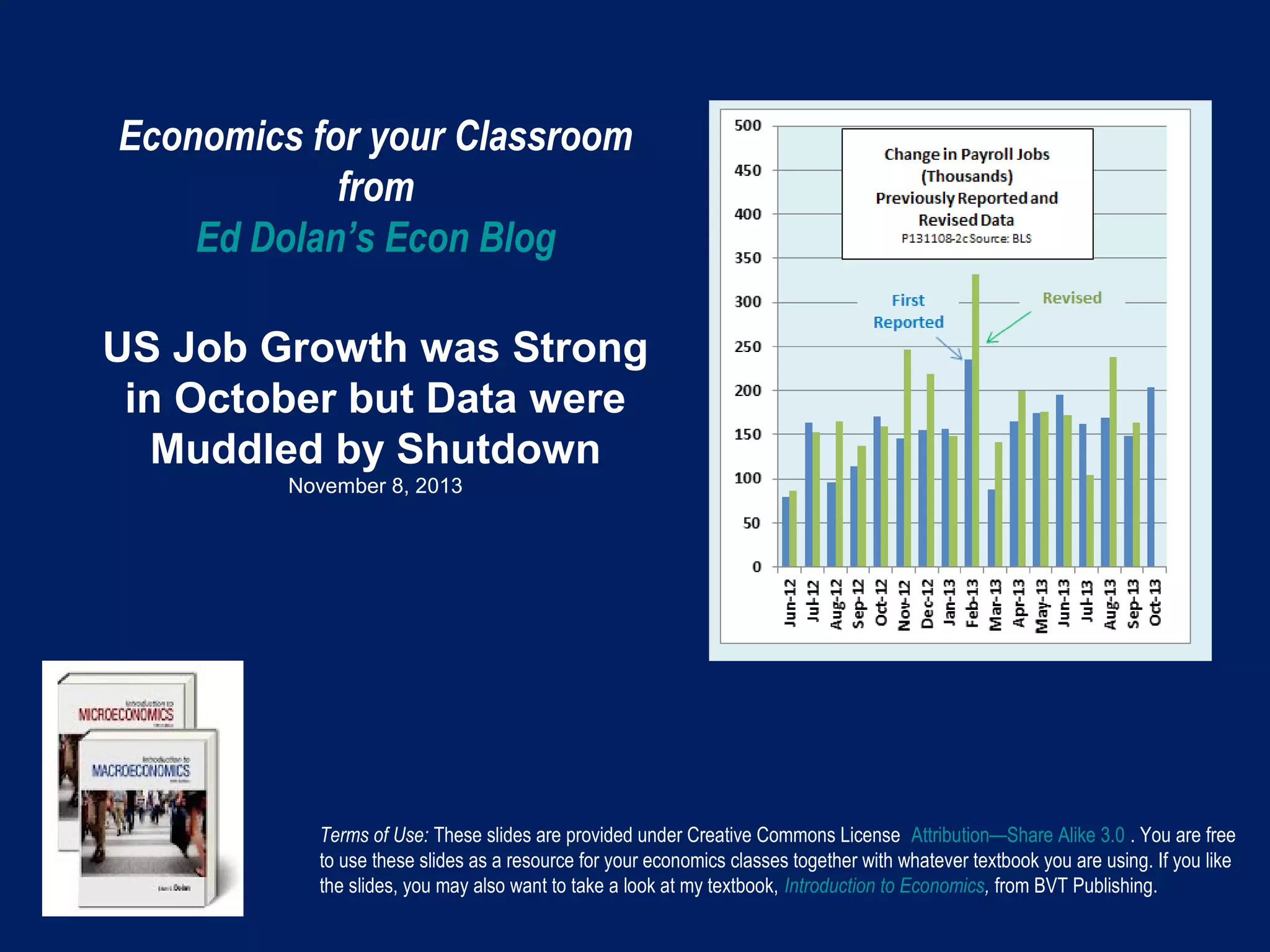
US Job Growth was Strong
in October but Data were
Muddled by Shutdown
November 8, 2013

Terms of Use: These slides are provided under Creative Commons License Attribution—Share Alike 3.0 . You are free
to use these slides as a resource for your economics classes together with whatever textbook you are using. If you like
the slides, you may also want to take a look at my textbook, Introduction to Economics, from BVT Publishing.
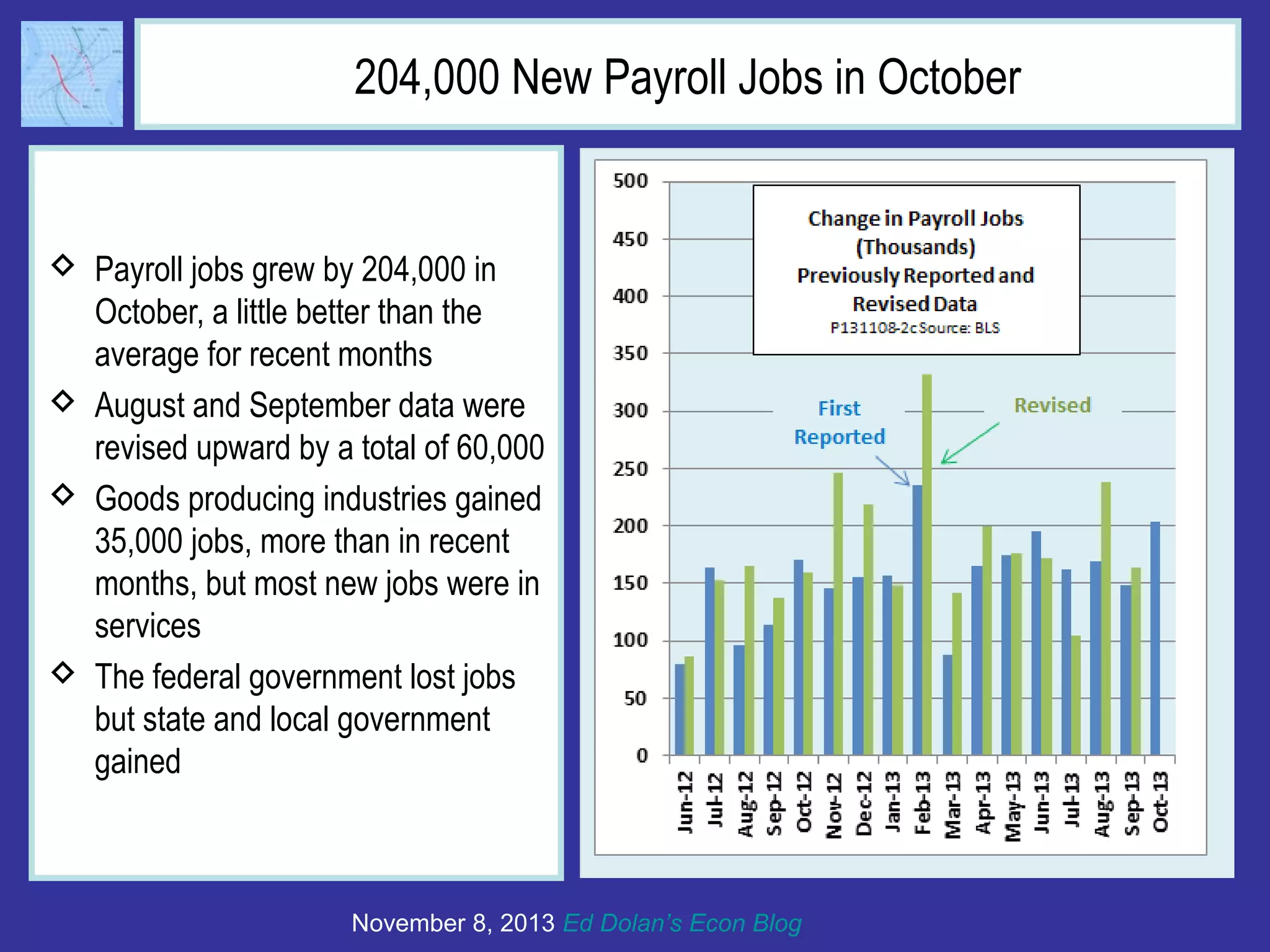
204,000 New Payroll Jobs in October

 Payroll jobs grew by 204,000 in
October, a little better than the
average for recent months
 August and September data were
revised upward by a total of 60,000
 Goods producing industries gained
35,000 jobs, more than in recent
months, but most new jobs were in
services
 The federal government lost jobs
but state and local government
gained

November 8, 2013 Ed Dolan’s Econ Blog
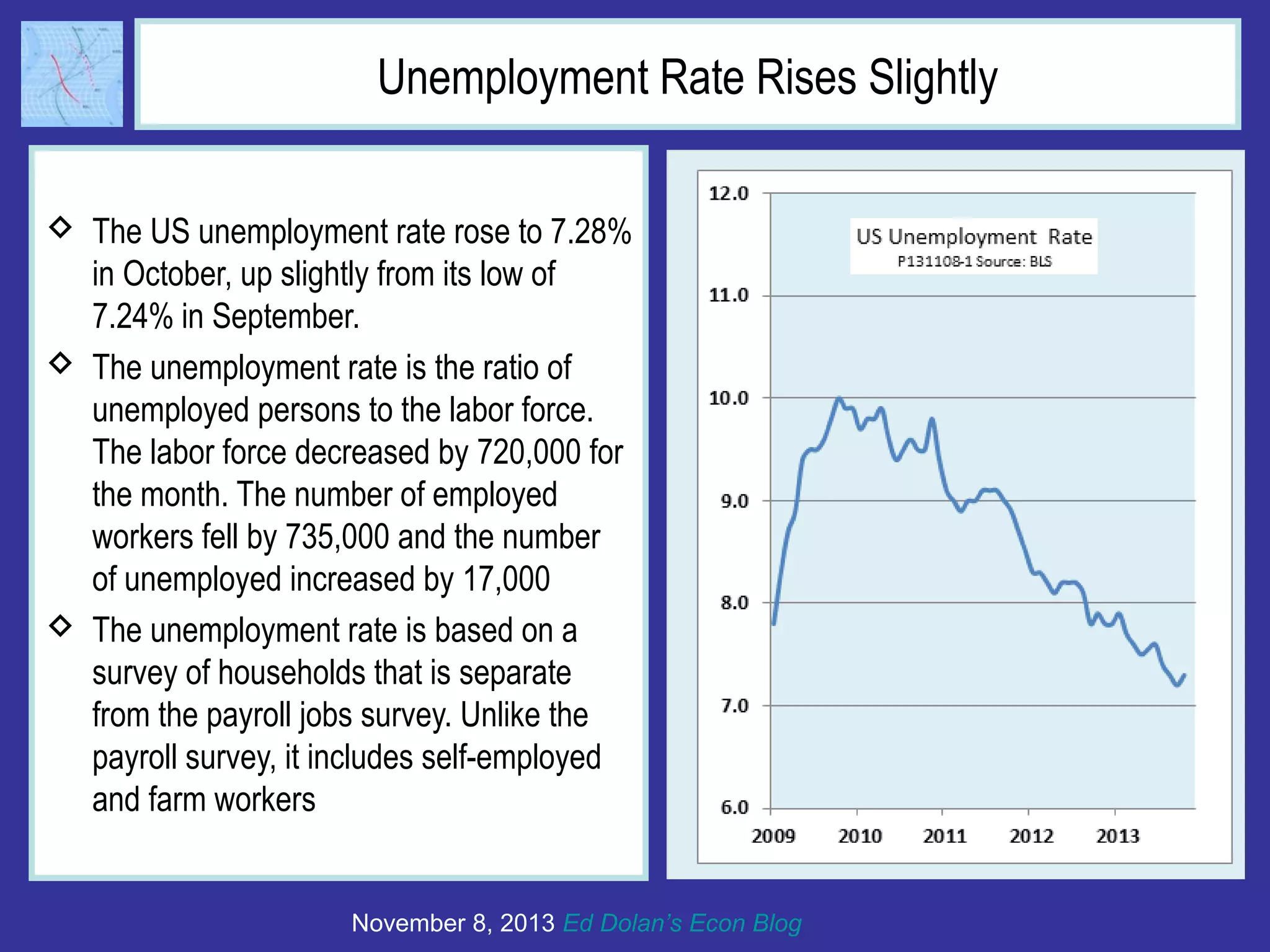
Unemployment Rate Rises Slightly
 The US unemployment rate rose to 7.28%
in October, up slightly from its low of
7.24% in September.
 The unemployment rate is the ratio of
unemployed persons to the labor force.
The labor force decreased by 720,000 for
the month. The number of employed
workers fell by 735,000 and the number
of unemployed increased by 17,000
 The unemployment rate is based on a
survey of households that is separate
from the payroll jobs survey. Unlike the
payroll survey, it includes self-employed
and farm workers

November 8, 2013 Ed Dolan’s Econ Blog
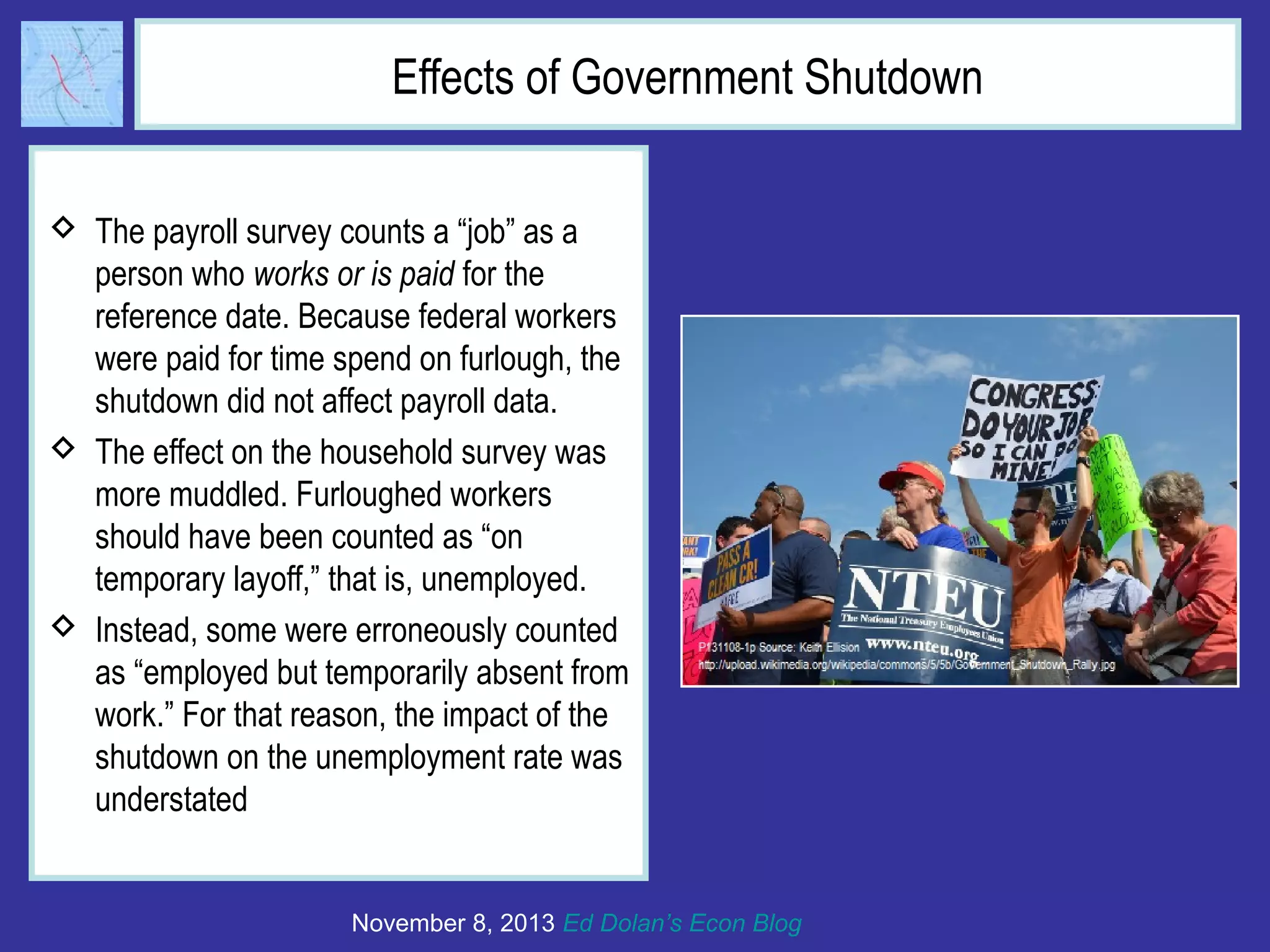
Effects of Government Shutdown
 The payroll survey counts a “job” as a
person who works or is paid for the
reference date. Because federal workers
were paid for time spend on furlough, the
shutdown did not affect payroll data.
 The effect on the household survey was
more muddled. Furloughed workers
should have been counted as “on
temporary layoff,” that is, unemployed.
 Instead, some were erroneously counted
as “employed but temporarily absent from
work.” For that reason, the impact of the
shutdown on the unemployment rate was
understated

November 8, 2013 Ed Dolan’s Econ Blog
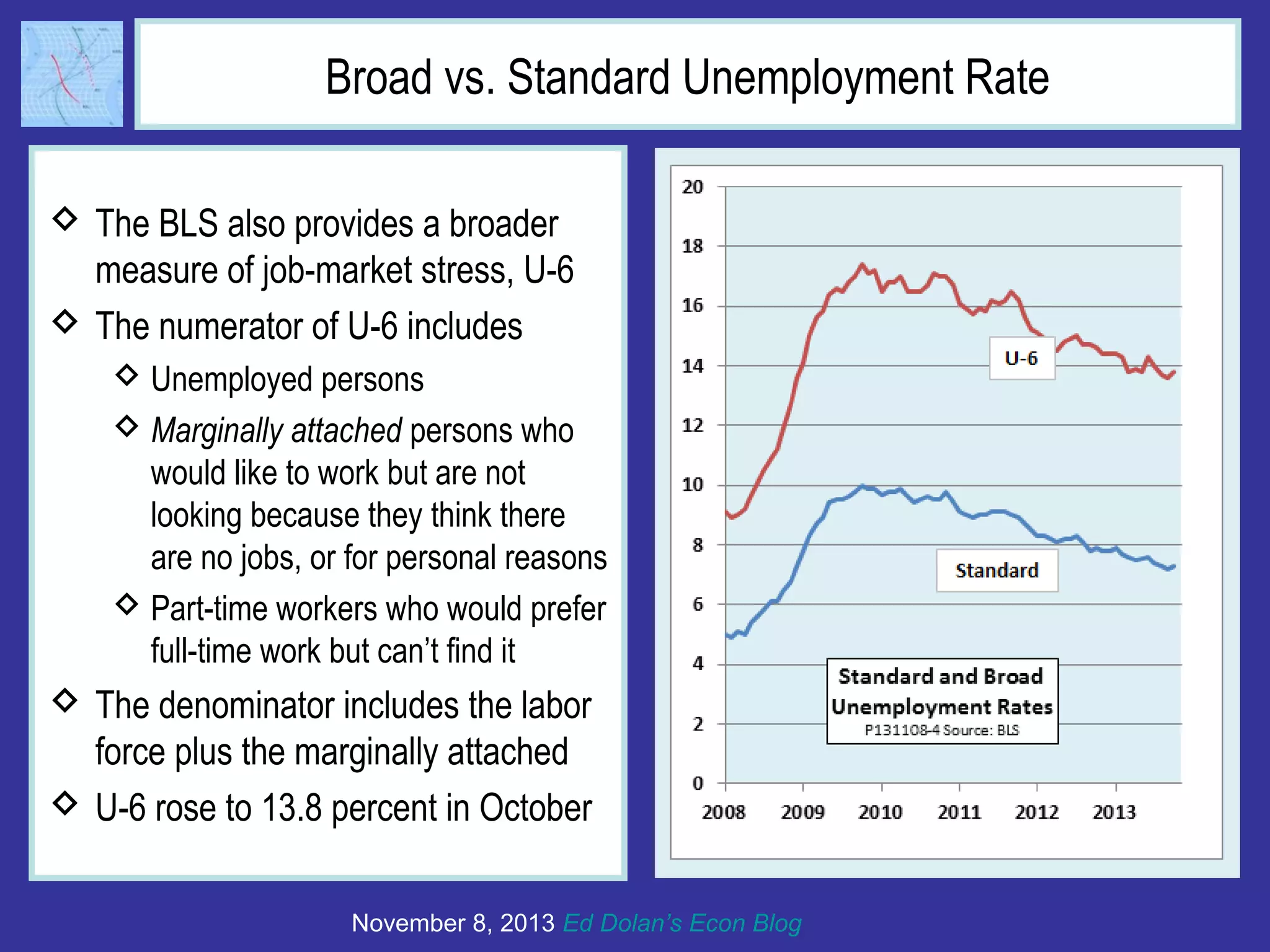
Broad vs. Standard Unemployment Rate
 The BLS also provides a broader
measure of job-market stress, U-6
 The numerator of U-6 includes
 Unemployed persons
 Marginally attached persons who
would like to work but are not
looking because they think there
are no jobs, or for personal reasons
 Part-time workers who would prefer
full-time work but can’t find it

 The denominator includes the labor
force plus the marginally attached
 U-6 rose to 13.8 percent in October
November 8, 2013 Ed Dolan’s Econ Blog
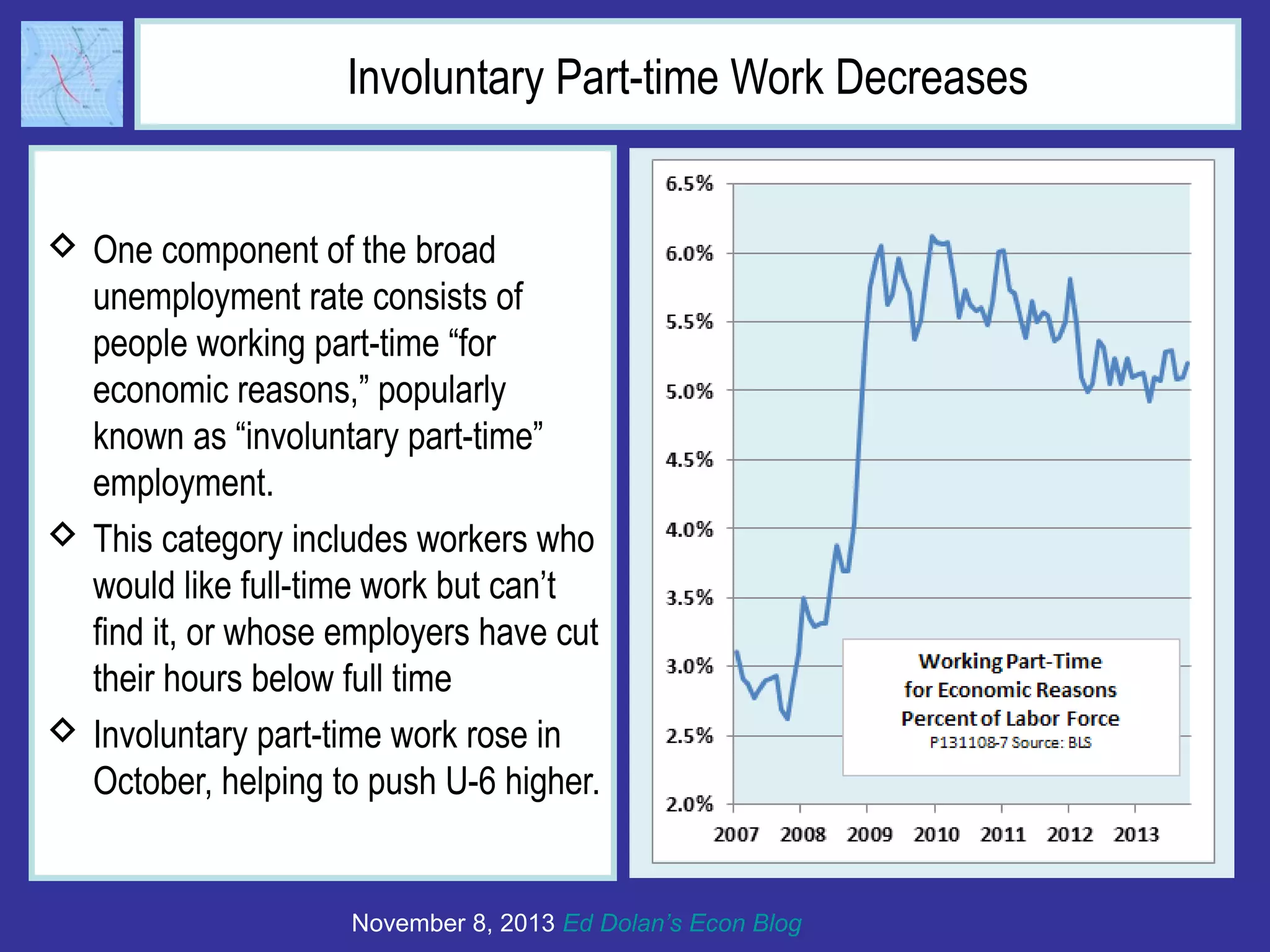
Involuntary Part-time Work Decreases
 One component of the broad
unemployment rate consists of
people working part-time “for
economic reasons,” popularly
known as “involuntary part-time”
employment.
 This category includes workers who
would like full-time work but can’t
find it, or whose employers have cut
their hours below full time
 Involuntary part-time work rose in
October, helping to push U-6 higher.

November 8, 2013 Ed Dolan’s Econ Blog
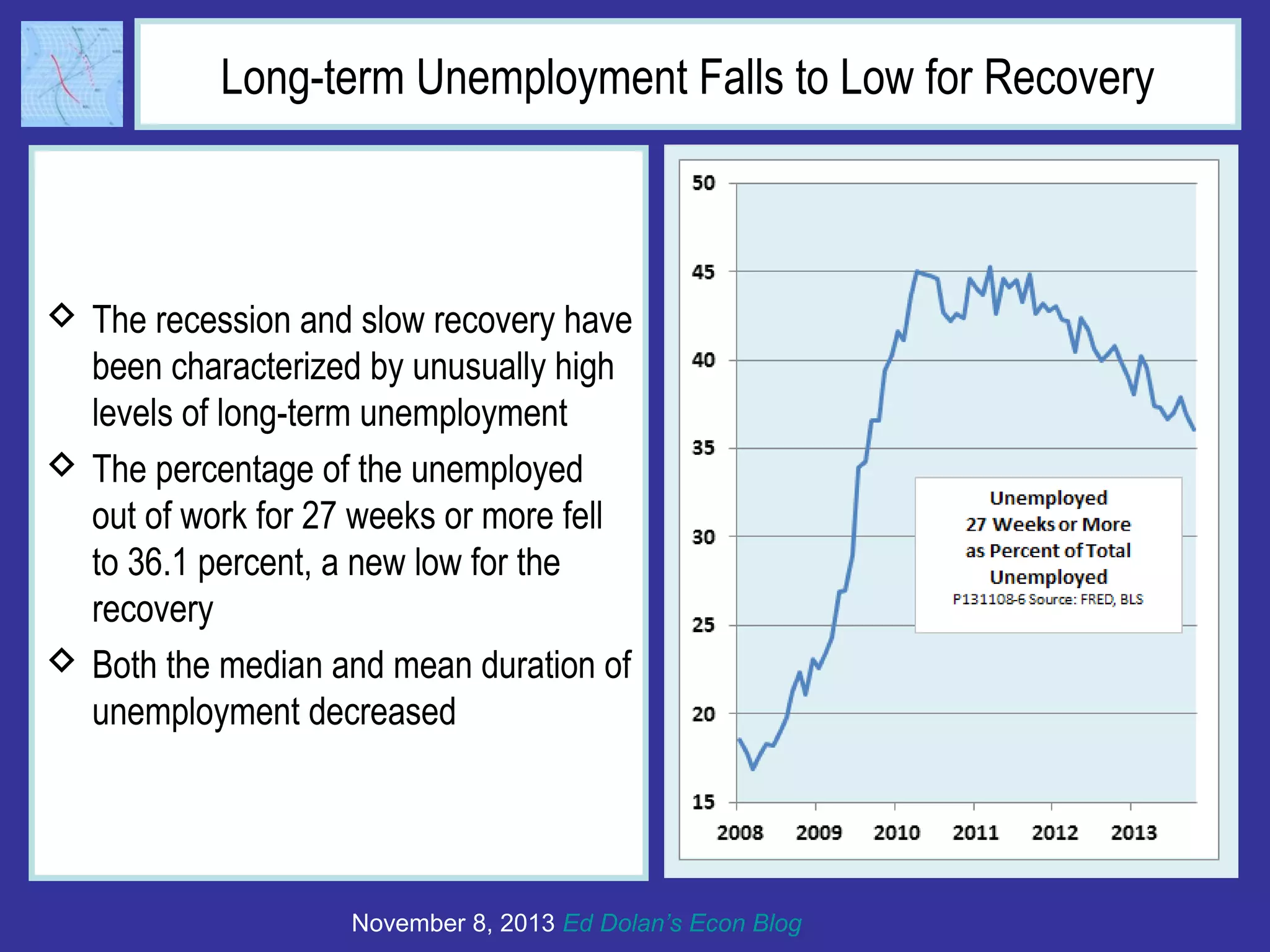
Long-term Unemployment Falls to Low for Recovery

 The recession and slow recovery have
been characterized by unusually high
levels of long-term unemployment
 The percentage of the unemployed
out of work for 27 weeks or more fell
to 36.1 percent, a new low for the
recovery
 Both the median and mean duration of
unemployment decreased

November 8, 2013 Ed Dolan’s Econ Blog
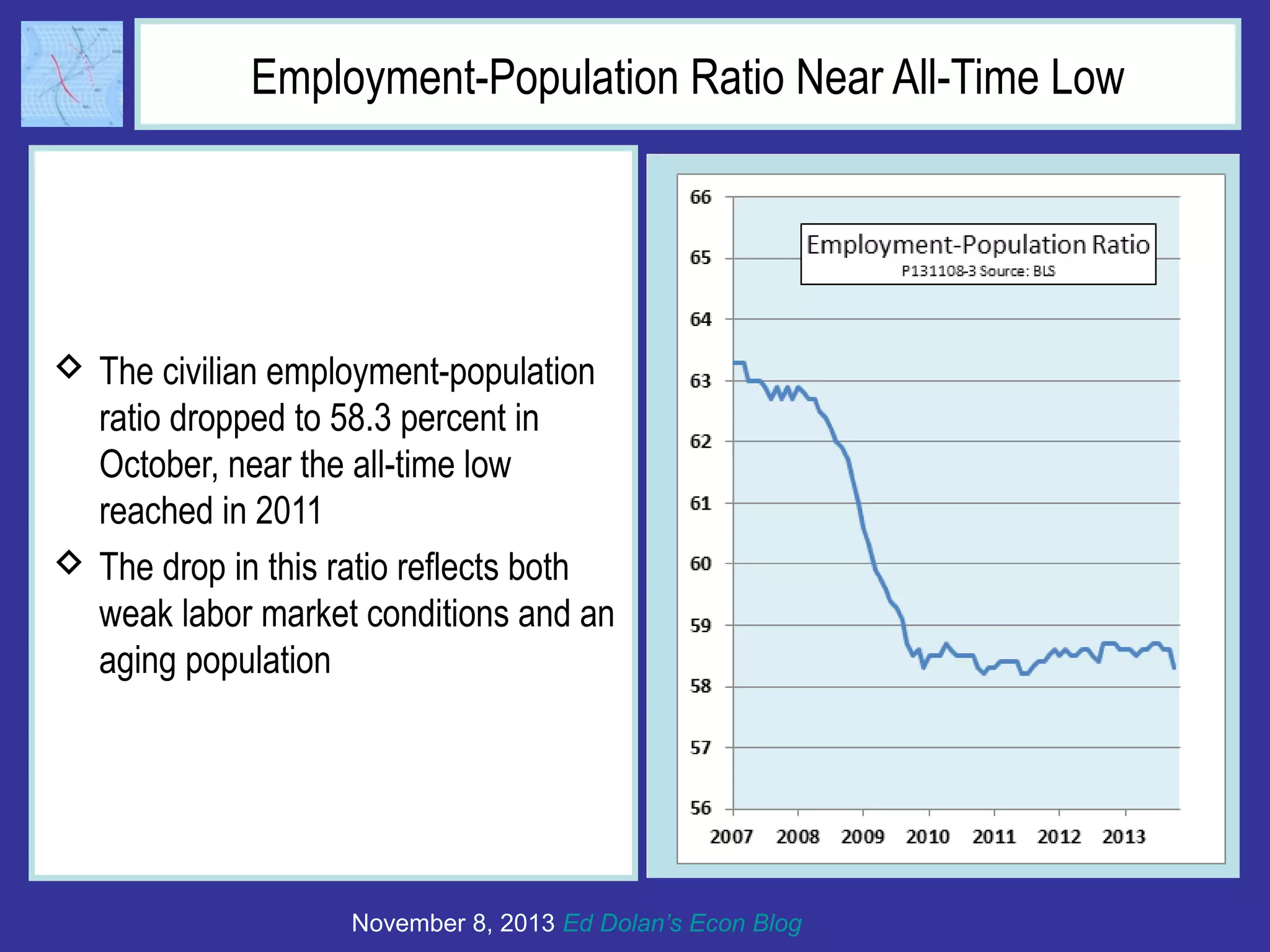
Employment-Population Ratio Near All-Time Low

 The civilian employment-population
ratio dropped to 58.3 percent in
October, near the all-time low
reached in 2011
 The drop in this ratio reflects both
weak labor market conditions and an
aging population

November 8, 2013 Ed Dolan’s Econ Blog
For more slideshows and commentary, follow Ed Dolan’s Econ Blog

Like this slideshow?
Follow @DolanEcon on Twitter

Click here to learn more about Ed Dolan’s Econ texts
For more slideshows and commentary, follow Ed Dolan’s Econ Blog

Like this slideshow?
Follow @DolanEcon on Twitter

Click here to learn more about Ed Dolan’s Econ texts

US Adds 204,000 Jobs in October Despite Shutdown

  • 1.
    Economics for yourClassroom from Ed Dolan’s Econ Blog US Job Growth was Strong in October but Data were Muddled by Shutdown November 8, 2013 Terms of Use: These slides are provided under Creative Commons License Attribution—Share Alike 3.0 . You are free to use these slides as a resource for your economics classes together with whatever textbook you are using. If you like the slides, you may also want to take a look at my textbook, Introduction to Economics, from BVT Publishing.
  • 2.
    204,000 New PayrollJobs in October  Payroll jobs grew by 204,000 in October, a little better than the average for recent months  August and September data were revised upward by a total of 60,000  Goods producing industries gained 35,000 jobs, more than in recent months, but most new jobs were in services  The federal government lost jobs but state and local government gained November 8, 2013 Ed Dolan’s Econ Blog
  • 3.
    Unemployment Rate RisesSlightly  The US unemployment rate rose to 7.28% in October, up slightly from its low of 7.24% in September.  The unemployment rate is the ratio of unemployed persons to the labor force. The labor force decreased by 720,000 for the month. The number of employed workers fell by 735,000 and the number of unemployed increased by 17,000  The unemployment rate is based on a survey of households that is separate from the payroll jobs survey. Unlike the payroll survey, it includes self-employed and farm workers November 8, 2013 Ed Dolan’s Econ Blog
  • 4.
    Effects of GovernmentShutdown  The payroll survey counts a “job” as a person who works or is paid for the reference date. Because federal workers were paid for time spend on furlough, the shutdown did not affect payroll data.  The effect on the household survey was more muddled. Furloughed workers should have been counted as “on temporary layoff,” that is, unemployed.  Instead, some were erroneously counted as “employed but temporarily absent from work.” For that reason, the impact of the shutdown on the unemployment rate was understated November 8, 2013 Ed Dolan’s Econ Blog
  • 5.
    Broad vs. StandardUnemployment Rate  The BLS also provides a broader measure of job-market stress, U-6  The numerator of U-6 includes  Unemployed persons  Marginally attached persons who would like to work but are not looking because they think there are no jobs, or for personal reasons  Part-time workers who would prefer full-time work but can’t find it  The denominator includes the labor force plus the marginally attached  U-6 rose to 13.8 percent in October November 8, 2013 Ed Dolan’s Econ Blog
  • 6.
    Involuntary Part-time WorkDecreases  One component of the broad unemployment rate consists of people working part-time “for economic reasons,” popularly known as “involuntary part-time” employment.  This category includes workers who would like full-time work but can’t find it, or whose employers have cut their hours below full time  Involuntary part-time work rose in October, helping to push U-6 higher. November 8, 2013 Ed Dolan’s Econ Blog
  • 7.
    Long-term Unemployment Fallsto Low for Recovery  The recession and slow recovery have been characterized by unusually high levels of long-term unemployment  The percentage of the unemployed out of work for 27 weeks or more fell to 36.1 percent, a new low for the recovery  Both the median and mean duration of unemployment decreased November 8, 2013 Ed Dolan’s Econ Blog
  • 8.
    Employment-Population Ratio NearAll-Time Low  The civilian employment-population ratio dropped to 58.3 percent in October, near the all-time low reached in 2011  The drop in this ratio reflects both weak labor market conditions and an aging population November 8, 2013 Ed Dolan’s Econ Blog
  • 9.
    For more slideshowsand commentary, follow Ed Dolan’s Econ Blog Like this slideshow? Follow @DolanEcon on Twitter Click here to learn more about Ed Dolan’s Econ texts
  • 10.
    For more slideshowsand commentary, follow Ed Dolan’s Econ Blog Like this slideshow? Follow @DolanEcon on Twitter Click here to learn more about Ed Dolan’s Econ texts