By - Nischay
Dakshay
Antra
Mayur
Abhinandan
Mridula
Conducted by RBI
Buy/sell of government securities.
To adjust the rupee liquidity
conditions.
Reserve Bank of India
Commercial Banks
Financial Institutions
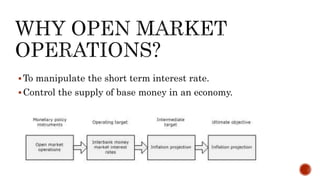
To manipulate the short term interest rate.
Control the supply of base money in an economy.
Outright Purchase (PEMO)
Repurchase Agreement (REPO)
PROCES
S
 Soften the Interest Rates.
 Fresh bonds can be issued at lower yields and Government can buy at reasonable
rates.
 Enables corporate to buy at favourable rates.
 It prevents rupee from strengthening unnecessarily and thus protects the
exporter.
 May tend to increase inflation.
Online
GSO Account
 After the 1991 economic reforms use of CRR and SLR tools
were de emphasized and the use of OMO increased.
 When they want to control the money supply in the market.
When there is excess or less of liquidity in the market.
 When the RBI wants to maintain an inflation rate within a
target range.
 When they want to target the specific short term interest
rates.
 When they want to achieve a fixed exchange rates with
relation to foreign currencies.

Open Market Operations

  • 1.
  • 2.
    Conducted by RBI Buy/sellof government securities. To adjust the rupee liquidity conditions.
  • 3.
    Reserve Bank ofIndia Commercial Banks Financial Institutions
  • 4.
    To manipulate theshort term interest rate. Control the supply of base money in an economy.
  • 5.
  • 6.
  • 7.
     Soften theInterest Rates.  Fresh bonds can be issued at lower yields and Government can buy at reasonable rates.  Enables corporate to buy at favourable rates.  It prevents rupee from strengthening unnecessarily and thus protects the exporter.  May tend to increase inflation.
  • 8.
  • 10.
     After the1991 economic reforms use of CRR and SLR tools were de emphasized and the use of OMO increased.  When they want to control the money supply in the market. When there is excess or less of liquidity in the market.  When the RBI wants to maintain an inflation rate within a target range.  When they want to target the specific short term interest rates.  When they want to achieve a fixed exchange rates with relation to foreign currencies.