

Strategic quantitative easing:
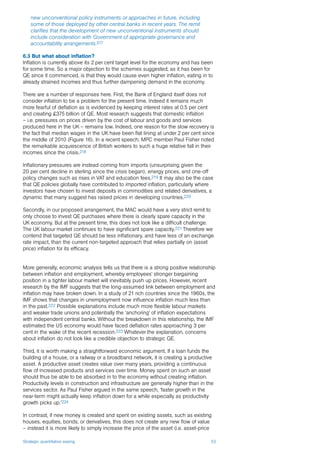
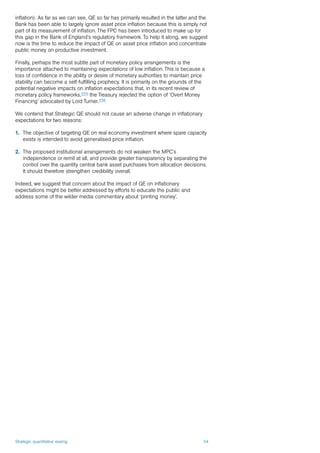
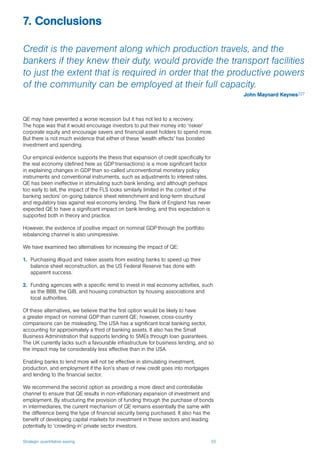
Stimulating investment to rebalance the economy
nef is an independent think-and-do tank that
inspires and demonstrates real economic
well-being.
We aim to improve quality of life by promoting
innovative solutions that challenge mainstream
thinking on economic, environmental and social
issues. We work in partnership and put people
and the planet first.
nef (the new economics foundation) is a registered charity founded in 1986 by the leaders of The Other Economic Summit (TOES),
which forced issues such as international debt onto the agenda of the G8 summit meetings. It has taken a lead in helping establish
new coalitions and organisations such as the Jubilee 2000 debt campaign; the Ethical Trading Initiative; the UK Social Investment
Forum; and new ways to measure social and economic well-being.
Contents
Executive summary 	 1
	 The impact of QE: theory and evidence	 1
	 If it is broke, don’t use it: the problem with trying to get banks to lend	 1
	 Strategic QE: public money for public benefit	 1
	 Getting the governance right	 2
1. 	 Introduction: public money for public good	 3
	 1.1 	 What this report is about	 3
	 1.2 	 Structure of the report	 4
2. 	 Money, credit, and economic policy	 5
	 2.1 	 Who creates money?	 5
	 2.2 	 UK economic policy and performance	 6
	 2.3 	 Monetary policy and central bank operations	 9
3. 	 Understanding QE in theory	 13
	 3.1 	 How QE works	 13
	 3.2 	 Who runs the Asset Purchase Facility?	 13
	 3.3 	 Theoretical impact of QE	 14
	 3.4 	 Funding for Lending	 17
4. 	 Assessing QE in practice	 19
	 4.1. 	 The portfolio re-balancing channel	 19
	 4.2 	 The bank lending channel	 21
	 4.3 	 Impact on government debt	 24
	 4.4 	 Distributional impacts of QE	 25
	 4.5 	 Risks posed by QE	 28
	 4.6 	 Empirical evidence on drivers of GDP	 28
	 4.7 	 Summary	 31
5. 	 Strategic QE: kick-starting the real economy	 32
	 5.1 	 Purchasing non-performing assets from UK banks	 33
	 5.2 	 Direct lending for real economy investment	 36
6. 	 The implementation challenge: good governance	 46
	 6.1 	 Central bank independence and fiscal neutrality: myth and reality	 46
	 6.2 	 Governing strategic QE: the Monetary Allocation Committee	 51
	 6.3 	 But what about inflation?	 53
7. 	 Conclusions	 55
Endnotes	57
Glossary	65
List of figures
Figure 1. Bank lending to businesses and households, 2000–2013.	6
Figure 2. Change in real output by sector since financial crisis, rebased (2007=100).	7
Figure 3. Balance sheet interaction between a central bank and a commercial bank.	9
Figure 4. Bank of England assets, 2007–2012.	12
Figure 5. Quantitative Easing balance sheets. 	13
Figure 6. The effect of QE on the UK economy.	15
Figure 7. Equity prices and corporate bond yields.	20
Figure 8. External financing of UK companies 2003–2012.	21
Figure 9. Lending to the real economy, 2003–2012.	22
Figure 10. SME bank debt rejection rates (including renewals) 2001/2012.	22
Figure 11. Net lending to SMEs (excluding overdrafts) since introduction of FLS, £m, not seasonally adjusted.	23
Figure 12. Big 5 bank FLS take-up and change in balance sheet.	24
Figure 13. Total interest savings from QE to the Government.	25
Figure 14. UK Government bond holdings by sector. 	26
Figure 15. Inflation versus Real Wage growth, 2001–2012.	27
Figure 16. Change in household deposit rates and Bank Rate.	27
Figure 17. Bank lending to the real economy versus growth rate of nominal GDP.	30
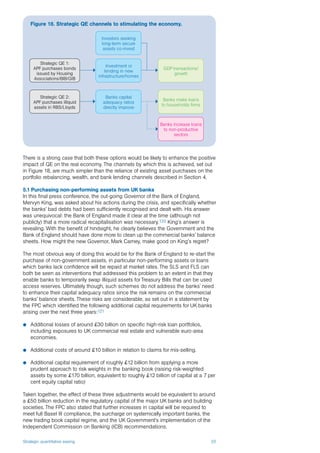
Figure 18. Strategic QE channels to stimulating the economy.	33
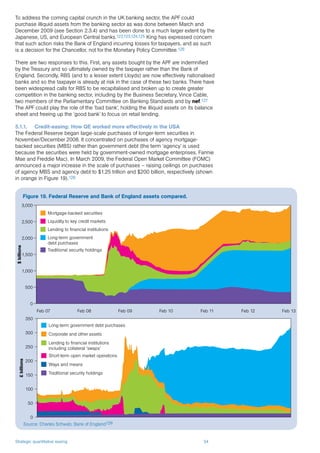
Figure 19. Federal Reserve and Bank of England assets compared. 	34
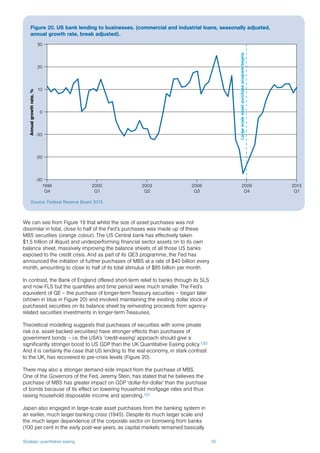
Figure 20. US bank lending to businesses	 35
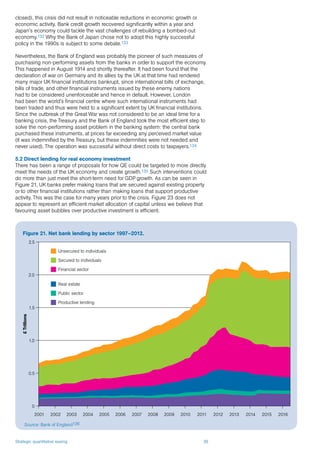
Figure 21. Net bank lending by sector 1997–2012.	36
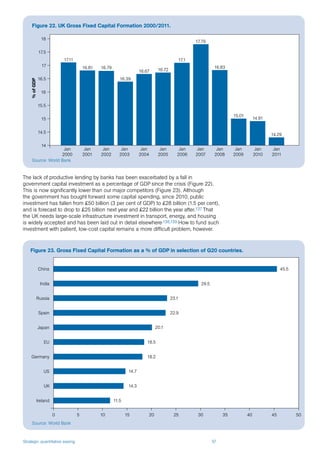
Figure 22. UK Gross Fixed Capital Formation 2000/2011. 	 37
Figure 23. Gross Fixed Capital Formation as a % of GDP in selection of G20 countries. 	37
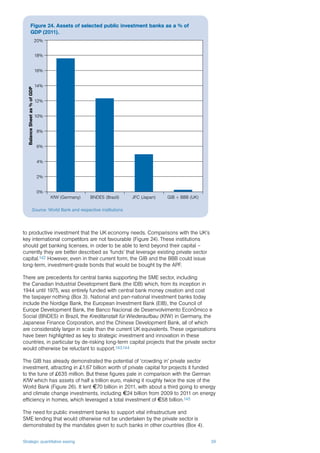
Figure 24. Assets of selected public investment banks as a % of GDP (2011).	 39
Figure 25. Construction – quarterly % change, 2009–2013.	42
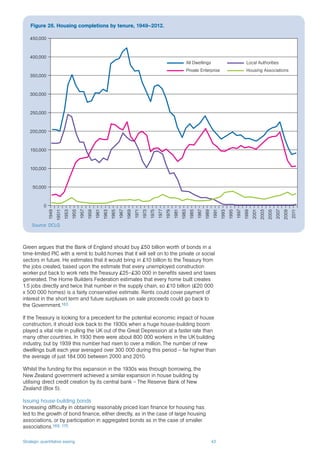
Figure 26. Housing completions by tenure, 1949–2012.	43
Strategic quantitative easing 1
The impact of QE: theory and evidence
The way QE has been interpreted and applied in the UK has benefitted some parts
of the economy at the expense of others. While it has assisted some borrowers
(including the Government) who have enjoyed lower medium and long-term interest
rates, it is bank credit for productive GDP transactions, not interest rates, that is the
primary driver of nominal GDP. In other words, success in lowering interest rates
does not necessarily translate into success in stimulating the real economy.
In theory, QE should induce investors to move money away from holding
government debt and into the corporate sector, boosting investment,
production and employment. But it is highly uncertain that this mechanism of
‘portfolio rebalancing’ works in reality. Instead – as evidenced by current volatility
in stock, bond and currency markets – investors reacting to QE are likely to
channel their money mainly into financial assets. This inflates the price of such
assets, and enriches the assets’ owners, with minimal positive impact on the
real economy.
If it is broke, don’t use it: FLS and the problem with trying to get banks to lend
Funding for Lending has stimulated bank credit for the real economy more directly
than QE. But in practice this credit has mainly been in the form of mortgage debt
rather than corporate lending, and has been severely constrained by the continued
weaknesses of bank balance sheets.
Even if bank lending does increase, we cannot be sure that it will lead to output,
investment and employment rather than a new house price, commodities or stock
market boom. Chronic structural weaknesses and perverse regulatory incentives
mean that, without further policies, reliance on the UK banking system is not an
effective channel for stimulating or rebalancing the economy.
Strategic QE: public money for public benefit
It is time to seriously consider more strategic use of the Bank of England’s powers
as a bank.
An estimated £550bn of investment in new low-carbon infrastructure is required
over the next 10 years in the UK,2 and housing construction remains at its lowest
level in the post-war period. We therefore propose that the Asset Purchase Facility
buys bonds issued by agencies with a specific remit for productive investment
within the UK, such as in housing-building and retrofit, infrastructure and small and
medium enterprises (SMEs).
Executive summary
The Bank of England’s programmes of Quantitative Easing (QE)
and Funding for Lending (FLS) are failing to stimulate GDP and
rebalance the economy.1
Both policies falsely assume that the
UK’s risk-averse capital markets, corporate sector and constrained
banking system can be nudged into supporting the productive
economy. We propose a new approach: one that channels
investment directly into new housing, infrastructure and SME
lending, boosting productivity and exports. QE must become less
scattergun and more strategic, with reformed governance structures
to match.
Strategic quantitative easing 2
Both government and opposition parties now support the economic case for a
national development bank. However – as is the case with our Green Investment
Bank – lack of a banking license and the Government’s reluctance to commit
taxpayer funds will severely limit the British Business Bank’s scale and impact.
Total capital for both these institutions of less than £4 billion compares with
balance sheets of over £200bn for the Brazilian development bank and £400bn
for Germany’s KfW.
Central bank support for national infrastructure investment has worked before.
The Industrial Development Bank of Canada, which supported Canadian SMEs
from 1946-1972, was capitalised entirely by the Central Bank with not a single
penny of taxpayers’ money required. In New Zealand in 1936, the central bank
extended credit for the building of new homes, helping the country out of
the Great Depression. Moreover, the majority of the UK’s major international
competitors, including emerging market economies, have public investment
banks or equivalent funds supporting infrastructure or SME financing.
We also examine the case for the APF purchasing a wider range of assets from
banks in order to free up their capital for more productive lending. This has been
successful in the USA and might improve the impact of QE here, but overall we
recommend strategic QE as the best approach to rebalancing the UK economy.
Getting the governance right: the fiscal/monetary policy mix
Would strategic QE blur the line between monetary and fiscal policy? In
reality the distinction has always been blurred. We should now be asking
what governance systems could allow us to carry out hybrid monetary/fiscal
measures, and then selecting the most effective tools to deploy.
We suggest the formation of a Monetary Allocation Committee that would be
accountable to the Treasury and Parliament but separate from the Bank of
England’s existing Monetary Policy Committee (MPC). The new committee would
decide how best to allocate new QE funding and any reinvestment of maturing
gilts (almost £100bn are being repaid over the next five years). The committee
would be charged with carefully examining different sectors of the economy
and spare capacity within them. It would make allocation judgements based
on a broad range of macroeconomic and policy criteria, such as sustainable
GDP growth, employment, financial stability, the trade balance and inflation
and ecological sustainability. Meanwhile, the independent MPC would remain
in charge of determining the quantity of Bank of England reserves created and
remain accountable for inflation. This would maintain an appropriate separation
of powers and ensure that inflation expectations remained anchored.
We have already entered the world of monetary policy activism; let’s make it as
effective, transparent and accountable as possible.
Strategic quantitative easing 3
1.1 What this report is about
We are caught on the horns of a dilemma. After the bursting of a credit-fuelled
bubble, we want our banks to shrink and repair their balance sheets. But at the
same time we want them to expand credit to fund investment in the real economy.
Large corporations, who have cash, seemingly lack the confidence to invest or
expand production. Meanwhile, the Government is cutting expenditure to try to
reduce its deficit. So where will the money come from to kick-start the economy?
In this report we suggest a solution. Most people perhaps are still not aware that
our money supply is created primarily by commercial banks, and hence shrinking
banks means less money flowing into the economy. The inelegant phrase
‘quantitative easing (QE)’, on the other hand, has certainly entered the popular
consciousness. Public institutions, in the shape of the Bank of England, can create
money, too. So far it has created £375 billion under the QE programme, prompting
two crucial questions: How well has this worked? and Could we do better?
We argue that the use of the Bank of England’s powers, through QE and other
schemes, has not been effective in stimulating an economic recovery. Neither will
it contribute to the Government’s stated objective of rebalancing the economy
towards manufacturing and exports. We explain why this is the case, in theory and
in practice.
We propose that the programme of QE be modified to be less scattergun and
more strategic. Specifically we propose that it directly finance investment in the
real economy. Importantly, we address the valid concern that unconventional
monetary policy might be subverted by short-term political pressures, risking loss
of control of inflation.
In essence, the solution is to mandate the Bank of England to act more like a
bank.
1. Introduction: public money for public good
When banks extend loans to their customers, they create money
by crediting their customers’ accounts. The usual role of a central
bank is to limit this rate of money creation, so that an excessive
expansion of money spending does not lead to inflation. But a
damaged banking system means that today banks aren’t creating
enough money. We have to do it for them.
Mervyn King, Governor of the Bank of England, October 20123
[E]specially as fiscal policy becomes constrained by budget
stringency … monetary policy is the main instrument for affecting
macroeconomic performance. That this key determinant of what
happens to society – this key collective action – should be so
removed from control of the democratically elected officials should
at least raise questions.
Joseph Stiglitz, 19984
Strategic quantitative easing 4
1.2 Structure of the report
In Section 2, we briefly outline the basics of the role of banks, governments, and
the central bank in the business of lending and money creation. We highlight the
significance for economic performance when bank credit is abnormally constrained,
and then describe key issues facing the UK economy. We outline the economic
strategy of the Government since 2010, i.e. to combine fiscal consolidation with
monetary activism, and examine some of the innovations in monetary policy that
have taken place in response to the financial crisis.
In Section 3, we explain the economic theory of QE and the institutional
arrangements for its implementation. We dispel some popular myths about what
it is and how it works. The Bank of England is neither printing money nor giving it
away to the banks or anyone else. In essence it is extending a very large long-term
and very low interest loan to a newly created body – the Asset Purchase Facility –
which has used this almost entirely to purchase government bonds.
The impact of QE, and other unconventional policy measures, is assessed
in Section 4. We examine a range of empirical evidence, including our own
econometric analysis of the primary drivers of nominal gross domestic product
(GDP).
Based on this analysis, in Section 5 we set out two proposals for more targeted
use of QE to achieve greater impact on nominal GDP and specific macroeconomic
variables, such as production and employment. We conclude that the purchase
of bonds in institutions with specific investment mandates for small and medium
enterprise (SME) lending, infrastructure, and housing construction is both viable and
desirable.
In Section 6, we consider reforms to institutional arrangements that recognise the
blurring of fiscal and monetary policy that has already taken place, and that can
better accommodate the competent execution of more strategic QE. We propose
the creation of a Monetary Allocation Committee and a separation of powers
between it and the Bank of England’s Monetary Policy Committee (MPC).
Section 7 concludes.
Strategic quantitative easing 5
2.1 Who creates money?
In modern capitalist societies such as the UK, the vast majority of new money,
around 97 per cent, is created by commercial banks. When banks extend credit they
add brand new electronic deposits to the borrowers’ accounts.5 This has profound
economic consequences, as Mervyn King, Governor of the Bank of England, alludes
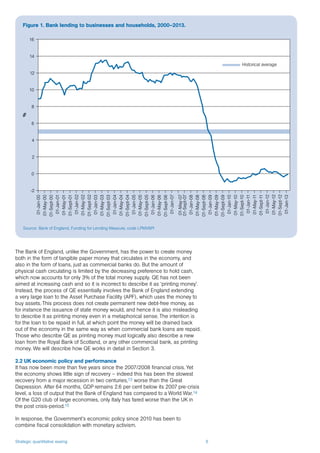
to. If commercial banks decrease their net lending6 to households and businesses, the
flow of new money into the economy falls and fewer economic transactions can take
place. The economy will contract. Since 2007, this is exactly what has happened. There
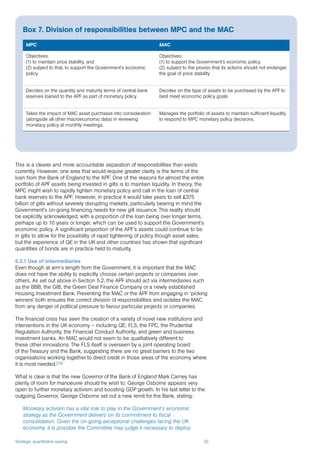
has been a huge decline in money created for the real economy7 and whilst the rate of
growth in lending has stabilised, it remains negative for businesses and well below its
historical 5 per cent growth average (Figure 1).
Understanding the money-creation process is crucial to understanding the dilemma
currently faced by the UK economy. We are overburdened with private debt, public
debt has risen rapidly as a result of the banking crisis and recession, and yet there
is too little money flowing through those parts of the economy that will generate
investment and consumption, and thereby production and jobs. The key to this is the
impact of credit on different sectors of the economy. When a new bank deposit is
created, it matters enormously in whose hands the deposit is, and what they intend
to do with it. It is possible for banks to reduce overall lending while increasing lending
for investment and consumption.8 Reducing credit to businesses and householders
means taking money out of the real economy, thereby depressing economic activity.
It is the latter course that we have been following, as Figure 1 demonstrates.
The Government is prevented under EU legislation9 from to making up for this
shortfall in bank lending by requiring the central bank to purchase newly issued
government bonds. This system is intended to exert financial discipline on
governments to prevent their access to central bank ‘printing presses’ with potentially
dire inflationary consequences. However, the current practice of QE has severely
reduced the meaning of such legislation. Furthermore, alongside the examples of
the Weimar Republic in the 1920s and Zimbabwe in the 2000s which are often
cited as ‘proof’ that government control of money creation is always and inevitably
hyperinflationary, there are many historical examples of governments directly creating
debt-free money responsibly and with good effect, but the debate around sovereign
money is not for this report.10,11
So the Government does not directly print money, which, like the issuance of coins,
could be considered as an asset rather than a liability of the state. Instead, the
Government increases spending by borrowing more from financial markets, thereby
increasing national debt. It has indeed massively increased borrowing since the start
of the crisis, mainly to meet the costs of bailing out banks and the wider costs of
recession, such as unemployment, housing benefits, and tax credits.
However, government borrowing does not have the same effect as the money
creation process that banks carry out. The same purchasing power is being put to a
different use, and so rather than creating new money, the Government is reallocating
existing money.12
2. Money, credit, and economic policy
The financial crisis of 2008 and the resulting recession have
refocused attention on the role of bank credit in stimulating the
economy. In order to review the interventions of the Government
and central bank in context, we need to briefly examine the
significance of money creation and how this relates to economic
policy and performance in the UK.
Strategic quantitative easing 6
The Bank of England, unlike the Government, has the power to create money
both in the form of tangible paper money that circulates in the economy, and
also in the form of loans, just as commercial banks do. But the amount of
physical cash circulating is limited by the decreasing preference to hold cash,
which now accounts for only 3% of the total money supply. QE has not been
aimed at increasing cash and so it is incorrect to describe it as ‘printing money’.
Instead, the process of QE essentially involves the Bank of England extending
a very large loan to the Asset Purchase Facility (APF), which uses the money to
buy assets. This process does not create permanent new debt-free money, as
for instance the issuance of state money would, and hence it is also misleading
to describe it as printing money even in a metaphorical sense. The intention is
for the loan to be repaid in full, at which point the money will be drained back
out of the economy in the same way as when commercial bank loans are repaid.
Those who describe QE as printing money must logically also describe a new
loan from the Royal Bank of Scotland, or any other commercial bank, as printing
money. We will describe how QE works in detail in Section 3.
2.2 UK economic policy and performance
It has now been more than five years since the 2007/2008 financial crisis. Yet
the economy shows little sign of recovery – indeed this has been the slowest
recovery from a major recession in two centuries,13 worse than the Great
Depression. After 64 months, GDP remains 2.6 per cent below its 2007 pre-crisis
level, a loss of output that the Bank of England has compared to a World War.14
Of the G20 club of large economies, only Italy has fared worse than the UK in
the post crisis-period.15
In response, the Government’s economic policy since 2010 has been to
combine fiscal consolidation with monetary activism.
Figure 1. Bank lending to businesses and households, 2000–2013.
Source: Bank of England, Funding for Lending Measure, code LPMV6PI
%
-2
0
2
4
6
8
10
12
14
16 01-Jan-00
01-May-00
01-Sept-00
01-Jan-01
01-May-01
01-Sept-01
01-Jan-02
01-May-02
01-Sept-02
01-Jan-03
01-May-03
01-Sept-03
01-Jan-04
01-May-04
01-Sept-04
01-Jan-05
01-May-05
01-Sept-05
01-Jan-06
01-May-06
01-Sept-06
01-Jan-07
01-May-07
01-Sept-07
01-Jan-08
01-May-08
01-Sept-08
01-Jan-09
01-May-09
01-Sept-09
01-Jan-10
01-May-10
01-Sept-10
01-Jan-11
01-May-11
01-Sept-11
01-Jan-12
01-May-12
01-Sept-12
01-Jan-13
Historical average
Strategic quantitative easing 7
P	 Fiscal consolidation involves cutting public spending in the hope of reducing
the ‘structural’ deficit (the cyclically adjusted difference between spending
and income over the course of a year) and eventually bringing down the
public-debt-to-GDP ratio.
P	 Monetary activism involves the Bank of England creating effectively negative
real interest rates to entice households, banks, and companies to start
spending or lending rather than saving or paying back debts (de-leveraging).
The theory is that the private sector will ‘take up the slack’ and invest as the
public sector reduces spending, and international markets will keep interest
rates low. Private sector employment (mainly in the service sector) has been
expanding in recent years but research suggests much of these jobs are part-
time or held by self-employed workers who in previous, less severe downturns
might have pulled out of the workforce completely to search for full-time work.16
The unemployment rate remains high at 8 per cent suggesting considerable
slack in the economy.
But, as the Government has repeatedly stated, the UK economy also needs to
rebalance. Instead of growth coming primarily from the service, financial, and
public sectors, it should come from the productive sectors – high-value
manufacturing and other export-orientated industries – to help improve the UK
trade balance, which has stayed stubbornly in deficit since the late 1990s17 – and
from construction and infrastructure investment to create the platform for longer-
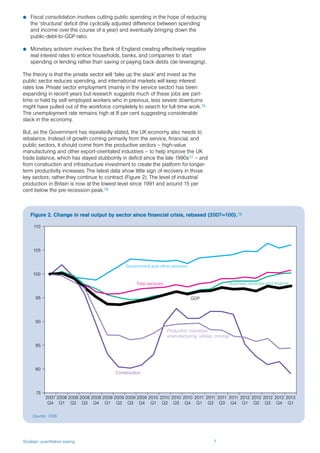
term productivity increases. The latest data show little sign of recovery in those
key sectors; rather they continue to contract (Figure 2). The level of industrial
production in Britain is now at the lowest level since 1991 and around 15 per
cent below the pre-recession peak.18
Figure 2. Change in real output by sector since financial crisis, rebased (2007=100).19
75
80
85
90
95
100
105
110
2007
Q4
2008
Q1
2008
Q2
2008
Q3
2008
Q4
2009
Q1
2009
Q2
2009
Q3
2009
Q4
2010
Q1
2010
Q2
2010
Q3
2010
Q4
2011
Q1
2011
Q2
2011
Q3
2011
Q4
2012
Q1
2012
Q2
2012
Q3
2012
Q4
2013
Q1
Government and other services
GDP
Total services
Construction
Business services and finance
Production industries
(manufacturing, utitilies, mining)
Source: ONS
Strategic quantitative easing 8
Ironically, even in the face of the most severe austerity policies since World War
II,20 it is government and other services which show the highest levels of growth.
Recent decisions suggest that the Government believes that the quickest way
to reflate the economy is by getting banks to extend more mortgages. This is
suggested by both the Funding for Lending Scheme (Section 3.4) on behalf of
the Bank and the ‘Help to Buy’ scheme announced in the Spring Budget.21
From a macroeconomic perspective, this policy appears misguided for a number
of reasons. First, it involves creating even more private debt. The Coalition
Government has focused its attention on the UK’s public debt and the deficit.
But the reality is that the UK has a private debt problem. Private debt is currently
over 400 per cent of GDP whilst public debt is just 80 per cent. Household debt
stands at 100 per cent of GDP.22
Secondly, as the Office of Budget Responsibility, amongst others, has
suggested, the policy risks inflating another housing bubble if the new credit
is not matched by an increase in the supply of new homes, and there is little
evidence of this being forthcoming (Section 5). Academic studies across
different countries and time periods show large increases in household credit to
be a strong predictor of financial crises and volatility.23,24
Thirdly, households generally spend credit on consumption not on investment.
This will not help rebalance the economy or address the UK’s trade deficit
(Figure 4). Buying new cars or carrying out home improvement mainly
involves importing goods from abroad. Studies of the impact of increases in
household credit show strong evidence that it leads to deterioration in the trade
balance.25,26
Fourthly, as argued in a recent nef report on macroeconomic strategy,27 the
UK needs to find a way of weaning itself off a reliance on flows of footloose
international capital to prop up the economy and fund our current account
deficit.
The need for a domestic source of investment and productive credit creation
is even greater when we consider the state of the UK banking sector. Whilst
households and businesses hold a dangerously large amount of total debt,
the most serious concern is the financial sector which remains hamstrung by
non-preforming assets and the need for banks to shrink their balance sheets and
rebuild levels of core capital.
On a theoretical level, it is well-established that domestic investment is the
driver of economic growth. For this to take place, funds are needed. At the same
time, there is ample evidence that firms, especially SMEs, are credit rationed
and would like to borrow more for investment than they are currently receiving.28
However, who provides the funds is also important. Government initiatives to
obtain direct funding by investors, for instance via tax-advantaged venture capital
schemes, or by encouraging equity issuance, cannot substitute for bank credit:
such ‘direct’ finance merely transfers existing purchasing power. Bank credit
creation, on the other hand, expands the effective money supply and ensures
that more purchasing power is being exerted.29 However, even bank credit
creation may not necessarily be the answer: it can be extended for transactions
that do not contribute to GDP (financial transactions that influence asset prices),
for unproductive consumption (boosting inflation), or for productive investment
delivering growth.30 Only the latter type of bank credit creation is sustainable
and comes without undue cost to society, especially when productivity is
defined to be consistent with environmental and ecological imperatives.
In summary then, what is required is a massive investment of domestic capital
in the productive sector. As we shall see, however, the Bank of England’s £375
billion programme of asset purchases – and other interventions – has failed to
provide such a stimulus. We turn next to a description of monetary policy and
how it has developed since the financial crisis, before we examine the theory of
QE in Section 3.
Strategic quantitative easing 9
2.3 Monetary policy and central bank operations
In much of the media reporting of QE and other central bank activity, you will
read phrases like ‘printing money’ or ‘giving money to the banks’. These are
misleading expressions. The Bank of England is a bank, but one with unique
characteristics and responsibilities that we describe in this section.
2.3.1 Central bank interaction with banks
Just like commercial banks, the Bank of England has a balance sheet with
assets and liabilities, and just like commercial banks it can create money by
making loans. There are important differences however:
P	 Commercial banks create bank deposits (commercial bank money or
broad money), i.e. the type of money used by everyone in the economy.
The amount of money that any individual bank can create is determined by
regulatory constraints, balance sheet constraints (their liquidity and capital
positions), institutional and financial infrastructure constraints (whether
they can access funding in wholesale and capital markets), the internal
management and incentive structure (such as the bonus culture, etc.), and
by their confidence in the economy.
P	 The central bank creates bank reserves at the central bank (narrow money
or base money, henceforth referred to as ‘central bank reserves’), which
is a type of money that can only be used by commercial banks to make
payments between themselves. Although sometimes referred to as ‘money’
(narrow money or reserve money), central bank reserves are not money that
is available to households and businesses to use and rather than circulating
in the economy they stay on the central bank balance sheet. The amount of
central bank reserves the central bank can create is constrained only by the
need to maintain confidence in the currency itself. Unlike commercial banks,
the central bank has no liquidity, capital, or funding constraints.
As shown in Figure 3, when the central bank makes a loan to a commercial
bank, it simultaneously creates central bank reserves for the commercial bank.
For the commercial bank, its holding of central bank reserves in an account at
the Bank of England is very much like our holdings of bank deposits at our own
bank. The commercial bank pays interest to borrow these reserves. The rate of
interest is the ‘bank rate’ or ‘policy rate’ which the Bank of England meets to
discuss every quarter and which makes a lot of news since it affects all the other
interest rates in the economy. These reserves can be used to settle payments
between banks when customers transfer deposits. They are thus vital to the
heath of the economy.
The Bank of England has another important function: acting as the
Government’s banker. In this role the Bank of England holds and thus has
access to the Government’s reserve account and hence the Debt Management
Office (DMO). It can borrow and return government bonds from the DMO,
which it can then lend to banks. Government debt instruments have a range of
maturities, ranging from 25 years down to just three months (the latter called
Treasury bills or T-bills). The Bank of England is able to borrow T-bills from the
Government and lend them to commercial banks. This activity does not involve
the creation of new reserves but helps commercial banks to manage their
liquidity effectively. Commercial banks can easily trade T-bills for central bank
reserves in the interbank market.
Figure 3. Balance sheet interaction between a central bank and a
commercial bank
Commercial Banks Central Bank
Assets Liabilities Assets Liabilities
What borrowers
owe to the bank
What the bank
owes to customers
Loan to customers Depoits of customers Loans to
private banks
Reserve deposits
of private banks
+ Central bank reserves + Loans from central bank
Strategic quantitative easing 10
When you get a mortgage from a bank, you have to pledge some form of collateral
in return (usually the house itself) as well as paying interest to the bank. In just the
same way, when the central bank makes a loan of central bank reserves or T-bills,
it also takes collateral. In this case the collateral will be another financial asset on
the commercial bank’s balance sheet. The central bank today prefers only very ‘high
quality’ assets as collateral, usually government bonds (gilts) or investment grade
corporate bonds (i.e. corporate bonds that would easily sell on financial markets).
As we shall see, however, central banks are free to purchase or accept as collateral
any kind of assets they wish, and have done so throughout history for a range of
different objectives. The European Central Bank (ECB) currently accepts various
kinds of assets, including loans, as collateral from banks.
It should be noted that the Bank of England, just like a commercial bank, will want
to have the option of calling in its loan at some future point in time. It can achieve
this easily by using repurchase agreements (repos) and reverse repurchase
agreements (reverse repos). When the Bank of England conducts a repo it sells an
asset, such as a T-bill, to the bank in exchange for central bank reserves, but with a
legal agreement to buy the asset back again after a set period of time. This process
of lending and withdrawing reserves on a fairly short-term basis is called Open
Market Operations (OMOs). They have been a tool of central banks’ monetary policy
since their inception.31 As the Bank of England itself has noted:
There is nothing unusual about central banks purchasing assets per se…
QE is just a return to the classic policy operation of the textbook: an open
market operation. The only things that distinguish the present operation…
are the circumstances under which they are taking place and their scale.32
The difference between a central bank and a commercial bank is that that a central
bank will make decisions about creating central bank reserves based on the
stability of the banking system and other broad macroeconomic concerns, whilst a
commercial bank’s creation of bank deposits is simply dictated by its own efforts to
maximise profits. As already noted, the rate of interest that the Bank of England will
charge on short-term loans to commercial banks is known as the official bank rate,
or base rate, and manipulating this interest rate is the primary tool of conventional
monetary policy.
2.3.2 Conventional monetary policy
The objective of monetary policy is said to be primarily to achieve price stability,
often defined as a low and stable rate of inflation. The Bank of England is tasked
with keeping inflation at 2 per cent over the medium term. Sometimes broader
macroeconomic goals are included, such as the US central bank’s twin objectives
of achieving maximum sustainable output and price stability.
Modern monetary policy is conducted mainly through adjustments to interest
rates. The official description is along the following lines: when the central bank
believes that the economy is heating up, it will raise interest rates to dampen
economic activity. Conversely, if too little economic activity is taking place, the Bank
of England will lower the bank rate on the basis that, since interest rates are the
driving force of economic activity, this will stimulate growth.
This theory is contested and there is evidence that interest rates tend to follow, not
lead, economic growth and are positively correlated with it.33,34 Nevertheless, even
if we accept the theory, a problem arises when interest rates have been lowered so
many times – and without the desired effect – that they approach zero. The same
economic theory would then suggest that interest rates would need to fall below
zero, becoming negative – in effect punishing banks for holding reserves with the
central bank by requiring them to pay a fee. This is widely described as interest
rates ‘reaching the zero lower bound’. In such a situation, commonly termed a
‘liquidity trap’, the core mechanism of monetary policy seems to fall apart.
2.3.3 Japanese deflation and the origins of QE
When the Bank of Japan faced this situation in the 1990s, it stuck rigidly to the
conventional view that ever further interest reductions were necessary and the only
policy available. However, when it had reduced short-term interest rates from 7% at
the beginning of the 1990s to 0.001 per cent at the end of it, the results were not
Strategic quantitative easing 11
impressive: Japan remained mired in deflation. Thus, in March 2001, the Bank
of Japan adopted a new policy of significantly expanding the quantity of central
bank reserves in the hope of boosting bank lending. This policy was based on
monetarist theory (Box 1) which was common among central banks in the early
1980s, but abandoned due to its ineffectiveness.35
Unfortunately this massive expansion in the quantity of central bank reserves
was no more effective in stimulating an economic recovery than the previous
cuts in interest rates had been. However, the label used by the Bank of Japan
for the policy – quantitative easing – caught the imagination of investors and
commentators. Ironically the term was originally defined by one of the authors
of this report to mean expanding credit creation (not central bank reserves).36
Nevertheless base money expansion is now commonly referred to as
‘quantitative easing’, or QE.
2.3.4 UK monetary policy since the financial crisis
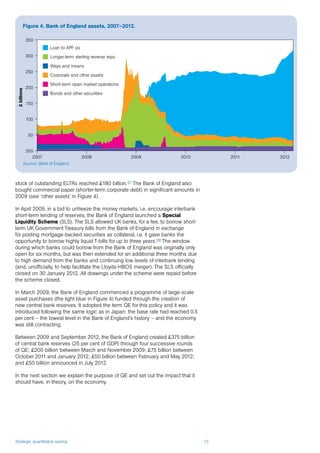
As shown in Figure 4, the bank has expanded its balance by a factor of five in
the five years since the financial crisis. What does this mean? The expansion
can be thought of in two distinct phases. The first phase, from the end of 2007
until the end of 2009, was mainly about stabilising the financial system by
injecting a massive amount of liquidity (central bank reserves or Treasury bills)
into the banking system following the credit crunch and the collapse of Lehman
Brothers in September 2008. Once the system stabilised, the second phase,
from 2010 onwards, has been about trying to kick-start the economy. Several
difference types of intervention have taken place:
Longer-term sterling reverse repos (green shading Figure 4) represent the
Bank of England expanding the purchases of assets at the height of the financial
crisis. The Bank of England also expanded the type of collateral it would accept
in exchange for three-month Treasury Bills from high-quality sovereign securities
to include AAA-rated residential mortgage-backed securities (RMBS) and
covered bonds. Initially, these extended-collateral long-term repos (ELTRs) were
offered in monthly auctions of £10 billion, with the sizes of subsequent auctions
reflecting financial market conditions at the time. In particular, in the wake of the
disruption to the global financial system in the autumn of 2008, these operations
were offered in greater size and at greater frequency, and the range of eligible
collateral was further expanded to include securities backed by commercial
mortgage assets and corporate debt. At their peak during January 2009, the
Box 1. Monetarism and the money multiplier myth
Monetarism, commonly associated with the economist Milton Friedman, is a school of economic thought which
emphasises the need for governments to control the quantity of money in circulation in order to stabilise the economy
and prevent excessive inflation or deflation. However, by ‘money’, monetarists historically meant central bank reserves
(and notes and coins) rather than credit from commercial banks. Initial monetarist theory rested on the existence of the
‘money multiplier’ to allow control over bank credit. This theory suggested that there is a mathematical link between
the quantity of base money and bank deposits in the economy. Since banks need reserves in order to settle payments
with each other, they will only create credit in relation to the reserves they possess. So by expanding base money, the
central bank can increase credit and vice versa.
The money multiplier theory is not supported by evidence, however. First, deregulation of the financial sector means
that banks have no obligation to hold any ratio of reserves to deposits. Secondly, the historical record shows us that
banks tend to lend on the basis of their confidence in the borrower and perceived profitability and then seek out the
necessary reserves required to settle any payments after making the loan.
Indeed the experience of monetarist policies in the UK confirms this. When the policy of ‘monetary base control’
proved ineffective at controlling bank credit, monetarist policies evolved to attempt control the growth of Sterling M3,
a broader measure of the money supply, through manipulating interest rates.
Central banks now widely see the money multiplier theory as outdated, agreeing that money creation is ‘endogenous’
– i.e. it cannot be controlled by the central bank through altering the quantity of central bank reserves.
Strategic quantitative easing 12
stock of outstanding ELTRs reached £180 billion.37 The Bank of England also
bought commercial paper (shorter-term corporate debt) in significant amounts in
2009 (see ‘other assets’ in Figure 4).
In April 2009, in a bid to unfreeze the money markets, i.e. encourage interbank
short-term lending of reserves, the Bank of England launched a Special
Liquidity Scheme (SLS). The SLS allowed UK banks, for a fee, to borrow short-
term UK Government Treasury bills from the Bank of England in exchange
for posting mortgage-backed securities as collateral, i.e. it gave banks the
opportunity to borrow highly liquid T-bills for up to three years.38 The window
during which banks could borrow from the Bank of England was originally only
open for six months, but was then extended for an additional three months due
to high demand from the banks and continuing low levels of interbank lending
(and, unofficially, to help facilitate the Lloyds-HBOS merger). The SLS officially
closed on 30 January 2012. All drawings under the scheme were repaid before
the scheme closed.
In March 2009, the Bank of England commenced a programme of large-scale
asset purchases (the light blue in Figure 4) funded through the creation of
new central bank reserves. It adopted the term QE for this policy and it was
introduced following the same logic as in Japan: the base rate had reached 0.5
per cent – the lowest level in the Bank of England’s history – and the economy
was still contracting.
Between 2009 and September 2012, the Bank of England created £375 billion
of central bank reserves (25 per cent of GDP) through four successive rounds
of QE; £200 billion between March and November 2009; £75 billion between
October 2011 and January 2012; £50 billion between February and May 2012;
and £50 billion announced in July 2012.
In the next section we explain the purpose of QE and set out the impact that it
should have, in theory, on the economy.
Figure 4. Bank of England assets, 2007–2012.
Source: Bank of England
355
50
100
150
200
250
300
350
2007 2008 2009 2010 2011 2012
£billions
Loan to APF (a)
Longer-term sterling reverse repo
Ways and means
Corporate and other assets
Short-term open market operations
Bonds and other securities
Strategic quantitative easing 13
3.1 How QE works
In January 2009 the Bank of England, together with the Treasury, created a new
vehicle for carrying out the QE programme of assets purchases – called the
Asset Purchase Facility (APF). When the MPC takes a decision to conduct more
QE, the Bank of England creates new electronic central bank reserves and
lends them to the APF by simply adding these numbers to the APF’s account.
It is important to note that the Bank of England has made a loan, and that the
intention is that at some point the loan will be repaid and these new reserves
will be withdrawn from the economy. For this reason the phrase ‘printing money’
is very misleading as it implies the permanent creation of new interest-free
money, not the temporary creation of money through making a loan at interest.
In this sense, the Bank of England is no more printing money than RBS is when
it extends credit to its customers.39
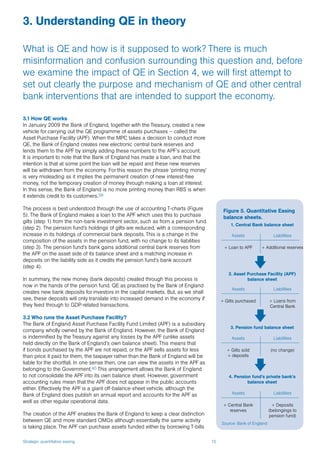
The process is best understood through the use of accounting T-charts (Figure
5). The Bank of England makes a loan to the APF which uses this to purchase
gilts (step 1) from the non-bank investment sector, such as from a pension fund
(step 2). The pension fund’s holdings of gilts are reduced, with a corresponding
increase in its holdings of commercial bank deposits. This is a change in the
composition of the assets in the pension fund, with no change to its liabilities
(step 3). The pension fund’s bank gains additional central bank reserves from
the APF on the asset side of its balance sheet and a matching increase in
deposits on the liability side as it credits the pension fund’s bank account
(step 4).
In summary, the new money (bank deposits) created through this process is
now in the hands of the pension fund. QE as practised by the Bank of England
creates new bank deposits for investors in the capital markets. But, as we shall
see, these deposits will only translate into increased demand in the economy if
they feed through to GDP-related transactions.
3.2 Who runs the Asset Purchase Facility?
The Bank of England Asset Purchase Facility Fund Limited (APF) is a subsidiary
company wholly owned by the Bank of England. However, the Bank of England
is indemnified by the Treasury against any losses by the APF (unlike assets
held directly on the Bank of England’s own balance sheet). This means that
if bonds purchased by the APF are not repaid, or the APF sells assets for less
than price it paid for them, the taxpayer rather than the Bank of England will be
liable for the shortfall. In one sense then, one can view the assets in the APF as
belonging to the Government.40 This arrangement allows the Bank of England
to not consolidate the APF into its own balance sheet. However, government
accounting rules mean that the APF does not appear in the public accounts
either. Effectively the APF is a giant off-balance-sheet vehicle, although the
Bank of England does publish an annual report and accounts for the APF as
well as other regular operational data.
The creation of the APF enables the Bank of England to keep a clear distinction
between QE and more standard OMOs although essentially the same activity
is taking place. The APF can purchase assets funded either by borrowing T-bills
3. Understanding QE in theory
What is QE and how is it supposed to work? There is much
misinformation and confusion surrounding this question and, before
we examine the impact of QE in Section 4, we will first attempt to
set out clearly the purpose and mechanism of QE and other central
bank interventions that are intended to support the economy.
Figure 5. Quantitative Easing
balance sheets.
1. Central Bank balance sheet
2. Asset Purchase Facility (APF)
balance sheet
3. Pension fund balance sheet
4. Pension fund’s private bank’s
balance sheet
Assets
Assets
Assets
Assets
+ Loan to APF
+ Gilts purchased
+ Gilts sold
+ deposits
+ Central Bank
reserves
Liabilities
Liabilities
Liabilities
Liabilities
+ Additional reserves
+ Loans from
Central Bank
(no change)
+ Deposits
(belongings to
pension fund)
Source: Bank of England
Strategic quantitative easing 14
from the Bank of England or by using central bank reserves created by the Bank
of England under the QE programme.
Members of the independent MPC decide on the quantity of assets that will be
purchased by the APF using Central Bank reserves. However, the APF itself is
staffed by Directors of the Bank of England and it is they, rather than the MPC,
who determine what type of assets will be bought by the APF.41 Specifically,
the Bank’s Executive Directors for Markets and Monetary Analysis and Statistics
make recommendations on the assets to be purchased to the Governor of the
Bank, who decides after consulting with the two Deputy Governors.42
Whilst the general public probably associates QE with the purchase of
government bonds, initially it was intended that corporate bonds be purchased
by the APF in exchange for Treasury bills. Only in February of 2009 was it agreed
that government bonds could also be purchased by the Bank of England, just
prior to the commencement of the large-scale purchase of assets funded by
new central bank reserves. The initial perceived importance of buying private
sector assets at the time is clear in Mervyn King’s letter to the Chancellor:
In order to facilitate an expansion of the monetary base through the Asset
Purchase Facility, the MPC proposes that gilt-edged securities be added
to the list of eligible assets set out in your letter of 29 January. I suggest
that the MPC be authorised to use the facility to purchase eligible assets
financed by central bank money up to a maximum of £150 billion but that,
in line with the current arrangements and in recognition of the importance
of supporting the flow of corporate credit, up to £50 billion of that should
be used to purchase private sector assets. Within those limits, the speed
and scale of purchases would be for the Committee to decide.
Mervyn King, Governor of the Bank of England43
Since this announcement however, the APF that has taken the decision to
purchase almost exclusively gilts, rather than any other kind of asset, such as
corporate bonds. We explain the significance of this decision next.
3.3 Theoretical impact of QE
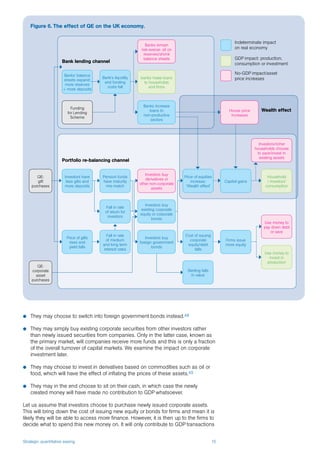
Figure 6 shows how QE could or should affect the economy. It is a complicated
process. The blue boxes (and corresponding arrows) are intermediate steps
where the outcome is indeterminate. The Bank of England is ultimately interested
in achieving the outcomes in the green boxes – they all involve the creation of
new GDP transactions and hence GDP growth. However, such outcomes are
uncertain and it would appear just as likely, if not more so, that the red outcomes
have occurred, given the current economic conditions. There are two main
channels through which QE is thought to impact on the economy; the bank
lending channel and the portfolio rebalancing effect.
3.3.1The portfolio rebalancing effect
The Bank of England has placed the most emphasis on the impact of QE on
changes in investors’ portfolios. As shown in Figure 6, the process is somewhat
drawn out. Purchase of gilts from financial investors by the APF creates new
deposits for those investors. The increase in central bank reserves (narrow
money) has led to an equal increase in bank deposits (broad money).44 The
important question for assessing the macroeconomic impact is what they will
do with these deposits. The theory is that this ‘shock’ to their portfolio will lead
to investors rebalancing their holdings by seeking out similar kinds of financial
assets (Box 2).45,46 They may want to do this for a number of reasons.
First, government bonds, particularly longer dated gilts (e.g. 10 or 25 years) will
have a higher rate of return than deposits. Secondly, certain kinds of investors, in
particular pension funds, will want to hold assets of longer maturity than deposits
as they have correspondingly long-dated liabilities.47
The hope is that investors will switch instead to corporate assets – bonds or
equities (shares) – that will in turn support businesses operating in the real
economy. However, investors have other options, as shown in the red boxes.
Strategic quantitative easing 15
P	 They may choose to switch into foreign government bonds instead.48
P	 They may simply buy existing corporate securities from other investors rather
than newly issued securities from companies. Only in the latter case, known as
the primary market, will companies receive more funds and this is only a fraction
of the overall turnover of capital markets. We examine the impact on corporate
investment later.
P	 They may choose to invest in derivatives based on commodities such as oil or
food, which will have the effect of inflating the prices of these assets.49
P	 They may in the end choose to sit on their cash, in which case the newly
created money will have made no contribution to GDP whatsoever.
Let us assume that investors choose to purchase newly issued corporate assets.
This will bring down the cost of issuing new equity or bonds for firms and mean it is
likely they will be able to access more finance. However, it is then up to the firms to
decide what to spend this new money on. It will only contribute to GDP transactions
Figure 6. The effect of QE on the UK economy.
Banks’ balance
sheets expand:
more reserves
+ more deposits
Portfolio re-balancing channel
Wealth effect
Bank lending channel
Funding
for Lending
Scheme
Banks remain
risk-averse: sit on
reserves/shrink
balance sheets
banks make loans
to households
and firms
Banks increase
loans to
non-productive
sectors
Bank’s liquidity
and funding
costs fall
House price
increases
Household
/ investors’
consumption
Investors/richer
households choose
to save/invest in
existing assets
Use money to
pay down debt
or save
Use money to
invest in
production
Price of equities
increase:
‘Wealth effect’
Sterling falls
in value
Cost of issuing
corporate
equity/debt
falls
Firms issue
more equity
Capital gains
Investors buy
derivatives or
other non-corporate
assets
Investors buy
existing corporate
equity or corporate
bonds
Pension funds
have maturity
mis-match
Fall in rate
of return for
investors
Fall in rate
of medium
and long term
interest rates
Investors have
less gilts and
more deposits
Price of gilts
rises and
yield falls
QE:
corporate
asset
purchases
QE:
gift
purchases
Investors buy
foreign government
bonds
Indeterminate impact
on real economy
GDP impact: production,
consumption or investment
No-GDP impact/asset
price increases
Strategic quantitative easing 16
and growth if it is invested in new production. In the current environment, it appears
larger firms are happier just sitting on cash. The Office of National Statistics recently
estimated that the UK companies were sitting on £750 billion in cash, 50 per cent
of GDP.51 Or companies might use the funds to pay down existing bank loans. This
will have the paradoxical effect of reducing the money supply.
3.3.2 The wealth effect
An additional potential consequence of portfolio rebalancing is known as the
‘wealth effect’. As investors buy more equities this should push up their price,
meaning holders of these assets will feel wealthier. They may choose to invest this
additional wealth in consumption which would contribute to GDP growth (although
it may not help the trade deficit if it involves buying goods that are imported).
However, again it is not clear that asset holders will do this. They might just buy
other kinds of existing assets or save the money. Academic research shows that
wealthier individuals tend to be less likely to spend any additional income on
consumption.52 Furthermore the impact on consumption for any consumer will
depend on whether they feel it is a long-term or merely a short-term improvement
in their economic position, and how the current increase in wealth affects their
confidence about their future financial prospects. It is also possible that banks,
which also hold assets, will also feel a ‘wealth effect’ because the value of their
capital will rise. They may then pass on this effect via charging lower rates of
interest.53
3.3.3 The bank lending channel
As commercial banks hold significantly higher levels of central bank reserves as a
result of QE, it is possible that additional liquidity and reduced cost of funding will
enable banks to increase their lending to the real economy, creating credit for new
GDP transactions. David Miles, a member of the MPC, in a speech in October 2011,
stated that:
When the Bank of England purchases gilts owned by non-banks, all else
equal, banks’ deposits rise as do reserve balances at the central bank. To
the extent that a bank’s reserve holdings would then come to exceed its
demand for liquidity, it is likely to be more willing to expand lending. Or, if a
bank had already lost some of its other funding, it might be able to avoid a
contraction in its lending or a sale of less liquid assets.54
Box 2: Government versus corporate bonds
Government bonds are the safest and most liquid form of financial asset, with the exception of cash or central bank
reserves. This is because governments very rarely (in the UK’s case, never) default on their debts, in contrast for
example to businesses (corporate bonds). The rate on government debt is thus often known as the ‘risk-free’ rate of
return. The desired return for investing in corporate bonds is the addition of the risk-free rate and the risk premium. Of
course, different people have different risk premia, depending on their own tolerance for risk and the companies they
are buying into. In general, however, as the risk-free rate goes up, the total return required for investing in corporate
bonds also increases and vice versa. At times of economic instability and declining corporate profitability, the risk
premia rises and the risk-free rate falls as investors turn to safer government debt. If corporate bond issuance to fund
investment becomes more difficult, this will be bad news for the economy, especially if, as at the present time, banks
and households are deleveraging rather than offering and taking out new credit.
QE involves the Bank of England trading one type of relatively safe IOU – gilts – for another: Bank of England reserves
which pays a lower rate of interest. The Bank of England targeted its purchases at the non-bank private sector – for
example, pension funds and insurance companies. It did this by buying gilts of longer maturity (3, 5, 10, or 25 years)
than the types banks would normally hold.50 As with any market, the purchases have the effect of increasing the
demand for gilts relative to supply, thus pushing up their price. At the same time, this has the effect of pushing down
the return that holders of such assets receive, known as the yield-to-maturity. This is because government bonds are
fixed-income assets – they pay out the same total amount in every period, known as the coupon. So the price and the
interest rate on gilts are inversely linked. As the demand for them and their price increases, the rate of return received
on them decreases.
Strategic quantitative easing 17
The first phase of QE in 2009, when £200 billion was injected in the space of just
six months, may have supported bank lending, or at least prevented a further fall
in credit creation, although the Bank of England has played down this effect in its
analysis.55 A number of other schemes aimed more directly at improving banks’
balance sheets were also underway at the time, including the Government
guaranteeing bonds issued by the banks (the credit guarantee scheme56), the
SLS, and the partial nationalisations of RBS and Lloyds via massive tax-payer-
funded re-capitalisations. These interventions would appear to support the
banking system more directly and hence prevent further contractions in lending.
Either way, the impact of expansion of central bank reserves on credit creation,
as mentioned in Box 1, is indirect and dependent entirely on banks’ confidence.
Their overall effect is likely to be limited, simply because banks were already
holding excess reserves before the policy was adopted. It is not obvious that
a significant increase in the amount of excess reserves will have any impact
on banks’ lending decisions. This is especially true since, as discussed earlier,
central bank reserves cannot in total be reduced by banks ‘lending the money’
– banks create new credit when they lend, for which they do not need reserves,
and the reserves at the central bank cannot in aggregate be reduced by banks
via any action of their own. Thus, in aggregate, banks must hold these large
reserve balances, and they currently receive 0.5 per cent interest on them.57
3.4 Funding for Lending
The ‘portfolio’ effect of QE described above might help larger businesses
who can issue equity and bonds but it does not help households or smaller
businesses that are not large enough to access the capital markets. They are
dependent, for larger loans at least, almost entirely on the banking sector.
Realising that QE did not address the problem of bank credit-creation, the Bank
of England introduced a new policy in July 2012 – the Funding for Lending
(FLS) scheme. This scheme more directly targets the banks and their lending,
rather than just creating new deposits in the financial sector. Banks create
money by buying assets or making loans, but they have to fund these loans
once the borrower spends the money. FLS lowers banks’ cost of funding if they
commit to particular kinds of bank lending – that is lending to households and
businesses.58
To understand FLS, it’s necessary to understand what is meant by bank ‘funding’.
When banks make loans, they also create deposits, as explained in Section 1.
But deposits are short-term liabilities which can be withdrawn without notice – or
‘on sight’. In contrast, banks’ loans – their assets – are typically longer term (e.g.
a mortgage might be 25 years). So banks typically have a maturity ‘mis-match’.
They fund long-term assets (loans) with short-term liabilities (deposits).
This is not a problem so long as there is not a sudden rush to withdraw large
quantities of electronic deposits from any particular bank or withdraw deposits
in the form of cash (in which case these liabilities leaved the banking system
entirely). However, at the present time banks are concerned about maturity mis-
match because there remain doubts about banks’ solvency following the financial
crisis. This means banks are seeking to improve the maturity match between
their assets and liabilities. So if a bank issues many 5-year business loans, they
may want the assurance that a good proportion of their liabilities are ‘term debt’
(e.g. fixed-rate bonds that cannot be withdrawn for one or two years) rather than
all being deposits.
Banks access such term debt from the capital markets and since the financial
crisis, the costs of such term debt have risen substantially as demand for longer
term liabilities has gone up. This high cost of funding, also driven by problems in
the Eurozone, makes banks reluctant to make more loans. Funding for Lending,
together perhaps with the European Central Bank’s announcement that it would
buy government bonds in whatever quantities were required to lower long-term
yields (‘Outright Monetary Transactions) has helped to bring the costs of bank
funding down.
Strategic quantitative easing 18
The FLS facilities are made for four years, i.e. once drawn down, the banks do
not have to repay for four years. This means the banks would have no maturity
mis-match risk on loans up to four years (which should cover the majority of
SME loans), and would probably be happy to leverage up on that by funding
additional loans from short-dated wholesale money. And obviously the funds
should work out a lot cheaper for the commercial bank than going to the capital
markets.
In March, the Government announced changes to the FLS scheme to make it
more orientated towards lending to SMEs rather than just for secured lending.
The amount, and cost, of the cheap money offered through the FLS is linked to
the degree to which banks expand their balance sheets by lending to the UK’s
businesses and households. Under the changes, for every £1 that participants
in the FLS expand lending to SMEs this year, the Bank of England will offer up
to £10 of additional funds, compared with £1 for loans to households. For SME
lending granted in 2014, the Bank of England will offer £5.
The scheme will now remain open for another year until the beginning of 2015.
In the March announcement, the Treasury also stated that alternative providers of
finance, such as financial leasing and factoring corporations, could be included
in the definition of FLS lending for the first time.
FLS is in line with the disaggregated Quantity Theory Credit, as it explicitly aims
to stimulate credit creation for GDP transactions rather than simply increasing
reserves in the banking system.59 If borrowers use the funds for consumption
(e.g. home improvement) then this will boost GDP. But if banks increase their
mortgage lending the outcome in terms of nominal GDP growth is somewhat
ambiguous. Mortgage lending may just increase house prices. If this happens, it
is possible that there may be some wealth effect in the short term, encouraging
more consumption, but in the long-term the higher monthly mortgage
repayments suffered by new entrants to the housing market paying inflated
house prices might reduce consumer demand.
Only lending to businesses can be more reliably viewed as resulting in an
increase in GDP transactions, without the negative effects of asset inflation or
consumer price inflation. It is for this reason perhaps that the Bank of England
chose in March 2013 to alter the terms of FLS to more specifically incentivize
lending to SMEs over mortgage financing.60
To summarise, all of these channels are indirect and all of them attempt to
stimulate the real economy by acting through the financial sector. Thus bond
purchase operations by central banks, including what is styled as QE, do not
create new credit or even deposits (purchasing power) directly in the hands of
households, businesses, or the Government. New deposits are created in the
non-bank financial (or investment) sector only.
Strategic quantitative easing 19
Attribution issues arise when it is not possible to isolate the impact of
one among many different causal factors. A number of other interventions
occurred at the same time as QE: a historically unparalleled drop in interest
rates, a massive increase in government spending as well as the liquidity
and recapitalisation policies mentioned in Section 3. Other countries – the
USA, Japan, and the Eurozone in particular – were also undertaking QE-type
policies meaning there were likely to be spill-over effects, in particular given the
internationalised nature of the UK economy.
The counterfactual problem is that we can never know what would have
happened if we had not carried out QE, so we can never truly know its impact.
We can only observe how the economy has changed. QE was initiated during
extraordinary economic times – with output and bank lending and confidence
in stock-markets collapsing in a fashion not seen since the Great Depression.
Finally, whilst analysis of changes in financial markets (asset prices, risk
spreads) is fairly amenable to direct observation, this is less true for broader
macroeconomic impacts where significant time lags may be present.
It may be for the latter reason that the vast majority of empirical studies of QE,
both in the UK and internationally, have concentrated on the impact of QE on
changes in financial markets. Such studies have been criticised for missing the
point; since the ultimate objective of QE was to boost nominal GDP and inflation,
measuring such intermediate variables appears not very useful.62,63 In this
section we review existing empirical studies, trying where possible to relate them
to effects on the real economy, reviewing both the portfolio re-balancing and
bank lending channels, including FLS, described in Section 3. We then examine
the impact of QE on government debt and the distributional affects. Finally, we
lay out our own analysis of potential drivers of growth in the UK economy from
1990 to 2013, concluding that bank credit creation for the real economy is the
most important determinant of GDP growth.
4.1. The portfolio re-balancing channel
4.1.1 Effect on gilt yields
QE does appear to have contributed to a lowering of medium- and long-
term government bond rates – the first phase of the portfolio rebalancing
objectives outlined in Section 3.64,65 The Bank of England estimates that QE
phase 1 reduced long-term gilt yields by around 100 basis points.66 However,
econometric studies suggest these effects may only have been temporary and
had most of their impact in the first round of QE in 2008/2009 at the height of
the crisis.67 For later actions, it is particularly difficult to disentangle this effect
from international dynamics that may affect foreign investors’ desire for UK
bonds. Most obviously, the problems in the Eurozone have undoubtedly made
gilts unusually attractive relative to Eurozone sovereign debt. Subsequent QE
interventions might also appear to have had less of an impact because markets
had already ‘priced in’ their probable occurrence.68,69 This ‘signalling channel’
– whereby the Bank of England makes its intention to buy up sovereign debt in
large quantities – is inevitably likely to be stronger the first time the intervention
was practised.
4. Assessing QE and Funding for Lending in practice
Studies by the Bank of England suggest that QE contributed around
1.5 per cent to GDP growth at its peak and boosted annual inflation
by around 1.25 per cent.61
The transmission mechanism from QE to
these figures is very complex however. There are both attribution and
counterfactual issues.
Strategic quantitative easing 20
4.1.2 Effect on exchange rates
Pushing down the availability and yield on UK Government bonds, and raising
their price may lead investors to instead purchase foreign government bonds
in order to maintain their portfolio risk and maturity profile, as described earlier.
To do so they would need to exchange their sterling for foreign currency, which
may put downward pressure on the exchange rate. The overall impact on sterling
will depend on the actions of other players, such as central banks, however. If
other central banks carry out similar purchases of their own sovereign debt, this
may cancel out the exchange rate devaluation – the ‘beggar-my-neighbour’ (or
‘currency war’) effect.
Whilst sterling has depreciated 20 per cent since the crisis, much of this can
be attributed to the sharp initial reduction in interest rates. Estimates by the
Bank of England and others suggest that the direct effect of QE interventions
on sterling is nearer 4 per cent.70 This could be seen to have made UK exports
more competitive and foreign imports less competitive, increasing demand for
domestic goods of services. Both these effects will boost GDP. This channel
could be quite weak, however, for a number of reasons. First, imports may
not fall, particularly if there are no domestic substitutes, and so the economy
faces higher prices – the so-called ‘cost push’ inflation. Secondly, even with
more competitive export prices, SMEs in particular may not be able to increase
production without bank credit. Thirdly, the UK commercial sector is dominated
by larger firms which invest abroad rather than export overseas.71 Finally, as
noted earlier, even despite the fall in interest rates and sterling, foreign investors
may have preferred sterling assets as the ‘best of a bad bunch’ during the
Eurozone crisis. Specifically, demand for gilts might have been increased by the
presence of a massive buyer in the gilt market (the APF) guaranteeing to support
the price of gilts. This increased demand for sterling would have mitigated the
depreciation effect of lower interest rates.
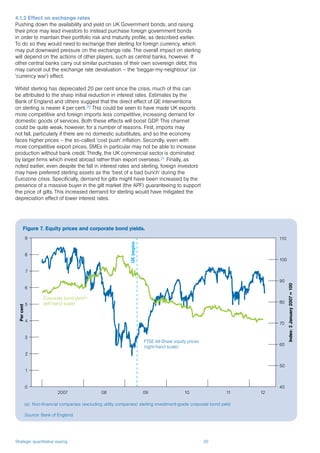
Figure 7. Equity prices and corporate bond yields.
Source: Bank of England
Corporate bond yield(a)
(left-hand scale)
FTSE All-Share equity prices
(right-hand scale)
QEbegins
0
1
2
3
4
5
6
7
8
9
40
50
60
70
80
90
100
110
2007 08 09 10 11 12
Percent
Index:2January2007=100
(a)	 Non-financial companies (excluding utility companies) sterling investment-grade corporate bond yield
Strategic quantitative easing 21
4.1.3 Effect on price and issuance of corporate assets
QE purchases of gilts appear to have helped boost equity prices which have
recovered to pre-crisis levels (Figure 7).73 Bank of England research estimates
that UK QE1 boosted equity prices by around 20 per cent.74 Again, however,
it is difficult disentangle international effects. In particular, the FTSE 100 is
closely correlated with the US Standard and Poor Index (S&P 500); it tracked
this very closely during the first phase of QE, modestly outperforming it, and
outperformed it more significantly in the second phase of QE by 2012.75
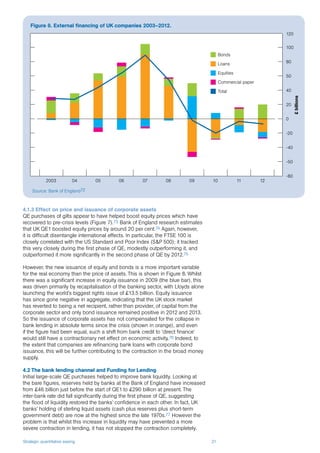
However, the new issuance of equity and bonds is a more important variable
for the real economy than the price of assets. This is shown in Figure 8. Whilst
there was a significant increase in equity issuance in 2009 (the blue bar), this
was driven primarily by recapitalisation of the banking sector, with Lloyds alone
launching the world’s biggest rights issue of £13.5 billion. Equity issuance
has since gone negative in aggregate, indicating that the UK stock market
has reverted to being a net recipient, rather than provider, of capital from the
corporate sector and only bond issuance remained positive in 2012 and 2013.
So the issuance of corporate assets has not compensated for the collapse in
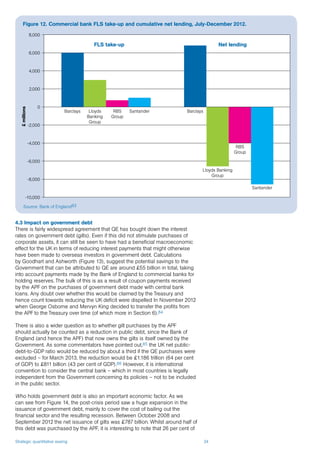
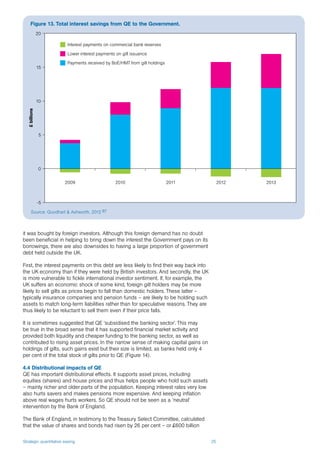
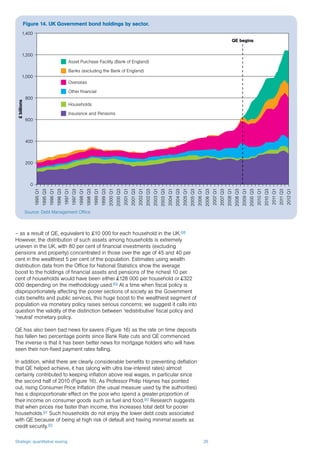
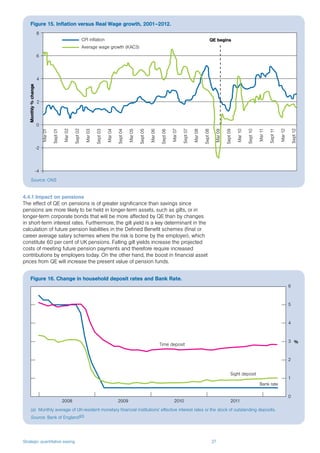
bank lending in absolute terms since the crisis (shown in orange), and even
if the figure had been equal, such a shift from bank credit to ‘direct finance’
would still have a contractionary net effect on economic activity.76 Indeed, to
the extent that companies are refinancing bank loans with corporate bond
issuance, this will be further contributing to the contraction in the broad money
supply.
4.2 The bank lending channel and Funding for Lending
Initial large-scale QE purchases helped to improve bank liquidity. Looking at
the bare figures, reserves held by banks at the Bank of England have increased
from £46 billion just before the start of QE1 to £290 billion at present. The
inter-bank rate did fall significantly during the first phase of QE, suggesting
the flood of liquidity restored the banks’ confidence in each other. In fact, UK
banks’ holding of sterling liquid assets (cash plus reserves plus short-term
government debt) are now at the highest since the late 1970s.77 However the
problem is that whilst this increase in liquidity may have prevented a more
severe contraction in lending, it has not stopped the contraction completely.
Figure 8. External financing of UK companies 2003–2012.
Source: Bank of England72
£billions
100
120
80
50
40
20
0
-20
-40
-50
-80
2003 04 05 06 07 08 09 10 11 12
Bonds
Loans
Equities
Commercial paper
Total
Strategic quantitative easing 22
0
5
10
15
20
25
2001-4 2005-7 2007-8 2008-9 2010-11 2011-12
11%
5%
8%
6%
15%
9%
16%
14% 14%
18%
19%
23%
Figure 9 shows the huge fall in the rate of growth of lending that occurred during
the financial crisis, from the beginning of 2008 to the autumn of 2009, split by
lending to households and individuals and to businesses (public non-financial
corporations (PNFCs)). The first phase of QE involved the purchase of £200 billion
of corporate and government bonds between March and November of 2009 and,
along with the other schemes to recapitalise the banks, would appear to have
played a role in stabilising lending to businesses and households. However, Figure
9 shows, lending has since flat-lined in the case of lending to households and
continues to contract in the case of business lending.
Particular attention has been paid to banks failing to lend to SMEs. Despite the
many schemes introduced by the Government and the Bank of England to boost
lending to SMEs (the credit guarantee scheme, Project Merlin, and now FLS)
there is little evidence of a recovery in lending, A recent comprehensive report
commissioned by the Department of Business painted a bleak picture of rising
rejection rates for both short- and longer-term financing for SMEs (Figure 10).79
Figure 9. Lending to the real economy, 2003–2012.
Source: Bank of England78
Percentagechangesonayearearlier
-10
-5
0
5
10
16
20
25
2004 2007 2010 2013
Sterling loans to PNFCs(a)
Sterling loans to PNFCs and households(b)
Loans to individuals(c)
(a)	 M4 loans excluding the effects of securitisations and loan transfers.
(b)	 Sterling loans by UK-resident monetary financial institutions (MFIs) and related specialist mortgage lenders excluding
the effects of securitsations and loan transfers. Funding for Lending Scheme measure. Non seasonally adjusted
(c)	 Sterling loans by UK-resident MFIs and other lenders. Excludes student loans.
Figure 10. SME bank debt rejection rates (including renewals) 2001/2012.
Source: BIS/NIESR80
Includes data on SMEs with bank debt
Overdrafts
Term loans
Strategic quantitative easing 23
Neither has the FLS so far created the pick-up in small business lending the
Treasury and the Bank of England were hoping for (Figure 11).
There are a variety of explanations as to why banks have not used the scheme.
The most obvious is that three of the UK’s major SME lenders, the partially
nationalised RBS, Lloyds, and Santander, appear to be actively shrinking
their loan books. Remarkably, in the first quarter of 2013, none of the four big
banks (Barclays, Lloyds TSB, RBS, and Santander) used the FLS scheme at all.
Meanwhile, whilst Barclays expanded its net lending by £1.2 billion (less than
each of the previous three quarters of the FLS), the other three large banks
further contracted their net lending: Lloyds by almost £1 billion, RBS by £1.6
billion, and Santander by £2.3 billion.
Of the Big 5 lenders, only Barclays and Nationwide increased net lending since
the introduction of the FLS.
In addition, the banking sector as a whole remains concerned about capital
ratios. In March, the Bank of England decided to force the banks to raise another
£25 billion of capital in the hope of rectifying this problem. We examine the
possibility of splitting the nationalised banks into good and bad banks in order to
properly clean up their balance sheets in more detail in Section 5.
Bankers and the central bank often suggest that a final problem has been a lack
of demand for loans from the SME sector (partially because of lack of success
in the past). Survey evidence suggests that the demand for new borrowing has
been very weak with Bank of England Credit Conditions Survey, Q1, reporting
a 28 per cent fall in demand for loans from small businesses, and around 8 per
cent fall from medium businesses.81 However, such surveys tend not to cover
the largest group of firms, namely micro-scale firms. The smaller the firm, the
larger the problem of credit rationing tends to be, as scale is perceived to be
linked to risk. The credit supplier finds it increasingly uneconomical, the smaller
the size of the borrower – a ‘diseconomy of scale’ for the economy that is
exacerbated by the increased concentration and size of the lenders in the UK.82
Source: Bank of England, table A8.1, code Z8Y8
Figure 11. Net lending to SMEs (excluding overdrafts) since introduction of FLS, £m, not seasonally adjusted.
-1,200
-1,000
-800
-600
-400
-200
0
200
400
2011May
2011June
2011July
2011Aug
2011Sept
2011Oct
2011Nov
2011Dec
2012Jan
2012Feb
2012Mar
2012Apr
2012May
2012June
2012July
2012Aug
2012Sept
2012Oct
2012Nov
2012Dec
2013Jan
2013Feb
2013Mar
2013April
£millions
Strategic quantitative easing 24
Figure 12. Commercial bank FLS take-up and cumulative net lending, July-December 2012.
Source: Bank of England83
£millions
-10,000
-8,000
-6,000
-4,000
-2,000
0
2,000
4,000
6,000
8,000
Barclays BarclaysLloyds
Banking
Group
Lloyds Banking
Group
RBS
Group
RBS
Group
Santander
Santander
4.3 Impact on government debt
There is fairly widespread agreement that QE has bought down the interest
rates on government debt (gilts). Even if this did not stimulate purchases of
corporate assets, it can still be seen to have had a beneficial macroeconomic
effect for the UK in terms of reducing interest payments that might otherwise
have been made to overseas investors in government debt. Calculations
by Goodhart and Ashworth (Figure 13), suggest the potential savings to the
Government that can be attributed to QE are around £55 billion in total, taking
into account payments made by the Bank of England to commercial banks for
holding reserves. The bulk of this is as a result of coupon payments received
by the APF on the purchases of government debt made with central bank
loans. Any doubt over whether this would be claimed by the Treasury and
hence count towards reducing the UK deficit were dispelled In November 2012
when George Osborne and Mervyn King decided to transfer the profits from
the APF to the Treasury over time (of which more in Section 6).84
There is also a wider question as to whether gilt purchases by the APF
should actually be counted as a reduction in public debt, since the Bank of
England (and hence the APF) that now owns the gilts is itself owned by the
Government. As some commentators have pointed out,85 the UK net public-
debt-to-GDP ratio would be reduced by about a third if the QE purchases were
excluded – for March 2013, the reduction would be £1.186 trillion (64 per cent
of GDP) to £811 billion (43 per cent of GDP).86 However, it is international
convention to consider the central bank – which in most countries is legally
independent from the Government concerning its policies – not to be included
in the public sector.
Who holds government debt is also an important economic factor. As we
can see from Figure 14, the post-crisis period saw a huge expansion in the
issuance of government debt, mainly to cover the cost of bailing out the
financial sector and the resulting recession. Between October 2008 and
September 2012 the net issuance of gilts was £787 billion. Whilst around half of
this debt was purchased by the APF, it is interesting to note that 26 per cent of
FLS take-up Net lending
Strategic quantitative easing 25
it was bought by foreign investors. Although this foreign demand has no doubt
been beneficial in helping to bring down the interest the Government pays on its
borrowings, there are also downsides to having a large proportion of government
debt held outside the UK.
First, the interest payments on this debt are less likely to find their way back into
the UK economy than if they were held by British investors. And secondly, the UK
is more vulnerable to fickle international investor sentiment. If, for example, the
UK suffers an economic shock of some kind, foreign gilt holders may be more
likely to sell gilts as prices begin to fall than domestic holders. These latter –
typically insurance companies and pension funds – are likely to be holding such
assets to match long-term liabilities rather than for speculative reasons. They are
thus likely to be reluctant to sell them even if their price falls.
It is sometimes suggested that QE ‘subsidised the banking sector’. This may
be true in the broad sense that it has supported financial market activity and
provided both liquidity and cheaper funding to the banking sector, as well as
contributed to rising asset prices. In the narrow sense of making capital gains on
holdings of gilts, such gains exist but their size is limited, as banks held only 4
per cent of the total stock of gilts prior to QE (Figure 14).
4.4 Distributional impacts of QE
QE has important distributional effects. It supports asset prices, including
equities (shares) and house prices and thus helps people who hold such assets
– mainly richer and older parts of the population. Keeping interest rates very low
also hurts savers and makes pensions more expensive. And keeping inflation
above real wages hurts workers. So QE should not be seen as a ‘neutral’
intervention by the Bank of England.
The Bank of England, in testimony to the Treasury Select Committee, calculated
that the value of shares and bonds had risen by 26 per cent – or £600 billion
Figure 13. Total interest savings from QE to the Government.
Source: Goodhart & Ashworth, 2012 87
£billions
0
-5
5
10
15
20
2009 2010 2011 2012 2013
Interest payments on commercial bank reserves
Lower interest payments on gilt issuance
Payments received by BoE/HMT from gilt holdings
Strategic quantitative easing 26
– as a result of QE, equivalent to £10 000 for each household in the UK.88
However, the distribution of such assets among households is extremely
uneven in the UK, with 80 per cent of financial investments (excluding
pensions and property) concentrated in those over the age of 45 and 40 per
cent in the wealthiest 5 per cent of the population. Estimates using wealth
distribution data from the Office for National Statistics show the average
boost to the holdings of financial assets and pensions of the richest 10 per
cent of households would have been either £128 000 per household or £322
000 depending on the methodology used.89 At a time when fiscal policy is
disproportionately affecting the poorer sections of society as the Government
cuts benefits and public services, this huge boost to the wealthiest segment of
population via monetary policy raises serious concerns; we suggest it calls into
question the validity of the distinction between ‘redistributive’ fiscal policy and
‘neutral’ monetary policy.
QE has also been bad news for savers (Figure 16) as the rate on time deposits
has fallen two percentage points since Bank Rate cuts and QE commenced.
The inverse is that it has been better news for mortgage holders who will have
seen their non-fixed payment rates falling.
In addition, whilst there are clearly considerable benefits to preventing deflation
that QE helped achieve, it has (along with ultra low-interest rates) almost
certainly contributed to keeping inflation above real wages, in particular since
the second half of 2010 (Figure 16). As Professor Philip Haynes has pointed
out, rising Consumer Price Inflation (the usual measure used by the authorities)
has a disproportionate effect on the poor who spend a greater proportion of
their income on consumer goods such as fuel and food.90 Research suggests
that when prices rise faster than income, this increases total debt for poorer
households.91 Such households do not enjoy the lower debt costs associated
with QE because of being at high risk of default and having minimal assets as
credit security.92
Figure 14. UK Government bond holdings by sector.
£billions
0
200
400
600
800
1,000
1,200
1,400
1995Q1
1995Q3
1996Q1
1996Q3
1997Q1
1997Q3
1998Q1
1998Q3
1999Q1
1999Q3
2000Q1
2000Q3
2001Q1
2001Q3
2002Q1
2002Q3
2003Q1
2003Q3
2004Q1
2004Q3
2005Q1
2005Q3
2006Q1
2006Q3
2007Q1
2007Q3
2008Q1
2008Q3
2009Q1
2000Q3
2010Q1
2010Q3
2011Q1
2011Q3
2012Q1
Asset Purchase Facility (Bank of England)
Banks (excluding the Bank of England)
Overseas
Other financial
Households
Insurance and Pensions
QE begins
Source: Debt Management Office
Strategic quantitative easing 27
4.4.1 Impact on pensions
The effect of QE on pensions is of greater significance than savings since
pensions are more likely to be held in longer-term assets, such as gilts, or in
longer-term corporate bonds that will be more affected by QE than by changes
in short-term interest rates. Furthermore, the gilt yield is a key determinant in the
calculation of future pension liabilities in the Defined Benefit schemes (final or
career average salary schemes where the risk is borne by the employer), which
constitute 60 per cent of UK pensions. Falling gilt yields increase the projected
costs of meeting future pension payments and therefore require increased
contributions by employers today. On the other hand, the boost in financial asset
prices from QE will increase the present value of pension funds.
Figure 15. Inflation versus Real Wage growth, 2001–2012.
Figure 16. Change in household deposit rates and Bank Rate.
Source: ONS
Source: Bank of England93
Monthly%change
-4
-2
0
2
4
6
8
Mar01
Mar02
Mar03
Mar04
Mar05
Mar06
Mar07
Mar08
Mar09
Mar10
Mar11
Mar12
Sept01
Sept02
Sept03
Sept04
Sept05
Sept06
Sept07
Sept08
Sept09
Sept10
Sept11
Sept12
CPI inflation
Average wage growth (KAC3)
QE begins
5
6
4
3
2
1
0
2008 2009 2010 2011
%
Time deposit
Sight deposit
Bank rate
(a)	 Monthly average of UK-resident monetary financial institutions’ effective interest rates or the stock of outstanding deposits.
Strategic quantitative easing 28
The Bank of England has argued that falls in government bond yields, which
will negatively affect the value of pensions, may have been offset by the rise
in corporate yields.94 However, for pension schemes whose liabilities (future
payments to employees) are already greater than their assets, QE will lead to
a proportionately greater increase in this deficit. In analysing the impact of the
first round of QE1, the Pension Corporation (2011) estimated that it increased
pension fund deficits in the UK by around £74 billion (after netting off equity
gains)— equivalent to £7.4 billion additional annual contributions by employers
over a 10-year period.95 Since QE began, there has been a sharp deterioration
in the liabilities of pension funds that were already in deficit, bringing down the
aggregate surplus/deficit significantly. 96
This worsening deficit position may be one of a number of factors behind UK
companies’ reluctance to invest more of their estimated £750 billion97 cash pile
on expanding production – a perverse outcome for QE which is a policy aimed
at boosting nominal demand and GDP growth.
4.5 Risks posed by QE
QE, as currently practised by the UK and other countries, carries with it a range
of risks and unintended consequences. Most obviously, there is a danger that
QE artificially inflates the value of certain assets, in particular equities and
commodities. Deprived of government debt, investors’ search for yield may
become increasingly detached from market fundamentals. The huge rise in
equity prices since 2009 (Figure 7) needs some explanation given the global
economy has been in a slump, unemployment is rising and many developed
economies have been cutting back on government expenditure. The combined
effects of large-scale asset purchases by western central banks – $7 trillion in
total up to now – appear to provide it.98,99
International financial institutions, including the World Bank, the International
Monetary Fund (IMF), and the Bank of International Settlements have
expressed concern about this phenomenon in recent times.100,101 In a recent
report, the IMF warned of signs of a ‘mispricing of credit risk’, a euphemism
for asset bubbles.102 It also estimated that losses from soaring bond yields –
and therefore falling values – could reach 6 per cent for the Bank of England
(although this, of course, assumes that the Bank of England will eventually
sell the bonds back in to the market). Both the IMF and the World Bank have
also pointed to the potentially destabilising effect on developing countries as
investors flood currency and commodity markets with QE funds. The IMF stated
in the same report that:
More generally, effects on Emerging Market Economies can be
destabilizing if amplified by market imperfections and relatively shallow
markets. The limited ability to absorb capital and the tendency to trade
on short-term trends can cause excessive currency appreciation and
volatility, unsustainable credit expansion, and asset price bubbles
(including in commodities, especially those held as assets, like oil).
These could eventually undermine financial stability.
There was a large financial outflow from the UK following the first round of
QE103,104 alongside major inflows in developing countries – in particular East
Asia and the Americas – suggesting investors were using the funds to buy up
assets in these countries. The recent announcement of the potential unwinding
of QE in the U.S. has caused considerable volatility in stock markets and in
emerging market economies.
4.6 Empirical evidence on drivers of GDP
As mentioned earlier, a flaw with many of the empirical studies of QE is that
they focus on intermediate variables – typically financial market prices or
yields – rather than on the ultimate goal of QE, nominal demand, or GDP
growth (nominal means not adjusted for inflation). Another problem is that the
time period for analysis is so short and the economic and financial dynamics
so extraordinary that counterfactual analysis and attribution become major
problems.
Strategic quantitative easing 29
Our empirical quantitative research on the effects of QE, which develops earlier
work by co-author Richard Werner,105,106,107 attempts to overcome these
problems in two ways. First, we examine the impact of a wide range of different
monetary policy variables, including QE-related variables, directly on nominal
GDP growth, the ultimate goal of QE. These are laid out in Table 1, along with
their hypothesised effects. Secondly, we use a long quarterly time series,
stretching back to the first quarter of 1990 and up to the last quarter of 2012, a
total of 92 observations.
To further capture the historical dynamics of the period under question, we also
regressed four ‘lags’ of each variable (i.e. the result in the corresponding quarter
of the year before) and also included lags of the dependent variable (nominal
GDP growth). This provides us with a total of 34 different independent variables.
We also include a ‘dummy’ variable to adjust for the effect of the financial crisis.
A full explanation of the methodology along with a range of statistical tests and
data sources is provided in the Technical Appendix.108
Table 1. Variables and their hypothesised effects.
Variable
Variable name
(Quarterly Year-
on-Year change) Hypothesised effect
Bank Rate (the bank of
England interest rate charged
to banks for holding reserves)
Bankrate Standard monetary policy
impact – reduce interest rate
leads to increased growth
Quantity of reserves in the
banking system
Reserves More reserves in the banking
system reduces liquidity and
funding costs and leads to more
bank lending and increased
growth
Bank of England total assets BoETA ‘Portfolio rebalancing effect’ –
as the bank takes more safe
assets on to its balance sheet
and pushes up prices, it should
stimulate investors to switch
to corporate assets (bonds or
equities), leading to increased
business investment
Qualitative easing – the
ratio of long-term assets
(government bonds) to Total
Assets held on the Bank of
England’s balance sheet
QualEasing ‘Portfolio re-balancing effect’
– by pushing down medium
and long term interest rates on
government bonds, investors
should again be incentivized to
buy corporate assets.
Broad money – the broadest
deposit aggregate
M4 Increase in broad money will
have portfolio re-balancing
effects as investors switch out
of deposits and in to higher
yielding corporate assets.
Bank credit to the real
economy (excluding the
effects of securitization)
M4LREx Credit creation by banks for
GDP transactions should directly
create growth
Our ‘general-to-specific’ methodology involves sequentially reducing the least
significant of the independent variables in the general model down until we are
left with a parsimonious109 specific model, as shown in Figure 17 (the General
model is in the Appendix). Our results suggest changes in bank credit creation
to the real economy (with a one-year time lag – M4LREx_1) are the most
important predictor of GDP growth, taking into account the relative impact of all
variables on GDP and their lags.
Strategic quantitative easing 30
Table 2. Parsimonious model of Ordinary Least Squared general-to-specific
model of QE variables regressed on to Quarterly Year-on-Year GDP growth,
1990 Q1: 2012:Q4 (92 observations).
Coefficient Std. Error t-ratio p-value
const 0.0200038 0.00281726 7.1004 <0.00001 ***
YoYM4LREx_1 0.0918259 0.025919 3.5428 0.00064 ***
Crisis Dummy -0.0363168 0.00544343 -6.6717 <0.00001 ***
YoYGDP_1 0.453059 0.0891117 5.0842 <0.00001 ***
YoYGDP_2 0.335024 0.0941462 3.5585 0.00061 ***
YoYGDP_4 -0.291836 0.0686314 -4.2522 0.00005 ***
Mean dependent var 0.047987 S.D. dependent var 0.023799
Sum squared resid 0.008481 S.E. of regression 0.009931
R-squared 0.835448 Adjusted R-squared 0.825881
F(5, 86) 87.32633 P-value(F) 3.40e-32
Log-likelihood 296.8744 Akaike criterion -581.7489
Schwarz criterion -566.6182 Hannan-Quinn -575.6420
rho -0.003576 Durbin's h -0.064769
Changes in interest rates and increases to ‘broad money’ (increased deposits in
the hands of investors and banks) do not appear to have had any significant effect
on nominal GDP growth even in non-recessionary periods (e.g. 1993 to 2008) –
both variables drop out of the specific model. Likewise the proposed ‘portfolio re-
balancing’ instruments, ‘QualitativeEasing’ and changes to total Bank of England
assets. The lags of GDP (e.g. YoYGDP_2) remain in the parsimonious model, but this
is quite a standard result for quarterly time series data.
As shown in Figure 17, the results support the Quantity Theory of Credit110 which
postulates that nominal GDP growth is a function of credit creation for GDP
transactions. It is found that the relationship between credit creation for the real
economy and nominal GDP is close for the whole 12-year period under analysis,
with the exception of the crisis period itself where credit creation appears to lag GDP
growth. We believe this may be due to the impact of automatic stabilisers111 coming
into effect as the recession emerged and also the international effects described
earlier, in particular the action of the Federal Reserve. The UK banking system,
meanwhile, took much longer to recover for reasons already described in detail.
Figure 17. Bank lending to the real economy versus growth rate of nominal GDP. 1990, Q1 to 2012,
Q1 (Quarterly, not seasonally adjusted).
YoYM4LREex
YoYGDP
-0.1
-0.05
0
0.05
0.1
0.15
0.2
1990 1995 2000 2005 2010
QuarterlyYearonYeargrowthrate
Strategic quantitative easing 31
4.7 Summary
For a range of reasons, QE has appeared to have a limited impact on bank
lending, which our empirical analysis suggests is a key driver of nominal GDP.
The portfolio rebalancing effect hasn’t appeared to be very strong either.
Investors, companies and (richer) households seem to prefer holding on to the
extra liquidity or wealth that QE has provided them with rather than invest their
money in GDP-related transactions. The reasons for this are no doubt manifold
but surveys suggest a major barrier to investment is a simple lack of confidence
in the economy and future demand for goods and services.112 This lack of
confidence rose significantly in 2008 and has remained high relative to historical
levels at around 60 per cent of respondents. Inability to raise external finance
is also cited by over 10 per cent of respondents which is also high by historical
standards.
Meanwhile, the banking system remains equally stymied. Despite the more
direct intervention of the FLS, key parts of the sector are deleveraging and
reducing their balance sheets at just the time the Government needs them
to be doing the opposite. Once they have built up their capital to the levels
required by the Bank of England, no doubt they will start to become more willing
to lend again. But UK banks had been failing to invest in SMEs and other parts
of the productive economy for decades even before the financial crisis.113 We
conclude that more urgent and direct action is warranted to re-boot and re-
balance the UK economy, and the next section sets out proposals for how this
can be achieved.
Strategic quantitative easing 32
5. Strategic QE: kick-starting the real economy
It was estimated at the time that one out of ten commercial aircraft
in Canada was pledged to the Industrial Development Bank and
that a person could probably travel from one end of the country to
the other on aircraft mortgaged to the Bank, being handed on from
one borrowing company to the next.
E. Ritchie Clark114
It is clear … that what a great nation can ‘afford’ in periods of crisis
depends not on its money but on its man power and its goods.
Russia, Italy, Germany, Japan, the United States, all used money
in the situations mentioned, but money was obviously not the
dominant factor. Man power and materials were the dominant
factor. Yet at other times, when crisis was not so acute, the money
for necessary tasks could not be found. Unemployment, insecurity,
want, dragged on. This is a puzzling paradox. At certain times a
nation can afford what at other times, with no less money, it cannot
afford. At certain times we are afraid of national bankruptcy, and at
other times we give it hardly a thought.
Stuart Chase, 1943, Economist, engineer
and adviser to Franklin Roosevelt and Lyndon Johnson.115
So there clearly is spare capacity. But I think it’s also the case that if
demand were to pick up quickly then there would be a period over
which demand could grow at much faster rates than at present and
would bring forth the supply that would meet that demand.
Mervyn King, Governor of the Bank of England116
Our econometric modelling shows that the most important macroeconomic
variable driving GDP growth is likely to be credit creation by banks for the real
economy. QE and the Bank of England’s other polices have failed to sufficiently
stimulate this kind of lending. The Government needs a different kind of
‘monetary activism’.117
We assess two options for more targeted use of QE funding: first a massive
purchase of illiquid assets from those banks which are most in need of a
balance sheet clean-up;118,119 secondly, getting new money into the real
economy directly via the purchase of bonds in institutions – such as public
development banks or housing associations – with a remit to invest directly in
the real economy.
Strategic quantitative easing 33
There is a strong case that both these options would be likely to enhance the positive
impact of QE on the real economy. The channels by which this is achieved, set out
in Figure 18, are much simpler than the reliance of existing asset purchases on the
portfolio rebalancing, wealth, and bank lending channels described in Section 4.
5.1 Purchasing non-performing assets from UK banks
In this final press conference, the out-going Governor of the Bank of England,
Mervyn King, was asked about his actions during the crisis, and specifically whether
the banks’ bad debts had been sufficiently recognised and dealt with. His answer
was unequivocal: the Bank of England made it clear at the time (although not
publicly) that a more radical recapitalisation was necessary.120 King’s answer is
revealing. With the benefit of hindsight, he clearly believes the Government and the
Bank of England should have done more to clean up the commercial banks’ balance
sheets. How might the new Governor, Mark Carney, make good on King’s regret?
The most obvious way of doing this would be for the Bank of England to re-start the
purchase of non-government assets, in particular non-performing assets or loans
which banks lack confidence will be repaid at market rates. The SLS and FLS can
both be seen as interventions that addressed this problem to an extent in that they
enable banks to temporarily swap illiquid assets for Treasury Bills that can be used
access reserves. Ultimately though, such schemes do not address the banks’ need
to enhance their capital adequacy ratios since the risk remains on the commercial
banks’ balance sheets. These risks are considerable, as set out in a statement by
the FPC which identified the following additional capital requirements for UK banks
arising over the next three years:121
P	 Additional losses of around £30 billion on specific high-risk loan portfolios,
including exposures to UK commercial real estate and vulnerable euro-area
economies.
P	 Additional costs of around £10 billion in relation to claims for mis-selling.
P	 Additional capital requirement of roughly £12 billion from applying a more
prudent approach to risk weights in the banking book (raising risk-weighted
assets by some £170 billion, equivalent to roughly £12 billion of capital at a 7 per
cent equity capital ratio)
Taken together, the effect of these three adjustments would be equivalent to around
a £50 billion reduction in the regulatory capital of the major UK banks and building
societies. The FPC also stated that further increases in capital will be required to
meet full Basel III compliance, the surcharge on systemically important banks, the
new trading book capital regime, and the UK Government’s implementation of the
Independent Commission on Banking (ICB) recommendations.
Figure 18. Strategic QE channels to stimulating the economy.
GDP transactions/
growth
Banks make loans
to households firms
Banks increase loans
to non-productive
sectors
Strategic QE 1:
APF purchases bonds
issued by Housing
Associations/BIB/GIB
Strategic QE 2:
APF purchases illiquid
assets in RBS/Lloyds
Investment or
lending in new
infrastructure/homes
Banks capital
adequacy ratios
directly improve
Investors seeking
long-term secure
assets co-invest
Strategic quantitative easing 34
To address the coming capital crunch in the UK banking sector, the APF could
purchase illiquid assets from the banking sector as was done between March and
December 2009 (see Section 2.3.4) and has been done to a much larger extent by the
Japanese, US, and European Central banks.122,123,124,125 King has expressed concern
that such action risks the Bank of England incurring losses for taxpayers, and as such
is a decision for the Chancellor, not for the Monetary Policy Committee.126
There are two responses to this. First, any assets bought by the APF are indemnified
by the Treasury and so ultimately owned by the taxpayer rather than the Bank of
England. Secondly, RBS (and to a lesser extent Lloyds) are now effectively nationalised
banks and so the taxpayer is already at risk in the case of these two banks. There have
been widespread calls for RBS to be recapitalised and broken up to create greater
competition in the banking sector, including by the Business Secretary, Vince Cable,
two members of the Parliamentary Committee on Banking Standards and by nef.127
The APF could play the role of the ‘bad bank’, holding the illiquid assets on its balance
sheet and freeing up the ‘good bank’ to focus on retail lending.
5.1.1.	 Credit-easing: How QE worked more effectively in the USA
The Federal Reserve began large-scale purchases of longer-term securities in
November/December 2008. It concentrated on purchases of agency mortgage-
backed securities (MBS) rather than government debt (the term ‘agency’ is used
because the securities were held by government-owned mortgage enterprises, Fannie
Mae and Freddie Mac). In March 2009, the Federal Open Market Committee (FOMC)
announced a major increase in the scale of purchases – raising ceilings on purchases
of agency MBS and agency debt to $1.25 trillion and $200 billion, respectively (shown
in orange in Figure 19).128
Figure 19. Federal Reserve and Bank of England assets compared.
Source: Charles Schwab; Bank of England129
$billions
0
500
1,000
1,500
2,000
2,500
3,000
Feb 07 Feb 08 Feb 09 Feb 10 Feb 11 Feb 12 Feb 13
Mortgage-backed securities
Liquidity to key credit markets
Lending to financial institutions
Long-term government
debt purchases
Traditional security holdings
0
50
100
150
200
250
300
350
£billions
Long-term government debt purchases
Corporate and other assets
Lending to financial institutions
including collateral ‘swaps’
Short-term open market operations
Ways and means
Traditional security holdings
Strategic quantitative easing 35
We can see from Figure 19 that whilst the size of asset purchases was not
dissimilar in total, close to half of the Fed’s purchases was made up of these
MBS securities (orange colour). The US Central bank has effectively taken
$1.5 trillion of illiquid and underperforming financial sector assets on to its own
balance sheet, massively improving the balance sheets of all those US banks
exposed to the credit crisis. And as part of its QE3 programme, the Fed has
announced the initiation of further purchases of MBS at a rate of $40 billion every
month, amounting to close to half of its total stimulus of $85 billion per month.
In contrast, the Bank of England offered short-term relief to banks through its SLS
and now FLS but the quantities and time period were much smaller. The Fed’s
equivalent of QE – the purchase of longer-term Treasury securities – began later
(shown in blue in Figure 20) and involved maintaining the existing dollar stock of
purchased securities on its balance sheet by reinvesting proceeds from agency-
related securities investments in longer-term Treasuries.
Theoretical modelling suggests that purchases of securities with some private
risk (i.e. asset-backed securities) have stronger effects than purchases of
government bonds – i.e. the USA’s ‘credit-easing’ approach should give a
significantly stronger boost to US GDP than the UK Quantitative Easing policy.130
And it is certainly the case that US lending to the real economy, in stark contrast
to the UK, has recovered to pre-crisis levels (Figure 20).
There may also a stronger demand-side impact from the purchase of MBS.
One of the Governors of the Fed, Jeremy Stein, has stated that he believes the
purchase of MBS has greater impact on GDP ‘dollar-for-dollar’ than the purchase
of bonds because of its effect on lowering household mortgage rates and thus
raising household disposable income and spending.131
Japan also engaged in large-scale asset purchases from the banking system in
an earlier, much larger banking crisis (1945). Despite its much larger scale and
the much larger dependence of the corporate sector on borrowing from banks
(100 per cent in the early post-war years, as capital markets remained basically
Figure 20. US bank lending to businesses. (commercial and industrial loans, seasonally adjusted,
annual growth rate, break adjusted).
Source: Federal Reserve Board 2013
Annualgrowthrate,%
-30
-20
-30
0
10
20
30
1996
Q4
2000
Q1
2003
Q2
2006
Q3
2009
Q4
2013
Q1
Largescaleassetpurchaseprogrambegins
Strategic quantitative easing 36
£Trillions
0
0.5
1.0
1.5
2.0
2.5
2001 2002 2003 2004 2005 2006 2007 2008 2009 2010 2011 2012 2013 2014 2015 2016
closed), this crisis did not result in noticeable reductions in economic growth or
economic activity. Bank credit growth recovered significantly within a year and
Japan’s economy could tackle the vast challenges of rebuilding a bombed-out
economy.132 Why the Bank of Japan chose not to adopt this highly successful
policy in the 1990s is subject to some debate.133
Nevertheless, the Bank of England was probably the pioneer of such measures of
purchasing non-performing assets from the banks in order to support the economy.
This happened in August 1914 and shortly thereafter. It had been found that the
declaration of war on Germany and its allies by the UK at that time had rendered
many major UK financial institutions bankrupt, since international bills of exchange,
bills of trade, and other financial instruments issued by these enemy nations
had to be considered unenforceable and hence in default. However, London
had been the world’s financial centre where such international instruments had
been traded and thus were held to a significant extent by UK financial institutions.
Since the outbreak of the Great War was not considered to be an ideal time for a
banking crisis, the Treasury and the Bank of England took the most efficient step to
solve the non-performing asset problem in the banking system: the central bank
purchased these instruments, at prices far exceeding any perceived market value
(it was indemnified by the Treasury, but these indemnities were not needed and
never used). The operation was successful without direct costs to taxpayers.134
5.2 Direct lending for real economy investment
There has been a range of proposals for how QE could be targeted to more directly
meet the needs of the UK economy and create growth.135 Such interventions could
do more than just meet the short-term need for GDP growth. As can be seen in
Figure 21, UK banks prefer making loans that are secured against existing property
or to other financial institutions rather than making loans that support productive
activity. This was the case for many years prior to the crisis. Figure 23 does not
appear to represent an efficient market allocation of capital unless we believe that
favouring asset bubbles over productive investment is efficient.
Figure 21. Net bank lending by sector 1997–2012.
Source: Bank of England136
Unsecured to individuals
Secured to individuals
Financial sector
Real estate
Public sector
Productive lending
Strategic quantitative easing 37
The lack of productive lending by banks has been exacerbated by a fall in
government capital investment as a percentage of GDP since the crisis (Figure 22).
This is now significantly lower than our major competitors (Figure 23). Although
the government has bought forward some capital spending, since 2010, public
investment has fallen from £50 billion (3 per cent of GDP) to £28 billion (1.5 per cent),
and is forecast to drop to £25 billion next year and £22 billion the year after.137 That
the UK needs large-scale infrastructure investment in transport, energy, and housing
is widely accepted and has been laid out in detail elsewhere.138,139 How to fund such
investment with patient, low-cost capital remains a more difficult problem, however.
Source: World Bank
Figure 22. UK Gross Fixed Capital Formation 2000/2011.
Figure 23. Gross Fixed Capital Formation as a % of GDP in selection of G20 countries.
%ofGDP
14
14.5
15
15.5
16
16.5
17
17.5
18
17.11
16.81 16.79
16.39
16.67 16.72
17.1
17.79
16.83
15.01
14.91
14.29
Ireland 11.5
14.3
14.7
18.2
18.5
20.1
22.9
23.1
29.5
45.5
UK
US
Germany
EU
Japan
Spain
Russia
India
China
0 5 10 15 20 25 30 35 40 45 50
Source: World Bank
Jan
2001
Jan
2002
Jan
2003
Jan
2004
Jan
2005
Jan
2006
Jan
2007
Jan
2008
Jan
2009
Jan
2010
Jan
2011
Jan
2000
Strategic quantitative easing 38
We propose that the APF could purchase bonds in intermediaries that specialise
in providing funding to particular sectors of the economy that are recognised
as having spare capacity. The existence of spare capacity and/or unfulfilled
demand provides prima facie evidence of market failure, which should ensure
compliance with EU state aid regulations (although this is a complex area where
further research, including expert legal opinion, is required to define the precise
structures and terms and conditions required to ensure compliance).
The advantages of this proposal are as follows:
P	 Investment via purchase of newly issued bonds is a small evolution from
current practice. Indeed, as the original mandate of the APF was to purchase
corporate bonds, it may be seen as more in keeping with the intended
purpose of the Treasury in authorising the creation of the APF than the
purchase of government bonds.
P	 Purchase of newly issued bonds, rather than existing bonds in the secondary
market, provides a direct injection of capital into the economy instead of relying
on financial investors to reallocate capital through the portfolio rebalancing
effect.
P	 The use of intermediaries ensures an appropriate division of responsibilities
between investment professionals that have the expertise to assess and select
individual companies and projects, and economists at the Bank of England
who have the expertise to identify economic sectors that require capital
investment. We examine governance issues in more detail in Section 6.2.
P	 The provision of patient capital to intermediaries is likely to provide
opportunities to ‘crowd-in’ private finance by giving confidence to private sector
investors.
P	 The terms of finance can either be at market rates or preferential rates. Market
rates would allow for sale of bonds by the APF into the secondary markets at
a later date, preserving maximum flexibility around monetary policy and also
developing the breadth and depth of UK bond markets. Alternatively, low-cost
finance via bonds with very low coupon rates held by the APF until maturity
would expand the range of feasible projects to include economically beneficial
investment that cannot be provided by the private sector because of extensive
social or environmental externalities. This precedent has been set already by
FLS and Help to Buy, both of which provide funding and guarantees at non-
commercial rates to commercial banks. FLS funding can be accessed for as
little as 0.25 per cent per annum.140
One of the key obstacles to injecting funds into the real economy under strategic
QE (or indeed tax-funded government investment programmes) is finding the
means of deploying investment rapidly and efficiently. We examine a range
of options which either exist already, or could be utilised with relatively little
institutional and regulatory change:
1.	 National development banks, building on the British Business Bank (BBB) and
the Green Investment Bank (GIB).
2.	 Housing construction, via a new intermediary to fund construction of new
homes for social and affordable rent.
3.	 Housing retrofit, via the Green Deal Finance Company.
We do not consider this to be an exhaustive list and certainly should not preclude
other options. They are intended to illustrate that strategic QE is possible in
practice.
5.2.1 Capitalising national development banks
We suggest that the APF could fund the GIB and the BBB.141 The current and
planned capital base for these institutions – £4 billion of new capital is being
invested – suggest they will not be of a size or scale to make a material difference
Strategic quantitative easing 39
to productive investment that the UK economy needs. Comparisons with the UK’s
key international competitors are not favourable (Figure 24). These institutions
should get banking licenses, in order to be able to lend beyond their capital –
currently they are better described as ‘funds’ that leverage existing private sector
capital.142 However, even in their current form, the GIB and the BBB could issue
long-term, investment-grade bonds that would be bought by the APF.
There are precedents for central banks supporting the SME sector, including
the Canadian Industrial Development Bank (the IDB) which, from its inception in
1944 until 1975, was entirely funded with central bank money creation and cost
the taxpayer nothing (Box 3). National and pan-national investment banks today
include the Nordige Bank, the European Investment Bank (EIB), the Council of
Europe Development Bank, the Banco Nacional de Desenvolvimento Econômico e
Social (BNDES) in Brazil, the Kreditanstalt für Wiederaufbau (KfW) in Germany, the
Japanese Finance Corporation, and the Chinese Development Bank, all of which
are considerably larger in scale than the current UK equivalents. These organisations
have been highlighted as key to strategic investment and innovation in these
countries, in particular by de-risking long-term capital projects that the private sector
would otherwise be reluctant to support.143,144
The GIB has already demonstrated the potential of ‘crowding in’ private sector
investment, attracting in £1.67 billion worth of private capital for projects it funded
to the tune of £635 million. But these figures pale in comparison with the German
KfW which has assets of half a trillion euro, making it roughly twice the size of the
World Bank (Figure 26). It lent €70 billion in 2011, with about a third going to energy
and climate change investments, including €24 billion from 2009 to 2011 on energy
efficiency in homes, which leveraged a total investment of €58 billion.145
The need for public investment banks to support vital infrastructure and
SME lending that would otherwise not be undertaken by the private sector is
demonstrated by the mandates given to such banks in other countries (Box 4).
Source: World Bank and respective institutions
Figure 24. Assets of selected public investment banks as a % of
GDP (2011).BalanceSheetas%ofGDP
0%
2%
4%
6%
8%
10%
12%
14%
16%
18%
20%
KfW (Germany) BNDES (Brazil) JFC (Japan) GIB + BBB (UK)
Strategic quantitative easing 40
Box 3: The Canadian Industrial Development Bank.
The Canadian government established the Industrial Development Bank (IDB), as a subsidiary of the Canadian
Central Bank, with a specific remit to support the SME sector in 1944. The IDB was one of the first ever development
banks and became one of the largest and most successful.146 The important role of the central bank and monetary
policy is made clear in the preamble to the Act which saw the IDB come in force, with the purpose of the bank:
to promote the economic welfare of Canada by increasing the effectiveness of monetary action through
ensuring the availability of credit to industrial enterprises which may reasonably be expected to prove
successful if a high level of national income and employment is maintained, by supplementing the activities
of other lenders and by providing capital assistance to industry with particular consideration to the financing
problems of smaller enterprises.147
As with UK banks today, the Canadian chartered banks showed little interest in the kind of medium- or long-term
loans that Canadian businesses needed to rebuild their economy. The IDB was set up to plug this financing gap
and any business that requested funds would have to demonstrate that it could not attain them at reasonable rates
from a commercial bank first.
There were concerns in the Canadian parliament that the IDB would create a conflict of interest for the central bank
which was also charged with regulating the country’s economy. However, the then Deputy Minister of Finance did
not see this as a concern, arguing that the link between the two banks would be beneficial to the central bank. It
would have ‘more intimate contact… with the conditions and the problems of small and medium sized industries’.
Further, ‘the operations of the IDB will naturally have to dovetail into the country’s monetary policy’, and a corporate
link between the two banks would make this easier.148
Despite gloomy forecasts that IDB would help only bankrupts and ‘lame duck’ businesses, in its 31 years the IDB
authorised 65 000 loans totalling $3 billion for 48 000 businesses that were considered by the Bank (as required by
the IDB Act) to be unable to obtain the financing elsewhere on reasonable terms and conditions. Well over 90 per
cent were successful in establishing themselves and retiring their IDB loans. It was estimated that they employed
close to 900 000 people. Most of the Bank’s borrowers were small; the average loan was $47 000 and 48 per cent
of the loans authorised were for $25 000 or less.149
In his history of the IDB, former employee E. Ritchie Clark records that:
The Bank assisted in just about every kind of business and program imaginable, from setting up a new pipe
mill or refinery to helping a young lawyer acquire his own law library. It was active in every part of Canada,
and in some remote areas such as the Yukon was a major factor in economic growth. The IDB was probably
the most important source of financial support from commercial air services apart from the mainline
operations, for motels and other kind of tourist services, and for many kinds of manufacturing such as small
and medium sized lumber operations and the production of hosiery.150
The IDB was entirely funded via the creation of reserves by the Bank of Canada which bought all of its bonds in its
31 years, with not a single penny from the tax payer.
The IDB was initially funded by the purchase of $25 million equity stock by the Bank of Canada. By starting off with
only equity money and no borrowed funds, the new Bank was to have a favourable start and develop some strength
and attractiveness in its operating record before it should have to borrow and pay interest. By end of 1947, all $25
million of stock had been taken down leaving IDB with significant surplus funds. These were invested in government
securities. By 1951, virtually all equity funds had been used up in the IDB’s loans, and it was starting to look into
ways of borrowing.
The IDB charged a 5 per cent flat rate of interest on all of its loans, no matter what the size or sector of business,
which was 2 per cent above the average commercial rate of the time. It earned considerable interest on surplus
cash from interest – $600 000 as compared to income from loans totalling $550 000 – which was important in
enabling IDB to meet its operating expenses in the early years.151
Strategic quantitative easing 41
5.2.2 Buying housing association bonds for new home construction
Alternatively, or in addition, APF funds could be used to support the construction
of new low-cost housing, a call already made by a number of organisations and
experts in the housing area.152,153,154
Construction has long been recognised as an important source of growth in
the UK economy. While it only contributes around 7 per cent to GDP directly,
when the entire construction value chain is included the figure goes to 13 per
cent, with around three million people employed in 2010.155 Estimates put the
construction ‘multiplier’ at around £1:2.84, much higher than most sectors.156
Construction work is especially good for generating local jobs and local
economic activity, with over 90p in every £1 of construction spending retained
locally and 93 per cent of the supply chain sourced domestically. As the vast
majority of the 263 000 firms are classed as SMEs, the sector can also harness
this growth potential.157 In addition, the sector places little reliance on imports,
with 93 per cent of intermediate consumption (its supply chain) being
accounted for by UK-based suppliers and considerable export potential.158
Construction jobs are also estimated to be around 75 per cent more labour
intensive than service sector jobs and well suited to apprenticeships and youth
training schemes.159
Yet in 2012 alone, 89 000 jobs were lost in the construction sector160 and, after
a brief resurgence in 2010, the sector has contracted in all but two of the last 10
quarters (Figure 25).
Whilst the fall-off in demand for some kinds of construction, in particular out-
of-town shopping centres and business parks, is likely part of an inevitable
readjustment to long-term trends following the credit bubble of 2000–2007,
there remains enormous pent-up demand for new housing. As shown in Figure
26, home completions remain at historic lows. House-building was particularly
vulnerable to the financial crisis because the vast majority of new homes are
now built by the private sector which is itself dependent on bank credit, both
directly and via the mortgage market. When mortgage lending collapsed in
2008, so did home building. It has yet to recover.
Box 4: Mandates of a selection of national and supranational state
investment banks.
Institution Mandate or mission statement
KfW (Germany) To sustainably improve the economic, social, and ecological condition of peoples’
lives.
Small Business Administration (USA) To aid, counsel, assist, and protect the interests of small business concerns, to
preserve free competitive enterprise and to maintain and strengthen the overall
economy of our nation.
BNDEs (Brazil) To contribute to the economic development of Brazil, including sustainable socio-
economic development, technological innovation and the modernisation of public
administration.
Council of Europe Development Bank Strengthening social cohesion in Europe.
•	 Strengthen social integration
•	 Manage the environment
•	 Support public infrastructure with a social vocation
Nordic Investment Bank To promote sustainable growth by providing complementary financing based on
sound banking principles which strengthen competitiveness and enhance the
environment.
European Investment Bank To support projects which make a significant contribution to growth, employment,
economics and social cohesion and environmental sustainability in Europe and
beyond.
Strategic quantitative easing 42
But even if private sector house building was to recover, the great need in the UK is
for more affordable housing, rather than housing per se. Historically, local authorities
created social and affordable housing and more recently housing associations have
been contributing but the volume remains small. The UK has spent almost £2 billion
housing homeless families in short-term temporary accommodation, according to a
recent study.161
We would argue that the APF should consider purchasing bonds for new house-
building that could be issued by housing associations, local authority housing
companies, or perhaps via a Public Interest Company (PIC) with a remit to build
homes that it will sell on to private or social sectors in the future.
A Housing Investment Bank or public interest company
A financial intermediary would be required in order to fairly allocate APF funds
across the UK. One option would be the creation of a third publically owned
investment bank, a National Housing Bank. Alternatively, a PIC could be set up with
a remit to build homes that it will sell on to private or social sectors in the future,
as suggested by construction expert Brian Green.162 A housing bank or PIC could
choose either to buy the bonds at market rates, ensuring they would tradable in
the secondary market, or at a subsidised rate in order to enable more homes to
be provided at social and affordable rents, perhaps as low as the 0.25 per cent
currently offered by the Treasury and the Bank of England in the FLS.163
Both the CBI and trade unions have called on the Government to boost capital
spending on housing and construction. In an independent inquiry into affordable
housing published last summer by a group of housing agencies, NGOs and trade
unions, a call for £5–10 billion QE investment in housing was made and it was
estimated this would deliver around 60 000 new homes and enable developments
that are currently stalled to proceed. In the same report, The National Housing
Federation argues that investment to deliver just 10 000 homes would deliver
75,000 jobs and make a contribution of £4 billion to the wider economy. It would
also save £290 million from the social security bill by reducing housing benefit and
Jobseeker’s Allowance claims.164
Figure 25. Construction – quarterly % change, 2009–2013.
Source: ONS
0
-2
-4
-6
-8
2
4
6
8
Q3
2009
Q4 Q1
2010
Q2 Q3 Q1
2011
Q2 Q3 Q4 Q4Q4 Q1
2012
Q2 Q3 Q1
2013
%
Strategic quantitative easing 43
Green argues that the Bank of England should buy £50 billion worth of bonds in a
time-limited PIC with a remit to build homes that it will sell on to the private or social
sectors in future. He estimates that it would bring in £10 billion to the Treasury from
the jobs created, based upon the estimate that every unemployed construction
worker put back to work nets the Treasury £25–£30 000 in benefits saved and taxes
generated. The Home Builders Federation estimates that every home built creates
1.5 jobs directly and twice that number in the supply chain, so £10 billion (£20 000
x 500 000 homes) is a fairly conservative estimate. Rents could cover payment of
interest in the short term and future surpluses on sale proceeds could go back to
the Government.165
If the Treasury is looking for a precedent for the potential economic impact of house
construction, it should look back to the 1930s when a huge house-building boom
played a vital role in pulling the UK out of the Great Depression at a faster rate than
many other countries. In 1930 there were about 800 000 workers in the UK building
industry, but by 1939 this number had risen to over a million. The number of new
dwellings built each year averaged over 300 000 during this period – far higher than
the average of just 184 000 between 2000 and 2010.
Whilst the funding for this expansion in the 1930s was through borrowing, the
New Zealand government achieved a similar expansion in house building by
utilising direct credit creation by its central bank – The Reserve Bank of New
Zealand (Box 5).
Issuing house-building bonds
Increasing difficulty in obtaining reasonably priced loan finance for housing has
led to the growth of bond finance, either directly, as in the case of large housing
associations, or by participation in aggregated bonds as in the case of smaller
associations.169, 170
Source: DCLG
Figure 26. Housing completions by tenure, 1949–2012.
0
50,000
100,000
150,000
200,000
250,000
300,000
350,000
400,000
450,000
1949
19511
1953
1955
1957
1959
1961
1963
1965
1967
1969
1971
1973
1975
1977
1979
1981
1983
1985
1987
1989
1991
1993
1995
1997
1999
2001
2003
2005
2007
2009
2011
All Dwellings Local Authorities
Private Enterprise Housing Associations
Strategic quantitative easing 44
However, transaction costs, in time and money, remain high in this emerging market
and there is also the requirement for a strong credit rating. Even if all of these
hurdles are overcome, market conditions and investor confidence are fragile in
current economic conditions. Therefore, we argue that the proposal for the APF to
purchase housing bonds is building on current trends and would help to stimulate
a major new investment asset class. Over the medium to longer term, this may help
to ‘crowd-in’ private finance which would help to counter problems with EU state aid
regulation.
In fact, the construction of social housing has always been subsidised, and remains
so even if the Government has moved away from direct capital subsidy towards
offering state-backed guarantees to investors in English housing associations. If the
taxpayer is already on the hook by the offer of loan guarantees, then surely there
can be no objection in principle to finance from the APF, which is also guaranteed
by the Treasury?
Irrespective of the subsidy argument, however, it is hard to think of an asset less
risky in terms of future returns than a new home, especially in the UK. A home is a
highly tradable asset and in the long run retains its value, with new homes normally
gaining added value as the communities they create mature.172 It is for this reason
that it is estimated that to rebuild the UK’s housing stock would cost less than half
the asset value.
We would not argue that QE funding for house-building alone would solve the many
issues with the UK housing market, some of which are set out briefly in Box 6.
Box 5. Central Bank public works investment in New Zealand, 1935–1939.
In 1934, New Zealand (still a British colony at the time) established its own (partially privately owned) central bank,
the Reserve Bank of New Zealand (RBNZ), with the blessing of the Bank of England. The main objective of the
Conservative government of the time was to stabilise the national currency and help reflate the economy following the
Great Depression. The New Zealand pound was pegged to sterling and subject to major fluctuations in international
commodity prices, with New Zealand highly dependent on Britain and Australia for both imports and exports. Following
a devaluation of the NZ£, the central bank began to hold foreign reserves and smooth out these fluctuations.
In 1935, the incoming Labour government made a number of changes to the form of functioning of the RBNZ in its
1936 Reserve Bank Amendment Act. The Act nationalised the organisation completely, with the state buying out the
Bank’s private shareholders, provided more scope for the Bank to extend credit to the government and its agencies,
and also added a power that allowed the Reserve Bank to vary the reserve requirements on trading banks.166
The incoming finance minister, John Nash, was determined to use the RBNZ as a tool to support the massive
fiscal expansion the Labour party thought necessary to shift the economy out of recession and tackle the massive
unemployment problem. This broad remit, going well beyond price stability, saw the Reserve Bank being used to
support government spending in the form of credit creation for the real economy. The two most notable uses of this
policy were RBNZ being used to guarantee farm prices, with shortfalls between market and guaranteed prices met by
its advances, and credit for housing finance.
Nash ordered the Reserve Bank to make advances available as a deliberate test of the effect of ‘a limited amount of
credit expansion’ for the building of state housing. The sum involved was significant at £5 million. The new homes built
were mainly for poorer households and targeted New Zealand’s most serious slums. Aside from housing, the Reserve
Bank supported a range of other infrastructure and public works activities and supported farmers by guaranteeing
their exports. In total, in the period from 1936 to 1939, the RBNZ created NZ£30 million of credit to support the
government. In the latter two years this was 5 per cent and 7 per cent of GDP and 13 per cent and 17 per cent of
commercial bank assets.
According to detailed econometric analysis by Greasley and Oxley, the RBNZ’s expansionary credit policy was a key
feature in reflating the domestic economy and enabling the country to grow more rapidly out of the 1930s depression
than many other countries. Over the four year period from when the Bank commenced its credit creation policies, real
GDP increased by 30 per cent,167 with 15 per cent growth in 1936 and 1937 alone.168
Strategic quantitative easing 45
5.2.3 Financing the Green Deal
The Green Deal is a government initiative to finance the retrofitting of building to
higher energy efficiency standards. Owners face a big disincentive to invest in such
improvements if they sell the building before reaping the benefits of cost savings.
Under the Green Deal, the cost of investment can be repaid by the building owner
over time through their energy bills, and unlike a conventional loan it stays with the
building when ownership changes hands. The Green Deal also makes financing
such improvements easier, with repayments made out of the energy cost savings.
Financing for the initiative is being arranged by a new not-for-profit financial
intermediary, the Green Deal Finance Company, which has secured funding from
the GIB, among others, and is also seeking funding from the EIB.174 An estimated
£14 billion of financing will be required according to government estimates.175
However, take-up has been slow so far with fewer than 200 contracts signed up
in the first five months of 2013, out of 19 000 assessments undertaken.176 Part
of the reason might be the cost of finance. Homeowners will pay a rate of nearly
7 per cent, which is more than the rate of interest on most domestic mortgages.
In contrast, programmes from the German investment bank, KfW, retrofitted one
million homes in a three-year period between 2006 and 2009. This has to be
seen in the context of differences in the whole suite of energy and climate change
policies between the UK and Germany, but one key difference is the financing cost.
A representative deal for a whole-house energy refurbishment financed through a
KfW loan is 1 per cent fixed for 10 years.177
The APF is currently paying a rate of interest to the Bank of England of 0.5 per
cent, and the lowest rate that can be accessed by commercial banks under the
FLS is even less at 0.25 per cent. Purchasing bonds in the Green Deal Finance
Company at such low rates of interest could help unlock significant demand for
building refurbishment which would create significant employment and re-skilling
opportunities.
Box 6. Addressing structural problems with the UK housing market.
There are numerous issues with the UK housing market, including, as we have seen, a volatile and bubble-prone
mortgage lending market, supply constraints due to bureaucratic planning rules, tax arrangements and subsidies
that favour private home ownership over other forms of tenure, the house-building sector itself being concentrated in
the hands of a handful of large construction companies that are prone to ‘land-banking’ (waiting to build until prices
rise) and, relatedly, the windfall benefits of infrastructure development being concentrated in the hands of these
developers and private homeowners.
As a result, houses in the UK are increasingly bought as assets or investments rather than places to live. This is in stark
contrast to many other countries, where different institutional and tax arrangements and constraints on lending have
led to better balanced tenure distributions, a more diverse and competitive home-building sector building better quality
homes, and stable home prices, with profits from land appreciation being evenly spread across communities.171
Local authorities could do what is standard practice in other European countries, and use their rights to purchase (even
compulsorily) agricultural land at agricultural market prices, before changing the land-use permission. Alternatively,
innovations in mutual or co-operative land ownership enable the benefits of rising land values to be retained in
common, while buildings are privately owned.173
Strategic quantitative easing 46
The proposals set out in Section 5 represent practical options for more effective
targeting of QE. We believe this enhanced monetary activism would better enable
the Bank of England to deliver on both its primary aim of price stability and also the
subsidiary aims of delivering on the Government’s economic policy objectives.
However, targeted QE does raise important issues of governance and
accountability. In this section we examine these issues and propose modifications
to existing institutional arrangements that can meet these challenges.
6.1 Central bank independence and fiscal neutrality: myth and reality
The separation between monetary and fiscal policy and central bank independence
over monetary policy has been held up as key reason behind the relatively benign
economic conditions enjoyed by western economies in the 15 years prior to the
financial crisis. By providing central banks with operational independence and a
strong focus on price stability, the idea was that not only actual inflation, but also
inflationary expectations would be ‘anchored’. This would be beneficial for the
economy since both companies and households would feel confident to plan
investments well in to the future.
The financial crisis of 2007–2009 does not, astonishingly, seem to have led to
much questioning of this division.179 This is despite the fact that the crisis was
largely the result of central banks failing to prevent the build-up of massive inflation
in a key sector of economy: the housing market.180 But this arrangement is not one
with a long historical precedent.
6.1.1 A brief history of central banking
Whilst most people probably think of central banks as public institutions, for the
majority of their history they have been privately owned. Most, however, were
nationalised after the Great Depression and World War II as governments felt
they needed more control over this power of money creation to rebuild their
economies.181 In many countries, governments and central banks worked
closely together to devise policies that led to high rates of growth and low
unemployment.
6. The implementation challenge: good governance
Independent central bankers tend to get very squeamish about
expressing support for any particular government proposal…
Tragedies have occurred, however, when [they] let worries about
the perception that they are too close to the fiscal authority prevent
them from doing something constructive in times of crisis… It is
critical… that we do not get caught up in a ‘You first, my friend’,
‘No, after you, my good sir’, routine over who should make the
first overture to whom… Even in places where relations between
fiscal and monetary policymakers are constructive and not fraught
by distrust, there is a tendency for joint efforts to fall between the
cracks due to turf considerations and natural divisions of labour.
We just have to be transparent about this, and we should get going.
Adam Posen, Monetary Policy Committee member, 2009-201278
Strategic quantitative easing 47
Central bank remits in this period were wide. They included achieving GDP growth
generally and growth in particular in industrial sectors, high employment, exchange
rate targeting to promote exports and financial stability, as well as price stability.182
There were no turf wars between fiscal and monetary policy. Then in the 1970s, with
high levels of inflation, concerns grew that central banks were not paying enough
attention to price stability. By the 1990s, the idea of central bank operational
independence had taken off. To maintain low levels of inflation and to anchor
expectations about future (low) inflation, it was thought that central banks should
become operationally independent from the government of the day. Not only that,
but they should be given a very clear remit to focus on inflation targeting as their
primary goal, above and beyond broader macroeconomic objectives.
For a lengthy period this policy seemed to work. It appeared possible to have
historically low inflation and stable growth. The ‘Great Moderation’ came to an
abrupt end with the worst financial crisis since the Great Depression in 2007–2009.
Suddenly, the narrow focus on inflation and the independence of central banks had
been called in to question.
6.1.2 The remit of the Bank of England
One reason that the Bank of England might be reluctant to engage in the kind of
strategic QE policies we have discussed is that it might be perceived as being
outside of its remit. What exactly is the Bank of England’s remit?
The Bank of England is a public institution whose broad role, accordingly, is to serve
the public interest. This was not always the case, since it was privately owned until
1946, when the Attlee government nationalised it.183 The Bank of England Act of
that year transferred the Bank of England’s capital stock to the Treasury and brought
the Bank ‘under public control’.184 The Bank of England is wholly owned by the
Government but accountable to Parliament. Each year, it is required to submit its
Report and Accounts to Parliament, via the Chancellor of the Exchequer. The 1946
Act also lays out how the Bank of England would relate to the Treasury and other
banks. The Act states that:
The Treasury may from time to time give such directions to the Bank as, after
consultations with the Governor of the Bank, they think necessary in the
public interest.
And that:
The Bank, if they think it necessary in the public interest, may request
information from and make recommendations to bankers, and may, if so
authorised by the Treasury, issue directions to any banker for the purpose of
securing that effect is given to any such request or recommendation:
Provided that:-
no such request or recommendation shall be made with respect to the
affairs of any particular customer of a banker; and
before authorizing the issue of any such directions the Treasury shall give
the banker concerned, or such person appears to them to represent him, an
opportunity of making representations with respect thereto.
This remit is obviously quite wide. In theory, it gives the Treasury ultimate control
over the Bank of England which in turn has a lot of power over commercial banks.
However, the activity of the Bank of England has, over time, become quite narrowly
focused on monetary policy with a clear separation between this and fiscal policy.
What then is ‘monetary policy’?
6.1.3 Defining monetary policy and its connection to fiscal policy
In the 1980s, under the influence of monetarism, central banks began to focus
more narrowly on price stability, a feature that in Britain was politically popular
following the rampant inflation of the 1970s. In 1992, this shift towards maintaining
low inflation was formalised, with the Government giving the Bank a formal inflation
target range of 1–4 per cent. Six years later, the Bank of England was given
Strategic quantitative easing 48
operational independence in the setting of monetary policy, altering the target to 2.5
per cent,185 and adding a clause to the end of the above statement in regard to the
direction the Treasury could give to the bank: [except in relation to monetary policy].
The 1998 Act also set out more formally the bank’s objectives, stating:
In relation to monetary policy, the objectives of the Bank of England shall
be—
(a) to maintain price stability, and (b) subject to that, to support the
economic policy of Her Majesty’s Government.186
The Government’s economic policy objective is:187
…to achieve strong, sustainable and balanced growth that is more evenly
shared across the country and between industries. This objective recognises
that over a number of years preceding the recent financial crisis, economic
growth in the UK was driven by unsustainable levels of private sector
debt and rising public sector debt. This pattern of unbalanced growth and
excessive debt helped to create exceptional economic challenges in the UK.
The Government also handed over control of financial regulation to the independent
Financial Services Authority (FSA). Following the financial crisis of 2007–2009, the
Bank of England’s remit has been significantly broadened. The 2009 Banking Act
gave the Bank of England a statutory objective to protect and enhance the stability
of the financial systems of the United Kingdom and the Court, consulting HM
Treasury and on advice from the newly formed Financial Policy Committee (FPC), in
determining the Bank’s strategy in relation to that objective.188
None of this, however, really tells us a lot about the monetary/fiscal policy divide.
It would appear there is nothing in writing to guide policy in this area. Rather,
we seem to be dependent on statements, mainly by the Bank of England, to
understand the divide. The most comprehensive statement we could find in recent
years was made by Mervyn King in a speech last October:189
The role of the Bank of England is to create the right amount of money,
neither too much, nor too little, to support sustainable growth at the target
rate of inflation. We are not doing it at the behest of the Government to
help finance its spending. It is the independence of the Bank that allows us
to create money without raising doubts about our motives. But just as it is
crucial that governments do not control the printing of money, so too the
unelected central bank must not determine the levels of taxes and public
spending.
Fiscal policy is a matter for elected governments. There has been some talk
about the possibility that money created by the Bank could be used directly
to finance additional government spending, or even that money could be
given away. Abstracting from the colourful metaphor of ‘helicopter money’,
such operations would combine monetary and fiscal policies.
There is no need to combine them because, as now, once the Bank has
decided how much money should be created to meet the inflation target,
the case for the Government to increase spending or cut taxes to counter a
downturn stands or falls on its own merits… Not only is combining monetary
and fiscal policies unnecessary, it is also dangerous. Either the government
controls the process – which is ‘bad’ money creation – or the Bank controls
it and enters the forbidden territory of fiscal policy.
This is a remarkable statement for a number of reasons. First, it implies that the
Bank of England can actually determine, reasonably effectively, what the ‘right
amount of money’ is in the economy. But the financial crisis – and indeed nearly
all major twentieth-century banking crises – was the result of excessive money
creation by the banking sector, as a number of studies show and as Adair Turner,
former Chairman of the FSA has recently stated.190,191,192 If Mervyn King accepts
this, then he must also accept that the Bank of England got its estimations of the
Strategic quantitative easing 49
‘right amount’ of money in the economy completely wrong in the period leading up
the financial crisis.
The reality is that 97 per cent of the money in circulation is created by commercial
banks and just 3 per cent by the central bank.193 And deregulation between
the 1970s and 2000s has meant that the Bank of England has chosen to have
increasingly little, if any, control of over commercial bank credit creation (see also
Box 1 on the money multiplier myth). Rather, ‘banks make loans first and search
for the reserves later’ in the words of Federal Reserve Banker, Alan Holmes.194 The
central bank must always ensure there are sufficient reserves in the banking system
or it will collapse, with catastrophic results for the economy.
Mervyn King terms ‘bad money creation’ a situation where the government of the
day controls the process of money creation. One wonders, then, what the Governor
would call the 370 per cent increase in mortgage credit created by the banking
system in the period 1997–2007 that eventually contributed to the financial crisis.
Presumably, this is ‘good’ money creation? Such a distinction purely on the basis
of whether money creation is in public or private hands appears to us to be simply
ideological rather than grounded in evidence.
If the Bank of England has virtually no control over the amount of money in
circulation and where it is allocated, the argument for a strong divide between
monetary and fiscal policy to ensure central bank ‘independence’ is undermined.
Monetary policy, defined as control over the creation and allocation of money, would
then appear to be entirely in the hands of commercial banks. The Bank’s role is not
to scrutinise or direct such activities, hence providing some element of democratic
accountability, but to prop up this system by supporting such commercial banks
(for the sake of the wider economy) by ensuring there is sufficient liquidity in the
system.
There is then a very strong democratic and economic argument to say that current
arrangements need reform. Furthermore, as this report has detailed in Sections 2
and 3, QE does favour certain sectors of the market economy over others. Buying
government bonds would appear to increase asset prices and thus support (mainly
large) UK private companies and that very concentrated part of the UK population
that holds such assets. It is not clear why this kind of monetary policy is any more
neutral than buying corporate bonds issued by agencies with a remit to invest in
infrastructure or home-building or SMEs. Indeed, one might argue the onus is on
the Bank of England to demonstrate why it has not bought assets to support these
neglected sectors of the economy as to do so would surely more evenly balance
out the fiscal impact of QE policies.
At one point during 2011, it did look as if the Treasury and the Bank of England
were about to enact a policy – ‘credit easing’ – that would have supported the SME
sector through Bank of England purchase of securitized SME loans.195 Many were
in favour of such an intervention, including former MPC member Charles Goodhart
who makes the same point that such an intervention is not really any less or more
‘fiscal’ than existing QE:
This [credit easing] proposal, however, runs into the question whether such
a mechanism should be regarded as primarily fiscal, and within the purview
of the Ministry of Finance, rather than monetary. Such lending would both
involve risk and involve intervention in markets to shift relative prices. Indeed
so, but existing QE in whatever form involves risk, even if collateralized, and
also shifts relative prices; that is, after all, largely the purpose of the exercise
via portfolio effects.196,197
6.1.4 The blurring of the monetary/fiscal policy dividing line
Recent developments suggest the ice may be melting on the monetary/fiscal
policy divide. Most obviously, these are the addition to the Bank’s remit of ‘financial
resilience’ and the creation of the Financial Policy Committee (FPC). The FPC’s job
is to conduct ‘macroprudential policy’ which involves assessing system-wide risks to
the resilience of the economy and which has powers of direction to intervene where
it considers unsustainable risk is building up.
Strategic quantitative easing 50
The FPC’s powers include the ability to influence bank credit creation via making
adjustments to the amount of capital banks must hold against assets, both in
total and by sector. Specifically, the FPC will bring in to force Sectoral Capital
Requirements (SCRs).198 Thus if the FPC felt that excessive lending was being
created for the real estate or domestic housing market, posing system risk to the
economy, it could increase SCRs on these types of loans. It would also provide
targeted incentives for banks to limit the expansion of riskier exposures. The list
of indicators upon which the FPC can alter SCRs includes Bank leverage ratios,
average mortgage risk-weights, balance sheet interconnectedness (with other
banks), intra-financial borrowing growth, derivatives growth, overseas concentration,
credit growth to household and commercial real estate, debt-to-profit/income ratios
for companies, households and non-bank financial intermediaries, price-to-rent
ratios, loan-to-value- and-income ratios, and spreads on corporate and mortgage
lending.199,200
Even if the objective of SCRs is financial system resilience rather than GDP growth,
they appear to be a first step towards the Bank of England regaining the power to
more directly control credit creation and allocation in the economy. Senior members
of the FPC, including Andy Haldane, and former member Adair Turner have already
questioned whether the FPC should also have explicit powers to encourage more
bank lending to particular sectors, the SME sector in particular.201,202
Rather than being a radical departure in to the dangerous land of credit allocation, if
the Bank of England was to take up Haldane and Turner’s proposal, it would simply
be returning to what was quite standard practise in the post-war period. Then the
Bank of England had its own (informal) qualitative and quantitative credit controls,
known as ‘moral suasion’. As reported in a review of monetary policy in the 1960s,
this was effective in limiting the total amount of credit banks could create and set
quotas for specific sectors, always according priority to export finance.203,204,205
It should be noted that this period of credit guidance coincided with high rates
of growth and employment in the UK and similar positive correlations have been
observed in a range of other development and developing countries.206,207 In
contrast, cross-country studies where central banks have focused strictly on
inflation targeting and left credit creation and allocation to ‘the market’, suggest
there is no positive effect on nominal GDP growth or employment.208
Other recent examples of fiscal/monetary ‘blurring’ include the decision by the
Treasury to move the profits of the APF on to the Government’s balance sheet
(Section 3.4) and, to some extent at least, the FLS. Some commentators suggest
the FLS involves the Bank of England taking risk of a particular type on to its
balance sheet without indemnity from the Government, in contrast to the APF.209,210
When we sought clarification from the Bank of England on this point, it said that
it is only at risk from the collateral the commercial banks post rather than the
loans themselves.211 The Bank of England does not publish details of the specific
collateral that banks post.
Either way, Mervyn King has admitted that the FLS involves the Bank of England
favouring a particular sector of the economy because of a perceived ‘market failure’,
although he is careful to imply that the Government ultimately made the decision to
commence the scheme:212
The question is why would we want to decide which assets should be
purchased rather than the market itself? Now if you can detect an example
– which we did with small and medium sized enterprises – where they are
being particularly harshly treated, where there is particular market failure,
then there is an argument for intervention. But that’s an argument for giving a
subsidy to that sector relative to the rest of the economy… That is something
which the government should decide, not us…
Well, if there is a market failure in getting credit to SMEs, then there are surely also
major ‘market failures’ in the areas of infrastructure and house-building, failures with
major short-, medium- and long-term welfare costs to the UK economy. We would
argue that there is equal justification for intervention in these sectors.
Strategic quantitative easing 51
6.2 Governing strategic QE: the Monetary Allocation Committee
Rather than attempting to persuade the Bank of England to return uncomfortably
to its broader remit of the 1960s, the Treasury might be better served focusing on
creating an institutional framework that would enable QE to be directed to the real
economy in a way that the Bank of England would be comfortable with. In any case,
we argue that there is room for improvement in the decision-making process for the
allocation of QE asset purchases.
Let us briefly examine the logic for restricting asset purchases to gilts. Any losses
incurred by the APF are underwritten by the Treasury; the directors of the APF,
it would appear, have sought to ensure that there is the minimum of credit risk
attached to any asset purchases that they make (e.g. the corporate bonds the APF
purchased were of investment grade only). However, there still remains significant
market risk on the potential sale of any bonds that are not held to maturity. The
Government might not default on the bond, but the APF might still have to sell it
back to the market for less than it purchased it for, thereby incurring a capital loss.
Furthermore, the Government always intended the APF to buy a broader range of
assets, so who made the decision to only purchase gilts?
Let us first recall the current governance arrangements for the APF (Section 3.2).
The MPC decides on the quantity of assets to be purchased. Who decides on the
type of assets to be purchased? Not the MPC, it seems, as evidence from former
member of the MPC, Adam Posen, to the Treasury Select Committee, suggests that
MPC members were even blocked from discussing the purchase of a broader range
of assets during MPC meetings.213
The APF is structured as a limited company, the Bank of England Asset Purchase
Facility Fund Limited, wholly owned by the Bank of England. It is the directors of the
APF who decide on the allocation of purchases. There are two directors, Spencer
Dale and Paul Fisher, both of whom are executives of the Bank of England and
who directly report to the Deputy-Governor, Charlie Bean, who in turn reports to the
Governor. It this group of Directors that ultimately decides on how QE funds will be
allocated. There are no independent non-executive directors,214 and according to
Posen, no oversight by or accountability to the MPC.
After stepping down as MPC member, Posen publicly criticised the Governor and
others for ignoring his pleas for the Bank of England to use the APF to capitalise an
SME-financing public bank. Posen is quoted by Reuters as stating:215
The current and previous chancellor wanted to see strong monetary easing
and wanted at least contemplated alternative asset purchases, but were
unwilling to take on an independent central bank’ […] But an independent
central bank isn’t the same as one individual being able to block discussion.
We suggest that the transparency and oversight of asset allocation decisions can
be improved. The Treasury should create an independent ‘Monetary Allocation
Committee’ (MAC), with clear terms of reference and answerable to Parliament via
the Treasury Select Committee, that could decide on the optimal allocation of asset
purchases. This would include not only new QE, but also the reinvestment of some
£100 billion of bonds maturing during the next five years. The MAC would direct the
operations of the APF, effectively becoming the board of directors of the existing
Bank of England Asset Purchase Facility Fund Limited.
The MAC would have a much broader macroeconomic remit than the Bank of
England and might be best staffed by academic macroeconomists and industry
leaders, in much the same way as the MPC. Their focus would be on the best use
of QE money in terms of employment, regional imbalances, capital investment,
supporting SMEs, spare capacity, exports and the trade balance, energy security,
and carbon targets. The MAC would be expected to coordinate closely with the FPC
and the MPC and could have non-executive members of each plus the Treasury on
its board. The quantity and maturity structure of asset purchases would remain with
the MPC with its focus on longer-term rates and inflation.
We propose that the remits of the MAC and the MPC might be complementary as
set out in Box 7.
Strategic quantitative easing 52
This is a clearer and more accountable separation of responsibilities than exists
currently. However, one area that would require greater clarity is the terms of the
loan from the Bank of England to the APF. One of the reasons for almost the entire
portfolio of APF assets being invested in gilts is to maintain liquidity. In theory, the
MPC might wish to rapidly tighten monetary policy and call in the loan of central
bank reserves to the APF. However, in practice it would take years to sell £375
billion of gilts without severely disrupting markets, particularly bearing in mind the
Government’s on-going financing needs for new gilt issuance. This reality should
be explicitly acknowledged, with a proportion of the loan being over longer terms,
perhaps up to 10 years or longer, which can be used to support the Government’s
economic policy. A significant proportion of the APF’s assets could continue to be
in gilts to allow for the possibility of rapid tightening of policy though asset sales,
but the experience of QE in the UK and other countries has shown that significant
quantities of bonds are in practice held to maturity.
6.2.1 Use of intermediaries
Even though at arm’s length from the Government, it is important that the MAC
does not have the ability to explicitly choose certain projects or companies over
others. As set out above in Section 5.2, the APF should act via intermediaries such
as the BBB, the GIB, the Green Deal Finance Company or a newly established
Housing Investment Bank. Preventing the MAC or the APF from engaging in ‘picking
winners’ both ensures the correct division of responsibilities and isolates the MAC
from any danger of political pressure to favour particular projects or companies.
The financial crisis has seen the creation of a variety of novel new institutions and
interventions in the UK economy – including QE, FLS, the FPC, the Prudential
Regulation Authority, the Financial Conduct Authority, and green and business
investment banks. An MAC would not seem to be qualitatively different to
these other innovations. The FLS itself is overseen by a joint operating board
of the Treasury and the Bank, suggesting there are no great barriers to the two
organisations working together to direct credit in those areas of the economy where
it is most needed.216
What is clear is that the new Governor of the Bank of England Mark Carney has
plenty of room for manoeuvre should he wish to. George Osborne appears very
open to further monetary activism and boosting GDP growth. In his last letter to the
outgoing Governor, George Osborne set out a new remit for the Bank, stating:
Monetary activism has a vital role to play in the Government’s economic
strategy as the Government delivers on its commitment to fiscal
consolidation. Given the on-going exceptional challenges facing the UK
economy, it is possible the Committee may judge it necessary to deploy
Box 7. Division of responsibilities between MPC and the MAC
MPC MAC
Objectives:
(1) to maintain price stability, and
(2) subject to that, to support the Government’s economic
policy
Objectives:
(1) to support the Government’s economic policy
(2) subject to the proviso that its actions should not endanger
the goal of price stability
Decides on the quantity and maturity terms of central bank
reserves loaned to the APF as part of monetary policy
Decides on the type of assets to be purchased by the APF to
best meet economic policy goals
Takes the impact of MAC asset purchases into consideration
(alongside all other macroeconomic data) in reviewing
monetary policy at monthly meetings.
Manages the portfolio of assets to maintain sufficient liquidity
to respond to MPC monetary policy decisions.
Strategic quantitative easing 53
new unconventional policy instruments or approaches in future, including
some of those deployed by other central banks in recent years. The remit
clarifies that the development of new unconventional instruments should
include consideration with Government of appropriate governance and
accountability arrangements.217
6.3 But what about inflation?
Inflation is currently above its 2 per cent target level for the economy and has been
for some time. So a major objection to the schemes suggested, as it has been for
QE since it commenced, is that they would cause even higher inflation, eating in to
already strained incomes and thus further dampening demand in the economy.
There are a number of responses here. First, the Bank of England itself does not
consider inflation to be a problem for the present time. Indeed it remains much
more fearful of deflation as is evidenced by keeping interest rates at 0.5 per cent
and creating £375 billion of QE. Most research suggests that domestic inflation
– i.e. pressures on prices driven by the cost of labour and goods and services
produced here in the UK – remains low. Indeed, one reason for the slow recovery is
the fact that median wages in the UK have been flat lining at under 2 per cent since
the middle of 2010 (Figure 16). In a recent speech, MPC member Paul Fisher noted
the remarkable acquiescence of British workers to such a huge relative fall in their
incomes since the crisis.218
Inflationary pressures are instead coming from imports (unsurprising given the
20 per cent decline in sterling since the crisis began), energy prices, and one-off
policy changes such as rises in VAT and education fees.219 It may also be the case
that QE policies globally have contributed to imported inflation, particularly where
investors have chosen to invest deposits in commodities and related derivatives, a
dynamic that many suggest has raised prices in developing countries.220
Secondly, in our proposed arrangement, the MAC would have a very strict remit to
only choose to invest QE purchases where there is clearly spare capacity in the
UK economy. But at the present time, this does not look like a difficult challenge.
The UK labour market continues to have significant spare capacity.221 Therefore we
contend that targeted QE should be less inflationary, and have less of an exchange
rate impact, than the current non-targeted approach that relies partially on (asset
price) inflation for its efficacy.
More generally, economic analysis tells us that there is a strong positive relationship
between inflation and employment, whereby employees’ stronger bargaining
position in a tighter labour market will inevitably push up prices. However, recent
research by the IMF suggests that the long-assumed link between employment and
inflation may have broken down. In a study of 21 rich countries since the 1960s, the
IMF shows that changes in unemployment now influence inflation much less than
in the past.222 Possible explanations include much more flexible labour markets
and weaker trade unions and potentially the ‘anchoring’ of inflation expectations
with independent central banks. Without the breakdown in this relationship, the IMF
estimated the US economy would have faced deflation rates approaching 3 per
cent in the wake of the recent recession.223 Whatever the explanation, concerns
about inflation do not look like a credible objection to strategic QE.
Third, it is worth making a straightforward economic argument. If a loan funds the
building of a house, or a railway or a broadband network, it is creating a productive
asset. A productive asset creates value over many years, providing a continuous
flow of increased products and services over time. Money spent on such an asset
should thus be able to be absorbed in to the economy without creating inflation.
Productivity levels in construction and infrastructure are generally higher than in the
services sector. As Paul Fisher argued in the same speech, ‘faster growth in the
near-term might actually keep inflation down for a while especially as productivity
growth picks up.’224
In contrast, if new money is created and spent on existing assets, such as existing
houses, equities, bonds, or derivatives, this does not create any new flow of value
– instead it is more likely to simply increase the price of the asset (i.e. asset-price
Strategic quantitative easing 54
inflation). As far as we can see, QE so far has primarily resulted in the latter and the
Bank has been able to largely ignore asset price inflation because this is simply not
part of its measurement of inflation. The FPC has been introduced to make up for
this gap in the Bank of England’s regulatory framework. To help it along, we suggest
now is the time to reduce the impact of QE on asset price inflation and concentrate
public money on productive investment.
Finally, perhaps the most subtle part of monetary policy arrangements is the
importance attached to maintaining expectations of low inflation. This is because a
loss of confidence in the ability or desire of monetary authorities to maintain price
stability can become a self-fulfilling prophecy. It is primarily on the grounds of the
potential negative impacts on inflation expectations that, in its recent review of
monetary policy frameworks,225 the Treasury rejected the option of ‘Overt Money
Financing’ advocated by Lord Turner.226
We contend that Strategic QE should not cause an adverse change in inflationary
expectations for two reasons:
1.	 The objective of targeting QE on real economy investment where spare capacity
exists is intended to avoid generalised price inflation.
2.	 The proposed institutional arrangements do not weaken the MPC’s
independence or remit at all, and provide greater transparency by separating the
control over the quantity central bank asset purchases from allocation decisions.
It should therefore strengthen credibility overall.
Indeed, we suggest that concern about the impact of QE on inflationary
expectations might be better addressed by efforts to educate the public and
address some of the wilder media commentary about ‘printing money’.
Strategic quantitative easing 55
QE may have prevented a worse recession but it has not led to a recovery.
The hope was that it would encourage investors to put their money into ‘riskier’
corporate equity and encourage savers and financial asset holders to spend more.
But there is not much evidence that either of these ‘wealth effects’ has boosted
investment and spending.
Our empirical evidence supports the thesis that expansion of credit specifically for
the real economy (defined here as GDP transactions) is a more significant factor
in explaining changes in GDP than so-called unconventional monetary policy
instruments and conventional instruments, such as adjustments to interest rates.
QE has been ineffective in stimulating such bank lending, and although perhaps
too early to tell, the impact of the FLS looks similarly limited in the context of the
banking sectors’ on-going balance sheet retrenchment and long-term structural
and regulatory bias against real economy lending. The Bank of England has never
expected QE to have a significant impact on bank lending, and this expectation is
supported both in theory and practice.
However, the evidence of positive impact on nominal GDP through the portfolio
rebalancing channel is also unimpressive.
We have examined two alternatives for increasing the impact of QE:
1.	 Purchasing illiquid and riskier assets from existing banks to speed up their
balance sheet reconstruction, as the US Federal Reserve has done with
apparent success.
2.	 Funding agencies with a specific remit to invest in real economy activities, such
as the BBB, the GIB, and housing construction by housing associations and
local authorities.
Of these alternatives, we believe that the first option would be likely to have
a greater impact on nominal GDP than current QE; however, cross-country
comparisons can be misleading. The USA has a significant local banking sector,
accounting for approximately a third of banking assets. It also has the Small
Business Administration that supports lending to SMEs through loan guarantees.
The UK currently lacks such a favourable infrastructure for business lending, and so
the impact may be considerably less effective than in the USA.
Enabling banks to lend more will not be effective in stimulating investment,
production, and employment if the lion’s share of new credit goes into mortgages
and lending to the financial sector.
We recommend the second option as providing a more direct and controllable
channel to ensure that QE results in non-inflationary expansion of investment and
employment. By structuring the provision of funding through the purchase of bonds
in intermediaries, the current mechanism of QE remains essentially the same with
the difference being the type of financial security being purchased. It also has the
benefit of developing capital markets for investment in these sectors and leading
potentially to ‘crowding-in’ private sector investors.
7. Conclusions
Credit is the pavement along which production travels, and the
bankers if they knew their duty, would provide the transport facilities
to just the extent that is required in order that the productive powers
of the community can be employed at their full capacity.
John Maynard Keynes227
Strategic quantitative easing 56
We recognise the validity of concerns about the process of decision-making,
governance, and accountability for expanding QE beyond the narrow remit of gilt
purchases.
However, we think that efforts to maintain a clear distinction between fiscal and
monetary policy can be a red herring. In reality, such distinctions have always
been blurred and have broken down further with the deployment of unconventional
monetary policy since the crisis. The more important question is what institutional
arrangements are best for preserving the integrity of each kind of decision. We
believe that a separation of powers between the MPC, deciding the quantity of
QE in line with its current remit, and a new Monetary Allocation Committee to
decide how best to allocate QE to deliver against a broader set of goals, including
investment and employment.
As shown by the case studies of the Canadian Industrial Development Bank and
New Zealand’s house-building programme, both funded by loans from the central
bank, there are successful international historical precedents for these proposals.
And in the UK itself, for close to 30 years after World War II it was standard practise
for the Bank of England, in discussions with the Treasury, to directly influence bank
credit creation according to broad macroeconomic objectives.
Any new institutional arrangements and policy measures involve a degree of risk,
but since 2008 there has been a series of institutional and policy innovations and
unconventional monetary policy measures. Indeed, the Chancellor has called for
more monetary activism from the new Governor of the Bank of England and a
stronger focus on growth. The greater risk to the economy would be posed by a
failure to answer his call. The time is right for strategic QE.
Strategic quantitative easing 57
Endnotes
1	 This report focusses on how QE might be more effective in stimulating nominal GDP in a way that rebalances the British economy and creates jobs.
This is not contradictory to the notion, argued elsewhere by nef among many others, that GDP is not an effective measure of social progress or
quality of life. Neither is it an endorsement of resource optimism that presumes no constraints on economic growth. Indeed, we see policy tools that
are able to improve the social and environmental quality of GDP as essential to meeting the challenges of resource scarcity.
2	 Holmes, I. and Mabey, N. (2010) Accelerating to the Transition to a Low Carbon Economy: The case for a Green Infrastructure bank (London: E3G)
3	 Speech given by Mervyn King, Governor of the Bank of England to the South Wales Chamber of Commerce at The Millennium Centre, Cardiff, 23
October 2012. Retrieved from www.bankofengland.co.uk/publications/documents/speeches/2012/speech613.pdf [accessed 2 May 2013].
4	 Stiglitz, J. (1998). Central banking in a democratic society. De Economist 146, 199–226.
5	 Ryan-Collins, J., Greenham, T., Werner, R. A., & Jackson, A., (2012). Where does money come from? A guide to the UK monetary and banking
system (2nd edition). London: nef (the new economics foundation).
6	 It is important to note that loans are being repaid all the time, and so if the gross amount of fresh loans is less than the amount of existing loans
repaid, net lending will be negative. In other words, the total stock of outstanding loans will fall as will the total stock of bank deposits. The same
dynamic occurs with purchases by banks of investment assets which will mature over time
7	 In this report we will use the term ‘real economy’ to refer to transactions that are counted as part of GDP, in order to distinguish them from financial
transactions which do not contribute to economic output. It is not intended to imply that social and economic relations that are not included in GDP
accounting are unimportant.
8	 It is also possible for them to reduce their lending without shrinking the money supply. If banks’ customers repaid their debts and banks restored
their asset side by buying seasoned securities, the level of deposits would be unchanged while debt went down. What happens to economic
activity then depends on the spending intentions of those who sold securities to the banks and whether the repayment of loans came from forgone
consumption or selling other assets
9	 Ryan-Collins, J., Greenham, T., Werner, R. A., & Jackson, A. (2012). Where does money come from? A guide to the UK monetary and banking
system (2nd edition), London: nef, pp 117–120.
10	 For an examination of historical evidence and economic modelling of the positive impact of moving from bank to state money creation, see Kumhof,
M., & Benes, J. (2012). The Chicago Plan Revisited. Washington DC: IMF.
11	 For a contemporary proposal of how to enact such a reform on the UK see Jackson, D. & Dyson, B. (2012). Modernising Money: Why our monetary
system is broken and how it can be fixed. London: Positive Money.
12	 For more on ‘crowding out’ theory see Ryan-Collins, J., Greenham, T., Werner, R. A., & Jackson, A. (2012). Where does money come from? A guide
to the UK monetary and banking system (2nd edition). London: nef, p. 126. The overall macro-economic impact of deficit financed government
expenditure is a much contested topic
13	 National Institute for Social and Economic Research.
14	 The Telegraph, ‘Loss of income caused by banks as bad as a ‘world war’, says BoE’s Andrew Haldane’. Retrieved from http://www.telegraph.co.uk/
finance/financialcrisis/9719300/Loss-of-income-caused-by-banks-as-bad-as-a-world-war-says-BoEs-Andrew-Haldane.html [accessed 30 April
2013].
15	 The Economist. (2013). ‘Just Better than nothing’, 26 April.
16	 Bank of England. (2013). Inflation Report. London: Bank of England, pp 26-30. Retrieved from http://www.bankofengland.co.uk/publications/Pages/
inflationreport/2013/ir1302.aspx
17	 Meadway, J. (2013). Why we need a new macroeconomic strategy. London: nef, p. 19.
18	 Wall Street Journal. (2013). ‘UK risks recession as output drops’. 12 March. Retrieved from http://online.wsj.com/article/SB100014241278873238267
04578355933415165920.html
19	 ONS. (no date). Data retrieved from http://www.ons.gov.uk/ons/rel/gva/gross-domestic-product--preliminary-estimate/q1-2013/tsd-gdp-preliminary-
estimate--q1-2013.html
20	 Comparisons with wartime austerity are mis-leading because at that time austerity meant forgoing consumption of other goods and services in
favour of war expenditure or post-war reconstruction. Today the term is used differently to describe cutting government expenditure in an attempt to
reduce government debt.
21	 The ‘Help to Buy’ scheme allows people buying new homes up to a value of £600 000 can borrow 20 per cent of the value of their property
interest-free for five years, in return for the Government taking a stake in the equity. The Chancellor also introduced a new ‘mortgage guarantee’ to
help more people get a home loan without the need for a prohibitively large deposit.
22	 Meadway, J. (2013). Why we need a new macroeconomic strategy. London: nef, p. 11.
23	 Schularick, M. H., & Taylor, A. M. (2011). Credit Booms Gone Bust: Monetary Policy, Leverage Cycles, and Financial Crises, 1870-2008. American
Economic Review, 102(2): 1029-61
24	 Büyükkarabacak, B., & Valev, N. T. (2010). The role of household and business credit in banking crises. Journal of Banking & Finance 34(6), 1247-
1256.
25	 Büyükkarabacak, B., & Gumus, I. (2011). ‘Credit Decomposition and Business Cycles.’ Retrieved from www.eea-esem.com [accessed 8th May
2013]. This study shows that credit for both households and businesses is negatively correlated with the trade balance. However, the correlation
between household credit and trade balance was -0.65, whereas it is only -0.12 for the business credit.
26	 An earlier study of 18 emerging economies also found a strong negative correlation between household credit and the trade balance.
Büyükkarabacak, B., & Krause, S. (2009). Studying the effects of household and firm credit on the trade balance: The composition of funds matters.
Economic Inquiry, 47(4), 653-666
Strategic quantitative easing 58
27	 Meadway, J. (2013). Why we need a New Macroeconomic Strategy. London: nef. Retrieved from http://www.neweconomics.org/publications/entry/
why-we-need-a-new-macroeconomic-strategy
28	 For example, the Federation of Small Business publishes members surveys that regularly cite the availability and cost of finance as a barrier to
growth. See http://www.fsb.org.uk/News.aspx?loc=pressroom&rec=7801
29	 Werner, R. (2005). New Paradigm in Macroeconomics. Basingstoke: Palgrave Macmillan
30	 As postulated by the Quantity Theory of Credit. See Werner, R. (1997). Towards a new monetary paradigm: a quantity theorem of disaggregated
credit, with evidence from Japan. Kredit und Kapital, 30(2), 276–309.
31	 For more detailed information on the above processes, see Ryan-Collins, J., Greenham, T., Werner, R. A., & Jackson, A. (2012). Where does money
come from? (2nd edition), London: nef, ch. 4.
32	 Bowdler, C., & Radia, A. (2012). Unconventional monetary policy: the assessment. Oxford Review of Economic Policy, 28(4), 603–621.
33	 Werner, R.A. (2005). New Paradigm in Macroeconomics. Basingstoke: Palgrave Macmillan.
34	 Werner, R. A., & Zhu, M. (2012). The relationship between interest rates and nominal GDP growth in the U.S., U.K., Germany and Japan from the
1960s to 2008. Paper presented at the International Conference on the Global Financial Crisis: European Financial Markets and Institutions,
University of Southampton, Southampton Management School, held at Chilworth Manor House Hotel on 25-26 April 2013.
35	 Lyonnet, V., & Werner, R.A. (2012). Lessons from the Bank of England on ‘quantitative easing’ and other ‘unconventional’ monetary policies.
International Review of Financial Analysis. 25, 1–17.
36	 The term QE had been proposed in 1994 and 1995 by Richard Werner to recommend a policy that would expand broad credit creation. The Bank of
Japan is usually thought of as commencing QE on 19 March 2001, but it did not use the expression ‘quantitative easing’ in its official descriptions of
its policy in March 2001, and its scheme differed in key respects to Werner’s scheme of quantitative easing. In fact, Werner had predicted that mere
reserve expansion would not work after banking crises – neither would interest rate reductions or fiscal policy that is not monetised. Lyonnet, V., &
Werner, R.A. (2012). Lessons from the Bank of England on ‘quantitative easing’ and other ‘unconventional’ monetary policies. International Review
of Financial Analysis. 25, 1-17.
37	 Cross, M., Fisher, P., & Weeken, O. (2010). The Bank’s balance sheet during the crisis. Bank of England Quarterly Bulletin, Q1., p. 37.
38	 To protect the taxpayer, due to the uncertainty surrounding the value of mortgage-backed securities, the Bank of England imposed a ‘haircut’ on the
collateral. This meant that the banks had to post a significantly higher value of mortgage-backed securities than they received back in Treasury bills.
39	 That said, if the Bank were to charge no interest on the loan and never asked for repayment the effect would be the same as permanent interest-
free money creation.
40	 Although it should be noted that the Bank of England is also wholly owned by the Government, or more accurately by the Treasury Solicitor on
behalf of the Government. The Bank pays 50 per cent of its operating surpluses to the Treasury.
41	 In testimony to the House of Commons Treasury Committee, Mervyn King stated that ‘Alistair Darling was adamant that the Monetary Policy
Committee not be given the authority to purchase corporate bonds, or any asset other than gilts. He was very clear about that, and that is set
out in the letter. The decision on what corporate bonds we should buy was for the Bank and we should do it in a way that did not put taxpayers’
money at risk.’ Uncorrected oral evidence, Bank of England February 2012 Inflation Report. Retrieved from http://www.publications.parliament.uk/pa/
cm201012/cmselect/cmtreasy/uc1867/uc186701.htm [accessed 29 May 2013].
42	 Email response from the Bank of England Public Information and Enquiries Group, 10th
June 2013.
43	 Letter from the Governor of the Bank of England to Alistair Darling, Chancellor of the Exchequer , 17 February 2009
44	 Note that this is not the same as the theoretical ‘money multiplier’ effect which assumes, wrongly, that banks will increase lending by a multiple of
the increase in reserves.
45	 The theory behind portfolio rebalancing was first developed by the economist James Tobin writing in the 1960s Tobin, J. (1961). Money, capital, and
other stores of value. The American Economic Review, 51(2), 26–37.
46	 Tobin, J. (1969). A general equilibrium approach to monetary theory. Journal of Money, Credit and Banking, 1(1), 15–29.
47	 Bowdler, C., & Radia, A. (2012). Unconventional monetary policy: the assessment. Oxford Review of Economic Policy, 28(4), 603–621.
48	 Buying foreign government debt will likely push down the value of sterling. This is could be seen to be indirectly beneficial to the real economy in
terms of making exports more competitive and the Bank has on occasion pointed to the fall in sterling as a positive outcome of QE.
49	 QE – this time a policy by bankers for the benefit of bankers. Retrieved from http://www.taxresearch.org.uk/Blog/2011/10/06/12264/?utm_
source=feedburner&utm_medium=feed&utm_campaign=Feed%3A+org%2FlWWh+%28Tax+Research+UK+2%29 [accessed 16 May 2013].
50	 Banks would typically hold short-dated government debt (e.g. three-month Treasury bills) because they are likely to need to quickly buy or sell
reserves and thus need more liquid forms of low risk assets. As mentioned, standard Open Market Operations (OMOs) involve the Central Bank
buying and selling such debt in order to ensure there is sufficient liquidity in the banking sector.
51	 The Guardian. (2013) Firms told to spend cash to boost economy, 14 April. Retrieved from http://www.guardian.co.uk/business/2012/apr/15/firms-
told-to-spend-cash-to-boost-economy [accessed 19 May 2013].
52	 Kumhof, M., & Rancière, R. (2010). Inequality, leverage and crises. IMF Working Papers 1-37.
53	 Bowdler, C., & Radia, A. (2012). Unconventional monetary policy: the assessment. Oxford Review of Economic Policy, 28(4), 603–621
54	 Miles, D. (2011). ‘Monetary Policy and Financial Dislocation’, Speech to the Royal Economic Society, London. Retrieved from http://www.
bankofengland.co.uk/publications/Pages/speeches/2011/521.aspx
55	 Joyce, M., Tong, M., & Woods, R. (2011). The United Kingdom’s quantitative easing policy: design, operation and impact. Bank of England Quarterly
Bulletin, 51(3), 200–212.
56	 The scheme allowed banks to pay a fee to have the government guarantee newly issued bonds for up to five years. Under this scheme, £125 billion
of debt was guaranteed. Lloyds alone guaranteed £49 billion of new debt, and accordingly paid £498 million in fees.
Strategic quantitative easing 59
57	 Prior to the commencement of QE, a demand-based ‘corridor’ system of reserves management was in operation, whereby banks would borrow a
pre-defined quantity of reserves via repos from the central bank at a rate equivalent to the bank rate. The net cost of holding reserves was thus zero.
With QE, however, the banking system was flooded with reserves and banks no longer needed to borrow from the Bank via repos. This means they
are being effectively paid by the central bank to hold reserves. This has prompted former Monetary Policy Committee member Charles Goodhart to
call for the central bank to stop paying interest on reserves or even charge a tax on such reserves. One reason the Bank may be reluctant to take
up Goodhart’s suggestion is that there would then be nothing to stop the overnight LIBOR rate falling below 0.5 per cent which is effectively the
‘floor’ set by the Bank for LIBOR. Such a drop would call into question the Bank of England’s control over market interest rates.
58	 Any commercial bank is able to access reserves via the Bank’s ‘Discount Window Facility’.
59	 ‘The FLS is designed to incentivise banks and building societies to boost their lending to UK households and private non-financial corporations
(PNFCs) — the “real economy”.’ Churm. R., Radia, A., Leake, J., Srinivasan, S., and Whisker, R. (2013) The Funding for Lending Scheme. Bank of
England Quarterly Bulletin 2012 Q4, 306–320.
60	 News Release – Bank of England and HM Treasury announce extension to the Funding for Lending Scheme. Retrived from http://www.
bankofengland.co.uk/publications/Pages/news/2013/061.aspx
61	 Joyce, M., Miles, D., Scott, A., & Vayanos, D. (2012). Quantitative Easing and Unconventional Monetary Policy–an Introduction*. The Economic
Journal, 122(564), F271–F288.
62	 For critiques, see Lyonnet, V., & Werner, R.A. (2012). Lessons from the Bank of England on ‘quantitative easing’ and other ‘unconventional’ monetary
policies. International Review of Financial Analysis. 25, 1–17.
63	 Goodhart, C. A., & Ashworth, J. P. (2012). QE: a successful start may be running into diminishing returns. Oxford Review of Economic Policy, 28(4), 640–670.
64	 Joyce, M., Lasaosa, A., Stevens, I., & Tong, M. (2011). The financial market impact of quantitative easing in the United Kingdom. International Journal
of Central Banking, 7(3), 113-161.
65	 Joyce, M., Miles, D., Scott, A., & Vayanos, D. (2012). Quantitative Easing and Unconventional Monetary Policy–an Introduction*. The Economic
Journal, 122(564), F271–F288.
66	 Joyce, M., Lasaosa, A., Stevens, I., & Tong, M. (2010). ‘The Financial Market Impact of Quantitative Easing’. Bank of England WP No. 393. Retrieved
from http://www.bankofengland.co.uk/publications/
67	 Pesaran, H., & Smith, R. P. (2012). ‘Counterfactual Analysis in Macroeconometrics: An Empirical Investigation into the Effects of Quantitative Easing’.
Retrieved from http://www.econ.cam.ac.uk/faculty/pesaran/wp12/PS-on-CF-16May2012.pdf
68	 Joyce, M., Lasaosa, A., Stevens, I., & Tong, M. (2010). ‘The Financial Market Impact of Quantitative Easing’. Bank of England WP No. 393. Retrieved
from http://www.bankofengland.co.uk/publications/Documents/workingpapers/wp393.pdf
69	 Goodhart, C. A., & Ashworth, J. P. (2012). QE: a successful start may be running into diminishing returns. Oxford Review of Economic Policy, 28(4),
640–670.
70	 Joyce, M., Lasaosa, A., Stevens, I., & Tong, M. (2010). ‘The Financial Market Impact of Quantitative Easing’. Bank of England WP No. 393. Retrieved
from http://www.bankofengland.co.uk/publications/Documents/workingpapers/wp393.pdf
71	 The Economist. (2013) ‘Better out than in’. 9 February. Retrieved from http://www.economist.com/news/britain/21571424-britain-open-trading-
nation-does-not-export-enough-blame-lack-medium-sized [accessed 19 May 2013].
72	 Bank of England, Inflation report, February 2013, p13. Retrieved from www.bankofengland.co.uk
73	 Bank of England Inflation report May 2013, p11
74	 Joyce, M., Lasaosa, A., Stevens, I., & Tong, M. (2010). ‘The Financial Market Impact of Quantitative Easing’. Bank of England WP No. 393. Retrieved
from http://www.bankofengland.co.uk/publications/
75	 Goodhart, C. A., & Ashworth, J. P. (2012). QE: a successful start may be running into diminishing returns. Oxford Review of Economic Policy, 28(4),
640–670.
76	 In the case of Japan during the 1990s, debt and equity issuance in the capital markets increased vastly, often at times outpacing the credit
destruction. In economic theories that do not consider the role of banks as creators of the money supply this should have resulted in a positive
effect on the economy or at least no negative effect from the negative bank credit growth. However, this was not the case. See Werner, R. A.
(2004). Three Essays on Japanese Macroeconomic Policy in the 1980s and 1990s, D.Phil. Dissertation, Oxford University
77	 Bank of England figures, quoted in Goodhart, C. A., & Ashworth, J. P. (2012). QE: a successful start may be running into diminishing returns. Oxford
Review of Economic Policy, 28(4), 640–670.
78	 Bank of England, Inflation report February 2013, p15
79	 BIS/NIESR. (2013). ‘Evaluating changes in bank lending to UK SMEs over 2001–12 — ongoing tight credit?’, pp 17-18. Retrieved from www.gov.
uk/government/uploads/system/uploads/attachment_data/file/185700/bis-13-752-evaluating-changes-in-bank-lending-to-uk-smes-2001-12.pdf;
Rejection rates in figure 10 include renewals. The rejection rate is defined as the proportion of firms which applied for credit and were either refused
outright or received less credit than they requested, as a proportion of firms applying
80	 BIS/NIESR. (2013). ‘Evaluating changes in bank lending to UK SMEs over 2001–12 — ongoing tight credit?’, p. 17. Retrieved from www.gov.uk/
government/uploads/system/uploads/attachment_data/file/185700/bis-13-752-evaluating-changes-in-bank-lending-to-uk-smes-2001-12.pdf
81	 Bank of England, Credit Conditions Survey Survey results, 2013 Q1, Annex 3. Corporate lending questionnaire results, p. 13.
82	 Werner, R. A. (2012). Access to Finance for SMEs: What we can learn from the experience in Germany and the United States, presentation given at
the Institute of Welsh Affairs on 23 October 2012 at a conference organised by the Federation of Small Businesses
83	 Bank England, Funding for Lending, Usage and lending data. Retrieved from http://www.bankofengland.co.uk/markets/Pages/FLS/data.aspx
84	 BBC News. (2012) ‘Bank of England hands QE income to Treasury’. 9 November. Retrieved from http://www.bbc.co.uk/news/business-20268679
[accessed 19 May 2013].
85	 Murphy, R. (2012). ‘The untold truth about quantitative easing is it simply cancels debt – and that means national debt is now just 45.1% of GDP’.
Retrieved from http://www.taxresearch.org.uk/Blog/2012/07/13/the-untold-truth-about-quantitative-easing-is-it-simply-cancels-debt-and-that-
means-national-debt-is-now-just-45-1-of-gdp [accessed 19 Mary 2013].
Strategic quantitative easing 60
86	 ONS, Public Sector Finances, March 2013.
87	 Goodhart, C. A., & Ashworth, J. P. (2012). QE: a successful start may be running into diminishing returns. Oxford Review of Economic Policy, 28(4),
640–670.
88	 Bank of England. (2012). ‘The Distributional effect of asset purchases’. Quarterly Bulletin 2012, Q3.
89	 The Guardian. (2012). Britain’s richest 5% gained most from quantitative easing – Bank of England. 23 August. Retrieved from http://www.guardian.
co.uk/business/2012/aug/23/britains-richest-gained-quantative-easing-bank [accessed 19 May 2013].
90	 Hayes, P., (2013). ‘The policy limitations of Quantitative Easing and the need for new forms of unconventional Monetary Policy’. Submission to the
Treasury Select Committee. Retrieved from http://www.publications.parliament.uk/pa/cm201213/cmselect/cmtreasy/writev/qe/m11.htm [accessed
28 May 2013].
91	 Consumer Credit Counselling Service. (2011). Debt and Household Incomes. Leeds: Foundation for Credit Counselling, quoted in Hayes, P., (2013).
‘The policy limitations of Quantitative Easing and the need for new forms of unconventional Monetary Policy’. Submission to the Treasury Select
Committee. Retrieved from http://www.publications.parliament.uk/pa/cm201213/cmselect/cmtreasy/writev/qe/m11.htm [accessed 28 May 2013].
92	 87
Hayes, P., (2013). ‘The policy limitations of Quantitative Easing and the need for new forms of unconventional Monetary Policy’. Submission to the
Treasury Select Committee. Retrieved from http://www.publications.parliament.uk/pa/cm201213/cmselect/cmtreasy/writev/qe/m11.htm [accessed
28 May 2013].
93	 Bank of England. (2012). ‘The Distributional effect of asset purchases’. Quarterly Bulletin 2012, Q3, Volume 52 No. 3. p258.
94	 Ibid. p261.
95	 Pension Corporation. (2011). ‘QE’s Impact on Pension Fund Liabilities’. Retrieved from http://www.pensioncorporation.com/sites/default/files/files/
Pension_Corp_-_QEs_impact_on_pension_fund_liabilities_FINAL.pdf quoted in Goodhart, C. A., & Ashworth, J. P. (2012). QE: a successful start may
be running into diminishing returns. Oxford Review of Economic Policy, 28(4), 640–670.
96	 Goodhart, C. A., & Ashworth, J. P. (2012). QE: a successful start may be running into diminishing returns. Oxford Review of Economic Policy, 28(4),
640–670.
97	 The Guardian. (2013). Firms told to spend cash to boost economy. 14 April. Retrieved from http://www.guardian.co.uk/business/2012/apr/15/firms-
told-to-spend-cash-to-boost-economy [accessed 19 May 2013].
98	 Tett, G. (2013). ‘Markets Insight: Phoney QE peace masks rising risk of instability’. The Financial Times, 16 May. Retrieved from http://www.ft.com/
cms/s/0/0810ce9a-be2c-11e2-9b27-00144feab7de.html#axzz2UOWBHOi7 [accessed 29 May 2013].
99	 King, M. (2013) ‘Mind the gap: Investing in repressed markets’. Citigroup Research. Retrieved fromhttps://ir.citi.com/I5WkH80XEO1nCEn9ZS7JFkVd
uj3KCtPeOlssZz3N3Z0%3D
100	 The Telegraph. (2013). BIS and IMF attacks on Quantitative Easing deeply misguided warn monetarists’. 28 May. Retrieved from http://www.
telegraph.co.uk/finance/economics/10067080/BIS-and-IMF-attacks-on-quantitative-easing-deeply-misguided-warn-monetarists.html
101	 World Bank. (2012). Remaining Resilient. New York: The World Bank: New York, p. 6.
102	 IMF. (2013). ‘Unconventional Monetary Policies – Recent Experiences and Prospects’. 16 May, p, 21. Retrieved from http://www.imf.org/external/pp/
longres.aspx?id=4764 [accessed 28 May 2013].
103	 Hayes, P. (2013). ‘The policy limitations of Quantitative Easing and the need for new forms of unconventional Monetary Policy’. Submission to the
Treasury Select Committee. Retrieved from http://www.publications.parliament.uk/pa/cm201213/cmselect/cmtreasy/writev/qe/m11.htm [accessed
28 May 2013].
104	 World Bank. (2012). Remaining Resilient. East Asia and Pacific Economic Update 2012, volume 2, New York: The World Bank, p. 7.
105	 This methodology is a development of Voutsinas, K., & Werner R. A. (2010). The Effectiveness of ‘Quantitative Easing’ and the Accountability of the
Central Bank in Japan. Paper presented at the Infinity 2010 Conference Dublin, Trinity College Dublin, 14 June 2010. Lyonnet, V., and Werner, R.
(2012)”Lessons from the Bank of England on ‘quantitative easing’and other ‘unconventional’monetary policies.” International Review of Financial
Analysis 25, 1-17; and Bernardo, G., Ryan-Collins, J., and Werner, R., (2013), UK QE Reconsidered, University of Southampton Working Paper and
Josh Ryan-Collins’ doctoral thesis at the University of Southampton.
106	 Lyonnet, V., & Werner, R. (2012). Lessons from the Bank of England on ‘quantitative easing’ and other ‘unconventional’monetary policies.
International Review of Financial Analysis, 25, 1–17.
107	 Bernardo, G., Ryan-Collins, J., & Werner, R. (2013). UK QE Reconsidered. University of Southampton Working Paper and Josh Ryan-Collins’ doctoral
thesis at the University of Southampton.
108	 Downloadable from the nef website
109	 In accordance with the rule of ‘Ockham’s razor’, parsimonious here refers to the principle that assumptions introduced to explain a thing must not
be multiplied beyond necessity, and hence the simplest of several hypotheses is always the best in accounting for unexplained facts.
110	 Werner, R. (2005). New Paradigm in Macroeconomics. Basingstoke: Palgrave Macmillan.
111	 Automatic stabilisers describe changes in taxation and government spending (fiscal policy) that occur to smooth out the effects of fluctuations in
GDP growth. Because many taxes, such as income tax, corporate tax and VAT are based upon output and/or are progressive, a recession has the
effect of proportionately reducing the proportion of such taxes taken out of the economy. In addition, government spending automatically increases
during a recession due to increased welfare and unemployment benefits, creating economic multiplier effects. The combined effect is an increase
the government deficit to counter falls in private output. The opposite process applies during booms. See Sullivan, A., & Sheffrin, S.M. (2003).
Economics: Principles in action. Upper Saddle River, New Jersey 07458: Pearson Prentice Hall. p. 399.
112	 Bank of England
113	 Carnevali, F. and L. Hannah (1995). ‘The effects of banking cartels and credit rationing on UK industrial structure and economic performance since
World War Two.’ Anglo-American Financial Systems. M. D. Bordo and. R. Sylla. Burr Ridge, Ill : Irwin Professional Pub, Illinois, Homewood.; Baker, M.
and M. Collins (2010). “English Commercial Banks and Organizational Inertia: The Financing of SMEs, 1944–1960.” Enterprise and Society 11(1):
65-97.
Strategic quantitative easing 61
114	 Clark, E.R. (1983). Industrial Development Bank: A History of Canada’s Industrial Development Bank. Buffalo, NY: University of Toronto Press, p. 93.
115	 Chase, S. (1943). When the War Ends: Where’s the money coming from? Problems of postwar finance (Vol. 3). New York: Twentieth Century Fund.,
p. 43.
116	 Bank of England, Quarterly Inflation Report Q&A 13th February 2013. Retrieved from http://www.bankofengland.co.uk/publications/Pages/
inflationreport/2013/ir1302.asp
117	 As also concluded by Lyonnet, V., & Werner, R.A. (2012). Lessons from the Bank of England on ‘quantitative easing’ and other ‘unconventional’
monetary policies. International Review of Financial Analysis. 25, 1–17.
118	 As suggested by Werner, R. A. (2012). Towards a new research programme on ‘banking and the economy’ – Implications of the Quantity Theory of
Credit for the prevention and resolution of banking and debt crises. International Review of Financial Analysis (In Press)
119	 As suggested by Werner, R. A. (2005), New Paradigm in Macroeconomics, Basingstoke: Palgrave Macmillan.
120	 Bank of England Quarterly Inflation Report press conference Q&A – 15th May 2013. Retrieved from http://www.bankofengland.co.uk/publications/
Pages/inflationreport/2013/ir1302.aspx
121	 Bank of England News Release – Financial Policy Committee statement from its policy meeting, 19 March 2013. Retrieved fromhttp://www.
bankofengland.co.uk/publications/Pages/news/2013/013.aspx
122	 This policy was suggested by Werner in the 1990s in Japan, such as in Werner, R. A. (1998), Minkanginkoukarano kariire de keikitaisaku wo
okonaeba issekinichou (Effective stimulation policy via government borrowing from commercial banks), Economist (Japan), 14 July 1998.
123	 See also Werner, R. A. (2009), Financial Crises in Japan during the 20th Century. Bankhistorisches Archiv, Beiheft 47, pp. 98-123.
124	 Werner, R. A. (2012), How to end the European crisis – at no further cost and without the need for political changes. Southampton, University of
Southampton (Centre for Banking, Finance and Sustainable Development Policy Discussion Paper, 2-12).
125	 See also Fawley, B. W., & Neely, C. J. (2013). Four stories of quantitative easing. Review, Federal Reserve Bank of St Louis, pp. 51–88.
126	 Quarterly Inflation Report press conference Q&A – 15th May 2013 (p. 23). Retrieved from http://www.bankofengland.co.uk/publications/Pages/
inflationreport/2013/ir1302.aspx
127	 Lord Lawson and The Archbishop of Canterbury Justin Welby – see the Guardian, 6 May 2013, ‘Vince Cable: Consider RBS break-up to increase
banking competition’. Retrieved from http://www.guardian.co.uk/business/2013/may/04/vince-cable-rbs-break-up
128	 Nelson, E. (2013).Key aspects of longer-term asset purchase programs in UK and US monetary policy. Oxford Economic Papers 65.suppl 1 (2013):
i92-i114. Retrieved from http://oep.oxfordjournals.org/content/65/suppl_1/i92.abstract [accessed 21 April 2013].
129	 Jones, K. A. (2013). ‘The Fed’s Exit Strategy’ , Charles Schwab. Retrived from http://www.schwab.com/public/schwab/resource_center/expert_
insight/schwab_investing_brief/fed_and_bonds/feds_exit_strategy.html [accessed 6 May 2013].
130	 Gertler, M., &Karadi, P. (2013). vs. 2 vs. 3...: A Framework for Analyzing Large-Scale Asset Purchases as a Monetary Policy Tool. International Journal
of Central Banking, 9(1) 5–53.
131	 Stein, Jeremy, C., ‘Evaluating Large-Scale Asset Purchases’, Remarks to The Brookings Institution, Washington, D.C., October 11, 2012
132	 Werner, R. A. (2009), Financial Crises in Japan during the 20th Century. Bankhistorisches Archiv, Beiheft 47, pp. 98-123.
133	 In greater detail: Werner, R. A. (2003), Princes of the Yen: Japan’s Central Bankers and the Transformation of the Economy, Armonk, NY: M. E. Sharpe.
134	 Any remaining claims on non-residents were, among other demands, reinforced later in the Treaty of Versailles. German reparation payments for
World War I were completed only in 2012, just short of the centenary of the outbreak of the Great War. See Werner, R. A. (2013), UK banking in
World War One, CBFSD Discussion Paper (forthcoming).
135	 These have included:
1)	 ‘Green’ Quantitative Easing proposals:
	 Murphy, R., & Hines, C. (2010). ‘Green quantitative easing: Paying for the economy we need’ Finance for the Future, retrieved from at:
www.financeforthefuture.com/GreenQuEasing.pdf
	 Werner, R. (2012). Time for Green Quantitative Easing: How to Generate Green, Sustainable Growth at No Cost. Policy News, University of
Southampton, retrieved from http://www.greennewdealgroup.org/?p=175
	 The Guardian, 26 June 2012, ‘Sir David King: quantitative easing should be aimed at green economy’, retrieved from http://www.guardian.
co.uk/environment/2012/jun/26/david-king-quantitative-easing-green
2) 	 Using Central Bank money to directly finance government expenditure
	 Turner, A, (2013) ‘Debt, Money and Mephistoles,: How do we get out of this mess?’, Speech to Cass Business School, 6th February 2013
3) 	 Full-reserve banking proposals – see Kumhoff, M. (2012). The Chicago School Revisited. IMF Working Paper and Jackson, D. & Dyson, B.
(2013). Modernising Money, London: Positive Money
136	 Bank of England Interactive Database – ‘Annual amounts outstanding of UK residential monetary financial institutions lending” to respective sectors:
codes RPQTBVD, RPQTBVE, RPQTBVF, RPAB6PT, RPAB8F, RPATBVI and RPATBUA. Adjustments were made to figures on secured lending (code
RPATBVX) to reflect changes in the Bank of England’s reporting of covered bonds and securitised loans. Retrieved from http://www.bankofengland.
co.uk/mfsd/iadb/notesiadb/Industrial.htm
137	 The Guardian, Vince Cable urges greater capital spending. Retrieved from http://www.guardian.co.uk/politics/2013/mar/03/vince-cable-capital-
spending [accessed 3 May 2013]. The OBR’s Autumn Statement forecast was that net investment in 2012/2013 would be £21.8 billion (adjusting for
the impact of financial transactions relating to the Asset Purchase Facility and Royal Mail, which is 24.0 per cent below last year’s level.
138	 See for example Besley, T., & Van Reenen, J. (2013). Investing in UK prosperity: skills, infrastructure and innovation can get us out of the current
stasis. British Politics and Policy at LSE. London: LSE
139	 Nash, D. & Dolphin, T. (2012). Investing for the future: Why we need a British Investment Bank. London: IPPR.
140	 Bank of England. (2013). Funding for Lending Scheme extension: worked examples of borrowing allowance and fee. Retrieved from http://www.
bankofengland.co.uk/markets/Documents/flsworkedexample2.pdf
Strategic quantitative easing 62
141	 EU law prevents CBs directly financing government debt (via primary purchasing) or expenditure. But it does not prevent purchase of equity in
‘publically owned credit institutions’ which have credit creation powers and are treated in the same way as private banks under EU law.
142	 Carrington, D. (2012). ‘How the Green Investment Bank really works’. The Guardian 24 May, Environment Blog. Retrieved from www.guardian.co.uk/
environment/damian-carrington-blog/2012/may/24/green-investment-bank-energy-efficiency?CMP=twt_gu [accessed 7 June 2013].
143	 Mazzacuto, M. (2012). ‘Public money spent on ‘digging ditches’ won’t stimulate the economy, The Guardian, Comment is Free, 2nd September.
Retrieved from www.guardian.co.uk/commentisfree/2012/sep/02/state-spending-digging-ditches-transform-economy A recent review of publically
owned banks showed a positively correlation with economic growth, contradicting much earlier academic work.
144	 A recent review of publically owned banks showed a positively correlation with economic growth, contradicting much earlier academic work.
Andrianova S., Demetriades, P., & Shortland, A. (2012). Government ownership of banks, institutions and economic growth. Economica, 79.315,
449–469.
145	 Carrington, D. (2012). ‘How the Green Investment Bank really works’. The Guardian 24 May, Environment Blog. Retrieved from
www.guardian.co.uk/environment/damian-carrington-blog/2012/may/24/green-investment-bank-energy-efficiency?CMP=twt_gu
[accessed 7 June 2013].
146	 Business Development Bank of Canada, official website. Retrieved from http://www.bdc.ca/EN/about/overview/history/Pages/pioneer_years.aspx
[accessed 14 February 2013].
147	 Canadian Parliament, 8 George VI, c. 44 (I944), p. 383. Quoted in Fergusson, D. (1948). The Industrial Development Bank of Canada. Journal of
Business of the University of Chicago, 21, 214–229.
148	 Clark, E. R. (1985). The IDB: A History of Canada’s Industrial Development Bank. Buffalo, NY: University of Toronto Press., p. 21.
149	 Ibid., p. 7.
150	 Ibid.
151	 Ibid., p. 83.
152	 Green, B. (2011). Mr Cameron, here’s how to build 500,000 homes and net £10 billion for the Treasury – well maybe. Retrieved from
http://brickonomics.building.co.uk/2011/10/mr-cameron-heres-how-to-build-500000-homes-and-net-10-billion-for-the-treasury-well-maybe/
[acccessed 29 May 2013].
153	 Darrington, M. (2013). ‘With £100bn of quantitative easing cash we could rebuild Britain brick by brick’, The Telegraph. Retrieved from
http://www.telegraph.co.uk/finance/financialcrisis/9923427/With-100bn-of-quantitative-easing-cash-we-could-rebuild-Britain-brick-by-brick.html
[accessed 29 May 2013].
154	 To have or have not? Taking responsibility for tomorrow’s affordable homes today, Independent Inquiry into the Affordable Homes Crisis. Retrieved
from http://www.housingvoice.co.uk/ [accessed 3 May 2013], pp. 29–30.
155	 LEK Consulting. (2010). Construction in the UK economy, in CBI. (2012). ‘Bridging the Gap: Backing the construction sector to generate jobs’.
Retrieved from www.cbi.org.uk
156	 Ibid.
157	 ONS, Construction statistics – annual report, No. 12, 2011 Edition
158	 LEK Consulting. (2010). Construction in the UK economy, in CBI. (2012). ‘Bridging the Gap: Backing the construction sector to generate jobs’.
Retrieved from www.cbi.org.uk
159	 Ibid.
160	 NOMIS official labour market statistics. Retrieved from http://www.nomisweb.co.uk/articles/733.aspx
161	 http://www.guardian.co.uk/society/2013/may/19/uk-spends-2bn-housing-homeless-short-term?INTCMP=SRCH
162	 Green, B. (2011). Mr Cameron, here’s how to build 500,000 homes and net £10 billion for the Treasury – well maybe. Retrieved from
http://brickonomics.building.co.uk/2011/10/mr-cameron-heres-how-to-build-500000-homes-and-net-10-billion-for-the-treasury-well-maybe/
[acccessed 29 May 2013].
163	 Bank of England. (2013). ‘Funding for Lending Scheme extension: worked examples of borrowing allowance and fee’. Retrieved from http://www.
bankofengland.co.uk/markets/Documents/fls-workedexample2.pdf
164	 To have or have not? Taking responsibility for tomorrow’s affordable homes today, Independent Inquiry into the Affordable Homes Crisis. Retrieved
from http://www.housingvoice.co.uk/ [accessed 3 May 2013], p29-30. The estimation is based upon using ‘The combined effect of these two
measures would be to provide £3bn of grants to support the development of new social rented housing (using the National Affordable Housing
Programme Model this delivers 50,000 new social rented homes). Combining this with reductions in the costs of the borrowing for social rented
housing developments through Quantitative Easing could increase this to approximately 60,000 new homes and would enable developments that
are currently stalled to proceed.’The public services Union Unison has made a similar call.
165	 Green, B. (2011). Mr Cameron, here’s how to build 500,000 homes and net £10 billion for the Treasury – well maybe. Retrieved from
http://brickonomics.building.co.uk/2011/10/mr-cameron-heres-how-to-build-500000-homes-and-net-10-billion-for-the-treasury-well-maybe/
[acccessed 29 May 2013].
166	 Wright, M. (2006) The Policy Origins of the Reserve Bank of New Zealand, Reserve Bank of New Zealand Bulletin, 69/3, September 2006. P18.
167	 Source: New Zealand Long Term Data Series, Series E.1.1 Nominal Gross Domestic Product, table G.2.1 (consolidated accounts from a range of
sources). Retrieved from http://www.stats.govt.nz/browse_for_stats/economic_indicators/NationalAccounts/long-term-data-series/national-income.
aspx
168	 Greasley and Oxley develop a counterfactual measure of the money supply (M1) and M1 velocity in the 1930s based upon projecting a pre-1930
model with the UK GDP deflator as a paroxy for what would have happened to prices in New Zwealand had the old regime been maintained. They
find that New Zealand’s nominal money stock M1, which fell between 1923 and 1929, actually doubled between 1929 and 1939 and estimate that
had the old, sterling backed regime survived, New Zeland’s GDP per capita in 1938 would have been around one third lower. See Greasley, D. &
Oxley, L. (2002) Regime shift and fast recovery on the periphery: New Zealand in the 1930s. The Economic History Review, Volume 55, Issue 4,
pages 697–720, November 2002
Strategic quantitative easing 63
169	 Gibb, K., Maclennan, D. and Mark Stephens, M. (2013). ‘Innovative financing of affordable housing’, Joseph Rowntree Foundation. Retrieved from
www.jrf.org.uk/sites/files/jrf/affordable-housing-finance-full.pdf [accessed 3 May 2013], pp. 50–53.
170	Williams et al., 2011
171	 For an analysis of the problems with UK housing, see Lloyd, T. (2009). Don’t bet the house on it: No turning back to housing boom and bust,
Compass. Retrieved from http://clients.squareeye.net/uploads/compass/documents/Compass%20Housing%20web.pdf
172	 Green, B. (2012). ‘Why calling for housing QE is not special pleading: Part 2’, 5 March 2012. Retrieved from http://brickonomics.building.
co.uk/2012/03/why-calling-for-housing-qe-is-not-special-pleading-part-2
173	 For interesting discussions of international alternatives see Lewis, M. & Conaty, P. (2012). The Resilience Imperative, Ch 4, British Columbia: New
Society Publishers.
174	 Bateman, L. (2013). First Green Deal Plan ‘good to go’, says Green Deal Finance Company chief. Retrieved from http://www.greenwisebusiness.
co.uk/news/first-green-deal-plan-good-to-go-says-green-deal-finance-company-chief-3895.aspx
175	 Green Deal Initiative (no date). Who will finance green deal loans? Retrieved from http://www.greendealinitiative.co.uk/frequently-asked-questions-f-
a-q/who-will-finance-green-deal-loans/
176	 BBC News. (2013). Only 200 homes signed up for Green Deal energy loans. Retrieved from http://www.bbc.co.uk/news/uk-politics-22815902
177	 Schröder, M., Ekins, P., Power, A., Zulauf, M., & Lowe, R. (2011). The KfW experience in the reduction of energy use in and CO2 emissions from
buildings: operation, impacts and lessons for the UK. London: UCL, p. 51.
178	 Posen A. (2011). Speech given by Adam Posen, External Member of the Monetary Policy Committee, Bank of England at Wotton-under-Edge,
Gloucestershire. 13 September. Retrieved from www.bankofengland.co.uk/publications/speeches
179	 The Treasury’s review of the Monetary Policy remit examines a number of possible alternatives to inflation targeting for the Bank of England but
concludes the current regime remains the preference: HMT, March 2013, Review of the monetary policy framework. Retrieved from https://www.gov.
uk/government/publications/review-of-the-monetary-policy-framework [accessed 20 May 2013].
180	 Some commentators had argued that increased central bank independence and legal powers were in fact causing greater incidents of property
and asset boom-bust cycles. Werner R. A. (2003) warned, for instance, that the unprecedented degree of independence of the ECB was likely
to result in the generation of vast credit boom-bust cycles and banking crises. The crises in Eurozone countries such as Ireland, Portugal, Spain
and Greece was due to the build-up of excessive credit growth for non-GDP transactions. As the Quantity Theory of Credit indicates, this is never
sustainable and results in banking and economic crises. However, central banks are the decisive decision-makers that could have prevented these
problems. Werner, R. A. (2003), Princes of the Yen: Japan’s Central Bankers and the Transformation of the Economy, Armonk, NY: M. E. Sharpe.
181	 The Federal Reserve was created in 1913 by private bankers who gathered at a secret meeting on Jekyll Island, Georgia in 1910. Although over time it has
become a quasi-public system, to this day, the 12 regional Federal Reserve Banks, which are in charge of regulating banks, are owned and governed by
their member banks. Many decisions about international financial regulation and banking are taken by the Bank of International Settlements (BIS) a private
grouping of the worlds’ central bankers based in Switzerland which is not accountable to any parliament or democratic body.
182	 Epstein, G., & Yeldan, E. (2008). Inflation targeting, employment creation and economic development: assessing the impacts and policy
alternatives. International Review of Applied Economics, 22(2), 131–144.
183	 Although Montagu Norman, the Bank of England’s longest serving Governor (1920–1944), maintained that the bank acted in the public interest
even when it was privately owned.
184	 Bank of England (no date). Bank of England Act 1946, p. 1. Retrieved from http://www.bankofengland.co.uk/about/Documents/legislation/1946act.
pdf [accessed 19 April 2013].
185	 In 1998, the Government used the Retail Price Index (RPI) inflation target of 2.5 per cent.The target has changed to 2 per cent since the Consumer
Price Index (CPI) replaced the Retail Prices Index as the Treasury’s inflation index. If inflation overshoots or undershoots the target by more than 1
per cent, the Governor has to write a letter to the Chancellor explaining why, and how he will remedy the situation.
186	 As set out in a letter from the Governor of the Bank of England to the Chancellor fo the Exchanquer, 21 June 2012 Retrieved from
http://www.bankofengland.co.uk/monetarypolicy/Documents/pdf/chancellorletter120321.pdf [accessed 20 May 2013].
187	 Letter from the Chancellor to the Governor laying out the Monetary Policy Remit, 20 March 2013, p. 4. Retrieved from
https://www.gov.uk/government/publications/monetary-policy-remit-2013 [accessed 20 May 2013].
188	 Bank of England (no date). Governance. Retrieved from http://www.bankofengland.co.uk/about/Pages/governance/default.aspx [accessed 21 April
2013].
189	 Speech given by Mervyn King, Governor of the Bank of England to the South Wales Chamber of Commerce at The Millennium Centre, Cardiff 23
October 2012, pp. 5–6. Retrieved from www.bankofengland.co.uk/publications/speeches/ [accessed 28 April 2013].
190	 Werner, R.A. (2005). New Paradigm in Macroeconomics. Basingstoke: Palgrave Macmillan.
191	 Schularick, M. H., & Taylor, A. M. (2012). Credit Booms Gone Bust Monetary Policy, Leverage Cycles, and Financial Crises, 1870-2008. American
Economic Review, American Economic Association, vol. 102(2), pages 1029-61, April
192	 Turner, A. (2013). Debt, Money and Mephistoles,: How do we get out of this mess?, Speech to Cass Business School, 6th February 2013.
193	 Ryan-Collins, J., Greenham, T., Werner, R. A., & Jackson, A. (2012) Where Does Money Come From? (2nd edition). London: nef (the new
economics foundation).
194	 Holmes, A. R. (1969). Operational constraints on the stabilization of money supply growth. Controlling Monetary Aggregates, 65-77., p. 72. Retrieved
from http://www.bos.frb.org/economic/conf/conf1/conf1i.pdf
195	 The Guardian (2011) What is Credit Easing? 3 October. Retrieved from http://www.guardian.co.uk/business/2011/oct/03/what-is-credit-easing
[accessed 28 May 2013].
196	 Goodhart, C. A., & Ashworth, J. P. (2012). QE: a successful start may be running into diminishing returns. Oxford Review of Economic Policy, 28(4), 654.
197	 The two authors were supportive of the scheme – see Ashworth, J., & Goodhart, C. A. E. (2011). Credit Easing—What Could the Chancellor Do?
Morgan Stanley Research, available on request from authors.
Strategic quantitative easing 64
198	 Bank of England. (2013). The Financial Policy Committee’s powers to supplement capital requirements, a draft policy statement, p.9. Retrieved from
http://www.bankofengland.co.uk/financialstability/Pages/fpc/default.aspx [accessed 20 May 2013].
199	 Bank of England. (2013). The Financial Policy Committee’s powers to supplement capital requirements, a draft policy statement. Appendix, p. 40.
Retrieved from http://www.bankofengland.co.uk/financialstability/Pages/fpc/default.aspx [accessed 20 May 2013].
200	 In its recent report on the state of the UK economy, the IMF argued that the powers of the FPC should be extended to allow it to regulate loan-
to-value and loan-to-income ratios on mortgages, fearing that adjustments to capital ratios would not be enough to stop property bubbles – see
United Kingdom—2013 Article IV Consultation Concluding Statement of the Mission, 22 May 2013. |
Retrieved from http://www.imf.org/external/np/ms/2013/052213.htm
201	 Haldane, A. (2011). ‘Risk Off’. Speech, 18 August. Retrieved from www.economia.puc-rio.br
202	 Turner, A. (2012). Credit creation and social optimality. International Review of Financial Analysis, 25, 142–153.
203	 Croome, D. R., & Johnson, G. J., (eds) (1970). Money in Britain 1959–69: The papers of the ‘Radcliffe report – ten years after’ conference at Hove,
Sussex, October 1969. London: Oxford University Press, p. 225.
204	 Dow, J.C.R. (1970). The management of the British Economy, 1945-60, Cambridge: Cambridge University Press, pp. 235-242.
205	 In a recent article Charles Goodhart recalls arrangements upon first entering the Bank of England as a young economists in 1968: ‘When I first
entered the Bank of England in 1968, as an economist on secondment from the London School of Economics (LSE), the relative roles of the Bank
of England and the Treasury (HMT) in the conduct of monetary policy, of debt management, and of financial stability were very different from what
they are now… The main control on bank lending, and hence monetary expansion, was, however, direct ceilings on bank lending to the private
sector. These were argued over, and decided, between HMT, and the Chancellor, and the Bank, with HMT generally asking for tougher limits, to
protect the exchange rate, reduce inflation, etc., and the Bank, which had to administer the ceilings, seeking more flexible ceilings.’ In Goodhart, C.
(2012). Monetary policy and public debt, Banque de France. Financial Stability Review, 16.
206	 Ryan-Collins, J., Greenham, T., Werner, R. A., & Jackson, A. (2012) Where Does Money Come From? (2nd edition). London: nef (the new
economics foundation), pp 110-112.
207	 World Bank. (1993). The East Asian Miracle, Economic Growth and Public Policy. Oxford: Oxford University Press.
208	 Epstein, G. A., & Yeldan, A. E. (Eds.). (2010). Beyond inflation targeting: Assessing the impacts and policy alternatives. Cheltenham: Edward Elgar
Publishing.
209	 Davies, G. (2013). Micro but not macro effects from the new Funding for Lending scheme. Financial Times, 24 April. Retrieved from
http://blogs.ft.com/gavyndavies/2013/04/24/micro-but-not-macro-effects-from-the-new-funding-for-lending-scheme
210	 Authors’ email correspondence with the Bank of England, 20 May 2013.
211	 Authors’ email correspondence with the Bank of England, 20 May 2013.
212	 Bank of England. (2012). Quarterly Inflation Report Q&A. 15 February 2012, pp. 21–22.
213	 Uncorrected oral evidence, Bank of England February 2012 Inflation Report. Retrieved from http://www.publications.parliament.uk/pa/cm201012/
cmselect/cmtreasy/uc1867/uc186701.htm [accessed 29 May 2013].
214	 Annual Report 2011/2012, Bank of England Asset Purchase Facility Fund Limited.
215	 Reuters. (2013).‘King Reigns Unchallenged at BoE Due to Lax Regime, Posen Says’. 13 January 2013. Retrived from http://www.bloomberg.com/
news/2013-01-22/king-reigns-unchallenged-at-boe-due-to-lax-regime-posen-says.html
216	 Bank of England. (2013). Bank of England and HM Treasury announce extension to the Funding for Lending scheme. Retrieved from
http://www.bankofengland.co.uk/publications/Pages/news/2013/061.aspx
217	 Letter from the Chancellor to the Governor laying out the Monetary Policy Remit, 20 March 2013, p. 4. Retrieved from https://www.gov.uk/
government/publications/monetary-policy-remit-2013 [accessed 20 May 2013].
218	 Fisher, P. (2013). Speech to the Cardiff Breakfast Club, St David’s Hotel, Cardiff, 24 May 2013, p.4. Retrieved from www.bankofengland.co.uk/
publications/Pages/speeches/default.aspx [accessed 31 May 2013].
219	 Bank of England, Inflation Report February 2013, p. 28.
220	 Innman, P. (2011). ‘How the world paid the hidden cost of America’s quantitative easing’, The Guardian, 29 June. Retrieved from
http://www.guardian.co.uk/business/2011/jun/29/how-world-paid-hidden-cost-america-quantitative-easing
221	 Bank of England. (2013). Inflation Report May 2013, p. 30. Surveys by the Bank of England, British Chambers of Commerce, Confederation of British
Industry, PwC and Office of National Statistics.
222	 R.A. (2013) The mystery of stable prices. Retrieved from http://www.economist.com/blogs/freeexchange/2013/04/monetary-policy-1
223	 Another explanation is that credit creation for financial transactions has been spilling over into the real economy, for instance via mortgages and
equity withdrawal, or the high bonuses in the financial sector, which are used for conspicuous consumption and purchases of property, allowing
continued equity withdrawal by a larger part of the economy, further boosting consumption.
224	 Fisher, P. (2013). Speech to the Cardiff Breakfast Club, St David’s Hotel, Cardiff, 24 May 2013, p.4. Retrieved from www.bankofengland.co.uk/
publications/Pages/speeches/default.aspx [accessed 31 May 2013]. p7
225	 HM Treasury. (2013). Review of the monetary policy framework. London: The Stationery Office. Retrieved from https://www.gov.uk/government/
publications/monetary-policy-remit-2013 [accessed 20 May 2013].
226	 Turner, A. (2013). Debt, Money and Mephistopheles: How Do We Get Out of This Mess? speech to CASS Business School on 6 February. Retrieved
from http://www.fsa.gov.uk/static/pubs/speeches/0206-at.pdf
227	 Keynes, J.M. (1895). A Treatise on Money, VII. London: AC Black; New York: Macmillan & Co. p.197.
Strategic quantitative easing 65
Glossary
Bank deposits: 	 Bank deposits, either held in current (sight) and no-notice savings accounts
or in savings accounts with fixed-term notice periods. The word ‘deposit’ is
conventional but misleading in the ordinary English use of the term. These
balances are a liability of the bank, in other words simply an electronic IOU
to the customer from the bank. The customer is given a guarantee that
the bank will honour this IOU up to £85 000 under the Financial Services
Compensation Scheme.
Base rate: 	 The main interest rate set by the Bank of England’s Monetary Policy
Committee, which reviews it on a monthly basis. Also known as the Bank
Rate or Policy Rate, it is the rate at which the Bank of England will lend
funds overnight to commercial banks. Currently it is also the rate of interest
paid on commercial banks’ reserves held at the Bank of England.
Capital markets: 	 Markets for tradable financial instruments including shares (equity), bonds
(debt instruments), commodities, and financial derivatives.
Central bank:	 The central bank acts as the bank for commercial banks. It performs the
function of lender of last resort and generally is tasked with carrying out
monetary policy. Some central banks are also responsible for regulation of
financial firms. The UK’s central bank is the Bank of England.
Central bank reserves: 	 The balances held at the Bank of England by commercial banks,
effectively equivalent to current accounts for commercial banks. They are
the ultimate means of payment between banks. This form of money cannot
be held directly by ordinary households and business, or indeed by financial
institutions, such as credit unions, that do not have reserve accounts at the
Bank of England.
Collateral: 	 Assets that are offered as security to the lender by a borrower. Ownership
of the assets remains with the borrower unless he defaults on repayment of
the loan, in which case the lender has the legal right to seize the asset. The
most familiar example for most people is a mortgage for which the house is
collateral for the mortgage company.
Commercial banks: 	 All licensed deposit-taking institutions (i.e. banks) that are not central
banks, including shareholder-owned, mutual, and publically owned banks.
Coupon rate: 	 The amount of interest paid every year on a bond, in relation to the face
value of the bond. As bonds are traded on financial markets, investors can
purchase them for a price that is more or less than face value, and thus the
actual return received by the investor will be different to the coupon rate
(see Yield to maturity)
Financial Policy Committee (FPC): 	 The FPC is a committee at the Bank of England whose primary objective
is the stability of the UK financial system. Created in April 2013, it seeks to
monitor and identify sources of excessive systemic financial risk and take
action to reduce it.
Fiscal policy: 	 Usually defined as the use of government spending and taxation to
influence the economy.
Funding for lending scheme (FLS): 	 See Section 3.4.
GDP-related transactions: 	 Also referred to as real economy transactions, these are financial
transactions that are recorded as part of GDP. Not all bank loans are
considered GDP transactions, for example, lending between financial
institutions or for the purchase of existing financial assets are excluded
because they do not create additional economic output.
Strategic quantitative easing 66
Gilts: 	 The name given to UK Government bonds (tradable debt instruments),
distinguishing them from bonds issued by other institutions such as
corporations.
Government bonds: 	 See Gilts.
Gross Fixed Capital Formation: 	 Includes land improvements (fences, ditches, drains, and so on); plant,
machinery, and equipment purchases; and the construction of roads,
railways, and the like, including schools, offices, hospitals, private residential
dwellings, and commercial and industrial buildings.
Monetary policy: 	 Usually defined as the manipulation of interest rates, or other means of
influencing the supply of money, in order to influence the economy.
Monetary Policy Committee (MPC): 	 The committee at the Bank of England whose primary objective is to
achieve price stability by means of manipulating the Base rate, and other
interventions in the banking system.
Official bank rate 	 See Base rate.
Open market operations (OMOs): 	 See definition on page 10.
Private non-financial corporation (PNFC): 	 Businesses that are owned privately, including those whose shares are
traded on public stock exchanges, and are not financial institutions. In other
words they are companies that produce goods and/or provide non-financial
services.
Real economy: 	 The part of the economy that is concerned with producing goods and
services, as opposed to the part of the economy that is concerned with
buying and selling financial assets.
Repurchase agreement (repo): 	 See definition on page 10.
Reverse repurchase agreement
(reverse repo): 	 See definition on page 10.
Special Liquidity Scheme (SLS): 	 See definition on page 12.
Treasury bills (T-bills): 	 Gilts that have a maturity of up to 12 months. They are ‘zero coupon’; in
other words no interest payments are made on them. Instead they are sold
at a discount to their face value, with the discount representing the financial
return to the buyer. The discount is determined through a competitive
bidding process where buyers state what price they would be willing to pay
for the bills.
Yield to maturity: 	 The overall rate of return received by a purchaser of a bond. It includes
all the regular interest (or coupon) payments plus the repayment of the
principal, or face value of the bond, upon maturity.
new economics foundation
3 Jonathan Street
London SE11 5NH
United Kingdom
Telephone: +44 (0)20 7820 6300
Facsimile: +44 (0)20 7820 6301
E-mail: info@neweconomics.org
Website: www.neweconomics.org
This work is licensed under the Creative Commons Attribution-NonCommercial-NoDerivs 3.0 Unported License. To view a copy of this
license, visit http://creativecommons.org/licenses/by-nc-nd/3.0/ and www.neweconomics.org/publications
Registered charity number 1055254
© July 2013 nef (the new economics foundation)
ISBN: 978 1 908506 41 2
Authors: Josh Ryan-Collins, Richard Werner, Tony Greenham, and Giovanni Bernardo
With thanks to: Victoria Chick, Nick Edmonds, and Andre Cohen for their helpful comments.
Edited by: Mary Murphy
Design by: the Argument by Design – www.tabd.co.uk
Cover image: liamgrue via Flickr
This study would not have been possible without the generous support of the Hadley Trust

Qe report final_web

  • 1.
    Strategic quantitative easing: Stimulatinginvestment to rebalance the economy
  • 2.
    nef is anindependent think-and-do tank that inspires and demonstrates real economic well-being. We aim to improve quality of life by promoting innovative solutions that challenge mainstream thinking on economic, environmental and social issues. We work in partnership and put people and the planet first. nef (the new economics foundation) is a registered charity founded in 1986 by the leaders of The Other Economic Summit (TOES), which forced issues such as international debt onto the agenda of the G8 summit meetings. It has taken a lead in helping establish new coalitions and organisations such as the Jubilee 2000 debt campaign; the Ethical Trading Initiative; the UK Social Investment Forum; and new ways to measure social and economic well-being.
  • 3.
    Contents Executive summary 1 The impact of QE: theory and evidence 1 If it is broke, don’t use it: the problem with trying to get banks to lend 1 Strategic QE: public money for public benefit 1 Getting the governance right 2 1. Introduction: public money for public good 3 1.1 What this report is about 3 1.2 Structure of the report 4 2. Money, credit, and economic policy 5 2.1 Who creates money? 5 2.2 UK economic policy and performance 6 2.3 Monetary policy and central bank operations 9 3. Understanding QE in theory 13 3.1 How QE works 13 3.2 Who runs the Asset Purchase Facility? 13 3.3 Theoretical impact of QE 14 3.4 Funding for Lending 17
  • 4.
    4. AssessingQE in practice 19 4.1. The portfolio re-balancing channel 19 4.2 The bank lending channel 21 4.3 Impact on government debt 24 4.4 Distributional impacts of QE 25 4.5 Risks posed by QE 28 4.6 Empirical evidence on drivers of GDP 28 4.7 Summary 31 5. Strategic QE: kick-starting the real economy 32 5.1 Purchasing non-performing assets from UK banks 33 5.2 Direct lending for real economy investment 36 6. The implementation challenge: good governance 46 6.1 Central bank independence and fiscal neutrality: myth and reality 46 6.2 Governing strategic QE: the Monetary Allocation Committee 51 6.3 But what about inflation? 53 7. Conclusions 55 Endnotes 57 Glossary 65 List of figures Figure 1. Bank lending to businesses and households, 2000–2013. 6 Figure 2. Change in real output by sector since financial crisis, rebased (2007=100). 7 Figure 3. Balance sheet interaction between a central bank and a commercial bank. 9 Figure 4. Bank of England assets, 2007–2012. 12 Figure 5. Quantitative Easing balance sheets. 13 Figure 6. The effect of QE on the UK economy. 15 Figure 7. Equity prices and corporate bond yields. 20 Figure 8. External financing of UK companies 2003–2012. 21 Figure 9. Lending to the real economy, 2003–2012. 22 Figure 10. SME bank debt rejection rates (including renewals) 2001/2012. 22 Figure 11. Net lending to SMEs (excluding overdrafts) since introduction of FLS, £m, not seasonally adjusted. 23 Figure 12. Big 5 bank FLS take-up and change in balance sheet. 24 Figure 13. Total interest savings from QE to the Government. 25 Figure 14. UK Government bond holdings by sector. 26 Figure 15. Inflation versus Real Wage growth, 2001–2012. 27 Figure 16. Change in household deposit rates and Bank Rate. 27 Figure 17. Bank lending to the real economy versus growth rate of nominal GDP. 30 Figure 18. Strategic QE channels to stimulating the economy. 33 Figure 19. Federal Reserve and Bank of England assets compared. 34 Figure 20. US bank lending to businesses 35 Figure 21. Net bank lending by sector 1997–2012. 36 Figure 22. UK Gross Fixed Capital Formation 2000/2011. 37 Figure 23. Gross Fixed Capital Formation as a % of GDP in selection of G20 countries. 37 Figure 24. Assets of selected public investment banks as a % of GDP (2011). 39 Figure 25. Construction – quarterly % change, 2009–2013. 42 Figure 26. Housing completions by tenure, 1949–2012. 43
  • 5.
    Strategic quantitative easing1 The impact of QE: theory and evidence The way QE has been interpreted and applied in the UK has benefitted some parts of the economy at the expense of others. While it has assisted some borrowers (including the Government) who have enjoyed lower medium and long-term interest rates, it is bank credit for productive GDP transactions, not interest rates, that is the primary driver of nominal GDP. In other words, success in lowering interest rates does not necessarily translate into success in stimulating the real economy. In theory, QE should induce investors to move money away from holding government debt and into the corporate sector, boosting investment, production and employment. But it is highly uncertain that this mechanism of ‘portfolio rebalancing’ works in reality. Instead – as evidenced by current volatility in stock, bond and currency markets – investors reacting to QE are likely to channel their money mainly into financial assets. This inflates the price of such assets, and enriches the assets’ owners, with minimal positive impact on the real economy. If it is broke, don’t use it: FLS and the problem with trying to get banks to lend Funding for Lending has stimulated bank credit for the real economy more directly than QE. But in practice this credit has mainly been in the form of mortgage debt rather than corporate lending, and has been severely constrained by the continued weaknesses of bank balance sheets. Even if bank lending does increase, we cannot be sure that it will lead to output, investment and employment rather than a new house price, commodities or stock market boom. Chronic structural weaknesses and perverse regulatory incentives mean that, without further policies, reliance on the UK banking system is not an effective channel for stimulating or rebalancing the economy. Strategic QE: public money for public benefit It is time to seriously consider more strategic use of the Bank of England’s powers as a bank. An estimated £550bn of investment in new low-carbon infrastructure is required over the next 10 years in the UK,2 and housing construction remains at its lowest level in the post-war period. We therefore propose that the Asset Purchase Facility buys bonds issued by agencies with a specific remit for productive investment within the UK, such as in housing-building and retrofit, infrastructure and small and medium enterprises (SMEs). Executive summary The Bank of England’s programmes of Quantitative Easing (QE) and Funding for Lending (FLS) are failing to stimulate GDP and rebalance the economy.1 Both policies falsely assume that the UK’s risk-averse capital markets, corporate sector and constrained banking system can be nudged into supporting the productive economy. We propose a new approach: one that channels investment directly into new housing, infrastructure and SME lending, boosting productivity and exports. QE must become less scattergun and more strategic, with reformed governance structures to match.
  • 6.
    Strategic quantitative easing2 Both government and opposition parties now support the economic case for a national development bank. However – as is the case with our Green Investment Bank – lack of a banking license and the Government’s reluctance to commit taxpayer funds will severely limit the British Business Bank’s scale and impact. Total capital for both these institutions of less than £4 billion compares with balance sheets of over £200bn for the Brazilian development bank and £400bn for Germany’s KfW. Central bank support for national infrastructure investment has worked before. The Industrial Development Bank of Canada, which supported Canadian SMEs from 1946-1972, was capitalised entirely by the Central Bank with not a single penny of taxpayers’ money required. In New Zealand in 1936, the central bank extended credit for the building of new homes, helping the country out of the Great Depression. Moreover, the majority of the UK’s major international competitors, including emerging market economies, have public investment banks or equivalent funds supporting infrastructure or SME financing. We also examine the case for the APF purchasing a wider range of assets from banks in order to free up their capital for more productive lending. This has been successful in the USA and might improve the impact of QE here, but overall we recommend strategic QE as the best approach to rebalancing the UK economy. Getting the governance right: the fiscal/monetary policy mix Would strategic QE blur the line between monetary and fiscal policy? In reality the distinction has always been blurred. We should now be asking what governance systems could allow us to carry out hybrid monetary/fiscal measures, and then selecting the most effective tools to deploy. We suggest the formation of a Monetary Allocation Committee that would be accountable to the Treasury and Parliament but separate from the Bank of England’s existing Monetary Policy Committee (MPC). The new committee would decide how best to allocate new QE funding and any reinvestment of maturing gilts (almost £100bn are being repaid over the next five years). The committee would be charged with carefully examining different sectors of the economy and spare capacity within them. It would make allocation judgements based on a broad range of macroeconomic and policy criteria, such as sustainable GDP growth, employment, financial stability, the trade balance and inflation and ecological sustainability. Meanwhile, the independent MPC would remain in charge of determining the quantity of Bank of England reserves created and remain accountable for inflation. This would maintain an appropriate separation of powers and ensure that inflation expectations remained anchored. We have already entered the world of monetary policy activism; let’s make it as effective, transparent and accountable as possible.
  • 7.
    Strategic quantitative easing3 1.1 What this report is about We are caught on the horns of a dilemma. After the bursting of a credit-fuelled bubble, we want our banks to shrink and repair their balance sheets. But at the same time we want them to expand credit to fund investment in the real economy. Large corporations, who have cash, seemingly lack the confidence to invest or expand production. Meanwhile, the Government is cutting expenditure to try to reduce its deficit. So where will the money come from to kick-start the economy? In this report we suggest a solution. Most people perhaps are still not aware that our money supply is created primarily by commercial banks, and hence shrinking banks means less money flowing into the economy. The inelegant phrase ‘quantitative easing (QE)’, on the other hand, has certainly entered the popular consciousness. Public institutions, in the shape of the Bank of England, can create money, too. So far it has created £375 billion under the QE programme, prompting two crucial questions: How well has this worked? and Could we do better? We argue that the use of the Bank of England’s powers, through QE and other schemes, has not been effective in stimulating an economic recovery. Neither will it contribute to the Government’s stated objective of rebalancing the economy towards manufacturing and exports. We explain why this is the case, in theory and in practice. We propose that the programme of QE be modified to be less scattergun and more strategic. Specifically we propose that it directly finance investment in the real economy. Importantly, we address the valid concern that unconventional monetary policy might be subverted by short-term political pressures, risking loss of control of inflation. In essence, the solution is to mandate the Bank of England to act more like a bank. 1. Introduction: public money for public good When banks extend loans to their customers, they create money by crediting their customers’ accounts. The usual role of a central bank is to limit this rate of money creation, so that an excessive expansion of money spending does not lead to inflation. But a damaged banking system means that today banks aren’t creating enough money. We have to do it for them. Mervyn King, Governor of the Bank of England, October 20123 [E]specially as fiscal policy becomes constrained by budget stringency … monetary policy is the main instrument for affecting macroeconomic performance. That this key determinant of what happens to society – this key collective action – should be so removed from control of the democratically elected officials should at least raise questions. Joseph Stiglitz, 19984
  • 8.
    Strategic quantitative easing4 1.2 Structure of the report In Section 2, we briefly outline the basics of the role of banks, governments, and the central bank in the business of lending and money creation. We highlight the significance for economic performance when bank credit is abnormally constrained, and then describe key issues facing the UK economy. We outline the economic strategy of the Government since 2010, i.e. to combine fiscal consolidation with monetary activism, and examine some of the innovations in monetary policy that have taken place in response to the financial crisis. In Section 3, we explain the economic theory of QE and the institutional arrangements for its implementation. We dispel some popular myths about what it is and how it works. The Bank of England is neither printing money nor giving it away to the banks or anyone else. In essence it is extending a very large long-term and very low interest loan to a newly created body – the Asset Purchase Facility – which has used this almost entirely to purchase government bonds. The impact of QE, and other unconventional policy measures, is assessed in Section 4. We examine a range of empirical evidence, including our own econometric analysis of the primary drivers of nominal gross domestic product (GDP). Based on this analysis, in Section 5 we set out two proposals for more targeted use of QE to achieve greater impact on nominal GDP and specific macroeconomic variables, such as production and employment. We conclude that the purchase of bonds in institutions with specific investment mandates for small and medium enterprise (SME) lending, infrastructure, and housing construction is both viable and desirable. In Section 6, we consider reforms to institutional arrangements that recognise the blurring of fiscal and monetary policy that has already taken place, and that can better accommodate the competent execution of more strategic QE. We propose the creation of a Monetary Allocation Committee and a separation of powers between it and the Bank of England’s Monetary Policy Committee (MPC). Section 7 concludes.
  • 9.
    Strategic quantitative easing5 2.1 Who creates money? In modern capitalist societies such as the UK, the vast majority of new money, around 97 per cent, is created by commercial banks. When banks extend credit they add brand new electronic deposits to the borrowers’ accounts.5 This has profound economic consequences, as Mervyn King, Governor of the Bank of England, alludes to. If commercial banks decrease their net lending6 to households and businesses, the flow of new money into the economy falls and fewer economic transactions can take place. The economy will contract. Since 2007, this is exactly what has happened. There has been a huge decline in money created for the real economy7 and whilst the rate of growth in lending has stabilised, it remains negative for businesses and well below its historical 5 per cent growth average (Figure 1). Understanding the money-creation process is crucial to understanding the dilemma currently faced by the UK economy. We are overburdened with private debt, public debt has risen rapidly as a result of the banking crisis and recession, and yet there is too little money flowing through those parts of the economy that will generate investment and consumption, and thereby production and jobs. The key to this is the impact of credit on different sectors of the economy. When a new bank deposit is created, it matters enormously in whose hands the deposit is, and what they intend to do with it. It is possible for banks to reduce overall lending while increasing lending for investment and consumption.8 Reducing credit to businesses and householders means taking money out of the real economy, thereby depressing economic activity. It is the latter course that we have been following, as Figure 1 demonstrates. The Government is prevented under EU legislation9 from to making up for this shortfall in bank lending by requiring the central bank to purchase newly issued government bonds. This system is intended to exert financial discipline on governments to prevent their access to central bank ‘printing presses’ with potentially dire inflationary consequences. However, the current practice of QE has severely reduced the meaning of such legislation. Furthermore, alongside the examples of the Weimar Republic in the 1920s and Zimbabwe in the 2000s which are often cited as ‘proof’ that government control of money creation is always and inevitably hyperinflationary, there are many historical examples of governments directly creating debt-free money responsibly and with good effect, but the debate around sovereign money is not for this report.10,11 So the Government does not directly print money, which, like the issuance of coins, could be considered as an asset rather than a liability of the state. Instead, the Government increases spending by borrowing more from financial markets, thereby increasing national debt. It has indeed massively increased borrowing since the start of the crisis, mainly to meet the costs of bailing out banks and the wider costs of recession, such as unemployment, housing benefits, and tax credits. However, government borrowing does not have the same effect as the money creation process that banks carry out. The same purchasing power is being put to a different use, and so rather than creating new money, the Government is reallocating existing money.12 2. Money, credit, and economic policy The financial crisis of 2008 and the resulting recession have refocused attention on the role of bank credit in stimulating the economy. In order to review the interventions of the Government and central bank in context, we need to briefly examine the significance of money creation and how this relates to economic policy and performance in the UK.
  • 10.
    Strategic quantitative easing6 The Bank of England, unlike the Government, has the power to create money both in the form of tangible paper money that circulates in the economy, and also in the form of loans, just as commercial banks do. But the amount of physical cash circulating is limited by the decreasing preference to hold cash, which now accounts for only 3% of the total money supply. QE has not been aimed at increasing cash and so it is incorrect to describe it as ‘printing money’. Instead, the process of QE essentially involves the Bank of England extending a very large loan to the Asset Purchase Facility (APF), which uses the money to buy assets. This process does not create permanent new debt-free money, as for instance the issuance of state money would, and hence it is also misleading to describe it as printing money even in a metaphorical sense. The intention is for the loan to be repaid in full, at which point the money will be drained back out of the economy in the same way as when commercial bank loans are repaid. Those who describe QE as printing money must logically also describe a new loan from the Royal Bank of Scotland, or any other commercial bank, as printing money. We will describe how QE works in detail in Section 3. 2.2 UK economic policy and performance It has now been more than five years since the 2007/2008 financial crisis. Yet the economy shows little sign of recovery – indeed this has been the slowest recovery from a major recession in two centuries,13 worse than the Great Depression. After 64 months, GDP remains 2.6 per cent below its 2007 pre-crisis level, a loss of output that the Bank of England has compared to a World War.14 Of the G20 club of large economies, only Italy has fared worse than the UK in the post crisis-period.15 In response, the Government’s economic policy since 2010 has been to combine fiscal consolidation with monetary activism. Figure 1. Bank lending to businesses and households, 2000–2013. Source: Bank of England, Funding for Lending Measure, code LPMV6PI % -2 0 2 4 6 8 10 12 14 16 01-Jan-00 01-May-00 01-Sept-00 01-Jan-01 01-May-01 01-Sept-01 01-Jan-02 01-May-02 01-Sept-02 01-Jan-03 01-May-03 01-Sept-03 01-Jan-04 01-May-04 01-Sept-04 01-Jan-05 01-May-05 01-Sept-05 01-Jan-06 01-May-06 01-Sept-06 01-Jan-07 01-May-07 01-Sept-07 01-Jan-08 01-May-08 01-Sept-08 01-Jan-09 01-May-09 01-Sept-09 01-Jan-10 01-May-10 01-Sept-10 01-Jan-11 01-May-11 01-Sept-11 01-Jan-12 01-May-12 01-Sept-12 01-Jan-13 Historical average
  • 11.
    Strategic quantitative easing7 P Fiscal consolidation involves cutting public spending in the hope of reducing the ‘structural’ deficit (the cyclically adjusted difference between spending and income over the course of a year) and eventually bringing down the public-debt-to-GDP ratio. P Monetary activism involves the Bank of England creating effectively negative real interest rates to entice households, banks, and companies to start spending or lending rather than saving or paying back debts (de-leveraging). The theory is that the private sector will ‘take up the slack’ and invest as the public sector reduces spending, and international markets will keep interest rates low. Private sector employment (mainly in the service sector) has been expanding in recent years but research suggests much of these jobs are part- time or held by self-employed workers who in previous, less severe downturns might have pulled out of the workforce completely to search for full-time work.16 The unemployment rate remains high at 8 per cent suggesting considerable slack in the economy. But, as the Government has repeatedly stated, the UK economy also needs to rebalance. Instead of growth coming primarily from the service, financial, and public sectors, it should come from the productive sectors – high-value manufacturing and other export-orientated industries – to help improve the UK trade balance, which has stayed stubbornly in deficit since the late 1990s17 – and from construction and infrastructure investment to create the platform for longer- term productivity increases. The latest data show little sign of recovery in those key sectors; rather they continue to contract (Figure 2). The level of industrial production in Britain is now at the lowest level since 1991 and around 15 per cent below the pre-recession peak.18 Figure 2. Change in real output by sector since financial crisis, rebased (2007=100).19 75 80 85 90 95 100 105 110 2007 Q4 2008 Q1 2008 Q2 2008 Q3 2008 Q4 2009 Q1 2009 Q2 2009 Q3 2009 Q4 2010 Q1 2010 Q2 2010 Q3 2010 Q4 2011 Q1 2011 Q2 2011 Q3 2011 Q4 2012 Q1 2012 Q2 2012 Q3 2012 Q4 2013 Q1 Government and other services GDP Total services Construction Business services and finance Production industries (manufacturing, utitilies, mining) Source: ONS
  • 12.
    Strategic quantitative easing8 Ironically, even in the face of the most severe austerity policies since World War II,20 it is government and other services which show the highest levels of growth. Recent decisions suggest that the Government believes that the quickest way to reflate the economy is by getting banks to extend more mortgages. This is suggested by both the Funding for Lending Scheme (Section 3.4) on behalf of the Bank and the ‘Help to Buy’ scheme announced in the Spring Budget.21 From a macroeconomic perspective, this policy appears misguided for a number of reasons. First, it involves creating even more private debt. The Coalition Government has focused its attention on the UK’s public debt and the deficit. But the reality is that the UK has a private debt problem. Private debt is currently over 400 per cent of GDP whilst public debt is just 80 per cent. Household debt stands at 100 per cent of GDP.22 Secondly, as the Office of Budget Responsibility, amongst others, has suggested, the policy risks inflating another housing bubble if the new credit is not matched by an increase in the supply of new homes, and there is little evidence of this being forthcoming (Section 5). Academic studies across different countries and time periods show large increases in household credit to be a strong predictor of financial crises and volatility.23,24 Thirdly, households generally spend credit on consumption not on investment. This will not help rebalance the economy or address the UK’s trade deficit (Figure 4). Buying new cars or carrying out home improvement mainly involves importing goods from abroad. Studies of the impact of increases in household credit show strong evidence that it leads to deterioration in the trade balance.25,26 Fourthly, as argued in a recent nef report on macroeconomic strategy,27 the UK needs to find a way of weaning itself off a reliance on flows of footloose international capital to prop up the economy and fund our current account deficit. The need for a domestic source of investment and productive credit creation is even greater when we consider the state of the UK banking sector. Whilst households and businesses hold a dangerously large amount of total debt, the most serious concern is the financial sector which remains hamstrung by non-preforming assets and the need for banks to shrink their balance sheets and rebuild levels of core capital. On a theoretical level, it is well-established that domestic investment is the driver of economic growth. For this to take place, funds are needed. At the same time, there is ample evidence that firms, especially SMEs, are credit rationed and would like to borrow more for investment than they are currently receiving.28 However, who provides the funds is also important. Government initiatives to obtain direct funding by investors, for instance via tax-advantaged venture capital schemes, or by encouraging equity issuance, cannot substitute for bank credit: such ‘direct’ finance merely transfers existing purchasing power. Bank credit creation, on the other hand, expands the effective money supply and ensures that more purchasing power is being exerted.29 However, even bank credit creation may not necessarily be the answer: it can be extended for transactions that do not contribute to GDP (financial transactions that influence asset prices), for unproductive consumption (boosting inflation), or for productive investment delivering growth.30 Only the latter type of bank credit creation is sustainable and comes without undue cost to society, especially when productivity is defined to be consistent with environmental and ecological imperatives. In summary then, what is required is a massive investment of domestic capital in the productive sector. As we shall see, however, the Bank of England’s £375 billion programme of asset purchases – and other interventions – has failed to provide such a stimulus. We turn next to a description of monetary policy and how it has developed since the financial crisis, before we examine the theory of QE in Section 3.
  • 13.
    Strategic quantitative easing9 2.3 Monetary policy and central bank operations In much of the media reporting of QE and other central bank activity, you will read phrases like ‘printing money’ or ‘giving money to the banks’. These are misleading expressions. The Bank of England is a bank, but one with unique characteristics and responsibilities that we describe in this section. 2.3.1 Central bank interaction with banks Just like commercial banks, the Bank of England has a balance sheet with assets and liabilities, and just like commercial banks it can create money by making loans. There are important differences however: P Commercial banks create bank deposits (commercial bank money or broad money), i.e. the type of money used by everyone in the economy. The amount of money that any individual bank can create is determined by regulatory constraints, balance sheet constraints (their liquidity and capital positions), institutional and financial infrastructure constraints (whether they can access funding in wholesale and capital markets), the internal management and incentive structure (such as the bonus culture, etc.), and by their confidence in the economy. P The central bank creates bank reserves at the central bank (narrow money or base money, henceforth referred to as ‘central bank reserves’), which is a type of money that can only be used by commercial banks to make payments between themselves. Although sometimes referred to as ‘money’ (narrow money or reserve money), central bank reserves are not money that is available to households and businesses to use and rather than circulating in the economy they stay on the central bank balance sheet. The amount of central bank reserves the central bank can create is constrained only by the need to maintain confidence in the currency itself. Unlike commercial banks, the central bank has no liquidity, capital, or funding constraints. As shown in Figure 3, when the central bank makes a loan to a commercial bank, it simultaneously creates central bank reserves for the commercial bank. For the commercial bank, its holding of central bank reserves in an account at the Bank of England is very much like our holdings of bank deposits at our own bank. The commercial bank pays interest to borrow these reserves. The rate of interest is the ‘bank rate’ or ‘policy rate’ which the Bank of England meets to discuss every quarter and which makes a lot of news since it affects all the other interest rates in the economy. These reserves can be used to settle payments between banks when customers transfer deposits. They are thus vital to the heath of the economy. The Bank of England has another important function: acting as the Government’s banker. In this role the Bank of England holds and thus has access to the Government’s reserve account and hence the Debt Management Office (DMO). It can borrow and return government bonds from the DMO, which it can then lend to banks. Government debt instruments have a range of maturities, ranging from 25 years down to just three months (the latter called Treasury bills or T-bills). The Bank of England is able to borrow T-bills from the Government and lend them to commercial banks. This activity does not involve the creation of new reserves but helps commercial banks to manage their liquidity effectively. Commercial banks can easily trade T-bills for central bank reserves in the interbank market. Figure 3. Balance sheet interaction between a central bank and a commercial bank Commercial Banks Central Bank Assets Liabilities Assets Liabilities What borrowers owe to the bank What the bank owes to customers Loan to customers Depoits of customers Loans to private banks Reserve deposits of private banks + Central bank reserves + Loans from central bank
  • 14.
    Strategic quantitative easing10 When you get a mortgage from a bank, you have to pledge some form of collateral in return (usually the house itself) as well as paying interest to the bank. In just the same way, when the central bank makes a loan of central bank reserves or T-bills, it also takes collateral. In this case the collateral will be another financial asset on the commercial bank’s balance sheet. The central bank today prefers only very ‘high quality’ assets as collateral, usually government bonds (gilts) or investment grade corporate bonds (i.e. corporate bonds that would easily sell on financial markets). As we shall see, however, central banks are free to purchase or accept as collateral any kind of assets they wish, and have done so throughout history for a range of different objectives. The European Central Bank (ECB) currently accepts various kinds of assets, including loans, as collateral from banks. It should be noted that the Bank of England, just like a commercial bank, will want to have the option of calling in its loan at some future point in time. It can achieve this easily by using repurchase agreements (repos) and reverse repurchase agreements (reverse repos). When the Bank of England conducts a repo it sells an asset, such as a T-bill, to the bank in exchange for central bank reserves, but with a legal agreement to buy the asset back again after a set period of time. This process of lending and withdrawing reserves on a fairly short-term basis is called Open Market Operations (OMOs). They have been a tool of central banks’ monetary policy since their inception.31 As the Bank of England itself has noted: There is nothing unusual about central banks purchasing assets per se… QE is just a return to the classic policy operation of the textbook: an open market operation. The only things that distinguish the present operation… are the circumstances under which they are taking place and their scale.32 The difference between a central bank and a commercial bank is that that a central bank will make decisions about creating central bank reserves based on the stability of the banking system and other broad macroeconomic concerns, whilst a commercial bank’s creation of bank deposits is simply dictated by its own efforts to maximise profits. As already noted, the rate of interest that the Bank of England will charge on short-term loans to commercial banks is known as the official bank rate, or base rate, and manipulating this interest rate is the primary tool of conventional monetary policy. 2.3.2 Conventional monetary policy The objective of monetary policy is said to be primarily to achieve price stability, often defined as a low and stable rate of inflation. The Bank of England is tasked with keeping inflation at 2 per cent over the medium term. Sometimes broader macroeconomic goals are included, such as the US central bank’s twin objectives of achieving maximum sustainable output and price stability. Modern monetary policy is conducted mainly through adjustments to interest rates. The official description is along the following lines: when the central bank believes that the economy is heating up, it will raise interest rates to dampen economic activity. Conversely, if too little economic activity is taking place, the Bank of England will lower the bank rate on the basis that, since interest rates are the driving force of economic activity, this will stimulate growth. This theory is contested and there is evidence that interest rates tend to follow, not lead, economic growth and are positively correlated with it.33,34 Nevertheless, even if we accept the theory, a problem arises when interest rates have been lowered so many times – and without the desired effect – that they approach zero. The same economic theory would then suggest that interest rates would need to fall below zero, becoming negative – in effect punishing banks for holding reserves with the central bank by requiring them to pay a fee. This is widely described as interest rates ‘reaching the zero lower bound’. In such a situation, commonly termed a ‘liquidity trap’, the core mechanism of monetary policy seems to fall apart. 2.3.3 Japanese deflation and the origins of QE When the Bank of Japan faced this situation in the 1990s, it stuck rigidly to the conventional view that ever further interest reductions were necessary and the only policy available. However, when it had reduced short-term interest rates from 7% at the beginning of the 1990s to 0.001 per cent at the end of it, the results were not
  • 15.
    Strategic quantitative easing11 impressive: Japan remained mired in deflation. Thus, in March 2001, the Bank of Japan adopted a new policy of significantly expanding the quantity of central bank reserves in the hope of boosting bank lending. This policy was based on monetarist theory (Box 1) which was common among central banks in the early 1980s, but abandoned due to its ineffectiveness.35 Unfortunately this massive expansion in the quantity of central bank reserves was no more effective in stimulating an economic recovery than the previous cuts in interest rates had been. However, the label used by the Bank of Japan for the policy – quantitative easing – caught the imagination of investors and commentators. Ironically the term was originally defined by one of the authors of this report to mean expanding credit creation (not central bank reserves).36 Nevertheless base money expansion is now commonly referred to as ‘quantitative easing’, or QE. 2.3.4 UK monetary policy since the financial crisis As shown in Figure 4, the bank has expanded its balance by a factor of five in the five years since the financial crisis. What does this mean? The expansion can be thought of in two distinct phases. The first phase, from the end of 2007 until the end of 2009, was mainly about stabilising the financial system by injecting a massive amount of liquidity (central bank reserves or Treasury bills) into the banking system following the credit crunch and the collapse of Lehman Brothers in September 2008. Once the system stabilised, the second phase, from 2010 onwards, has been about trying to kick-start the economy. Several difference types of intervention have taken place: Longer-term sterling reverse repos (green shading Figure 4) represent the Bank of England expanding the purchases of assets at the height of the financial crisis. The Bank of England also expanded the type of collateral it would accept in exchange for three-month Treasury Bills from high-quality sovereign securities to include AAA-rated residential mortgage-backed securities (RMBS) and covered bonds. Initially, these extended-collateral long-term repos (ELTRs) were offered in monthly auctions of £10 billion, with the sizes of subsequent auctions reflecting financial market conditions at the time. In particular, in the wake of the disruption to the global financial system in the autumn of 2008, these operations were offered in greater size and at greater frequency, and the range of eligible collateral was further expanded to include securities backed by commercial mortgage assets and corporate debt. At their peak during January 2009, the Box 1. Monetarism and the money multiplier myth Monetarism, commonly associated with the economist Milton Friedman, is a school of economic thought which emphasises the need for governments to control the quantity of money in circulation in order to stabilise the economy and prevent excessive inflation or deflation. However, by ‘money’, monetarists historically meant central bank reserves (and notes and coins) rather than credit from commercial banks. Initial monetarist theory rested on the existence of the ‘money multiplier’ to allow control over bank credit. This theory suggested that there is a mathematical link between the quantity of base money and bank deposits in the economy. Since banks need reserves in order to settle payments with each other, they will only create credit in relation to the reserves they possess. So by expanding base money, the central bank can increase credit and vice versa. The money multiplier theory is not supported by evidence, however. First, deregulation of the financial sector means that banks have no obligation to hold any ratio of reserves to deposits. Secondly, the historical record shows us that banks tend to lend on the basis of their confidence in the borrower and perceived profitability and then seek out the necessary reserves required to settle any payments after making the loan. Indeed the experience of monetarist policies in the UK confirms this. When the policy of ‘monetary base control’ proved ineffective at controlling bank credit, monetarist policies evolved to attempt control the growth of Sterling M3, a broader measure of the money supply, through manipulating interest rates. Central banks now widely see the money multiplier theory as outdated, agreeing that money creation is ‘endogenous’ – i.e. it cannot be controlled by the central bank through altering the quantity of central bank reserves.
  • 16.
    Strategic quantitative easing12 stock of outstanding ELTRs reached £180 billion.37 The Bank of England also bought commercial paper (shorter-term corporate debt) in significant amounts in 2009 (see ‘other assets’ in Figure 4). In April 2009, in a bid to unfreeze the money markets, i.e. encourage interbank short-term lending of reserves, the Bank of England launched a Special Liquidity Scheme (SLS). The SLS allowed UK banks, for a fee, to borrow short- term UK Government Treasury bills from the Bank of England in exchange for posting mortgage-backed securities as collateral, i.e. it gave banks the opportunity to borrow highly liquid T-bills for up to three years.38 The window during which banks could borrow from the Bank of England was originally only open for six months, but was then extended for an additional three months due to high demand from the banks and continuing low levels of interbank lending (and, unofficially, to help facilitate the Lloyds-HBOS merger). The SLS officially closed on 30 January 2012. All drawings under the scheme were repaid before the scheme closed. In March 2009, the Bank of England commenced a programme of large-scale asset purchases (the light blue in Figure 4) funded through the creation of new central bank reserves. It adopted the term QE for this policy and it was introduced following the same logic as in Japan: the base rate had reached 0.5 per cent – the lowest level in the Bank of England’s history – and the economy was still contracting. Between 2009 and September 2012, the Bank of England created £375 billion of central bank reserves (25 per cent of GDP) through four successive rounds of QE; £200 billion between March and November 2009; £75 billion between October 2011 and January 2012; £50 billion between February and May 2012; and £50 billion announced in July 2012. In the next section we explain the purpose of QE and set out the impact that it should have, in theory, on the economy. Figure 4. Bank of England assets, 2007–2012. Source: Bank of England 355 50 100 150 200 250 300 350 2007 2008 2009 2010 2011 2012 £billions Loan to APF (a) Longer-term sterling reverse repo Ways and means Corporate and other assets Short-term open market operations Bonds and other securities
  • 17.
    Strategic quantitative easing13 3.1 How QE works In January 2009 the Bank of England, together with the Treasury, created a new vehicle for carrying out the QE programme of assets purchases – called the Asset Purchase Facility (APF). When the MPC takes a decision to conduct more QE, the Bank of England creates new electronic central bank reserves and lends them to the APF by simply adding these numbers to the APF’s account. It is important to note that the Bank of England has made a loan, and that the intention is that at some point the loan will be repaid and these new reserves will be withdrawn from the economy. For this reason the phrase ‘printing money’ is very misleading as it implies the permanent creation of new interest-free money, not the temporary creation of money through making a loan at interest. In this sense, the Bank of England is no more printing money than RBS is when it extends credit to its customers.39 The process is best understood through the use of accounting T-charts (Figure 5). The Bank of England makes a loan to the APF which uses this to purchase gilts (step 1) from the non-bank investment sector, such as from a pension fund (step 2). The pension fund’s holdings of gilts are reduced, with a corresponding increase in its holdings of commercial bank deposits. This is a change in the composition of the assets in the pension fund, with no change to its liabilities (step 3). The pension fund’s bank gains additional central bank reserves from the APF on the asset side of its balance sheet and a matching increase in deposits on the liability side as it credits the pension fund’s bank account (step 4). In summary, the new money (bank deposits) created through this process is now in the hands of the pension fund. QE as practised by the Bank of England creates new bank deposits for investors in the capital markets. But, as we shall see, these deposits will only translate into increased demand in the economy if they feed through to GDP-related transactions. 3.2 Who runs the Asset Purchase Facility? The Bank of England Asset Purchase Facility Fund Limited (APF) is a subsidiary company wholly owned by the Bank of England. However, the Bank of England is indemnified by the Treasury against any losses by the APF (unlike assets held directly on the Bank of England’s own balance sheet). This means that if bonds purchased by the APF are not repaid, or the APF sells assets for less than price it paid for them, the taxpayer rather than the Bank of England will be liable for the shortfall. In one sense then, one can view the assets in the APF as belonging to the Government.40 This arrangement allows the Bank of England to not consolidate the APF into its own balance sheet. However, government accounting rules mean that the APF does not appear in the public accounts either. Effectively the APF is a giant off-balance-sheet vehicle, although the Bank of England does publish an annual report and accounts for the APF as well as other regular operational data. The creation of the APF enables the Bank of England to keep a clear distinction between QE and more standard OMOs although essentially the same activity is taking place. The APF can purchase assets funded either by borrowing T-bills 3. Understanding QE in theory What is QE and how is it supposed to work? There is much misinformation and confusion surrounding this question and, before we examine the impact of QE in Section 4, we will first attempt to set out clearly the purpose and mechanism of QE and other central bank interventions that are intended to support the economy. Figure 5. Quantitative Easing balance sheets. 1. Central Bank balance sheet 2. Asset Purchase Facility (APF) balance sheet 3. Pension fund balance sheet 4. Pension fund’s private bank’s balance sheet Assets Assets Assets Assets + Loan to APF + Gilts purchased + Gilts sold + deposits + Central Bank reserves Liabilities Liabilities Liabilities Liabilities + Additional reserves + Loans from Central Bank (no change) + Deposits (belongings to pension fund) Source: Bank of England
  • 18.
    Strategic quantitative easing14 from the Bank of England or by using central bank reserves created by the Bank of England under the QE programme. Members of the independent MPC decide on the quantity of assets that will be purchased by the APF using Central Bank reserves. However, the APF itself is staffed by Directors of the Bank of England and it is they, rather than the MPC, who determine what type of assets will be bought by the APF.41 Specifically, the Bank’s Executive Directors for Markets and Monetary Analysis and Statistics make recommendations on the assets to be purchased to the Governor of the Bank, who decides after consulting with the two Deputy Governors.42 Whilst the general public probably associates QE with the purchase of government bonds, initially it was intended that corporate bonds be purchased by the APF in exchange for Treasury bills. Only in February of 2009 was it agreed that government bonds could also be purchased by the Bank of England, just prior to the commencement of the large-scale purchase of assets funded by new central bank reserves. The initial perceived importance of buying private sector assets at the time is clear in Mervyn King’s letter to the Chancellor: In order to facilitate an expansion of the monetary base through the Asset Purchase Facility, the MPC proposes that gilt-edged securities be added to the list of eligible assets set out in your letter of 29 January. I suggest that the MPC be authorised to use the facility to purchase eligible assets financed by central bank money up to a maximum of £150 billion but that, in line with the current arrangements and in recognition of the importance of supporting the flow of corporate credit, up to £50 billion of that should be used to purchase private sector assets. Within those limits, the speed and scale of purchases would be for the Committee to decide. Mervyn King, Governor of the Bank of England43 Since this announcement however, the APF that has taken the decision to purchase almost exclusively gilts, rather than any other kind of asset, such as corporate bonds. We explain the significance of this decision next. 3.3 Theoretical impact of QE Figure 6 shows how QE could or should affect the economy. It is a complicated process. The blue boxes (and corresponding arrows) are intermediate steps where the outcome is indeterminate. The Bank of England is ultimately interested in achieving the outcomes in the green boxes – they all involve the creation of new GDP transactions and hence GDP growth. However, such outcomes are uncertain and it would appear just as likely, if not more so, that the red outcomes have occurred, given the current economic conditions. There are two main channels through which QE is thought to impact on the economy; the bank lending channel and the portfolio rebalancing effect. 3.3.1The portfolio rebalancing effect The Bank of England has placed the most emphasis on the impact of QE on changes in investors’ portfolios. As shown in Figure 6, the process is somewhat drawn out. Purchase of gilts from financial investors by the APF creates new deposits for those investors. The increase in central bank reserves (narrow money) has led to an equal increase in bank deposits (broad money).44 The important question for assessing the macroeconomic impact is what they will do with these deposits. The theory is that this ‘shock’ to their portfolio will lead to investors rebalancing their holdings by seeking out similar kinds of financial assets (Box 2).45,46 They may want to do this for a number of reasons. First, government bonds, particularly longer dated gilts (e.g. 10 or 25 years) will have a higher rate of return than deposits. Secondly, certain kinds of investors, in particular pension funds, will want to hold assets of longer maturity than deposits as they have correspondingly long-dated liabilities.47 The hope is that investors will switch instead to corporate assets – bonds or equities (shares) – that will in turn support businesses operating in the real economy. However, investors have other options, as shown in the red boxes.
  • 19.
    Strategic quantitative easing15 P They may choose to switch into foreign government bonds instead.48 P They may simply buy existing corporate securities from other investors rather than newly issued securities from companies. Only in the latter case, known as the primary market, will companies receive more funds and this is only a fraction of the overall turnover of capital markets. We examine the impact on corporate investment later. P They may choose to invest in derivatives based on commodities such as oil or food, which will have the effect of inflating the prices of these assets.49 P They may in the end choose to sit on their cash, in which case the newly created money will have made no contribution to GDP whatsoever. Let us assume that investors choose to purchase newly issued corporate assets. This will bring down the cost of issuing new equity or bonds for firms and mean it is likely they will be able to access more finance. However, it is then up to the firms to decide what to spend this new money on. It will only contribute to GDP transactions Figure 6. The effect of QE on the UK economy. Banks’ balance sheets expand: more reserves + more deposits Portfolio re-balancing channel Wealth effect Bank lending channel Funding for Lending Scheme Banks remain risk-averse: sit on reserves/shrink balance sheets banks make loans to households and firms Banks increase loans to non-productive sectors Bank’s liquidity and funding costs fall House price increases Household / investors’ consumption Investors/richer households choose to save/invest in existing assets Use money to pay down debt or save Use money to invest in production Price of equities increase: ‘Wealth effect’ Sterling falls in value Cost of issuing corporate equity/debt falls Firms issue more equity Capital gains Investors buy derivatives or other non-corporate assets Investors buy existing corporate equity or corporate bonds Pension funds have maturity mis-match Fall in rate of return for investors Fall in rate of medium and long term interest rates Investors have less gilts and more deposits Price of gilts rises and yield falls QE: corporate asset purchases QE: gift purchases Investors buy foreign government bonds Indeterminate impact on real economy GDP impact: production, consumption or investment No-GDP impact/asset price increases
  • 20.
    Strategic quantitative easing16 and growth if it is invested in new production. In the current environment, it appears larger firms are happier just sitting on cash. The Office of National Statistics recently estimated that the UK companies were sitting on £750 billion in cash, 50 per cent of GDP.51 Or companies might use the funds to pay down existing bank loans. This will have the paradoxical effect of reducing the money supply. 3.3.2 The wealth effect An additional potential consequence of portfolio rebalancing is known as the ‘wealth effect’. As investors buy more equities this should push up their price, meaning holders of these assets will feel wealthier. They may choose to invest this additional wealth in consumption which would contribute to GDP growth (although it may not help the trade deficit if it involves buying goods that are imported). However, again it is not clear that asset holders will do this. They might just buy other kinds of existing assets or save the money. Academic research shows that wealthier individuals tend to be less likely to spend any additional income on consumption.52 Furthermore the impact on consumption for any consumer will depend on whether they feel it is a long-term or merely a short-term improvement in their economic position, and how the current increase in wealth affects their confidence about their future financial prospects. It is also possible that banks, which also hold assets, will also feel a ‘wealth effect’ because the value of their capital will rise. They may then pass on this effect via charging lower rates of interest.53 3.3.3 The bank lending channel As commercial banks hold significantly higher levels of central bank reserves as a result of QE, it is possible that additional liquidity and reduced cost of funding will enable banks to increase their lending to the real economy, creating credit for new GDP transactions. David Miles, a member of the MPC, in a speech in October 2011, stated that: When the Bank of England purchases gilts owned by non-banks, all else equal, banks’ deposits rise as do reserve balances at the central bank. To the extent that a bank’s reserve holdings would then come to exceed its demand for liquidity, it is likely to be more willing to expand lending. Or, if a bank had already lost some of its other funding, it might be able to avoid a contraction in its lending or a sale of less liquid assets.54 Box 2: Government versus corporate bonds Government bonds are the safest and most liquid form of financial asset, with the exception of cash or central bank reserves. This is because governments very rarely (in the UK’s case, never) default on their debts, in contrast for example to businesses (corporate bonds). The rate on government debt is thus often known as the ‘risk-free’ rate of return. The desired return for investing in corporate bonds is the addition of the risk-free rate and the risk premium. Of course, different people have different risk premia, depending on their own tolerance for risk and the companies they are buying into. In general, however, as the risk-free rate goes up, the total return required for investing in corporate bonds also increases and vice versa. At times of economic instability and declining corporate profitability, the risk premia rises and the risk-free rate falls as investors turn to safer government debt. If corporate bond issuance to fund investment becomes more difficult, this will be bad news for the economy, especially if, as at the present time, banks and households are deleveraging rather than offering and taking out new credit. QE involves the Bank of England trading one type of relatively safe IOU – gilts – for another: Bank of England reserves which pays a lower rate of interest. The Bank of England targeted its purchases at the non-bank private sector – for example, pension funds and insurance companies. It did this by buying gilts of longer maturity (3, 5, 10, or 25 years) than the types banks would normally hold.50 As with any market, the purchases have the effect of increasing the demand for gilts relative to supply, thus pushing up their price. At the same time, this has the effect of pushing down the return that holders of such assets receive, known as the yield-to-maturity. This is because government bonds are fixed-income assets – they pay out the same total amount in every period, known as the coupon. So the price and the interest rate on gilts are inversely linked. As the demand for them and their price increases, the rate of return received on them decreases.
  • 21.
    Strategic quantitative easing17 The first phase of QE in 2009, when £200 billion was injected in the space of just six months, may have supported bank lending, or at least prevented a further fall in credit creation, although the Bank of England has played down this effect in its analysis.55 A number of other schemes aimed more directly at improving banks’ balance sheets were also underway at the time, including the Government guaranteeing bonds issued by the banks (the credit guarantee scheme56), the SLS, and the partial nationalisations of RBS and Lloyds via massive tax-payer- funded re-capitalisations. These interventions would appear to support the banking system more directly and hence prevent further contractions in lending. Either way, the impact of expansion of central bank reserves on credit creation, as mentioned in Box 1, is indirect and dependent entirely on banks’ confidence. Their overall effect is likely to be limited, simply because banks were already holding excess reserves before the policy was adopted. It is not obvious that a significant increase in the amount of excess reserves will have any impact on banks’ lending decisions. This is especially true since, as discussed earlier, central bank reserves cannot in total be reduced by banks ‘lending the money’ – banks create new credit when they lend, for which they do not need reserves, and the reserves at the central bank cannot in aggregate be reduced by banks via any action of their own. Thus, in aggregate, banks must hold these large reserve balances, and they currently receive 0.5 per cent interest on them.57 3.4 Funding for Lending The ‘portfolio’ effect of QE described above might help larger businesses who can issue equity and bonds but it does not help households or smaller businesses that are not large enough to access the capital markets. They are dependent, for larger loans at least, almost entirely on the banking sector. Realising that QE did not address the problem of bank credit-creation, the Bank of England introduced a new policy in July 2012 – the Funding for Lending (FLS) scheme. This scheme more directly targets the banks and their lending, rather than just creating new deposits in the financial sector. Banks create money by buying assets or making loans, but they have to fund these loans once the borrower spends the money. FLS lowers banks’ cost of funding if they commit to particular kinds of bank lending – that is lending to households and businesses.58 To understand FLS, it’s necessary to understand what is meant by bank ‘funding’. When banks make loans, they also create deposits, as explained in Section 1. But deposits are short-term liabilities which can be withdrawn without notice – or ‘on sight’. In contrast, banks’ loans – their assets – are typically longer term (e.g. a mortgage might be 25 years). So banks typically have a maturity ‘mis-match’. They fund long-term assets (loans) with short-term liabilities (deposits). This is not a problem so long as there is not a sudden rush to withdraw large quantities of electronic deposits from any particular bank or withdraw deposits in the form of cash (in which case these liabilities leaved the banking system entirely). However, at the present time banks are concerned about maturity mis- match because there remain doubts about banks’ solvency following the financial crisis. This means banks are seeking to improve the maturity match between their assets and liabilities. So if a bank issues many 5-year business loans, they may want the assurance that a good proportion of their liabilities are ‘term debt’ (e.g. fixed-rate bonds that cannot be withdrawn for one or two years) rather than all being deposits. Banks access such term debt from the capital markets and since the financial crisis, the costs of such term debt have risen substantially as demand for longer term liabilities has gone up. This high cost of funding, also driven by problems in the Eurozone, makes banks reluctant to make more loans. Funding for Lending, together perhaps with the European Central Bank’s announcement that it would buy government bonds in whatever quantities were required to lower long-term yields (‘Outright Monetary Transactions) has helped to bring the costs of bank funding down.
  • 22.
    Strategic quantitative easing18 The FLS facilities are made for four years, i.e. once drawn down, the banks do not have to repay for four years. This means the banks would have no maturity mis-match risk on loans up to four years (which should cover the majority of SME loans), and would probably be happy to leverage up on that by funding additional loans from short-dated wholesale money. And obviously the funds should work out a lot cheaper for the commercial bank than going to the capital markets. In March, the Government announced changes to the FLS scheme to make it more orientated towards lending to SMEs rather than just for secured lending. The amount, and cost, of the cheap money offered through the FLS is linked to the degree to which banks expand their balance sheets by lending to the UK’s businesses and households. Under the changes, for every £1 that participants in the FLS expand lending to SMEs this year, the Bank of England will offer up to £10 of additional funds, compared with £1 for loans to households. For SME lending granted in 2014, the Bank of England will offer £5. The scheme will now remain open for another year until the beginning of 2015. In the March announcement, the Treasury also stated that alternative providers of finance, such as financial leasing and factoring corporations, could be included in the definition of FLS lending for the first time. FLS is in line with the disaggregated Quantity Theory Credit, as it explicitly aims to stimulate credit creation for GDP transactions rather than simply increasing reserves in the banking system.59 If borrowers use the funds for consumption (e.g. home improvement) then this will boost GDP. But if banks increase their mortgage lending the outcome in terms of nominal GDP growth is somewhat ambiguous. Mortgage lending may just increase house prices. If this happens, it is possible that there may be some wealth effect in the short term, encouraging more consumption, but in the long-term the higher monthly mortgage repayments suffered by new entrants to the housing market paying inflated house prices might reduce consumer demand. Only lending to businesses can be more reliably viewed as resulting in an increase in GDP transactions, without the negative effects of asset inflation or consumer price inflation. It is for this reason perhaps that the Bank of England chose in March 2013 to alter the terms of FLS to more specifically incentivize lending to SMEs over mortgage financing.60 To summarise, all of these channels are indirect and all of them attempt to stimulate the real economy by acting through the financial sector. Thus bond purchase operations by central banks, including what is styled as QE, do not create new credit or even deposits (purchasing power) directly in the hands of households, businesses, or the Government. New deposits are created in the non-bank financial (or investment) sector only.
  • 23.
    Strategic quantitative easing19 Attribution issues arise when it is not possible to isolate the impact of one among many different causal factors. A number of other interventions occurred at the same time as QE: a historically unparalleled drop in interest rates, a massive increase in government spending as well as the liquidity and recapitalisation policies mentioned in Section 3. Other countries – the USA, Japan, and the Eurozone in particular – were also undertaking QE-type policies meaning there were likely to be spill-over effects, in particular given the internationalised nature of the UK economy. The counterfactual problem is that we can never know what would have happened if we had not carried out QE, so we can never truly know its impact. We can only observe how the economy has changed. QE was initiated during extraordinary economic times – with output and bank lending and confidence in stock-markets collapsing in a fashion not seen since the Great Depression. Finally, whilst analysis of changes in financial markets (asset prices, risk spreads) is fairly amenable to direct observation, this is less true for broader macroeconomic impacts where significant time lags may be present. It may be for the latter reason that the vast majority of empirical studies of QE, both in the UK and internationally, have concentrated on the impact of QE on changes in financial markets. Such studies have been criticised for missing the point; since the ultimate objective of QE was to boost nominal GDP and inflation, measuring such intermediate variables appears not very useful.62,63 In this section we review existing empirical studies, trying where possible to relate them to effects on the real economy, reviewing both the portfolio re-balancing and bank lending channels, including FLS, described in Section 3. We then examine the impact of QE on government debt and the distributional affects. Finally, we lay out our own analysis of potential drivers of growth in the UK economy from 1990 to 2013, concluding that bank credit creation for the real economy is the most important determinant of GDP growth. 4.1. The portfolio re-balancing channel 4.1.1 Effect on gilt yields QE does appear to have contributed to a lowering of medium- and long- term government bond rates – the first phase of the portfolio rebalancing objectives outlined in Section 3.64,65 The Bank of England estimates that QE phase 1 reduced long-term gilt yields by around 100 basis points.66 However, econometric studies suggest these effects may only have been temporary and had most of their impact in the first round of QE in 2008/2009 at the height of the crisis.67 For later actions, it is particularly difficult to disentangle this effect from international dynamics that may affect foreign investors’ desire for UK bonds. Most obviously, the problems in the Eurozone have undoubtedly made gilts unusually attractive relative to Eurozone sovereign debt. Subsequent QE interventions might also appear to have had less of an impact because markets had already ‘priced in’ their probable occurrence.68,69 This ‘signalling channel’ – whereby the Bank of England makes its intention to buy up sovereign debt in large quantities – is inevitably likely to be stronger the first time the intervention was practised. 4. Assessing QE and Funding for Lending in practice Studies by the Bank of England suggest that QE contributed around 1.5 per cent to GDP growth at its peak and boosted annual inflation by around 1.25 per cent.61 The transmission mechanism from QE to these figures is very complex however. There are both attribution and counterfactual issues.
  • 24.
    Strategic quantitative easing20 4.1.2 Effect on exchange rates Pushing down the availability and yield on UK Government bonds, and raising their price may lead investors to instead purchase foreign government bonds in order to maintain their portfolio risk and maturity profile, as described earlier. To do so they would need to exchange their sterling for foreign currency, which may put downward pressure on the exchange rate. The overall impact on sterling will depend on the actions of other players, such as central banks, however. If other central banks carry out similar purchases of their own sovereign debt, this may cancel out the exchange rate devaluation – the ‘beggar-my-neighbour’ (or ‘currency war’) effect. Whilst sterling has depreciated 20 per cent since the crisis, much of this can be attributed to the sharp initial reduction in interest rates. Estimates by the Bank of England and others suggest that the direct effect of QE interventions on sterling is nearer 4 per cent.70 This could be seen to have made UK exports more competitive and foreign imports less competitive, increasing demand for domestic goods of services. Both these effects will boost GDP. This channel could be quite weak, however, for a number of reasons. First, imports may not fall, particularly if there are no domestic substitutes, and so the economy faces higher prices – the so-called ‘cost push’ inflation. Secondly, even with more competitive export prices, SMEs in particular may not be able to increase production without bank credit. Thirdly, the UK commercial sector is dominated by larger firms which invest abroad rather than export overseas.71 Finally, as noted earlier, even despite the fall in interest rates and sterling, foreign investors may have preferred sterling assets as the ‘best of a bad bunch’ during the Eurozone crisis. Specifically, demand for gilts might have been increased by the presence of a massive buyer in the gilt market (the APF) guaranteeing to support the price of gilts. This increased demand for sterling would have mitigated the depreciation effect of lower interest rates. Figure 7. Equity prices and corporate bond yields. Source: Bank of England Corporate bond yield(a) (left-hand scale) FTSE All-Share equity prices (right-hand scale) QEbegins 0 1 2 3 4 5 6 7 8 9 40 50 60 70 80 90 100 110 2007 08 09 10 11 12 Percent Index:2January2007=100 (a) Non-financial companies (excluding utility companies) sterling investment-grade corporate bond yield
  • 25.
    Strategic quantitative easing21 4.1.3 Effect on price and issuance of corporate assets QE purchases of gilts appear to have helped boost equity prices which have recovered to pre-crisis levels (Figure 7).73 Bank of England research estimates that UK QE1 boosted equity prices by around 20 per cent.74 Again, however, it is difficult disentangle international effects. In particular, the FTSE 100 is closely correlated with the US Standard and Poor Index (S&P 500); it tracked this very closely during the first phase of QE, modestly outperforming it, and outperformed it more significantly in the second phase of QE by 2012.75 However, the new issuance of equity and bonds is a more important variable for the real economy than the price of assets. This is shown in Figure 8. Whilst there was a significant increase in equity issuance in 2009 (the blue bar), this was driven primarily by recapitalisation of the banking sector, with Lloyds alone launching the world’s biggest rights issue of £13.5 billion. Equity issuance has since gone negative in aggregate, indicating that the UK stock market has reverted to being a net recipient, rather than provider, of capital from the corporate sector and only bond issuance remained positive in 2012 and 2013. So the issuance of corporate assets has not compensated for the collapse in bank lending in absolute terms since the crisis (shown in orange), and even if the figure had been equal, such a shift from bank credit to ‘direct finance’ would still have a contractionary net effect on economic activity.76 Indeed, to the extent that companies are refinancing bank loans with corporate bond issuance, this will be further contributing to the contraction in the broad money supply. 4.2 The bank lending channel and Funding for Lending Initial large-scale QE purchases helped to improve bank liquidity. Looking at the bare figures, reserves held by banks at the Bank of England have increased from £46 billion just before the start of QE1 to £290 billion at present. The inter-bank rate did fall significantly during the first phase of QE, suggesting the flood of liquidity restored the banks’ confidence in each other. In fact, UK banks’ holding of sterling liquid assets (cash plus reserves plus short-term government debt) are now at the highest since the late 1970s.77 However the problem is that whilst this increase in liquidity may have prevented a more severe contraction in lending, it has not stopped the contraction completely. Figure 8. External financing of UK companies 2003–2012. Source: Bank of England72 £billions 100 120 80 50 40 20 0 -20 -40 -50 -80 2003 04 05 06 07 08 09 10 11 12 Bonds Loans Equities Commercial paper Total
  • 26.
    Strategic quantitative easing22 0 5 10 15 20 25 2001-4 2005-7 2007-8 2008-9 2010-11 2011-12 11% 5% 8% 6% 15% 9% 16% 14% 14% 18% 19% 23% Figure 9 shows the huge fall in the rate of growth of lending that occurred during the financial crisis, from the beginning of 2008 to the autumn of 2009, split by lending to households and individuals and to businesses (public non-financial corporations (PNFCs)). The first phase of QE involved the purchase of £200 billion of corporate and government bonds between March and November of 2009 and, along with the other schemes to recapitalise the banks, would appear to have played a role in stabilising lending to businesses and households. However, Figure 9 shows, lending has since flat-lined in the case of lending to households and continues to contract in the case of business lending. Particular attention has been paid to banks failing to lend to SMEs. Despite the many schemes introduced by the Government and the Bank of England to boost lending to SMEs (the credit guarantee scheme, Project Merlin, and now FLS) there is little evidence of a recovery in lending, A recent comprehensive report commissioned by the Department of Business painted a bleak picture of rising rejection rates for both short- and longer-term financing for SMEs (Figure 10).79 Figure 9. Lending to the real economy, 2003–2012. Source: Bank of England78 Percentagechangesonayearearlier -10 -5 0 5 10 16 20 25 2004 2007 2010 2013 Sterling loans to PNFCs(a) Sterling loans to PNFCs and households(b) Loans to individuals(c) (a) M4 loans excluding the effects of securitisations and loan transfers. (b) Sterling loans by UK-resident monetary financial institutions (MFIs) and related specialist mortgage lenders excluding the effects of securitsations and loan transfers. Funding for Lending Scheme measure. Non seasonally adjusted (c) Sterling loans by UK-resident MFIs and other lenders. Excludes student loans. Figure 10. SME bank debt rejection rates (including renewals) 2001/2012. Source: BIS/NIESR80 Includes data on SMEs with bank debt Overdrafts Term loans
  • 27.
    Strategic quantitative easing23 Neither has the FLS so far created the pick-up in small business lending the Treasury and the Bank of England were hoping for (Figure 11). There are a variety of explanations as to why banks have not used the scheme. The most obvious is that three of the UK’s major SME lenders, the partially nationalised RBS, Lloyds, and Santander, appear to be actively shrinking their loan books. Remarkably, in the first quarter of 2013, none of the four big banks (Barclays, Lloyds TSB, RBS, and Santander) used the FLS scheme at all. Meanwhile, whilst Barclays expanded its net lending by £1.2 billion (less than each of the previous three quarters of the FLS), the other three large banks further contracted their net lending: Lloyds by almost £1 billion, RBS by £1.6 billion, and Santander by £2.3 billion. Of the Big 5 lenders, only Barclays and Nationwide increased net lending since the introduction of the FLS. In addition, the banking sector as a whole remains concerned about capital ratios. In March, the Bank of England decided to force the banks to raise another £25 billion of capital in the hope of rectifying this problem. We examine the possibility of splitting the nationalised banks into good and bad banks in order to properly clean up their balance sheets in more detail in Section 5. Bankers and the central bank often suggest that a final problem has been a lack of demand for loans from the SME sector (partially because of lack of success in the past). Survey evidence suggests that the demand for new borrowing has been very weak with Bank of England Credit Conditions Survey, Q1, reporting a 28 per cent fall in demand for loans from small businesses, and around 8 per cent fall from medium businesses.81 However, such surveys tend not to cover the largest group of firms, namely micro-scale firms. The smaller the firm, the larger the problem of credit rationing tends to be, as scale is perceived to be linked to risk. The credit supplier finds it increasingly uneconomical, the smaller the size of the borrower – a ‘diseconomy of scale’ for the economy that is exacerbated by the increased concentration and size of the lenders in the UK.82 Source: Bank of England, table A8.1, code Z8Y8 Figure 11. Net lending to SMEs (excluding overdrafts) since introduction of FLS, £m, not seasonally adjusted. -1,200 -1,000 -800 -600 -400 -200 0 200 400 2011May 2011June 2011July 2011Aug 2011Sept 2011Oct 2011Nov 2011Dec 2012Jan 2012Feb 2012Mar 2012Apr 2012May 2012June 2012July 2012Aug 2012Sept 2012Oct 2012Nov 2012Dec 2013Jan 2013Feb 2013Mar 2013April £millions
  • 28.
    Strategic quantitative easing24 Figure 12. Commercial bank FLS take-up and cumulative net lending, July-December 2012. Source: Bank of England83 £millions -10,000 -8,000 -6,000 -4,000 -2,000 0 2,000 4,000 6,000 8,000 Barclays BarclaysLloyds Banking Group Lloyds Banking Group RBS Group RBS Group Santander Santander 4.3 Impact on government debt There is fairly widespread agreement that QE has bought down the interest rates on government debt (gilts). Even if this did not stimulate purchases of corporate assets, it can still be seen to have had a beneficial macroeconomic effect for the UK in terms of reducing interest payments that might otherwise have been made to overseas investors in government debt. Calculations by Goodhart and Ashworth (Figure 13), suggest the potential savings to the Government that can be attributed to QE are around £55 billion in total, taking into account payments made by the Bank of England to commercial banks for holding reserves. The bulk of this is as a result of coupon payments received by the APF on the purchases of government debt made with central bank loans. Any doubt over whether this would be claimed by the Treasury and hence count towards reducing the UK deficit were dispelled In November 2012 when George Osborne and Mervyn King decided to transfer the profits from the APF to the Treasury over time (of which more in Section 6).84 There is also a wider question as to whether gilt purchases by the APF should actually be counted as a reduction in public debt, since the Bank of England (and hence the APF) that now owns the gilts is itself owned by the Government. As some commentators have pointed out,85 the UK net public- debt-to-GDP ratio would be reduced by about a third if the QE purchases were excluded – for March 2013, the reduction would be £1.186 trillion (64 per cent of GDP) to £811 billion (43 per cent of GDP).86 However, it is international convention to consider the central bank – which in most countries is legally independent from the Government concerning its policies – not to be included in the public sector. Who holds government debt is also an important economic factor. As we can see from Figure 14, the post-crisis period saw a huge expansion in the issuance of government debt, mainly to cover the cost of bailing out the financial sector and the resulting recession. Between October 2008 and September 2012 the net issuance of gilts was £787 billion. Whilst around half of this debt was purchased by the APF, it is interesting to note that 26 per cent of FLS take-up Net lending
  • 29.
    Strategic quantitative easing25 it was bought by foreign investors. Although this foreign demand has no doubt been beneficial in helping to bring down the interest the Government pays on its borrowings, there are also downsides to having a large proportion of government debt held outside the UK. First, the interest payments on this debt are less likely to find their way back into the UK economy than if they were held by British investors. And secondly, the UK is more vulnerable to fickle international investor sentiment. If, for example, the UK suffers an economic shock of some kind, foreign gilt holders may be more likely to sell gilts as prices begin to fall than domestic holders. These latter – typically insurance companies and pension funds – are likely to be holding such assets to match long-term liabilities rather than for speculative reasons. They are thus likely to be reluctant to sell them even if their price falls. It is sometimes suggested that QE ‘subsidised the banking sector’. This may be true in the broad sense that it has supported financial market activity and provided both liquidity and cheaper funding to the banking sector, as well as contributed to rising asset prices. In the narrow sense of making capital gains on holdings of gilts, such gains exist but their size is limited, as banks held only 4 per cent of the total stock of gilts prior to QE (Figure 14). 4.4 Distributional impacts of QE QE has important distributional effects. It supports asset prices, including equities (shares) and house prices and thus helps people who hold such assets – mainly richer and older parts of the population. Keeping interest rates very low also hurts savers and makes pensions more expensive. And keeping inflation above real wages hurts workers. So QE should not be seen as a ‘neutral’ intervention by the Bank of England. The Bank of England, in testimony to the Treasury Select Committee, calculated that the value of shares and bonds had risen by 26 per cent – or £600 billion Figure 13. Total interest savings from QE to the Government. Source: Goodhart & Ashworth, 2012 87 £billions 0 -5 5 10 15 20 2009 2010 2011 2012 2013 Interest payments on commercial bank reserves Lower interest payments on gilt issuance Payments received by BoE/HMT from gilt holdings
  • 30.
    Strategic quantitative easing26 – as a result of QE, equivalent to £10 000 for each household in the UK.88 However, the distribution of such assets among households is extremely uneven in the UK, with 80 per cent of financial investments (excluding pensions and property) concentrated in those over the age of 45 and 40 per cent in the wealthiest 5 per cent of the population. Estimates using wealth distribution data from the Office for National Statistics show the average boost to the holdings of financial assets and pensions of the richest 10 per cent of households would have been either £128 000 per household or £322 000 depending on the methodology used.89 At a time when fiscal policy is disproportionately affecting the poorer sections of society as the Government cuts benefits and public services, this huge boost to the wealthiest segment of population via monetary policy raises serious concerns; we suggest it calls into question the validity of the distinction between ‘redistributive’ fiscal policy and ‘neutral’ monetary policy. QE has also been bad news for savers (Figure 16) as the rate on time deposits has fallen two percentage points since Bank Rate cuts and QE commenced. The inverse is that it has been better news for mortgage holders who will have seen their non-fixed payment rates falling. In addition, whilst there are clearly considerable benefits to preventing deflation that QE helped achieve, it has (along with ultra low-interest rates) almost certainly contributed to keeping inflation above real wages, in particular since the second half of 2010 (Figure 16). As Professor Philip Haynes has pointed out, rising Consumer Price Inflation (the usual measure used by the authorities) has a disproportionate effect on the poor who spend a greater proportion of their income on consumer goods such as fuel and food.90 Research suggests that when prices rise faster than income, this increases total debt for poorer households.91 Such households do not enjoy the lower debt costs associated with QE because of being at high risk of default and having minimal assets as credit security.92 Figure 14. UK Government bond holdings by sector. £billions 0 200 400 600 800 1,000 1,200 1,400 1995Q1 1995Q3 1996Q1 1996Q3 1997Q1 1997Q3 1998Q1 1998Q3 1999Q1 1999Q3 2000Q1 2000Q3 2001Q1 2001Q3 2002Q1 2002Q3 2003Q1 2003Q3 2004Q1 2004Q3 2005Q1 2005Q3 2006Q1 2006Q3 2007Q1 2007Q3 2008Q1 2008Q3 2009Q1 2000Q3 2010Q1 2010Q3 2011Q1 2011Q3 2012Q1 Asset Purchase Facility (Bank of England) Banks (excluding the Bank of England) Overseas Other financial Households Insurance and Pensions QE begins Source: Debt Management Office
  • 31.
    Strategic quantitative easing27 4.4.1 Impact on pensions The effect of QE on pensions is of greater significance than savings since pensions are more likely to be held in longer-term assets, such as gilts, or in longer-term corporate bonds that will be more affected by QE than by changes in short-term interest rates. Furthermore, the gilt yield is a key determinant in the calculation of future pension liabilities in the Defined Benefit schemes (final or career average salary schemes where the risk is borne by the employer), which constitute 60 per cent of UK pensions. Falling gilt yields increase the projected costs of meeting future pension payments and therefore require increased contributions by employers today. On the other hand, the boost in financial asset prices from QE will increase the present value of pension funds. Figure 15. Inflation versus Real Wage growth, 2001–2012. Figure 16. Change in household deposit rates and Bank Rate. Source: ONS Source: Bank of England93 Monthly%change -4 -2 0 2 4 6 8 Mar01 Mar02 Mar03 Mar04 Mar05 Mar06 Mar07 Mar08 Mar09 Mar10 Mar11 Mar12 Sept01 Sept02 Sept03 Sept04 Sept05 Sept06 Sept07 Sept08 Sept09 Sept10 Sept11 Sept12 CPI inflation Average wage growth (KAC3) QE begins 5 6 4 3 2 1 0 2008 2009 2010 2011 % Time deposit Sight deposit Bank rate (a) Monthly average of UK-resident monetary financial institutions’ effective interest rates or the stock of outstanding deposits.
  • 32.
    Strategic quantitative easing28 The Bank of England has argued that falls in government bond yields, which will negatively affect the value of pensions, may have been offset by the rise in corporate yields.94 However, for pension schemes whose liabilities (future payments to employees) are already greater than their assets, QE will lead to a proportionately greater increase in this deficit. In analysing the impact of the first round of QE1, the Pension Corporation (2011) estimated that it increased pension fund deficits in the UK by around £74 billion (after netting off equity gains)— equivalent to £7.4 billion additional annual contributions by employers over a 10-year period.95 Since QE began, there has been a sharp deterioration in the liabilities of pension funds that were already in deficit, bringing down the aggregate surplus/deficit significantly. 96 This worsening deficit position may be one of a number of factors behind UK companies’ reluctance to invest more of their estimated £750 billion97 cash pile on expanding production – a perverse outcome for QE which is a policy aimed at boosting nominal demand and GDP growth. 4.5 Risks posed by QE QE, as currently practised by the UK and other countries, carries with it a range of risks and unintended consequences. Most obviously, there is a danger that QE artificially inflates the value of certain assets, in particular equities and commodities. Deprived of government debt, investors’ search for yield may become increasingly detached from market fundamentals. The huge rise in equity prices since 2009 (Figure 7) needs some explanation given the global economy has been in a slump, unemployment is rising and many developed economies have been cutting back on government expenditure. The combined effects of large-scale asset purchases by western central banks – $7 trillion in total up to now – appear to provide it.98,99 International financial institutions, including the World Bank, the International Monetary Fund (IMF), and the Bank of International Settlements have expressed concern about this phenomenon in recent times.100,101 In a recent report, the IMF warned of signs of a ‘mispricing of credit risk’, a euphemism for asset bubbles.102 It also estimated that losses from soaring bond yields – and therefore falling values – could reach 6 per cent for the Bank of England (although this, of course, assumes that the Bank of England will eventually sell the bonds back in to the market). Both the IMF and the World Bank have also pointed to the potentially destabilising effect on developing countries as investors flood currency and commodity markets with QE funds. The IMF stated in the same report that: More generally, effects on Emerging Market Economies can be destabilizing if amplified by market imperfections and relatively shallow markets. The limited ability to absorb capital and the tendency to trade on short-term trends can cause excessive currency appreciation and volatility, unsustainable credit expansion, and asset price bubbles (including in commodities, especially those held as assets, like oil). These could eventually undermine financial stability. There was a large financial outflow from the UK following the first round of QE103,104 alongside major inflows in developing countries – in particular East Asia and the Americas – suggesting investors were using the funds to buy up assets in these countries. The recent announcement of the potential unwinding of QE in the U.S. has caused considerable volatility in stock markets and in emerging market economies. 4.6 Empirical evidence on drivers of GDP As mentioned earlier, a flaw with many of the empirical studies of QE is that they focus on intermediate variables – typically financial market prices or yields – rather than on the ultimate goal of QE, nominal demand, or GDP growth (nominal means not adjusted for inflation). Another problem is that the time period for analysis is so short and the economic and financial dynamics so extraordinary that counterfactual analysis and attribution become major problems.
  • 33.
    Strategic quantitative easing29 Our empirical quantitative research on the effects of QE, which develops earlier work by co-author Richard Werner,105,106,107 attempts to overcome these problems in two ways. First, we examine the impact of a wide range of different monetary policy variables, including QE-related variables, directly on nominal GDP growth, the ultimate goal of QE. These are laid out in Table 1, along with their hypothesised effects. Secondly, we use a long quarterly time series, stretching back to the first quarter of 1990 and up to the last quarter of 2012, a total of 92 observations. To further capture the historical dynamics of the period under question, we also regressed four ‘lags’ of each variable (i.e. the result in the corresponding quarter of the year before) and also included lags of the dependent variable (nominal GDP growth). This provides us with a total of 34 different independent variables. We also include a ‘dummy’ variable to adjust for the effect of the financial crisis. A full explanation of the methodology along with a range of statistical tests and data sources is provided in the Technical Appendix.108 Table 1. Variables and their hypothesised effects. Variable Variable name (Quarterly Year- on-Year change) Hypothesised effect Bank Rate (the bank of England interest rate charged to banks for holding reserves) Bankrate Standard monetary policy impact – reduce interest rate leads to increased growth Quantity of reserves in the banking system Reserves More reserves in the banking system reduces liquidity and funding costs and leads to more bank lending and increased growth Bank of England total assets BoETA ‘Portfolio rebalancing effect’ – as the bank takes more safe assets on to its balance sheet and pushes up prices, it should stimulate investors to switch to corporate assets (bonds or equities), leading to increased business investment Qualitative easing – the ratio of long-term assets (government bonds) to Total Assets held on the Bank of England’s balance sheet QualEasing ‘Portfolio re-balancing effect’ – by pushing down medium and long term interest rates on government bonds, investors should again be incentivized to buy corporate assets. Broad money – the broadest deposit aggregate M4 Increase in broad money will have portfolio re-balancing effects as investors switch out of deposits and in to higher yielding corporate assets. Bank credit to the real economy (excluding the effects of securitization) M4LREx Credit creation by banks for GDP transactions should directly create growth Our ‘general-to-specific’ methodology involves sequentially reducing the least significant of the independent variables in the general model down until we are left with a parsimonious109 specific model, as shown in Figure 17 (the General model is in the Appendix). Our results suggest changes in bank credit creation to the real economy (with a one-year time lag – M4LREx_1) are the most important predictor of GDP growth, taking into account the relative impact of all variables on GDP and their lags.
  • 34.
    Strategic quantitative easing30 Table 2. Parsimonious model of Ordinary Least Squared general-to-specific model of QE variables regressed on to Quarterly Year-on-Year GDP growth, 1990 Q1: 2012:Q4 (92 observations). Coefficient Std. Error t-ratio p-value const 0.0200038 0.00281726 7.1004 <0.00001 *** YoYM4LREx_1 0.0918259 0.025919 3.5428 0.00064 *** Crisis Dummy -0.0363168 0.00544343 -6.6717 <0.00001 *** YoYGDP_1 0.453059 0.0891117 5.0842 <0.00001 *** YoYGDP_2 0.335024 0.0941462 3.5585 0.00061 *** YoYGDP_4 -0.291836 0.0686314 -4.2522 0.00005 *** Mean dependent var 0.047987 S.D. dependent var 0.023799 Sum squared resid 0.008481 S.E. of regression 0.009931 R-squared 0.835448 Adjusted R-squared 0.825881 F(5, 86) 87.32633 P-value(F) 3.40e-32 Log-likelihood 296.8744 Akaike criterion -581.7489 Schwarz criterion -566.6182 Hannan-Quinn -575.6420 rho -0.003576 Durbin's h -0.064769 Changes in interest rates and increases to ‘broad money’ (increased deposits in the hands of investors and banks) do not appear to have had any significant effect on nominal GDP growth even in non-recessionary periods (e.g. 1993 to 2008) – both variables drop out of the specific model. Likewise the proposed ‘portfolio re- balancing’ instruments, ‘QualitativeEasing’ and changes to total Bank of England assets. The lags of GDP (e.g. YoYGDP_2) remain in the parsimonious model, but this is quite a standard result for quarterly time series data. As shown in Figure 17, the results support the Quantity Theory of Credit110 which postulates that nominal GDP growth is a function of credit creation for GDP transactions. It is found that the relationship between credit creation for the real economy and nominal GDP is close for the whole 12-year period under analysis, with the exception of the crisis period itself where credit creation appears to lag GDP growth. We believe this may be due to the impact of automatic stabilisers111 coming into effect as the recession emerged and also the international effects described earlier, in particular the action of the Federal Reserve. The UK banking system, meanwhile, took much longer to recover for reasons already described in detail. Figure 17. Bank lending to the real economy versus growth rate of nominal GDP. 1990, Q1 to 2012, Q1 (Quarterly, not seasonally adjusted). YoYM4LREex YoYGDP -0.1 -0.05 0 0.05 0.1 0.15 0.2 1990 1995 2000 2005 2010 QuarterlyYearonYeargrowthrate
  • 35.
    Strategic quantitative easing31 4.7 Summary For a range of reasons, QE has appeared to have a limited impact on bank lending, which our empirical analysis suggests is a key driver of nominal GDP. The portfolio rebalancing effect hasn’t appeared to be very strong either. Investors, companies and (richer) households seem to prefer holding on to the extra liquidity or wealth that QE has provided them with rather than invest their money in GDP-related transactions. The reasons for this are no doubt manifold but surveys suggest a major barrier to investment is a simple lack of confidence in the economy and future demand for goods and services.112 This lack of confidence rose significantly in 2008 and has remained high relative to historical levels at around 60 per cent of respondents. Inability to raise external finance is also cited by over 10 per cent of respondents which is also high by historical standards. Meanwhile, the banking system remains equally stymied. Despite the more direct intervention of the FLS, key parts of the sector are deleveraging and reducing their balance sheets at just the time the Government needs them to be doing the opposite. Once they have built up their capital to the levels required by the Bank of England, no doubt they will start to become more willing to lend again. But UK banks had been failing to invest in SMEs and other parts of the productive economy for decades even before the financial crisis.113 We conclude that more urgent and direct action is warranted to re-boot and re- balance the UK economy, and the next section sets out proposals for how this can be achieved.
  • 36.
    Strategic quantitative easing32 5. Strategic QE: kick-starting the real economy It was estimated at the time that one out of ten commercial aircraft in Canada was pledged to the Industrial Development Bank and that a person could probably travel from one end of the country to the other on aircraft mortgaged to the Bank, being handed on from one borrowing company to the next. E. Ritchie Clark114 It is clear … that what a great nation can ‘afford’ in periods of crisis depends not on its money but on its man power and its goods. Russia, Italy, Germany, Japan, the United States, all used money in the situations mentioned, but money was obviously not the dominant factor. Man power and materials were the dominant factor. Yet at other times, when crisis was not so acute, the money for necessary tasks could not be found. Unemployment, insecurity, want, dragged on. This is a puzzling paradox. At certain times a nation can afford what at other times, with no less money, it cannot afford. At certain times we are afraid of national bankruptcy, and at other times we give it hardly a thought. Stuart Chase, 1943, Economist, engineer and adviser to Franklin Roosevelt and Lyndon Johnson.115 So there clearly is spare capacity. But I think it’s also the case that if demand were to pick up quickly then there would be a period over which demand could grow at much faster rates than at present and would bring forth the supply that would meet that demand. Mervyn King, Governor of the Bank of England116 Our econometric modelling shows that the most important macroeconomic variable driving GDP growth is likely to be credit creation by banks for the real economy. QE and the Bank of England’s other polices have failed to sufficiently stimulate this kind of lending. The Government needs a different kind of ‘monetary activism’.117 We assess two options for more targeted use of QE funding: first a massive purchase of illiquid assets from those banks which are most in need of a balance sheet clean-up;118,119 secondly, getting new money into the real economy directly via the purchase of bonds in institutions – such as public development banks or housing associations – with a remit to invest directly in the real economy.
  • 37.
    Strategic quantitative easing33 There is a strong case that both these options would be likely to enhance the positive impact of QE on the real economy. The channels by which this is achieved, set out in Figure 18, are much simpler than the reliance of existing asset purchases on the portfolio rebalancing, wealth, and bank lending channels described in Section 4. 5.1 Purchasing non-performing assets from UK banks In this final press conference, the out-going Governor of the Bank of England, Mervyn King, was asked about his actions during the crisis, and specifically whether the banks’ bad debts had been sufficiently recognised and dealt with. His answer was unequivocal: the Bank of England made it clear at the time (although not publicly) that a more radical recapitalisation was necessary.120 King’s answer is revealing. With the benefit of hindsight, he clearly believes the Government and the Bank of England should have done more to clean up the commercial banks’ balance sheets. How might the new Governor, Mark Carney, make good on King’s regret? The most obvious way of doing this would be for the Bank of England to re-start the purchase of non-government assets, in particular non-performing assets or loans which banks lack confidence will be repaid at market rates. The SLS and FLS can both be seen as interventions that addressed this problem to an extent in that they enable banks to temporarily swap illiquid assets for Treasury Bills that can be used access reserves. Ultimately though, such schemes do not address the banks’ need to enhance their capital adequacy ratios since the risk remains on the commercial banks’ balance sheets. These risks are considerable, as set out in a statement by the FPC which identified the following additional capital requirements for UK banks arising over the next three years:121 P Additional losses of around £30 billion on specific high-risk loan portfolios, including exposures to UK commercial real estate and vulnerable euro-area economies. P Additional costs of around £10 billion in relation to claims for mis-selling. P Additional capital requirement of roughly £12 billion from applying a more prudent approach to risk weights in the banking book (raising risk-weighted assets by some £170 billion, equivalent to roughly £12 billion of capital at a 7 per cent equity capital ratio) Taken together, the effect of these three adjustments would be equivalent to around a £50 billion reduction in the regulatory capital of the major UK banks and building societies. The FPC also stated that further increases in capital will be required to meet full Basel III compliance, the surcharge on systemically important banks, the new trading book capital regime, and the UK Government’s implementation of the Independent Commission on Banking (ICB) recommendations. Figure 18. Strategic QE channels to stimulating the economy. GDP transactions/ growth Banks make loans to households firms Banks increase loans to non-productive sectors Strategic QE 1: APF purchases bonds issued by Housing Associations/BIB/GIB Strategic QE 2: APF purchases illiquid assets in RBS/Lloyds Investment or lending in new infrastructure/homes Banks capital adequacy ratios directly improve Investors seeking long-term secure assets co-invest
  • 38.
    Strategic quantitative easing34 To address the coming capital crunch in the UK banking sector, the APF could purchase illiquid assets from the banking sector as was done between March and December 2009 (see Section 2.3.4) and has been done to a much larger extent by the Japanese, US, and European Central banks.122,123,124,125 King has expressed concern that such action risks the Bank of England incurring losses for taxpayers, and as such is a decision for the Chancellor, not for the Monetary Policy Committee.126 There are two responses to this. First, any assets bought by the APF are indemnified by the Treasury and so ultimately owned by the taxpayer rather than the Bank of England. Secondly, RBS (and to a lesser extent Lloyds) are now effectively nationalised banks and so the taxpayer is already at risk in the case of these two banks. There have been widespread calls for RBS to be recapitalised and broken up to create greater competition in the banking sector, including by the Business Secretary, Vince Cable, two members of the Parliamentary Committee on Banking Standards and by nef.127 The APF could play the role of the ‘bad bank’, holding the illiquid assets on its balance sheet and freeing up the ‘good bank’ to focus on retail lending. 5.1.1. Credit-easing: How QE worked more effectively in the USA The Federal Reserve began large-scale purchases of longer-term securities in November/December 2008. It concentrated on purchases of agency mortgage- backed securities (MBS) rather than government debt (the term ‘agency’ is used because the securities were held by government-owned mortgage enterprises, Fannie Mae and Freddie Mac). In March 2009, the Federal Open Market Committee (FOMC) announced a major increase in the scale of purchases – raising ceilings on purchases of agency MBS and agency debt to $1.25 trillion and $200 billion, respectively (shown in orange in Figure 19).128 Figure 19. Federal Reserve and Bank of England assets compared. Source: Charles Schwab; Bank of England129 $billions 0 500 1,000 1,500 2,000 2,500 3,000 Feb 07 Feb 08 Feb 09 Feb 10 Feb 11 Feb 12 Feb 13 Mortgage-backed securities Liquidity to key credit markets Lending to financial institutions Long-term government debt purchases Traditional security holdings 0 50 100 150 200 250 300 350 £billions Long-term government debt purchases Corporate and other assets Lending to financial institutions including collateral ‘swaps’ Short-term open market operations Ways and means Traditional security holdings
  • 39.
    Strategic quantitative easing35 We can see from Figure 19 that whilst the size of asset purchases was not dissimilar in total, close to half of the Fed’s purchases was made up of these MBS securities (orange colour). The US Central bank has effectively taken $1.5 trillion of illiquid and underperforming financial sector assets on to its own balance sheet, massively improving the balance sheets of all those US banks exposed to the credit crisis. And as part of its QE3 programme, the Fed has announced the initiation of further purchases of MBS at a rate of $40 billion every month, amounting to close to half of its total stimulus of $85 billion per month. In contrast, the Bank of England offered short-term relief to banks through its SLS and now FLS but the quantities and time period were much smaller. The Fed’s equivalent of QE – the purchase of longer-term Treasury securities – began later (shown in blue in Figure 20) and involved maintaining the existing dollar stock of purchased securities on its balance sheet by reinvesting proceeds from agency- related securities investments in longer-term Treasuries. Theoretical modelling suggests that purchases of securities with some private risk (i.e. asset-backed securities) have stronger effects than purchases of government bonds – i.e. the USA’s ‘credit-easing’ approach should give a significantly stronger boost to US GDP than the UK Quantitative Easing policy.130 And it is certainly the case that US lending to the real economy, in stark contrast to the UK, has recovered to pre-crisis levels (Figure 20). There may also a stronger demand-side impact from the purchase of MBS. One of the Governors of the Fed, Jeremy Stein, has stated that he believes the purchase of MBS has greater impact on GDP ‘dollar-for-dollar’ than the purchase of bonds because of its effect on lowering household mortgage rates and thus raising household disposable income and spending.131 Japan also engaged in large-scale asset purchases from the banking system in an earlier, much larger banking crisis (1945). Despite its much larger scale and the much larger dependence of the corporate sector on borrowing from banks (100 per cent in the early post-war years, as capital markets remained basically Figure 20. US bank lending to businesses. (commercial and industrial loans, seasonally adjusted, annual growth rate, break adjusted). Source: Federal Reserve Board 2013 Annualgrowthrate,% -30 -20 -30 0 10 20 30 1996 Q4 2000 Q1 2003 Q2 2006 Q3 2009 Q4 2013 Q1 Largescaleassetpurchaseprogrambegins
  • 40.
    Strategic quantitative easing36 £Trillions 0 0.5 1.0 1.5 2.0 2.5 2001 2002 2003 2004 2005 2006 2007 2008 2009 2010 2011 2012 2013 2014 2015 2016 closed), this crisis did not result in noticeable reductions in economic growth or economic activity. Bank credit growth recovered significantly within a year and Japan’s economy could tackle the vast challenges of rebuilding a bombed-out economy.132 Why the Bank of Japan chose not to adopt this highly successful policy in the 1990s is subject to some debate.133 Nevertheless, the Bank of England was probably the pioneer of such measures of purchasing non-performing assets from the banks in order to support the economy. This happened in August 1914 and shortly thereafter. It had been found that the declaration of war on Germany and its allies by the UK at that time had rendered many major UK financial institutions bankrupt, since international bills of exchange, bills of trade, and other financial instruments issued by these enemy nations had to be considered unenforceable and hence in default. However, London had been the world’s financial centre where such international instruments had been traded and thus were held to a significant extent by UK financial institutions. Since the outbreak of the Great War was not considered to be an ideal time for a banking crisis, the Treasury and the Bank of England took the most efficient step to solve the non-performing asset problem in the banking system: the central bank purchased these instruments, at prices far exceeding any perceived market value (it was indemnified by the Treasury, but these indemnities were not needed and never used). The operation was successful without direct costs to taxpayers.134 5.2 Direct lending for real economy investment There has been a range of proposals for how QE could be targeted to more directly meet the needs of the UK economy and create growth.135 Such interventions could do more than just meet the short-term need for GDP growth. As can be seen in Figure 21, UK banks prefer making loans that are secured against existing property or to other financial institutions rather than making loans that support productive activity. This was the case for many years prior to the crisis. Figure 23 does not appear to represent an efficient market allocation of capital unless we believe that favouring asset bubbles over productive investment is efficient. Figure 21. Net bank lending by sector 1997–2012. Source: Bank of England136 Unsecured to individuals Secured to individuals Financial sector Real estate Public sector Productive lending
  • 41.
    Strategic quantitative easing37 The lack of productive lending by banks has been exacerbated by a fall in government capital investment as a percentage of GDP since the crisis (Figure 22). This is now significantly lower than our major competitors (Figure 23). Although the government has bought forward some capital spending, since 2010, public investment has fallen from £50 billion (3 per cent of GDP) to £28 billion (1.5 per cent), and is forecast to drop to £25 billion next year and £22 billion the year after.137 That the UK needs large-scale infrastructure investment in transport, energy, and housing is widely accepted and has been laid out in detail elsewhere.138,139 How to fund such investment with patient, low-cost capital remains a more difficult problem, however. Source: World Bank Figure 22. UK Gross Fixed Capital Formation 2000/2011. Figure 23. Gross Fixed Capital Formation as a % of GDP in selection of G20 countries. %ofGDP 14 14.5 15 15.5 16 16.5 17 17.5 18 17.11 16.81 16.79 16.39 16.67 16.72 17.1 17.79 16.83 15.01 14.91 14.29 Ireland 11.5 14.3 14.7 18.2 18.5 20.1 22.9 23.1 29.5 45.5 UK US Germany EU Japan Spain Russia India China 0 5 10 15 20 25 30 35 40 45 50 Source: World Bank Jan 2001 Jan 2002 Jan 2003 Jan 2004 Jan 2005 Jan 2006 Jan 2007 Jan 2008 Jan 2009 Jan 2010 Jan 2011 Jan 2000
  • 42.
    Strategic quantitative easing38 We propose that the APF could purchase bonds in intermediaries that specialise in providing funding to particular sectors of the economy that are recognised as having spare capacity. The existence of spare capacity and/or unfulfilled demand provides prima facie evidence of market failure, which should ensure compliance with EU state aid regulations (although this is a complex area where further research, including expert legal opinion, is required to define the precise structures and terms and conditions required to ensure compliance). The advantages of this proposal are as follows: P Investment via purchase of newly issued bonds is a small evolution from current practice. Indeed, as the original mandate of the APF was to purchase corporate bonds, it may be seen as more in keeping with the intended purpose of the Treasury in authorising the creation of the APF than the purchase of government bonds. P Purchase of newly issued bonds, rather than existing bonds in the secondary market, provides a direct injection of capital into the economy instead of relying on financial investors to reallocate capital through the portfolio rebalancing effect. P The use of intermediaries ensures an appropriate division of responsibilities between investment professionals that have the expertise to assess and select individual companies and projects, and economists at the Bank of England who have the expertise to identify economic sectors that require capital investment. We examine governance issues in more detail in Section 6.2. P The provision of patient capital to intermediaries is likely to provide opportunities to ‘crowd-in’ private finance by giving confidence to private sector investors. P The terms of finance can either be at market rates or preferential rates. Market rates would allow for sale of bonds by the APF into the secondary markets at a later date, preserving maximum flexibility around monetary policy and also developing the breadth and depth of UK bond markets. Alternatively, low-cost finance via bonds with very low coupon rates held by the APF until maturity would expand the range of feasible projects to include economically beneficial investment that cannot be provided by the private sector because of extensive social or environmental externalities. This precedent has been set already by FLS and Help to Buy, both of which provide funding and guarantees at non- commercial rates to commercial banks. FLS funding can be accessed for as little as 0.25 per cent per annum.140 One of the key obstacles to injecting funds into the real economy under strategic QE (or indeed tax-funded government investment programmes) is finding the means of deploying investment rapidly and efficiently. We examine a range of options which either exist already, or could be utilised with relatively little institutional and regulatory change: 1. National development banks, building on the British Business Bank (BBB) and the Green Investment Bank (GIB). 2. Housing construction, via a new intermediary to fund construction of new homes for social and affordable rent. 3. Housing retrofit, via the Green Deal Finance Company. We do not consider this to be an exhaustive list and certainly should not preclude other options. They are intended to illustrate that strategic QE is possible in practice. 5.2.1 Capitalising national development banks We suggest that the APF could fund the GIB and the BBB.141 The current and planned capital base for these institutions – £4 billion of new capital is being invested – suggest they will not be of a size or scale to make a material difference
  • 43.
    Strategic quantitative easing39 to productive investment that the UK economy needs. Comparisons with the UK’s key international competitors are not favourable (Figure 24). These institutions should get banking licenses, in order to be able to lend beyond their capital – currently they are better described as ‘funds’ that leverage existing private sector capital.142 However, even in their current form, the GIB and the BBB could issue long-term, investment-grade bonds that would be bought by the APF. There are precedents for central banks supporting the SME sector, including the Canadian Industrial Development Bank (the IDB) which, from its inception in 1944 until 1975, was entirely funded with central bank money creation and cost the taxpayer nothing (Box 3). National and pan-national investment banks today include the Nordige Bank, the European Investment Bank (EIB), the Council of Europe Development Bank, the Banco Nacional de Desenvolvimento Econômico e Social (BNDES) in Brazil, the Kreditanstalt für Wiederaufbau (KfW) in Germany, the Japanese Finance Corporation, and the Chinese Development Bank, all of which are considerably larger in scale than the current UK equivalents. These organisations have been highlighted as key to strategic investment and innovation in these countries, in particular by de-risking long-term capital projects that the private sector would otherwise be reluctant to support.143,144 The GIB has already demonstrated the potential of ‘crowding in’ private sector investment, attracting in £1.67 billion worth of private capital for projects it funded to the tune of £635 million. But these figures pale in comparison with the German KfW which has assets of half a trillion euro, making it roughly twice the size of the World Bank (Figure 26). It lent €70 billion in 2011, with about a third going to energy and climate change investments, including €24 billion from 2009 to 2011 on energy efficiency in homes, which leveraged a total investment of €58 billion.145 The need for public investment banks to support vital infrastructure and SME lending that would otherwise not be undertaken by the private sector is demonstrated by the mandates given to such banks in other countries (Box 4). Source: World Bank and respective institutions Figure 24. Assets of selected public investment banks as a % of GDP (2011).BalanceSheetas%ofGDP 0% 2% 4% 6% 8% 10% 12% 14% 16% 18% 20% KfW (Germany) BNDES (Brazil) JFC (Japan) GIB + BBB (UK)
  • 44.
    Strategic quantitative easing40 Box 3: The Canadian Industrial Development Bank. The Canadian government established the Industrial Development Bank (IDB), as a subsidiary of the Canadian Central Bank, with a specific remit to support the SME sector in 1944. The IDB was one of the first ever development banks and became one of the largest and most successful.146 The important role of the central bank and monetary policy is made clear in the preamble to the Act which saw the IDB come in force, with the purpose of the bank: to promote the economic welfare of Canada by increasing the effectiveness of monetary action through ensuring the availability of credit to industrial enterprises which may reasonably be expected to prove successful if a high level of national income and employment is maintained, by supplementing the activities of other lenders and by providing capital assistance to industry with particular consideration to the financing problems of smaller enterprises.147 As with UK banks today, the Canadian chartered banks showed little interest in the kind of medium- or long-term loans that Canadian businesses needed to rebuild their economy. The IDB was set up to plug this financing gap and any business that requested funds would have to demonstrate that it could not attain them at reasonable rates from a commercial bank first. There were concerns in the Canadian parliament that the IDB would create a conflict of interest for the central bank which was also charged with regulating the country’s economy. However, the then Deputy Minister of Finance did not see this as a concern, arguing that the link between the two banks would be beneficial to the central bank. It would have ‘more intimate contact… with the conditions and the problems of small and medium sized industries’. Further, ‘the operations of the IDB will naturally have to dovetail into the country’s monetary policy’, and a corporate link between the two banks would make this easier.148 Despite gloomy forecasts that IDB would help only bankrupts and ‘lame duck’ businesses, in its 31 years the IDB authorised 65 000 loans totalling $3 billion for 48 000 businesses that were considered by the Bank (as required by the IDB Act) to be unable to obtain the financing elsewhere on reasonable terms and conditions. Well over 90 per cent were successful in establishing themselves and retiring their IDB loans. It was estimated that they employed close to 900 000 people. Most of the Bank’s borrowers were small; the average loan was $47 000 and 48 per cent of the loans authorised were for $25 000 or less.149 In his history of the IDB, former employee E. Ritchie Clark records that: The Bank assisted in just about every kind of business and program imaginable, from setting up a new pipe mill or refinery to helping a young lawyer acquire his own law library. It was active in every part of Canada, and in some remote areas such as the Yukon was a major factor in economic growth. The IDB was probably the most important source of financial support from commercial air services apart from the mainline operations, for motels and other kind of tourist services, and for many kinds of manufacturing such as small and medium sized lumber operations and the production of hosiery.150 The IDB was entirely funded via the creation of reserves by the Bank of Canada which bought all of its bonds in its 31 years, with not a single penny from the tax payer. The IDB was initially funded by the purchase of $25 million equity stock by the Bank of Canada. By starting off with only equity money and no borrowed funds, the new Bank was to have a favourable start and develop some strength and attractiveness in its operating record before it should have to borrow and pay interest. By end of 1947, all $25 million of stock had been taken down leaving IDB with significant surplus funds. These were invested in government securities. By 1951, virtually all equity funds had been used up in the IDB’s loans, and it was starting to look into ways of borrowing. The IDB charged a 5 per cent flat rate of interest on all of its loans, no matter what the size or sector of business, which was 2 per cent above the average commercial rate of the time. It earned considerable interest on surplus cash from interest – $600 000 as compared to income from loans totalling $550 000 – which was important in enabling IDB to meet its operating expenses in the early years.151
  • 45.
    Strategic quantitative easing41 5.2.2 Buying housing association bonds for new home construction Alternatively, or in addition, APF funds could be used to support the construction of new low-cost housing, a call already made by a number of organisations and experts in the housing area.152,153,154 Construction has long been recognised as an important source of growth in the UK economy. While it only contributes around 7 per cent to GDP directly, when the entire construction value chain is included the figure goes to 13 per cent, with around three million people employed in 2010.155 Estimates put the construction ‘multiplier’ at around £1:2.84, much higher than most sectors.156 Construction work is especially good for generating local jobs and local economic activity, with over 90p in every £1 of construction spending retained locally and 93 per cent of the supply chain sourced domestically. As the vast majority of the 263 000 firms are classed as SMEs, the sector can also harness this growth potential.157 In addition, the sector places little reliance on imports, with 93 per cent of intermediate consumption (its supply chain) being accounted for by UK-based suppliers and considerable export potential.158 Construction jobs are also estimated to be around 75 per cent more labour intensive than service sector jobs and well suited to apprenticeships and youth training schemes.159 Yet in 2012 alone, 89 000 jobs were lost in the construction sector160 and, after a brief resurgence in 2010, the sector has contracted in all but two of the last 10 quarters (Figure 25). Whilst the fall-off in demand for some kinds of construction, in particular out- of-town shopping centres and business parks, is likely part of an inevitable readjustment to long-term trends following the credit bubble of 2000–2007, there remains enormous pent-up demand for new housing. As shown in Figure 26, home completions remain at historic lows. House-building was particularly vulnerable to the financial crisis because the vast majority of new homes are now built by the private sector which is itself dependent on bank credit, both directly and via the mortgage market. When mortgage lending collapsed in 2008, so did home building. It has yet to recover. Box 4: Mandates of a selection of national and supranational state investment banks. Institution Mandate or mission statement KfW (Germany) To sustainably improve the economic, social, and ecological condition of peoples’ lives. Small Business Administration (USA) To aid, counsel, assist, and protect the interests of small business concerns, to preserve free competitive enterprise and to maintain and strengthen the overall economy of our nation. BNDEs (Brazil) To contribute to the economic development of Brazil, including sustainable socio- economic development, technological innovation and the modernisation of public administration. Council of Europe Development Bank Strengthening social cohesion in Europe. • Strengthen social integration • Manage the environment • Support public infrastructure with a social vocation Nordic Investment Bank To promote sustainable growth by providing complementary financing based on sound banking principles which strengthen competitiveness and enhance the environment. European Investment Bank To support projects which make a significant contribution to growth, employment, economics and social cohesion and environmental sustainability in Europe and beyond.
  • 46.
    Strategic quantitative easing42 But even if private sector house building was to recover, the great need in the UK is for more affordable housing, rather than housing per se. Historically, local authorities created social and affordable housing and more recently housing associations have been contributing but the volume remains small. The UK has spent almost £2 billion housing homeless families in short-term temporary accommodation, according to a recent study.161 We would argue that the APF should consider purchasing bonds for new house- building that could be issued by housing associations, local authority housing companies, or perhaps via a Public Interest Company (PIC) with a remit to build homes that it will sell on to private or social sectors in the future. A Housing Investment Bank or public interest company A financial intermediary would be required in order to fairly allocate APF funds across the UK. One option would be the creation of a third publically owned investment bank, a National Housing Bank. Alternatively, a PIC could be set up with a remit to build homes that it will sell on to private or social sectors in the future, as suggested by construction expert Brian Green.162 A housing bank or PIC could choose either to buy the bonds at market rates, ensuring they would tradable in the secondary market, or at a subsidised rate in order to enable more homes to be provided at social and affordable rents, perhaps as low as the 0.25 per cent currently offered by the Treasury and the Bank of England in the FLS.163 Both the CBI and trade unions have called on the Government to boost capital spending on housing and construction. In an independent inquiry into affordable housing published last summer by a group of housing agencies, NGOs and trade unions, a call for £5–10 billion QE investment in housing was made and it was estimated this would deliver around 60 000 new homes and enable developments that are currently stalled to proceed. In the same report, The National Housing Federation argues that investment to deliver just 10 000 homes would deliver 75,000 jobs and make a contribution of £4 billion to the wider economy. It would also save £290 million from the social security bill by reducing housing benefit and Jobseeker’s Allowance claims.164 Figure 25. Construction – quarterly % change, 2009–2013. Source: ONS 0 -2 -4 -6 -8 2 4 6 8 Q3 2009 Q4 Q1 2010 Q2 Q3 Q1 2011 Q2 Q3 Q4 Q4Q4 Q1 2012 Q2 Q3 Q1 2013 %
  • 47.
    Strategic quantitative easing43 Green argues that the Bank of England should buy £50 billion worth of bonds in a time-limited PIC with a remit to build homes that it will sell on to the private or social sectors in future. He estimates that it would bring in £10 billion to the Treasury from the jobs created, based upon the estimate that every unemployed construction worker put back to work nets the Treasury £25–£30 000 in benefits saved and taxes generated. The Home Builders Federation estimates that every home built creates 1.5 jobs directly and twice that number in the supply chain, so £10 billion (£20 000 x 500 000 homes) is a fairly conservative estimate. Rents could cover payment of interest in the short term and future surpluses on sale proceeds could go back to the Government.165 If the Treasury is looking for a precedent for the potential economic impact of house construction, it should look back to the 1930s when a huge house-building boom played a vital role in pulling the UK out of the Great Depression at a faster rate than many other countries. In 1930 there were about 800 000 workers in the UK building industry, but by 1939 this number had risen to over a million. The number of new dwellings built each year averaged over 300 000 during this period – far higher than the average of just 184 000 between 2000 and 2010. Whilst the funding for this expansion in the 1930s was through borrowing, the New Zealand government achieved a similar expansion in house building by utilising direct credit creation by its central bank – The Reserve Bank of New Zealand (Box 5). Issuing house-building bonds Increasing difficulty in obtaining reasonably priced loan finance for housing has led to the growth of bond finance, either directly, as in the case of large housing associations, or by participation in aggregated bonds as in the case of smaller associations.169, 170 Source: DCLG Figure 26. Housing completions by tenure, 1949–2012. 0 50,000 100,000 150,000 200,000 250,000 300,000 350,000 400,000 450,000 1949 19511 1953 1955 1957 1959 1961 1963 1965 1967 1969 1971 1973 1975 1977 1979 1981 1983 1985 1987 1989 1991 1993 1995 1997 1999 2001 2003 2005 2007 2009 2011 All Dwellings Local Authorities Private Enterprise Housing Associations
  • 48.
    Strategic quantitative easing44 However, transaction costs, in time and money, remain high in this emerging market and there is also the requirement for a strong credit rating. Even if all of these hurdles are overcome, market conditions and investor confidence are fragile in current economic conditions. Therefore, we argue that the proposal for the APF to purchase housing bonds is building on current trends and would help to stimulate a major new investment asset class. Over the medium to longer term, this may help to ‘crowd-in’ private finance which would help to counter problems with EU state aid regulation. In fact, the construction of social housing has always been subsidised, and remains so even if the Government has moved away from direct capital subsidy towards offering state-backed guarantees to investors in English housing associations. If the taxpayer is already on the hook by the offer of loan guarantees, then surely there can be no objection in principle to finance from the APF, which is also guaranteed by the Treasury? Irrespective of the subsidy argument, however, it is hard to think of an asset less risky in terms of future returns than a new home, especially in the UK. A home is a highly tradable asset and in the long run retains its value, with new homes normally gaining added value as the communities they create mature.172 It is for this reason that it is estimated that to rebuild the UK’s housing stock would cost less than half the asset value. We would not argue that QE funding for house-building alone would solve the many issues with the UK housing market, some of which are set out briefly in Box 6. Box 5. Central Bank public works investment in New Zealand, 1935–1939. In 1934, New Zealand (still a British colony at the time) established its own (partially privately owned) central bank, the Reserve Bank of New Zealand (RBNZ), with the blessing of the Bank of England. The main objective of the Conservative government of the time was to stabilise the national currency and help reflate the economy following the Great Depression. The New Zealand pound was pegged to sterling and subject to major fluctuations in international commodity prices, with New Zealand highly dependent on Britain and Australia for both imports and exports. Following a devaluation of the NZ£, the central bank began to hold foreign reserves and smooth out these fluctuations. In 1935, the incoming Labour government made a number of changes to the form of functioning of the RBNZ in its 1936 Reserve Bank Amendment Act. The Act nationalised the organisation completely, with the state buying out the Bank’s private shareholders, provided more scope for the Bank to extend credit to the government and its agencies, and also added a power that allowed the Reserve Bank to vary the reserve requirements on trading banks.166 The incoming finance minister, John Nash, was determined to use the RBNZ as a tool to support the massive fiscal expansion the Labour party thought necessary to shift the economy out of recession and tackle the massive unemployment problem. This broad remit, going well beyond price stability, saw the Reserve Bank being used to support government spending in the form of credit creation for the real economy. The two most notable uses of this policy were RBNZ being used to guarantee farm prices, with shortfalls between market and guaranteed prices met by its advances, and credit for housing finance. Nash ordered the Reserve Bank to make advances available as a deliberate test of the effect of ‘a limited amount of credit expansion’ for the building of state housing. The sum involved was significant at £5 million. The new homes built were mainly for poorer households and targeted New Zealand’s most serious slums. Aside from housing, the Reserve Bank supported a range of other infrastructure and public works activities and supported farmers by guaranteeing their exports. In total, in the period from 1936 to 1939, the RBNZ created NZ£30 million of credit to support the government. In the latter two years this was 5 per cent and 7 per cent of GDP and 13 per cent and 17 per cent of commercial bank assets. According to detailed econometric analysis by Greasley and Oxley, the RBNZ’s expansionary credit policy was a key feature in reflating the domestic economy and enabling the country to grow more rapidly out of the 1930s depression than many other countries. Over the four year period from when the Bank commenced its credit creation policies, real GDP increased by 30 per cent,167 with 15 per cent growth in 1936 and 1937 alone.168
  • 49.
    Strategic quantitative easing45 5.2.3 Financing the Green Deal The Green Deal is a government initiative to finance the retrofitting of building to higher energy efficiency standards. Owners face a big disincentive to invest in such improvements if they sell the building before reaping the benefits of cost savings. Under the Green Deal, the cost of investment can be repaid by the building owner over time through their energy bills, and unlike a conventional loan it stays with the building when ownership changes hands. The Green Deal also makes financing such improvements easier, with repayments made out of the energy cost savings. Financing for the initiative is being arranged by a new not-for-profit financial intermediary, the Green Deal Finance Company, which has secured funding from the GIB, among others, and is also seeking funding from the EIB.174 An estimated £14 billion of financing will be required according to government estimates.175 However, take-up has been slow so far with fewer than 200 contracts signed up in the first five months of 2013, out of 19 000 assessments undertaken.176 Part of the reason might be the cost of finance. Homeowners will pay a rate of nearly 7 per cent, which is more than the rate of interest on most domestic mortgages. In contrast, programmes from the German investment bank, KfW, retrofitted one million homes in a three-year period between 2006 and 2009. This has to be seen in the context of differences in the whole suite of energy and climate change policies between the UK and Germany, but one key difference is the financing cost. A representative deal for a whole-house energy refurbishment financed through a KfW loan is 1 per cent fixed for 10 years.177 The APF is currently paying a rate of interest to the Bank of England of 0.5 per cent, and the lowest rate that can be accessed by commercial banks under the FLS is even less at 0.25 per cent. Purchasing bonds in the Green Deal Finance Company at such low rates of interest could help unlock significant demand for building refurbishment which would create significant employment and re-skilling opportunities. Box 6. Addressing structural problems with the UK housing market. There are numerous issues with the UK housing market, including, as we have seen, a volatile and bubble-prone mortgage lending market, supply constraints due to bureaucratic planning rules, tax arrangements and subsidies that favour private home ownership over other forms of tenure, the house-building sector itself being concentrated in the hands of a handful of large construction companies that are prone to ‘land-banking’ (waiting to build until prices rise) and, relatedly, the windfall benefits of infrastructure development being concentrated in the hands of these developers and private homeowners. As a result, houses in the UK are increasingly bought as assets or investments rather than places to live. This is in stark contrast to many other countries, where different institutional and tax arrangements and constraints on lending have led to better balanced tenure distributions, a more diverse and competitive home-building sector building better quality homes, and stable home prices, with profits from land appreciation being evenly spread across communities.171 Local authorities could do what is standard practice in other European countries, and use their rights to purchase (even compulsorily) agricultural land at agricultural market prices, before changing the land-use permission. Alternatively, innovations in mutual or co-operative land ownership enable the benefits of rising land values to be retained in common, while buildings are privately owned.173
  • 50.
    Strategic quantitative easing46 The proposals set out in Section 5 represent practical options for more effective targeting of QE. We believe this enhanced monetary activism would better enable the Bank of England to deliver on both its primary aim of price stability and also the subsidiary aims of delivering on the Government’s economic policy objectives. However, targeted QE does raise important issues of governance and accountability. In this section we examine these issues and propose modifications to existing institutional arrangements that can meet these challenges. 6.1 Central bank independence and fiscal neutrality: myth and reality The separation between monetary and fiscal policy and central bank independence over monetary policy has been held up as key reason behind the relatively benign economic conditions enjoyed by western economies in the 15 years prior to the financial crisis. By providing central banks with operational independence and a strong focus on price stability, the idea was that not only actual inflation, but also inflationary expectations would be ‘anchored’. This would be beneficial for the economy since both companies and households would feel confident to plan investments well in to the future. The financial crisis of 2007–2009 does not, astonishingly, seem to have led to much questioning of this division.179 This is despite the fact that the crisis was largely the result of central banks failing to prevent the build-up of massive inflation in a key sector of economy: the housing market.180 But this arrangement is not one with a long historical precedent. 6.1.1 A brief history of central banking Whilst most people probably think of central banks as public institutions, for the majority of their history they have been privately owned. Most, however, were nationalised after the Great Depression and World War II as governments felt they needed more control over this power of money creation to rebuild their economies.181 In many countries, governments and central banks worked closely together to devise policies that led to high rates of growth and low unemployment. 6. The implementation challenge: good governance Independent central bankers tend to get very squeamish about expressing support for any particular government proposal… Tragedies have occurred, however, when [they] let worries about the perception that they are too close to the fiscal authority prevent them from doing something constructive in times of crisis… It is critical… that we do not get caught up in a ‘You first, my friend’, ‘No, after you, my good sir’, routine over who should make the first overture to whom… Even in places where relations between fiscal and monetary policymakers are constructive and not fraught by distrust, there is a tendency for joint efforts to fall between the cracks due to turf considerations and natural divisions of labour. We just have to be transparent about this, and we should get going. Adam Posen, Monetary Policy Committee member, 2009-201278
  • 51.
    Strategic quantitative easing47 Central bank remits in this period were wide. They included achieving GDP growth generally and growth in particular in industrial sectors, high employment, exchange rate targeting to promote exports and financial stability, as well as price stability.182 There were no turf wars between fiscal and monetary policy. Then in the 1970s, with high levels of inflation, concerns grew that central banks were not paying enough attention to price stability. By the 1990s, the idea of central bank operational independence had taken off. To maintain low levels of inflation and to anchor expectations about future (low) inflation, it was thought that central banks should become operationally independent from the government of the day. Not only that, but they should be given a very clear remit to focus on inflation targeting as their primary goal, above and beyond broader macroeconomic objectives. For a lengthy period this policy seemed to work. It appeared possible to have historically low inflation and stable growth. The ‘Great Moderation’ came to an abrupt end with the worst financial crisis since the Great Depression in 2007–2009. Suddenly, the narrow focus on inflation and the independence of central banks had been called in to question. 6.1.2 The remit of the Bank of England One reason that the Bank of England might be reluctant to engage in the kind of strategic QE policies we have discussed is that it might be perceived as being outside of its remit. What exactly is the Bank of England’s remit? The Bank of England is a public institution whose broad role, accordingly, is to serve the public interest. This was not always the case, since it was privately owned until 1946, when the Attlee government nationalised it.183 The Bank of England Act of that year transferred the Bank of England’s capital stock to the Treasury and brought the Bank ‘under public control’.184 The Bank of England is wholly owned by the Government but accountable to Parliament. Each year, it is required to submit its Report and Accounts to Parliament, via the Chancellor of the Exchequer. The 1946 Act also lays out how the Bank of England would relate to the Treasury and other banks. The Act states that: The Treasury may from time to time give such directions to the Bank as, after consultations with the Governor of the Bank, they think necessary in the public interest. And that: The Bank, if they think it necessary in the public interest, may request information from and make recommendations to bankers, and may, if so authorised by the Treasury, issue directions to any banker for the purpose of securing that effect is given to any such request or recommendation: Provided that:- no such request or recommendation shall be made with respect to the affairs of any particular customer of a banker; and before authorizing the issue of any such directions the Treasury shall give the banker concerned, or such person appears to them to represent him, an opportunity of making representations with respect thereto. This remit is obviously quite wide. In theory, it gives the Treasury ultimate control over the Bank of England which in turn has a lot of power over commercial banks. However, the activity of the Bank of England has, over time, become quite narrowly focused on monetary policy with a clear separation between this and fiscal policy. What then is ‘monetary policy’? 6.1.3 Defining monetary policy and its connection to fiscal policy In the 1980s, under the influence of monetarism, central banks began to focus more narrowly on price stability, a feature that in Britain was politically popular following the rampant inflation of the 1970s. In 1992, this shift towards maintaining low inflation was formalised, with the Government giving the Bank a formal inflation target range of 1–4 per cent. Six years later, the Bank of England was given
  • 52.
    Strategic quantitative easing48 operational independence in the setting of monetary policy, altering the target to 2.5 per cent,185 and adding a clause to the end of the above statement in regard to the direction the Treasury could give to the bank: [except in relation to monetary policy]. The 1998 Act also set out more formally the bank’s objectives, stating: In relation to monetary policy, the objectives of the Bank of England shall be— (a) to maintain price stability, and (b) subject to that, to support the economic policy of Her Majesty’s Government.186 The Government’s economic policy objective is:187 …to achieve strong, sustainable and balanced growth that is more evenly shared across the country and between industries. This objective recognises that over a number of years preceding the recent financial crisis, economic growth in the UK was driven by unsustainable levels of private sector debt and rising public sector debt. This pattern of unbalanced growth and excessive debt helped to create exceptional economic challenges in the UK. The Government also handed over control of financial regulation to the independent Financial Services Authority (FSA). Following the financial crisis of 2007–2009, the Bank of England’s remit has been significantly broadened. The 2009 Banking Act gave the Bank of England a statutory objective to protect and enhance the stability of the financial systems of the United Kingdom and the Court, consulting HM Treasury and on advice from the newly formed Financial Policy Committee (FPC), in determining the Bank’s strategy in relation to that objective.188 None of this, however, really tells us a lot about the monetary/fiscal policy divide. It would appear there is nothing in writing to guide policy in this area. Rather, we seem to be dependent on statements, mainly by the Bank of England, to understand the divide. The most comprehensive statement we could find in recent years was made by Mervyn King in a speech last October:189 The role of the Bank of England is to create the right amount of money, neither too much, nor too little, to support sustainable growth at the target rate of inflation. We are not doing it at the behest of the Government to help finance its spending. It is the independence of the Bank that allows us to create money without raising doubts about our motives. But just as it is crucial that governments do not control the printing of money, so too the unelected central bank must not determine the levels of taxes and public spending. Fiscal policy is a matter for elected governments. There has been some talk about the possibility that money created by the Bank could be used directly to finance additional government spending, or even that money could be given away. Abstracting from the colourful metaphor of ‘helicopter money’, such operations would combine monetary and fiscal policies. There is no need to combine them because, as now, once the Bank has decided how much money should be created to meet the inflation target, the case for the Government to increase spending or cut taxes to counter a downturn stands or falls on its own merits… Not only is combining monetary and fiscal policies unnecessary, it is also dangerous. Either the government controls the process – which is ‘bad’ money creation – or the Bank controls it and enters the forbidden territory of fiscal policy. This is a remarkable statement for a number of reasons. First, it implies that the Bank of England can actually determine, reasonably effectively, what the ‘right amount of money’ is in the economy. But the financial crisis – and indeed nearly all major twentieth-century banking crises – was the result of excessive money creation by the banking sector, as a number of studies show and as Adair Turner, former Chairman of the FSA has recently stated.190,191,192 If Mervyn King accepts this, then he must also accept that the Bank of England got its estimations of the
  • 53.
    Strategic quantitative easing49 ‘right amount’ of money in the economy completely wrong in the period leading up the financial crisis. The reality is that 97 per cent of the money in circulation is created by commercial banks and just 3 per cent by the central bank.193 And deregulation between the 1970s and 2000s has meant that the Bank of England has chosen to have increasingly little, if any, control of over commercial bank credit creation (see also Box 1 on the money multiplier myth). Rather, ‘banks make loans first and search for the reserves later’ in the words of Federal Reserve Banker, Alan Holmes.194 The central bank must always ensure there are sufficient reserves in the banking system or it will collapse, with catastrophic results for the economy. Mervyn King terms ‘bad money creation’ a situation where the government of the day controls the process of money creation. One wonders, then, what the Governor would call the 370 per cent increase in mortgage credit created by the banking system in the period 1997–2007 that eventually contributed to the financial crisis. Presumably, this is ‘good’ money creation? Such a distinction purely on the basis of whether money creation is in public or private hands appears to us to be simply ideological rather than grounded in evidence. If the Bank of England has virtually no control over the amount of money in circulation and where it is allocated, the argument for a strong divide between monetary and fiscal policy to ensure central bank ‘independence’ is undermined. Monetary policy, defined as control over the creation and allocation of money, would then appear to be entirely in the hands of commercial banks. The Bank’s role is not to scrutinise or direct such activities, hence providing some element of democratic accountability, but to prop up this system by supporting such commercial banks (for the sake of the wider economy) by ensuring there is sufficient liquidity in the system. There is then a very strong democratic and economic argument to say that current arrangements need reform. Furthermore, as this report has detailed in Sections 2 and 3, QE does favour certain sectors of the market economy over others. Buying government bonds would appear to increase asset prices and thus support (mainly large) UK private companies and that very concentrated part of the UK population that holds such assets. It is not clear why this kind of monetary policy is any more neutral than buying corporate bonds issued by agencies with a remit to invest in infrastructure or home-building or SMEs. Indeed, one might argue the onus is on the Bank of England to demonstrate why it has not bought assets to support these neglected sectors of the economy as to do so would surely more evenly balance out the fiscal impact of QE policies. At one point during 2011, it did look as if the Treasury and the Bank of England were about to enact a policy – ‘credit easing’ – that would have supported the SME sector through Bank of England purchase of securitized SME loans.195 Many were in favour of such an intervention, including former MPC member Charles Goodhart who makes the same point that such an intervention is not really any less or more ‘fiscal’ than existing QE: This [credit easing] proposal, however, runs into the question whether such a mechanism should be regarded as primarily fiscal, and within the purview of the Ministry of Finance, rather than monetary. Such lending would both involve risk and involve intervention in markets to shift relative prices. Indeed so, but existing QE in whatever form involves risk, even if collateralized, and also shifts relative prices; that is, after all, largely the purpose of the exercise via portfolio effects.196,197 6.1.4 The blurring of the monetary/fiscal policy dividing line Recent developments suggest the ice may be melting on the monetary/fiscal policy divide. Most obviously, these are the addition to the Bank’s remit of ‘financial resilience’ and the creation of the Financial Policy Committee (FPC). The FPC’s job is to conduct ‘macroprudential policy’ which involves assessing system-wide risks to the resilience of the economy and which has powers of direction to intervene where it considers unsustainable risk is building up.
  • 54.
    Strategic quantitative easing50 The FPC’s powers include the ability to influence bank credit creation via making adjustments to the amount of capital banks must hold against assets, both in total and by sector. Specifically, the FPC will bring in to force Sectoral Capital Requirements (SCRs).198 Thus if the FPC felt that excessive lending was being created for the real estate or domestic housing market, posing system risk to the economy, it could increase SCRs on these types of loans. It would also provide targeted incentives for banks to limit the expansion of riskier exposures. The list of indicators upon which the FPC can alter SCRs includes Bank leverage ratios, average mortgage risk-weights, balance sheet interconnectedness (with other banks), intra-financial borrowing growth, derivatives growth, overseas concentration, credit growth to household and commercial real estate, debt-to-profit/income ratios for companies, households and non-bank financial intermediaries, price-to-rent ratios, loan-to-value- and-income ratios, and spreads on corporate and mortgage lending.199,200 Even if the objective of SCRs is financial system resilience rather than GDP growth, they appear to be a first step towards the Bank of England regaining the power to more directly control credit creation and allocation in the economy. Senior members of the FPC, including Andy Haldane, and former member Adair Turner have already questioned whether the FPC should also have explicit powers to encourage more bank lending to particular sectors, the SME sector in particular.201,202 Rather than being a radical departure in to the dangerous land of credit allocation, if the Bank of England was to take up Haldane and Turner’s proposal, it would simply be returning to what was quite standard practise in the post-war period. Then the Bank of England had its own (informal) qualitative and quantitative credit controls, known as ‘moral suasion’. As reported in a review of monetary policy in the 1960s, this was effective in limiting the total amount of credit banks could create and set quotas for specific sectors, always according priority to export finance.203,204,205 It should be noted that this period of credit guidance coincided with high rates of growth and employment in the UK and similar positive correlations have been observed in a range of other development and developing countries.206,207 In contrast, cross-country studies where central banks have focused strictly on inflation targeting and left credit creation and allocation to ‘the market’, suggest there is no positive effect on nominal GDP growth or employment.208 Other recent examples of fiscal/monetary ‘blurring’ include the decision by the Treasury to move the profits of the APF on to the Government’s balance sheet (Section 3.4) and, to some extent at least, the FLS. Some commentators suggest the FLS involves the Bank of England taking risk of a particular type on to its balance sheet without indemnity from the Government, in contrast to the APF.209,210 When we sought clarification from the Bank of England on this point, it said that it is only at risk from the collateral the commercial banks post rather than the loans themselves.211 The Bank of England does not publish details of the specific collateral that banks post. Either way, Mervyn King has admitted that the FLS involves the Bank of England favouring a particular sector of the economy because of a perceived ‘market failure’, although he is careful to imply that the Government ultimately made the decision to commence the scheme:212 The question is why would we want to decide which assets should be purchased rather than the market itself? Now if you can detect an example – which we did with small and medium sized enterprises – where they are being particularly harshly treated, where there is particular market failure, then there is an argument for intervention. But that’s an argument for giving a subsidy to that sector relative to the rest of the economy… That is something which the government should decide, not us… Well, if there is a market failure in getting credit to SMEs, then there are surely also major ‘market failures’ in the areas of infrastructure and house-building, failures with major short-, medium- and long-term welfare costs to the UK economy. We would argue that there is equal justification for intervention in these sectors.
  • 55.
    Strategic quantitative easing51 6.2 Governing strategic QE: the Monetary Allocation Committee Rather than attempting to persuade the Bank of England to return uncomfortably to its broader remit of the 1960s, the Treasury might be better served focusing on creating an institutional framework that would enable QE to be directed to the real economy in a way that the Bank of England would be comfortable with. In any case, we argue that there is room for improvement in the decision-making process for the allocation of QE asset purchases. Let us briefly examine the logic for restricting asset purchases to gilts. Any losses incurred by the APF are underwritten by the Treasury; the directors of the APF, it would appear, have sought to ensure that there is the minimum of credit risk attached to any asset purchases that they make (e.g. the corporate bonds the APF purchased were of investment grade only). However, there still remains significant market risk on the potential sale of any bonds that are not held to maturity. The Government might not default on the bond, but the APF might still have to sell it back to the market for less than it purchased it for, thereby incurring a capital loss. Furthermore, the Government always intended the APF to buy a broader range of assets, so who made the decision to only purchase gilts? Let us first recall the current governance arrangements for the APF (Section 3.2). The MPC decides on the quantity of assets to be purchased. Who decides on the type of assets to be purchased? Not the MPC, it seems, as evidence from former member of the MPC, Adam Posen, to the Treasury Select Committee, suggests that MPC members were even blocked from discussing the purchase of a broader range of assets during MPC meetings.213 The APF is structured as a limited company, the Bank of England Asset Purchase Facility Fund Limited, wholly owned by the Bank of England. It is the directors of the APF who decide on the allocation of purchases. There are two directors, Spencer Dale and Paul Fisher, both of whom are executives of the Bank of England and who directly report to the Deputy-Governor, Charlie Bean, who in turn reports to the Governor. It this group of Directors that ultimately decides on how QE funds will be allocated. There are no independent non-executive directors,214 and according to Posen, no oversight by or accountability to the MPC. After stepping down as MPC member, Posen publicly criticised the Governor and others for ignoring his pleas for the Bank of England to use the APF to capitalise an SME-financing public bank. Posen is quoted by Reuters as stating:215 The current and previous chancellor wanted to see strong monetary easing and wanted at least contemplated alternative asset purchases, but were unwilling to take on an independent central bank’ […] But an independent central bank isn’t the same as one individual being able to block discussion. We suggest that the transparency and oversight of asset allocation decisions can be improved. The Treasury should create an independent ‘Monetary Allocation Committee’ (MAC), with clear terms of reference and answerable to Parliament via the Treasury Select Committee, that could decide on the optimal allocation of asset purchases. This would include not only new QE, but also the reinvestment of some £100 billion of bonds maturing during the next five years. The MAC would direct the operations of the APF, effectively becoming the board of directors of the existing Bank of England Asset Purchase Facility Fund Limited. The MAC would have a much broader macroeconomic remit than the Bank of England and might be best staffed by academic macroeconomists and industry leaders, in much the same way as the MPC. Their focus would be on the best use of QE money in terms of employment, regional imbalances, capital investment, supporting SMEs, spare capacity, exports and the trade balance, energy security, and carbon targets. The MAC would be expected to coordinate closely with the FPC and the MPC and could have non-executive members of each plus the Treasury on its board. The quantity and maturity structure of asset purchases would remain with the MPC with its focus on longer-term rates and inflation. We propose that the remits of the MAC and the MPC might be complementary as set out in Box 7.
  • 56.
    Strategic quantitative easing52 This is a clearer and more accountable separation of responsibilities than exists currently. However, one area that would require greater clarity is the terms of the loan from the Bank of England to the APF. One of the reasons for almost the entire portfolio of APF assets being invested in gilts is to maintain liquidity. In theory, the MPC might wish to rapidly tighten monetary policy and call in the loan of central bank reserves to the APF. However, in practice it would take years to sell £375 billion of gilts without severely disrupting markets, particularly bearing in mind the Government’s on-going financing needs for new gilt issuance. This reality should be explicitly acknowledged, with a proportion of the loan being over longer terms, perhaps up to 10 years or longer, which can be used to support the Government’s economic policy. A significant proportion of the APF’s assets could continue to be in gilts to allow for the possibility of rapid tightening of policy though asset sales, but the experience of QE in the UK and other countries has shown that significant quantities of bonds are in practice held to maturity. 6.2.1 Use of intermediaries Even though at arm’s length from the Government, it is important that the MAC does not have the ability to explicitly choose certain projects or companies over others. As set out above in Section 5.2, the APF should act via intermediaries such as the BBB, the GIB, the Green Deal Finance Company or a newly established Housing Investment Bank. Preventing the MAC or the APF from engaging in ‘picking winners’ both ensures the correct division of responsibilities and isolates the MAC from any danger of political pressure to favour particular projects or companies. The financial crisis has seen the creation of a variety of novel new institutions and interventions in the UK economy – including QE, FLS, the FPC, the Prudential Regulation Authority, the Financial Conduct Authority, and green and business investment banks. An MAC would not seem to be qualitatively different to these other innovations. The FLS itself is overseen by a joint operating board of the Treasury and the Bank, suggesting there are no great barriers to the two organisations working together to direct credit in those areas of the economy where it is most needed.216 What is clear is that the new Governor of the Bank of England Mark Carney has plenty of room for manoeuvre should he wish to. George Osborne appears very open to further monetary activism and boosting GDP growth. In his last letter to the outgoing Governor, George Osborne set out a new remit for the Bank, stating: Monetary activism has a vital role to play in the Government’s economic strategy as the Government delivers on its commitment to fiscal consolidation. Given the on-going exceptional challenges facing the UK economy, it is possible the Committee may judge it necessary to deploy Box 7. Division of responsibilities between MPC and the MAC MPC MAC Objectives: (1) to maintain price stability, and (2) subject to that, to support the Government’s economic policy Objectives: (1) to support the Government’s economic policy (2) subject to the proviso that its actions should not endanger the goal of price stability Decides on the quantity and maturity terms of central bank reserves loaned to the APF as part of monetary policy Decides on the type of assets to be purchased by the APF to best meet economic policy goals Takes the impact of MAC asset purchases into consideration (alongside all other macroeconomic data) in reviewing monetary policy at monthly meetings. Manages the portfolio of assets to maintain sufficient liquidity to respond to MPC monetary policy decisions.
  • 57.
    Strategic quantitative easing53 new unconventional policy instruments or approaches in future, including some of those deployed by other central banks in recent years. The remit clarifies that the development of new unconventional instruments should include consideration with Government of appropriate governance and accountability arrangements.217 6.3 But what about inflation? Inflation is currently above its 2 per cent target level for the economy and has been for some time. So a major objection to the schemes suggested, as it has been for QE since it commenced, is that they would cause even higher inflation, eating in to already strained incomes and thus further dampening demand in the economy. There are a number of responses here. First, the Bank of England itself does not consider inflation to be a problem for the present time. Indeed it remains much more fearful of deflation as is evidenced by keeping interest rates at 0.5 per cent and creating £375 billion of QE. Most research suggests that domestic inflation – i.e. pressures on prices driven by the cost of labour and goods and services produced here in the UK – remains low. Indeed, one reason for the slow recovery is the fact that median wages in the UK have been flat lining at under 2 per cent since the middle of 2010 (Figure 16). In a recent speech, MPC member Paul Fisher noted the remarkable acquiescence of British workers to such a huge relative fall in their incomes since the crisis.218 Inflationary pressures are instead coming from imports (unsurprising given the 20 per cent decline in sterling since the crisis began), energy prices, and one-off policy changes such as rises in VAT and education fees.219 It may also be the case that QE policies globally have contributed to imported inflation, particularly where investors have chosen to invest deposits in commodities and related derivatives, a dynamic that many suggest has raised prices in developing countries.220 Secondly, in our proposed arrangement, the MAC would have a very strict remit to only choose to invest QE purchases where there is clearly spare capacity in the UK economy. But at the present time, this does not look like a difficult challenge. The UK labour market continues to have significant spare capacity.221 Therefore we contend that targeted QE should be less inflationary, and have less of an exchange rate impact, than the current non-targeted approach that relies partially on (asset price) inflation for its efficacy. More generally, economic analysis tells us that there is a strong positive relationship between inflation and employment, whereby employees’ stronger bargaining position in a tighter labour market will inevitably push up prices. However, recent research by the IMF suggests that the long-assumed link between employment and inflation may have broken down. In a study of 21 rich countries since the 1960s, the IMF shows that changes in unemployment now influence inflation much less than in the past.222 Possible explanations include much more flexible labour markets and weaker trade unions and potentially the ‘anchoring’ of inflation expectations with independent central banks. Without the breakdown in this relationship, the IMF estimated the US economy would have faced deflation rates approaching 3 per cent in the wake of the recent recession.223 Whatever the explanation, concerns about inflation do not look like a credible objection to strategic QE. Third, it is worth making a straightforward economic argument. If a loan funds the building of a house, or a railway or a broadband network, it is creating a productive asset. A productive asset creates value over many years, providing a continuous flow of increased products and services over time. Money spent on such an asset should thus be able to be absorbed in to the economy without creating inflation. Productivity levels in construction and infrastructure are generally higher than in the services sector. As Paul Fisher argued in the same speech, ‘faster growth in the near-term might actually keep inflation down for a while especially as productivity growth picks up.’224 In contrast, if new money is created and spent on existing assets, such as existing houses, equities, bonds, or derivatives, this does not create any new flow of value – instead it is more likely to simply increase the price of the asset (i.e. asset-price
  • 58.
    Strategic quantitative easing54 inflation). As far as we can see, QE so far has primarily resulted in the latter and the Bank has been able to largely ignore asset price inflation because this is simply not part of its measurement of inflation. The FPC has been introduced to make up for this gap in the Bank of England’s regulatory framework. To help it along, we suggest now is the time to reduce the impact of QE on asset price inflation and concentrate public money on productive investment. Finally, perhaps the most subtle part of monetary policy arrangements is the importance attached to maintaining expectations of low inflation. This is because a loss of confidence in the ability or desire of monetary authorities to maintain price stability can become a self-fulfilling prophecy. It is primarily on the grounds of the potential negative impacts on inflation expectations that, in its recent review of monetary policy frameworks,225 the Treasury rejected the option of ‘Overt Money Financing’ advocated by Lord Turner.226 We contend that Strategic QE should not cause an adverse change in inflationary expectations for two reasons: 1. The objective of targeting QE on real economy investment where spare capacity exists is intended to avoid generalised price inflation. 2. The proposed institutional arrangements do not weaken the MPC’s independence or remit at all, and provide greater transparency by separating the control over the quantity central bank asset purchases from allocation decisions. It should therefore strengthen credibility overall. Indeed, we suggest that concern about the impact of QE on inflationary expectations might be better addressed by efforts to educate the public and address some of the wilder media commentary about ‘printing money’.
  • 59.
    Strategic quantitative easing55 QE may have prevented a worse recession but it has not led to a recovery. The hope was that it would encourage investors to put their money into ‘riskier’ corporate equity and encourage savers and financial asset holders to spend more. But there is not much evidence that either of these ‘wealth effects’ has boosted investment and spending. Our empirical evidence supports the thesis that expansion of credit specifically for the real economy (defined here as GDP transactions) is a more significant factor in explaining changes in GDP than so-called unconventional monetary policy instruments and conventional instruments, such as adjustments to interest rates. QE has been ineffective in stimulating such bank lending, and although perhaps too early to tell, the impact of the FLS looks similarly limited in the context of the banking sectors’ on-going balance sheet retrenchment and long-term structural and regulatory bias against real economy lending. The Bank of England has never expected QE to have a significant impact on bank lending, and this expectation is supported both in theory and practice. However, the evidence of positive impact on nominal GDP through the portfolio rebalancing channel is also unimpressive. We have examined two alternatives for increasing the impact of QE: 1. Purchasing illiquid and riskier assets from existing banks to speed up their balance sheet reconstruction, as the US Federal Reserve has done with apparent success. 2. Funding agencies with a specific remit to invest in real economy activities, such as the BBB, the GIB, and housing construction by housing associations and local authorities. Of these alternatives, we believe that the first option would be likely to have a greater impact on nominal GDP than current QE; however, cross-country comparisons can be misleading. The USA has a significant local banking sector, accounting for approximately a third of banking assets. It also has the Small Business Administration that supports lending to SMEs through loan guarantees. The UK currently lacks such a favourable infrastructure for business lending, and so the impact may be considerably less effective than in the USA. Enabling banks to lend more will not be effective in stimulating investment, production, and employment if the lion’s share of new credit goes into mortgages and lending to the financial sector. We recommend the second option as providing a more direct and controllable channel to ensure that QE results in non-inflationary expansion of investment and employment. By structuring the provision of funding through the purchase of bonds in intermediaries, the current mechanism of QE remains essentially the same with the difference being the type of financial security being purchased. It also has the benefit of developing capital markets for investment in these sectors and leading potentially to ‘crowding-in’ private sector investors. 7. Conclusions Credit is the pavement along which production travels, and the bankers if they knew their duty, would provide the transport facilities to just the extent that is required in order that the productive powers of the community can be employed at their full capacity. John Maynard Keynes227
  • 60.
    Strategic quantitative easing56 We recognise the validity of concerns about the process of decision-making, governance, and accountability for expanding QE beyond the narrow remit of gilt purchases. However, we think that efforts to maintain a clear distinction between fiscal and monetary policy can be a red herring. In reality, such distinctions have always been blurred and have broken down further with the deployment of unconventional monetary policy since the crisis. The more important question is what institutional arrangements are best for preserving the integrity of each kind of decision. We believe that a separation of powers between the MPC, deciding the quantity of QE in line with its current remit, and a new Monetary Allocation Committee to decide how best to allocate QE to deliver against a broader set of goals, including investment and employment. As shown by the case studies of the Canadian Industrial Development Bank and New Zealand’s house-building programme, both funded by loans from the central bank, there are successful international historical precedents for these proposals. And in the UK itself, for close to 30 years after World War II it was standard practise for the Bank of England, in discussions with the Treasury, to directly influence bank credit creation according to broad macroeconomic objectives. Any new institutional arrangements and policy measures involve a degree of risk, but since 2008 there has been a series of institutional and policy innovations and unconventional monetary policy measures. Indeed, the Chancellor has called for more monetary activism from the new Governor of the Bank of England and a stronger focus on growth. The greater risk to the economy would be posed by a failure to answer his call. The time is right for strategic QE.
  • 61.
    Strategic quantitative easing57 Endnotes 1 This report focusses on how QE might be more effective in stimulating nominal GDP in a way that rebalances the British economy and creates jobs. This is not contradictory to the notion, argued elsewhere by nef among many others, that GDP is not an effective measure of social progress or quality of life. Neither is it an endorsement of resource optimism that presumes no constraints on economic growth. Indeed, we see policy tools that are able to improve the social and environmental quality of GDP as essential to meeting the challenges of resource scarcity. 2 Holmes, I. and Mabey, N. (2010) Accelerating to the Transition to a Low Carbon Economy: The case for a Green Infrastructure bank (London: E3G) 3 Speech given by Mervyn King, Governor of the Bank of England to the South Wales Chamber of Commerce at The Millennium Centre, Cardiff, 23 October 2012. Retrieved from www.bankofengland.co.uk/publications/documents/speeches/2012/speech613.pdf [accessed 2 May 2013]. 4 Stiglitz, J. (1998). Central banking in a democratic society. De Economist 146, 199–226. 5 Ryan-Collins, J., Greenham, T., Werner, R. A., & Jackson, A., (2012). Where does money come from? A guide to the UK monetary and banking system (2nd edition). London: nef (the new economics foundation). 6 It is important to note that loans are being repaid all the time, and so if the gross amount of fresh loans is less than the amount of existing loans repaid, net lending will be negative. In other words, the total stock of outstanding loans will fall as will the total stock of bank deposits. The same dynamic occurs with purchases by banks of investment assets which will mature over time 7 In this report we will use the term ‘real economy’ to refer to transactions that are counted as part of GDP, in order to distinguish them from financial transactions which do not contribute to economic output. It is not intended to imply that social and economic relations that are not included in GDP accounting are unimportant. 8 It is also possible for them to reduce their lending without shrinking the money supply. If banks’ customers repaid their debts and banks restored their asset side by buying seasoned securities, the level of deposits would be unchanged while debt went down. What happens to economic activity then depends on the spending intentions of those who sold securities to the banks and whether the repayment of loans came from forgone consumption or selling other assets 9 Ryan-Collins, J., Greenham, T., Werner, R. A., & Jackson, A. (2012). Where does money come from? A guide to the UK monetary and banking system (2nd edition), London: nef, pp 117–120. 10 For an examination of historical evidence and economic modelling of the positive impact of moving from bank to state money creation, see Kumhof, M., & Benes, J. (2012). The Chicago Plan Revisited. Washington DC: IMF. 11 For a contemporary proposal of how to enact such a reform on the UK see Jackson, D. & Dyson, B. (2012). Modernising Money: Why our monetary system is broken and how it can be fixed. London: Positive Money. 12 For more on ‘crowding out’ theory see Ryan-Collins, J., Greenham, T., Werner, R. A., & Jackson, A. (2012). Where does money come from? A guide to the UK monetary and banking system (2nd edition). London: nef, p. 126. The overall macro-economic impact of deficit financed government expenditure is a much contested topic 13 National Institute for Social and Economic Research. 14 The Telegraph, ‘Loss of income caused by banks as bad as a ‘world war’, says BoE’s Andrew Haldane’. Retrieved from http://www.telegraph.co.uk/ finance/financialcrisis/9719300/Loss-of-income-caused-by-banks-as-bad-as-a-world-war-says-BoEs-Andrew-Haldane.html [accessed 30 April 2013]. 15 The Economist. (2013). ‘Just Better than nothing’, 26 April. 16 Bank of England. (2013). Inflation Report. London: Bank of England, pp 26-30. Retrieved from http://www.bankofengland.co.uk/publications/Pages/ inflationreport/2013/ir1302.aspx 17 Meadway, J. (2013). Why we need a new macroeconomic strategy. London: nef, p. 19. 18 Wall Street Journal. (2013). ‘UK risks recession as output drops’. 12 March. Retrieved from http://online.wsj.com/article/SB100014241278873238267 04578355933415165920.html 19 ONS. (no date). Data retrieved from http://www.ons.gov.uk/ons/rel/gva/gross-domestic-product--preliminary-estimate/q1-2013/tsd-gdp-preliminary- estimate--q1-2013.html 20 Comparisons with wartime austerity are mis-leading because at that time austerity meant forgoing consumption of other goods and services in favour of war expenditure or post-war reconstruction. Today the term is used differently to describe cutting government expenditure in an attempt to reduce government debt. 21 The ‘Help to Buy’ scheme allows people buying new homes up to a value of £600 000 can borrow 20 per cent of the value of their property interest-free for five years, in return for the Government taking a stake in the equity. The Chancellor also introduced a new ‘mortgage guarantee’ to help more people get a home loan without the need for a prohibitively large deposit. 22 Meadway, J. (2013). Why we need a new macroeconomic strategy. London: nef, p. 11. 23 Schularick, M. H., & Taylor, A. M. (2011). Credit Booms Gone Bust: Monetary Policy, Leverage Cycles, and Financial Crises, 1870-2008. American Economic Review, 102(2): 1029-61 24 Büyükkarabacak, B., & Valev, N. T. (2010). The role of household and business credit in banking crises. Journal of Banking & Finance 34(6), 1247- 1256. 25 Büyükkarabacak, B., & Gumus, I. (2011). ‘Credit Decomposition and Business Cycles.’ Retrieved from www.eea-esem.com [accessed 8th May 2013]. This study shows that credit for both households and businesses is negatively correlated with the trade balance. However, the correlation between household credit and trade balance was -0.65, whereas it is only -0.12 for the business credit. 26 An earlier study of 18 emerging economies also found a strong negative correlation between household credit and the trade balance. Büyükkarabacak, B., & Krause, S. (2009). Studying the effects of household and firm credit on the trade balance: The composition of funds matters. Economic Inquiry, 47(4), 653-666
  • 62.
    Strategic quantitative easing58 27 Meadway, J. (2013). Why we need a New Macroeconomic Strategy. London: nef. Retrieved from http://www.neweconomics.org/publications/entry/ why-we-need-a-new-macroeconomic-strategy 28 For example, the Federation of Small Business publishes members surveys that regularly cite the availability and cost of finance as a barrier to growth. See http://www.fsb.org.uk/News.aspx?loc=pressroom&rec=7801 29 Werner, R. (2005). New Paradigm in Macroeconomics. Basingstoke: Palgrave Macmillan 30 As postulated by the Quantity Theory of Credit. See Werner, R. (1997). Towards a new monetary paradigm: a quantity theorem of disaggregated credit, with evidence from Japan. Kredit und Kapital, 30(2), 276–309. 31 For more detailed information on the above processes, see Ryan-Collins, J., Greenham, T., Werner, R. A., & Jackson, A. (2012). Where does money come from? (2nd edition), London: nef, ch. 4. 32 Bowdler, C., & Radia, A. (2012). Unconventional monetary policy: the assessment. Oxford Review of Economic Policy, 28(4), 603–621. 33 Werner, R.A. (2005). New Paradigm in Macroeconomics. Basingstoke: Palgrave Macmillan. 34 Werner, R. A., & Zhu, M. (2012). The relationship between interest rates and nominal GDP growth in the U.S., U.K., Germany and Japan from the 1960s to 2008. Paper presented at the International Conference on the Global Financial Crisis: European Financial Markets and Institutions, University of Southampton, Southampton Management School, held at Chilworth Manor House Hotel on 25-26 April 2013. 35 Lyonnet, V., & Werner, R.A. (2012). Lessons from the Bank of England on ‘quantitative easing’ and other ‘unconventional’ monetary policies. International Review of Financial Analysis. 25, 1–17. 36 The term QE had been proposed in 1994 and 1995 by Richard Werner to recommend a policy that would expand broad credit creation. The Bank of Japan is usually thought of as commencing QE on 19 March 2001, but it did not use the expression ‘quantitative easing’ in its official descriptions of its policy in March 2001, and its scheme differed in key respects to Werner’s scheme of quantitative easing. In fact, Werner had predicted that mere reserve expansion would not work after banking crises – neither would interest rate reductions or fiscal policy that is not monetised. Lyonnet, V., & Werner, R.A. (2012). Lessons from the Bank of England on ‘quantitative easing’ and other ‘unconventional’ monetary policies. International Review of Financial Analysis. 25, 1-17. 37 Cross, M., Fisher, P., & Weeken, O. (2010). The Bank’s balance sheet during the crisis. Bank of England Quarterly Bulletin, Q1., p. 37. 38 To protect the taxpayer, due to the uncertainty surrounding the value of mortgage-backed securities, the Bank of England imposed a ‘haircut’ on the collateral. This meant that the banks had to post a significantly higher value of mortgage-backed securities than they received back in Treasury bills. 39 That said, if the Bank were to charge no interest on the loan and never asked for repayment the effect would be the same as permanent interest- free money creation. 40 Although it should be noted that the Bank of England is also wholly owned by the Government, or more accurately by the Treasury Solicitor on behalf of the Government. The Bank pays 50 per cent of its operating surpluses to the Treasury. 41 In testimony to the House of Commons Treasury Committee, Mervyn King stated that ‘Alistair Darling was adamant that the Monetary Policy Committee not be given the authority to purchase corporate bonds, or any asset other than gilts. He was very clear about that, and that is set out in the letter. The decision on what corporate bonds we should buy was for the Bank and we should do it in a way that did not put taxpayers’ money at risk.’ Uncorrected oral evidence, Bank of England February 2012 Inflation Report. Retrieved from http://www.publications.parliament.uk/pa/ cm201012/cmselect/cmtreasy/uc1867/uc186701.htm [accessed 29 May 2013]. 42 Email response from the Bank of England Public Information and Enquiries Group, 10th June 2013. 43 Letter from the Governor of the Bank of England to Alistair Darling, Chancellor of the Exchequer , 17 February 2009 44 Note that this is not the same as the theoretical ‘money multiplier’ effect which assumes, wrongly, that banks will increase lending by a multiple of the increase in reserves. 45 The theory behind portfolio rebalancing was first developed by the economist James Tobin writing in the 1960s Tobin, J. (1961). Money, capital, and other stores of value. The American Economic Review, 51(2), 26–37. 46 Tobin, J. (1969). A general equilibrium approach to monetary theory. Journal of Money, Credit and Banking, 1(1), 15–29. 47 Bowdler, C., & Radia, A. (2012). Unconventional monetary policy: the assessment. Oxford Review of Economic Policy, 28(4), 603–621. 48 Buying foreign government debt will likely push down the value of sterling. This is could be seen to be indirectly beneficial to the real economy in terms of making exports more competitive and the Bank has on occasion pointed to the fall in sterling as a positive outcome of QE. 49 QE – this time a policy by bankers for the benefit of bankers. Retrieved from http://www.taxresearch.org.uk/Blog/2011/10/06/12264/?utm_ source=feedburner&utm_medium=feed&utm_campaign=Feed%3A+org%2FlWWh+%28Tax+Research+UK+2%29 [accessed 16 May 2013]. 50 Banks would typically hold short-dated government debt (e.g. three-month Treasury bills) because they are likely to need to quickly buy or sell reserves and thus need more liquid forms of low risk assets. As mentioned, standard Open Market Operations (OMOs) involve the Central Bank buying and selling such debt in order to ensure there is sufficient liquidity in the banking sector. 51 The Guardian. (2013) Firms told to spend cash to boost economy, 14 April. Retrieved from http://www.guardian.co.uk/business/2012/apr/15/firms- told-to-spend-cash-to-boost-economy [accessed 19 May 2013]. 52 Kumhof, M., & Rancière, R. (2010). Inequality, leverage and crises. IMF Working Papers 1-37. 53 Bowdler, C., & Radia, A. (2012). Unconventional monetary policy: the assessment. Oxford Review of Economic Policy, 28(4), 603–621 54 Miles, D. (2011). ‘Monetary Policy and Financial Dislocation’, Speech to the Royal Economic Society, London. Retrieved from http://www. bankofengland.co.uk/publications/Pages/speeches/2011/521.aspx 55 Joyce, M., Tong, M., & Woods, R. (2011). The United Kingdom’s quantitative easing policy: design, operation and impact. Bank of England Quarterly Bulletin, 51(3), 200–212. 56 The scheme allowed banks to pay a fee to have the government guarantee newly issued bonds for up to five years. Under this scheme, £125 billion of debt was guaranteed. Lloyds alone guaranteed £49 billion of new debt, and accordingly paid £498 million in fees.
  • 63.
    Strategic quantitative easing59 57 Prior to the commencement of QE, a demand-based ‘corridor’ system of reserves management was in operation, whereby banks would borrow a pre-defined quantity of reserves via repos from the central bank at a rate equivalent to the bank rate. The net cost of holding reserves was thus zero. With QE, however, the banking system was flooded with reserves and banks no longer needed to borrow from the Bank via repos. This means they are being effectively paid by the central bank to hold reserves. This has prompted former Monetary Policy Committee member Charles Goodhart to call for the central bank to stop paying interest on reserves or even charge a tax on such reserves. One reason the Bank may be reluctant to take up Goodhart’s suggestion is that there would then be nothing to stop the overnight LIBOR rate falling below 0.5 per cent which is effectively the ‘floor’ set by the Bank for LIBOR. Such a drop would call into question the Bank of England’s control over market interest rates. 58 Any commercial bank is able to access reserves via the Bank’s ‘Discount Window Facility’. 59 ‘The FLS is designed to incentivise banks and building societies to boost their lending to UK households and private non-financial corporations (PNFCs) — the “real economy”.’ Churm. R., Radia, A., Leake, J., Srinivasan, S., and Whisker, R. (2013) The Funding for Lending Scheme. Bank of England Quarterly Bulletin 2012 Q4, 306–320. 60 News Release – Bank of England and HM Treasury announce extension to the Funding for Lending Scheme. Retrived from http://www. bankofengland.co.uk/publications/Pages/news/2013/061.aspx 61 Joyce, M., Miles, D., Scott, A., & Vayanos, D. (2012). Quantitative Easing and Unconventional Monetary Policy–an Introduction*. The Economic Journal, 122(564), F271–F288. 62 For critiques, see Lyonnet, V., & Werner, R.A. (2012). Lessons from the Bank of England on ‘quantitative easing’ and other ‘unconventional’ monetary policies. International Review of Financial Analysis. 25, 1–17. 63 Goodhart, C. A., & Ashworth, J. P. (2012). QE: a successful start may be running into diminishing returns. Oxford Review of Economic Policy, 28(4), 640–670. 64 Joyce, M., Lasaosa, A., Stevens, I., & Tong, M. (2011). The financial market impact of quantitative easing in the United Kingdom. International Journal of Central Banking, 7(3), 113-161. 65 Joyce, M., Miles, D., Scott, A., & Vayanos, D. (2012). Quantitative Easing and Unconventional Monetary Policy–an Introduction*. The Economic Journal, 122(564), F271–F288. 66 Joyce, M., Lasaosa, A., Stevens, I., & Tong, M. (2010). ‘The Financial Market Impact of Quantitative Easing’. Bank of England WP No. 393. Retrieved from http://www.bankofengland.co.uk/publications/ 67 Pesaran, H., & Smith, R. P. (2012). ‘Counterfactual Analysis in Macroeconometrics: An Empirical Investigation into the Effects of Quantitative Easing’. Retrieved from http://www.econ.cam.ac.uk/faculty/pesaran/wp12/PS-on-CF-16May2012.pdf 68 Joyce, M., Lasaosa, A., Stevens, I., & Tong, M. (2010). ‘The Financial Market Impact of Quantitative Easing’. Bank of England WP No. 393. Retrieved from http://www.bankofengland.co.uk/publications/Documents/workingpapers/wp393.pdf 69 Goodhart, C. A., & Ashworth, J. P. (2012). QE: a successful start may be running into diminishing returns. Oxford Review of Economic Policy, 28(4), 640–670. 70 Joyce, M., Lasaosa, A., Stevens, I., & Tong, M. (2010). ‘The Financial Market Impact of Quantitative Easing’. Bank of England WP No. 393. Retrieved from http://www.bankofengland.co.uk/publications/Documents/workingpapers/wp393.pdf 71 The Economist. (2013) ‘Better out than in’. 9 February. Retrieved from http://www.economist.com/news/britain/21571424-britain-open-trading- nation-does-not-export-enough-blame-lack-medium-sized [accessed 19 May 2013]. 72 Bank of England, Inflation report, February 2013, p13. Retrieved from www.bankofengland.co.uk 73 Bank of England Inflation report May 2013, p11 74 Joyce, M., Lasaosa, A., Stevens, I., & Tong, M. (2010). ‘The Financial Market Impact of Quantitative Easing’. Bank of England WP No. 393. Retrieved from http://www.bankofengland.co.uk/publications/ 75 Goodhart, C. A., & Ashworth, J. P. (2012). QE: a successful start may be running into diminishing returns. Oxford Review of Economic Policy, 28(4), 640–670. 76 In the case of Japan during the 1990s, debt and equity issuance in the capital markets increased vastly, often at times outpacing the credit destruction. In economic theories that do not consider the role of banks as creators of the money supply this should have resulted in a positive effect on the economy or at least no negative effect from the negative bank credit growth. However, this was not the case. See Werner, R. A. (2004). Three Essays on Japanese Macroeconomic Policy in the 1980s and 1990s, D.Phil. Dissertation, Oxford University 77 Bank of England figures, quoted in Goodhart, C. A., & Ashworth, J. P. (2012). QE: a successful start may be running into diminishing returns. Oxford Review of Economic Policy, 28(4), 640–670. 78 Bank of England, Inflation report February 2013, p15 79 BIS/NIESR. (2013). ‘Evaluating changes in bank lending to UK SMEs over 2001–12 — ongoing tight credit?’, pp 17-18. Retrieved from www.gov. uk/government/uploads/system/uploads/attachment_data/file/185700/bis-13-752-evaluating-changes-in-bank-lending-to-uk-smes-2001-12.pdf; Rejection rates in figure 10 include renewals. The rejection rate is defined as the proportion of firms which applied for credit and were either refused outright or received less credit than they requested, as a proportion of firms applying 80 BIS/NIESR. (2013). ‘Evaluating changes in bank lending to UK SMEs over 2001–12 — ongoing tight credit?’, p. 17. Retrieved from www.gov.uk/ government/uploads/system/uploads/attachment_data/file/185700/bis-13-752-evaluating-changes-in-bank-lending-to-uk-smes-2001-12.pdf 81 Bank of England, Credit Conditions Survey Survey results, 2013 Q1, Annex 3. Corporate lending questionnaire results, p. 13. 82 Werner, R. A. (2012). Access to Finance for SMEs: What we can learn from the experience in Germany and the United States, presentation given at the Institute of Welsh Affairs on 23 October 2012 at a conference organised by the Federation of Small Businesses 83 Bank England, Funding for Lending, Usage and lending data. Retrieved from http://www.bankofengland.co.uk/markets/Pages/FLS/data.aspx 84 BBC News. (2012) ‘Bank of England hands QE income to Treasury’. 9 November. Retrieved from http://www.bbc.co.uk/news/business-20268679 [accessed 19 May 2013]. 85 Murphy, R. (2012). ‘The untold truth about quantitative easing is it simply cancels debt – and that means national debt is now just 45.1% of GDP’. Retrieved from http://www.taxresearch.org.uk/Blog/2012/07/13/the-untold-truth-about-quantitative-easing-is-it-simply-cancels-debt-and-that- means-national-debt-is-now-just-45-1-of-gdp [accessed 19 Mary 2013].
  • 64.
    Strategic quantitative easing60 86 ONS, Public Sector Finances, March 2013. 87 Goodhart, C. A., & Ashworth, J. P. (2012). QE: a successful start may be running into diminishing returns. Oxford Review of Economic Policy, 28(4), 640–670. 88 Bank of England. (2012). ‘The Distributional effect of asset purchases’. Quarterly Bulletin 2012, Q3. 89 The Guardian. (2012). Britain’s richest 5% gained most from quantitative easing – Bank of England. 23 August. Retrieved from http://www.guardian. co.uk/business/2012/aug/23/britains-richest-gained-quantative-easing-bank [accessed 19 May 2013]. 90 Hayes, P., (2013). ‘The policy limitations of Quantitative Easing and the need for new forms of unconventional Monetary Policy’. Submission to the Treasury Select Committee. Retrieved from http://www.publications.parliament.uk/pa/cm201213/cmselect/cmtreasy/writev/qe/m11.htm [accessed 28 May 2013]. 91 Consumer Credit Counselling Service. (2011). Debt and Household Incomes. Leeds: Foundation for Credit Counselling, quoted in Hayes, P., (2013). ‘The policy limitations of Quantitative Easing and the need for new forms of unconventional Monetary Policy’. Submission to the Treasury Select Committee. Retrieved from http://www.publications.parliament.uk/pa/cm201213/cmselect/cmtreasy/writev/qe/m11.htm [accessed 28 May 2013]. 92 87 Hayes, P., (2013). ‘The policy limitations of Quantitative Easing and the need for new forms of unconventional Monetary Policy’. Submission to the Treasury Select Committee. Retrieved from http://www.publications.parliament.uk/pa/cm201213/cmselect/cmtreasy/writev/qe/m11.htm [accessed 28 May 2013]. 93 Bank of England. (2012). ‘The Distributional effect of asset purchases’. Quarterly Bulletin 2012, Q3, Volume 52 No. 3. p258. 94 Ibid. p261. 95 Pension Corporation. (2011). ‘QE’s Impact on Pension Fund Liabilities’. Retrieved from http://www.pensioncorporation.com/sites/default/files/files/ Pension_Corp_-_QEs_impact_on_pension_fund_liabilities_FINAL.pdf quoted in Goodhart, C. A., & Ashworth, J. P. (2012). QE: a successful start may be running into diminishing returns. Oxford Review of Economic Policy, 28(4), 640–670. 96 Goodhart, C. A., & Ashworth, J. P. (2012). QE: a successful start may be running into diminishing returns. Oxford Review of Economic Policy, 28(4), 640–670. 97 The Guardian. (2013). Firms told to spend cash to boost economy. 14 April. Retrieved from http://www.guardian.co.uk/business/2012/apr/15/firms- told-to-spend-cash-to-boost-economy [accessed 19 May 2013]. 98 Tett, G. (2013). ‘Markets Insight: Phoney QE peace masks rising risk of instability’. The Financial Times, 16 May. Retrieved from http://www.ft.com/ cms/s/0/0810ce9a-be2c-11e2-9b27-00144feab7de.html#axzz2UOWBHOi7 [accessed 29 May 2013]. 99 King, M. (2013) ‘Mind the gap: Investing in repressed markets’. Citigroup Research. Retrieved fromhttps://ir.citi.com/I5WkH80XEO1nCEn9ZS7JFkVd uj3KCtPeOlssZz3N3Z0%3D 100 The Telegraph. (2013). BIS and IMF attacks on Quantitative Easing deeply misguided warn monetarists’. 28 May. Retrieved from http://www. telegraph.co.uk/finance/economics/10067080/BIS-and-IMF-attacks-on-quantitative-easing-deeply-misguided-warn-monetarists.html 101 World Bank. (2012). Remaining Resilient. New York: The World Bank: New York, p. 6. 102 IMF. (2013). ‘Unconventional Monetary Policies – Recent Experiences and Prospects’. 16 May, p, 21. Retrieved from http://www.imf.org/external/pp/ longres.aspx?id=4764 [accessed 28 May 2013]. 103 Hayes, P. (2013). ‘The policy limitations of Quantitative Easing and the need for new forms of unconventional Monetary Policy’. Submission to the Treasury Select Committee. Retrieved from http://www.publications.parliament.uk/pa/cm201213/cmselect/cmtreasy/writev/qe/m11.htm [accessed 28 May 2013]. 104 World Bank. (2012). Remaining Resilient. East Asia and Pacific Economic Update 2012, volume 2, New York: The World Bank, p. 7. 105 This methodology is a development of Voutsinas, K., & Werner R. A. (2010). The Effectiveness of ‘Quantitative Easing’ and the Accountability of the Central Bank in Japan. Paper presented at the Infinity 2010 Conference Dublin, Trinity College Dublin, 14 June 2010. Lyonnet, V., and Werner, R. (2012)”Lessons from the Bank of England on ‘quantitative easing’and other ‘unconventional’monetary policies.” International Review of Financial Analysis 25, 1-17; and Bernardo, G., Ryan-Collins, J., and Werner, R., (2013), UK QE Reconsidered, University of Southampton Working Paper and Josh Ryan-Collins’ doctoral thesis at the University of Southampton. 106 Lyonnet, V., & Werner, R. (2012). Lessons from the Bank of England on ‘quantitative easing’ and other ‘unconventional’monetary policies. International Review of Financial Analysis, 25, 1–17. 107 Bernardo, G., Ryan-Collins, J., & Werner, R. (2013). UK QE Reconsidered. University of Southampton Working Paper and Josh Ryan-Collins’ doctoral thesis at the University of Southampton. 108 Downloadable from the nef website 109 In accordance with the rule of ‘Ockham’s razor’, parsimonious here refers to the principle that assumptions introduced to explain a thing must not be multiplied beyond necessity, and hence the simplest of several hypotheses is always the best in accounting for unexplained facts. 110 Werner, R. (2005). New Paradigm in Macroeconomics. Basingstoke: Palgrave Macmillan. 111 Automatic stabilisers describe changes in taxation and government spending (fiscal policy) that occur to smooth out the effects of fluctuations in GDP growth. Because many taxes, such as income tax, corporate tax and VAT are based upon output and/or are progressive, a recession has the effect of proportionately reducing the proportion of such taxes taken out of the economy. In addition, government spending automatically increases during a recession due to increased welfare and unemployment benefits, creating economic multiplier effects. The combined effect is an increase the government deficit to counter falls in private output. The opposite process applies during booms. See Sullivan, A., & Sheffrin, S.M. (2003). Economics: Principles in action. Upper Saddle River, New Jersey 07458: Pearson Prentice Hall. p. 399. 112 Bank of England 113 Carnevali, F. and L. Hannah (1995). ‘The effects of banking cartels and credit rationing on UK industrial structure and economic performance since World War Two.’ Anglo-American Financial Systems. M. D. Bordo and. R. Sylla. Burr Ridge, Ill : Irwin Professional Pub, Illinois, Homewood.; Baker, M. and M. Collins (2010). “English Commercial Banks and Organizational Inertia: The Financing of SMEs, 1944–1960.” Enterprise and Society 11(1): 65-97.
  • 65.
    Strategic quantitative easing61 114 Clark, E.R. (1983). Industrial Development Bank: A History of Canada’s Industrial Development Bank. Buffalo, NY: University of Toronto Press, p. 93. 115 Chase, S. (1943). When the War Ends: Where’s the money coming from? Problems of postwar finance (Vol. 3). New York: Twentieth Century Fund., p. 43. 116 Bank of England, Quarterly Inflation Report Q&A 13th February 2013. Retrieved from http://www.bankofengland.co.uk/publications/Pages/ inflationreport/2013/ir1302.asp 117 As also concluded by Lyonnet, V., & Werner, R.A. (2012). Lessons from the Bank of England on ‘quantitative easing’ and other ‘unconventional’ monetary policies. International Review of Financial Analysis. 25, 1–17. 118 As suggested by Werner, R. A. (2012). Towards a new research programme on ‘banking and the economy’ – Implications of the Quantity Theory of Credit for the prevention and resolution of banking and debt crises. International Review of Financial Analysis (In Press) 119 As suggested by Werner, R. A. (2005), New Paradigm in Macroeconomics, Basingstoke: Palgrave Macmillan. 120 Bank of England Quarterly Inflation Report press conference Q&A – 15th May 2013. Retrieved from http://www.bankofengland.co.uk/publications/ Pages/inflationreport/2013/ir1302.aspx 121 Bank of England News Release – Financial Policy Committee statement from its policy meeting, 19 March 2013. Retrieved fromhttp://www. bankofengland.co.uk/publications/Pages/news/2013/013.aspx 122 This policy was suggested by Werner in the 1990s in Japan, such as in Werner, R. A. (1998), Minkanginkoukarano kariire de keikitaisaku wo okonaeba issekinichou (Effective stimulation policy via government borrowing from commercial banks), Economist (Japan), 14 July 1998. 123 See also Werner, R. A. (2009), Financial Crises in Japan during the 20th Century. Bankhistorisches Archiv, Beiheft 47, pp. 98-123. 124 Werner, R. A. (2012), How to end the European crisis – at no further cost and without the need for political changes. Southampton, University of Southampton (Centre for Banking, Finance and Sustainable Development Policy Discussion Paper, 2-12). 125 See also Fawley, B. W., & Neely, C. J. (2013). Four stories of quantitative easing. Review, Federal Reserve Bank of St Louis, pp. 51–88. 126 Quarterly Inflation Report press conference Q&A – 15th May 2013 (p. 23). Retrieved from http://www.bankofengland.co.uk/publications/Pages/ inflationreport/2013/ir1302.aspx 127 Lord Lawson and The Archbishop of Canterbury Justin Welby – see the Guardian, 6 May 2013, ‘Vince Cable: Consider RBS break-up to increase banking competition’. Retrieved from http://www.guardian.co.uk/business/2013/may/04/vince-cable-rbs-break-up 128 Nelson, E. (2013).Key aspects of longer-term asset purchase programs in UK and US monetary policy. Oxford Economic Papers 65.suppl 1 (2013): i92-i114. Retrieved from http://oep.oxfordjournals.org/content/65/suppl_1/i92.abstract [accessed 21 April 2013]. 129 Jones, K. A. (2013). ‘The Fed’s Exit Strategy’ , Charles Schwab. Retrived from http://www.schwab.com/public/schwab/resource_center/expert_ insight/schwab_investing_brief/fed_and_bonds/feds_exit_strategy.html [accessed 6 May 2013]. 130 Gertler, M., &Karadi, P. (2013). vs. 2 vs. 3...: A Framework for Analyzing Large-Scale Asset Purchases as a Monetary Policy Tool. International Journal of Central Banking, 9(1) 5–53. 131 Stein, Jeremy, C., ‘Evaluating Large-Scale Asset Purchases’, Remarks to The Brookings Institution, Washington, D.C., October 11, 2012 132 Werner, R. A. (2009), Financial Crises in Japan during the 20th Century. Bankhistorisches Archiv, Beiheft 47, pp. 98-123. 133 In greater detail: Werner, R. A. (2003), Princes of the Yen: Japan’s Central Bankers and the Transformation of the Economy, Armonk, NY: M. E. Sharpe. 134 Any remaining claims on non-residents were, among other demands, reinforced later in the Treaty of Versailles. German reparation payments for World War I were completed only in 2012, just short of the centenary of the outbreak of the Great War. See Werner, R. A. (2013), UK banking in World War One, CBFSD Discussion Paper (forthcoming). 135 These have included: 1) ‘Green’ Quantitative Easing proposals: Murphy, R., & Hines, C. (2010). ‘Green quantitative easing: Paying for the economy we need’ Finance for the Future, retrieved from at: www.financeforthefuture.com/GreenQuEasing.pdf Werner, R. (2012). Time for Green Quantitative Easing: How to Generate Green, Sustainable Growth at No Cost. Policy News, University of Southampton, retrieved from http://www.greennewdealgroup.org/?p=175 The Guardian, 26 June 2012, ‘Sir David King: quantitative easing should be aimed at green economy’, retrieved from http://www.guardian. co.uk/environment/2012/jun/26/david-king-quantitative-easing-green 2) Using Central Bank money to directly finance government expenditure Turner, A, (2013) ‘Debt, Money and Mephistoles,: How do we get out of this mess?’, Speech to Cass Business School, 6th February 2013 3) Full-reserve banking proposals – see Kumhoff, M. (2012). The Chicago School Revisited. IMF Working Paper and Jackson, D. & Dyson, B. (2013). Modernising Money, London: Positive Money 136 Bank of England Interactive Database – ‘Annual amounts outstanding of UK residential monetary financial institutions lending” to respective sectors: codes RPQTBVD, RPQTBVE, RPQTBVF, RPAB6PT, RPAB8F, RPATBVI and RPATBUA. Adjustments were made to figures on secured lending (code RPATBVX) to reflect changes in the Bank of England’s reporting of covered bonds and securitised loans. Retrieved from http://www.bankofengland. co.uk/mfsd/iadb/notesiadb/Industrial.htm 137 The Guardian, Vince Cable urges greater capital spending. Retrieved from http://www.guardian.co.uk/politics/2013/mar/03/vince-cable-capital- spending [accessed 3 May 2013]. The OBR’s Autumn Statement forecast was that net investment in 2012/2013 would be £21.8 billion (adjusting for the impact of financial transactions relating to the Asset Purchase Facility and Royal Mail, which is 24.0 per cent below last year’s level. 138 See for example Besley, T., & Van Reenen, J. (2013). Investing in UK prosperity: skills, infrastructure and innovation can get us out of the current stasis. British Politics and Policy at LSE. London: LSE 139 Nash, D. & Dolphin, T. (2012). Investing for the future: Why we need a British Investment Bank. London: IPPR. 140 Bank of England. (2013). Funding for Lending Scheme extension: worked examples of borrowing allowance and fee. Retrieved from http://www. bankofengland.co.uk/markets/Documents/flsworkedexample2.pdf
  • 66.
    Strategic quantitative easing62 141 EU law prevents CBs directly financing government debt (via primary purchasing) or expenditure. But it does not prevent purchase of equity in ‘publically owned credit institutions’ which have credit creation powers and are treated in the same way as private banks under EU law. 142 Carrington, D. (2012). ‘How the Green Investment Bank really works’. The Guardian 24 May, Environment Blog. Retrieved from www.guardian.co.uk/ environment/damian-carrington-blog/2012/may/24/green-investment-bank-energy-efficiency?CMP=twt_gu [accessed 7 June 2013]. 143 Mazzacuto, M. (2012). ‘Public money spent on ‘digging ditches’ won’t stimulate the economy, The Guardian, Comment is Free, 2nd September. Retrieved from www.guardian.co.uk/commentisfree/2012/sep/02/state-spending-digging-ditches-transform-economy A recent review of publically owned banks showed a positively correlation with economic growth, contradicting much earlier academic work. 144 A recent review of publically owned banks showed a positively correlation with economic growth, contradicting much earlier academic work. Andrianova S., Demetriades, P., & Shortland, A. (2012). Government ownership of banks, institutions and economic growth. Economica, 79.315, 449–469. 145 Carrington, D. (2012). ‘How the Green Investment Bank really works’. The Guardian 24 May, Environment Blog. Retrieved from www.guardian.co.uk/environment/damian-carrington-blog/2012/may/24/green-investment-bank-energy-efficiency?CMP=twt_gu [accessed 7 June 2013]. 146 Business Development Bank of Canada, official website. Retrieved from http://www.bdc.ca/EN/about/overview/history/Pages/pioneer_years.aspx [accessed 14 February 2013]. 147 Canadian Parliament, 8 George VI, c. 44 (I944), p. 383. Quoted in Fergusson, D. (1948). The Industrial Development Bank of Canada. Journal of Business of the University of Chicago, 21, 214–229. 148 Clark, E. R. (1985). The IDB: A History of Canada’s Industrial Development Bank. Buffalo, NY: University of Toronto Press., p. 21. 149 Ibid., p. 7. 150 Ibid. 151 Ibid., p. 83. 152 Green, B. (2011). Mr Cameron, here’s how to build 500,000 homes and net £10 billion for the Treasury – well maybe. Retrieved from http://brickonomics.building.co.uk/2011/10/mr-cameron-heres-how-to-build-500000-homes-and-net-10-billion-for-the-treasury-well-maybe/ [acccessed 29 May 2013]. 153 Darrington, M. (2013). ‘With £100bn of quantitative easing cash we could rebuild Britain brick by brick’, The Telegraph. Retrieved from http://www.telegraph.co.uk/finance/financialcrisis/9923427/With-100bn-of-quantitative-easing-cash-we-could-rebuild-Britain-brick-by-brick.html [accessed 29 May 2013]. 154 To have or have not? Taking responsibility for tomorrow’s affordable homes today, Independent Inquiry into the Affordable Homes Crisis. Retrieved from http://www.housingvoice.co.uk/ [accessed 3 May 2013], pp. 29–30. 155 LEK Consulting. (2010). Construction in the UK economy, in CBI. (2012). ‘Bridging the Gap: Backing the construction sector to generate jobs’. Retrieved from www.cbi.org.uk 156 Ibid. 157 ONS, Construction statistics – annual report, No. 12, 2011 Edition 158 LEK Consulting. (2010). Construction in the UK economy, in CBI. (2012). ‘Bridging the Gap: Backing the construction sector to generate jobs’. Retrieved from www.cbi.org.uk 159 Ibid. 160 NOMIS official labour market statistics. Retrieved from http://www.nomisweb.co.uk/articles/733.aspx 161 http://www.guardian.co.uk/society/2013/may/19/uk-spends-2bn-housing-homeless-short-term?INTCMP=SRCH 162 Green, B. (2011). Mr Cameron, here’s how to build 500,000 homes and net £10 billion for the Treasury – well maybe. Retrieved from http://brickonomics.building.co.uk/2011/10/mr-cameron-heres-how-to-build-500000-homes-and-net-10-billion-for-the-treasury-well-maybe/ [acccessed 29 May 2013]. 163 Bank of England. (2013). ‘Funding for Lending Scheme extension: worked examples of borrowing allowance and fee’. Retrieved from http://www. bankofengland.co.uk/markets/Documents/fls-workedexample2.pdf 164 To have or have not? Taking responsibility for tomorrow’s affordable homes today, Independent Inquiry into the Affordable Homes Crisis. Retrieved from http://www.housingvoice.co.uk/ [accessed 3 May 2013], p29-30. The estimation is based upon using ‘The combined effect of these two measures would be to provide £3bn of grants to support the development of new social rented housing (using the National Affordable Housing Programme Model this delivers 50,000 new social rented homes). Combining this with reductions in the costs of the borrowing for social rented housing developments through Quantitative Easing could increase this to approximately 60,000 new homes and would enable developments that are currently stalled to proceed.’The public services Union Unison has made a similar call. 165 Green, B. (2011). Mr Cameron, here’s how to build 500,000 homes and net £10 billion for the Treasury – well maybe. Retrieved from http://brickonomics.building.co.uk/2011/10/mr-cameron-heres-how-to-build-500000-homes-and-net-10-billion-for-the-treasury-well-maybe/ [acccessed 29 May 2013]. 166 Wright, M. (2006) The Policy Origins of the Reserve Bank of New Zealand, Reserve Bank of New Zealand Bulletin, 69/3, September 2006. P18. 167 Source: New Zealand Long Term Data Series, Series E.1.1 Nominal Gross Domestic Product, table G.2.1 (consolidated accounts from a range of sources). Retrieved from http://www.stats.govt.nz/browse_for_stats/economic_indicators/NationalAccounts/long-term-data-series/national-income. aspx 168 Greasley and Oxley develop a counterfactual measure of the money supply (M1) and M1 velocity in the 1930s based upon projecting a pre-1930 model with the UK GDP deflator as a paroxy for what would have happened to prices in New Zwealand had the old regime been maintained. They find that New Zealand’s nominal money stock M1, which fell between 1923 and 1929, actually doubled between 1929 and 1939 and estimate that had the old, sterling backed regime survived, New Zeland’s GDP per capita in 1938 would have been around one third lower. See Greasley, D. & Oxley, L. (2002) Regime shift and fast recovery on the periphery: New Zealand in the 1930s. The Economic History Review, Volume 55, Issue 4, pages 697–720, November 2002
  • 67.
    Strategic quantitative easing63 169 Gibb, K., Maclennan, D. and Mark Stephens, M. (2013). ‘Innovative financing of affordable housing’, Joseph Rowntree Foundation. Retrieved from www.jrf.org.uk/sites/files/jrf/affordable-housing-finance-full.pdf [accessed 3 May 2013], pp. 50–53. 170 Williams et al., 2011 171 For an analysis of the problems with UK housing, see Lloyd, T. (2009). Don’t bet the house on it: No turning back to housing boom and bust, Compass. Retrieved from http://clients.squareeye.net/uploads/compass/documents/Compass%20Housing%20web.pdf 172 Green, B. (2012). ‘Why calling for housing QE is not special pleading: Part 2’, 5 March 2012. Retrieved from http://brickonomics.building. co.uk/2012/03/why-calling-for-housing-qe-is-not-special-pleading-part-2 173 For interesting discussions of international alternatives see Lewis, M. & Conaty, P. (2012). The Resilience Imperative, Ch 4, British Columbia: New Society Publishers. 174 Bateman, L. (2013). First Green Deal Plan ‘good to go’, says Green Deal Finance Company chief. Retrieved from http://www.greenwisebusiness. co.uk/news/first-green-deal-plan-good-to-go-says-green-deal-finance-company-chief-3895.aspx 175 Green Deal Initiative (no date). Who will finance green deal loans? Retrieved from http://www.greendealinitiative.co.uk/frequently-asked-questions-f- a-q/who-will-finance-green-deal-loans/ 176 BBC News. (2013). Only 200 homes signed up for Green Deal energy loans. Retrieved from http://www.bbc.co.uk/news/uk-politics-22815902 177 Schröder, M., Ekins, P., Power, A., Zulauf, M., & Lowe, R. (2011). The KfW experience in the reduction of energy use in and CO2 emissions from buildings: operation, impacts and lessons for the UK. London: UCL, p. 51. 178 Posen A. (2011). Speech given by Adam Posen, External Member of the Monetary Policy Committee, Bank of England at Wotton-under-Edge, Gloucestershire. 13 September. Retrieved from www.bankofengland.co.uk/publications/speeches 179 The Treasury’s review of the Monetary Policy remit examines a number of possible alternatives to inflation targeting for the Bank of England but concludes the current regime remains the preference: HMT, March 2013, Review of the monetary policy framework. Retrieved from https://www.gov. uk/government/publications/review-of-the-monetary-policy-framework [accessed 20 May 2013]. 180 Some commentators had argued that increased central bank independence and legal powers were in fact causing greater incidents of property and asset boom-bust cycles. Werner R. A. (2003) warned, for instance, that the unprecedented degree of independence of the ECB was likely to result in the generation of vast credit boom-bust cycles and banking crises. The crises in Eurozone countries such as Ireland, Portugal, Spain and Greece was due to the build-up of excessive credit growth for non-GDP transactions. As the Quantity Theory of Credit indicates, this is never sustainable and results in banking and economic crises. However, central banks are the decisive decision-makers that could have prevented these problems. Werner, R. A. (2003), Princes of the Yen: Japan’s Central Bankers and the Transformation of the Economy, Armonk, NY: M. E. Sharpe. 181 The Federal Reserve was created in 1913 by private bankers who gathered at a secret meeting on Jekyll Island, Georgia in 1910. Although over time it has become a quasi-public system, to this day, the 12 regional Federal Reserve Banks, which are in charge of regulating banks, are owned and governed by their member banks. Many decisions about international financial regulation and banking are taken by the Bank of International Settlements (BIS) a private grouping of the worlds’ central bankers based in Switzerland which is not accountable to any parliament or democratic body. 182 Epstein, G., & Yeldan, E. (2008). Inflation targeting, employment creation and economic development: assessing the impacts and policy alternatives. International Review of Applied Economics, 22(2), 131–144. 183 Although Montagu Norman, the Bank of England’s longest serving Governor (1920–1944), maintained that the bank acted in the public interest even when it was privately owned. 184 Bank of England (no date). Bank of England Act 1946, p. 1. Retrieved from http://www.bankofengland.co.uk/about/Documents/legislation/1946act. pdf [accessed 19 April 2013]. 185 In 1998, the Government used the Retail Price Index (RPI) inflation target of 2.5 per cent.The target has changed to 2 per cent since the Consumer Price Index (CPI) replaced the Retail Prices Index as the Treasury’s inflation index. If inflation overshoots or undershoots the target by more than 1 per cent, the Governor has to write a letter to the Chancellor explaining why, and how he will remedy the situation. 186 As set out in a letter from the Governor of the Bank of England to the Chancellor fo the Exchanquer, 21 June 2012 Retrieved from http://www.bankofengland.co.uk/monetarypolicy/Documents/pdf/chancellorletter120321.pdf [accessed 20 May 2013]. 187 Letter from the Chancellor to the Governor laying out the Monetary Policy Remit, 20 March 2013, p. 4. Retrieved from https://www.gov.uk/government/publications/monetary-policy-remit-2013 [accessed 20 May 2013]. 188 Bank of England (no date). Governance. Retrieved from http://www.bankofengland.co.uk/about/Pages/governance/default.aspx [accessed 21 April 2013]. 189 Speech given by Mervyn King, Governor of the Bank of England to the South Wales Chamber of Commerce at The Millennium Centre, Cardiff 23 October 2012, pp. 5–6. Retrieved from www.bankofengland.co.uk/publications/speeches/ [accessed 28 April 2013]. 190 Werner, R.A. (2005). New Paradigm in Macroeconomics. Basingstoke: Palgrave Macmillan. 191 Schularick, M. H., & Taylor, A. M. (2012). Credit Booms Gone Bust Monetary Policy, Leverage Cycles, and Financial Crises, 1870-2008. American Economic Review, American Economic Association, vol. 102(2), pages 1029-61, April 192 Turner, A. (2013). Debt, Money and Mephistoles,: How do we get out of this mess?, Speech to Cass Business School, 6th February 2013. 193 Ryan-Collins, J., Greenham, T., Werner, R. A., & Jackson, A. (2012) Where Does Money Come From? (2nd edition). London: nef (the new economics foundation). 194 Holmes, A. R. (1969). Operational constraints on the stabilization of money supply growth. Controlling Monetary Aggregates, 65-77., p. 72. Retrieved from http://www.bos.frb.org/economic/conf/conf1/conf1i.pdf 195 The Guardian (2011) What is Credit Easing? 3 October. Retrieved from http://www.guardian.co.uk/business/2011/oct/03/what-is-credit-easing [accessed 28 May 2013]. 196 Goodhart, C. A., & Ashworth, J. P. (2012). QE: a successful start may be running into diminishing returns. Oxford Review of Economic Policy, 28(4), 654. 197 The two authors were supportive of the scheme – see Ashworth, J., & Goodhart, C. A. E. (2011). Credit Easing—What Could the Chancellor Do? Morgan Stanley Research, available on request from authors.
  • 68.
    Strategic quantitative easing64 198 Bank of England. (2013). The Financial Policy Committee’s powers to supplement capital requirements, a draft policy statement, p.9. Retrieved from http://www.bankofengland.co.uk/financialstability/Pages/fpc/default.aspx [accessed 20 May 2013]. 199 Bank of England. (2013). The Financial Policy Committee’s powers to supplement capital requirements, a draft policy statement. Appendix, p. 40. Retrieved from http://www.bankofengland.co.uk/financialstability/Pages/fpc/default.aspx [accessed 20 May 2013]. 200 In its recent report on the state of the UK economy, the IMF argued that the powers of the FPC should be extended to allow it to regulate loan- to-value and loan-to-income ratios on mortgages, fearing that adjustments to capital ratios would not be enough to stop property bubbles – see United Kingdom—2013 Article IV Consultation Concluding Statement of the Mission, 22 May 2013. | Retrieved from http://www.imf.org/external/np/ms/2013/052213.htm 201 Haldane, A. (2011). ‘Risk Off’. Speech, 18 August. Retrieved from www.economia.puc-rio.br 202 Turner, A. (2012). Credit creation and social optimality. International Review of Financial Analysis, 25, 142–153. 203 Croome, D. R., & Johnson, G. J., (eds) (1970). Money in Britain 1959–69: The papers of the ‘Radcliffe report – ten years after’ conference at Hove, Sussex, October 1969. London: Oxford University Press, p. 225. 204 Dow, J.C.R. (1970). The management of the British Economy, 1945-60, Cambridge: Cambridge University Press, pp. 235-242. 205 In a recent article Charles Goodhart recalls arrangements upon first entering the Bank of England as a young economists in 1968: ‘When I first entered the Bank of England in 1968, as an economist on secondment from the London School of Economics (LSE), the relative roles of the Bank of England and the Treasury (HMT) in the conduct of monetary policy, of debt management, and of financial stability were very different from what they are now… The main control on bank lending, and hence monetary expansion, was, however, direct ceilings on bank lending to the private sector. These were argued over, and decided, between HMT, and the Chancellor, and the Bank, with HMT generally asking for tougher limits, to protect the exchange rate, reduce inflation, etc., and the Bank, which had to administer the ceilings, seeking more flexible ceilings.’ In Goodhart, C. (2012). Monetary policy and public debt, Banque de France. Financial Stability Review, 16. 206 Ryan-Collins, J., Greenham, T., Werner, R. A., & Jackson, A. (2012) Where Does Money Come From? (2nd edition). London: nef (the new economics foundation), pp 110-112. 207 World Bank. (1993). The East Asian Miracle, Economic Growth and Public Policy. Oxford: Oxford University Press. 208 Epstein, G. A., & Yeldan, A. E. (Eds.). (2010). Beyond inflation targeting: Assessing the impacts and policy alternatives. Cheltenham: Edward Elgar Publishing. 209 Davies, G. (2013). Micro but not macro effects from the new Funding for Lending scheme. Financial Times, 24 April. Retrieved from http://blogs.ft.com/gavyndavies/2013/04/24/micro-but-not-macro-effects-from-the-new-funding-for-lending-scheme 210 Authors’ email correspondence with the Bank of England, 20 May 2013. 211 Authors’ email correspondence with the Bank of England, 20 May 2013. 212 Bank of England. (2012). Quarterly Inflation Report Q&A. 15 February 2012, pp. 21–22. 213 Uncorrected oral evidence, Bank of England February 2012 Inflation Report. Retrieved from http://www.publications.parliament.uk/pa/cm201012/ cmselect/cmtreasy/uc1867/uc186701.htm [accessed 29 May 2013]. 214 Annual Report 2011/2012, Bank of England Asset Purchase Facility Fund Limited. 215 Reuters. (2013).‘King Reigns Unchallenged at BoE Due to Lax Regime, Posen Says’. 13 January 2013. Retrived from http://www.bloomberg.com/ news/2013-01-22/king-reigns-unchallenged-at-boe-due-to-lax-regime-posen-says.html 216 Bank of England. (2013). Bank of England and HM Treasury announce extension to the Funding for Lending scheme. Retrieved from http://www.bankofengland.co.uk/publications/Pages/news/2013/061.aspx 217 Letter from the Chancellor to the Governor laying out the Monetary Policy Remit, 20 March 2013, p. 4. Retrieved from https://www.gov.uk/ government/publications/monetary-policy-remit-2013 [accessed 20 May 2013]. 218 Fisher, P. (2013). Speech to the Cardiff Breakfast Club, St David’s Hotel, Cardiff, 24 May 2013, p.4. Retrieved from www.bankofengland.co.uk/ publications/Pages/speeches/default.aspx [accessed 31 May 2013]. 219 Bank of England, Inflation Report February 2013, p. 28. 220 Innman, P. (2011). ‘How the world paid the hidden cost of America’s quantitative easing’, The Guardian, 29 June. Retrieved from http://www.guardian.co.uk/business/2011/jun/29/how-world-paid-hidden-cost-america-quantitative-easing 221 Bank of England. (2013). Inflation Report May 2013, p. 30. Surveys by the Bank of England, British Chambers of Commerce, Confederation of British Industry, PwC and Office of National Statistics. 222 R.A. (2013) The mystery of stable prices. Retrieved from http://www.economist.com/blogs/freeexchange/2013/04/monetary-policy-1 223 Another explanation is that credit creation for financial transactions has been spilling over into the real economy, for instance via mortgages and equity withdrawal, or the high bonuses in the financial sector, which are used for conspicuous consumption and purchases of property, allowing continued equity withdrawal by a larger part of the economy, further boosting consumption. 224 Fisher, P. (2013). Speech to the Cardiff Breakfast Club, St David’s Hotel, Cardiff, 24 May 2013, p.4. Retrieved from www.bankofengland.co.uk/ publications/Pages/speeches/default.aspx [accessed 31 May 2013]. p7 225 HM Treasury. (2013). Review of the monetary policy framework. London: The Stationery Office. Retrieved from https://www.gov.uk/government/ publications/monetary-policy-remit-2013 [accessed 20 May 2013]. 226 Turner, A. (2013). Debt, Money and Mephistopheles: How Do We Get Out of This Mess? speech to CASS Business School on 6 February. Retrieved from http://www.fsa.gov.uk/static/pubs/speeches/0206-at.pdf 227 Keynes, J.M. (1895). A Treatise on Money, VII. London: AC Black; New York: Macmillan & Co. p.197.
  • 69.
    Strategic quantitative easing65 Glossary Bank deposits: Bank deposits, either held in current (sight) and no-notice savings accounts or in savings accounts with fixed-term notice periods. The word ‘deposit’ is conventional but misleading in the ordinary English use of the term. These balances are a liability of the bank, in other words simply an electronic IOU to the customer from the bank. The customer is given a guarantee that the bank will honour this IOU up to £85 000 under the Financial Services Compensation Scheme. Base rate: The main interest rate set by the Bank of England’s Monetary Policy Committee, which reviews it on a monthly basis. Also known as the Bank Rate or Policy Rate, it is the rate at which the Bank of England will lend funds overnight to commercial banks. Currently it is also the rate of interest paid on commercial banks’ reserves held at the Bank of England. Capital markets: Markets for tradable financial instruments including shares (equity), bonds (debt instruments), commodities, and financial derivatives. Central bank: The central bank acts as the bank for commercial banks. It performs the function of lender of last resort and generally is tasked with carrying out monetary policy. Some central banks are also responsible for regulation of financial firms. The UK’s central bank is the Bank of England. Central bank reserves: The balances held at the Bank of England by commercial banks, effectively equivalent to current accounts for commercial banks. They are the ultimate means of payment between banks. This form of money cannot be held directly by ordinary households and business, or indeed by financial institutions, such as credit unions, that do not have reserve accounts at the Bank of England. Collateral: Assets that are offered as security to the lender by a borrower. Ownership of the assets remains with the borrower unless he defaults on repayment of the loan, in which case the lender has the legal right to seize the asset. The most familiar example for most people is a mortgage for which the house is collateral for the mortgage company. Commercial banks: All licensed deposit-taking institutions (i.e. banks) that are not central banks, including shareholder-owned, mutual, and publically owned banks. Coupon rate: The amount of interest paid every year on a bond, in relation to the face value of the bond. As bonds are traded on financial markets, investors can purchase them for a price that is more or less than face value, and thus the actual return received by the investor will be different to the coupon rate (see Yield to maturity) Financial Policy Committee (FPC): The FPC is a committee at the Bank of England whose primary objective is the stability of the UK financial system. Created in April 2013, it seeks to monitor and identify sources of excessive systemic financial risk and take action to reduce it. Fiscal policy: Usually defined as the use of government spending and taxation to influence the economy. Funding for lending scheme (FLS): See Section 3.4. GDP-related transactions: Also referred to as real economy transactions, these are financial transactions that are recorded as part of GDP. Not all bank loans are considered GDP transactions, for example, lending between financial institutions or for the purchase of existing financial assets are excluded because they do not create additional economic output.
  • 70.
    Strategic quantitative easing66 Gilts: The name given to UK Government bonds (tradable debt instruments), distinguishing them from bonds issued by other institutions such as corporations. Government bonds: See Gilts. Gross Fixed Capital Formation: Includes land improvements (fences, ditches, drains, and so on); plant, machinery, and equipment purchases; and the construction of roads, railways, and the like, including schools, offices, hospitals, private residential dwellings, and commercial and industrial buildings. Monetary policy: Usually defined as the manipulation of interest rates, or other means of influencing the supply of money, in order to influence the economy. Monetary Policy Committee (MPC): The committee at the Bank of England whose primary objective is to achieve price stability by means of manipulating the Base rate, and other interventions in the banking system. Official bank rate See Base rate. Open market operations (OMOs): See definition on page 10. Private non-financial corporation (PNFC): Businesses that are owned privately, including those whose shares are traded on public stock exchanges, and are not financial institutions. In other words they are companies that produce goods and/or provide non-financial services. Real economy: The part of the economy that is concerned with producing goods and services, as opposed to the part of the economy that is concerned with buying and selling financial assets. Repurchase agreement (repo): See definition on page 10. Reverse repurchase agreement (reverse repo): See definition on page 10. Special Liquidity Scheme (SLS): See definition on page 12. Treasury bills (T-bills): Gilts that have a maturity of up to 12 months. They are ‘zero coupon’; in other words no interest payments are made on them. Instead they are sold at a discount to their face value, with the discount representing the financial return to the buyer. The discount is determined through a competitive bidding process where buyers state what price they would be willing to pay for the bills. Yield to maturity: The overall rate of return received by a purchaser of a bond. It includes all the regular interest (or coupon) payments plus the repayment of the principal, or face value of the bond, upon maturity.
  • 72.
    new economics foundation 3Jonathan Street London SE11 5NH United Kingdom Telephone: +44 (0)20 7820 6300 Facsimile: +44 (0)20 7820 6301 E-mail: info@neweconomics.org Website: www.neweconomics.org This work is licensed under the Creative Commons Attribution-NonCommercial-NoDerivs 3.0 Unported License. To view a copy of this license, visit http://creativecommons.org/licenses/by-nc-nd/3.0/ and www.neweconomics.org/publications Registered charity number 1055254 © July 2013 nef (the new economics foundation) ISBN: 978 1 908506 41 2 Authors: Josh Ryan-Collins, Richard Werner, Tony Greenham, and Giovanni Bernardo With thanks to: Victoria Chick, Nick Edmonds, and Andre Cohen for their helpful comments. Edited by: Mary Murphy Design by: the Argument by Design – www.tabd.co.uk Cover image: liamgrue via Flickr This study would not have been possible without the generous support of the Hadley Trust