PROBABILITY AND STATISTICS BY ENGR. JORGE P. BAUTISTA
COURSE OUTLINE Introduction  to Statistics Tabular and Graphical representation of Data Measures of Central Tendencies, Locations and Variations Measure of Dispersion and Correlation Probability and Combinatorics Discrete and Continious Distributions Hypothesis Testing
Text and References Statistics: a simplified approach by Punsalan and Uriarte, 1998, Rex Texbook Probability and Statistics by Johnson, 2008, Wiley Counterexamples in Probability and Statistics by Romano and Siegel, 1986, Chapman and Hall
Introduction to Statistics Definition In its plural sense, statistics is a set of numerical data e.g. Vital statistics, monthly sales, exchange rates, etc. In its singular sense, statistics is a branch of science that deals with the collection, presentation, analysis and interpretation of data.
General uses of Statistics Aids in decision making by providing comparison of data, explains action that has taken place, justify a claim or assertion, predicts future outcome and estimates un known quantities Summarizes data for public use
Examples on the role of Statistics In Biological and medical sciences, it helps researchers discover relationship worthy of further attention. Ex. A doctor can use statistics to determine to what extent is an increase in blood pressure dependent upon age - In social sciences, it guides researchers and helps them support theories and models that cannot stand on rationale alone. Ex. Empirical studies are using statistics to obtain socio-economic profile of the middle class to form new socio-political theories.
Con’t In business, a company can use statistics to forecast sales, design products, and produce goods more efficiently. Ex. A pharmaceutical company can apply statistical procedures to find out if the new formula is indeed more effective than the one being used. In Engineering, it can be used to test properties of various materials, Ex. A quality controller can use statistics to estimate the average lifetime of the products produced by their current equipment.
Fields of Statistics Statistical Methods of Applied Statistics: Descriptive-comprise those methods concerned with the collection, description, and analysis of a set of data without drawing conclusions or inferences about a larger set. Inferential-comprise those methods concerned with making predictions or inferences about a larger set of data using only the information gathered from a subset of this larger set.
con’t b. Statistical theory of mathematical statistics- deals with the development and exposition of theories that serve as a basis of statistical methods
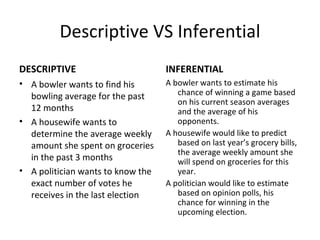
Descriptive VS Inferential DESCRIPTIVE A bowler wants to find his bowling average for the past 12 months A housewife wants to determine the average weekly amount she spent on groceries in the past 3 months A politician wants to know the exact number of votes he receives in the last election INFERENTIAL A bowler wants to estimate his chance of winning a game based on his current season averages and the average of his opponents. A housewife would like to predict based on last year’s grocery bills, the average weekly amount she will spend on groceries for this year. A politician would like to estimate based on opinion polls, his chance for winning in the upcoming election.
Population as Differrentiated from Sample The word population refers to groups or aggregates of people, animals, objects, materials, happenings or things of any form,  this means that there are populations of students, teachers, supervisors, principals, laboratory animals, trees, manufactured articles, birds and many others. If your interest is on few members of the population to represent their characteristics or traits, these members constitute a sample. The measures of the population are called parameters, while those of the sample are called estimates or statistics.
The Variable It refers to a characteristic or property whereby the members of the group or set vary or differ from one another. However, a constant refers to a property whereby the members of the group do not differ one another. Variables can be according to functional relationship which is classified as independent and dependent. If you treat variable y as a function of variable z, then z is your independent variable and y is your dependent variable. This means that the value of y, say academic achievement depends on the value of z.
Con’t Variables according to continuity of values. 1. Continuous variable – these are variables whose levels can take continuous values. Examples are height, weight, length and width. 2. Discrete variables – these are variables whose values or levels can not take the form of a decimal. An example is the size of a particular family.
Con’t Variables according to scale of measurements: 1. Nominal – this refers to a property of the members of a group defined by an operation which allows making of statements only of equality or difference. For example, individuals can be classified according to thier sex or skin color. Color is an example of nominal variable.
Con’t 2. Ordinal – it is defined by an operation whereby members of a particular group are ranked. In this operation, we can state that one member is greater or less that the others in a criterion rather than saying that he/it is only equal or different from the others such as what is meant by the nominal variable. 3. Interval – this refers to a property defined by an operation which permits making statement of equality of intervals rather than just statement of sameness of difference and greater than or less than. An interval variable does not have a “true” zero point.; althought for convenience, a zero point may be assigned.
Con’t 4. Ratio –  is defined by the operation which permits making statements of equality of ratios in addition to statements of sameness or difference, greater than or less than and equality or inequality of differences.  This means that one level or value may be thought of or said as double, triple or five times another and so on.
Assignment no. 1 Make a list of at least 5 mathematician or scientist that contributes in the field of statistics. State their contributions With your knowledge of statistics, give a real life situation how statistics is applied. Expand your answer. When can a variable be considered independent and dependent? Give an example for your answer.
Con’t IV. Enumerate some uses of statistics. Do you think that any science will develop without test of the hypothesis? Why?

Probability and statistics

  • 1.
    PROBABILITY AND STATISTICSBY ENGR. JORGE P. BAUTISTA
  • 2.
    COURSE OUTLINE Introduction to Statistics Tabular and Graphical representation of Data Measures of Central Tendencies, Locations and Variations Measure of Dispersion and Correlation Probability and Combinatorics Discrete and Continious Distributions Hypothesis Testing
  • 3.
    Text and ReferencesStatistics: a simplified approach by Punsalan and Uriarte, 1998, Rex Texbook Probability and Statistics by Johnson, 2008, Wiley Counterexamples in Probability and Statistics by Romano and Siegel, 1986, Chapman and Hall
  • 4.
    Introduction to StatisticsDefinition In its plural sense, statistics is a set of numerical data e.g. Vital statistics, monthly sales, exchange rates, etc. In its singular sense, statistics is a branch of science that deals with the collection, presentation, analysis and interpretation of data.
  • 5.
    General uses ofStatistics Aids in decision making by providing comparison of data, explains action that has taken place, justify a claim or assertion, predicts future outcome and estimates un known quantities Summarizes data for public use
  • 6.
    Examples on therole of Statistics In Biological and medical sciences, it helps researchers discover relationship worthy of further attention. Ex. A doctor can use statistics to determine to what extent is an increase in blood pressure dependent upon age - In social sciences, it guides researchers and helps them support theories and models that cannot stand on rationale alone. Ex. Empirical studies are using statistics to obtain socio-economic profile of the middle class to form new socio-political theories.
  • 7.
    Con’t In business,a company can use statistics to forecast sales, design products, and produce goods more efficiently. Ex. A pharmaceutical company can apply statistical procedures to find out if the new formula is indeed more effective than the one being used. In Engineering, it can be used to test properties of various materials, Ex. A quality controller can use statistics to estimate the average lifetime of the products produced by their current equipment.
  • 8.
    Fields of StatisticsStatistical Methods of Applied Statistics: Descriptive-comprise those methods concerned with the collection, description, and analysis of a set of data without drawing conclusions or inferences about a larger set. Inferential-comprise those methods concerned with making predictions or inferences about a larger set of data using only the information gathered from a subset of this larger set.
  • 9.
    con’t b. Statisticaltheory of mathematical statistics- deals with the development and exposition of theories that serve as a basis of statistical methods
  • 10.
    Descriptive VS InferentialDESCRIPTIVE A bowler wants to find his bowling average for the past 12 months A housewife wants to determine the average weekly amount she spent on groceries in the past 3 months A politician wants to know the exact number of votes he receives in the last election INFERENTIAL A bowler wants to estimate his chance of winning a game based on his current season averages and the average of his opponents. A housewife would like to predict based on last year’s grocery bills, the average weekly amount she will spend on groceries for this year. A politician would like to estimate based on opinion polls, his chance for winning in the upcoming election.
  • 11.
    Population as Differrentiatedfrom Sample The word population refers to groups or aggregates of people, animals, objects, materials, happenings or things of any form, this means that there are populations of students, teachers, supervisors, principals, laboratory animals, trees, manufactured articles, birds and many others. If your interest is on few members of the population to represent their characteristics or traits, these members constitute a sample. The measures of the population are called parameters, while those of the sample are called estimates or statistics.
  • 12.
    The Variable Itrefers to a characteristic or property whereby the members of the group or set vary or differ from one another. However, a constant refers to a property whereby the members of the group do not differ one another. Variables can be according to functional relationship which is classified as independent and dependent. If you treat variable y as a function of variable z, then z is your independent variable and y is your dependent variable. This means that the value of y, say academic achievement depends on the value of z.
  • 13.
    Con’t Variables accordingto continuity of values. 1. Continuous variable – these are variables whose levels can take continuous values. Examples are height, weight, length and width. 2. Discrete variables – these are variables whose values or levels can not take the form of a decimal. An example is the size of a particular family.
  • 14.
    Con’t Variables accordingto scale of measurements: 1. Nominal – this refers to a property of the members of a group defined by an operation which allows making of statements only of equality or difference. For example, individuals can be classified according to thier sex or skin color. Color is an example of nominal variable.
  • 15.
    Con’t 2. Ordinal– it is defined by an operation whereby members of a particular group are ranked. In this operation, we can state that one member is greater or less that the others in a criterion rather than saying that he/it is only equal or different from the others such as what is meant by the nominal variable. 3. Interval – this refers to a property defined by an operation which permits making statement of equality of intervals rather than just statement of sameness of difference and greater than or less than. An interval variable does not have a “true” zero point.; althought for convenience, a zero point may be assigned.
  • 16.
    Con’t 4. Ratio– is defined by the operation which permits making statements of equality of ratios in addition to statements of sameness or difference, greater than or less than and equality or inequality of differences. This means that one level or value may be thought of or said as double, triple or five times another and so on.
  • 17.
    Assignment no. 1Make a list of at least 5 mathematician or scientist that contributes in the field of statistics. State their contributions With your knowledge of statistics, give a real life situation how statistics is applied. Expand your answer. When can a variable be considered independent and dependent? Give an example for your answer.
  • 18.
    Con’t IV. Enumeratesome uses of statistics. Do you think that any science will develop without test of the hypothesis? Why?