“Quantifying Your Superorganism Body 
Using Big Data Supercomputing” 
ACM International Workshop on Big Data in Life Sciences 
BigLS 2014 
Newport Beach, CA 
September 20, 2014 
Dr. Larry Smarr 
Director, California Institute for Telecommunications and Information 
Technology 
Harry E. Gruber Professor, 
Dept. of Computer Science and Engineering 
Jacobs School of Engineering, UCSD 
http://lsmarr.calit2.net 
1
Abstract 
The human body is host to 100 trillion microorganisms, ten times the number of 
cells in the human body and these microbes contain 100 times the number of 
DNA genes that our human DNA does. The microbial component of this 
"superorganism" is comprised of hundreds of species spread over many 
taxonomic phyla. The human immune system is tightly coupled with this 
microbial ecology and in cases of autoimmune disease, both the immune 
system and the microbial ecology can have dynamic excursions far from 
normal. Our research starts with trillions of DNA bases, produced by Illumina 
Next Generation sequencers, of the human gut microbial DNA taken from my 
own body, as well as from hundreds of people sequenced under the NIH Human 
Microbiome Project. To decode the details of the microbial ecology we feed this 
data into parallel supercomputers, running sophisticated bioinformatics 
software pipelines. We then use Calit2/SDSC designed Big Data PCs to manage 
the data and drive innovative scalable visualization systems to examine the 
complexities of the changing human gut microbial ecology in health and 
disease. Finally, I will show how advanced data analytics tools find patterns in 
the resulting microbial distribution data that suggest new hypotheses for 
clinical application.
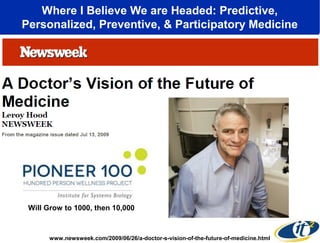
Where I Believe We are Headed: Predictive, 
Personalized, Preventive, & Participatory Medicine 
Will Grow to 1000, then 10,000 
www.newsweek.com/2009/06/26/a-doctor-s-vision-of-the-future-of-medicine.html
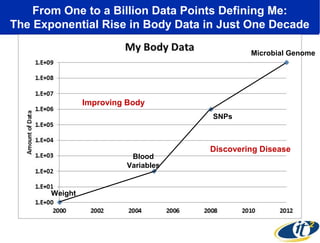
From One to a Billion Data Points Defining Me: 
The Exponential Rise in Body Data in Just One Decade 
Billion: My Full DNA, 
MRI/CT Images 
Million: My DNA SNPs, 
Zeo, FitBit 
One: Hundred: My Blood Variables 
WeigMhyt Weight 
Blood 
Variables 
SNPs 
Microbial Genome 
Improving Body 
Discovering Disease
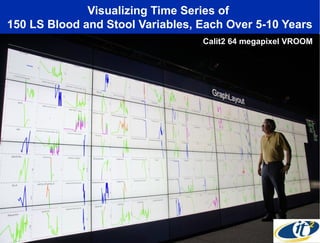
Visualizing Time Series of 
150 LS Blood and Stool Variables, Each Over 5-10 Years 
Calit2 64 megapixel VROOM
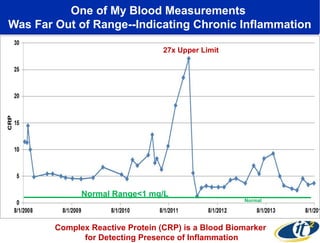
One of My Blood Measurements 
Was Far Out of Range--Indicating Chronic Inflammation 
Normal Range<1 mg/L 
Normal 
27x Upper Limit 
Complex Reactive Protein (CRP) is a Blood Biomarker 
for Detecting Presence of Inflammation
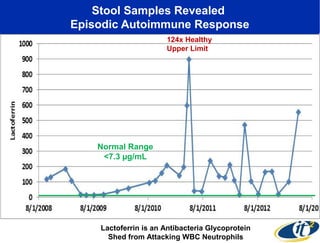
Stool Samples Revealed 
Episodic Autoimmune Response 
Normal Range 
<7.3 μg/mL 
124x Healthy 
Upper Limit 
Lactoferrin is an Antibacteria Glycoprotein 
Shed from Attacking WBC Neutrophils
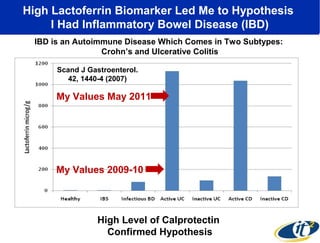
High Lactoferrin Biomarker Led Me to Hypothesis 
I Had Inflammatory Bowel Disease (IBD) 
IBD is an Autoimmune Disease Which Comes in Two Subtypes: 
Crohn’s and Ulcerative Colitis 
Scand J Gastroenterol. 
42, 1440-4 (2007) 
My Values May 2011 
My Values 2009-10 
High Level of Calprotectin 
Confirmed Hypothesis
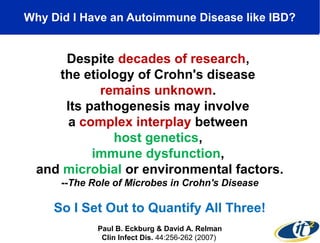
Why Did I Have an Autoimmune Disease like IBD? 
Despite decades of research, 
the etiology of Crohn's disease 
remains unknown. 
Its pathogenesis may involve 
a complex interplay between 
host genetics, 
immune dysfunction, 
and microbial or environmental factors. 
--The Role of Microbes in Crohn's Disease 
So I Set Out to Quantify All Three! 
Paul B. Eckburg & David A. Relman 
Clin Infect Dis. 44:256-262 (2007)
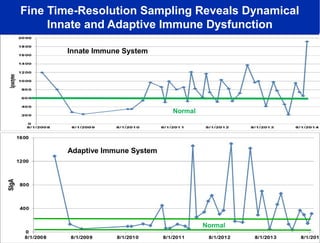
Fine Time-Resolution Sampling Reveals Dynamical 
Innate and Adaptive Immune Dysfunction 
Normal 
Normal 
Innate Immune System 
Adaptive Immune System
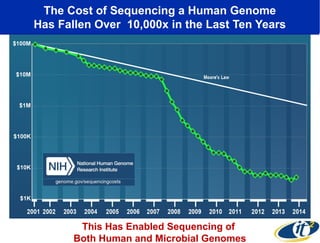
The Cost of Sequencing a Human Genome 
Has Fallen Over 10,000x in the Last Ten Years 
This Has Enabled Sequencing of 
Both Human and Microbial Genomes
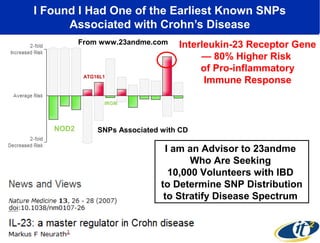
I Found I Had One of the Earliest Known SNPs 
Associated with Crohn’s Disease 
From www.23andme.com 
Interleukin-23 Receptor Gene 
ATG16L1 
SNPs Associated with CD 
— 80% Higher Risk 
of Pro-inflammatory 
Immune Response 
NOD2 
IRGM 
I am an Advisor to 23andme 
Who Are Seeking 
10,000 Volunteers with IBD 
to Determine SNP Distribution 
to Stratify Disease Spectrum
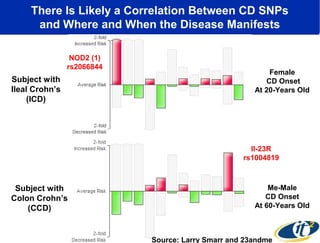
There Is Likely a Correlation Between CD SNPs 
and Where and When the Disease Manifests 
Female 
CD Onset 
At 20-Years Old 
Me-Male 
CD Onset 
At 60-Years Old 
NOD2 (1) 
rs2066844 
Il-23R 
rs1004819 
Subject with 
Ileal Crohn’s 
(ICD) 
Subject with 
Colon Crohn’s 
(CCD) 
Source: Larry Smarr and 23andme
I Also Had an Increased Risk for Ulcerative Colitis, 
But a SNP that is Also Associated with Colonic CD 
I Have a 
33% Increased Risk 
for Ulcerative Colitis 
HLA-DRA (rs2395185) 
I Have the Same Level 
of HLA-DRA Increased Risk 
as Another Male Who Has Had 
Ulcerative Colitis for 20 Years 
“Our results suggest that at least for the SNPs investigated 
[including HLA-DRA], 
colonic CD and UC have common genetic basis.” 
-Waterman, et al., IBD 17, 1936-42 (2011)
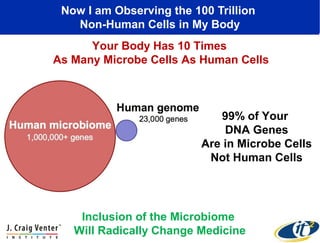
Now I am Observing the 100 Trillion 
Non-Human Cells in My Body 
Your Body Has 10 Times 
As Many Microbe Cells As Human Cells 
99% of Your 
DNA Genes 
Are in Microbe Cells 
Not Human Cells 
Inclusion of the Microbiome 
Will Radically Change Medicine
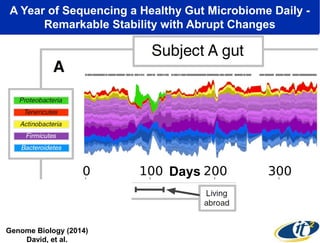
A Year of Sequencing a Healthy Gut Microbiome Daily - 
Remarkable Stability with Abrupt Changes 
Days 
Genome Biology (2014) 
David, et al.
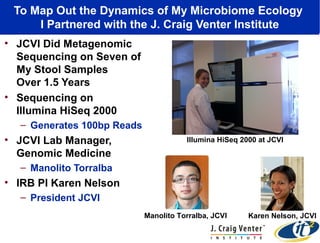
To Map Out the Dynamics of My Microbiome Ecology 
I Partnered with the J. Craig Venter Institute 
• JCVI Did Metagenomic 
Sequencing on Seven of 
My Stool Samples 
Over 1.5 Years 
• Sequencing on 
Illumina HiSeq 2000 
– Generates 100bp Reads 
• JCVI Lab Manager, 
Genomic Medicine 
– Manolito Torralba 
• IRB PI Karen Nelson 
– President JCVI 
Illumina HiSeq 2000 at JCVI 
Manolito Torralba, JCVI Karen Nelson, JCVI
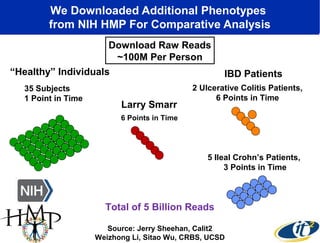
We Downloaded Additional Phenotypes 
from NIH HMP For Comparative Analysis 
Download Raw Reads 
~100M Per Person 
IBD Patients 
2 Ulcerative Colitis Patients, 
6 Points in Time 
5 Ileal Crohn’s Patients, 
3 Points in Time 
“Healthy” Individuals 
35 Subjects 
1 Point in Time Larry Smarr 
6 Points in Time 
Total of 5 Billion Reads 
Source: Jerry Sheehan, Calit2 
Weizhong Li, Sitao Wu, CRBS, UCSD
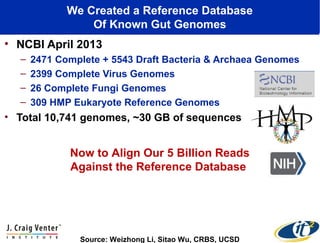
We Created a Reference Database 
Of Known Gut Genomes 
• NCBI April 2013 
– 2471 Complete + 5543 Draft Bacteria & Archaea Genomes 
– 2399 Complete Virus Genomes 
– 26 Complete Fungi Genomes 
– 309 HMP Eukaryote Reference Genomes 
• Total 10,741 genomes, ~30 GB of sequences 
Now to Align Our 5 Billion Reads 
Against the Reference Database 
Source: Weizhong Li, Sitao Wu, CRBS, UCSD
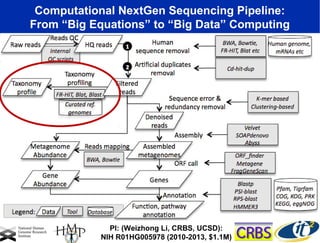
Computational NextGen Sequencing Pipeline: 
From “Big Equations” to “Big Data” Computing 
PI: (Weizhong Li, CRBS, UCSD): 
NIH R01HG005978 (2010-2013, $1.1M)
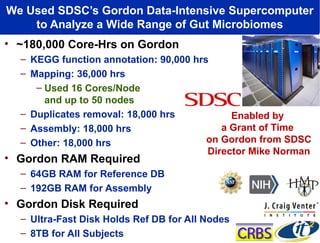
We Used SDSC’s Gordon Data-Intensive Supercomputer 
to Analyze a Wide Range of Gut Microbiomes 
• ~180,000 Core-Hrs on Gordon 
– KEGG function annotation: 90,000 hrs 
– Mapping: 36,000 hrs 
– Used 16 Cores/Node 
and up to 50 nodes 
– Duplicates removal: 18,000 hrs 
– Assembly: 18,000 hrs 
– Other: 18,000 hrs 
• Gordon RAM Required 
– 64GB RAM for Reference DB 
– 192GB RAM for Assembly 
• Gordon Disk Required 
Enabled by 
a Grant of Time 
on Gordon from SDSC 
Director Mike Norman 
– Ultra-Fast Disk Holds Ref DB for All Nodes 
– 8TB for All Subjects
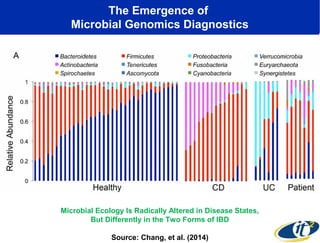
The Emergence of 
Microbial Genomics Diagnostics 
Microbial Ecology Is Radically Altered in Disease States, 
But Differently in the Two Forms of IBD 
Source: Chang, et al. (2014)
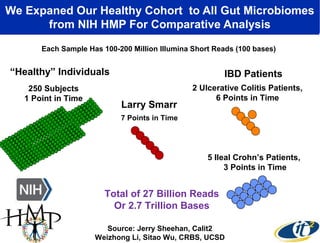
We Expaned Our Healthy Cohort to All Gut Microbiomes 
from NIH HMP For Comparative Analysis 
Each Sample Has 100-200 Million Illumina Short Reads (100 bases) 
IBD Patients 
2 Ulcerative Colitis Patients, 
6 Points in Time 
5 Ileal Crohn’s Patients, 
3 Points in Time 
“Healthy” Individuals 
250 Subjects 
1 Point in Time Larry Smarr 
7 Points in Time 
Total of 27 Billion Reads 
Or 2.7 Trillion Bases 
Source: Jerry Sheehan, Calit2 
Weizhong Li, Sitao Wu, CRBS, UCSD
We Used Dell’s HPC Cloud to Analyze 
All of Our Human Gut Microbiomes 
• Dell’s Sanger Cluster 
– 32 Nodes, 512 Cores 
– 48GB RAM per Node 
• We Processed the Taxonomic Relative Abundance 
– Used ~35,000 Core-Hours on Dell’s Sanger 
• Produced Relative Abundance of 
~10,000 Bacteria, Archaea, Viruses in ~300 People 
– ~3Million Spreadsheet Cells 
• New System: R Bio-Gen System 
– 48 Nodes, 768 Cores 
– 128 GB RAM per Node 
Source: Weizhong Li, UCSD
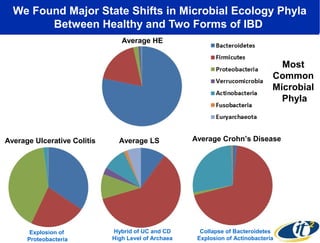
We Found Major State Shifts in Microbial Ecology Phyla 
Between Healthy and Two Forms of IBD 
Most 
Common 
Microbial 
Phyla 
Average HE 
Average Ulcerative Colitis Average LS Average Crohn’s Disease 
Collapse of Bacteroidetes 
Explosion of Actinobacteria 
Explosion of 
Proteobacteria 
Hybrid of UC and CD 
High Level of Archaea
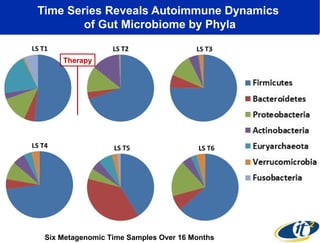
Time Series Reveals Autoimmune Dynamics 
of Gut Microbiome by Phyla 
Therapy 
Six Metagenomic Time Samples Over 16 Months
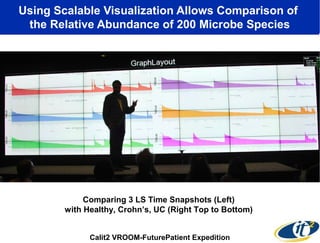
Using Scalable Visualization Allows Comparison of 
the Relative Abundance of 200 Microbe Species 
Comparing 3 LS Time Snapshots (Left) 
with Healthy, Crohn’s, UC (Right Top to Bottom) 
Calit2 VROOM-FuturePatient Expedition
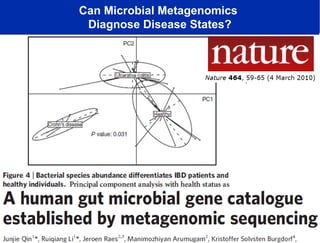
Can Microbial Metagenomics 
Diagnose Disease States? 
From www.23andme.com 
Mutation in Interleukin-23 
Receptor Gene—80% Higher 
Risk of Pro-inflammatory 
SNPs Associated with CD 
Immune Response 
2009
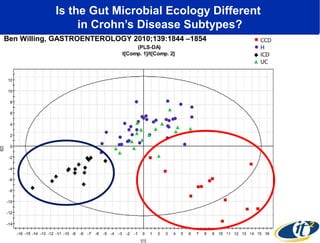
Is the Gut Microbial Ecology Different 
in Crohn’s Disease Subtypes? 
Ben Willing, GASTROENTEROLOGY 2010;139:1844 –1854
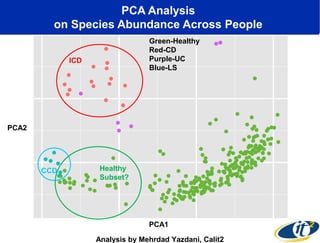
PCA Analysis 
on Species Abundance Across People 
PCA2 
Green-Healthy 
Red-CD 
Purple-UC 
Blue-LS 
PCA1 
Analysis by Mehrdad Yazdani, Calit2 
ICD 
CCD Healthy 
Subset?
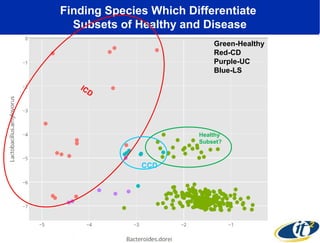
Finding Species Which Differentiate 
Subsets of Healthy and Disease 
Green-Healthy 
Red-CD 
Purple-UC 
Blue-LS 
ICD 
CCD 
Healthy 
Subset?
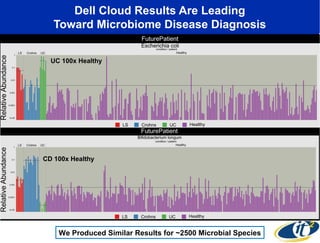
Dell Cloud Results Are Leading 
Toward Microbiome Disease Diagnosis 
UC 100x Healthy 
CD 100x Healthy 
We Produced Similar Results for ~2500 Microbial Species
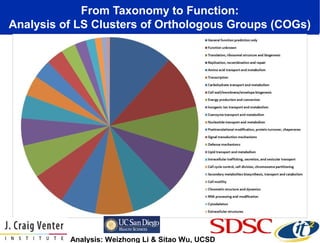
From Taxonomy to Function: 
Analysis of LS Clusters of Orthologous Groups (COGs) 
Analysis: Weizhong Li & Sitao Wu, UCSD
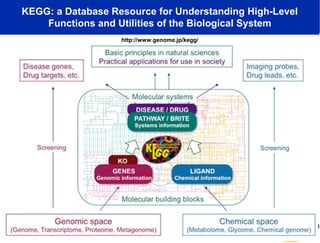
KEGG: a Database Resource for Understanding High-Level 
Functions and Utilities of the Biological System 
http://www.genome.jp/kegg/
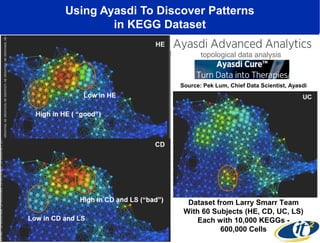
Using Ayasdi To Discover Patterns 
in KEGG Dataset 
topological data analysis 
Source: Pek Lum, Chief Data Scientist, Ayasdi 
Dataset from Larry Smarr Team 
With 60 Subjects (HE, CD, UC, LS) 
Each with 10,000 KEGGs - 
600,000 Cells
Next Step: 
Compute Genes and Function 
Full Processing to Function 
(COGs, KEGGs) 
Would Require 
~1-2 Million 
Core-Hours 
Plus Dedicated Network to Move Data 
From R Systems / Dell to Calit2@UC San Diego
Next Step: Time Series of Metagenomic Gut Microbiomes 
and Immune Variables in an N=100 Clinic Trial 
Goal: Understand 
The Coupled Human Immune-Microbiome Dynamics 
In the Presence of Human Genetic Predispositions 
Drs. William J. Sandborn, John Chang, & Brigid Boland 
UCSD School of Medicine, Division of Gastroenterology
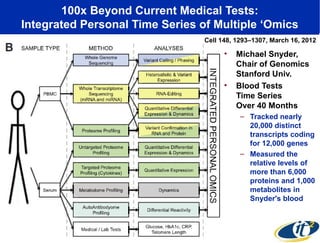
100x Beyond Current Medical Tests: 
Integrated Personal Time Series of Multiple ‘Omics 
Cell 148, 1293–1307, March 16, 2012 
• Michael Snyder, 
Chair of Genomics 
Stanford Univ. 
• Blood Tests 
Time Series 
Over 40 Months 
– Tracked nearly 
20,000 distinct 
transcripts coding 
for 12,000 genes 
– Measured the 
relative levels of 
more than 6,000 
proteins and 1,000 
metabolites in 
Snyder's blood
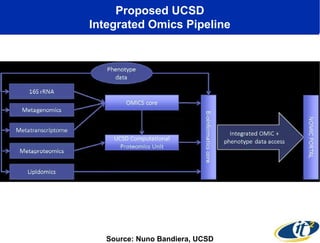
Proposed UCSD 
Integrated Omics Pipeline 
Source: Nuno Bandiera, UCSD
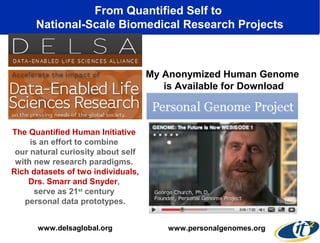
From Quantified Self to 
National-Scale Biomedical Research Projects 
My Anonymized Human Genome 
is Available for Download 
www.personalgenomes.org 
The Quantified Human Initiative 
is an effort to combine 
our natural curiosity about self 
with new research paradigms. 
Rich datasets of two individuals, 
Drs. Smarr and Snyder, 
serve as 21st century 
personal data prototypes. 
www.delsaglobal.org
Thanks to Our Great Team! 
UCSD Metagenomics Team 
Weizhong Li 
Sitao Wu 
Calit2@UCSD 
Future Patient Team 
Jerry Sheehan 
Tom DeFanti 
Kevin Patrick 
Jurgen Schulze 
Andrew Prudhomme 
Philip Weber 
Fred Raab 
Joe Keefe 
Ernesto Ramirez 
JCVI Team 
Karen Nelson 
Shibu Yooseph 
Manolito Torralba 
SDSC Team 
Michael Norman 
Mahidhar Tatineni 
Robert Sinkovits 
UCSD Health Sciences Team 
William J. Sandborn 
Elisabeth Evans 
John Chang 
Brigid Boland 
David Brenner

Quantifying Your Superorganism Body Using Big Data Supercomputing

  • 1.
    “Quantifying Your SuperorganismBody Using Big Data Supercomputing” ACM International Workshop on Big Data in Life Sciences BigLS 2014 Newport Beach, CA September 20, 2014 Dr. Larry Smarr Director, California Institute for Telecommunications and Information Technology Harry E. Gruber Professor, Dept. of Computer Science and Engineering Jacobs School of Engineering, UCSD http://lsmarr.calit2.net 1
  • 2.
    Abstract The humanbody is host to 100 trillion microorganisms, ten times the number of cells in the human body and these microbes contain 100 times the number of DNA genes that our human DNA does. The microbial component of this "superorganism" is comprised of hundreds of species spread over many taxonomic phyla. The human immune system is tightly coupled with this microbial ecology and in cases of autoimmune disease, both the immune system and the microbial ecology can have dynamic excursions far from normal. Our research starts with trillions of DNA bases, produced by Illumina Next Generation sequencers, of the human gut microbial DNA taken from my own body, as well as from hundreds of people sequenced under the NIH Human Microbiome Project. To decode the details of the microbial ecology we feed this data into parallel supercomputers, running sophisticated bioinformatics software pipelines. We then use Calit2/SDSC designed Big Data PCs to manage the data and drive innovative scalable visualization systems to examine the complexities of the changing human gut microbial ecology in health and disease. Finally, I will show how advanced data analytics tools find patterns in the resulting microbial distribution data that suggest new hypotheses for clinical application.
  • 3.
    Where I BelieveWe are Headed: Predictive, Personalized, Preventive, & Participatory Medicine Will Grow to 1000, then 10,000 www.newsweek.com/2009/06/26/a-doctor-s-vision-of-the-future-of-medicine.html
  • 4.
    From One toa Billion Data Points Defining Me: The Exponential Rise in Body Data in Just One Decade Billion: My Full DNA, MRI/CT Images Million: My DNA SNPs, Zeo, FitBit One: Hundred: My Blood Variables WeigMhyt Weight Blood Variables SNPs Microbial Genome Improving Body Discovering Disease
  • 5.
    Visualizing Time Seriesof 150 LS Blood and Stool Variables, Each Over 5-10 Years Calit2 64 megapixel VROOM
  • 6.
    One of MyBlood Measurements Was Far Out of Range--Indicating Chronic Inflammation Normal Range<1 mg/L Normal 27x Upper Limit Complex Reactive Protein (CRP) is a Blood Biomarker for Detecting Presence of Inflammation
  • 7.
    Stool Samples Revealed Episodic Autoimmune Response Normal Range <7.3 μg/mL 124x Healthy Upper Limit Lactoferrin is an Antibacteria Glycoprotein Shed from Attacking WBC Neutrophils
  • 8.
    High Lactoferrin BiomarkerLed Me to Hypothesis I Had Inflammatory Bowel Disease (IBD) IBD is an Autoimmune Disease Which Comes in Two Subtypes: Crohn’s and Ulcerative Colitis Scand J Gastroenterol. 42, 1440-4 (2007) My Values May 2011 My Values 2009-10 High Level of Calprotectin Confirmed Hypothesis
  • 9.
    Why Did IHave an Autoimmune Disease like IBD? Despite decades of research, the etiology of Crohn's disease remains unknown. Its pathogenesis may involve a complex interplay between host genetics, immune dysfunction, and microbial or environmental factors. --The Role of Microbes in Crohn's Disease So I Set Out to Quantify All Three! Paul B. Eckburg & David A. Relman Clin Infect Dis. 44:256-262 (2007)
  • 10.
    Fine Time-Resolution SamplingReveals Dynamical Innate and Adaptive Immune Dysfunction Normal Normal Innate Immune System Adaptive Immune System
  • 11.
    The Cost ofSequencing a Human Genome Has Fallen Over 10,000x in the Last Ten Years This Has Enabled Sequencing of Both Human and Microbial Genomes
  • 12.
    I Found IHad One of the Earliest Known SNPs Associated with Crohn’s Disease From www.23andme.com Interleukin-23 Receptor Gene ATG16L1 SNPs Associated with CD — 80% Higher Risk of Pro-inflammatory Immune Response NOD2 IRGM I am an Advisor to 23andme Who Are Seeking 10,000 Volunteers with IBD to Determine SNP Distribution to Stratify Disease Spectrum
  • 13.
    There Is Likelya Correlation Between CD SNPs and Where and When the Disease Manifests Female CD Onset At 20-Years Old Me-Male CD Onset At 60-Years Old NOD2 (1) rs2066844 Il-23R rs1004819 Subject with Ileal Crohn’s (ICD) Subject with Colon Crohn’s (CCD) Source: Larry Smarr and 23andme
  • 14.
    I Also Hadan Increased Risk for Ulcerative Colitis, But a SNP that is Also Associated with Colonic CD I Have a 33% Increased Risk for Ulcerative Colitis HLA-DRA (rs2395185) I Have the Same Level of HLA-DRA Increased Risk as Another Male Who Has Had Ulcerative Colitis for 20 Years “Our results suggest that at least for the SNPs investigated [including HLA-DRA], colonic CD and UC have common genetic basis.” -Waterman, et al., IBD 17, 1936-42 (2011)
  • 15.
    Now I amObserving the 100 Trillion Non-Human Cells in My Body Your Body Has 10 Times As Many Microbe Cells As Human Cells 99% of Your DNA Genes Are in Microbe Cells Not Human Cells Inclusion of the Microbiome Will Radically Change Medicine
  • 16.
    A Year ofSequencing a Healthy Gut Microbiome Daily - Remarkable Stability with Abrupt Changes Days Genome Biology (2014) David, et al.
  • 17.
    To Map Outthe Dynamics of My Microbiome Ecology I Partnered with the J. Craig Venter Institute • JCVI Did Metagenomic Sequencing on Seven of My Stool Samples Over 1.5 Years • Sequencing on Illumina HiSeq 2000 – Generates 100bp Reads • JCVI Lab Manager, Genomic Medicine – Manolito Torralba • IRB PI Karen Nelson – President JCVI Illumina HiSeq 2000 at JCVI Manolito Torralba, JCVI Karen Nelson, JCVI
  • 18.
    We Downloaded AdditionalPhenotypes from NIH HMP For Comparative Analysis Download Raw Reads ~100M Per Person IBD Patients 2 Ulcerative Colitis Patients, 6 Points in Time 5 Ileal Crohn’s Patients, 3 Points in Time “Healthy” Individuals 35 Subjects 1 Point in Time Larry Smarr 6 Points in Time Total of 5 Billion Reads Source: Jerry Sheehan, Calit2 Weizhong Li, Sitao Wu, CRBS, UCSD
  • 19.
    We Created aReference Database Of Known Gut Genomes • NCBI April 2013 – 2471 Complete + 5543 Draft Bacteria & Archaea Genomes – 2399 Complete Virus Genomes – 26 Complete Fungi Genomes – 309 HMP Eukaryote Reference Genomes • Total 10,741 genomes, ~30 GB of sequences Now to Align Our 5 Billion Reads Against the Reference Database Source: Weizhong Li, Sitao Wu, CRBS, UCSD
  • 20.
    Computational NextGen SequencingPipeline: From “Big Equations” to “Big Data” Computing PI: (Weizhong Li, CRBS, UCSD): NIH R01HG005978 (2010-2013, $1.1M)
  • 21.
    We Used SDSC’sGordon Data-Intensive Supercomputer to Analyze a Wide Range of Gut Microbiomes • ~180,000 Core-Hrs on Gordon – KEGG function annotation: 90,000 hrs – Mapping: 36,000 hrs – Used 16 Cores/Node and up to 50 nodes – Duplicates removal: 18,000 hrs – Assembly: 18,000 hrs – Other: 18,000 hrs • Gordon RAM Required – 64GB RAM for Reference DB – 192GB RAM for Assembly • Gordon Disk Required Enabled by a Grant of Time on Gordon from SDSC Director Mike Norman – Ultra-Fast Disk Holds Ref DB for All Nodes – 8TB for All Subjects
  • 22.
    The Emergence of Microbial Genomics Diagnostics Microbial Ecology Is Radically Altered in Disease States, But Differently in the Two Forms of IBD Source: Chang, et al. (2014)
  • 23.
    We Expaned OurHealthy Cohort to All Gut Microbiomes from NIH HMP For Comparative Analysis Each Sample Has 100-200 Million Illumina Short Reads (100 bases) IBD Patients 2 Ulcerative Colitis Patients, 6 Points in Time 5 Ileal Crohn’s Patients, 3 Points in Time “Healthy” Individuals 250 Subjects 1 Point in Time Larry Smarr 7 Points in Time Total of 27 Billion Reads Or 2.7 Trillion Bases Source: Jerry Sheehan, Calit2 Weizhong Li, Sitao Wu, CRBS, UCSD
  • 24.
    We Used Dell’sHPC Cloud to Analyze All of Our Human Gut Microbiomes • Dell’s Sanger Cluster – 32 Nodes, 512 Cores – 48GB RAM per Node • We Processed the Taxonomic Relative Abundance – Used ~35,000 Core-Hours on Dell’s Sanger • Produced Relative Abundance of ~10,000 Bacteria, Archaea, Viruses in ~300 People – ~3Million Spreadsheet Cells • New System: R Bio-Gen System – 48 Nodes, 768 Cores – 128 GB RAM per Node Source: Weizhong Li, UCSD
  • 25.
    We Found MajorState Shifts in Microbial Ecology Phyla Between Healthy and Two Forms of IBD Most Common Microbial Phyla Average HE Average Ulcerative Colitis Average LS Average Crohn’s Disease Collapse of Bacteroidetes Explosion of Actinobacteria Explosion of Proteobacteria Hybrid of UC and CD High Level of Archaea
  • 26.
    Time Series RevealsAutoimmune Dynamics of Gut Microbiome by Phyla Therapy Six Metagenomic Time Samples Over 16 Months
  • 27.
    Using Scalable VisualizationAllows Comparison of the Relative Abundance of 200 Microbe Species Comparing 3 LS Time Snapshots (Left) with Healthy, Crohn’s, UC (Right Top to Bottom) Calit2 VROOM-FuturePatient Expedition
  • 28.
    Can Microbial Metagenomics Diagnose Disease States? From www.23andme.com Mutation in Interleukin-23 Receptor Gene—80% Higher Risk of Pro-inflammatory SNPs Associated with CD Immune Response 2009
  • 29.
    Is the GutMicrobial Ecology Different in Crohn’s Disease Subtypes? Ben Willing, GASTROENTEROLOGY 2010;139:1844 –1854
  • 30.
    PCA Analysis onSpecies Abundance Across People PCA2 Green-Healthy Red-CD Purple-UC Blue-LS PCA1 Analysis by Mehrdad Yazdani, Calit2 ICD CCD Healthy Subset?
  • 31.
    Finding Species WhichDifferentiate Subsets of Healthy and Disease Green-Healthy Red-CD Purple-UC Blue-LS ICD CCD Healthy Subset?
  • 32.
    Dell Cloud ResultsAre Leading Toward Microbiome Disease Diagnosis UC 100x Healthy CD 100x Healthy We Produced Similar Results for ~2500 Microbial Species
  • 33.
    From Taxonomy toFunction: Analysis of LS Clusters of Orthologous Groups (COGs) Analysis: Weizhong Li & Sitao Wu, UCSD
  • 34.
    KEGG: a DatabaseResource for Understanding High-Level Functions and Utilities of the Biological System http://www.genome.jp/kegg/
  • 35.
    Using Ayasdi ToDiscover Patterns in KEGG Dataset topological data analysis Source: Pek Lum, Chief Data Scientist, Ayasdi Dataset from Larry Smarr Team With 60 Subjects (HE, CD, UC, LS) Each with 10,000 KEGGs - 600,000 Cells
  • 36.
    Next Step: ComputeGenes and Function Full Processing to Function (COGs, KEGGs) Would Require ~1-2 Million Core-Hours Plus Dedicated Network to Move Data From R Systems / Dell to Calit2@UC San Diego
  • 37.
    Next Step: TimeSeries of Metagenomic Gut Microbiomes and Immune Variables in an N=100 Clinic Trial Goal: Understand The Coupled Human Immune-Microbiome Dynamics In the Presence of Human Genetic Predispositions Drs. William J. Sandborn, John Chang, & Brigid Boland UCSD School of Medicine, Division of Gastroenterology
  • 38.
    100x Beyond CurrentMedical Tests: Integrated Personal Time Series of Multiple ‘Omics Cell 148, 1293–1307, March 16, 2012 • Michael Snyder, Chair of Genomics Stanford Univ. • Blood Tests Time Series Over 40 Months – Tracked nearly 20,000 distinct transcripts coding for 12,000 genes – Measured the relative levels of more than 6,000 proteins and 1,000 metabolites in Snyder's blood
  • 39.
    Proposed UCSD IntegratedOmics Pipeline Source: Nuno Bandiera, UCSD
  • 40.
    From Quantified Selfto National-Scale Biomedical Research Projects My Anonymized Human Genome is Available for Download www.personalgenomes.org The Quantified Human Initiative is an effort to combine our natural curiosity about self with new research paradigms. Rich datasets of two individuals, Drs. Smarr and Snyder, serve as 21st century personal data prototypes. www.delsaglobal.org
  • 41.
    Thanks to OurGreat Team! UCSD Metagenomics Team Weizhong Li Sitao Wu Calit2@UCSD Future Patient Team Jerry Sheehan Tom DeFanti Kevin Patrick Jurgen Schulze Andrew Prudhomme Philip Weber Fred Raab Joe Keefe Ernesto Ramirez JCVI Team Karen Nelson Shibu Yooseph Manolito Torralba SDSC Team Michael Norman Mahidhar Tatineni Robert Sinkovits UCSD Health Sciences Team William J. Sandborn Elisabeth Evans John Chang Brigid Boland David Brenner