“Using Supercomputers and Data Science
to Reveal Your Inner Microbiome”
Invited Data Sciences Lecture
School of Informatics and Computing
Indiana University
April 29, 2016
Dr. Larry Smarr
Director, California Institute for Telecommunications and Information Technology
Harry E. Gruber Professor,
Dept. of Computer Science and Engineering
Jacobs School of Engineering, UCSD
http://lsmarr.calit2.net
1
Abstract
The human body is host to 100 trillion microorganisms, ten times the number of cells in the human body and these microbes
contain 300 times the number of DNA genes that our human DNA does. The microbial component of our “superorganism” is
comprised of hundreds of species with immense biodiversity. Thanks to the National Institutes of Health’s Human Microbiome
Program researchers have been discovering the states of the human microbiome in health and disease. To put a more personal
face on the “patient of the future,” I have been collecting massive amounts of data from my own body over the last ten years,
which reveals detailed examples of the episodic evolution of this coupled immune-microbial system. An elaborate software
pipeline, running on high performance computers, reveals the details of the microbial ecology and its genetic components. A
variety of data science techniques are used to pull biomedical insights from this large data set. We can look forward to
revolutionary changes in medical practice over the next decade.
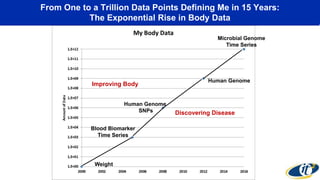
From One to a Trillion Data Points Defining Me in 15 Years:
The Exponential Rise in Body Data
Weight
Blood Biomarker
Time Series
Human Genome
SNPs
Microbial Genome
Time Series
Improving Body
Discovering Disease
Human Genome
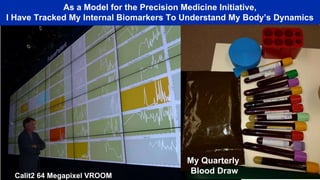
As a Model for the Precision Medicine Initiative,
I Have Tracked My Internal Biomarkers To Understand My Body’s Dynamics
My Quarterly
Blood Draw
Calit2 64 Megapixel VROOM
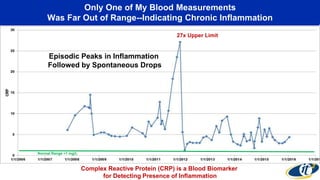
Only One of My Blood Measurements
Was Far Out of Range--Indicating Chronic Inflammation
Normal Range <1 mg/L
27x Upper Limit
Complex Reactive Protein (CRP) is a Blood Biomarker
for Detecting Presence of Inflammation
Episodic Peaks in Inflammation
Followed by Spontaneous Drops
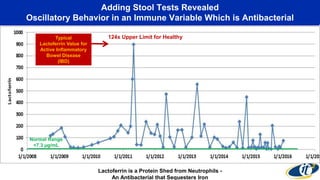
Adding Stool Tests Revealed
Oscillatory Behavior in an Immune Variable Which is Antibacterial
Normal Range
<7.3 µg/mL
124x Upper Limit for Healthy
Lactoferrin is a Protein Shed from Neutrophils -
An Antibacterial that Sequesters Iron
Typical
Lactoferrin Value for
Active Inflammatory
Bowel Disease
(IBD)
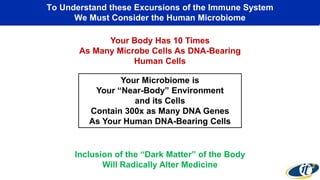
To Understand these Excursions of the Immune System
We Must Consider the Human Microbiome
Your Microbiome is
Your “Near-Body” Environment
and its Cells
Contain 300x as Many DNA Genes
As Your Human DNA-Bearing Cells
Your Body Has 10 Times
As Many Microbe Cells As DNA-Bearing
Human Cells
Inclusion of the “Dark Matter” of the Body
Will Radically Alter Medicine
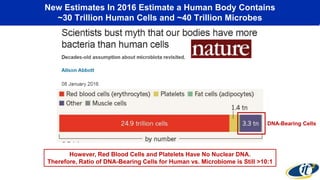
New Estimates In 2016 Estimate a Human Body Contains
~30 Trillion Human Cells and ~40 Trillion Microbes
However, Red Blood Cells and Platelets Have No Nuclear DNA.
Therefore, Ratio of DNA-Bearing Cells for Human vs. Microbiome is Still >10:1
DNA-Bearing Cells
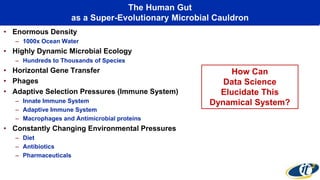
The Human Gut
as a Super-Evolutionary Microbial Cauldron
• Enormous Density
– 1000x Ocean Water
• Highly Dynamic Microbial Ecology
– Hundreds to Thousands of Species
• Horizontal Gene Transfer
• Phages
• Adaptive Selection Pressures (Immune System)
– Innate Immune System
– Adaptive Immune System
– Macrophages and Antimicrobial proteins
• Constantly Changing Environmental Pressures
– Diet
– Antibiotics
– Pharmaceuticals
How Can
Data Science
Elucidate This
Dynamical System?
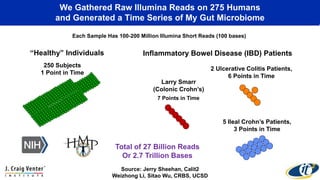
We Gathered Raw Illumina Reads on 275 Humans
and Generated a Time Series of My Gut Microbiome
5 Ileal Crohn’s Patients,
3 Points in Time
2 Ulcerative Colitis Patients,
6 Points in Time
“Healthy” Individuals
Source: Jerry Sheehan, Calit2
Weizhong Li, Sitao Wu, CRBS, UCSD
Total of 27 Billion Reads
Or 2.7 Trillion Bases
Inflammatory Bowel Disease (IBD) Patients
250 Subjects
1 Point in Time
7 Points in Time
Each Sample Has 100-200 Million Illumina Short Reads (100 bases)
Larry Smarr
(Colonic Crohn’s)
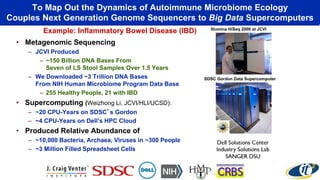
To Map Out the Dynamics of Autoimmune Microbiome Ecology
Couples Next Generation Genome Sequencers to Big Data Supercomputers
• Metagenomic Sequencing
– JCVI Produced
– ~150 Billion DNA Bases From
Seven of LS Stool Samples Over 1.5 Years
– We Downloaded ~3 Trillion DNA Bases
From NIH Human Microbiome Program Data Base
– 255 Healthy People, 21 with IBD
• Supercomputing (Weizhong Li, JCVI/HLI/UCSD):
– ~20 CPU-Years on SDSC’s Gordon
– ~4 CPU-Years on Dell’s HPC Cloud
• Produced Relative Abundance of
– ~10,000 Bacteria, Archaea, Viruses in ~300 People
– ~3 Million Filled Spreadsheet Cells
Illumina HiSeq 2000 at JCVI
SDSC Gordon Data Supercomputer
Example: Inflammatory Bowel Disease (IBD)
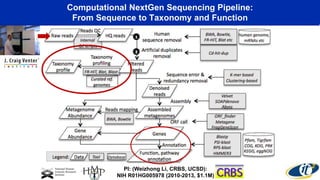
Computational NextGen Sequencing Pipeline:
From Sequence to Taxonomy and Function
PI: (Weizhong Li, CRBS, UCSD):
NIH R01HG005978 (2010-2013, $1.1M)
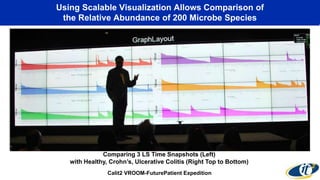
Using Scalable Visualization Allows Comparison of
the Relative Abundance of 200 Microbe Species
Calit2 VROOM-FuturePatient Expedition
Comparing 3 LS Time Snapshots (Left)
with Healthy, Crohn’s, Ulcerative Colitis (Right Top to Bottom)
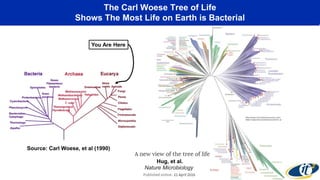
The Carl Woese Tree of Life
Shows The Most Life on Earth is Bacterial
Nature Microbiology
Hug, et al.
Source: Carl Woese, et al (1990)
You Are Here
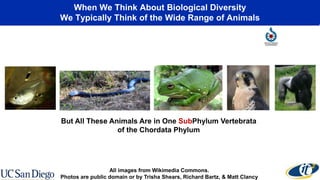
When We Think About Biological Diversity
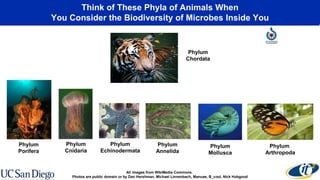
We Typically Think of the Wide Range of Animals
But All These Animals Are in One SubPhylum Vertebrata
of the Chordata Phylum
All images from Wikimedia Commons.
Photos are public domain or by Trisha Shears, Richard Bartz, & Matt Clancy
Think of These Phyla of Animals When
You Consider the Biodiversity of Microbes Inside You
Phylum
Annelida
Phylum
Echinodermata
Phylum
Cnidaria
Phylum
Mollusca
Phylum
Arthropoda
Phylum
Chordata
Phylum
Porifera
All images from WikiMedia Commons.
Photos are public domain or by Dan Hershman, Michael Linnenbach, Manuae, B_cool, Nick Hobgood
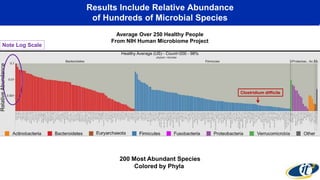
Results Include Relative Abundance
of Hundreds of Microbial Species
Average Over 250 Healthy People
From NIH Human Microbiome Project
Note Log Scale
Clostridium difficile
200 Most Abundant Species
Colored by Phyla
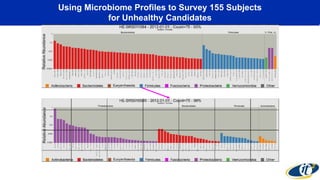
Using Microbiome Profiles to Survey 155 Subjects
for Unhealthy Candidates
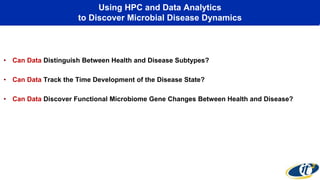
Using HPC and Data Analytics
to Discover Microbial Disease Dynamics
• Can Data Distinguish Between Health and Disease Subtypes?
• Can Data Track the Time Development of the Disease State?
• Can Data Discover Functional Microbiome Gene Changes Between Health and Disease?
Can Data Distinguish Between
Health and Disease Subtypes?
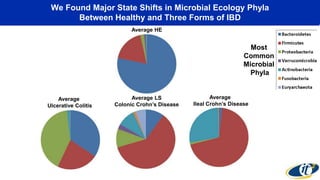
We Found Major State Shifts in Microbial Ecology Phyla
Between Healthy and Three Forms of IBD
Most
Common
Microbial
Phyla
Average HE
Average
Ulcerative Colitis
Average LS
Colonic Crohn’s Disease
Average
Ileal Crohn’s Disease
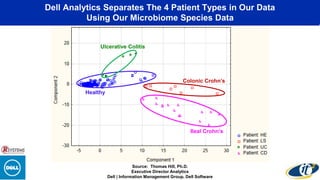
Dell Analytics Separates The 4 Patient Types in Our Data
Using Our Microbiome Species Data
Source: Thomas Hill, Ph.D.
Executive Director Analytics
Dell | Information Management Group, Dell Software
Healthy
Ulcerative Colitis
Colonic Crohn’s
Ileal Crohn’s
Can Data Track
the Time Development of the Disease State?
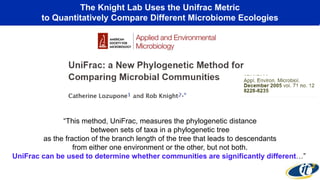
The Knight Lab Uses the Unifrac Metric
to Quantitatively Compare Different Microbiome Ecologies
“This method, UniFrac, measures the phylogenetic distance
between sets of taxa in a phylogenetic tree
as the fraction of the branch length of the tree that leads to descendants
from either one environment or the other, but not both.
UniFrac can be used to determine whether communities are significantly different…”
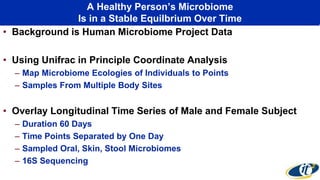
A Healthy Person’s Microbiome
Is in a Stable Equilbrium Over Time
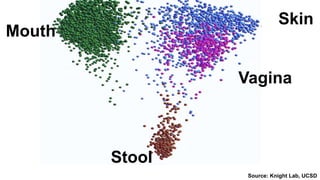
• Background is Human Microbiome Project Data
• Using Unifrac in Principle Coordinate Analysis
– Map Microbiome Ecologies of Individuals to Points
– Samples From Multiple Body Sites
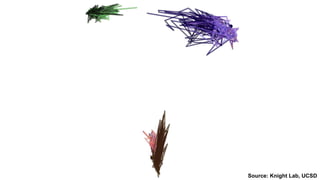
• Overlay Longitudinal Time Series of Male and Female Subject
– Duration 60 Days
– Time Points Separated by One Day
– Sampled Oral, Skin, Stool Microbiomes
– 16S Sequencing
Mouth
Stool
Vagina
Skin
Source: Knight Lab, UCSD
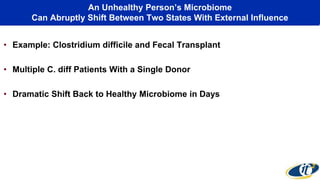
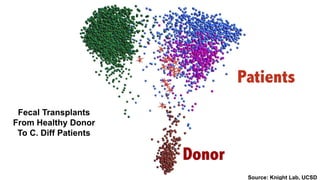
An Unhealthy Person’s Microbiome
Can Abruptly Shift Between Two States With External Influence
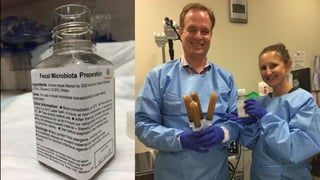
• Example: Clostridium difficile and Fecal Transplant
• Multiple C. diff Patients With a Single Donor
• Dramatic Shift Back to Healthy Microbiome in Days
Fecal Transplants
From Healthy Donor
To C. Diff Patients
Source: Knight Lab, UCSD
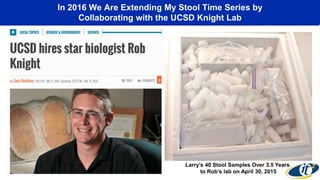
In 2016 We Are Extending My Stool Time Series by
Collaborating with the UCSD Knight Lab
Larry’s 40 Stool Samples Over 3.5 Years
to Rob’s lab on April 30, 2015
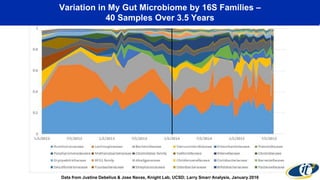
Variation in My Gut Microbiome by 16S Families –
40 Samples Over 3.5 Years
Data from Justine Debelius & Jose Navas, Knight Lab, UCSD; Larry Smarr Analysis, January 2016
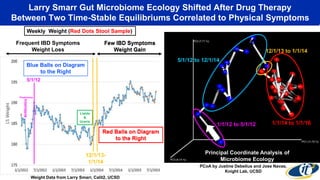
Larry Smarr Gut Microbiome Ecology Shifted After Drug Therapy
Between Two Time-Stable Equilibriums Correlated to Physical Symptoms
Lialda
&
Uceris
12/1/13 to 1/1/14
12/1/13-
1/1/14
Frequent IBD Symptoms
Weight Loss
5/1/12 to 12/1/14
Blue Balls on Diagram
to the Right
Few IBD Symptoms
Weight Gain
1/1/14 to 1/1/16
Red Balls on Diagram
to the Right
Principal Coordinate Analysis of
Microbiome Ecology
PCoA by Justine Debelius and Jose Navas,
Knight Lab, UCSD
Weight Data from Larry Smarr, Calit2, UCSD
Antibiotics
Prednisone
1/1/12 to 5/1/12
5/1/12
Weekly Weight (Red Dots Stool Sample)
Few IBD Symptoms
Weight Gain
1/1/14 to 1/1/16
Red Balls on Diagram
to the Right
Can Data Discover Functional Microbiome Gene Changes
Between Health and Disease?
We Computed the Relative Abundance of Microbial Gene Families -
~10,000 KEGG Orthologous Genes, Across Healthy and IBD Subjects
How Large is the Microbiome’s Genetic Change
Between Health and Disease States?
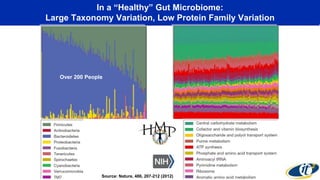
In a “Healthy” Gut Microbiome:
Large Taxonomy Variation, Low Protein Family Variation
Source: Nature, 486, 207-212 (2012)
Over 200 People
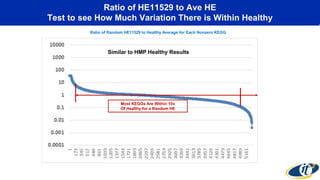
Ratio of HE11529 to Ave HE
Test to see How Much Variation There is Within Healthy
Most KEGGs Are Within 10x
Of Healthy for a Random HE
Ratio of Random HE11529 to Healthy Average for Each Nonzero KEGG
Similar to HMP Healthy Results
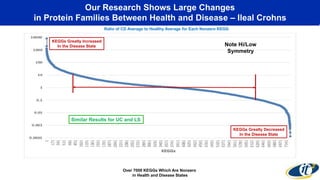
Our Research Shows Large Changes
in Protein Families Between Health and Disease – Ileal Crohns
KEGGs Greatly Increased
In the Disease State
KEGGs Greatly Decreased
In the Disease State
Over 7000 KEGGs Which Are Nonzero
in Health and Disease States
Ratio of CD Average to Healthy Average for Each Nonzero KEGG
Note Hi/Low
Symmetry
Similar Results for UC and LS
Using Ayasdi Topological Data Analysis
to Discover Hidden Patterns in Our Data
topological data analysis
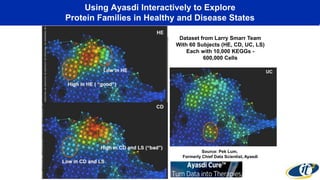
Using Ayasdi Interactively to Explore
Protein Families in Healthy and Disease States
Source: Pek Lum,
Formerly Chief Data Scientist, Ayasdi
Dataset from Larry Smarr Team
With 60 Subjects (HE, CD, UC, LS)
Each with 10,000 KEGGs -
600,000 Cells
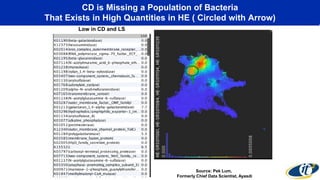
CD is Missing a Population of Bacteria
That Exists in High Quantities in HE ( Circled with Arrow)
Low in CD and LS
Source: Pek Lum,
Formerly Chief Data Scientist, Ayasdi
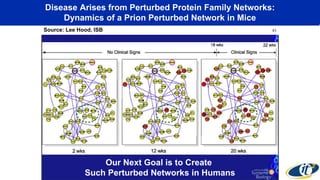
Disease Arises from Perturbed Protein Family Networks:
Dynamics of a Prion Perturbed Network in Mice
Source: Lee Hood, ISB 43
Our Next Goal is to Create
Such Perturbed Networks in Humans
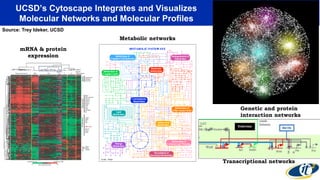
Genetic and protein
interaction networks
Transcriptional networks
Metabolic networks
mRNA & protein
expression
UCSD’s Cytoscape Integrates and Visualizes
Molecular Networks and Molecular Profiles
Source: Trey Ideker, UCSD
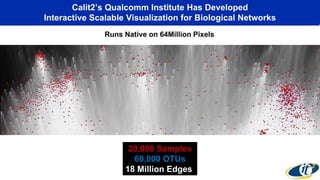
Calit2’s Qualcomm Institute Has Developed
Interactive Scalable Visualization for Biological Networks
20,000 Samples
60,000 OTUs
18 Million Edges
Runs Native on 64Million Pixels
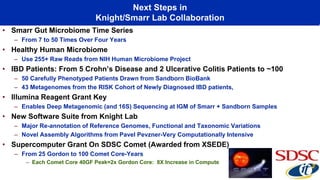
Next Steps in
Knight/Smarr Lab Collaboration
• Smarr Gut Microbiome Time Series
– From 7 to 50 Times Over Four Years
• Healthy Human Microbiome
– Use 255+ Raw Reads from NIH Human Microbiome Project
• IBD Patients: From 5 Crohn’s Disease and 2 Ulcerative Colitis Patients to ~100
– 50 Carefully Phenotyped Patients Drawn from Sandborn BioBank
– 43 Metagenomes from the RISK Cohort of Newly Diagnosed IBD patients,
• Illumina Reagent Grant Key
– Enables Deep Metagenomic (and 16S) Sequencing at IGM of Smarr + Sandborn Samples
• New Software Suite from Knight Lab
– Major Re-annotation of Reference Genomes, Functional and Taxonomic Variations
– Novel Assembly Algorithms from Pavel Pevzner-Very Computationally Intensive
• Supercomputer Grant On SDSC Comet (Awarded from XSEDE)
– From 25 Gordon to 100 Comet Core-Years
– Each Comet Core 40GF Peak=2x Gordon Core: 8X Increase in Compute
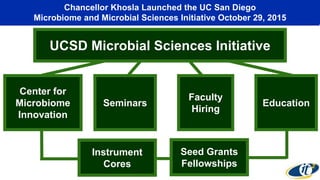
Center for
Microbiome
Innovation
Seminars
Faculty
Hiring
Education
UCSD Microbial Sciences Initiative
Instrument
Cores
Seed Grants
Fellowships
Chancellor Khosla Launched the UC San Diego
Microbiome and Microbial Sciences Initiative October 29, 2015
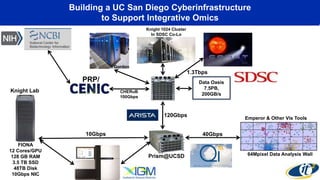
Building a UC San Diego Cyberinfrastructure
to Support Integrative Omics
FIONA
12 Cores/GPU
128 GB RAM
3.5 TB SSD
48TB Disk
10Gbps NIC
Knight Lab
10Gbps
Gordon
Prism@UCSD
Data Oasis
7.5PB,
200GB/s
Knight 1024 Cluster
In SDSC Co-Lo
CHERuB
100Gbps
Emperor & Other Vis Tools
64Mpixel Data Analysis Wall
120Gbps
40Gbps
1.3Tbps
PRP/
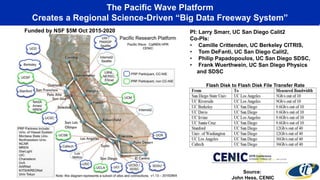
The Pacific Wave Platform
Creates a Regional Science-Driven “Big Data Freeway System”
Source:
John Hess, CENIC
Funded by NSF $5M Oct 2015-2020
Flash Disk to Flash Disk File Transfer Rate
PI: Larry Smarr, UC San Diego Calit2
Co-PIs:
• Camille Crittenden, UC Berkeley CITRIS,
• Tom DeFanti, UC San Diego Calit2,
• Philip Papadopoulos, UC San Diego SDSC,
• Frank Wuerthwein, UC San Diego Physics
and SDSC
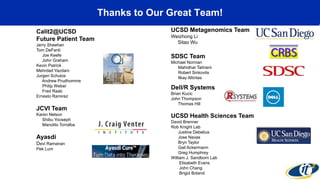
Thanks to Our Great Team!
Calit2@UCSD
Future Patient Team
Jerry Sheehan
Tom DeFanti
Joe Keefe
John Graham
Kevin Patrick
Mehrdad Yazdani
Jurgen Schulze
Andrew Prudhomme
Philip Weber
Fred Raab
Ernesto Ramirez
JCVI Team
Karen Nelson
Shibu Yooseph
Manolito Torralba
Ayasdi
Devi Ramanan
Pek Lum
UCSD Metagenomics Team
Weizhong Li
Sitao Wu
SDSC Team
Michael Norman
Mahidhar Tatineni
Robert Sinkovits
Ilkay Altintas
UCSD Health Sciences Team
David Brenner
Rob Knight Lab
Justine Debelius
Jose Navas
Bryn Taylor
Gail Ackermann
Greg Humphrey
William J. Sandborn Lab
Elisabeth Evans
John Chang
Brigid Boland
Dell/R Systems
Brian Kucic
John Thompson
Thomas Hill

Using Supercomputers and Data Science to Reveal Your Inner Microbiome

  • 1.
    “Using Supercomputers andData Science to Reveal Your Inner Microbiome” Invited Data Sciences Lecture School of Informatics and Computing Indiana University April 29, 2016 Dr. Larry Smarr Director, California Institute for Telecommunications and Information Technology Harry E. Gruber Professor, Dept. of Computer Science and Engineering Jacobs School of Engineering, UCSD http://lsmarr.calit2.net 1
  • 2.
    Abstract The human bodyis host to 100 trillion microorganisms, ten times the number of cells in the human body and these microbes contain 300 times the number of DNA genes that our human DNA does. The microbial component of our “superorganism” is comprised of hundreds of species with immense biodiversity. Thanks to the National Institutes of Health’s Human Microbiome Program researchers have been discovering the states of the human microbiome in health and disease. To put a more personal face on the “patient of the future,” I have been collecting massive amounts of data from my own body over the last ten years, which reveals detailed examples of the episodic evolution of this coupled immune-microbial system. An elaborate software pipeline, running on high performance computers, reveals the details of the microbial ecology and its genetic components. A variety of data science techniques are used to pull biomedical insights from this large data set. We can look forward to revolutionary changes in medical practice over the next decade.
  • 3.
    From One toa Trillion Data Points Defining Me in 15 Years: The Exponential Rise in Body Data Weight Blood Biomarker Time Series Human Genome SNPs Microbial Genome Time Series Improving Body Discovering Disease Human Genome
  • 4.
    As a Modelfor the Precision Medicine Initiative, I Have Tracked My Internal Biomarkers To Understand My Body’s Dynamics My Quarterly Blood Draw Calit2 64 Megapixel VROOM
  • 5.
    Only One ofMy Blood Measurements Was Far Out of Range--Indicating Chronic Inflammation Normal Range <1 mg/L 27x Upper Limit Complex Reactive Protein (CRP) is a Blood Biomarker for Detecting Presence of Inflammation Episodic Peaks in Inflammation Followed by Spontaneous Drops
  • 6.
    Adding Stool TestsRevealed Oscillatory Behavior in an Immune Variable Which is Antibacterial Normal Range <7.3 µg/mL 124x Upper Limit for Healthy Lactoferrin is a Protein Shed from Neutrophils - An Antibacterial that Sequesters Iron Typical Lactoferrin Value for Active Inflammatory Bowel Disease (IBD)
  • 7.
    To Understand theseExcursions of the Immune System We Must Consider the Human Microbiome Your Microbiome is Your “Near-Body” Environment and its Cells Contain 300x as Many DNA Genes As Your Human DNA-Bearing Cells Your Body Has 10 Times As Many Microbe Cells As DNA-Bearing Human Cells Inclusion of the “Dark Matter” of the Body Will Radically Alter Medicine
  • 8.
    New Estimates In2016 Estimate a Human Body Contains ~30 Trillion Human Cells and ~40 Trillion Microbes However, Red Blood Cells and Platelets Have No Nuclear DNA. Therefore, Ratio of DNA-Bearing Cells for Human vs. Microbiome is Still >10:1 DNA-Bearing Cells
  • 9.
    The Human Gut asa Super-Evolutionary Microbial Cauldron • Enormous Density – 1000x Ocean Water • Highly Dynamic Microbial Ecology – Hundreds to Thousands of Species • Horizontal Gene Transfer • Phages • Adaptive Selection Pressures (Immune System) – Innate Immune System – Adaptive Immune System – Macrophages and Antimicrobial proteins • Constantly Changing Environmental Pressures – Diet – Antibiotics – Pharmaceuticals How Can Data Science Elucidate This Dynamical System?
  • 10.
    We Gathered RawIllumina Reads on 275 Humans and Generated a Time Series of My Gut Microbiome 5 Ileal Crohn’s Patients, 3 Points in Time 2 Ulcerative Colitis Patients, 6 Points in Time “Healthy” Individuals Source: Jerry Sheehan, Calit2 Weizhong Li, Sitao Wu, CRBS, UCSD Total of 27 Billion Reads Or 2.7 Trillion Bases Inflammatory Bowel Disease (IBD) Patients 250 Subjects 1 Point in Time 7 Points in Time Each Sample Has 100-200 Million Illumina Short Reads (100 bases) Larry Smarr (Colonic Crohn’s)
  • 11.
    To Map Outthe Dynamics of Autoimmune Microbiome Ecology Couples Next Generation Genome Sequencers to Big Data Supercomputers • Metagenomic Sequencing – JCVI Produced – ~150 Billion DNA Bases From Seven of LS Stool Samples Over 1.5 Years – We Downloaded ~3 Trillion DNA Bases From NIH Human Microbiome Program Data Base – 255 Healthy People, 21 with IBD • Supercomputing (Weizhong Li, JCVI/HLI/UCSD): – ~20 CPU-Years on SDSC’s Gordon – ~4 CPU-Years on Dell’s HPC Cloud • Produced Relative Abundance of – ~10,000 Bacteria, Archaea, Viruses in ~300 People – ~3 Million Filled Spreadsheet Cells Illumina HiSeq 2000 at JCVI SDSC Gordon Data Supercomputer Example: Inflammatory Bowel Disease (IBD)
  • 12.
    Computational NextGen SequencingPipeline: From Sequence to Taxonomy and Function PI: (Weizhong Li, CRBS, UCSD): NIH R01HG005978 (2010-2013, $1.1M)
  • 13.
    Using Scalable VisualizationAllows Comparison of the Relative Abundance of 200 Microbe Species Calit2 VROOM-FuturePatient Expedition Comparing 3 LS Time Snapshots (Left) with Healthy, Crohn’s, Ulcerative Colitis (Right Top to Bottom)
  • 14.
    The Carl WoeseTree of Life Shows The Most Life on Earth is Bacterial Nature Microbiology Hug, et al. Source: Carl Woese, et al (1990) You Are Here
  • 15.
    When We ThinkAbout Biological Diversity We Typically Think of the Wide Range of Animals But All These Animals Are in One SubPhylum Vertebrata of the Chordata Phylum All images from Wikimedia Commons. Photos are public domain or by Trisha Shears, Richard Bartz, & Matt Clancy
  • 16.
    Think of ThesePhyla of Animals When You Consider the Biodiversity of Microbes Inside You Phylum Annelida Phylum Echinodermata Phylum Cnidaria Phylum Mollusca Phylum Arthropoda Phylum Chordata Phylum Porifera All images from WikiMedia Commons. Photos are public domain or by Dan Hershman, Michael Linnenbach, Manuae, B_cool, Nick Hobgood
  • 17.
    Results Include RelativeAbundance of Hundreds of Microbial Species Average Over 250 Healthy People From NIH Human Microbiome Project Note Log Scale Clostridium difficile 200 Most Abundant Species Colored by Phyla
  • 18.
    Using Microbiome Profilesto Survey 155 Subjects for Unhealthy Candidates
  • 19.
    Using HPC andData Analytics to Discover Microbial Disease Dynamics • Can Data Distinguish Between Health and Disease Subtypes? • Can Data Track the Time Development of the Disease State? • Can Data Discover Functional Microbiome Gene Changes Between Health and Disease?
  • 20.
    Can Data DistinguishBetween Health and Disease Subtypes?
  • 21.
    We Found MajorState Shifts in Microbial Ecology Phyla Between Healthy and Three Forms of IBD Most Common Microbial Phyla Average HE Average Ulcerative Colitis Average LS Colonic Crohn’s Disease Average Ileal Crohn’s Disease
  • 22.
    Dell Analytics SeparatesThe 4 Patient Types in Our Data Using Our Microbiome Species Data Source: Thomas Hill, Ph.D. Executive Director Analytics Dell | Information Management Group, Dell Software Healthy Ulcerative Colitis Colonic Crohn’s Ileal Crohn’s
  • 23.
    Can Data Track theTime Development of the Disease State?
  • 24.
    The Knight LabUses the Unifrac Metric to Quantitatively Compare Different Microbiome Ecologies “This method, UniFrac, measures the phylogenetic distance between sets of taxa in a phylogenetic tree as the fraction of the branch length of the tree that leads to descendants from either one environment or the other, but not both. UniFrac can be used to determine whether communities are significantly different…”
  • 25.
    A Healthy Person’sMicrobiome Is in a Stable Equilbrium Over Time • Background is Human Microbiome Project Data • Using Unifrac in Principle Coordinate Analysis – Map Microbiome Ecologies of Individuals to Points – Samples From Multiple Body Sites • Overlay Longitudinal Time Series of Male and Female Subject – Duration 60 Days – Time Points Separated by One Day – Sampled Oral, Skin, Stool Microbiomes – 16S Sequencing
  • 26.
  • 27.
  • 29.
    An Unhealthy Person’sMicrobiome Can Abruptly Shift Between Two States With External Influence • Example: Clostridium difficile and Fecal Transplant • Multiple C. diff Patients With a Single Donor • Dramatic Shift Back to Healthy Microbiome in Days
  • 31.
    Fecal Transplants From HealthyDonor To C. Diff Patients Source: Knight Lab, UCSD
  • 32.
    In 2016 WeAre Extending My Stool Time Series by Collaborating with the UCSD Knight Lab Larry’s 40 Stool Samples Over 3.5 Years to Rob’s lab on April 30, 2015
  • 33.
    Variation in MyGut Microbiome by 16S Families – 40 Samples Over 3.5 Years Data from Justine Debelius & Jose Navas, Knight Lab, UCSD; Larry Smarr Analysis, January 2016
  • 34.
    Larry Smarr GutMicrobiome Ecology Shifted After Drug Therapy Between Two Time-Stable Equilibriums Correlated to Physical Symptoms Lialda & Uceris 12/1/13 to 1/1/14 12/1/13- 1/1/14 Frequent IBD Symptoms Weight Loss 5/1/12 to 12/1/14 Blue Balls on Diagram to the Right Few IBD Symptoms Weight Gain 1/1/14 to 1/1/16 Red Balls on Diagram to the Right Principal Coordinate Analysis of Microbiome Ecology PCoA by Justine Debelius and Jose Navas, Knight Lab, UCSD Weight Data from Larry Smarr, Calit2, UCSD Antibiotics Prednisone 1/1/12 to 5/1/12 5/1/12 Weekly Weight (Red Dots Stool Sample) Few IBD Symptoms Weight Gain 1/1/14 to 1/1/16 Red Balls on Diagram to the Right
  • 35.
    Can Data DiscoverFunctional Microbiome Gene Changes Between Health and Disease?
  • 36.
    We Computed theRelative Abundance of Microbial Gene Families - ~10,000 KEGG Orthologous Genes, Across Healthy and IBD Subjects How Large is the Microbiome’s Genetic Change Between Health and Disease States?
  • 37.
    In a “Healthy”Gut Microbiome: Large Taxonomy Variation, Low Protein Family Variation Source: Nature, 486, 207-212 (2012) Over 200 People
  • 38.
    Ratio of HE11529to Ave HE Test to see How Much Variation There is Within Healthy Most KEGGs Are Within 10x Of Healthy for a Random HE Ratio of Random HE11529 to Healthy Average for Each Nonzero KEGG Similar to HMP Healthy Results
  • 39.
    Our Research ShowsLarge Changes in Protein Families Between Health and Disease – Ileal Crohns KEGGs Greatly Increased In the Disease State KEGGs Greatly Decreased In the Disease State Over 7000 KEGGs Which Are Nonzero in Health and Disease States Ratio of CD Average to Healthy Average for Each Nonzero KEGG Note Hi/Low Symmetry Similar Results for UC and LS
  • 40.
    Using Ayasdi TopologicalData Analysis to Discover Hidden Patterns in Our Data topological data analysis
  • 41.
    Using Ayasdi Interactivelyto Explore Protein Families in Healthy and Disease States Source: Pek Lum, Formerly Chief Data Scientist, Ayasdi Dataset from Larry Smarr Team With 60 Subjects (HE, CD, UC, LS) Each with 10,000 KEGGs - 600,000 Cells
  • 42.
    CD is Missinga Population of Bacteria That Exists in High Quantities in HE ( Circled with Arrow) Low in CD and LS Source: Pek Lum, Formerly Chief Data Scientist, Ayasdi
  • 43.
    Disease Arises fromPerturbed Protein Family Networks: Dynamics of a Prion Perturbed Network in Mice Source: Lee Hood, ISB 43 Our Next Goal is to Create Such Perturbed Networks in Humans
  • 44.
    Genetic and protein interactionnetworks Transcriptional networks Metabolic networks mRNA & protein expression UCSD’s Cytoscape Integrates and Visualizes Molecular Networks and Molecular Profiles Source: Trey Ideker, UCSD
  • 45.
    Calit2’s Qualcomm InstituteHas Developed Interactive Scalable Visualization for Biological Networks 20,000 Samples 60,000 OTUs 18 Million Edges Runs Native on 64Million Pixels
  • 46.
    Next Steps in Knight/SmarrLab Collaboration • Smarr Gut Microbiome Time Series – From 7 to 50 Times Over Four Years • Healthy Human Microbiome – Use 255+ Raw Reads from NIH Human Microbiome Project • IBD Patients: From 5 Crohn’s Disease and 2 Ulcerative Colitis Patients to ~100 – 50 Carefully Phenotyped Patients Drawn from Sandborn BioBank – 43 Metagenomes from the RISK Cohort of Newly Diagnosed IBD patients, • Illumina Reagent Grant Key – Enables Deep Metagenomic (and 16S) Sequencing at IGM of Smarr + Sandborn Samples • New Software Suite from Knight Lab – Major Re-annotation of Reference Genomes, Functional and Taxonomic Variations – Novel Assembly Algorithms from Pavel Pevzner-Very Computationally Intensive • Supercomputer Grant On SDSC Comet (Awarded from XSEDE) – From 25 Gordon to 100 Comet Core-Years – Each Comet Core 40GF Peak=2x Gordon Core: 8X Increase in Compute
  • 47.
    Center for Microbiome Innovation Seminars Faculty Hiring Education UCSD MicrobialSciences Initiative Instrument Cores Seed Grants Fellowships Chancellor Khosla Launched the UC San Diego Microbiome and Microbial Sciences Initiative October 29, 2015
  • 48.
    Building a UCSan Diego Cyberinfrastructure to Support Integrative Omics FIONA 12 Cores/GPU 128 GB RAM 3.5 TB SSD 48TB Disk 10Gbps NIC Knight Lab 10Gbps Gordon Prism@UCSD Data Oasis 7.5PB, 200GB/s Knight 1024 Cluster In SDSC Co-Lo CHERuB 100Gbps Emperor & Other Vis Tools 64Mpixel Data Analysis Wall 120Gbps 40Gbps 1.3Tbps PRP/
  • 49.
    The Pacific WavePlatform Creates a Regional Science-Driven “Big Data Freeway System” Source: John Hess, CENIC Funded by NSF $5M Oct 2015-2020 Flash Disk to Flash Disk File Transfer Rate PI: Larry Smarr, UC San Diego Calit2 Co-PIs: • Camille Crittenden, UC Berkeley CITRIS, • Tom DeFanti, UC San Diego Calit2, • Philip Papadopoulos, UC San Diego SDSC, • Frank Wuerthwein, UC San Diego Physics and SDSC
  • 50.
    Thanks to OurGreat Team! Calit2@UCSD Future Patient Team Jerry Sheehan Tom DeFanti Joe Keefe John Graham Kevin Patrick Mehrdad Yazdani Jurgen Schulze Andrew Prudhomme Philip Weber Fred Raab Ernesto Ramirez JCVI Team Karen Nelson Shibu Yooseph Manolito Torralba Ayasdi Devi Ramanan Pek Lum UCSD Metagenomics Team Weizhong Li Sitao Wu SDSC Team Michael Norman Mahidhar Tatineni Robert Sinkovits Ilkay Altintas UCSD Health Sciences Team David Brenner Rob Knight Lab Justine Debelius Jose Navas Bryn Taylor Gail Ackermann Greg Humphrey William J. Sandborn Lab Elisabeth Evans John Chang Brigid Boland Dell/R Systems Brian Kucic John Thompson Thomas Hill