Prpared By
Vinayak R Bodhankar
M. Pharm F.y (Sem – I)
P’ceutical Quality Assurance
Roll no. : 01
Guided by
Dr. P. N. Kendre
Sanjivani College of Pharmaceutical Education & Research,
Kopargaon
 Introduction
 Composition of ICH
 ICH guidelines : QSEM
 Q Family
 Q - series guidelines
 References
 ICH stands for International Conference On
Harmonization.(Technical requirement for
registration of pharmaceuticals for human use)
 ICH is a joint initiative involving both regulators
and research based industry representative of
EU, Japan and US in scientific and technical
aspect of testing procedure required to access
and ensure safety, quality, and efficacy of the
medicines.
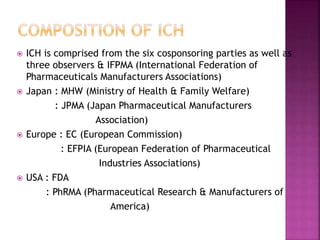
 ICH is comprised from the six cosponsoring parties as well as
three observers & IFPMA (International Federation of
Pharmaceuticals Manufacturers Associations)
 Japan : MHW (Ministry of Health & Family Welfare)
: JPMA (Japan Pharmaceutical Manufacturers
Association)
 Europe : EC (European Commission)
: EFPIA (European Federation of Pharmaceutical
Industries Associations)
 USA : FDA
: PhRMA (Pharmaceutical Research & Manufacturers of
America)
 WHO (World Health Organization)
 Canada
 EFTA (European Free Trade Associations)
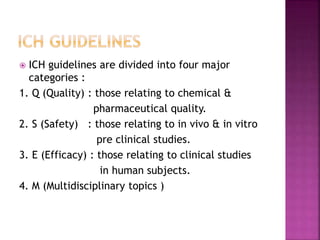
 ICH guidelines are divided into four major
categories :
1. Q (Quality) : those relating to chemical &
pharmaceutical quality.
2. S (Safety) : those relating to in vivo & in vitro
pre clinical studies.
3. E (Efficacy) : those relating to clinical studies
in human subjects.
4. M (Multidisciplinary topics )
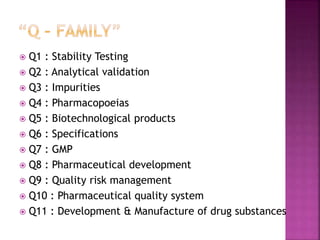
 Q1 : Stability Testing
 Q2 : Analytical validation
 Q3 : Impurities
 Q4 : Pharmacopoeias
 Q5 : Biotechnological products
 Q6 : Specifications
 Q7 : GMP
 Q8 : Pharmaceutical development
 Q9 : Quality risk management
 Q10 : Pharmaceutical quality system
 Q11 : Development & Manufacture of drug substances
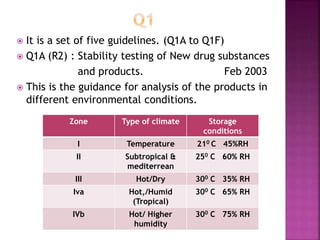
 It is a set of five guidelines. (Q1A to Q1F)
 Q1A (R2) : Stability testing of New drug substances
and products. Feb 2003
 This is the guidance for analysis of the products in
different environmental conditions.
Zone Type of climate Storage
conditions
I Temperature 210 C 45%RH
II Subtropical &
mediterrean
250 C 60% RH
III Hot/Dry 300 C 35% RH
Iva Hot,/Humid
(Tropical)
300 C 65% RH
IVb Hot/ Higher
humidity
300 C 75% RH
 Stability Testing : Photostability testing of New Drug
Substances & Products. Nov 1996
 Photostability studies are conducted with objective that
light exposure does not leads to unacceptable changes
in the dosage form.
 Photodegradation leads to changes in Physical
appearance as well as Chemical compostion.
 Photodegradation may observed as Discoloration of the
products.
 Stability Testing for New Dosage Forms. Nov 1996
 This guideline extend the stability guidance for new
formulation of already approved medicines and defines the
circumstances under which reduced stability data is
accepted.
Q1 D
• Bracketing and Matrixing designs for stability testing of
New drug substances and Products.
Feb 2002
• Bracketing and Matrixing are the procedures used to
reduce the amount of stability testing required.
 Bracketing : It is the design of stability schedule
such that only samples on the extremes of
certain design factors (e.g., strength, container
size) are tested at all time points as in a full
design.
 Matrixing : it is the design of a stability schedule
such that a selected subset of the total number
of possible samples for all factor combinations
would be tested at a specified time points.
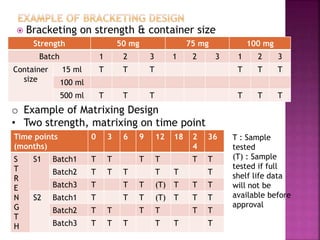
 Bracketing on strength & container size
Strength 50 mg 75 mg 100 mg
Batch 1 2 3 1 2 3 1 2 3
Container
size
15 ml T T T T T T
100 ml
500 ml T T T T T T
o Example of Matrixing Design
• Two strength, matrixing on time point
Time points
(months)
0 3 6 9 12 18 2
4
36
S
T
R
E
N
G
T
H
S1 Batch1 T T T T T T
Batch2 T T T T T T
Batch3 T T T (T) T T T
S2 Batch1 T T T (T) T T T
Batch2 T T T T T T
Batch3 T T T T T T
T : Sample
tested
(T) : Sample
tested if full
shelf life data
will not be
available before
approval
 Evaluation for Stability data. Feb 2003
 This guidelines involving the methods used for
evaluating stability data found after analysis.
 Regression Analysis is most commonly used method for
this purpose.
Q1 F
 Stability data Package for Registration applications in
the climatic zone III and IV. Feb 2003
 (Withdrawn in 8th june 2006)
 Validation of Analytical Procedures : Text and Methodology
Oct 1994
 Actual experimental data along with the statistical
interpretation is required for validation of analytical
procedures.
 Four types of analytical procedures are used for Validation :
1. Identification test
2. Quantitative test for Impurity content
3. Limit test
4. Quantitative test for active moiety in the drug product
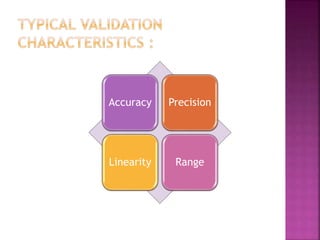
Accuracy Precision
Linearity Range
 Impurities in New drug substances Oct 2006
 This is the guidance addresses the chemistry and safety
aspect of impurities and defines the threshold for
reporting, identification and qualification.
 Classification of Impurities :
1. Organic Impurities : Starting materials,
reactions by products, etc.
2. Inorganic Impurities : Reagents, catalyst, Heavy
metals, etc.
3. Residual Solvents
 Identification threshold : A limit above which a
degradation product should be identified.
 Qualification threshold : A limit above which a
degradation product should be qualified.
 Reporting threshold : A limit above which a degradation
product should be reported.
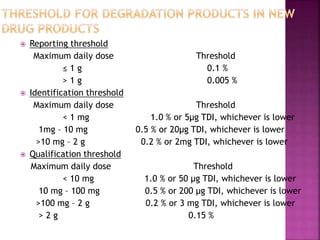
 Reporting threshold
Maximum daily dose Threshold
≤ 1 g 0.1 %
> 1 g 0.005 %
 Identification threshold
Maximum daily dose Threshold
< 1 mg 1.0 % or 5µg TDI, whichever is lower
1mg – 10 mg 0.5 % or 20µg TDI, whichever is lower
>10 mg – 2 g 0.2 % or 2mg TDI, whichever is lower
 Qualification threshold
Maximum daily dose Threshold
< 10 mg 1.0 % or 50 µg TDI, whichever is lower
10 mg – 100 mg 0.5 % or 200 µg TDI, whichever is lower
>100 mg – 2 g 0.2 % or 3 mg TDI, whichever is lower
> 2 g 0.15 %
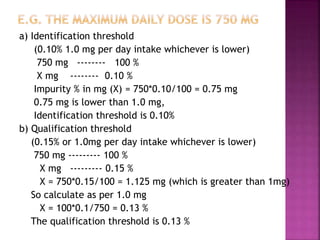
a) Identification threshold
(0.10% 1.0 mg per day intake whichever is lower)
750 mg -------- 100 %
X mg -------- 0.10 %
Impurity % in mg (X) = 750*0.10/100 = 0.75 mg
0.75 mg is lower than 1.0 mg,
Identification threshold is 0.10%
b) Qualification threshold
(0.15% or 1.0mg per day intake whichever is lower)
750 mg --------- 100 %
X mg --------- 0.15 %
X = 750*0.15/100 = 1.125 mg (which is greater than 1mg)
So calculate as per 1.0 mg
X = 100*0.1/750 = 0.13 %
The qualification threshold is 0.13 %
 Impurities in New drug products. Jun 2006
 These are the guidelines on impurities in new drug
products and advice in regards to impurities in product
containing new or chemically synthesized drug
substances.
 Impurities : Guidelines for residual solvents. Feb 2011
 Classification of Residual solvents :
Class – I : Solvents to be avoided
e.g Benzene, Carbon tetrachloride
Class – II : Solvents to be limited
e.g Chloroform, methanol
Class – III : Solvents with low toxic potential to man
e.g Acetone, butanol, ethanol
 Guidelines for Elemental Impurities. Dec 2014
 Objective of these guidelines is to limit the
metal impurities in the drug products.
 ICH guidelines Index
http://www.ich.org
 Guidance for Industry Q3B (R2) impurities in
new drug products U.S department of Health
and human services.
 ICH Quality Guidelines: An Implementation
Guide by Andrew Teasdale David Elder Raymond
W. Nims Pages (1-280)
ICH guidelines

ICH guidelines

  • 1.
    Prpared By Vinayak RBodhankar M. Pharm F.y (Sem – I) P’ceutical Quality Assurance Roll no. : 01 Guided by Dr. P. N. Kendre Sanjivani College of Pharmaceutical Education & Research, Kopargaon
  • 2.
     Introduction  Compositionof ICH  ICH guidelines : QSEM  Q Family  Q - series guidelines  References
  • 3.
     ICH standsfor International Conference On Harmonization.(Technical requirement for registration of pharmaceuticals for human use)  ICH is a joint initiative involving both regulators and research based industry representative of EU, Japan and US in scientific and technical aspect of testing procedure required to access and ensure safety, quality, and efficacy of the medicines.
  • 4.
     ICH iscomprised from the six cosponsoring parties as well as three observers & IFPMA (International Federation of Pharmaceuticals Manufacturers Associations)  Japan : MHW (Ministry of Health & Family Welfare) : JPMA (Japan Pharmaceutical Manufacturers Association)  Europe : EC (European Commission) : EFPIA (European Federation of Pharmaceutical Industries Associations)  USA : FDA : PhRMA (Pharmaceutical Research & Manufacturers of America)
  • 5.
     WHO (WorldHealth Organization)  Canada  EFTA (European Free Trade Associations)
  • 6.
     ICH guidelinesare divided into four major categories : 1. Q (Quality) : those relating to chemical & pharmaceutical quality. 2. S (Safety) : those relating to in vivo & in vitro pre clinical studies. 3. E (Efficacy) : those relating to clinical studies in human subjects. 4. M (Multidisciplinary topics )
  • 7.
     Q1 :Stability Testing  Q2 : Analytical validation  Q3 : Impurities  Q4 : Pharmacopoeias  Q5 : Biotechnological products  Q6 : Specifications  Q7 : GMP  Q8 : Pharmaceutical development  Q9 : Quality risk management  Q10 : Pharmaceutical quality system  Q11 : Development & Manufacture of drug substances
  • 8.
     It isa set of five guidelines. (Q1A to Q1F)  Q1A (R2) : Stability testing of New drug substances and products. Feb 2003  This is the guidance for analysis of the products in different environmental conditions. Zone Type of climate Storage conditions I Temperature 210 C 45%RH II Subtropical & mediterrean 250 C 60% RH III Hot/Dry 300 C 35% RH Iva Hot,/Humid (Tropical) 300 C 65% RH IVb Hot/ Higher humidity 300 C 75% RH
  • 9.
     Stability Testing: Photostability testing of New Drug Substances & Products. Nov 1996  Photostability studies are conducted with objective that light exposure does not leads to unacceptable changes in the dosage form.  Photodegradation leads to changes in Physical appearance as well as Chemical compostion.  Photodegradation may observed as Discoloration of the products.
  • 10.
     Stability Testingfor New Dosage Forms. Nov 1996  This guideline extend the stability guidance for new formulation of already approved medicines and defines the circumstances under which reduced stability data is accepted. Q1 D • Bracketing and Matrixing designs for stability testing of New drug substances and Products. Feb 2002 • Bracketing and Matrixing are the procedures used to reduce the amount of stability testing required.
  • 11.
     Bracketing :It is the design of stability schedule such that only samples on the extremes of certain design factors (e.g., strength, container size) are tested at all time points as in a full design.  Matrixing : it is the design of a stability schedule such that a selected subset of the total number of possible samples for all factor combinations would be tested at a specified time points.
  • 12.
     Bracketing onstrength & container size Strength 50 mg 75 mg 100 mg Batch 1 2 3 1 2 3 1 2 3 Container size 15 ml T T T T T T 100 ml 500 ml T T T T T T o Example of Matrixing Design • Two strength, matrixing on time point Time points (months) 0 3 6 9 12 18 2 4 36 S T R E N G T H S1 Batch1 T T T T T T Batch2 T T T T T T Batch3 T T T (T) T T T S2 Batch1 T T T (T) T T T Batch2 T T T T T T Batch3 T T T T T T T : Sample tested (T) : Sample tested if full shelf life data will not be available before approval
  • 13.
     Evaluation forStability data. Feb 2003  This guidelines involving the methods used for evaluating stability data found after analysis.  Regression Analysis is most commonly used method for this purpose. Q1 F  Stability data Package for Registration applications in the climatic zone III and IV. Feb 2003  (Withdrawn in 8th june 2006)
  • 14.
     Validation ofAnalytical Procedures : Text and Methodology Oct 1994  Actual experimental data along with the statistical interpretation is required for validation of analytical procedures.  Four types of analytical procedures are used for Validation : 1. Identification test 2. Quantitative test for Impurity content 3. Limit test 4. Quantitative test for active moiety in the drug product
  • 15.
  • 16.
     Impurities inNew drug substances Oct 2006  This is the guidance addresses the chemistry and safety aspect of impurities and defines the threshold for reporting, identification and qualification.  Classification of Impurities : 1. Organic Impurities : Starting materials, reactions by products, etc. 2. Inorganic Impurities : Reagents, catalyst, Heavy metals, etc. 3. Residual Solvents
  • 17.
     Identification threshold: A limit above which a degradation product should be identified.  Qualification threshold : A limit above which a degradation product should be qualified.  Reporting threshold : A limit above which a degradation product should be reported.
  • 18.
     Reporting threshold Maximumdaily dose Threshold ≤ 1 g 0.1 % > 1 g 0.005 %  Identification threshold Maximum daily dose Threshold < 1 mg 1.0 % or 5µg TDI, whichever is lower 1mg – 10 mg 0.5 % or 20µg TDI, whichever is lower >10 mg – 2 g 0.2 % or 2mg TDI, whichever is lower  Qualification threshold Maximum daily dose Threshold < 10 mg 1.0 % or 50 µg TDI, whichever is lower 10 mg – 100 mg 0.5 % or 200 µg TDI, whichever is lower >100 mg – 2 g 0.2 % or 3 mg TDI, whichever is lower > 2 g 0.15 %
  • 19.
    a) Identification threshold (0.10%1.0 mg per day intake whichever is lower) 750 mg -------- 100 % X mg -------- 0.10 % Impurity % in mg (X) = 750*0.10/100 = 0.75 mg 0.75 mg is lower than 1.0 mg, Identification threshold is 0.10% b) Qualification threshold (0.15% or 1.0mg per day intake whichever is lower) 750 mg --------- 100 % X mg --------- 0.15 % X = 750*0.15/100 = 1.125 mg (which is greater than 1mg) So calculate as per 1.0 mg X = 100*0.1/750 = 0.13 % The qualification threshold is 0.13 %
  • 20.
     Impurities inNew drug products. Jun 2006  These are the guidelines on impurities in new drug products and advice in regards to impurities in product containing new or chemically synthesized drug substances.
  • 21.
     Impurities :Guidelines for residual solvents. Feb 2011  Classification of Residual solvents : Class – I : Solvents to be avoided e.g Benzene, Carbon tetrachloride Class – II : Solvents to be limited e.g Chloroform, methanol Class – III : Solvents with low toxic potential to man e.g Acetone, butanol, ethanol
  • 22.
     Guidelines forElemental Impurities. Dec 2014  Objective of these guidelines is to limit the metal impurities in the drug products.
  • 23.
     ICH guidelinesIndex http://www.ich.org  Guidance for Industry Q3B (R2) impurities in new drug products U.S department of Health and human services.  ICH Quality Guidelines: An Implementation Guide by Andrew Teasdale David Elder Raymond W. Nims Pages (1-280)