ZEN 2
INTEGRATED MANAGEMENT SYSTEM
INDUCTION TRAINING
Kindly turn off your cell phone for the duration of the
presentation.
04.072.006/SHEQ Rev. 06 2018/04/06
Page 1 of 92
ORGANISATIONAL STRUCTURE
Page 2 of 92
POLICY STATEMENTS
ISO 9001 - QUALITY OHSAS 18001 - HEALTH & SAFETY ISO 14001 - ENVIRONMENT
Page 3 of 92
POLICY STATEMENTS (CONT.)
SMOKING POLICY
AVK Holding Southern Africa and its affiliated
companies strives to be legally compliant and
are therefore committed to implement and
adhere to the requirements of the Tobacco
Products Act, 1993 (Act No. 83 of 1993).
Smoking is only allowed in designated smoking
areas.
Page 4 of 92
INTEGRATED MANAGEMENT SYSTEM
Management System means what the organization does to manage its processes or
activities, in order that:
•Its products or services meet the organization’s objectives, such as:
•Satisfying the customer’s quality requirements / specifications.
•Complying with regulations.
• To be really efficient and effective, the organization can manage its way of doing
things by systemizing it.
• Nothing important is left out.
•Everyone is clear about who is responsible for doing what, when, how, why
and where.
•Management System Standards provide the organization with an
international, state-of-the-art model to follow.
Page 5 of 92
INTEGRATED MANAGEMENT SYSTEM
Management System Standards are PROCESSES, not PRODUCTS :
• These standards are concerned with the way an organization goes about its work.
• They are not product standards.
• They are not service standards.
• They are PROCESSstandards.
• They can be used by product manufacturers and service providers.
• Processes affect final product or services.
• ISO 9001 gives the requirements for what the organization must do to manage
processes affecting the quality of its products and services.
•ISO 45001 (OHSAS 18001 ) gives the requirements for managing the processes in a
safe and healthy manner (according to OHSACT / Regulatory requirements). •ISO
14001 gives the requirements for what the organization must do to manage processes
affecting the impact of its activities on the environment.
Page 6 of 92
INTEGRATED MANAGEMENT SYSTEM
CERTIFICATION:
•Certification means that an independent, external body (i.e. SGS) has audited an organization’s
management system and verified that it conforms to the requirements specified in the applicable
Management System (ISO) Standards.
•Accreditationis like certification of the certification body.
• It means the formal approval by an accreditation body (i.e. SANAS / SABS), that a certification body
(i.e. SGS) is competent to carry out ISO-Standard certification in specific business sectors. •
Certificates issued by accredited certification bodies (known as accredited certificates), may be
perceived on the market as having increased credibility.
ISO does not carry out certification.
ISO does not issue or approve certificates.
ISO does not accredit, approve or control the certification bodies.
ISO develops standards and guides to encourage good practice in accreditation and certification.
Page 7 of 92
INTEGRATED MANAGEMENT SYSTEM
INTEGRATED MANAGEMENT SYSTEM CERTIFICATION
Page 8 of 92
QUALITY
ISO 9001:2015 - Quality Management
• Quality refers to all those features of a product (or service) which are
required by the customer, i.e. a good, quality product, which conforms to
product specifications, delivered on time at the right price, etc.
•Quality Management means what the organization does to:
• Ensure that its products or services satisfy the customer’s quality
requirements and/or specification.
•Comply with any regulations applicable to those products or services.
•Quality management also means what the organization does to:
•Enhance customer satisfaction, and
•Achieve continual improvement of its performance.
Page 9 of 92
QUALITY
Quality Hierarchy
Why do we need Policies & Procedures?
Policies- Policies and Procedures clarify employee expectations about the business policies
and communicates corporate standards of action and behaviour. - Policies are a legal
requirement (OHS Act)
Procedures
Why do we need Work Instructions / Safe Work Procedures?
- To ensure the correct operating procedures are used, especially when
using large / electrical machinery.
Why do we need Documented Information?
Documented Information /
- Documented information will serve as a guideline and/or proof that
Proof / Forms
tasks had been completed, e.g. delivery notes (proof of delivery, etc.)
Page 10 of 92
QUALITY
What is Quality? Quality is:
• Perfection.
• Providing a good, usable product. •
Eliminating waste.
• Consistency.
• Fast delivery. •
Fitness for use.
• Doing it right the first time. • Delighting
or pleasing customers. • Total customer
service and satisfaction.
Objectives of ISO 9001 Standard
• Achieve, maintain, and continuously improve product quality.
• Improve quality of operations to continually meet customers’ and stakeholders’ needs. •
Provide confidence to all stakeholders and interested parties (i.e. shareholders, management,
customers, employees, etc.) that quality requirements are being fulfilled.
Page 11 of 92
QUALITY
CUSTOMER SERVICE:
• Customer service plays an important role in an organization's ability to generate income and revenue.
• It is the act of taking care of the customer's needs by providing and delivering professional, helpful, high quality service
and assistance before, during, and after the customer's requirements are met.
• Customer service is meeting the needs and desires of any customer. Some characteristics of good customer service
include:
• Promptness: Promises for delivery of products must be on time. Delays and cancellations of products should be
avoided.
• Politeness: Politeness is almost a lost art. Saying 'hello,' 'good afternoon,' 'sir', and 'thank you very much' are a part of
good customer service. For any business, using good manners is appropriate whether the customer makes a purchase
or not.
• Professionalism: All customers should be treated professionally, which means the use of competence or skill
expected of the professional. Professionalism shows the customer they're cared for.
• Customer service concerns the priority an organization assigns to customer service relative to components such as
product innovation and pricing.
• Customer service should be included as part of an overall approach to systematic improvement.
• One good customer service experience can change the entire perception a customer holds towards the organization.
Page 12 of 92
QUALITY
GETTING STARTED TO IMPROVE QUALITY:
The most effective approach is to launch Six Sigma (DMAIC) methodology:
• Recognize customer requirements - find out their needs and expectations. •
Set performance standards that meet customer requirements. • Control
processes and improve their capability. • Establish quality management
systems.
• Set a quality policy, motivate through leadership and equip people to achieve. •
Empower everyone to act for quality improvement.
What is Six Sigma (DMAIC Methodology)?
• Six Sigma is a business improvement approach.
• It seeks to find and eliminate causes of defects and errors in manufacturing and service
processes.
• It focuses on outputs that are critical to customers and to ensure a clear financial return
for the organization.
It aims at producing zero (no more than 3.4 ppm) defects.
• It was pioneered by Motorola in the mid-1980’s and popularized by the success of General
Electric.
Page 13 of 92
QUALITY
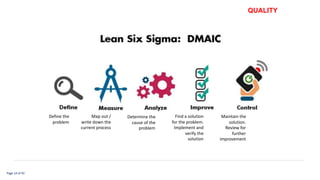
Define the Map out / Determine the Find a solution Maintain the
problem write down the cause of the for the problem. solution.
current process problem Implement and Review for
verify the further
solution improvement
Page 14 of 92
QUALITY
SIX SIGMA METHODOLOGY
Define Measure Analyse Improve Control
(DMAIC)
It all starts with:
SUPPLIERS:
INPUTS
Evaluating and/or rating
Are evaluated and MANUFACTURING AND
their service, product,
scrutinized for quality & SERVICE PROCESSES
price, etc. OUTPUTS
effectiveness
Are evaluated for effectiveness
Are inspected / tested for CUSTOMERS
and/or improvement quality conformance
Total Customer
Which ensures: satisfaction
IMPROVED
BUSINESS PERFORMANCE IMPROVED
QUALITY IMPROVED
REDUCED
PRODUCTIVITY INCREASED
COST / WASTE PROFITABILITY
Page 15 of 92
QUALITY
Why Six Sigma?.... Because it works for EVERYONE:
• Customers - higher satisfaction at lower cost.
• Plant Managers - reduced waste, improved product consistency, solved equipment problems
(through planned maintenance), increased capacity.
• Human Resource Managers - reduced staff turnover.
• Sales Managers - improved forecast reliability / pricing strategies / pricing variation. • Anyone -
better understanding of customer needs and tailored service to meet the demand.
Consequences of Poor Quality
• Product fails.
• Product / Service does not meet requirements. •
Exceed competitive pricing.
• Delivery goes beyond deadline.
• Loss of business: Poor designs / defective products / poor service - can result in loss of business. •
Liability: Damage or injuries resulting from faulty design.
• Cost: Poor quality increases production (rework / scrap) and marketing costs. •
Productivity loss: Due to rework, etc.(Productivity and quality are closely related).
Page 16 of 92
QUALITY
What is a QCP?
• Quality Control Plan, with the emphasis on CONTROL.
Why is it important to complete & follow a
QCP?
• It ensures that ALL customer requirements and/or
specifications are noted and followed.
• It defines the product’s work-flow and process route. • It
ensures that hold-points and inspections are adhered to and
signed-off.
• It ensures complete customer satisfaction, as the product
complies with the customer’s requirements and/or
specifications.
Page 17 of 92
ENVIRONMENT
ISO 14001 - Environmental Management
•The Standard prescribes what the organization should do to:
•Minimize harmful effects on the environment caused by its
activities;
•To conform to applicable regulatory requirements, and to;
•Achieve continual improvement of its environmental performance.
It is the organization’s aim to achieve certification during 2019.
Page 18 of 92
HEALTH & SAFETY
ISO 45001 (OHSAS 18001:2007 ) - Health & Safety
Management
• The Health & Safety Management Standard prescribes what the
organization should do to:
• Ensure a safe and healthy working environment for the employees and
other interested parties by minimizing operational risks, deliver
optimum working conditions, etc.;
• To conform to applicable legislative and regulatory requirements;
• To protecting the longevity, health and integrity of the organization;
• To achieve continual improvement of its health & safety performance.
Page 19 of 92
HEALTH & SAFETY
Safety Controls Hierarchy
1. Eliminate the Hazard
2. Reduce / Substitute the Hazard
3. Engineering Controls (implement Barriers/Guards, etc.) 4.
Administrative Controls (implement Procedures, SOP’s, etc.) 5.
PPE (is the last resort and cannot save lives.)
Page 20 of 92
HEALTH & SAFETY
OHS Act
Occupational Health and Safety Act 1993 (Act 85, 1993)
Aims to provide for:
• The health and safety of people at work.
• The health and safety of persons using plant and machinery.
• The protection of persons other than persons at work (i.e. Visitors,
customers, neighbours), against hazards to health and safety
arising out of or in connection with activities at work.
Page 21 of 92
HEALTH & SAFETY
DEPARTMENT OF LABOUR
The Occupational Health & Safety Act is administered by the Department of Labour, whose Inspectors
have the right to un-obstructive entrance to workplace premises. Based on their findings, they may issue the
following notices:
• Prohibition Notice
In the case of threatening danger, an inspector may prohibit a particular action, process or the use
of a machine/equipment. No person may disregard such a notice and compliance must take place
with immediate effect.
• Contravention Notice
A contravention of the Act, can result in immediate prosecution, but in case of a contravention of a
Regulation, the employer may be given the opportunity to correct the contravention within a given
time limit.
• Improvement Notice
Where health & safety measures which the employer has instituted, do not satisfactorily protect
the health & safety of workers, the Inspector may require the employer to bring about more
effective measures. An Improvement Notice which prescribes the corrective measures will be
served on the employer.
Page 22 of 92
HEALTH & SAFETY
DUTIES OF EMPLOYERS
• Section 8 of the OHS Act determines that every employer must, as far as reasonably
practicable, provide and maintain a workplace that is safe and without risk to the
health and safety of the employees.
• Provide Safe Systems, Plant and Machinery.
• Provide proper production-and storage facilities for objects & substances. •
Conduct HIRA - Hazard Identification, Risk Assessments. • Eliminate /
Mitigate hazards and risks before resorting to PPE. • Provide Information,
Instruction, Training and Supervision. • Prohibit Unsafe Acts.
• Enforce safe work procedures and policies.
• The employer has a duty to inform employees regarding safety related issues.
Page 23 of 92
HEALTH & SAFETY
DUTIES OF THE CEO / MD
Section 16(1) of the Occupational Health & Safety Act, automatically appoints the CEO / MD as the accountable
person (16)(1), responsible to provide and maintain a safe and healthy work environment that is without risk to
employees and others.
Section 37 of the same Act stipulates that whenever an employee does or omits to do any act, which would be an
offence for the employer of such employee, the CEO/MD would be seen as the accountable person.
Without derogating from this responsibility or liability, the CEO/MD may delegate safety and health related responsibilities to
the management of the business or organisation.
In terms of this appointment, the Section 16(2) appointee(s) will then be responsible for the management of occupational
health & safety matters at the designated area of appointment.
After appointment, they will be legally bound to help and assist the CEO/MD (Section 16(1)) with safety and health management
over these designated areas. It should be noted that a person may delegate responsibility but not accountability.
In order to meet this responsibility, Section 16(1) and (2) appointees should familiarize themselves with ALL statutory
requirements stipulated by the Occupational Health and Safety Act and Regulations.
The CEO / MD means the person who is responsible for the overall
management and control of the business or enterprise.
Page 24 of 92
HEALTH & SAFETY
OHSACT APPOINTMENTS
Main Appointments:
OHSA 8 (2)(h): Fire Fighters
OHSA 8 (2)(i): Supervisors
OHSA 16 (2): Assistant to the Chief Executive Officer
OHSA 17 (1): Health & Safety Representatives OHSA
19 (3): SHE Committee
GMR 2 (1): Person responsible for General & Driven Machinery
GSR 3(4): First Aiders (Valid certificate of competency)
GSR 8 (1)(a): Stacking Supervisor
Page 25 of 92
HEALTH & SAFETY
DUTIES OF EMPLOYEES
Section 14 of the OHS Act covers the duties of employees with respect to Health and
Safety in the workplace.
Employees must:
• Be aware of and understand all the hazards and risks associated with their job and work area. •
Co-operate and carry out all instructions given to prevent any incidents to health and safety. •
Follow safe work procedures as identified and implemented by the employer. • Report any high-
risk conditions to the Health & Safety Representative or employer as soon as possible.
• Report any incident (an injury or anything which may affect health and safety) to the Health &
Safety Representative or employer as soon as possible, but BEFORE THE END OF SHIFT. • Assist
the employer to establish and maintain a healthy and safe work place.
Page 26 of 92
HEALTH & SAFETY
HEALTH & SAFETY COMMITTEES
• Purpose:-
• Members meet in order to initiate, promote, maintain and review measures of ensuring the
health and safety of employees.
• The Committee may co-opt people as advisory members for their knowledge and expertise on
health & safety matters, however an advisory member does not have the right to vote.
• Duties:-
• Deal with health & safety matters at the workplace.
• Make recommendations to the employer with regards to the health & safety of employees. •
Discuss / Investigate Incidents/Accidents.
• Keep record of every recommendation to the employer and every report to an inspector.
• Perform any other functions required of them by regulation.
Page 27 of 92
HEALTH & SAFETY
HEALTH & SAFETY REPRESENTATIVES
• Duties include:-
• Inspections.
• Identify potential dangers.
• Assist in the investigation of Incidents/Accidents. •
Assist with Health & Safety Audits.
• Make representations regarding the safety of the workplace to the
employer or the Health & Safety Committee.
• Attend committee meetings.
Page 28 of 92
HEALTH & SAFETY
SITE RULES
• Security will direct all visitors and contractors to Reception, who will announce
their arrival to the host.
• Visitors are to be accompanied by their host at all times to all meetings or
locations.
• Prior to taking visitors on a walkabout through any plant, arrangements must be
made with the respective Managers or Supervisors in order to ensure the visitors’
safety in the workplace.
• Visitors should keep their visitors’ cards with them at all times and return them to
Security on exiting the premises.
• In case of emergency, the host is responsible for the safety of visitors and should
accompany them to the nearest assembly point.
• Managers / Supervisors are responsible for Contractors working in their area.
Page 29 of 92
HEALTH & SAFETY
SITE RULES (CONT.)
On entering any production area:
• No high heeled or open-toe shoes are allowed in production areas. •
Stay within the walkways.
• Stay clear from machines / operation areas. •
Beware of overhead / jib cranes.
• Beware of forklifts, loading equipment, trucks and other vehicles. •
Wear hearing protection.
Smoking is allowed in demarcated areas only.
NO SMOKING in offices, production areas, ablution facilities or while walking on the plant.
It is a legal requirement - refer to the Tobacco Products Act.
Page 30 of 92
HEALTH & SAFETY
SUBSTANCE ABUSE
• Do not drink alcohol or use drugs, while at work.
• If you need to take medicines which may affect your working ability,
advise your Manager / Supervisor accordingly. X
• PS - Please advise your Manager / Supervisor if you have any health
conditions which may affect your work, i.e. Diabetes, High/Low Blood
Pressure, etc.
PERSONAL HYGIENE
• Keep yourself clean.
• Wash hands before meals and after using the toilet. •
Dress tidily and keep your PPE clean.
• Wash hands after working with chemicals.
• Use barrier creams to protect hands and help keeping them clean. •
Do not keep any food in lockers or change-rooms. • Take care of the
facilities provided and keep it clean and tidy.
Page 31 of 92
HEALTH & SAFETY
FIRST AID / CLINIC
• Trained First Aiders are appointed in all departments to assist with incidents / accidents. Names are posted
on the First Aid boxes. Please ensure you know who the First Aider for your area is.
• A qualified and experienced Occupational Doctor is on Site twice per month.
• A qualified and experienced Occupational Sister is on Site, once a week. All new employees are required
to undergo a general medical examination within the first month of their employ.
• Employees, working under certain conditions (i.e. exposure to loud noise, exposure to grinding, dust etc.)
are required to undergo annual hearing, eye and lung-function tests, which will be co-ordinated by the
Sister and HR.
• All incidents / accidents (even minor cuts) need to be reported to the First Aider and/or the Sister on duty
BEFORE THE END OF THE SHIFT and either the First Aid Register (minor first aid treatments) or an
Incident Report must be completed and forwarded to the SHEQ Department immediately.
• Incidents requiring medical treatment (I.O.D’s), must be reported to the HR Department immediately to obtain
the necessary documentation for the doctor / casualty and reporting to DOL. These incidents are also to be
reported to SHEQ immediately, as all incidents need to be investigated as soon as possible, or at least
within 7 days.
(More details on Incident Reporting is provided later in the presentation)
Page 32 of 92
HEALTH & SAFETY
FIRE SAFETY
There is always a risk of fire, however the chances of fire can be reduced by being more vigilant of the risks. Therefore:
• Always keep the workplace clean and tidy.
To identify fire hazards in the workplace, consider the following:
•How a fire could start, i.e. ignition sources such as heaters, lighting and electrical equipment, machinery or tools
which may generate sparks or heat; and
• What could burn, i.e. fuel, such as packaging, plastics, rubber, wood, plastic, petrol and chemicals.
Potential fire hazards can result from unsafe activities, an unsafe • Unsafe Environments include:
environment, or a combination of both. The following activities and • Blocked, littered or obstructed passageways, fire exits, and stairs;
environment can increase the risk of fire: • Stored boxes of combustible materials, i.e. components of
machinery;
• Unsafe Activities include:
• Stacks or piles of refuse, cardboard boxes, pallets, rubber tyres, etc.
• Decanting chemicals into unlabelled containers;
• Lack of segregation of incompatible chemicals;
• Smoking in non-smoking or unventilated areas;
• Piles of oily rags;
• Overloading power outlets and power boards;
• Coiled-up connected electrical cables;
• Storing / using portable heaters underneath desks;
• Damaged or untagged electrical leads;
• Using or storing flammable liquids in poorly ventilated areas or
near sources of ignition; and • Poorly maintained electrical and mechanical equipment;
• Overgrown dry grass;
• Welding or grinding near solvents, wood shavings/objects and
• Flammable building materials.
similar areas.
•
Know where fire extinguishers are located and how they are used.
•
Know the evacuation routes and procedures.
Page 33 of 92
HEALTH & SAFETY
EMERGENCY PERSONNEL
Emergency Personnel are appointed at all areas on site:
• First Aiders
• Fire Fighters
• OHS Reps
• Lists with names and contact numbers are displayed in all areas. • Please
contact these people immediately in case of an emergency. • Emergency
response contact numbers are also posted on all information boards and
contained in the Emergency Preparedness Procedure.
Page 34 of 92
HEALTH & SAFETY
EMERGENCY PROCEDURES
AVK Holding S.A. (Pty) Ltd will respond to actual emergency situations and accidents to prevent or mitigate
associated adverse risks, hazards or environmental impacts.
A detailed Emergency preparedness and response plan is described in a procedure to identify the potential
emergency situations and accidents that can have an impact on:
• The health and safety of:
• The people working under AVK Holding S.A.’s supervision
• Contractors
• Visitors
• Neighbours
• The environment, and
• Normal business operation
The emergency preparedness and response procedure is tested and reviewed annually, involving relevant interested
parties as appropriate, or after the occurrence of accidents or emergency situations and will be amended based on
experience, to continually improve the procedure.
A copy of the Emergency Preparedness Procedure is handed to each delegate during this course. It is
the responsibility of each Manager, Supervisor and Staff Member to familiarize themselves with this procedure.
Page 35 of 92
HEALTH & SAFETY
EMERGENCY EVACUATION
What constitutes an emergency?
• Any unforeseen situation that threatens employees, customers or the public.
• Emergencies may be natural or man-made.
• May disrupt or shut down operations.
• May cause physical or environmental damage, e.g. fire, flooding, gas leaks, explosions etc.
What to do?
• If at anytime an evacuation alarm is sounded (air horns / fire alarm - sounded at 3 short intervals), please follow
the evacuation route.
• Proceed to the relevant assembly points.
• Visitors to accompany their hosts.
• Roll call will be taken and a decision will be made to re-enter buildings when safe to do so. • Contractors
and their employees are to accompany AVK-employees in their area of work. • Employees MAY NOT
divulge any information to the public / media regarding incidents / accidents. ONLY designated members
of Top Management are allowed to make statements.
Page 36 of 92
HEALTH & SAFETY
EMERGENCY EVACUATION (CONT.)
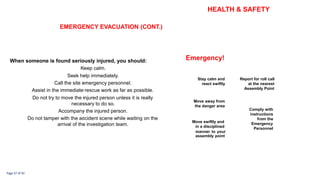
Emergency!
When someone is found seriously injured, you should:
•
Keep calm.
•
Seek help immediately.
Stay calm and Report for roll call
•
Call the site emergency personnel. react swiftly at the nearest
Assembly Point
•
Assist in the immediate rescue work as far as possible.
•
Do not try to move the injured person unless it is really
Move away from
necessary to do so. the danger area
Comply with
•
Accompany the injured person.
instructions
•
Do not tamper with the accident scene while waiting on the from the
Move swiftly and Emergency
arrival of the investigation team. in a disciplined Personnel
manner to your
assembly point
Page 37 of 92
HEALTH & SAFETY
EMERGENCY EVACUATION (CONT.)
SPECIAL PRECAUTIONS:
FIRE
• Raise the alarm. • Do not endanger yourself or others.
General Fire / Blaze • Evacuate people from the area. • Make sure you have an escape route.
• Activate the emergency shut-down systems. • Do not use water on petroleum or electrical fires.
• Call the Manager / Supervisor / Emergency Team. • Do not leave the site unattended if there is a risk of further
• Call Emergency Services (dial 10177 / 112). outbreak.
• Advise the Manager / Supervisor of the incident.
Moving around in smoke When moving about in smoke, it may only be possible to move around by touch, which calls for caution:
• Cover your mouth and nose with a handkerchief / cloth / clothing (if possible, damp items).
• Crawl on your hands and knees, as the air will be clearest and coolest near the floor. More people die from
smoke inhalation and inhaling toxic fumes, than from the actual fire.
• In moving forward, clench the one hand into a fist and raise it slightly in front of you. If the back of the hand
touches a live electrical wire, the shock will throw the hand clear and will not cause it to clasp the wire.
• If you don't know where the door is, move along the wall, around the room, until you find the door.
• Check underneath the door if there are any flames on the other side of the door. Do not open the door if there are
flames. Rather find a window from which to escape or to call for help. Be careful when opening doors and windows
where there are flames, as the sudden rush of Oxygen will aggravate / intensify the flames.
• Use something to cover the handle of the door, before opening it, as it can be hot and cause severe burns on the
hands.
• Never use elevators during fires.
• When using stairs, take care that steel structures and hand-railings may be hot.
Page 38 of 92
HEALTH & SAFETY
EMERGENCY EVACUATION (CONT.)
At Flammable Storage • Raise the alarm by sounding the alarm, air horn, shout.
Facilities • Evacuate people from the area.
• If it is safe to do so:
• Activate the emergency stop.
• Switch-off power to all equipment.
• Shut any isolation valves.
•If a small fire, use the fire extinguisher (if trained to do so) - contain and extinguish the fire.
•Call the Manager / Supervisor / Emergency Team.
•Call the Fire Services (dial 10177 / 112).
• If it is a large fire, do not attempt to extinguish the fire -retreat to a safe distance.
• If the fire involves a flammable gas or a compressed gas, apply water cooling it if is safe to do so.
• Ensure someone is available to direct the Fire Service to the scene.
Fire & Explosions involving Electricity can kill and many people die from electric shock or burns at work and at home. It is therefore eminent to
Electrical Equipment take extra care where there is an emergency involving electrical equipment. In such a case:
• Raise the alarm.
• If possible, switch off the equipment.
• If there are any casualties, provide first aid as necessary. BEFORE TOUCHING THE CASUALTY,ensure that the
main electrical supply is switched off.
• If it is safe to do so and without putting yourself at risk, extinguish the fire, using a suitable fire extinguisher, i.e.
CO2 or Dry Powder. Always check that your exit is clear and allow time to evacuate the building. • When the fire is
extinguished, report the incident to the Business Unit Manager / Supervisor. • Do not switch the equipment back on
until it has been checked by a competent person.
Page 39 of 92
HEALTH & SAFETY
EMERGENCY EVACUATION (CONT.)
Using a fire extinguisher Only use a fire extinguisher if you have been trained in the use thereof:
•
Make sure the extinguisher is of the correct type.
•
Make the extinguisher ready for use by breaking the seal / removing the safety pin.
•
Carry the extinguisher to the fire.
•
Keep yourself low to reduce the effect of the heat and smoke.
•
When in position, aim the extinguisher at the base of the flames.
•
Discharge the extinguisher in a sweeping motion across the base of the flames.
•
Keep going until you have completely extinguished the fire.
•
If the fire becomes uncontrollable, or there is too much heat or smoke for safety, leave immediately.
•
Always keep between the fire and your escape route.
After the event:
• Complete an incident report.
Spills
General Spills • Your first consideration is the immediate safety of all people present.
• Raise the alarm.
• Evacuate people from the area if necessary.
• Call the emergency team and services (dial 10177).
• Close valve, plug leak or upright container, if safe to do so.
• Utilize safety equipment to contain the spill.
• Call on specialist advice.
• Clean-up spill.
• Recover product or dispose of waste safely.
Page 40 of 92
HEALTH & SAFETY
EMERGENCY EVACUATION (CONT.)
Hazardous • Raise the alarm by sounding the alarm/air horn or shouting.
Substance Spills • Evacuate if necessary.
• Identify the nature of the spilled substance.
• Put on PPE, i.e. gloves, boots, eye protection, etc.
• If it is safe to do so, close-off the source of the spill.
• Remove sources of ignition if flammable substance present.
• Identify the danger posed by the spill - only respond if it is safe to do so.
• Refer to the MSDS (Material Safety Data Sheet) or call an approved handler or specialist for advice.
• MSDS (Material Safety Data Sheets) are available at the first aid box stations.
• If necessary, call emergency services and advise the local council.
• Use the spill kit to contain the spill if it is safe to do so.
After the event:
• Utilize a drip-tray, an oversized container or absorbent material
• Replenish the spill kit.
to soak up a small spill.
• Complete an incident report.
• Dispose of waste safely, as per the MSDS.
Gas:
Bulk Storage Leaks • Activate the alarm.
• Evacuate the area.
• Call the Fire Services.
• Remove all sources of ignition. After the event:
• Activate any fire protection systems.
• Complete an incident report.
• If a pipeline leaks, close the isolation valves, it if is safe to do so.
Page 41 of 92
HEALTH & SAFETY
EMERGENCY EVACUATION (CONT.)
LPG / Oxygen / Acetylene Know and understand what to do if a leak occurs:
SPECIAL PRECAUTIONS:
• The first consideration is the immediate safety of all people • Make sure there is an escape route.
present.
• Keep hands and face clear of any escaping gas or liquid.
• Sound the alarm.
• No smoking. Remove ignition sources until the area is
• Call the emergency team and services.
safe.
•
Evacuate people from the area. • Do not use equipment again until it has been inspected.
•
Activate any emergency shut-down systems.
• Do not leave the site unattended if there is a risk of
•
Contain the leak, but only if it is safe to do so. further leaks.
•
Remove all sources of ignition.
• Advise your Manager/Supervisor of the incident.
•If help is available, allocate responsibilities to others to
• Do not endanger yourself or others.
create a competent emergency team to deal with the leak.
• If there is any possibility of cylinder(s) being engulfed by fire, evacuate adjacent areas.
Suspected Cylinder
• Call the Fire Services, advise them of the location of the cylinder(s) or appliance, what type of gas it is and the cylinder size.
Leaks
• Keep cylinder(s) cool with a water hose, sprayed from maximum possible
distance. • Remove or extinguish sources of ignition.
• Remove from heat source if it is possible and safe to do so. • Do not interfere with any part of a fixed installation. • If gas is
leaking, ventilate the area thoroughly until the air is clear. • If the leak persists, remove the cylinder(s) to a safe outdoor
area, if it is safe to do so. • If it is a minor leak, check the system for any indication of gas, such as a smell or "hiss" sound. •
Test with soapy water solution (for Oxygen, use an Oxygen-safe solution), which will bubble at any point where gas escapes.
• If a leak is found at a connection, remove and re-apply the connection and test again.
• Do not use the cylinder or appliance again until inspected.
Page 42 of 92
HEALTH & SAFETY
EMERGENCY EVACUATION (CONT.)
Emergency First Aid
Control of bleeding • Wear PPE (e.g. gloves, masks, etc.)
• Apply direct pressure to the wound - use your hand(s)
• Elevate (raise) the limb.
• Apply a pad and firm bandage. • If
necessary, use clean rags or clothing.
• Remember to always check circulation below the bandage. • If
there is tingling, numbness or blueness, loosen the bandage.
Poisoning• Seek medical advise or call an ambulance/paramedics.
• Consult the MSDS or label. Chemicals in eye(s)
Remember: • Wash the eye(s) with clean, cool
• Do not make the person vomit without advice from a medical water for at least 15 minutes (or
professional. follow the instructions on the
• Do not give fluids without advice from a medical professional. MSDS).
• Wash from near the nose outwards
Foreign bodies in eye(s) and always wash under the upper
eyelid.
• Wash the eye(s) with clean, cool water.
• Send for, or take the person to
• If the foreign body is stuck to the eye surface, do not attempt to
medical aid/assistance.
remove it.
• Place a covering over both eyes and send for, or take the person to
medical aid / assistance.
Page 43 of 92
HEALTH & SAFETY
EMERGENCY EVACUATION (CONT.)
Danger: Check for the safety of yourself, the patient and bystanders.
Card pulmonary Resuscitation (CPR)
Response: Check for response, tap the casualty, gently shake and shout.
Send for Help: Call the First Aider / Sister / Phone 10177/112 and ask for an ambulance / paramedics.
Airway:Open airway, tilt head back.
Breathing: If not breathing normally, start administering CPR.
To Check for normal breathing:
• Tilt the head back and raise the chin forward. •
Look for movement.
• Listen for breathing.
• Feel for breath on your cheek.
• If the patient is not breathing normally, turn on back and start administering CPR.
CPR: Start CPR, 30 chest CPR should ideally be administered by trained persons only, however if no-one is available, follow the following
compressions, two breaths. procedure:
• Position hands in centre of chest, push down firmly and quickly (30 times).
• With the head tilted back, pinch nose and seal your mouth over the patient's mouth (using a mouth-piece). Blow
twice into the patient's mouth.
• Take care if poisoning is suspected. Make sure there is no residual poison in the mouth, in which case consider mouth to
nose resuscitation.
• Continue with two breaths and 30 pumps until help arrives. • If reluctant to give mouth to mouth,
continue with chest compressions. • CPR is needed if a patient has collapsed, is not responsive and is not
breathing normally. • Casualties who have collapsed, should be carefully assessed to decide what
emergency care is needed. • Chest compressions are the most important part of CPR.
Page 44 of 92
HEALTH & SAFETY
EMERGENCY EVACUATION (CONT.)
Management of Minor Wounds Breathing Difficulties
• Clean the wound with soap and • If a person is breathing, but unconscious, turn them onto
water. their side.
• Cover lightly with clean dressing. • Clear the airway of obstructions, such as tongue or vomit.
• Seek medical help if necessary. • Seek medical help if necessary.
Management of Burns • Cool the burnt area with cool water for 10-15
minutes. Remember:
• If necessary, cover the burn with a clean dressing • Do not burst blisters.
or plastic wrap before removing the person to • Do not remove clothing that is stuck.
medical aid/assistance. • Do not apply creams.
Management of Chemical Burns
• Consult the MSDS on the chemical to ensure safe procedures.
• Protect yourself from the substance.
• Avoid skin and eye contact.
• Avoid breathing in fumes.
• Brush-off dry chemicals, flush liquids from the skin using cool running water for 15 minutes or more.
• Remove any contaminated clothing and keep it sealed in a bag for safe disposal / cleaning.
• Treat for shock if faint, pale, shallow, rapid breathing.
• Wrap area with a dry sterile dressing or clean cloth.
• Protect from pressure or friction.
• If the skin has blisters or if there is an overall body reaction, get medical assistance immediately.
Page 45 of 92
HEALTH & SAFETY
EMERGENCY EVACUATION (CONT.)
Stroke
Watch for these signs and symptoms. Seek immediate medical attention, even if the symptoms seem to fluctuate or
disappear: • Trouble with speaking and understanding: There might be confusion or slurring of words.
• Paralysis or numbness of the face, arm or leg, especially on the one side of the body. • Trouble with seeing with
one or both eyes: There might be sudden blackened or blurred vision. • Headache: A sudden, severe headache,
which may be accompanied by vomiting, dizziness or altered consciousness. • Trouble with walking: There might be
stumbling or sudden dizziness, loss of balance or coordination.
Symptoms of a Stroke Think "FAST" and do the following:
Face: Ask the person to smile. Does the one side of the face droop?
Arms: Ask the person to raise both arms. Does one arm drift downward, or is one arm unable to raise
up?
Speech: Ask the person to repeat a simple phrase. Is his/her speech slurred or strange?
Time: If any of the signs above are observed, dial 112 / 10177 immediately to call for an ambulance
and paramedics.
Don't wait to see if the symptoms subside, every minute counts. While waiting for the emergency services,
watch the person carefully.
When Disaster Strikes
General Disaster
• Turn on the radio for advice and information.
• Know the civil defence warning signal.
• Know where the nearest civil defence post and police station is.
• Do not go sightseeing.
Page 46 of 92
HEALTH & SAFETY
EMERGENCY EVACUATION (CONT.)
Civil Defence
• The Civil defence warning signal is a prolonged siren.
• The nearest civil defence post is at the Fire Department in Swartkoppies Street, Alberton.
• The nearest police station is in Van Riebeeck Avenue, Alberton.
• The local radio station is Highveld FM 94.7 / Jacaranda FM 94.2 / SAFM / Radio Metro.
• Monitor for severe thunderstorms.
Tornadoes
• Know the warning system.
• Stay informed - listen to the radio or television about the situation.
• If a WARNING is issued - Seek shelter immediately.
• Go to the emergency shelter immediately!
• Interior hallway areas.
• Avoid glass walls and windows.
• Avoid areas with wide-span roof (e.g. warehouses)
• Designate an employee to be the contact for employees and customers.
• Individuals to sit facing the wall with their heads between their knees.
• Keep exterior doors and windows closed and interior doors (offices to corridors) open to minimize pressure.
• If there is time, turn off all utilities at the main power switch and close the main gas valve.
World-wide disease outbreak:
• If you are sick, stay at home, keep away from other people and avoid visitors.
• Wash and dry your hands when handling food, using the bathroom, wiping a child's nose, looking after sick
people. • Use tissues to cover coughs and sneezes, throw used tissues in a bin and wash your hands. • Give fluids to
people with a fever and/or diarrhoea.
• Paracetamol can be used to bring down high fevers.
• Obtain medical assistance.
Page 47 of 92
HEALTH & SAFETY
EMERGENCY EVACUATION (CONT.)
Earthquake / Buildings During the earthquake:
Structural Damages • Stay calm.
• Stay indoors where practical.
• Keep away from windows and heavy furniture.
• Take cover - use a doorway or get under a strong table or other sturdy structure.
After the earthquake if the building is damaged:
• Turn-off water, electricity and gas at the mains.
• Conserve water for use.
• Treat injuries.
• Get in touch with neighbours -they may need help. •
When help is needed, go to the nearest civil defence post. •
Advise your Manager / Supervisor of damage sustained.
Floods • Be prepared to get to high ground. •
Turn-off electricity and gas supplies. •
Do not go into floodwaters alone. •
Do not go sightseeing.
• Do not drink floodwater.
• Move valuables, clothing, food and medicines above the likely reach of floodwater if it is safe
to do so.
• Avoid backflow from drains and toilets - put bungs or sandbags to contain and/or weigh it
down. • If driving, do not attempt to cross through floodwaters, wait for the water to subside.
Page 48 of 92
HEALTH & SAFETY
SITE LA OUT & EMERGENCY EVACUATION ROUTES
Page 49 of 92
HEALTH & SAFETY
10RULES FOR WORKPLACE SAFETY
1. YOU are responsible for your own safety and for the safety of others.
2. All accidents are preventable.
3. Do not take short-cuts. Always follow the rules.
4. If you are not trained, don’t do it.
5. Use the right tools & equipment and use them in the right way.
6. Assess the risks before you approach your work.

Presentation1.pptx

  • 1.
    ZEN 2 INTEGRATED MANAGEMENTSYSTEM INDUCTION TRAINING Kindly turn off your cell phone for the duration of the presentation. 04.072.006/SHEQ Rev. 06 2018/04/06 Page 1 of 92
  • 2.
  • 3.
    POLICY STATEMENTS ISO 9001- QUALITY OHSAS 18001 - HEALTH & SAFETY ISO 14001 - ENVIRONMENT Page 3 of 92
  • 4.
    POLICY STATEMENTS (CONT.) SMOKINGPOLICY AVK Holding Southern Africa and its affiliated companies strives to be legally compliant and are therefore committed to implement and adhere to the requirements of the Tobacco Products Act, 1993 (Act No. 83 of 1993). Smoking is only allowed in designated smoking areas. Page 4 of 92
  • 5.
    INTEGRATED MANAGEMENT SYSTEM ManagementSystem means what the organization does to manage its processes or activities, in order that: •Its products or services meet the organization’s objectives, such as: •Satisfying the customer’s quality requirements / specifications. •Complying with regulations. • To be really efficient and effective, the organization can manage its way of doing things by systemizing it. • Nothing important is left out. •Everyone is clear about who is responsible for doing what, when, how, why and where. •Management System Standards provide the organization with an international, state-of-the-art model to follow. Page 5 of 92
  • 6.
    INTEGRATED MANAGEMENT SYSTEM ManagementSystem Standards are PROCESSES, not PRODUCTS : • These standards are concerned with the way an organization goes about its work. • They are not product standards. • They are not service standards. • They are PROCESSstandards. • They can be used by product manufacturers and service providers. • Processes affect final product or services. • ISO 9001 gives the requirements for what the organization must do to manage processes affecting the quality of its products and services. •ISO 45001 (OHSAS 18001 ) gives the requirements for managing the processes in a safe and healthy manner (according to OHSACT / Regulatory requirements). •ISO 14001 gives the requirements for what the organization must do to manage processes affecting the impact of its activities on the environment. Page 6 of 92
  • 7.
    INTEGRATED MANAGEMENT SYSTEM CERTIFICATION: •Certificationmeans that an independent, external body (i.e. SGS) has audited an organization’s management system and verified that it conforms to the requirements specified in the applicable Management System (ISO) Standards. •Accreditationis like certification of the certification body. • It means the formal approval by an accreditation body (i.e. SANAS / SABS), that a certification body (i.e. SGS) is competent to carry out ISO-Standard certification in specific business sectors. • Certificates issued by accredited certification bodies (known as accredited certificates), may be perceived on the market as having increased credibility. ISO does not carry out certification. ISO does not issue or approve certificates. ISO does not accredit, approve or control the certification bodies. ISO develops standards and guides to encourage good practice in accreditation and certification. Page 7 of 92
  • 8.
    INTEGRATED MANAGEMENT SYSTEM INTEGRATEDMANAGEMENT SYSTEM CERTIFICATION Page 8 of 92
  • 9.
    QUALITY ISO 9001:2015 -Quality Management • Quality refers to all those features of a product (or service) which are required by the customer, i.e. a good, quality product, which conforms to product specifications, delivered on time at the right price, etc. •Quality Management means what the organization does to: • Ensure that its products or services satisfy the customer’s quality requirements and/or specification. •Comply with any regulations applicable to those products or services. •Quality management also means what the organization does to: •Enhance customer satisfaction, and •Achieve continual improvement of its performance. Page 9 of 92
  • 10.
    QUALITY Quality Hierarchy Why dowe need Policies & Procedures? Policies- Policies and Procedures clarify employee expectations about the business policies and communicates corporate standards of action and behaviour. - Policies are a legal requirement (OHS Act) Procedures Why do we need Work Instructions / Safe Work Procedures? - To ensure the correct operating procedures are used, especially when using large / electrical machinery. Why do we need Documented Information? Documented Information / - Documented information will serve as a guideline and/or proof that Proof / Forms tasks had been completed, e.g. delivery notes (proof of delivery, etc.) Page 10 of 92
  • 11.
    QUALITY What is Quality?Quality is: • Perfection. • Providing a good, usable product. • Eliminating waste. • Consistency. • Fast delivery. • Fitness for use. • Doing it right the first time. • Delighting or pleasing customers. • Total customer service and satisfaction. Objectives of ISO 9001 Standard • Achieve, maintain, and continuously improve product quality. • Improve quality of operations to continually meet customers’ and stakeholders’ needs. • Provide confidence to all stakeholders and interested parties (i.e. shareholders, management, customers, employees, etc.) that quality requirements are being fulfilled. Page 11 of 92
  • 12.
    QUALITY CUSTOMER SERVICE: • Customerservice plays an important role in an organization's ability to generate income and revenue. • It is the act of taking care of the customer's needs by providing and delivering professional, helpful, high quality service and assistance before, during, and after the customer's requirements are met. • Customer service is meeting the needs and desires of any customer. Some characteristics of good customer service include: • Promptness: Promises for delivery of products must be on time. Delays and cancellations of products should be avoided. • Politeness: Politeness is almost a lost art. Saying 'hello,' 'good afternoon,' 'sir', and 'thank you very much' are a part of good customer service. For any business, using good manners is appropriate whether the customer makes a purchase or not. • Professionalism: All customers should be treated professionally, which means the use of competence or skill expected of the professional. Professionalism shows the customer they're cared for. • Customer service concerns the priority an organization assigns to customer service relative to components such as product innovation and pricing. • Customer service should be included as part of an overall approach to systematic improvement. • One good customer service experience can change the entire perception a customer holds towards the organization. Page 12 of 92
  • 13.
    QUALITY GETTING STARTED TOIMPROVE QUALITY: The most effective approach is to launch Six Sigma (DMAIC) methodology: • Recognize customer requirements - find out their needs and expectations. • Set performance standards that meet customer requirements. • Control processes and improve their capability. • Establish quality management systems. • Set a quality policy, motivate through leadership and equip people to achieve. • Empower everyone to act for quality improvement. What is Six Sigma (DMAIC Methodology)? • Six Sigma is a business improvement approach. • It seeks to find and eliminate causes of defects and errors in manufacturing and service processes. • It focuses on outputs that are critical to customers and to ensure a clear financial return for the organization. It aims at producing zero (no more than 3.4 ppm) defects. • It was pioneered by Motorola in the mid-1980’s and popularized by the success of General Electric. Page 13 of 92
  • 14.
    QUALITY Define the Mapout / Determine the Find a solution Maintain the problem write down the cause of the for the problem. solution. current process problem Implement and Review for verify the further solution improvement Page 14 of 92
  • 15.
    QUALITY SIX SIGMA METHODOLOGY DefineMeasure Analyse Improve Control (DMAIC) It all starts with: SUPPLIERS: INPUTS Evaluating and/or rating Are evaluated and MANUFACTURING AND their service, product, scrutinized for quality & SERVICE PROCESSES price, etc. OUTPUTS effectiveness Are evaluated for effectiveness Are inspected / tested for CUSTOMERS and/or improvement quality conformance Total Customer Which ensures: satisfaction IMPROVED BUSINESS PERFORMANCE IMPROVED QUALITY IMPROVED REDUCED PRODUCTIVITY INCREASED COST / WASTE PROFITABILITY Page 15 of 92
  • 16.
    QUALITY Why Six Sigma?....Because it works for EVERYONE: • Customers - higher satisfaction at lower cost. • Plant Managers - reduced waste, improved product consistency, solved equipment problems (through planned maintenance), increased capacity. • Human Resource Managers - reduced staff turnover. • Sales Managers - improved forecast reliability / pricing strategies / pricing variation. • Anyone - better understanding of customer needs and tailored service to meet the demand. Consequences of Poor Quality • Product fails. • Product / Service does not meet requirements. • Exceed competitive pricing. • Delivery goes beyond deadline. • Loss of business: Poor designs / defective products / poor service - can result in loss of business. • Liability: Damage or injuries resulting from faulty design. • Cost: Poor quality increases production (rework / scrap) and marketing costs. • Productivity loss: Due to rework, etc.(Productivity and quality are closely related). Page 16 of 92
  • 17.
    QUALITY What is aQCP? • Quality Control Plan, with the emphasis on CONTROL. Why is it important to complete & follow a QCP? • It ensures that ALL customer requirements and/or specifications are noted and followed. • It defines the product’s work-flow and process route. • It ensures that hold-points and inspections are adhered to and signed-off. • It ensures complete customer satisfaction, as the product complies with the customer’s requirements and/or specifications. Page 17 of 92
  • 18.
    ENVIRONMENT ISO 14001 -Environmental Management •The Standard prescribes what the organization should do to: •Minimize harmful effects on the environment caused by its activities; •To conform to applicable regulatory requirements, and to; •Achieve continual improvement of its environmental performance. It is the organization’s aim to achieve certification during 2019. Page 18 of 92
  • 19.
    HEALTH & SAFETY ISO45001 (OHSAS 18001:2007 ) - Health & Safety Management • The Health & Safety Management Standard prescribes what the organization should do to: • Ensure a safe and healthy working environment for the employees and other interested parties by minimizing operational risks, deliver optimum working conditions, etc.; • To conform to applicable legislative and regulatory requirements; • To protecting the longevity, health and integrity of the organization; • To achieve continual improvement of its health & safety performance. Page 19 of 92
  • 20.
    HEALTH & SAFETY SafetyControls Hierarchy 1. Eliminate the Hazard 2. Reduce / Substitute the Hazard 3. Engineering Controls (implement Barriers/Guards, etc.) 4. Administrative Controls (implement Procedures, SOP’s, etc.) 5. PPE (is the last resort and cannot save lives.) Page 20 of 92
  • 21.
    HEALTH & SAFETY OHSAct Occupational Health and Safety Act 1993 (Act 85, 1993) Aims to provide for: • The health and safety of people at work. • The health and safety of persons using plant and machinery. • The protection of persons other than persons at work (i.e. Visitors, customers, neighbours), against hazards to health and safety arising out of or in connection with activities at work. Page 21 of 92
  • 22.
    HEALTH & SAFETY DEPARTMENTOF LABOUR The Occupational Health & Safety Act is administered by the Department of Labour, whose Inspectors have the right to un-obstructive entrance to workplace premises. Based on their findings, they may issue the following notices: • Prohibition Notice In the case of threatening danger, an inspector may prohibit a particular action, process or the use of a machine/equipment. No person may disregard such a notice and compliance must take place with immediate effect. • Contravention Notice A contravention of the Act, can result in immediate prosecution, but in case of a contravention of a Regulation, the employer may be given the opportunity to correct the contravention within a given time limit. • Improvement Notice Where health & safety measures which the employer has instituted, do not satisfactorily protect the health & safety of workers, the Inspector may require the employer to bring about more effective measures. An Improvement Notice which prescribes the corrective measures will be served on the employer. Page 22 of 92
  • 23.
    HEALTH & SAFETY DUTIESOF EMPLOYERS • Section 8 of the OHS Act determines that every employer must, as far as reasonably practicable, provide and maintain a workplace that is safe and without risk to the health and safety of the employees. • Provide Safe Systems, Plant and Machinery. • Provide proper production-and storage facilities for objects & substances. • Conduct HIRA - Hazard Identification, Risk Assessments. • Eliminate / Mitigate hazards and risks before resorting to PPE. • Provide Information, Instruction, Training and Supervision. • Prohibit Unsafe Acts. • Enforce safe work procedures and policies. • The employer has a duty to inform employees regarding safety related issues. Page 23 of 92
  • 24.
    HEALTH & SAFETY DUTIESOF THE CEO / MD Section 16(1) of the Occupational Health & Safety Act, automatically appoints the CEO / MD as the accountable person (16)(1), responsible to provide and maintain a safe and healthy work environment that is without risk to employees and others. Section 37 of the same Act stipulates that whenever an employee does or omits to do any act, which would be an offence for the employer of such employee, the CEO/MD would be seen as the accountable person. Without derogating from this responsibility or liability, the CEO/MD may delegate safety and health related responsibilities to the management of the business or organisation. In terms of this appointment, the Section 16(2) appointee(s) will then be responsible for the management of occupational health & safety matters at the designated area of appointment. After appointment, they will be legally bound to help and assist the CEO/MD (Section 16(1)) with safety and health management over these designated areas. It should be noted that a person may delegate responsibility but not accountability. In order to meet this responsibility, Section 16(1) and (2) appointees should familiarize themselves with ALL statutory requirements stipulated by the Occupational Health and Safety Act and Regulations. The CEO / MD means the person who is responsible for the overall management and control of the business or enterprise. Page 24 of 92
  • 25.
    HEALTH & SAFETY OHSACTAPPOINTMENTS Main Appointments: OHSA 8 (2)(h): Fire Fighters OHSA 8 (2)(i): Supervisors OHSA 16 (2): Assistant to the Chief Executive Officer OHSA 17 (1): Health & Safety Representatives OHSA 19 (3): SHE Committee GMR 2 (1): Person responsible for General & Driven Machinery GSR 3(4): First Aiders (Valid certificate of competency) GSR 8 (1)(a): Stacking Supervisor Page 25 of 92
  • 26.
    HEALTH & SAFETY DUTIESOF EMPLOYEES Section 14 of the OHS Act covers the duties of employees with respect to Health and Safety in the workplace. Employees must: • Be aware of and understand all the hazards and risks associated with their job and work area. • Co-operate and carry out all instructions given to prevent any incidents to health and safety. • Follow safe work procedures as identified and implemented by the employer. • Report any high- risk conditions to the Health & Safety Representative or employer as soon as possible. • Report any incident (an injury or anything which may affect health and safety) to the Health & Safety Representative or employer as soon as possible, but BEFORE THE END OF SHIFT. • Assist the employer to establish and maintain a healthy and safe work place. Page 26 of 92
  • 27.
    HEALTH & SAFETY HEALTH& SAFETY COMMITTEES • Purpose:- • Members meet in order to initiate, promote, maintain and review measures of ensuring the health and safety of employees. • The Committee may co-opt people as advisory members for their knowledge and expertise on health & safety matters, however an advisory member does not have the right to vote. • Duties:- • Deal with health & safety matters at the workplace. • Make recommendations to the employer with regards to the health & safety of employees. • Discuss / Investigate Incidents/Accidents. • Keep record of every recommendation to the employer and every report to an inspector. • Perform any other functions required of them by regulation. Page 27 of 92
  • 28.
    HEALTH & SAFETY HEALTH& SAFETY REPRESENTATIVES • Duties include:- • Inspections. • Identify potential dangers. • Assist in the investigation of Incidents/Accidents. • Assist with Health & Safety Audits. • Make representations regarding the safety of the workplace to the employer or the Health & Safety Committee. • Attend committee meetings. Page 28 of 92
  • 29.
    HEALTH & SAFETY SITERULES • Security will direct all visitors and contractors to Reception, who will announce their arrival to the host. • Visitors are to be accompanied by their host at all times to all meetings or locations. • Prior to taking visitors on a walkabout through any plant, arrangements must be made with the respective Managers or Supervisors in order to ensure the visitors’ safety in the workplace. • Visitors should keep their visitors’ cards with them at all times and return them to Security on exiting the premises. • In case of emergency, the host is responsible for the safety of visitors and should accompany them to the nearest assembly point. • Managers / Supervisors are responsible for Contractors working in their area. Page 29 of 92
  • 30.
    HEALTH & SAFETY SITERULES (CONT.) On entering any production area: • No high heeled or open-toe shoes are allowed in production areas. • Stay within the walkways. • Stay clear from machines / operation areas. • Beware of overhead / jib cranes. • Beware of forklifts, loading equipment, trucks and other vehicles. • Wear hearing protection. Smoking is allowed in demarcated areas only. NO SMOKING in offices, production areas, ablution facilities or while walking on the plant. It is a legal requirement - refer to the Tobacco Products Act. Page 30 of 92
  • 31.
    HEALTH & SAFETY SUBSTANCEABUSE • Do not drink alcohol or use drugs, while at work. • If you need to take medicines which may affect your working ability, advise your Manager / Supervisor accordingly. X • PS - Please advise your Manager / Supervisor if you have any health conditions which may affect your work, i.e. Diabetes, High/Low Blood Pressure, etc. PERSONAL HYGIENE • Keep yourself clean. • Wash hands before meals and after using the toilet. • Dress tidily and keep your PPE clean. • Wash hands after working with chemicals. • Use barrier creams to protect hands and help keeping them clean. • Do not keep any food in lockers or change-rooms. • Take care of the facilities provided and keep it clean and tidy. Page 31 of 92
  • 32.
    HEALTH & SAFETY FIRSTAID / CLINIC • Trained First Aiders are appointed in all departments to assist with incidents / accidents. Names are posted on the First Aid boxes. Please ensure you know who the First Aider for your area is. • A qualified and experienced Occupational Doctor is on Site twice per month. • A qualified and experienced Occupational Sister is on Site, once a week. All new employees are required to undergo a general medical examination within the first month of their employ. • Employees, working under certain conditions (i.e. exposure to loud noise, exposure to grinding, dust etc.) are required to undergo annual hearing, eye and lung-function tests, which will be co-ordinated by the Sister and HR. • All incidents / accidents (even minor cuts) need to be reported to the First Aider and/or the Sister on duty BEFORE THE END OF THE SHIFT and either the First Aid Register (minor first aid treatments) or an Incident Report must be completed and forwarded to the SHEQ Department immediately. • Incidents requiring medical treatment (I.O.D’s), must be reported to the HR Department immediately to obtain the necessary documentation for the doctor / casualty and reporting to DOL. These incidents are also to be reported to SHEQ immediately, as all incidents need to be investigated as soon as possible, or at least within 7 days. (More details on Incident Reporting is provided later in the presentation) Page 32 of 92
  • 33.
    HEALTH & SAFETY FIRESAFETY There is always a risk of fire, however the chances of fire can be reduced by being more vigilant of the risks. Therefore: • Always keep the workplace clean and tidy. To identify fire hazards in the workplace, consider the following: •How a fire could start, i.e. ignition sources such as heaters, lighting and electrical equipment, machinery or tools which may generate sparks or heat; and • What could burn, i.e. fuel, such as packaging, plastics, rubber, wood, plastic, petrol and chemicals. Potential fire hazards can result from unsafe activities, an unsafe • Unsafe Environments include: environment, or a combination of both. The following activities and • Blocked, littered or obstructed passageways, fire exits, and stairs; environment can increase the risk of fire: • Stored boxes of combustible materials, i.e. components of machinery; • Unsafe Activities include: • Stacks or piles of refuse, cardboard boxes, pallets, rubber tyres, etc. • Decanting chemicals into unlabelled containers; • Lack of segregation of incompatible chemicals; • Smoking in non-smoking or unventilated areas; • Piles of oily rags; • Overloading power outlets and power boards; • Coiled-up connected electrical cables; • Storing / using portable heaters underneath desks; • Damaged or untagged electrical leads; • Using or storing flammable liquids in poorly ventilated areas or near sources of ignition; and • Poorly maintained electrical and mechanical equipment; • Overgrown dry grass; • Welding or grinding near solvents, wood shavings/objects and • Flammable building materials. similar areas. • Know where fire extinguishers are located and how they are used. • Know the evacuation routes and procedures. Page 33 of 92
  • 34.
    HEALTH & SAFETY EMERGENCYPERSONNEL Emergency Personnel are appointed at all areas on site: • First Aiders • Fire Fighters • OHS Reps • Lists with names and contact numbers are displayed in all areas. • Please contact these people immediately in case of an emergency. • Emergency response contact numbers are also posted on all information boards and contained in the Emergency Preparedness Procedure. Page 34 of 92
  • 35.
    HEALTH & SAFETY EMERGENCYPROCEDURES AVK Holding S.A. (Pty) Ltd will respond to actual emergency situations and accidents to prevent or mitigate associated adverse risks, hazards or environmental impacts. A detailed Emergency preparedness and response plan is described in a procedure to identify the potential emergency situations and accidents that can have an impact on: • The health and safety of: • The people working under AVK Holding S.A.’s supervision • Contractors • Visitors • Neighbours • The environment, and • Normal business operation The emergency preparedness and response procedure is tested and reviewed annually, involving relevant interested parties as appropriate, or after the occurrence of accidents or emergency situations and will be amended based on experience, to continually improve the procedure. A copy of the Emergency Preparedness Procedure is handed to each delegate during this course. It is the responsibility of each Manager, Supervisor and Staff Member to familiarize themselves with this procedure. Page 35 of 92
  • 36.
    HEALTH & SAFETY EMERGENCYEVACUATION What constitutes an emergency? • Any unforeseen situation that threatens employees, customers or the public. • Emergencies may be natural or man-made. • May disrupt or shut down operations. • May cause physical or environmental damage, e.g. fire, flooding, gas leaks, explosions etc. What to do? • If at anytime an evacuation alarm is sounded (air horns / fire alarm - sounded at 3 short intervals), please follow the evacuation route. • Proceed to the relevant assembly points. • Visitors to accompany their hosts. • Roll call will be taken and a decision will be made to re-enter buildings when safe to do so. • Contractors and their employees are to accompany AVK-employees in their area of work. • Employees MAY NOT divulge any information to the public / media regarding incidents / accidents. ONLY designated members of Top Management are allowed to make statements. Page 36 of 92
  • 37.
    HEALTH & SAFETY EMERGENCYEVACUATION (CONT.) Emergency! When someone is found seriously injured, you should: • Keep calm. • Seek help immediately. Stay calm and Report for roll call • Call the site emergency personnel. react swiftly at the nearest Assembly Point • Assist in the immediate rescue work as far as possible. • Do not try to move the injured person unless it is really Move away from necessary to do so. the danger area Comply with • Accompany the injured person. instructions • Do not tamper with the accident scene while waiting on the from the Move swiftly and Emergency arrival of the investigation team. in a disciplined Personnel manner to your assembly point Page 37 of 92
  • 38.
    HEALTH & SAFETY EMERGENCYEVACUATION (CONT.) SPECIAL PRECAUTIONS: FIRE • Raise the alarm. • Do not endanger yourself or others. General Fire / Blaze • Evacuate people from the area. • Make sure you have an escape route. • Activate the emergency shut-down systems. • Do not use water on petroleum or electrical fires. • Call the Manager / Supervisor / Emergency Team. • Do not leave the site unattended if there is a risk of further • Call Emergency Services (dial 10177 / 112). outbreak. • Advise the Manager / Supervisor of the incident. Moving around in smoke When moving about in smoke, it may only be possible to move around by touch, which calls for caution: • Cover your mouth and nose with a handkerchief / cloth / clothing (if possible, damp items). • Crawl on your hands and knees, as the air will be clearest and coolest near the floor. More people die from smoke inhalation and inhaling toxic fumes, than from the actual fire. • In moving forward, clench the one hand into a fist and raise it slightly in front of you. If the back of the hand touches a live electrical wire, the shock will throw the hand clear and will not cause it to clasp the wire. • If you don't know where the door is, move along the wall, around the room, until you find the door. • Check underneath the door if there are any flames on the other side of the door. Do not open the door if there are flames. Rather find a window from which to escape or to call for help. Be careful when opening doors and windows where there are flames, as the sudden rush of Oxygen will aggravate / intensify the flames. • Use something to cover the handle of the door, before opening it, as it can be hot and cause severe burns on the hands. • Never use elevators during fires. • When using stairs, take care that steel structures and hand-railings may be hot. Page 38 of 92
  • 39.
    HEALTH & SAFETY EMERGENCYEVACUATION (CONT.) At Flammable Storage • Raise the alarm by sounding the alarm, air horn, shout. Facilities • Evacuate people from the area. • If it is safe to do so: • Activate the emergency stop. • Switch-off power to all equipment. • Shut any isolation valves. •If a small fire, use the fire extinguisher (if trained to do so) - contain and extinguish the fire. •Call the Manager / Supervisor / Emergency Team. •Call the Fire Services (dial 10177 / 112). • If it is a large fire, do not attempt to extinguish the fire -retreat to a safe distance. • If the fire involves a flammable gas or a compressed gas, apply water cooling it if is safe to do so. • Ensure someone is available to direct the Fire Service to the scene. Fire & Explosions involving Electricity can kill and many people die from electric shock or burns at work and at home. It is therefore eminent to Electrical Equipment take extra care where there is an emergency involving electrical equipment. In such a case: • Raise the alarm. • If possible, switch off the equipment. • If there are any casualties, provide first aid as necessary. BEFORE TOUCHING THE CASUALTY,ensure that the main electrical supply is switched off. • If it is safe to do so and without putting yourself at risk, extinguish the fire, using a suitable fire extinguisher, i.e. CO2 or Dry Powder. Always check that your exit is clear and allow time to evacuate the building. • When the fire is extinguished, report the incident to the Business Unit Manager / Supervisor. • Do not switch the equipment back on until it has been checked by a competent person. Page 39 of 92
  • 40.
    HEALTH & SAFETY EMERGENCYEVACUATION (CONT.) Using a fire extinguisher Only use a fire extinguisher if you have been trained in the use thereof: • Make sure the extinguisher is of the correct type. • Make the extinguisher ready for use by breaking the seal / removing the safety pin. • Carry the extinguisher to the fire. • Keep yourself low to reduce the effect of the heat and smoke. • When in position, aim the extinguisher at the base of the flames. • Discharge the extinguisher in a sweeping motion across the base of the flames. • Keep going until you have completely extinguished the fire. • If the fire becomes uncontrollable, or there is too much heat or smoke for safety, leave immediately. • Always keep between the fire and your escape route. After the event: • Complete an incident report. Spills General Spills • Your first consideration is the immediate safety of all people present. • Raise the alarm. • Evacuate people from the area if necessary. • Call the emergency team and services (dial 10177). • Close valve, plug leak or upright container, if safe to do so. • Utilize safety equipment to contain the spill. • Call on specialist advice. • Clean-up spill. • Recover product or dispose of waste safely. Page 40 of 92
  • 41.
    HEALTH & SAFETY EMERGENCYEVACUATION (CONT.) Hazardous • Raise the alarm by sounding the alarm/air horn or shouting. Substance Spills • Evacuate if necessary. • Identify the nature of the spilled substance. • Put on PPE, i.e. gloves, boots, eye protection, etc. • If it is safe to do so, close-off the source of the spill. • Remove sources of ignition if flammable substance present. • Identify the danger posed by the spill - only respond if it is safe to do so. • Refer to the MSDS (Material Safety Data Sheet) or call an approved handler or specialist for advice. • MSDS (Material Safety Data Sheets) are available at the first aid box stations. • If necessary, call emergency services and advise the local council. • Use the spill kit to contain the spill if it is safe to do so. After the event: • Utilize a drip-tray, an oversized container or absorbent material • Replenish the spill kit. to soak up a small spill. • Complete an incident report. • Dispose of waste safely, as per the MSDS. Gas: Bulk Storage Leaks • Activate the alarm. • Evacuate the area. • Call the Fire Services. • Remove all sources of ignition. After the event: • Activate any fire protection systems. • Complete an incident report. • If a pipeline leaks, close the isolation valves, it if is safe to do so. Page 41 of 92
  • 42.
    HEALTH & SAFETY EMERGENCYEVACUATION (CONT.) LPG / Oxygen / Acetylene Know and understand what to do if a leak occurs: SPECIAL PRECAUTIONS: • The first consideration is the immediate safety of all people • Make sure there is an escape route. present. • Keep hands and face clear of any escaping gas or liquid. • Sound the alarm. • No smoking. Remove ignition sources until the area is • Call the emergency team and services. safe. • Evacuate people from the area. • Do not use equipment again until it has been inspected. • Activate any emergency shut-down systems. • Do not leave the site unattended if there is a risk of • Contain the leak, but only if it is safe to do so. further leaks. • Remove all sources of ignition. • Advise your Manager/Supervisor of the incident. •If help is available, allocate responsibilities to others to • Do not endanger yourself or others. create a competent emergency team to deal with the leak. • If there is any possibility of cylinder(s) being engulfed by fire, evacuate adjacent areas. Suspected Cylinder • Call the Fire Services, advise them of the location of the cylinder(s) or appliance, what type of gas it is and the cylinder size. Leaks • Keep cylinder(s) cool with a water hose, sprayed from maximum possible distance. • Remove or extinguish sources of ignition. • Remove from heat source if it is possible and safe to do so. • Do not interfere with any part of a fixed installation. • If gas is leaking, ventilate the area thoroughly until the air is clear. • If the leak persists, remove the cylinder(s) to a safe outdoor area, if it is safe to do so. • If it is a minor leak, check the system for any indication of gas, such as a smell or "hiss" sound. • Test with soapy water solution (for Oxygen, use an Oxygen-safe solution), which will bubble at any point where gas escapes. • If a leak is found at a connection, remove and re-apply the connection and test again. • Do not use the cylinder or appliance again until inspected. Page 42 of 92
  • 43.
    HEALTH & SAFETY EMERGENCYEVACUATION (CONT.) Emergency First Aid Control of bleeding • Wear PPE (e.g. gloves, masks, etc.) • Apply direct pressure to the wound - use your hand(s) • Elevate (raise) the limb. • Apply a pad and firm bandage. • If necessary, use clean rags or clothing. • Remember to always check circulation below the bandage. • If there is tingling, numbness or blueness, loosen the bandage. Poisoning• Seek medical advise or call an ambulance/paramedics. • Consult the MSDS or label. Chemicals in eye(s) Remember: • Wash the eye(s) with clean, cool • Do not make the person vomit without advice from a medical water for at least 15 minutes (or professional. follow the instructions on the • Do not give fluids without advice from a medical professional. MSDS). • Wash from near the nose outwards Foreign bodies in eye(s) and always wash under the upper eyelid. • Wash the eye(s) with clean, cool water. • Send for, or take the person to • If the foreign body is stuck to the eye surface, do not attempt to medical aid/assistance. remove it. • Place a covering over both eyes and send for, or take the person to medical aid / assistance. Page 43 of 92
  • 44.
    HEALTH & SAFETY EMERGENCYEVACUATION (CONT.) Danger: Check for the safety of yourself, the patient and bystanders. Card pulmonary Resuscitation (CPR) Response: Check for response, tap the casualty, gently shake and shout. Send for Help: Call the First Aider / Sister / Phone 10177/112 and ask for an ambulance / paramedics. Airway:Open airway, tilt head back. Breathing: If not breathing normally, start administering CPR. To Check for normal breathing: • Tilt the head back and raise the chin forward. • Look for movement. • Listen for breathing. • Feel for breath on your cheek. • If the patient is not breathing normally, turn on back and start administering CPR. CPR: Start CPR, 30 chest CPR should ideally be administered by trained persons only, however if no-one is available, follow the following compressions, two breaths. procedure: • Position hands in centre of chest, push down firmly and quickly (30 times). • With the head tilted back, pinch nose and seal your mouth over the patient's mouth (using a mouth-piece). Blow twice into the patient's mouth. • Take care if poisoning is suspected. Make sure there is no residual poison in the mouth, in which case consider mouth to nose resuscitation. • Continue with two breaths and 30 pumps until help arrives. • If reluctant to give mouth to mouth, continue with chest compressions. • CPR is needed if a patient has collapsed, is not responsive and is not breathing normally. • Casualties who have collapsed, should be carefully assessed to decide what emergency care is needed. • Chest compressions are the most important part of CPR. Page 44 of 92
  • 45.
    HEALTH & SAFETY EMERGENCYEVACUATION (CONT.) Management of Minor Wounds Breathing Difficulties • Clean the wound with soap and • If a person is breathing, but unconscious, turn them onto water. their side. • Cover lightly with clean dressing. • Clear the airway of obstructions, such as tongue or vomit. • Seek medical help if necessary. • Seek medical help if necessary. Management of Burns • Cool the burnt area with cool water for 10-15 minutes. Remember: • If necessary, cover the burn with a clean dressing • Do not burst blisters. or plastic wrap before removing the person to • Do not remove clothing that is stuck. medical aid/assistance. • Do not apply creams. Management of Chemical Burns • Consult the MSDS on the chemical to ensure safe procedures. • Protect yourself from the substance. • Avoid skin and eye contact. • Avoid breathing in fumes. • Brush-off dry chemicals, flush liquids from the skin using cool running water for 15 minutes or more. • Remove any contaminated clothing and keep it sealed in a bag for safe disposal / cleaning. • Treat for shock if faint, pale, shallow, rapid breathing. • Wrap area with a dry sterile dressing or clean cloth. • Protect from pressure or friction. • If the skin has blisters or if there is an overall body reaction, get medical assistance immediately. Page 45 of 92
  • 46.
    HEALTH & SAFETY EMERGENCYEVACUATION (CONT.) Stroke Watch for these signs and symptoms. Seek immediate medical attention, even if the symptoms seem to fluctuate or disappear: • Trouble with speaking and understanding: There might be confusion or slurring of words. • Paralysis or numbness of the face, arm or leg, especially on the one side of the body. • Trouble with seeing with one or both eyes: There might be sudden blackened or blurred vision. • Headache: A sudden, severe headache, which may be accompanied by vomiting, dizziness or altered consciousness. • Trouble with walking: There might be stumbling or sudden dizziness, loss of balance or coordination. Symptoms of a Stroke Think "FAST" and do the following: Face: Ask the person to smile. Does the one side of the face droop? Arms: Ask the person to raise both arms. Does one arm drift downward, or is one arm unable to raise up? Speech: Ask the person to repeat a simple phrase. Is his/her speech slurred or strange? Time: If any of the signs above are observed, dial 112 / 10177 immediately to call for an ambulance and paramedics. Don't wait to see if the symptoms subside, every minute counts. While waiting for the emergency services, watch the person carefully. When Disaster Strikes General Disaster • Turn on the radio for advice and information. • Know the civil defence warning signal. • Know where the nearest civil defence post and police station is. • Do not go sightseeing. Page 46 of 92
  • 47.
    HEALTH & SAFETY EMERGENCYEVACUATION (CONT.) Civil Defence • The Civil defence warning signal is a prolonged siren. • The nearest civil defence post is at the Fire Department in Swartkoppies Street, Alberton. • The nearest police station is in Van Riebeeck Avenue, Alberton. • The local radio station is Highveld FM 94.7 / Jacaranda FM 94.2 / SAFM / Radio Metro. • Monitor for severe thunderstorms. Tornadoes • Know the warning system. • Stay informed - listen to the radio or television about the situation. • If a WARNING is issued - Seek shelter immediately. • Go to the emergency shelter immediately! • Interior hallway areas. • Avoid glass walls and windows. • Avoid areas with wide-span roof (e.g. warehouses) • Designate an employee to be the contact for employees and customers. • Individuals to sit facing the wall with their heads between their knees. • Keep exterior doors and windows closed and interior doors (offices to corridors) open to minimize pressure. • If there is time, turn off all utilities at the main power switch and close the main gas valve. World-wide disease outbreak: • If you are sick, stay at home, keep away from other people and avoid visitors. • Wash and dry your hands when handling food, using the bathroom, wiping a child's nose, looking after sick people. • Use tissues to cover coughs and sneezes, throw used tissues in a bin and wash your hands. • Give fluids to people with a fever and/or diarrhoea. • Paracetamol can be used to bring down high fevers. • Obtain medical assistance. Page 47 of 92
  • 48.
    HEALTH & SAFETY EMERGENCYEVACUATION (CONT.) Earthquake / Buildings During the earthquake: Structural Damages • Stay calm. • Stay indoors where practical. • Keep away from windows and heavy furniture. • Take cover - use a doorway or get under a strong table or other sturdy structure. After the earthquake if the building is damaged: • Turn-off water, electricity and gas at the mains. • Conserve water for use. • Treat injuries. • Get in touch with neighbours -they may need help. • When help is needed, go to the nearest civil defence post. • Advise your Manager / Supervisor of damage sustained. Floods • Be prepared to get to high ground. • Turn-off electricity and gas supplies. • Do not go into floodwaters alone. • Do not go sightseeing. • Do not drink floodwater. • Move valuables, clothing, food and medicines above the likely reach of floodwater if it is safe to do so. • Avoid backflow from drains and toilets - put bungs or sandbags to contain and/or weigh it down. • If driving, do not attempt to cross through floodwaters, wait for the water to subside. Page 48 of 92
  • 49.
    HEALTH & SAFETY SITELA OUT & EMERGENCY EVACUATION ROUTES Page 49 of 92
  • 50.
    HEALTH & SAFETY 10RULESFOR WORKPLACE SAFETY 1. YOU are responsible for your own safety and for the safety of others. 2. All accidents are preventable. 3. Do not take short-cuts. Always follow the rules. 4. If you are not trained, don’t do it. 5. Use the right tools & equipment and use them in the right way. 6. Assess the risks before you approach your work.