Dr. Nafis Ahmad
Professor
Department of IPE, BUET
Email:nafis@ipe.buet.ac.bd
AEM-6235 Maintenance
and Safety Management
2.
Maintenance Management
and Control
3
Contents
▷ What is Maintenance Management?
▷ Maintenance Department Functions
▷ Objectives, Principles, Effectiveness
▷ Elements of Effective Maintenance
Management.
▷ Maintenance Management Control Indices
4
What is Maintenance Management?
▷ Maintenance management may be described as the
function of providing policy guidance for maintenance
activities, in addition to exercising technical and
management control of maintenance programs.
▷ Generally, as the size of the maintenance activity and
group increases, the need for better management and
control become essential.
▷ Today, the proportional size of the maintenance effort
compared to the operating group has increased
significantly. The prime factor behind this trend is the
tendency in industry to increase the mechanization and
automation of many processes.
5
Maintenance Department Functions
▷ Planning and repairing
▷ Performing preventive maintenance
▷ Preparing realistic budgets
▷ Managing inventory
▷ Keeping records on equipment, services, etc.
▷ Developing effective approaches to monitor
the activities.
▷ Developing effective techniques for keeping
operations personnel, upper-level
management, and other concerned groups
aware of maintenance activities
6
Maintenance Department Functions
▷ Training maintenance staff and other
concerned individuals.
▷ Reviewing plans for new facilities, installation
of new equipment.
▷ Implementing methods to improve workplace
safety and developing safety education-
related programs for maintenance staff.
▷ Developing contract specifications and
inspecting work performed by contractors to
ensure compliance with contractual
requirements.
7
Maintenance Department Functions
The four guidelines useful in planning a maintenance
organization are:
▷ establish reasonably clear division of authority
with minimal overlap,
▷ optimize number of persons reporting to an
individual,
▷ fit the organization to the personalities involved,
and
▷ keep vertical lines of authority and responsibility
as short as possible. Training maintenance staff
and other concerned individuals.
8
Managing a maintenance program
effectively
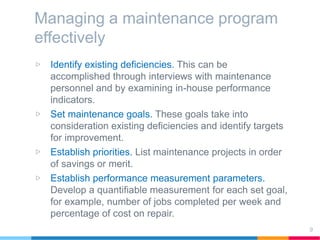
▷ Identify existing deficiencies. This can be
accomplished through interviews with maintenance
personnel and by examining in-house performance
indicators.
▷ Set maintenance goals. These goals take into
consideration existing deficiencies and identify targets
for improvement.
▷ Establish priorities. List maintenance projects in order
of savings or merit.
▷ Establish performance measurement parameters.
Develop a quantifiable measurement for each set goal,
for example, number of jobs completed per week and
percentage of cost on repair.
9
▷ Establish short- and long-range plans. The short-range plan
focuses on high-priority goals, usually within a one-year period.
The long-range plan is more strategic in nature and identifies
important goals to be reached within three to five years.
▷ Document both long- and short-range plans and forward copies
to all concerned individuals.
▷ Implement plan.
▷ Report status. Preparing a brief report periodically, say semi-
annually, and forward it to all involved individuals. The report
contains for each objective identified in the short-range plan
information on actual or potential slippage of the schedule and
associated causes.
▷ Examine progress annually.
Managing a maintenance program
effectively
10
▷ Maximum productivity results when each involved
person in an organization has a defined task to perform
in a definitive way and a definite time.
▷ Schedule control points effectively.
▷ Measurement comes before control.
▷ The customer service relationship is the basis of an
effective maintenance organization.
▷ Job control depends on definite, individual responsibility
for each activity during the life span of a work order.
▷ The optimal crew size is the minimum number that can
perform an assigned task effectively.
Maintenance Management
Principles
11
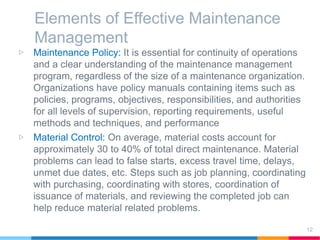
▷ Maintenance Policy: It is essential for continuity of operations
and a clear understanding of the maintenance management
program, regardless of the size of a maintenance organization.
Organizations have policy manuals containing items such as
policies, programs, objectives, responsibilities, and authorities
for all levels of supervision, reporting requirements, useful
methods and techniques, and performance
▷ Material Control: On average, material costs account for
approximately 30 to 40% of total direct maintenance. Material
problems can lead to false starts, excess travel time, delays,
unmet due dates, etc. Steps such as job planning, coordinating
with purchasing, coordinating with stores, coordination of
issuance of materials, and reviewing the completed job can
help reduce material related problems.
Elements of Effective Maintenance
Management
12
▷ Work Order System: A work order authorizes and directs an
individual or a group to perform a given task. A well-defined
work order system should cover all the maintenance jobs
requested and accomplished, whether repetitive or one-time
jobs. The work order system is useful for management in
controlling costs and evaluating job performance.
▷ Equipment Records: Equipment records play a critical role in
effectiveness and efficiency of the maintenance organization.
Usually, equipment records are grouped under four
classifications:
1) maintenance work performed,
2) maintenance cost,
3) inventory, and
4) files.
Elements of Effective Maintenance
Management
13
▷ Preventive and Corrective Maintenance: The basic purpose of
performing PM is to keep facility/equipment in satisfactory
condition through inspection and correction of early-stage
deficiencies. CM is also an important factor in the
effectiveness of maintenance organization.
▷ Job Planning and Scheduling: Job planning is an essential
element of the effective maintenance management. A number
of tasks may have to be performed prior to commencement of
a maintenance job; for example, procurement of parts, tools,
and materials, coordination and delivery of parts, tools, and
materials, identification of methods and sequencing,
coordination with other departments, and securing safety
permits. In most maintenance organizations 80 to 85%
planning coverage is attainable.
Elements of Effective Maintenance
Management
14
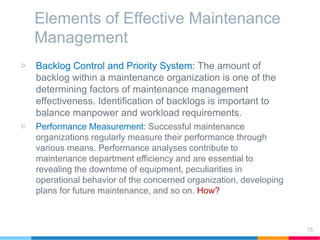
▷ Backlog Control and Priority System: The amount of
backlog within a maintenance organization is one of the
determining factors of maintenance management
effectiveness. Identification of backlogs is important to
balance manpower and workload requirements.
▷ Performance Measurement: Successful maintenance
organizations regularly measure their performance through
various means. Performance analyses contribute to
maintenance department efficiency and are essential to
revealing the downtime of equipment, peculiarities in
operational behavior of the concerned organization, developing
plans for future maintenance, and so on. How?
Elements of Effective Maintenance
Management
15
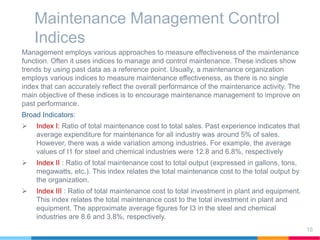
Management employs various approaches to measure effectiveness of the maintenance
function. Often it uses indices to manage and control maintenance. These indices show
trends by using past data as a reference point. Usually, a maintenance organization
employs various indices to measure maintenance effectiveness, as there is no single
index that can accurately reflect the overall performance of the maintenance activity. The
main objective of these indices is to encourage maintenance management to improve on
past performance.
Broad Indicators:
 Index I: Ratio of total maintenance cost to total sales. Past experience indicates that
average expenditure for maintenance for all industry was around 5% of sales.
However, there was a wide variation among industries. For example, the average
values of I1 for steel and chemical industries were 12.8 and 6.8%, respectively
 Index II : Ratio of total maintenance cost to total output (expressed in gallons, tons,
megawatts, etc.). This index relates the total maintenance cost to the total output by
the organization.
 Index III : Ratio of total maintenance cost to total investment in plant and equipment.
This index relates the total maintenance cost to the total investment in plant and
equipment. The approximate average figures for I3 in the steel and chemical
industries are 8.6 and 3.8%, respectively.
Maintenance Management Control
Indices
16
Specific Indicators:
 Index IV: Ratio of total time spent in performing preventive
maintenance to total time spent for the entire maintenance function.
his is a useful index to control preventive maintenance activity within
a maintenance organization.
 Index V: Ratio of total actual maintenance cost to total budgeted
maintenance cost. This index can be used to measure the accuracy
of the maintenance budget plan.
 Index VI : Ratio of total maintenance administration cost to total
maintenance cost. This is a useful index for maintenance overhead
control.
There are few more indices used for specific purposes. Please check the
reference/text book for detail.
Maintenance Management Control
Indices
17
In this lecture, first functions of a maintenance department is
discussed. Then discussed how to manage a maintenance
program effectively. Then objectives, principles, effectiveness
and elements of effective maintenance management. Then
presented maintenance management control indices used in
different industries.
Conclusions
18
Thanks!
Any questions?
You can find me at:
@ahmadn
nafis@ipe.buet.ac.bd
19

Maintenance management and control

  • 1.
    Dr. Nafis Ahmad Professor Departmentof IPE, BUET Email:nafis@ipe.buet.ac.bd AEM-6235 Maintenance and Safety Management
  • 3.
  • 4.
    Contents ▷ What isMaintenance Management? ▷ Maintenance Department Functions ▷ Objectives, Principles, Effectiveness ▷ Elements of Effective Maintenance Management. ▷ Maintenance Management Control Indices 4
  • 5.
    What is MaintenanceManagement? ▷ Maintenance management may be described as the function of providing policy guidance for maintenance activities, in addition to exercising technical and management control of maintenance programs. ▷ Generally, as the size of the maintenance activity and group increases, the need for better management and control become essential. ▷ Today, the proportional size of the maintenance effort compared to the operating group has increased significantly. The prime factor behind this trend is the tendency in industry to increase the mechanization and automation of many processes. 5
  • 6.
    Maintenance Department Functions ▷Planning and repairing ▷ Performing preventive maintenance ▷ Preparing realistic budgets ▷ Managing inventory ▷ Keeping records on equipment, services, etc. ▷ Developing effective approaches to monitor the activities. ▷ Developing effective techniques for keeping operations personnel, upper-level management, and other concerned groups aware of maintenance activities 6
  • 7.
    Maintenance Department Functions ▷Training maintenance staff and other concerned individuals. ▷ Reviewing plans for new facilities, installation of new equipment. ▷ Implementing methods to improve workplace safety and developing safety education- related programs for maintenance staff. ▷ Developing contract specifications and inspecting work performed by contractors to ensure compliance with contractual requirements. 7
  • 8.
    Maintenance Department Functions Thefour guidelines useful in planning a maintenance organization are: ▷ establish reasonably clear division of authority with minimal overlap, ▷ optimize number of persons reporting to an individual, ▷ fit the organization to the personalities involved, and ▷ keep vertical lines of authority and responsibility as short as possible. Training maintenance staff and other concerned individuals. 8
  • 9.
    Managing a maintenanceprogram effectively ▷ Identify existing deficiencies. This can be accomplished through interviews with maintenance personnel and by examining in-house performance indicators. ▷ Set maintenance goals. These goals take into consideration existing deficiencies and identify targets for improvement. ▷ Establish priorities. List maintenance projects in order of savings or merit. ▷ Establish performance measurement parameters. Develop a quantifiable measurement for each set goal, for example, number of jobs completed per week and percentage of cost on repair. 9
  • 10.
    ▷ Establish short-and long-range plans. The short-range plan focuses on high-priority goals, usually within a one-year period. The long-range plan is more strategic in nature and identifies important goals to be reached within three to five years. ▷ Document both long- and short-range plans and forward copies to all concerned individuals. ▷ Implement plan. ▷ Report status. Preparing a brief report periodically, say semi- annually, and forward it to all involved individuals. The report contains for each objective identified in the short-range plan information on actual or potential slippage of the schedule and associated causes. ▷ Examine progress annually. Managing a maintenance program effectively 10
  • 11.
    ▷ Maximum productivityresults when each involved person in an organization has a defined task to perform in a definitive way and a definite time. ▷ Schedule control points effectively. ▷ Measurement comes before control. ▷ The customer service relationship is the basis of an effective maintenance organization. ▷ Job control depends on definite, individual responsibility for each activity during the life span of a work order. ▷ The optimal crew size is the minimum number that can perform an assigned task effectively. Maintenance Management Principles 11
  • 12.
    ▷ Maintenance Policy:It is essential for continuity of operations and a clear understanding of the maintenance management program, regardless of the size of a maintenance organization. Organizations have policy manuals containing items such as policies, programs, objectives, responsibilities, and authorities for all levels of supervision, reporting requirements, useful methods and techniques, and performance ▷ Material Control: On average, material costs account for approximately 30 to 40% of total direct maintenance. Material problems can lead to false starts, excess travel time, delays, unmet due dates, etc. Steps such as job planning, coordinating with purchasing, coordinating with stores, coordination of issuance of materials, and reviewing the completed job can help reduce material related problems. Elements of Effective Maintenance Management 12
  • 13.
    ▷ Work OrderSystem: A work order authorizes and directs an individual or a group to perform a given task. A well-defined work order system should cover all the maintenance jobs requested and accomplished, whether repetitive or one-time jobs. The work order system is useful for management in controlling costs and evaluating job performance. ▷ Equipment Records: Equipment records play a critical role in effectiveness and efficiency of the maintenance organization. Usually, equipment records are grouped under four classifications: 1) maintenance work performed, 2) maintenance cost, 3) inventory, and 4) files. Elements of Effective Maintenance Management 13
  • 14.
    ▷ Preventive andCorrective Maintenance: The basic purpose of performing PM is to keep facility/equipment in satisfactory condition through inspection and correction of early-stage deficiencies. CM is also an important factor in the effectiveness of maintenance organization. ▷ Job Planning and Scheduling: Job planning is an essential element of the effective maintenance management. A number of tasks may have to be performed prior to commencement of a maintenance job; for example, procurement of parts, tools, and materials, coordination and delivery of parts, tools, and materials, identification of methods and sequencing, coordination with other departments, and securing safety permits. In most maintenance organizations 80 to 85% planning coverage is attainable. Elements of Effective Maintenance Management 14
  • 15.
    ▷ Backlog Controland Priority System: The amount of backlog within a maintenance organization is one of the determining factors of maintenance management effectiveness. Identification of backlogs is important to balance manpower and workload requirements. ▷ Performance Measurement: Successful maintenance organizations regularly measure their performance through various means. Performance analyses contribute to maintenance department efficiency and are essential to revealing the downtime of equipment, peculiarities in operational behavior of the concerned organization, developing plans for future maintenance, and so on. How? Elements of Effective Maintenance Management 15
  • 16.
    Management employs variousapproaches to measure effectiveness of the maintenance function. Often it uses indices to manage and control maintenance. These indices show trends by using past data as a reference point. Usually, a maintenance organization employs various indices to measure maintenance effectiveness, as there is no single index that can accurately reflect the overall performance of the maintenance activity. The main objective of these indices is to encourage maintenance management to improve on past performance. Broad Indicators:  Index I: Ratio of total maintenance cost to total sales. Past experience indicates that average expenditure for maintenance for all industry was around 5% of sales. However, there was a wide variation among industries. For example, the average values of I1 for steel and chemical industries were 12.8 and 6.8%, respectively  Index II : Ratio of total maintenance cost to total output (expressed in gallons, tons, megawatts, etc.). This index relates the total maintenance cost to the total output by the organization.  Index III : Ratio of total maintenance cost to total investment in plant and equipment. This index relates the total maintenance cost to the total investment in plant and equipment. The approximate average figures for I3 in the steel and chemical industries are 8.6 and 3.8%, respectively. Maintenance Management Control Indices 16
  • 17.
    Specific Indicators:  IndexIV: Ratio of total time spent in performing preventive maintenance to total time spent for the entire maintenance function. his is a useful index to control preventive maintenance activity within a maintenance organization.  Index V: Ratio of total actual maintenance cost to total budgeted maintenance cost. This index can be used to measure the accuracy of the maintenance budget plan.  Index VI : Ratio of total maintenance administration cost to total maintenance cost. This is a useful index for maintenance overhead control. There are few more indices used for specific purposes. Please check the reference/text book for detail. Maintenance Management Control Indices 17
  • 18.
    In this lecture,first functions of a maintenance department is discussed. Then discussed how to manage a maintenance program effectively. Then objectives, principles, effectiveness and elements of effective maintenance management. Then presented maintenance management control indices used in different industries. Conclusions 18
  • 19.
    Thanks! Any questions? You canfind me at: @ahmadn nafis@ipe.buet.ac.bd 19