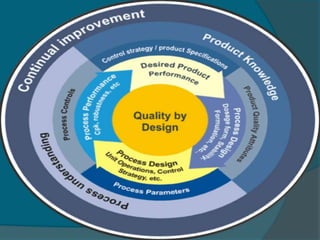
 The concept of “Quality by Design” (QbD) was
defined as an approach which covers a better
scientific understanding of critical process and
product qualities, designing controls and tests
based on the scientific limits of understanding
during the development phase and using the
knowledge obtained during the life-cycle of the
product to work on a constant improvement
environment
A systematic approach to development that begins with
predefined objectives and emphasizes product and process
understanding and process control, based on sound science
and quality risk management.
A system for designing, analyzing and controlling manufacturing
through timely measurements (i.e. during processing) of critical
quality and performance attributes of new and in-process
materials and processes, with the goal of ensuring final product
safety
 Eliminate batch failures
 Minimize deviations and costly investigations
 Avoid regulatory compliance problems
 Organizational learning is an investment in the future
 QbD is good Science
 Better development decisions
 Empowerment of technical staff
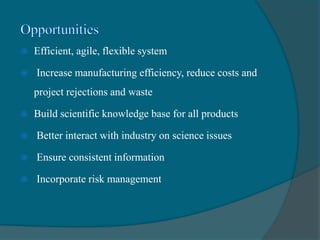
 Efficient, agile, flexible system
 Increase manufacturing efficiency, reduce costs and
project rejections and waste
 Build scientific knowledge base for all products
 Better interact with industry on science issues
 Ensure consistent information
 Incorporate risk management
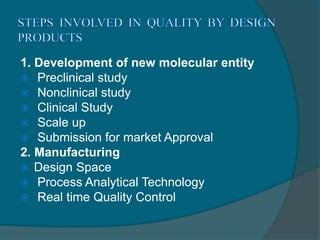
1. Development of new molecular entity
 Preclinical study
 Nonclinical study
 Clinical Study
 Scale up
 Submission for market Approval
2. Manufacturing
 Design Space
 Process Analytical Technology
 Real time Quality Control
3. Control Strategy
 Risk based decision
 Continuous Improvement
 Product performance
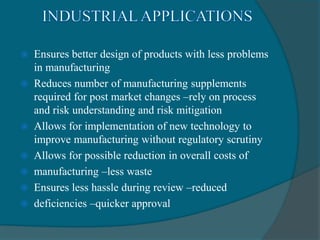
 Ensures better design of products with less problems
in manufacturing
 Reduces number of manufacturing supplements
required for post market changes –rely on process
and risk understanding and risk mitigation
 Allows for implementation of new technology to
improve manufacturing without regulatory scrutiny
 Allows for possible reduction in overall costs of
 manufacturing –less waste
 Ensures less hassle during review –reduced
 deficiencies –quicker approval
 Qbd contains the important scientific and
regulatory knowledge
 Evaluate whether a product is of high
quality
 Determine the level of risk associated with
the manufacture and design of this product.
 Successful in ensuring that questions
address issues
 Enhances scientific foundation for review
 compliance and inspection
 Provides for better consistency
 Improves quality of review (establishing a
QMS for CMC)
 Provides for more flexibility in decision making
 Ensures decisions made on science and not
on empirical information
 Involves various disciplines in decision making
 Uses resources to address higher risks
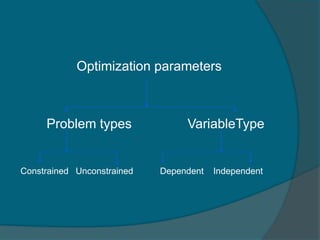
Optimization parameters
Problem types VariableType
Constrained Unconstrained Dependent Independent
-There are two general types of
optimization problems:
1. Unconstrained
2. Constrained
In unconstrained optimization problems there are no
restrictions. For a given pharmaceutical system one might
wish to make the hardest tablet possible
The constrained problem involved in it is to make the
hardest tablet possible, but it must disintegrate in less
than 15 minutes.
- The development procedure of the
pharmaceutical formulation involve several variables.
Mathematically these variables are divided into two
groups.
1.Independent variables
2.Dependent variables
The independent variables are under the control of the
formulator. These might include Ingredients,
compression force or the die cavity filling or the
mixing time.
The dependent variables are the responses or the
characteristics that are developed due to the
independent variables. The more the variables that are
present in the system the more the complications that
are involved in the optimization.
Relationship between independent variables
and response defines response surface
Representing >2 becomes graphically
impossible
Higher the variables , higher are the
complications hence it is to optimize each &
everyone.
quality by design

quality by design

  • 2.
     The conceptof “Quality by Design” (QbD) was defined as an approach which covers a better scientific understanding of critical process and product qualities, designing controls and tests based on the scientific limits of understanding during the development phase and using the knowledge obtained during the life-cycle of the product to work on a constant improvement environment
  • 3.
    A systematic approachto development that begins with predefined objectives and emphasizes product and process understanding and process control, based on sound science and quality risk management. A system for designing, analyzing and controlling manufacturing through timely measurements (i.e. during processing) of critical quality and performance attributes of new and in-process materials and processes, with the goal of ensuring final product safety
  • 5.
     Eliminate batchfailures  Minimize deviations and costly investigations  Avoid regulatory compliance problems  Organizational learning is an investment in the future  QbD is good Science  Better development decisions  Empowerment of technical staff
  • 6.
     Efficient, agile,flexible system  Increase manufacturing efficiency, reduce costs and project rejections and waste  Build scientific knowledge base for all products  Better interact with industry on science issues  Ensure consistent information  Incorporate risk management
  • 7.
    1. Development ofnew molecular entity  Preclinical study  Nonclinical study  Clinical Study  Scale up  Submission for market Approval 2. Manufacturing  Design Space  Process Analytical Technology  Real time Quality Control
  • 8.
    3. Control Strategy Risk based decision  Continuous Improvement  Product performance
  • 9.
     Ensures betterdesign of products with less problems in manufacturing  Reduces number of manufacturing supplements required for post market changes –rely on process and risk understanding and risk mitigation  Allows for implementation of new technology to improve manufacturing without regulatory scrutiny  Allows for possible reduction in overall costs of  manufacturing –less waste  Ensures less hassle during review –reduced  deficiencies –quicker approval
  • 10.
     Qbd containsthe important scientific and regulatory knowledge  Evaluate whether a product is of high quality  Determine the level of risk associated with the manufacture and design of this product.  Successful in ensuring that questions address issues
  • 11.
     Enhances scientificfoundation for review  compliance and inspection  Provides for better consistency  Improves quality of review (establishing a QMS for CMC)  Provides for more flexibility in decision making  Ensures decisions made on science and not on empirical information  Involves various disciplines in decision making  Uses resources to address higher risks
  • 12.
    Optimization parameters Problem typesVariableType Constrained Unconstrained Dependent Independent
  • 13.
    -There are twogeneral types of optimization problems: 1. Unconstrained 2. Constrained In unconstrained optimization problems there are no restrictions. For a given pharmaceutical system one might wish to make the hardest tablet possible The constrained problem involved in it is to make the hardest tablet possible, but it must disintegrate in less than 15 minutes.
  • 14.
    - The developmentprocedure of the pharmaceutical formulation involve several variables. Mathematically these variables are divided into two groups. 1.Independent variables 2.Dependent variables The independent variables are under the control of the formulator. These might include Ingredients, compression force or the die cavity filling or the mixing time. The dependent variables are the responses or the characteristics that are developed due to the independent variables. The more the variables that are present in the system the more the complications that are involved in the optimization.
  • 15.
    Relationship between independentvariables and response defines response surface Representing >2 becomes graphically impossible Higher the variables , higher are the complications hence it is to optimize each & everyone.