
Making MOOCs on a Budget
Pedagogies and Communication
xMOOCs vs cMOOCs
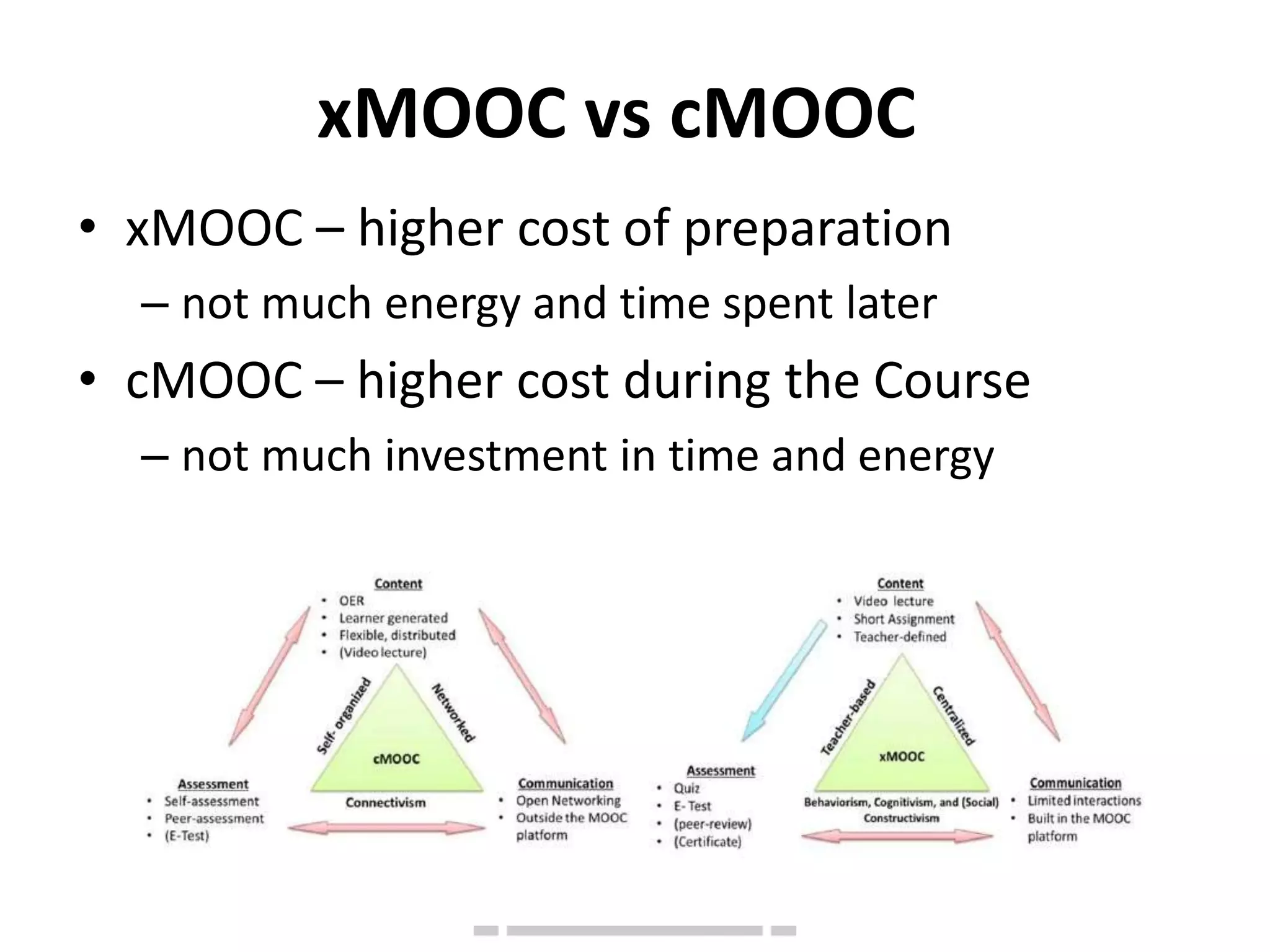
xMOOC vs cMOOC
• xMOOC – higher cost of preparation
– not much energy and time spent later
• cMOOC – higher cost during the Course
– not much investment in time and energy
xMOOC vs cMOOC
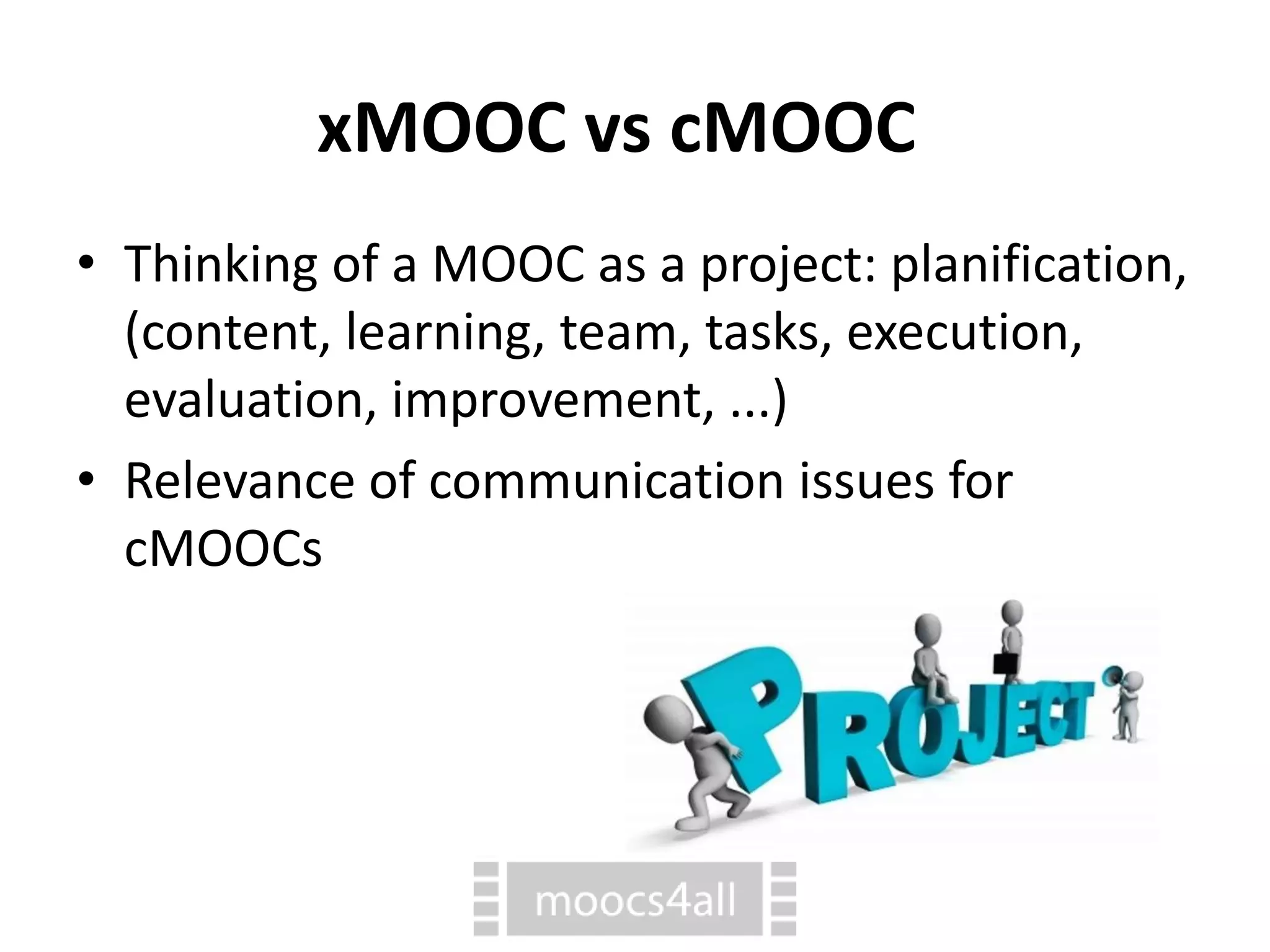
• Thinking of a MOOC as a project: planification,
(content, learning, team, tasks, execution,
evaluation, improvement, ...)
• Relevance of communication issues for
cMOOCs
xMOOC vs cMOOC
• Linking goal with
competences
• Clear learning path
• Surveys at the beginning,
in between, and just
before finishing course
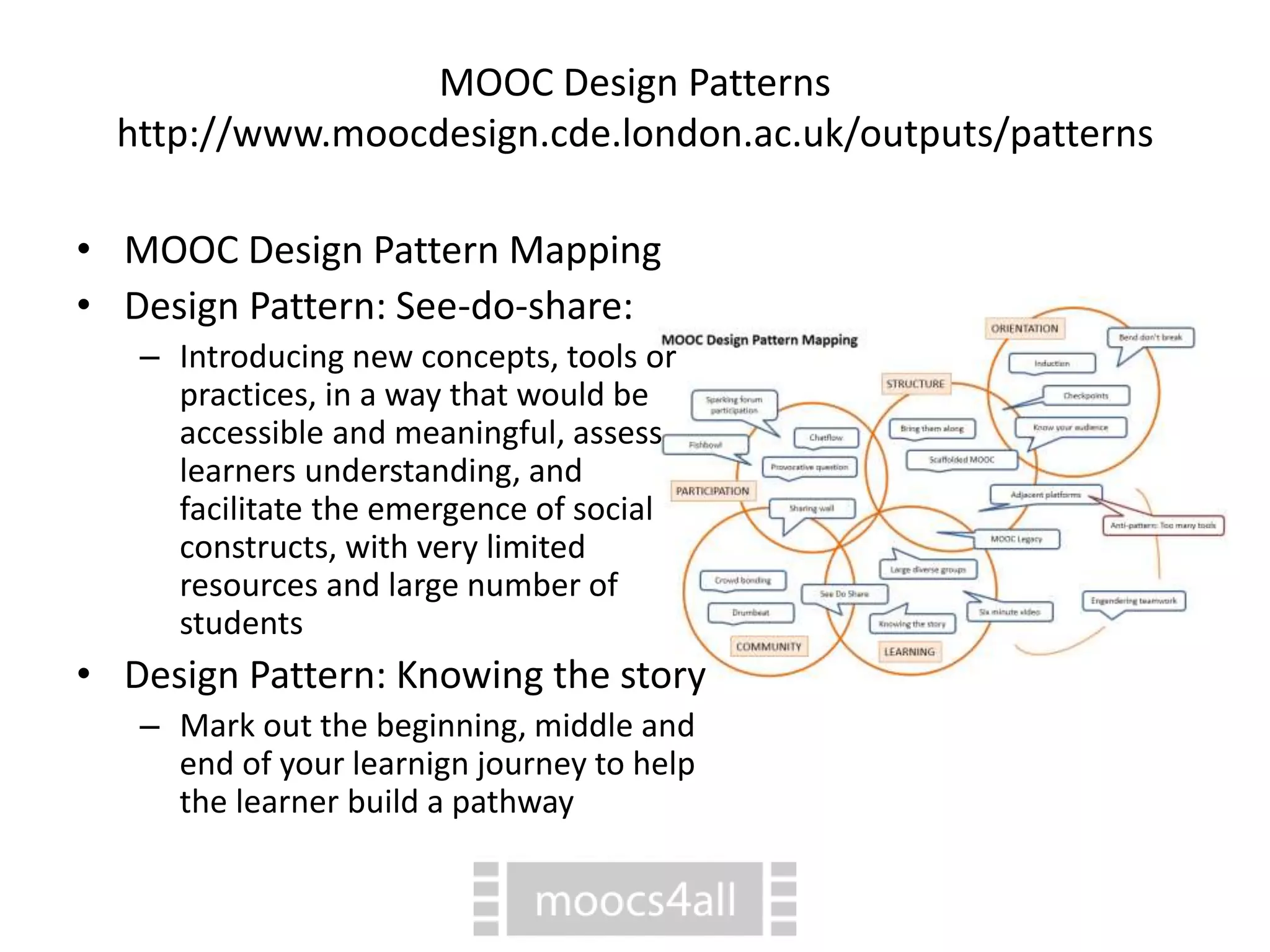
MOOC Design Patterns
http://www.moocdesign.cde.london.ac.uk/outputs/patterns
• MOOC Design Pattern Mapping
• Design Pattern: See-do-share:
– Introducing new concepts, tools or
practices, in a way that would be
accessible and meaningful, assess
learners understanding, and
facilitate the emergence of social
constructs, with very limited
resources and large number of
students
• Design Pattern: Knowing the story
– Mark out the beginning, middle and
end of your learnign journey to help
the learner build a pathway
Conclusions by A. Margaryan et al.
Computers & Education 80 (2015) 77-83
• In comparison to xMOOCs, more cMOOCs scored higher on
– the criteria of authenticity of learning activities and resources
– measurability of learning objectives
– activation of prior knowledge/skill
– application and integration of new knowledge/skill
– collaboration with and learning from other participants
– contributing to collective knowledge
– accommodating learners' preferences.
• In contrast, xMOOCs slightly outperformed cMOOCs in terms of
– the organisation and presentation of course material.
– learning activities that require learners to broaden their range of
collaboration by working with others outside the course rather than
only teaming up with other course participants.
On a budget...
• Saving time: planning well an xMOOC saves time later.
Using proper social networking, forums,
communication tools spares time in cMOOCs.
• Saving money: Using a simple spreadsheet for project
planning, rather than a costly project management
software.
• Saving energy: Plan the MOOC as a research project.
Use spreadsheet for what/how/who/when/where -
clear and simple. Some storytelling recharges staff
batteries and may spare some energy – besides making
the course more attractive.
Question open for discussion
So should xMOOCs be favored
vs. cMOOCs when considering a
low-cost approach?
Thanks for your attention.

3.3 xMOOCs vs cMOOCs

  • 2.
    Making MOOCs ona Budget Pedagogies and Communication xMOOCs vs cMOOCs
  • 3.
    xMOOC vs cMOOC •xMOOC – higher cost of preparation – not much energy and time spent later • cMOOC – higher cost during the Course – not much investment in time and energy
  • 4.
    xMOOC vs cMOOC •Thinking of a MOOC as a project: planification, (content, learning, team, tasks, execution, evaluation, improvement, ...) • Relevance of communication issues for cMOOCs
  • 5.
    xMOOC vs cMOOC •Linking goal with competences • Clear learning path • Surveys at the beginning, in between, and just before finishing course
  • 6.
    MOOC Design Patterns http://www.moocdesign.cde.london.ac.uk/outputs/patterns •MOOC Design Pattern Mapping • Design Pattern: See-do-share: – Introducing new concepts, tools or practices, in a way that would be accessible and meaningful, assess learners understanding, and facilitate the emergence of social constructs, with very limited resources and large number of students • Design Pattern: Knowing the story – Mark out the beginning, middle and end of your learnign journey to help the learner build a pathway
  • 7.
    Conclusions by A.Margaryan et al. Computers & Education 80 (2015) 77-83 • In comparison to xMOOCs, more cMOOCs scored higher on – the criteria of authenticity of learning activities and resources – measurability of learning objectives – activation of prior knowledge/skill – application and integration of new knowledge/skill – collaboration with and learning from other participants – contributing to collective knowledge – accommodating learners' preferences. • In contrast, xMOOCs slightly outperformed cMOOCs in terms of – the organisation and presentation of course material. – learning activities that require learners to broaden their range of collaboration by working with others outside the course rather than only teaming up with other course participants.
  • 8.
    On a budget... •Saving time: planning well an xMOOC saves time later. Using proper social networking, forums, communication tools spares time in cMOOCs. • Saving money: Using a simple spreadsheet for project planning, rather than a costly project management software. • Saving energy: Plan the MOOC as a research project. Use spreadsheet for what/how/who/when/where - clear and simple. Some storytelling recharges staff batteries and may spare some energy – besides making the course more attractive.
  • 9.
    Question open fordiscussion So should xMOOCs be favored vs. cMOOCs when considering a low-cost approach?
  • 10.
    Thanks for yourattention.