Qualitative Research Data
Management & Analysis
BY: DR. M ISMAIL ZUBAIR MD, MSC
Discussion Points:
• Data Management
• Data Transcription
• What is Transcription
• Who should transcribe
• Equipment needed for transcription
• Data Analysis
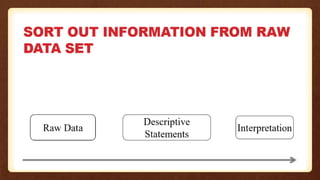
• Sort out data
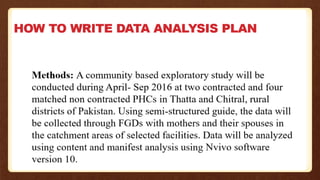
• Data analysis plan
• Qualitative content analysis
• Conclusion
2
Data Management
3
Data Management: Some Practical Issues
• Confidentiality and
security issues
• Consider safety of
participants
• Think of stigmatization,
humiliation, additional
trauma, victimization
• Chose a good interpreter
• Appropriate interview setting
• Don’t leave transcripts lying
around
• Write identification in code
• Use safe lockers
4
• Translation
• Translate yourself or choose
appropriate translator
• Brief the translator
• Insist to give you literal
sentence by sentence
translation
• S/he should not ask the
question himself
• Not have eye contact with
translator when asking
question but always with the
interviewee
Cont…
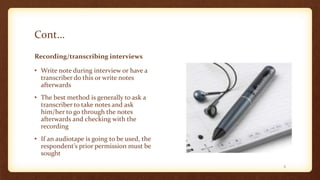
Recording/transcribing interviews
• Write note during interview or have a
transcriber do this or write notes
afterwards
• The best method is generally to ask a
transcriber to take notes and ask
him/her to go through the notes
afterwards and checking with the
recording
• If an audiotape is going to be used, the
respondent’s prior permission must be
sought
5
Data Analysis
6
Data Analysis:
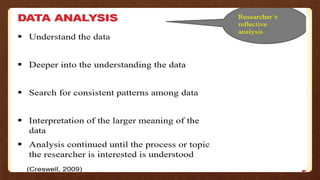
• The analysis of qualitative data
is often seen as the most
difficult part of the exercise
• There are many different ways
to analyses qualitative data,
content analysis, descriptive
approach, or more in-depth
methods
• For most applied projects,
content analysis is sufficient
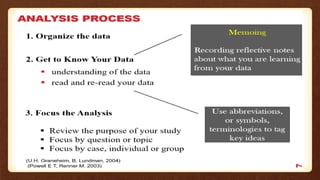
7
8
9
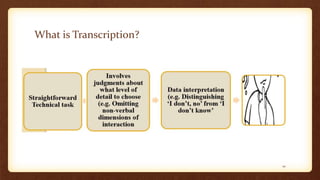
What is Transcription?
10
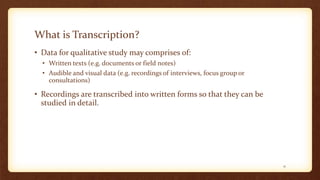
What is Transcription?
• Data for qualitative study may comprises of:
• Written texts (e.g. documents or field notes)
• Audible and visual data (e.g. recordings of interviews, focus group or
consultations)
• Recordings are transcribed into written forms so that they can be
studied in detail.
11
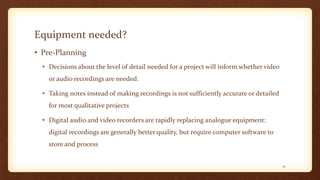
Equipment needed?
• Pre-Planning
• Decisions about the level of detail needed for a project will inform whether video
or audio recordings are needed.

• Taking notes instead of making recordings is not sufficiently accurate or detailed
for most qualitative projects
• Digital audio and video recorders are rapidly replacing analogue equipment:
digital recordings are generally better quality, but require computer software to
store and process
12
Who should transcribe?
• Transcribing is often delegated to a junior researcher or medical
secretary for example, but this can be a mistake.
• If the transcriber is inadequately trained or briefed.
• Transcription involves close observation of data through repeated
careful listening (and/ or watching), and this is an important first step
in data analysis.
13
When and why should we transcribe?
• On the same day, week
• Before next data collection
• If the phenomena is not clear and need to refined the guide for next
data collection
• If some points/data need more elaboration
• If the data is not clear/need explanation
• Observation should also be part of transcription
14
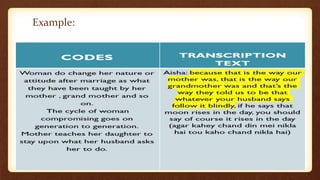
Example:
15
Example:
16
17
18
19
20
Example:
21
Qualitative Content Analysis
22
Outline
• What is Content Analysis
• Unit of Analysis
• Meaning Unit
• Condensation
• Code
• Category & Sub-category
• Theme
• Examples
23
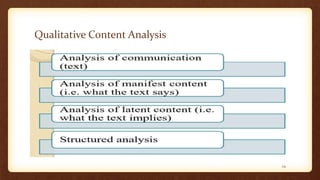
Qualitative Content Analysis
24
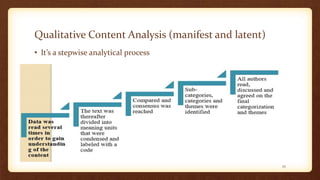
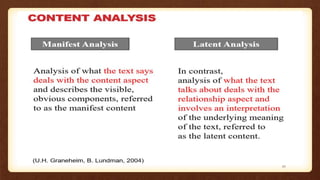
Qualitative Content Analysis (manifest and latent)
• It’s a stepwise analytical process
25
What is it?
• Initially Content Analysis dealt with ‘ the objective, systematic and
quantitative description of content of communication but, over time it
has expanded to also include interpretations of latent content.
26
27
28
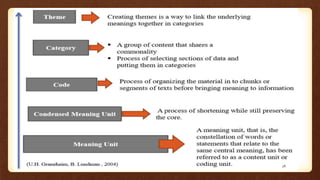
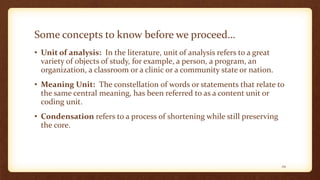
Some concepts to know before we proceed…
• Unit of analysis: In the literature, unit of analysis refers to a great
variety of objects of study, for example, a person, a program, an
organization, a classroom or a clinic or a community state or nation.
• Meaning Unit: The constellation of words or statements that relate to
the same central meaning, has been referred to as a content unit or
coding unit.
• Condensation refers to a process of shortening while still preserving
the core.
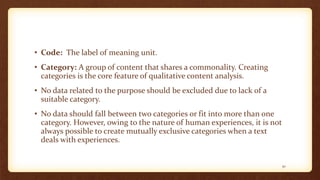
29
• Code: The label of meaning unit.
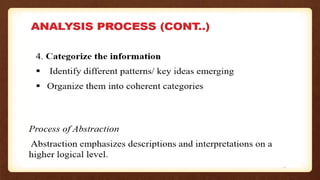
• Category: A group of content that shares a commonality. Creating
categories is the core feature of qualitative content analysis.
• No data related to the purpose should be excluded due to lack of a
suitable category.
• No data should fall between two categories or fit into more than one
category. However, owing to the nature of human experiences, it is not
always possible to create mutually exclusive categories when a text
deals with experiences.
30
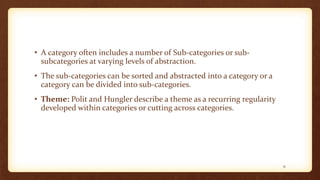
• A category often includes a number of Sub-categories or sub-
subcategories at varying levels of abstraction.
• The sub-categories can be sorted and abstracted into a category or a
category can be divided into sub-categories.
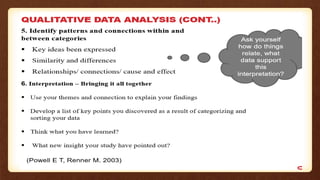
• Theme: Polit and Hungler describe a theme as a recurring regularity
developed within categories or cutting across categories.
31
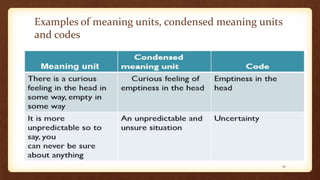
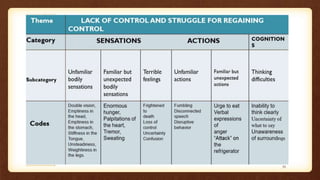
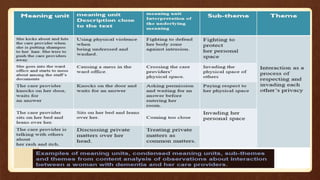
Examples of meaning units, condensed meaning units
and codes
32
33
34
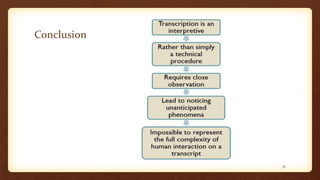
Conclusion
35
References:
• Atkinson, P. (1995) Some perils of paradigms. Qualitative Health Research, 5 (1) 117-
124.
• Hutchinson, S. & Webb, R (1991) Teaching qualitative research: perennial problems
and possible solutions. In Qualitative Research for Health
• Hudelson, P.M. (1994) Qualitative Research for Health Programs. Geneva, World
Health Organization.
• Leininger, M. (19985) Qualitative Research Methods in Nursing. New York, Grune and
Stratton.
• Bowling A (2002) Research methods in health- Investigating health and health
services, Open University Press
• Green J and Thorogood N (2004) Qualitative Methods for Health Research, London:
Sage.
• Morse, J.M. (re,) (1994) Critical Issues in Qualitative Research, Thousand Oaks, Sage.
36
For further discussion/queries:
Write me on
drismailzubair@gmail.com
37

Qualitative researc data_analysis

  • 1.
    Qualitative Research Data Management& Analysis BY: DR. M ISMAIL ZUBAIR MD, MSC
  • 2.
    Discussion Points: • DataManagement • Data Transcription • What is Transcription • Who should transcribe • Equipment needed for transcription • Data Analysis • Sort out data • Data analysis plan • Qualitative content analysis • Conclusion 2
  • 3.
  • 4.
    Data Management: SomePractical Issues • Confidentiality and security issues • Consider safety of participants • Think of stigmatization, humiliation, additional trauma, victimization • Chose a good interpreter • Appropriate interview setting • Don’t leave transcripts lying around • Write identification in code • Use safe lockers 4 • Translation • Translate yourself or choose appropriate translator • Brief the translator • Insist to give you literal sentence by sentence translation • S/he should not ask the question himself • Not have eye contact with translator when asking question but always with the interviewee
  • 5.
    Cont… Recording/transcribing interviews • Writenote during interview or have a transcriber do this or write notes afterwards • The best method is generally to ask a transcriber to take notes and ask him/her to go through the notes afterwards and checking with the recording • If an audiotape is going to be used, the respondent’s prior permission must be sought 5
  • 6.
  • 7.
    Data Analysis: • Theanalysis of qualitative data is often seen as the most difficult part of the exercise • There are many different ways to analyses qualitative data, content analysis, descriptive approach, or more in-depth methods • For most applied projects, content analysis is sufficient 7
  • 8.
  • 9.
  • 10.
  • 11.
    What is Transcription? •Data for qualitative study may comprises of: • Written texts (e.g. documents or field notes) • Audible and visual data (e.g. recordings of interviews, focus group or consultations) • Recordings are transcribed into written forms so that they can be studied in detail. 11
  • 12.
    Equipment needed? • Pre-Planning •Decisions about the level of detail needed for a project will inform whether video or audio recordings are needed. • Taking notes instead of making recordings is not sufficiently accurate or detailed for most qualitative projects • Digital audio and video recorders are rapidly replacing analogue equipment: digital recordings are generally better quality, but require computer software to store and process 12
  • 13.
    Who should transcribe? •Transcribing is often delegated to a junior researcher or medical secretary for example, but this can be a mistake. • If the transcriber is inadequately trained or briefed. • Transcription involves close observation of data through repeated careful listening (and/ or watching), and this is an important first step in data analysis. 13
  • 14.
    When and whyshould we transcribe? • On the same day, week • Before next data collection • If the phenomena is not clear and need to refined the guide for next data collection • If some points/data need more elaboration • If the data is not clear/need explanation • Observation should also be part of transcription 14
  • 15.
  • 16.
  • 17.
  • 18.
  • 19.
  • 20.
  • 21.
  • 22.
  • 23.
    Outline • What isContent Analysis • Unit of Analysis • Meaning Unit • Condensation • Code • Category & Sub-category • Theme • Examples 23
  • 24.
  • 25.
    Qualitative Content Analysis(manifest and latent) • It’s a stepwise analytical process 25
  • 26.
    What is it? •Initially Content Analysis dealt with ‘ the objective, systematic and quantitative description of content of communication but, over time it has expanded to also include interpretations of latent content. 26
  • 27.
  • 28.
  • 29.
    Some concepts toknow before we proceed… • Unit of analysis: In the literature, unit of analysis refers to a great variety of objects of study, for example, a person, a program, an organization, a classroom or a clinic or a community state or nation. • Meaning Unit: The constellation of words or statements that relate to the same central meaning, has been referred to as a content unit or coding unit. • Condensation refers to a process of shortening while still preserving the core. 29
  • 30.
    • Code: Thelabel of meaning unit. • Category: A group of content that shares a commonality. Creating categories is the core feature of qualitative content analysis. • No data related to the purpose should be excluded due to lack of a suitable category. • No data should fall between two categories or fit into more than one category. However, owing to the nature of human experiences, it is not always possible to create mutually exclusive categories when a text deals with experiences. 30
  • 31.
    • A categoryoften includes a number of Sub-categories or sub- subcategories at varying levels of abstraction. • The sub-categories can be sorted and abstracted into a category or a category can be divided into sub-categories. • Theme: Polit and Hungler describe a theme as a recurring regularity developed within categories or cutting across categories. 31
  • 32.
    Examples of meaningunits, condensed meaning units and codes 32
  • 33.
  • 34.
  • 35.
  • 36.
    References: • Atkinson, P.(1995) Some perils of paradigms. Qualitative Health Research, 5 (1) 117- 124. • Hutchinson, S. & Webb, R (1991) Teaching qualitative research: perennial problems and possible solutions. In Qualitative Research for Health • Hudelson, P.M. (1994) Qualitative Research for Health Programs. Geneva, World Health Organization. • Leininger, M. (19985) Qualitative Research Methods in Nursing. New York, Grune and Stratton. • Bowling A (2002) Research methods in health- Investigating health and health services, Open University Press • Green J and Thorogood N (2004) Qualitative Methods for Health Research, London: Sage. • Morse, J.M. (re,) (1994) Critical Issues in Qualitative Research, Thousand Oaks, Sage. 36
  • 37.
    For further discussion/queries: Writeme on drismailzubair@gmail.com 37