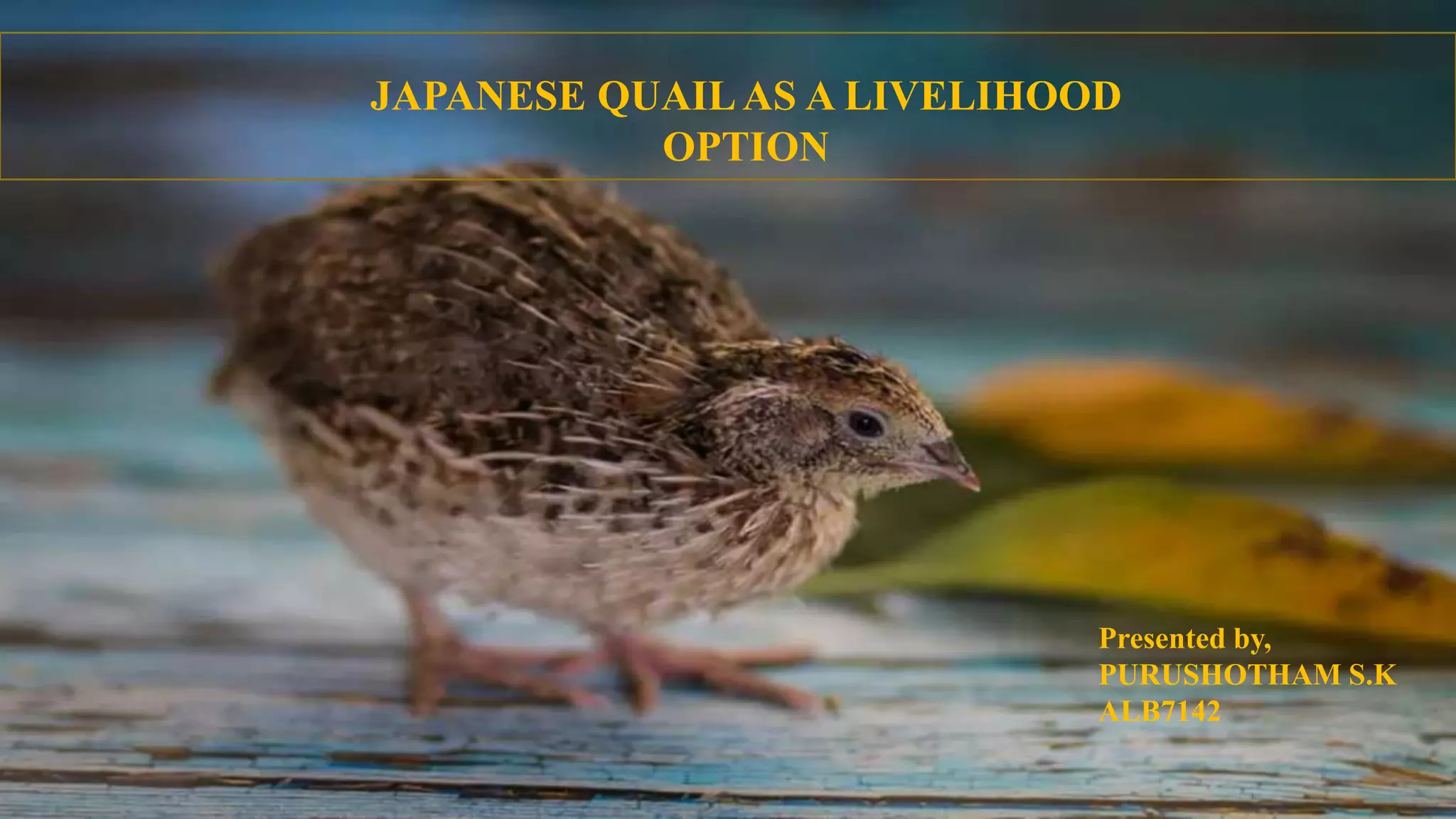
JAPANESE QUAILAS A LIVELIHOOD
OPTION
Presented by,
PURUSHOTHAM S.K
ALB7142
Why japanese quail(Coturnix japonica)?
• Quails are smaller sized bird, so they can be raised within small place.
• Quails grow very fast and gain maturity faster than any other poultry birds. Adult broiler quail
weights around 210 gm at 4 weeks of age.
• Japanese quail are prolific layers. They start laying eggs within their 6 to 7 weeks of age. They can
lay more than 290 eggs per year.
• It takes about 16 to 18 days to hatch their eggs.
• Meat and eggs of quail are very tasty, delicious and nutritious. So it’s a great source of food and
nutrition.
• Quail meat and eggs are used for treating asthma and several nervous disorders in Kerela and
neighbouring districts of Tamilnadu.
• Quail farming needs small capital, and labour cost is very low.
• Feeding cost of quails is comparatively lower than chickens or other poultry birds.
• Quails are very strong bird and diseases or other health problems are less. So risks are less in this
business. You can raise 6 to 7 quails in the same place that is required for one chicken.
• Diseases are less in quails, and they are very hardy.
• No vaccination is required.
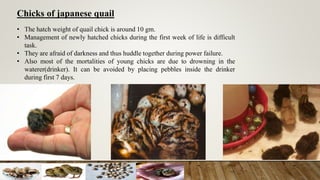
Chicks of japanese quail
• The hatch weight of quail chick is around 10 gm.
• Management of newly hatched chicks during the first week of life is difficult
task.
• They are afraid of darkness and thus huddle together during power failure.
• Also most of the mortalities of young chicks are due to drowning in the
waterer(drinker). It can be avoided by placing pebbles inside the drinker
during first 7 days.
Continued….
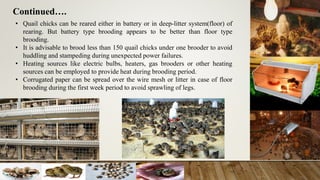
• Quail chicks can be reared either in battery or in deep-litter system(floor) of
rearing. But battery type brooding appears to be better than floor type
brooding.
• It is advisable to brood less than 150 quail chicks under one brooder to avoid
huddling and stampeding during unexpected power failures.
• Heating sources like electric bulbs, heaters, gas brooders or other heating
sources can be employed to provide heat during brooding period.
• Corrugated paper can be spread over the wire mesh or litter in case of floor
brooding during the first week period to avoid sprawling of legs.
• The behavior of the chicks is the indication of the optimum temperature requirement as they are
scattered. In general, the starting temperature should be around 37℃ and gradually reduced at the rate
of 3℃ every four days.
• Chicks used for meat purpose can be grown on 24 hours of light up to market age for more feed
consumption and body weight gain.
• In case of chicks reared for breeding purpose, they should be grown under restricted light after initial
brooding period (after 2 weeks of age). This will avoid
1) Early sexual maturity
2) Reduce mortality during early laying period due to prolapse and egg bound
condition.
Continued….
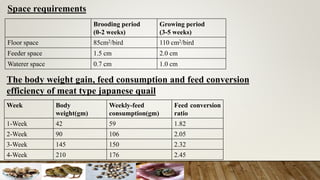
Space requirements
Brooding period
(0-2 weeks)
Growing period
(3-5 weeks)
Floor space 85cm2/bird 110 cm2/bird
Feeder space 1.5 cm 2.0 cm
Waterer space 0.7 cm 1.0 cm
The body weight gain, feed consumption and feed conversion
efficiency of meat type japanese quail
Week Body
weight(gm)
Weekly-feed
consumption(gm)
Feed conversion
ratio
1-Week 42 59 1.82
2-Week 90 106 2.05
3-Week 145 150 2.32
4-Week 210 176 2.45
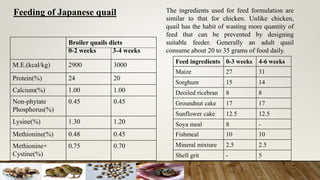
Feeding of Japanese quail
Broiler quails diets
0-2 weeks 3-4 weeks
M.E.(kcal/kg) 2900 3000
Protein(%) 24 20
Calcium(%) 1.00 1.00
Non-phytate
Phosphorus(%)
0.45 0.45
Lysine(%) 1.30 1.20
Methionine(%) 0.48 0.45
Methionine+
Cystine(%)
0.75 0.70
The ingredients used for feed formulation are
similar to that for chicken. Unlike chicken,
quail has the habit of wasting more quantity of
feed that can be prevented by designing
suitable feeder. Generally an adult quail
consume about 20 to 35 grams of food daily.
Feed ingredients 0-3 weeks 4-6 weeks
Maize 27 31
Sorghum 15 14
Deoiled ricebran 8 8
Groundnut cake 17 17
Sunflower cake 12.5 12.5
Soya meal 8 -
Fishmeal 10 10
Mineral mixture 2.5 2.5
Shell grit - 5
Management of breeding quail(≥6 weeks of age)
• Japanese quail start lay eggs at 6 weeks of age
• The quail used for breeding purpose should be reared under
restricted feeding and lighting programme during the growing
period.
• During laying the quail layers are provided with 16 hours total light
and hence a minimum of 4 hours extra artificial light is required for
maximum egg production.
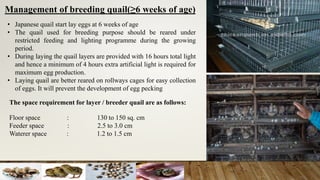
• Laying quail are better reared on rollways cages for easy collection
of eggs. It will prevent the development of egg pecking
The space requirement for layer / breeder quail are as follows:
Floor space : 130 to 150 sq. cm
Feeder space : 2.5 to 3.0 cm
Waterer space : 1.2 to 1.5 cm
Continued….
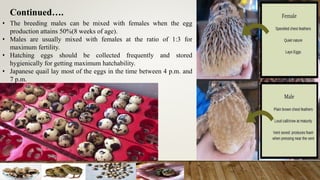
• The breeding males can be mixed with females when the egg
production attains 50%(8 weeks of age).
• Males are usually mixed with females at the ratio of 1:3 for
maximum fertility.
• Hatching eggs should be collected frequently and stored
hygienically for getting maximum hatchability.
• Japanese quail lay most of the eggs in the time between 4 p.m. and
7 p.m.
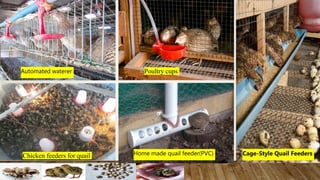
Automated waterer Poultry cups
Home made quail feeder(PVC)
Chicken feeders for quail Cage-Style Quail Feeders
Hatchery management
• Eggs selected for hatching should not have any dirt or breakages.
Excessively soiled eggs should be discarded.
• Quail eggs should be fumigated before storing in cold room with
potassium permanganate and formalin at 2x concentration (40 gm
potassium permanganate and 80 ml of formalin for 100 cu.ft space)
for 15 minutes.
• Then they can be stored at 65℉ temperature and 70% R.H. for a
maximum period of seven days.
• Nowadays fully automated settlers and hatchers are available for
hatching Japanese quail eggs.
• The temperature and relative humidity of settler should be 99.5℉
and 55 to 60%, respectively.
• Eggs should be turned atleast 6 times a day in settler
Continued….
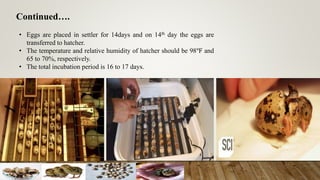
• Eggs are placed in settler for 14days and on 14th day the eggs are
transferred to hatcher.
• The temperature and relative humidity of hatcher should be 98℉ and
65 to 70%, respectively.
• The total incubation period is 16 to 17 days.
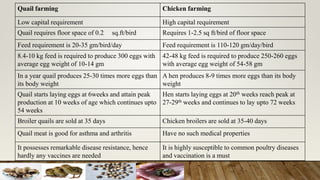
Quail farming Chicken farming
Low capital requirement High capital requirement
Quail requires floor space of 0.2 sq.ft/bird Requires 1-2.5 sq ft/bird of floor space
Feed requirement is 20-35 gm/bird/day Feed requirement is 110-120 gm/day/bird
8.4-10 kg feed is required to produce 300 eggs with
average egg weight of 10-14 gm
42-48 kg feed is required to produce 250-260 eggs
with average egg weight of 54-58 gm
In a year quail produces 25-30 times more eggs than
its body weight
A hen produces 8-9 times more eggs than its body
weight
Quail starts laying eggs at 6weeks and attain peak
production at 10 weeks of age which continues upto
54 weeks
Hen starts laying eggs at 20th weeks reach peak at
27-29th weeks and continues to lay upto 72 weeks
Broiler quails are sold at 35 days Chicken broilers are sold at 35-40 days
Quail meat is good for asthma and arthritis Have no such medical properties
It possesses remarkable disease resistance, hence
hardly any vaccines are needed
It is highly susceptible to common poultry diseases
and vaccination is a must
Japanese quail Production

Japanese quail Production

  • 1.
    JAPANESE QUAILAS ALIVELIHOOD OPTION Presented by, PURUSHOTHAM S.K ALB7142
  • 2.
    Why japanese quail(Coturnixjaponica)? • Quails are smaller sized bird, so they can be raised within small place. • Quails grow very fast and gain maturity faster than any other poultry birds. Adult broiler quail weights around 210 gm at 4 weeks of age. • Japanese quail are prolific layers. They start laying eggs within their 6 to 7 weeks of age. They can lay more than 290 eggs per year. • It takes about 16 to 18 days to hatch their eggs. • Meat and eggs of quail are very tasty, delicious and nutritious. So it’s a great source of food and nutrition. • Quail meat and eggs are used for treating asthma and several nervous disorders in Kerela and neighbouring districts of Tamilnadu. • Quail farming needs small capital, and labour cost is very low. • Feeding cost of quails is comparatively lower than chickens or other poultry birds. • Quails are very strong bird and diseases or other health problems are less. So risks are less in this business. You can raise 6 to 7 quails in the same place that is required for one chicken. • Diseases are less in quails, and they are very hardy. • No vaccination is required.
  • 3.
    Chicks of japanesequail • The hatch weight of quail chick is around 10 gm. • Management of newly hatched chicks during the first week of life is difficult task. • They are afraid of darkness and thus huddle together during power failure. • Also most of the mortalities of young chicks are due to drowning in the waterer(drinker). It can be avoided by placing pebbles inside the drinker during first 7 days.
  • 4.
    Continued…. • Quail chickscan be reared either in battery or in deep-litter system(floor) of rearing. But battery type brooding appears to be better than floor type brooding. • It is advisable to brood less than 150 quail chicks under one brooder to avoid huddling and stampeding during unexpected power failures. • Heating sources like electric bulbs, heaters, gas brooders or other heating sources can be employed to provide heat during brooding period. • Corrugated paper can be spread over the wire mesh or litter in case of floor brooding during the first week period to avoid sprawling of legs.
  • 5.
    • The behaviorof the chicks is the indication of the optimum temperature requirement as they are scattered. In general, the starting temperature should be around 37℃ and gradually reduced at the rate of 3℃ every four days. • Chicks used for meat purpose can be grown on 24 hours of light up to market age for more feed consumption and body weight gain. • In case of chicks reared for breeding purpose, they should be grown under restricted light after initial brooding period (after 2 weeks of age). This will avoid 1) Early sexual maturity 2) Reduce mortality during early laying period due to prolapse and egg bound condition. Continued….
  • 6.
    Space requirements Brooding period (0-2weeks) Growing period (3-5 weeks) Floor space 85cm2/bird 110 cm2/bird Feeder space 1.5 cm 2.0 cm Waterer space 0.7 cm 1.0 cm The body weight gain, feed consumption and feed conversion efficiency of meat type japanese quail Week Body weight(gm) Weekly-feed consumption(gm) Feed conversion ratio 1-Week 42 59 1.82 2-Week 90 106 2.05 3-Week 145 150 2.32 4-Week 210 176 2.45
  • 7.
    Feeding of Japanesequail Broiler quails diets 0-2 weeks 3-4 weeks M.E.(kcal/kg) 2900 3000 Protein(%) 24 20 Calcium(%) 1.00 1.00 Non-phytate Phosphorus(%) 0.45 0.45 Lysine(%) 1.30 1.20 Methionine(%) 0.48 0.45 Methionine+ Cystine(%) 0.75 0.70 The ingredients used for feed formulation are similar to that for chicken. Unlike chicken, quail has the habit of wasting more quantity of feed that can be prevented by designing suitable feeder. Generally an adult quail consume about 20 to 35 grams of food daily. Feed ingredients 0-3 weeks 4-6 weeks Maize 27 31 Sorghum 15 14 Deoiled ricebran 8 8 Groundnut cake 17 17 Sunflower cake 12.5 12.5 Soya meal 8 - Fishmeal 10 10 Mineral mixture 2.5 2.5 Shell grit - 5
  • 8.
    Management of breedingquail(≥6 weeks of age) • Japanese quail start lay eggs at 6 weeks of age • The quail used for breeding purpose should be reared under restricted feeding and lighting programme during the growing period. • During laying the quail layers are provided with 16 hours total light and hence a minimum of 4 hours extra artificial light is required for maximum egg production. • Laying quail are better reared on rollways cages for easy collection of eggs. It will prevent the development of egg pecking The space requirement for layer / breeder quail are as follows: Floor space : 130 to 150 sq. cm Feeder space : 2.5 to 3.0 cm Waterer space : 1.2 to 1.5 cm
  • 9.
    Continued…. • The breedingmales can be mixed with females when the egg production attains 50%(8 weeks of age). • Males are usually mixed with females at the ratio of 1:3 for maximum fertility. • Hatching eggs should be collected frequently and stored hygienically for getting maximum hatchability. • Japanese quail lay most of the eggs in the time between 4 p.m. and 7 p.m.
  • 10.
    Automated waterer Poultrycups Home made quail feeder(PVC) Chicken feeders for quail Cage-Style Quail Feeders
  • 11.
    Hatchery management • Eggsselected for hatching should not have any dirt or breakages. Excessively soiled eggs should be discarded. • Quail eggs should be fumigated before storing in cold room with potassium permanganate and formalin at 2x concentration (40 gm potassium permanganate and 80 ml of formalin for 100 cu.ft space) for 15 minutes. • Then they can be stored at 65℉ temperature and 70% R.H. for a maximum period of seven days. • Nowadays fully automated settlers and hatchers are available for hatching Japanese quail eggs. • The temperature and relative humidity of settler should be 99.5℉ and 55 to 60%, respectively. • Eggs should be turned atleast 6 times a day in settler
  • 12.
    Continued…. • Eggs areplaced in settler for 14days and on 14th day the eggs are transferred to hatcher. • The temperature and relative humidity of hatcher should be 98℉ and 65 to 70%, respectively. • The total incubation period is 16 to 17 days.
  • 13.
    Quail farming Chickenfarming Low capital requirement High capital requirement Quail requires floor space of 0.2 sq.ft/bird Requires 1-2.5 sq ft/bird of floor space Feed requirement is 20-35 gm/bird/day Feed requirement is 110-120 gm/day/bird 8.4-10 kg feed is required to produce 300 eggs with average egg weight of 10-14 gm 42-48 kg feed is required to produce 250-260 eggs with average egg weight of 54-58 gm In a year quail produces 25-30 times more eggs than its body weight A hen produces 8-9 times more eggs than its body weight Quail starts laying eggs at 6weeks and attain peak production at 10 weeks of age which continues upto 54 weeks Hen starts laying eggs at 20th weeks reach peak at 27-29th weeks and continues to lay upto 72 weeks Broiler quails are sold at 35 days Chicken broilers are sold at 35-40 days Quail meat is good for asthma and arthritis Have no such medical properties It possesses remarkable disease resistance, hence hardly any vaccines are needed It is highly susceptible to common poultry diseases and vaccination is a must