Mathematics Secondary Course 327
Quadrilaterals
Notes
MODULE - 3
Geometry
13
QUADRILATERALS
Ifyoulookaround,youwillfindmanyobjectsboundedbyfourline-segments.Anysurface
of a book, window door, some parts of window-grill, slice of bread, the floor of your
room are all examples of a closed figure bounded by four line-segments. Such a figure is
calledaquadrilateral.
The word quadrilateral has its origin from the two words “quadric” meaining four and
“lateral” meaning sides. Thus, a quadrilateral is that geometrical figure which has four
sides, enclosing a part of the plane.
In this lesson, we shall study about terms and concepts related to quadrilateral with their
properties.
OBJECTIVES
Afterstudyingthislesson,youwillbeableto
• describe various types of quadrilaterals viz. trapeziums, parallelograms,
rectangles, rhombuses and squares;
• verify properties of different types of quadrilaterals;
• verify that in a triangle the line segment joining the mid-points of any two sides
is parallel to the third side and is half of it;
• verify that the line drawn through the mid-point of a side of a triangle parallel to
another side bisects the third side;
• verify that if there are three or more parallel lines and the intercepts made by
them on a transversal are equal, the corresponding intercepts on any other
transversal are also equal;
• verify that a diagonal of a parallelogram divides it into two triangles of equal
area;
• solve problem based on starred results and direct numerical problems based on
unstarred results given in the curriculum;
Mathematics Secondary Course328
Notes
MODULE - 3
Geometry
Quadrilaterals
• prove that parallelograms on the same or equal bases and between the same
parallels are equal in area;
• verify that triangles on the same or equal bases and between the same parallels
are equal in area and its converse.
EXPECTED BACKGROUND KNOWLEDGE
• Drawingline-segmentsandanglesofgivenmeasure.
• Drawingcircles/arcsofgivenradius.
• Drawingparallelandperpendicularlines.
• Fourfundamentaloperationsonnumbers.
13.1 QUADRILATERAL
Recall that if A, B, C and D are four points in a plane such that no three of them are
collinear and the line segmentsAB, BC, CD and DAdo not intersect except at their end
points,thentheclosedfiguremadeupofthesefourlinesegmentsiscalledaquadrilateral
with vertices A, B, C and D. A quadrilateral with vertices A, B, C and D is generally
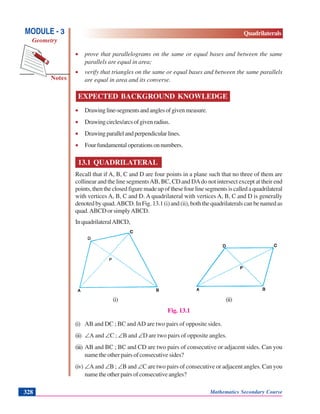
denoted by quad.ABCD. In Fig. 13.1 (i) and (ii), both the quadrilaterals can be named as
quad.ABCD or simplyABCD.
InquadrilateralABCD,
(i) (ii)
Fig. 13.1
(i) AB and DC ; BC andAD are two pairs of opposite sides.
(ii) ∠A and ∠C ; ∠B and ∠D are two pairs of opposite angles.
(iii) AB and BC ; BC and CD are two pairs of consecutive or adjacent sides. Can you
name the other pairs of consecutive sides?
(iv) ∠A and ∠B ; ∠B and ∠C are two pairs of consecutive or adjacent angles. Can you
nametheotherpairsofconsecutiveangles?
Mathematics Secondary Course 329
Quadrilaterals
Notes
MODULE - 3
Geometry
(v) AC and BD are the two diagonals.
In Fig. 13.2, angles denoted by l, 2, 3 and 4 are the interior angles or the angles of the
quad.ABCD.Angles denoted by 5, 6, 7 and 8 are the exterior angles of the quad.ABCD.
Measure ∠l, ∠2, ∠3 and ∠4.
(i) (ii)
Fig. 13.2
What is the sum of these anglesYou will find that ∠l + ∠2 + ∠3 + ∠4 = 360°.
i.e. sum of interior angles of a quadrilateral equals 360°.
Also what is the sum of exterior angles of the quadrilateralABCD?
You will again find that ∠5 + ∠6 + ∠7 + ∠8 = 360°
i.e., sum of exterior angles of a quadrilateral is also 360°.
13.2 TYPES OF QUADRILATERALS
Youarefamiliarwithquadrilateralsandtheirdifferentshapes.Youalsoknowhowtoname
them.However,wewillnowstudydifferenttypesofquadrilateralsinasystematicway.A
familytreeofquadrilateralsisgiveninFig.13.3below:
Quadrilateral
Parallelogram Kite Trapezium
Rectangle Rhombus
Square
Fig. 13.3
Let us describe them one by one.
1.Trapezium
Aquadrilateralwhichhasonlyonepairofoppositesidesparalleliscalledatrapezium.In
Mathematics Secondary Course330
Notes
MODULE - 3
Geometry
Quadrilaterals
Fig. 13.4 [(i) and (ii)] ABCD and PQRS are trapeziums with AB || DC and PQ || SR
respectively.
(i) (ii)
Fig. 13.4
2. Kite
Aquadrilateral, which has two pairs of equal sides next to each other, is called a kite.
Fig. 13.5 [(i) and (ii)]ABCD and PQRS are kites with adjacent sidesAB andAD, BC
and CD in (i) PQ and PS, QR and RS in (ii) being equal.
Fig. 13.5
3. Parallelogram
Aquadrilateralwhichhasbothpairsofoppositesidesparallel,iscalledaparallelogram.In
Fig. 13.6 [(i) and (ii)]ABCD and PQRS are parallelograms withAB||DC,AD||BC and
PQ||SR, SP||RQ.These are denoted by ||gm
ABCD (ParallelogramABCD) and ||gm
PQRS
(ParallelogramPQRS).
(i) (ii)
Fig. 13.6
A
B D
C
P
Q S
R
(i) (ii)
Mathematics Secondary Course 331
Quadrilaterals
Notes
MODULE - 3
Geometry
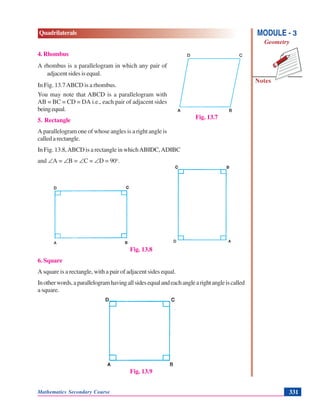
4. Rhombus
A rhombus is a parallelogram in which any pair of
adjacent sides is equal.
In Fig. 13.7ABCD is a rhombus.
You may note that ABCD is a parallelogram with
AB = BC = CD = DA i.e., each pair of adjacent sides
beingequal.
5. Rectangle
A parallelogram one of whose angles is a right angle is
calledarectangle.
In Fig. 13.8,ABCD is a rectangle in whichAB||DC,AD||BC
and ∠A = ∠B = ∠C = ∠D = 90o
.
Fig. 13.8
6. Square
A square is a rectangle, with a pair of adjacent sides equal.
Inotherwords,aparallelogramhavingallsidesequalandeachanglearightangleiscalled
a square.
Fig. 13.9
Fig. 13.7
Mathematics Secondary Course332
Notes
MODULE - 3
Geometry
Quadrilaterals
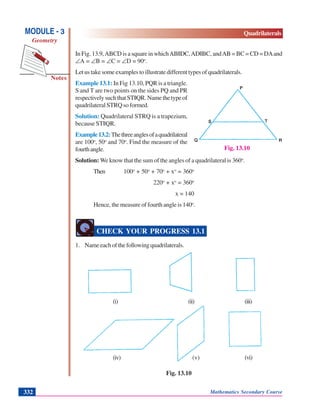
In Fig. 13.9,ABCD is a square in whichAB||DC,AD||BC, andAB = BC = CD = DAand
∠A = ∠B = ∠C = ∠D = 90o
.
Letustakesomeexamplestoillustratedifferenttypesofquadrilaterals.
Example 13.1: In Fig 13.10, PQR is a triangle.
S and T are two points on the sides PQ and PR
respectivelysuchthatST||QR.Namethetypeof
quadrilateral STRQ so formed.
Solution: Quadrilateral STRQ is a trapezium,
because ST||QR.
Example13.2:Thethreeanglesofaquadrilateral
are 100o
, 50o
and 70o
. Find the measure of the
fourthangle.
Solution: We know that the sum of the angles of a quadrilateral is 360o
.
Then 100o
+ 50o
+ 70o
+ xo
= 360o
220o
+ xo
= 360o
x = 140
Hence, the measure of fourth angle is 140o
.
CHECK YOUR PROGRESS 13.1
1. Nameeachofthefollowingquadrilaterals.
(i) (ii) (iii)
(iv) (v) (vi)
Fig. 13.10
Fig. 13.10
Mathematics Secondary Course 333
Quadrilaterals
Notes
MODULE - 3
Geometry
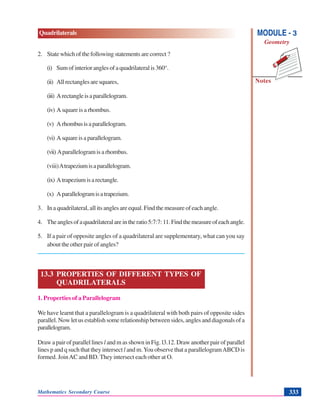
2. State which of the following statements are correct ?
(i) Sumofinterioranglesofaquadrilateralis360°.
(ii) All rectangles are squares,
(iii) Arectangleisaparallelogram.
(iv) A square is a rhombus.
(v) Arhombusisaparallelogram.
(vi) Asquareisaparallelogram.
(vii) Aparallelogramisarhombus.
(viii)Atrapeziumisaparallelogram.
(ix) Atrapeziumisarectangle.
(x) Aparallelogramisatrapezium.
3. In a quadrilateral, all its angles are equal. Find the measure of each angle.
4. Theanglesofaquadrilateralareintheratio5:7:7:11.Findthemeasureofeachangle.
5. If a pair of opposite angles of a quadrilateral are supplementary, what can you say
about the other pair of angles?
13.3 PROPERTIES OF DIFFERENT TYPES OF
QUADRILATERALS
1. Properties of a Parallelogram
We have learnt that a parallelogram is a quadrilateral with both pairs of opposite sides
parallel. Now let us establish some relationship between sides, angles and diagonals of a
parallelogram.
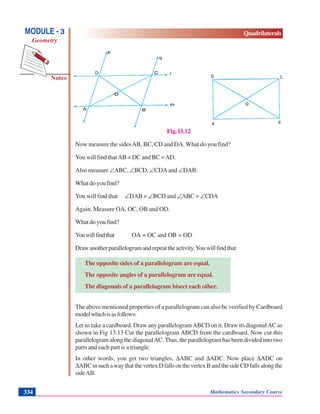
Draw a pair of parallel lines l and m as shown in Fig. l3.12. Draw another pair of parallel
lines p and q such that they intersect l and m.You observe that a parallelogramABCD is
formed. JoinAC and BD. They intersect each other at O.
Mathematics Secondary Course334
Notes
MODULE - 3
Geometry
Quadrilaterals
Fig. l3.12
Now measure the sidesAB, BC, CD and DA. What do you find?
You will find thatAB = DC and BC =AD.
Also measure ∠ABC, ∠BCD, ∠CDA and ∠DAB.
What do you find?
You will find that ∠DAB = ∠BCD and ∠ABC = ∠CDA
Again, Measure OA, OC, OB and OD.
What do you find?
Youwillfindthat OA = OC and OB = OD
Drawanotherparallelogramandrepeattheactivity.Youwillfindthat
The opposite sides of a parallelogram are equal.
The opposite angles of a parallelogram are equal.
The diagonals of a parallelogram bisect each other.
The above mentioned properties of a parallelogram can also be verified by Cardboard
modelwhichisasfollows:
Let us take a cardboard. Draw any parallelogramABCD on it. Draw its diagonalAC as
shown in Fig 13.13 Cut the parallelogram ABCD from the cardboard. Now cut this
parallelogram along the diagonalAC.Thus, the parallelogram has been divided into two
parts and each part is a triangle.
In other words, you get two triangles, ΔABC and ΔADC. Now place ΔADC on
ΔABCinsuchawaythatthevertexDfallsonthevertexBandthesideCDfallsalongthe
sideAB.
Mathematics Secondary Course 335
Quadrilaterals
Notes
MODULE - 3
Geometry
Fig. 13.13
Where does the point C fall?
Where does the pointAfall?
You will observe that ΔADC will coincide with ΔABC. In other words ΔABC ≅ΔADC.
Also AB = CD and BC = AD and ∠B = ∠D.
Youmayrepeatthisactivitybytakingsomeotherparallelograms,youwillalwaysgetthe
sameresultsasverifiedearlier,thus,provingtheabovetwopropertiesoftheparallelogram.
Now you can prove the third property of the parallelogram, i.e., the diagonals of a
parallelogrambisecteachother.
Again take a thin cardboard. Draw any parallelogram PQRS on it. Draw its diagonals
PR and QS which intersect each other at O as shown in Fig. l3.14. Now cut the
parallelogramPQRS.
Fig. 13.14
Also cut ΔPOQ and ΔROS.
Now place ΔROS and ΔPOQ in such a way that the vertex R coincides with the vertex P
and RO coincides with the side PO.
Where does the point S fall?
Where does the side OS fall?
Is ΔROS ≅ ΔPOQ? Yes, it is.
Mathematics Secondary Course336
Notes
MODULE - 3
Geometry
Quadrilaterals
So, what do you observe?
We find that RO = PO and OS = OQ
Youmayalsoverifythispropertybytakinganotherpairoftrianglesi.e.ΔPOSandΔROQ
Youwillagainarriveatthesameresult.
Youmayalsoverifythefollowingpropertieswhicharetheconverseofthepropertiesofa
parallelogramverifiedearlier.
A quadrilateral is a parallelogram if its opposite sides are equal.
A quadrilateral is a parallelogram if its opposite angles are equal.
Aquadrilateral is a parallelogram if its diagonals bisect each other.
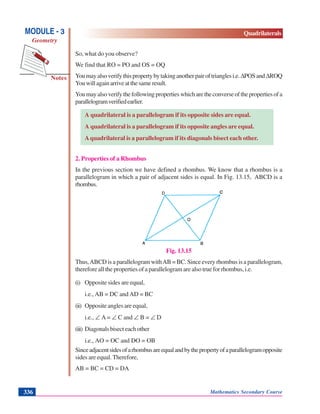
2. Properties of a Rhombus
In the previous section we have defined a rhombus. We know that a rhombus is a
parallelogram in which a pair of adjacent sides is equal. In Fig. 13.15, ABCD is a
rhombus.
Fig. 13.15
Thus,ABCD is a parallelogram withAB = BC. Since every rhombus is a parallelogram,
therefore all the properties of a parallelogram are also true for rhombus, i.e.
(i) Opposite sides are equal,
i.e., AB = DC and AD = BC
(ii) Opposite angles are equal,
i.e., ∠ A = ∠ C and ∠ B = ∠ D
(iii) Diagonalsbisecteachother
i.e., AO = OC and DO = OB
Sinceadjacentsidesofarhombusareequalandbythepropertyofaparallelogramopposite
sides are equal. Therefore,
AB = BC = CD = DA
Mathematics Secondary Course 337
Quadrilaterals
Notes
MODULE - 3
Geometry
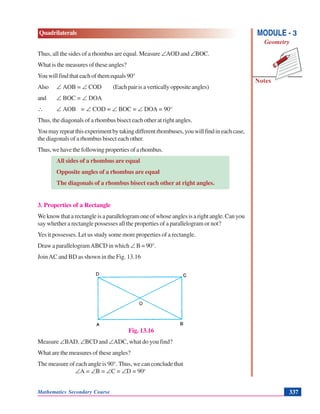
Thus, all the sides of a rhombus are equal. Measure ∠AOD and ∠BOC.
What is the measures of these angles?
Youwillfindthateachofthemequals90°
Also ∠ AOB = ∠ COD (Eachpairisaverticallyoppositeangles)
and ∠ BOC = ∠ DOA
∴ ∠ AOB = ∠ COD = ∠ BOC = ∠ DOA = 90°
Thus, the diagonals of a rhombus bisect each other at right angles.
Youmayrepeatthisexperimentbytakingdifferentrhombuses,youwillfindineachcase,
the diagonals of a rhombus bisect each other.
Thus,wehavethefollowingpropertiesofarhombus.
All sides of a rhombus are equal
Opposite angles of a rhombus are equal
The diagonals of a rhombus bisect each other at right angles.
3. Properties of a Rectangle
Weknowthatarectangleisaparallelogramoneofwhoseanglesisarightangle.Canyou
say whether a rectangle possesses all the properties of a parallelogram or not?
Yes it possesses. Let us study some more properties of a rectangle.
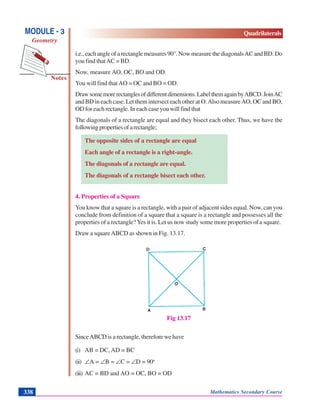
Draw a parallelogramABCD in which ∠ B = 90°.
JoinAC and BD as shown in the Fig. 13.16
Fig. 13.16
Measure ∠BAD, ∠BCD and ∠ADC, what do you find?
What are the measures of these angles?
The measure of each angle is 90°. Thus, we can conclude that
∠A = ∠B = ∠C = ∠D = 90o
Mathematics Secondary Course338
Notes
MODULE - 3
Geometry
Quadrilaterals
i.e., each angle of a rectangle measures 90°. Now measure the diagonalsAC and BD. Do
you find thatAC = BD.
Now, measure AO, OC, BO and OD.
You will find thatAO = OC and BO = OD.
Drawsomemorerectanglesofdifferentdimensions.LabelthemagainbyABCD.JoinAC
and BD in each case. Let them intersect each other at O.Also measureAO, OC and BO,
OD for each rectangle. In each case you will find that
The diagonals of a rectangle are equal and they bisect each other. Thus, we have the
followingpropertiesofarectangle;
The opposite sides of a rectangle are equal
Each angle of a rectangle is a right-angle.
The diagonals of a rectangle are equal.
The diagonals of a rectangle bisect each other.
4. Properties of a Square
You know that a square is a rectangle, with a pair of adjacent sides equal. Now, can you
conclude from definition of a square that a square is a rectangle and possesses all the
properties of a rectangle?Yes it is. Let us now study some more properties of a square.
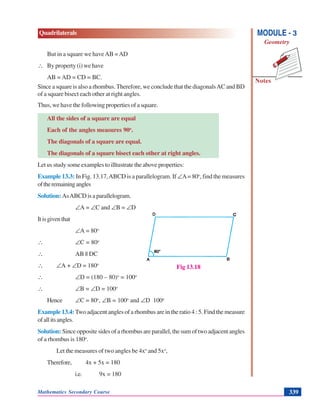
Draw a squareABCD as shown in Fig. 13.17.
Fig 13.17
SinceABCD is a rectangle, therefore we have
(i) AB = DC, AD = BC
(ii) ∠A = ∠B = ∠C = ∠D = 90o
(iii) AC = BD and AO = OC, BO = OD
Mathematics Secondary Course 339
Quadrilaterals
Notes
MODULE - 3
Geometry
But in a square we haveAB =AD
∴ By property (i) we have
AB = AD = CD = BC.
Since a square is also a rhombus.Therefore, we conclude that the diagonalsAC and BD
of a square bisect each other at right angles.
Thus, we have the following properties of a square.
All the sides of a square are equal
Each of the angles measures 90o
.
The diagonals of a square are equal.
The diagonals of a square bisect each other at right angles.
Let us study some examples to illtustrate the above properties:
Example 13.3: In Fig. 13.17,ABCD is a parallelogram. If ∠A= 80o
, find the measures
oftheremainingangles
Solution: AsABCDisaparallelogram.
∠A = ∠C and ∠B = ∠D
Itisgiventhat
∠A = 80o
∴ ∠C = 80o
∴ AB || DC
∴ ∠A + ∠D = 180o
∴ ∠D = (180 – 80)o
= 100o
∴ ∠B = ∠D = 100o
Hence ∠C = 80o
, ∠B = 100o
and ∠D 100o
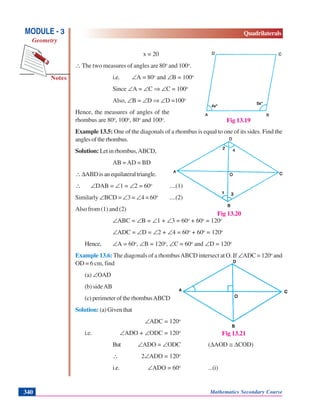
Example 13.4:Two adjacent angles of a rhombus are in the ratio 4 : 5. Find the measure
ofallitsangles.
Solution: Since opposite sides of a rhombus are parallel, the sum of two adjacent angles
of a rhombus is 180o
.
Let the measures of two angles be 4xo
and 5xo
,
Therefore, 4x + 5x = 180
i.e. 9x = 180
Fig 13.18
Mathematics Secondary Course340
Notes
MODULE - 3
Geometry
Quadrilaterals
x = 20
∴ The two measures of angles are 80o
and 100o
.
i.e. ∠A = 80o
and ∠B = 100o
Since ∠A = ∠C ⇒ ∠C = 100o
Also, ∠B = ∠D ⇒ ∠D =100o
Hence, the measures of angles of the
rhombus are 80o
, 100o
, 80o
and 100o
.
Example 13.5: One of the diagonals of a rhombus is equal to one of its sides. Find the
anglesoftherhombus.
Solution: Letinrhombus,ABCD,
AB =AD = BD
∴ΔABDisanequilateraltriangle.
∴ ∠DAB = ∠1 = ∠2 = 60o
....(1)
Similarly ∠BCD = ∠3 = ∠4 = 60o
....(2)
Also from (1) and (2)
∠ABC = ∠B = ∠1 + ∠3 = 60o
+ 60o
= 120o
∠ADC = ∠D = ∠2 + ∠4 = 60o
+ 60o
= 120o
Hence, ∠A = 60o
, ∠B = 120o
, ∠C = 60o
and ∠D = 120o
Example 13.6:The diagonals of a rhombusABCD intersect at O. If ∠ADC = 120o
and
OD = 6 cm, find
(a) ∠OAD
(b) sideAB
(c) perimeter of the rhombusABCD
Solution: (a)Giventhat
∠ADC = 120o
i.e. ∠ADO + ∠ODC = 120o
But ∠ADO = ∠ODC (ΔAOD ≅ ΔCOD)
∴ 2∠ADO = 120o
i.e. ∠ADO = 60o
...(i)
Fig 13.19
Fig 13.20
Fig 13.21
Mathematics Secondary Course 341
Quadrilaterals
Notes
MODULE - 3
Geometry
Also, we know that the diagonals of a rhombus bisect each that at 90o
.
∴ ∠DOA = 90o
...(ii)
Now, in ΔDOA
∠ADO + ∠DOA + ∠OAD = 180o
From (i) and (ii), we have
60o
+ 90o
+ ∠OAD = 180o
⇒ ∠OAD = 30o
(b) Now, ∠DAB = 60o
[since∠OAD=30o
,similarly∠OAB=30o
]
∴ΔDAB is an equilateral triangle.
OD = 6 cm [given]
⇒ OD + OB = BD
6 cm + 6 cm = BD
⇒ BD = 12 cm
so, AB = BD = AD = 12 cm
AB = 12 cm
(c) Now Perimeter = 4 × side
= (4 × 12) cm
= 48 cm
Hence, the perimeter of the rhombus = 48 cm.
CHECK YOUR PROGRESS 13.2
1. In a parallelogramABCD, ∠A= 62o
. Fing the measures of the other angles.
2. The sum of the two opposite angles of a parallelogram is 150o
. Find all the angles of
theparallelogram.
3. In a parallelogramABCD, ∠A= (2x + 10)o
and ∠C = (3x – 20)o
. Find the value of x.
4. ABCD is a parallelogram in which ∠DAB = 70o
and ∠CBD = 55o
. Find ∠CDBand
∠ADB.
5. ABCD is a rhombus in which ∠ABC = 58o
. Find the measure of ∠ACD.
Mathematics Secondary Course342
Notes
MODULE - 3
Geometry
Quadrilaterals
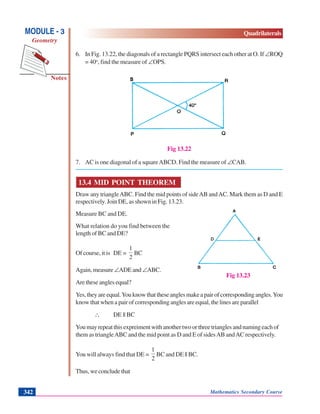
6. In Fig. 13.22, the diagonals of a rectangle PQRS intersect each other at O. If ∠ROQ
= 40o
, find the measure of ∠OPS.
Fig 13.22
7. AC is one diagonal of a squareABCD. Find the measure of ∠CAB.
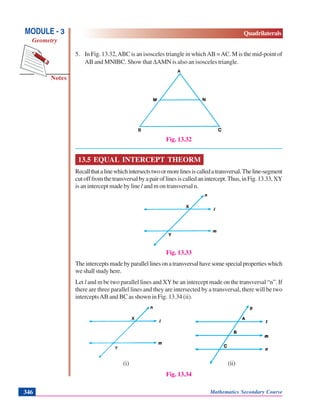
13.4 MID POINT THEOREM
Draw any triangleABC. Find the mid points of sideAB andAC. Mark them as D and E
respectively. Join DE, as shown in Fig. 13.23.
Measure BC and DE.
What relation do you find between the
length of BC and DE?
Of course, it is DE =
2
1
BC
Again, measure ∠ADE and ∠ABC.
Are these angles equal?
Yes,theyareequal.Youknowthattheseanglesmakeapairofcorrespondingangles.You
know that when a pair of corresponding angles are equal, the lines are parallel
∴ DE || BC
Youmayrepeatthisexpreimentwithanothertwoorthreetrianglesandnamingeachof
them as triangleABC and the mid point as D and E of sidesAB andAC respectively.
You will always find that DE =
2
1
BC and DE || BC.
Thus, we conclude that
Fig 13.23
Mathematics Secondary Course 343
Quadrilaterals
Notes
MODULE - 3
Geometry
In a triangle the line-segment joining the mid points of any two sides is
parallel to the third side and is half of it.
We can also verify the converse of the
above stated result.
Draw any ΔPQR. Find the mid point of
side RQ, and mark it as L. From L, draw
a line LX || PQ, which intersects, PR at
M.
Measure PM and MR. Are they equal?
Yes, they are equal.
You may repeat with different triangles
andbynamingeachofthemasPQRand
taking each time L as the mid-point of
RQ and drawing a line LM || PQ, you
will find in each case that RM = MP.
Thus, we conclude that
“The line drawn through the mid point of one side of a triangle parallel to
the another side bisects the third side.”
Example 13.7: In Fig. 13.25, D is the mid-point of the sideAB of ΔABC and DE || BC.
IfAC = 8 cm, findAE.
Solution: In ΔABC, DE || BC and D is the mid point ofAB
∴ E is also the mid point ofAC
i.e.AE =
2
1
AC
= cm]8AC[cm8
2
1
=⎟
⎠
⎞
⎜
⎝
⎛
× Q
= 4 cm
Hence, AE = 4 cm
Example 13.8: In Fig. 13.26, ABCD is a
trapeziuminwhichADandBCareitsnon-parallel
sides and E is the mid-point of AD. EF || AB.
Show that F is the mid-point of BC.
Solution: Since EG ||AB and E is the mid-point
ofAD(considering ΔABD)
∴ G is the mid point of DB
Fig 13.24
Fig 13.25
Fig 13.26
Mathematics Secondary Course344
Notes
MODULE - 3
Geometry
Quadrilaterals
In ΔDBC, GF || DC and G is the mid-point of DB,
∴ F is the mid-point of BC.
Example13.9: ABCisatriangle,inwhichP,QandRaremid-pointsofthesidesAB,BC
and CA respectively. If AB = 8 cm, BC = 7 cm and CA = 6 cm, find the sides of the
trianglePQR.
Solution: Pis the mid-point ofAB and R the mid-point ofAC.
∴ PR || BC and PR =
2
1
BC
=
2
1
× 7 cm [Q BC = cm]
= 3.5 cm
Similarly, PQ =
2
1
AC
=
2
1
× 6 cm [Q AC = 6 cm]
= 3 cm
and QR =
2
1
AB
=
2
1
× 8 cm [Q AB = 8 cm]
= 4 cm
Hence, the sides of ΔPQR are PQ = 3 cm, QR = 4 cm and PR = 3.5 cm.
CHECK YOUR PROGRESS 13.3
1. InFig.13.28,ABCisanequilateraltriangle.D,EandFarethemid-pointsofthesides
AB, BC and CArespectively. Prove that DEF is also an equilateral triangle.
Fig. 13.28
Fig 13.27
Mathematics Secondary Course 345
Quadrilaterals
Notes
MODULE - 3
Geometry
2. In Fig. 13.29, D and E are the mid-points of the sidesAB andAC respectively of a
ΔABC. If BC = 10 cm; find DE.
Fig. 13.29
3. In Fig. 13.30, AD is a median of the ΔABC and E is the mid-point of AD, BE is
produced to meet AC at F. DG || EF, meets AC at G. If AC = 9 cm, find AF.
[Hint: First consider ΔADG and next consider ΔCBF]
Fig. 13.30
4. InFig.13.31,AandCdividethesidePQofΔPQRintothreeequalparts,AB||CD||QR.
Prove that B and D also divide PR into three equal parts.
Fig. 13.31
Mathematics Secondary Course346
Notes
MODULE - 3
Geometry
Quadrilaterals
5. In Fig. 13.32,ABC is an isosceles triangle in whichAB =AC. M is the mid-point of
AB and MN||BC. Show that ΔAMN is also an isosceles triangle.
Fig. 13.32
13.5 EQUAL INTERCEPT THEORM
Recallthatalinewhichintersectstwoormorelinesiscalledatransversal.Theline-segment
cutofffromthetransversalbyapairoflinesiscalledanintercept.Thus,inFig.13.33,XY
is an intercept made by line l and m on transversal n.
Fig. 13.33
Theinterceptsmadebyparallellinesonatransversalhavesomespecialpropertieswhich
weshallstudyhere.
Let l and m be two parallel lines and XY be an intercept made on the transversal “n”. If
there are three parallel lines and they are intersected by a transversal, there will be two
interceptsAB and BC as shown in Fig. 13.34 (ii).
(i) (ii)
Fig. 13.34
Mathematics Secondary Course 347
Quadrilaterals
Notes
MODULE - 3
Geometry
Now let us learn an important property of intercepts made on the transversals by the
parallellines.
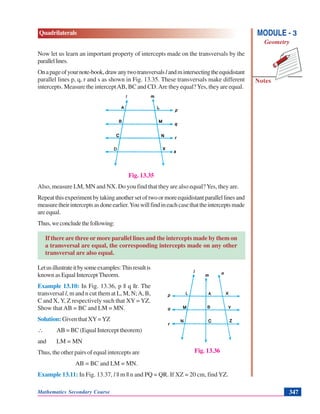
Onapageofyournote-book,drawanytwotransversalslandmintersectingtheequidistant
parallel lines p, q, r and s as shown in Fig. 13.35. These transversals make different
intercepts. Measure the interceptAB, BC and CD.Are they equal?Yes, they are equal.
Fig. 13.35
Also, measure LM, MN and NX. Do you find that they are also equal?Yes, they are.
Repeatthisexperimentbytakinganothersetoftwoormoreequidistantparallellinesand
measuretheirinterceptsasdoneearlier.Youwillfindineachcasethattheinterceptsmade
are equal.
Thus,weconcludethefollowing:
If there are three or more parallel lines and the intercepts made by them on
a transversal are equal, the corresponding intercepts made on any other
transversal are also equal.
Letusillustrateitbysomeexamples:Thisresultis
known as Equal Intercept Theorm.
Example 13.10: In Fig. 13.36, p || q ||r. The
transversal l, m and n cut them at L, M, N;A, B,
C and X, Y, Z respectively such that XY = YZ.
Show that AB = BC and LM = MN.
Solution: Given that XY=YZ
∴ AB = BC (Equal Intercept theorem)
and LM = MN
Thus, the other pairs of equal intercepts are
AB = BC and LM = MN.
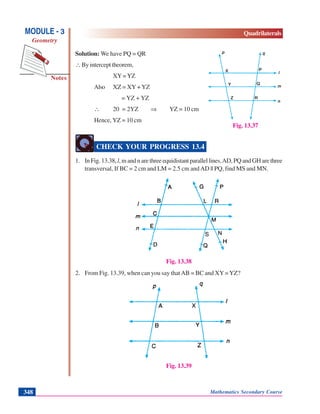
Example 13.11: In Fig. 13.37, l || m || n and PQ = QR. If XZ = 20 cm, find YZ.
Fig. 13.36
Mathematics Secondary Course348
Notes
MODULE - 3
Geometry
Quadrilaterals
Solution: We have PQ = QR
∴By intercept theorem,
XY=YZ
Also XZ = XY + YZ
= YZ + YZ
∴ 20 = 2YZ ⇒ YZ = 10 cm
Hence, YZ = 10 cm
CHECK YOUR PROGRESS 13.4
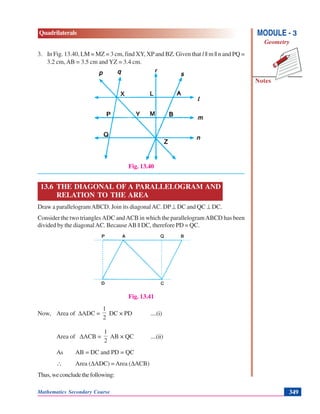
1. In Fig. 13.38, l,mandnarethreeequidistantparallellines.AD,PQandGHarethree
transversal, If BC = 2 cm and LM = 2.5 cm andAD || PQ, find MS and MN.
Fig. 13.38
2. From Fig. 13.39, when can you say thatAB = BC and XY=YZ?
Fig. 13.39
Fig. 13.37
Mathematics Secondary Course 349
Quadrilaterals
Notes
MODULE - 3
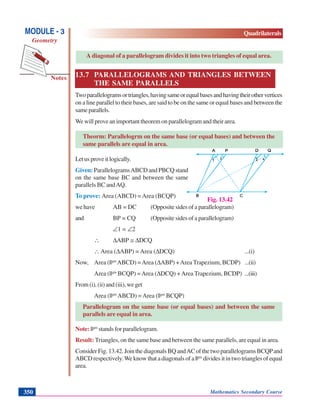
Geometry
3. In Fig. 13.40, LM = MZ = 3 cm, find XY, XPand BZ. Given that l || m || n and PQ =
3.2 cm, AB = 3.5 cm and YZ = 3.4 cm.
Fig. 13.40
13.6 THE DIAGONAL OF A PARALLELOGRAM AND
RELATION TO THE AREA
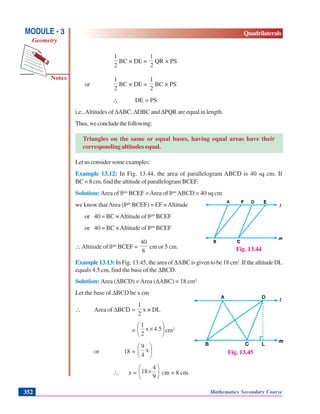
Draw a parallelogramABCD. Join its diagonalAC. DP⊥ DC and QC ⊥ DC.
Consider the two trianglesADC andACB in which the parallelogramABCD has been
divided by the diagonalAC. BecauseAB || DC, therefore PD = QC.
Fig. 13.41
Now, Area of ΔADC =
2
1
DC × PD ....(i)
Area of ΔACB =
2
1
AB × QC ....(ii)
As AB = DC and PD = QC
∴ Area (ΔADC) = Area (ΔACB)
Thus,weconcludethefollowing:
Mathematics Secondary Course350
Notes
MODULE - 3
Geometry
Quadrilaterals
A diagonal of a parallelogram divides it into two triangles of equal area.
13.7 PARALLELOGRAMS AND TRIANGLES BETWEEN
THE SAME PARALLELS
Twoparallelogramsortriangles,havingsameorequalbasesandhavingtheirothervertices
on a line parallel to their bases, are said to be on the same or equal bases and between the
sameparallels.
We will prove an important theorem on parallelogram and their area.
Theorm: Parallelogrm on the same base (or equal bases) and between the
same parallels are equal in area.
Letusproveitlogically.
Given: ParallelogramsABCD and PBCQ stand
on the same base BC and between the same
parallels BC andAQ.
To prove: Area (ABCD) =Area (BCQP)
we have AB = DC (Opposite sides of a parallelogram)
and BP = CQ (Opposite sides of a parallelogram)
∠1 = ∠2
∴ ΔABP ≅ ΔDCQ
∴ Area (ΔABP) = Area (ΔDCQ) ...(i)
Now, Area (||gm
ABCD) =Area (ΔABP) +Area Trapezium, BCDP) ...(ii)
Area (||gm
BCQP) =Area (ΔDCQ) +Area Trapezium, BCDP) ...(iii)
From(i),(ii)and(iii),weget
Area (||gm
ABCD) =Area (||gm
BCQP)
Parallelogram on the same base (or equal bases) and between the same
parallels are equal in area.
Note: ||gm
stands for parallelogram.
Result: Triangles, on the same base and between the same parallels, are equal in area.
ConsiderFig.13.42.JointhediagonalsBQandACofthetwoparallelogramsBCQPand
ABCD respectively.We know that a diagonals of a ||gm
divides it in two triangles of equal
area.
Fig. 13.42
Mathematics Secondary Course 351
Quadrilaterals
Notes
MODULE - 3
Geometry
∴ Area (ΔBCQ) = Area (ΔPBQ) [Each half of ||gm
BCQP]
and Area (ΔΑBC) =Area (ΔCAD) [Each half of ||gm
ABCD]
∴ Area (ΔABC) =Area (ΔBCQ) [Since area of ||gm
ABCD =Area of ||gm
BCQP]
Thusweconcludethefollowing:
Triangles on the same base (or equal bases) and between the same parallels
are equal in area.
13.8 TRIANGLES ON THE SAME OR EQUAL BASES
HAVING EQUAL AREAS HAVE THEIR
CORRESPONDING ALTITUDES EQUAL
Recall that the area of triangle =
2
1
(Base) ×Altitude
Fig. 13.43
Here BC = QR
and Area (ΔABC) = Area (ΔDBC) = Area (ΔPQR) [Given] ..(i)
Draw perpendiculars DE and PS from D and P to the line m meeting it in E and S
respectively.
Now Area (ΔABC) =
2
1
BC × DE
Area (ΔDBC) =
2
1
BC × DE ...(ii)
and Area (ΔPQR) =
2
1
QR × PS
Also, BC = QR (given) ...(iii)
From(i),(ii)and(iii),weget
Mathematics Secondary Course352
Notes
MODULE - 3
Geometry
Quadrilaterals
2
1
BC × DE =
2
1
QR × PS
or
2
1
BC × DE =
2
1
BC × PS
∴ DE = PS
i.e.,Altitudes of ΔABC, ΔDBC and ΔPQR are equal in length.
Thus,weconcludethefollowing:
Triangles on the same or equal bases, having equal areas have their
corresponding altitudes equal.
Letusconsidersomeexamples:
Example 13.12: In Fig. 13.44, the area of parallelogram ABCD is 40 sq cm. If
BC = 8 cm, find the altitude of parallelogram BCEF.
Solution: Area of ||gm
BCEF =Area of ||gm
ABCD = 40 sq cm
we know thatArea (||gm
BCEF) = EF ×Altitude
or 40 = BC ×Altitude of ||gm
BCEF
or 40 = BC ×Altitude of ||gm
BCEF
∴Altitude of ||gm
BCEF =
8
40
cm or 5 cm.
Example 13.13: In Fig. 13.45, the area of ΔABCisgiventobe18cm2
. If the altitude DL
equals 4.5 cm, find the base of the ΔBCD.
Solution: Area (ΔBCD) =Area (ΔABC) = 18 cm2
Let the base of ΔBCD be x cm
∴ Area of ΔBCD =
2
1
x × DL
= ⎟
⎠
⎞
⎜
⎝
⎛
×4.5x
2
1
cm2
or 18 = ⎟
⎠
⎞
⎜
⎝
⎛
x
4
9
∴ x = ⎟
⎠
⎞
⎜
⎝
⎛
×
9
4
18 cm = 8 cm.
Fig. 13.44
Fig. 13.45
Mathematics Secondary Course 353
Quadrilaterals
Notes
MODULE - 3
Geometry
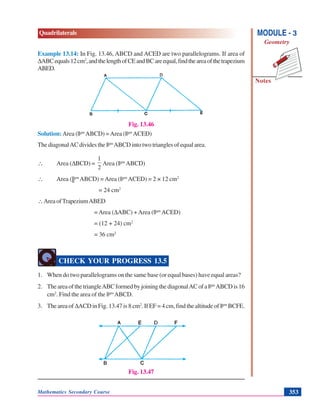
Example 13.14: In Fig. 13.46, ABCD and ACED are two parallelograms. If area of
ΔABCequals12cm2
,andthelengthofCEandBCareequal,findtheareaofthetrapezium
ABED.
Fig. 13.46
Solution:Area (||gm
ABCD) =Area (||gm
ACED)
The diagonalAC divides the ||gm
ABCD into two triangles of equal area.
∴ Area (ΔBCD) =
2
1
Area (||gm
ABCD)
∴ Area (||gm
ABCD) =Area (||gm
ACED) = 2 × 12 cm2
= 24 cm2
∴AreaofTrapeziumABED
=Area (ΔABC) +Area (||gm
ACED)
= (12 + 24) cm2
= 36 cm2
CHECK YOUR PROGRESS 13.5
1. When do two parallelograms on the same base (or equal bases) have equal areas?
2. The area of the triangleABC formed by joining the diagonalAC of a ||gm
ABCDis16
cm2
. Find the area of the ||gm
ABCD.
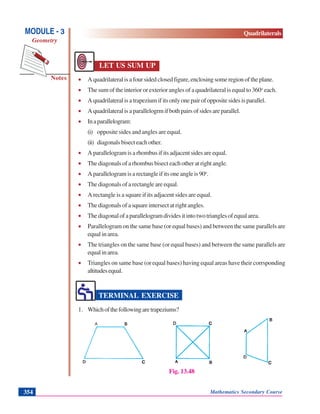
3. The area of ΔACD in Fig. 13.47 is 8 cm2
. If EF = 4 cm, find the altitude of ||gm
BCFE.
Fig. 13.47
Mathematics Secondary Course354
Notes
MODULE - 3
Geometry
Quadrilaterals
LET US SUM UP
• Aquadrilateralisafoursidedclosedfigure,enclosingsomeregionoftheplane.
• The sum of the interior or exterior angles of a quadrilateral is equal to 360o
each.
• Aquadrilateralisatrapeziumifitsonlyonepairofoppositesidesisparallel.
• Aquadrilateralisaparallelogrmifbothpairsofsidesareparallel.
• Inaparallelogram:
(i) opposite sides and angles are equal.
(ii) diagonals bisect each other.
• A parallelogram is a rhombus if its adjacent sides are equal.
• The diagonals of a rhombus bisect each other at right angle.
• Aparallelogramisarectangleifitsoneangleis90o
.
• The diagonals of a rectangle are equal.
• A rectangle is a square if its adjacent sides are equal.
• The diagonals of a square intersect at right angles.
• Thediagonalofaparallelogramdividesitintotwotrianglesofequalarea.
• Parallelogram on the same base (or equal bases) and between the same parallels are
equal in area.
• The triangles on the same base (or equal bases) and between the same parallels are
equal in area.
• Triangles on same base (or equal bases) having equal areas have their corrsponding
altitudesequal.
TERMINAL EXERCISE
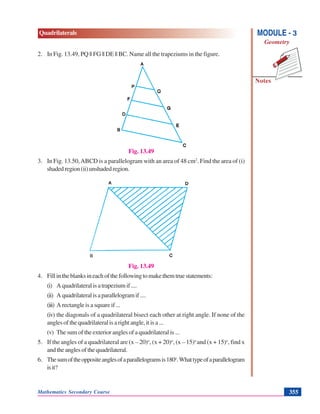
1. Whichofthefollowingaretrapeziums?
Fig. 13.48
Mathematics Secondary Course 355
Quadrilaterals
Notes
MODULE - 3
Geometry
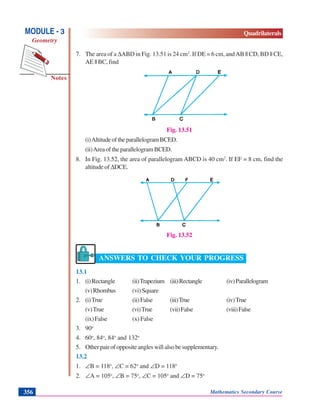
2. In Fig. 13.49, PQ || FG || DE || BC. Name all the trapeziums in the figure.
Fig. 13.49
3. In Fig. 13.50,ABCD is a parallelogram with an area of 48 cm2
. Find the area of (i)
shadedregion(ii)unshadedregion.
Fig. 13.49
4. Fillintheblanksineachofthefollowingtomakethemtruestatements:
(i) Aquadrilateralisatrapeziumif....
(ii) Aquadrilateralisaparallelogramif....
(iii) A rectangle is a square if ...
(iv) the diagonals of a quadrilateral bisect each other at right angle. If none of the
angles of the quadrilateral is a right angle, it is a ...
(v) The sum of the exterior angles of a quadrilateral is ...
5. If the angles of a quadrilateral are (x – 20)o
, (x + 20)o
, (x – 15)o
and (x + 15)o
, find x
andtheanglesofthequadrilateral.
6. Thesumoftheoppositeanglesofaparallelogramsis180o
.Whattypeofaparallelogram
isit?
Mathematics Secondary Course356
Notes
MODULE - 3
Geometry
Quadrilaterals
7. The area of a ΔABD in Fig. 13.51 is 24 cm2
. If DE = 6 cm, andAB || CD, BD || CE,
AE || BC, find
Fig. 13.51
(i)AltitudeoftheparallelogramBCED.
(ii)AreaoftheparallelogramBCED.
8. In Fig. 13.52, the area of parallelogram ABCD is 40 cm2
. If EF = 8 cm, find the
altitude of ΔDCE.
Fig. 13.52
ANSWERS TO CHECK YOUR PROGRESS
13.1
1. (i)Rectangle (ii)Trapezium (iii)Rectangle (iv)Parallelogram
(v)Rhombus (vi)Square
2. (i)True (ii)False (iii)True (iv)True
(v)True (vi)True (vii)False (viii)False
(ix)False (x)False
3. 90o
4. 60o
, 84o
, 84o
and 132o
5. Other pair of opposite angles will also be supplementary.
13.2
1. ∠B = 118o
, ∠C = 62o
and ∠D = 118o
2. ∠A = 105o
, ∠B = 75o
, ∠C = 105o
and ∠D = 75o
Mathematics Secondary Course 357
Quadrilaterals
Notes
MODULE - 3
Geometry
3. 30
4. ∠CDB = 55o
and ∠ADB = 55o
5. ∠ACD = 61o
6. ∠OPS = 70o
7. ∠CAB = 45o
13.3
2. 5 cm
3. 3 cm
13.4
1. MS = 2 cm and MN = 2.5 cm
2. 1, m and n are three equidistant parallel lines
3. XY = 3.4 cm, XP = 3.2 cm and BZ = 3.5 cm
13.5
1. Whentheyarelyingbetweenthesameparallellines
2. 32 cm2
3. 4 cm
ANSWERS TO TERMINAL EXERCISE
1. (i)and(iii)
2. PFGQ, FDEG, DBCE, PDEQ, FBCG and PBCQ
3. (i) 24 cm2
(ii) 24 cm2
4. (i) any one pair of opposite sides are parallel.
(ii) both pairs of opposite sids are parallel
(iii) pair of adjacent sides are equal
(iv) rhombus
(v) 360o
5. x = 90o
, angles are 70o
, 110o
, 75o
and 105o
respectively.
6. Rectangle.
7. (i) 8 cm (ii) 48 cm2
8. 5 cm

Quadrilaterals-GEOMETRY

  • 1.
    Mathematics Secondary Course327 Quadrilaterals Notes MODULE - 3 Geometry 13 QUADRILATERALS Ifyoulookaround,youwillfindmanyobjectsboundedbyfourline-segments.Anysurface of a book, window door, some parts of window-grill, slice of bread, the floor of your room are all examples of a closed figure bounded by four line-segments. Such a figure is calledaquadrilateral. The word quadrilateral has its origin from the two words “quadric” meaining four and “lateral” meaning sides. Thus, a quadrilateral is that geometrical figure which has four sides, enclosing a part of the plane. In this lesson, we shall study about terms and concepts related to quadrilateral with their properties. OBJECTIVES Afterstudyingthislesson,youwillbeableto • describe various types of quadrilaterals viz. trapeziums, parallelograms, rectangles, rhombuses and squares; • verify properties of different types of quadrilaterals; • verify that in a triangle the line segment joining the mid-points of any two sides is parallel to the third side and is half of it; • verify that the line drawn through the mid-point of a side of a triangle parallel to another side bisects the third side; • verify that if there are three or more parallel lines and the intercepts made by them on a transversal are equal, the corresponding intercepts on any other transversal are also equal; • verify that a diagonal of a parallelogram divides it into two triangles of equal area; • solve problem based on starred results and direct numerical problems based on unstarred results given in the curriculum;
  • 2.
    Mathematics Secondary Course328 Notes MODULE- 3 Geometry Quadrilaterals • prove that parallelograms on the same or equal bases and between the same parallels are equal in area; • verify that triangles on the same or equal bases and between the same parallels are equal in area and its converse. EXPECTED BACKGROUND KNOWLEDGE • Drawingline-segmentsandanglesofgivenmeasure. • Drawingcircles/arcsofgivenradius. • Drawingparallelandperpendicularlines. • Fourfundamentaloperationsonnumbers. 13.1 QUADRILATERAL Recall that if A, B, C and D are four points in a plane such that no three of them are collinear and the line segmentsAB, BC, CD and DAdo not intersect except at their end points,thentheclosedfiguremadeupofthesefourlinesegmentsiscalledaquadrilateral with vertices A, B, C and D. A quadrilateral with vertices A, B, C and D is generally denoted by quad.ABCD. In Fig. 13.1 (i) and (ii), both the quadrilaterals can be named as quad.ABCD or simplyABCD. InquadrilateralABCD, (i) (ii) Fig. 13.1 (i) AB and DC ; BC andAD are two pairs of opposite sides. (ii) ∠A and ∠C ; ∠B and ∠D are two pairs of opposite angles. (iii) AB and BC ; BC and CD are two pairs of consecutive or adjacent sides. Can you name the other pairs of consecutive sides? (iv) ∠A and ∠B ; ∠B and ∠C are two pairs of consecutive or adjacent angles. Can you nametheotherpairsofconsecutiveangles?
  • 3.
    Mathematics Secondary Course329 Quadrilaterals Notes MODULE - 3 Geometry (v) AC and BD are the two diagonals. In Fig. 13.2, angles denoted by l, 2, 3 and 4 are the interior angles or the angles of the quad.ABCD.Angles denoted by 5, 6, 7 and 8 are the exterior angles of the quad.ABCD. Measure ∠l, ∠2, ∠3 and ∠4. (i) (ii) Fig. 13.2 What is the sum of these anglesYou will find that ∠l + ∠2 + ∠3 + ∠4 = 360°. i.e. sum of interior angles of a quadrilateral equals 360°. Also what is the sum of exterior angles of the quadrilateralABCD? You will again find that ∠5 + ∠6 + ∠7 + ∠8 = 360° i.e., sum of exterior angles of a quadrilateral is also 360°. 13.2 TYPES OF QUADRILATERALS Youarefamiliarwithquadrilateralsandtheirdifferentshapes.Youalsoknowhowtoname them.However,wewillnowstudydifferenttypesofquadrilateralsinasystematicway.A familytreeofquadrilateralsisgiveninFig.13.3below: Quadrilateral Parallelogram Kite Trapezium Rectangle Rhombus Square Fig. 13.3 Let us describe them one by one. 1.Trapezium Aquadrilateralwhichhasonlyonepairofoppositesidesparalleliscalledatrapezium.In
  • 4.
    Mathematics Secondary Course330 Notes MODULE- 3 Geometry Quadrilaterals Fig. 13.4 [(i) and (ii)] ABCD and PQRS are trapeziums with AB || DC and PQ || SR respectively. (i) (ii) Fig. 13.4 2. Kite Aquadrilateral, which has two pairs of equal sides next to each other, is called a kite. Fig. 13.5 [(i) and (ii)]ABCD and PQRS are kites with adjacent sidesAB andAD, BC and CD in (i) PQ and PS, QR and RS in (ii) being equal. Fig. 13.5 3. Parallelogram Aquadrilateralwhichhasbothpairsofoppositesidesparallel,iscalledaparallelogram.In Fig. 13.6 [(i) and (ii)]ABCD and PQRS are parallelograms withAB||DC,AD||BC and PQ||SR, SP||RQ.These are denoted by ||gm ABCD (ParallelogramABCD) and ||gm PQRS (ParallelogramPQRS). (i) (ii) Fig. 13.6 A B D C P Q S R (i) (ii)
  • 5.
    Mathematics Secondary Course331 Quadrilaterals Notes MODULE - 3 Geometry 4. Rhombus A rhombus is a parallelogram in which any pair of adjacent sides is equal. In Fig. 13.7ABCD is a rhombus. You may note that ABCD is a parallelogram with AB = BC = CD = DA i.e., each pair of adjacent sides beingequal. 5. Rectangle A parallelogram one of whose angles is a right angle is calledarectangle. In Fig. 13.8,ABCD is a rectangle in whichAB||DC,AD||BC and ∠A = ∠B = ∠C = ∠D = 90o . Fig. 13.8 6. Square A square is a rectangle, with a pair of adjacent sides equal. Inotherwords,aparallelogramhavingallsidesequalandeachanglearightangleiscalled a square. Fig. 13.9 Fig. 13.7
  • 6.
    Mathematics Secondary Course332 Notes MODULE- 3 Geometry Quadrilaterals In Fig. 13.9,ABCD is a square in whichAB||DC,AD||BC, andAB = BC = CD = DAand ∠A = ∠B = ∠C = ∠D = 90o . Letustakesomeexamplestoillustratedifferenttypesofquadrilaterals. Example 13.1: In Fig 13.10, PQR is a triangle. S and T are two points on the sides PQ and PR respectivelysuchthatST||QR.Namethetypeof quadrilateral STRQ so formed. Solution: Quadrilateral STRQ is a trapezium, because ST||QR. Example13.2:Thethreeanglesofaquadrilateral are 100o , 50o and 70o . Find the measure of the fourthangle. Solution: We know that the sum of the angles of a quadrilateral is 360o . Then 100o + 50o + 70o + xo = 360o 220o + xo = 360o x = 140 Hence, the measure of fourth angle is 140o . CHECK YOUR PROGRESS 13.1 1. Nameeachofthefollowingquadrilaterals. (i) (ii) (iii) (iv) (v) (vi) Fig. 13.10 Fig. 13.10
  • 7.
    Mathematics Secondary Course333 Quadrilaterals Notes MODULE - 3 Geometry 2. State which of the following statements are correct ? (i) Sumofinterioranglesofaquadrilateralis360°. (ii) All rectangles are squares, (iii) Arectangleisaparallelogram. (iv) A square is a rhombus. (v) Arhombusisaparallelogram. (vi) Asquareisaparallelogram. (vii) Aparallelogramisarhombus. (viii)Atrapeziumisaparallelogram. (ix) Atrapeziumisarectangle. (x) Aparallelogramisatrapezium. 3. In a quadrilateral, all its angles are equal. Find the measure of each angle. 4. Theanglesofaquadrilateralareintheratio5:7:7:11.Findthemeasureofeachangle. 5. If a pair of opposite angles of a quadrilateral are supplementary, what can you say about the other pair of angles? 13.3 PROPERTIES OF DIFFERENT TYPES OF QUADRILATERALS 1. Properties of a Parallelogram We have learnt that a parallelogram is a quadrilateral with both pairs of opposite sides parallel. Now let us establish some relationship between sides, angles and diagonals of a parallelogram. Draw a pair of parallel lines l and m as shown in Fig. l3.12. Draw another pair of parallel lines p and q such that they intersect l and m.You observe that a parallelogramABCD is formed. JoinAC and BD. They intersect each other at O.
  • 8.
    Mathematics Secondary Course334 Notes MODULE- 3 Geometry Quadrilaterals Fig. l3.12 Now measure the sidesAB, BC, CD and DA. What do you find? You will find thatAB = DC and BC =AD. Also measure ∠ABC, ∠BCD, ∠CDA and ∠DAB. What do you find? You will find that ∠DAB = ∠BCD and ∠ABC = ∠CDA Again, Measure OA, OC, OB and OD. What do you find? Youwillfindthat OA = OC and OB = OD Drawanotherparallelogramandrepeattheactivity.Youwillfindthat The opposite sides of a parallelogram are equal. The opposite angles of a parallelogram are equal. The diagonals of a parallelogram bisect each other. The above mentioned properties of a parallelogram can also be verified by Cardboard modelwhichisasfollows: Let us take a cardboard. Draw any parallelogramABCD on it. Draw its diagonalAC as shown in Fig 13.13 Cut the parallelogram ABCD from the cardboard. Now cut this parallelogram along the diagonalAC.Thus, the parallelogram has been divided into two parts and each part is a triangle. In other words, you get two triangles, ΔABC and ΔADC. Now place ΔADC on ΔABCinsuchawaythatthevertexDfallsonthevertexBandthesideCDfallsalongthe sideAB.
  • 9.
    Mathematics Secondary Course335 Quadrilaterals Notes MODULE - 3 Geometry Fig. 13.13 Where does the point C fall? Where does the pointAfall? You will observe that ΔADC will coincide with ΔABC. In other words ΔABC ≅ΔADC. Also AB = CD and BC = AD and ∠B = ∠D. Youmayrepeatthisactivitybytakingsomeotherparallelograms,youwillalwaysgetthe sameresultsasverifiedearlier,thus,provingtheabovetwopropertiesoftheparallelogram. Now you can prove the third property of the parallelogram, i.e., the diagonals of a parallelogrambisecteachother. Again take a thin cardboard. Draw any parallelogram PQRS on it. Draw its diagonals PR and QS which intersect each other at O as shown in Fig. l3.14. Now cut the parallelogramPQRS. Fig. 13.14 Also cut ΔPOQ and ΔROS. Now place ΔROS and ΔPOQ in such a way that the vertex R coincides with the vertex P and RO coincides with the side PO. Where does the point S fall? Where does the side OS fall? Is ΔROS ≅ ΔPOQ? Yes, it is.
  • 10.
    Mathematics Secondary Course336 Notes MODULE- 3 Geometry Quadrilaterals So, what do you observe? We find that RO = PO and OS = OQ Youmayalsoverifythispropertybytakinganotherpairoftrianglesi.e.ΔPOSandΔROQ Youwillagainarriveatthesameresult. Youmayalsoverifythefollowingpropertieswhicharetheconverseofthepropertiesofa parallelogramverifiedearlier. A quadrilateral is a parallelogram if its opposite sides are equal. A quadrilateral is a parallelogram if its opposite angles are equal. Aquadrilateral is a parallelogram if its diagonals bisect each other. 2. Properties of a Rhombus In the previous section we have defined a rhombus. We know that a rhombus is a parallelogram in which a pair of adjacent sides is equal. In Fig. 13.15, ABCD is a rhombus. Fig. 13.15 Thus,ABCD is a parallelogram withAB = BC. Since every rhombus is a parallelogram, therefore all the properties of a parallelogram are also true for rhombus, i.e. (i) Opposite sides are equal, i.e., AB = DC and AD = BC (ii) Opposite angles are equal, i.e., ∠ A = ∠ C and ∠ B = ∠ D (iii) Diagonalsbisecteachother i.e., AO = OC and DO = OB Sinceadjacentsidesofarhombusareequalandbythepropertyofaparallelogramopposite sides are equal. Therefore, AB = BC = CD = DA
  • 11.
    Mathematics Secondary Course337 Quadrilaterals Notes MODULE - 3 Geometry Thus, all the sides of a rhombus are equal. Measure ∠AOD and ∠BOC. What is the measures of these angles? Youwillfindthateachofthemequals90° Also ∠ AOB = ∠ COD (Eachpairisaverticallyoppositeangles) and ∠ BOC = ∠ DOA ∴ ∠ AOB = ∠ COD = ∠ BOC = ∠ DOA = 90° Thus, the diagonals of a rhombus bisect each other at right angles. Youmayrepeatthisexperimentbytakingdifferentrhombuses,youwillfindineachcase, the diagonals of a rhombus bisect each other. Thus,wehavethefollowingpropertiesofarhombus. All sides of a rhombus are equal Opposite angles of a rhombus are equal The diagonals of a rhombus bisect each other at right angles. 3. Properties of a Rectangle Weknowthatarectangleisaparallelogramoneofwhoseanglesisarightangle.Canyou say whether a rectangle possesses all the properties of a parallelogram or not? Yes it possesses. Let us study some more properties of a rectangle. Draw a parallelogramABCD in which ∠ B = 90°. JoinAC and BD as shown in the Fig. 13.16 Fig. 13.16 Measure ∠BAD, ∠BCD and ∠ADC, what do you find? What are the measures of these angles? The measure of each angle is 90°. Thus, we can conclude that ∠A = ∠B = ∠C = ∠D = 90o
  • 12.
    Mathematics Secondary Course338 Notes MODULE- 3 Geometry Quadrilaterals i.e., each angle of a rectangle measures 90°. Now measure the diagonalsAC and BD. Do you find thatAC = BD. Now, measure AO, OC, BO and OD. You will find thatAO = OC and BO = OD. Drawsomemorerectanglesofdifferentdimensions.LabelthemagainbyABCD.JoinAC and BD in each case. Let them intersect each other at O.Also measureAO, OC and BO, OD for each rectangle. In each case you will find that The diagonals of a rectangle are equal and they bisect each other. Thus, we have the followingpropertiesofarectangle; The opposite sides of a rectangle are equal Each angle of a rectangle is a right-angle. The diagonals of a rectangle are equal. The diagonals of a rectangle bisect each other. 4. Properties of a Square You know that a square is a rectangle, with a pair of adjacent sides equal. Now, can you conclude from definition of a square that a square is a rectangle and possesses all the properties of a rectangle?Yes it is. Let us now study some more properties of a square. Draw a squareABCD as shown in Fig. 13.17. Fig 13.17 SinceABCD is a rectangle, therefore we have (i) AB = DC, AD = BC (ii) ∠A = ∠B = ∠C = ∠D = 90o (iii) AC = BD and AO = OC, BO = OD
  • 13.
    Mathematics Secondary Course339 Quadrilaterals Notes MODULE - 3 Geometry But in a square we haveAB =AD ∴ By property (i) we have AB = AD = CD = BC. Since a square is also a rhombus.Therefore, we conclude that the diagonalsAC and BD of a square bisect each other at right angles. Thus, we have the following properties of a square. All the sides of a square are equal Each of the angles measures 90o . The diagonals of a square are equal. The diagonals of a square bisect each other at right angles. Let us study some examples to illtustrate the above properties: Example 13.3: In Fig. 13.17,ABCD is a parallelogram. If ∠A= 80o , find the measures oftheremainingangles Solution: AsABCDisaparallelogram. ∠A = ∠C and ∠B = ∠D Itisgiventhat ∠A = 80o ∴ ∠C = 80o ∴ AB || DC ∴ ∠A + ∠D = 180o ∴ ∠D = (180 – 80)o = 100o ∴ ∠B = ∠D = 100o Hence ∠C = 80o , ∠B = 100o and ∠D 100o Example 13.4:Two adjacent angles of a rhombus are in the ratio 4 : 5. Find the measure ofallitsangles. Solution: Since opposite sides of a rhombus are parallel, the sum of two adjacent angles of a rhombus is 180o . Let the measures of two angles be 4xo and 5xo , Therefore, 4x + 5x = 180 i.e. 9x = 180 Fig 13.18
  • 14.
    Mathematics Secondary Course340 Notes MODULE- 3 Geometry Quadrilaterals x = 20 ∴ The two measures of angles are 80o and 100o . i.e. ∠A = 80o and ∠B = 100o Since ∠A = ∠C ⇒ ∠C = 100o Also, ∠B = ∠D ⇒ ∠D =100o Hence, the measures of angles of the rhombus are 80o , 100o , 80o and 100o . Example 13.5: One of the diagonals of a rhombus is equal to one of its sides. Find the anglesoftherhombus. Solution: Letinrhombus,ABCD, AB =AD = BD ∴ΔABDisanequilateraltriangle. ∴ ∠DAB = ∠1 = ∠2 = 60o ....(1) Similarly ∠BCD = ∠3 = ∠4 = 60o ....(2) Also from (1) and (2) ∠ABC = ∠B = ∠1 + ∠3 = 60o + 60o = 120o ∠ADC = ∠D = ∠2 + ∠4 = 60o + 60o = 120o Hence, ∠A = 60o , ∠B = 120o , ∠C = 60o and ∠D = 120o Example 13.6:The diagonals of a rhombusABCD intersect at O. If ∠ADC = 120o and OD = 6 cm, find (a) ∠OAD (b) sideAB (c) perimeter of the rhombusABCD Solution: (a)Giventhat ∠ADC = 120o i.e. ∠ADO + ∠ODC = 120o But ∠ADO = ∠ODC (ΔAOD ≅ ΔCOD) ∴ 2∠ADO = 120o i.e. ∠ADO = 60o ...(i) Fig 13.19 Fig 13.20 Fig 13.21
  • 15.
    Mathematics Secondary Course341 Quadrilaterals Notes MODULE - 3 Geometry Also, we know that the diagonals of a rhombus bisect each that at 90o . ∴ ∠DOA = 90o ...(ii) Now, in ΔDOA ∠ADO + ∠DOA + ∠OAD = 180o From (i) and (ii), we have 60o + 90o + ∠OAD = 180o ⇒ ∠OAD = 30o (b) Now, ∠DAB = 60o [since∠OAD=30o ,similarly∠OAB=30o ] ∴ΔDAB is an equilateral triangle. OD = 6 cm [given] ⇒ OD + OB = BD 6 cm + 6 cm = BD ⇒ BD = 12 cm so, AB = BD = AD = 12 cm AB = 12 cm (c) Now Perimeter = 4 × side = (4 × 12) cm = 48 cm Hence, the perimeter of the rhombus = 48 cm. CHECK YOUR PROGRESS 13.2 1. In a parallelogramABCD, ∠A= 62o . Fing the measures of the other angles. 2. The sum of the two opposite angles of a parallelogram is 150o . Find all the angles of theparallelogram. 3. In a parallelogramABCD, ∠A= (2x + 10)o and ∠C = (3x – 20)o . Find the value of x. 4. ABCD is a parallelogram in which ∠DAB = 70o and ∠CBD = 55o . Find ∠CDBand ∠ADB. 5. ABCD is a rhombus in which ∠ABC = 58o . Find the measure of ∠ACD.
  • 16.
    Mathematics Secondary Course342 Notes MODULE- 3 Geometry Quadrilaterals 6. In Fig. 13.22, the diagonals of a rectangle PQRS intersect each other at O. If ∠ROQ = 40o , find the measure of ∠OPS. Fig 13.22 7. AC is one diagonal of a squareABCD. Find the measure of ∠CAB. 13.4 MID POINT THEOREM Draw any triangleABC. Find the mid points of sideAB andAC. Mark them as D and E respectively. Join DE, as shown in Fig. 13.23. Measure BC and DE. What relation do you find between the length of BC and DE? Of course, it is DE = 2 1 BC Again, measure ∠ADE and ∠ABC. Are these angles equal? Yes,theyareequal.Youknowthattheseanglesmakeapairofcorrespondingangles.You know that when a pair of corresponding angles are equal, the lines are parallel ∴ DE || BC Youmayrepeatthisexpreimentwithanothertwoorthreetrianglesandnamingeachof them as triangleABC and the mid point as D and E of sidesAB andAC respectively. You will always find that DE = 2 1 BC and DE || BC. Thus, we conclude that Fig 13.23
  • 17.
    Mathematics Secondary Course343 Quadrilaterals Notes MODULE - 3 Geometry In a triangle the line-segment joining the mid points of any two sides is parallel to the third side and is half of it. We can also verify the converse of the above stated result. Draw any ΔPQR. Find the mid point of side RQ, and mark it as L. From L, draw a line LX || PQ, which intersects, PR at M. Measure PM and MR. Are they equal? Yes, they are equal. You may repeat with different triangles andbynamingeachofthemasPQRand taking each time L as the mid-point of RQ and drawing a line LM || PQ, you will find in each case that RM = MP. Thus, we conclude that “The line drawn through the mid point of one side of a triangle parallel to the another side bisects the third side.” Example 13.7: In Fig. 13.25, D is the mid-point of the sideAB of ΔABC and DE || BC. IfAC = 8 cm, findAE. Solution: In ΔABC, DE || BC and D is the mid point ofAB ∴ E is also the mid point ofAC i.e.AE = 2 1 AC = cm]8AC[cm8 2 1 =⎟ ⎠ ⎞ ⎜ ⎝ ⎛ × Q = 4 cm Hence, AE = 4 cm Example 13.8: In Fig. 13.26, ABCD is a trapeziuminwhichADandBCareitsnon-parallel sides and E is the mid-point of AD. EF || AB. Show that F is the mid-point of BC. Solution: Since EG ||AB and E is the mid-point ofAD(considering ΔABD) ∴ G is the mid point of DB Fig 13.24 Fig 13.25 Fig 13.26
  • 18.
    Mathematics Secondary Course344 Notes MODULE- 3 Geometry Quadrilaterals In ΔDBC, GF || DC and G is the mid-point of DB, ∴ F is the mid-point of BC. Example13.9: ABCisatriangle,inwhichP,QandRaremid-pointsofthesidesAB,BC and CA respectively. If AB = 8 cm, BC = 7 cm and CA = 6 cm, find the sides of the trianglePQR. Solution: Pis the mid-point ofAB and R the mid-point ofAC. ∴ PR || BC and PR = 2 1 BC = 2 1 × 7 cm [Q BC = cm] = 3.5 cm Similarly, PQ = 2 1 AC = 2 1 × 6 cm [Q AC = 6 cm] = 3 cm and QR = 2 1 AB = 2 1 × 8 cm [Q AB = 8 cm] = 4 cm Hence, the sides of ΔPQR are PQ = 3 cm, QR = 4 cm and PR = 3.5 cm. CHECK YOUR PROGRESS 13.3 1. InFig.13.28,ABCisanequilateraltriangle.D,EandFarethemid-pointsofthesides AB, BC and CArespectively. Prove that DEF is also an equilateral triangle. Fig. 13.28 Fig 13.27
  • 19.
    Mathematics Secondary Course345 Quadrilaterals Notes MODULE - 3 Geometry 2. In Fig. 13.29, D and E are the mid-points of the sidesAB andAC respectively of a ΔABC. If BC = 10 cm; find DE. Fig. 13.29 3. In Fig. 13.30, AD is a median of the ΔABC and E is the mid-point of AD, BE is produced to meet AC at F. DG || EF, meets AC at G. If AC = 9 cm, find AF. [Hint: First consider ΔADG and next consider ΔCBF] Fig. 13.30 4. InFig.13.31,AandCdividethesidePQofΔPQRintothreeequalparts,AB||CD||QR. Prove that B and D also divide PR into three equal parts. Fig. 13.31
  • 20.
    Mathematics Secondary Course346 Notes MODULE- 3 Geometry Quadrilaterals 5. In Fig. 13.32,ABC is an isosceles triangle in whichAB =AC. M is the mid-point of AB and MN||BC. Show that ΔAMN is also an isosceles triangle. Fig. 13.32 13.5 EQUAL INTERCEPT THEORM Recallthatalinewhichintersectstwoormorelinesiscalledatransversal.Theline-segment cutofffromthetransversalbyapairoflinesiscalledanintercept.Thus,inFig.13.33,XY is an intercept made by line l and m on transversal n. Fig. 13.33 Theinterceptsmadebyparallellinesonatransversalhavesomespecialpropertieswhich weshallstudyhere. Let l and m be two parallel lines and XY be an intercept made on the transversal “n”. If there are three parallel lines and they are intersected by a transversal, there will be two interceptsAB and BC as shown in Fig. 13.34 (ii). (i) (ii) Fig. 13.34
  • 21.
    Mathematics Secondary Course347 Quadrilaterals Notes MODULE - 3 Geometry Now let us learn an important property of intercepts made on the transversals by the parallellines. Onapageofyournote-book,drawanytwotransversalslandmintersectingtheequidistant parallel lines p, q, r and s as shown in Fig. 13.35. These transversals make different intercepts. Measure the interceptAB, BC and CD.Are they equal?Yes, they are equal. Fig. 13.35 Also, measure LM, MN and NX. Do you find that they are also equal?Yes, they are. Repeatthisexperimentbytakinganothersetoftwoormoreequidistantparallellinesand measuretheirinterceptsasdoneearlier.Youwillfindineachcasethattheinterceptsmade are equal. Thus,weconcludethefollowing: If there are three or more parallel lines and the intercepts made by them on a transversal are equal, the corresponding intercepts made on any other transversal are also equal. Letusillustrateitbysomeexamples:Thisresultis known as Equal Intercept Theorm. Example 13.10: In Fig. 13.36, p || q ||r. The transversal l, m and n cut them at L, M, N;A, B, C and X, Y, Z respectively such that XY = YZ. Show that AB = BC and LM = MN. Solution: Given that XY=YZ ∴ AB = BC (Equal Intercept theorem) and LM = MN Thus, the other pairs of equal intercepts are AB = BC and LM = MN. Example 13.11: In Fig. 13.37, l || m || n and PQ = QR. If XZ = 20 cm, find YZ. Fig. 13.36
  • 22.
    Mathematics Secondary Course348 Notes MODULE- 3 Geometry Quadrilaterals Solution: We have PQ = QR ∴By intercept theorem, XY=YZ Also XZ = XY + YZ = YZ + YZ ∴ 20 = 2YZ ⇒ YZ = 10 cm Hence, YZ = 10 cm CHECK YOUR PROGRESS 13.4 1. In Fig. 13.38, l,mandnarethreeequidistantparallellines.AD,PQandGHarethree transversal, If BC = 2 cm and LM = 2.5 cm andAD || PQ, find MS and MN. Fig. 13.38 2. From Fig. 13.39, when can you say thatAB = BC and XY=YZ? Fig. 13.39 Fig. 13.37
  • 23.
    Mathematics Secondary Course349 Quadrilaterals Notes MODULE - 3 Geometry 3. In Fig. 13.40, LM = MZ = 3 cm, find XY, XPand BZ. Given that l || m || n and PQ = 3.2 cm, AB = 3.5 cm and YZ = 3.4 cm. Fig. 13.40 13.6 THE DIAGONAL OF A PARALLELOGRAM AND RELATION TO THE AREA Draw a parallelogramABCD. Join its diagonalAC. DP⊥ DC and QC ⊥ DC. Consider the two trianglesADC andACB in which the parallelogramABCD has been divided by the diagonalAC. BecauseAB || DC, therefore PD = QC. Fig. 13.41 Now, Area of ΔADC = 2 1 DC × PD ....(i) Area of ΔACB = 2 1 AB × QC ....(ii) As AB = DC and PD = QC ∴ Area (ΔADC) = Area (ΔACB) Thus,weconcludethefollowing:
  • 24.
    Mathematics Secondary Course350 Notes MODULE- 3 Geometry Quadrilaterals A diagonal of a parallelogram divides it into two triangles of equal area. 13.7 PARALLELOGRAMS AND TRIANGLES BETWEEN THE SAME PARALLELS Twoparallelogramsortriangles,havingsameorequalbasesandhavingtheirothervertices on a line parallel to their bases, are said to be on the same or equal bases and between the sameparallels. We will prove an important theorem on parallelogram and their area. Theorm: Parallelogrm on the same base (or equal bases) and between the same parallels are equal in area. Letusproveitlogically. Given: ParallelogramsABCD and PBCQ stand on the same base BC and between the same parallels BC andAQ. To prove: Area (ABCD) =Area (BCQP) we have AB = DC (Opposite sides of a parallelogram) and BP = CQ (Opposite sides of a parallelogram) ∠1 = ∠2 ∴ ΔABP ≅ ΔDCQ ∴ Area (ΔABP) = Area (ΔDCQ) ...(i) Now, Area (||gm ABCD) =Area (ΔABP) +Area Trapezium, BCDP) ...(ii) Area (||gm BCQP) =Area (ΔDCQ) +Area Trapezium, BCDP) ...(iii) From(i),(ii)and(iii),weget Area (||gm ABCD) =Area (||gm BCQP) Parallelogram on the same base (or equal bases) and between the same parallels are equal in area. Note: ||gm stands for parallelogram. Result: Triangles, on the same base and between the same parallels, are equal in area. ConsiderFig.13.42.JointhediagonalsBQandACofthetwoparallelogramsBCQPand ABCD respectively.We know that a diagonals of a ||gm divides it in two triangles of equal area. Fig. 13.42
  • 25.
    Mathematics Secondary Course351 Quadrilaterals Notes MODULE - 3 Geometry ∴ Area (ΔBCQ) = Area (ΔPBQ) [Each half of ||gm BCQP] and Area (ΔΑBC) =Area (ΔCAD) [Each half of ||gm ABCD] ∴ Area (ΔABC) =Area (ΔBCQ) [Since area of ||gm ABCD =Area of ||gm BCQP] Thusweconcludethefollowing: Triangles on the same base (or equal bases) and between the same parallels are equal in area. 13.8 TRIANGLES ON THE SAME OR EQUAL BASES HAVING EQUAL AREAS HAVE THEIR CORRESPONDING ALTITUDES EQUAL Recall that the area of triangle = 2 1 (Base) ×Altitude Fig. 13.43 Here BC = QR and Area (ΔABC) = Area (ΔDBC) = Area (ΔPQR) [Given] ..(i) Draw perpendiculars DE and PS from D and P to the line m meeting it in E and S respectively. Now Area (ΔABC) = 2 1 BC × DE Area (ΔDBC) = 2 1 BC × DE ...(ii) and Area (ΔPQR) = 2 1 QR × PS Also, BC = QR (given) ...(iii) From(i),(ii)and(iii),weget
  • 26.
    Mathematics Secondary Course352 Notes MODULE- 3 Geometry Quadrilaterals 2 1 BC × DE = 2 1 QR × PS or 2 1 BC × DE = 2 1 BC × PS ∴ DE = PS i.e.,Altitudes of ΔABC, ΔDBC and ΔPQR are equal in length. Thus,weconcludethefollowing: Triangles on the same or equal bases, having equal areas have their corresponding altitudes equal. Letusconsidersomeexamples: Example 13.12: In Fig. 13.44, the area of parallelogram ABCD is 40 sq cm. If BC = 8 cm, find the altitude of parallelogram BCEF. Solution: Area of ||gm BCEF =Area of ||gm ABCD = 40 sq cm we know thatArea (||gm BCEF) = EF ×Altitude or 40 = BC ×Altitude of ||gm BCEF or 40 = BC ×Altitude of ||gm BCEF ∴Altitude of ||gm BCEF = 8 40 cm or 5 cm. Example 13.13: In Fig. 13.45, the area of ΔABCisgiventobe18cm2 . If the altitude DL equals 4.5 cm, find the base of the ΔBCD. Solution: Area (ΔBCD) =Area (ΔABC) = 18 cm2 Let the base of ΔBCD be x cm ∴ Area of ΔBCD = 2 1 x × DL = ⎟ ⎠ ⎞ ⎜ ⎝ ⎛ ×4.5x 2 1 cm2 or 18 = ⎟ ⎠ ⎞ ⎜ ⎝ ⎛ x 4 9 ∴ x = ⎟ ⎠ ⎞ ⎜ ⎝ ⎛ × 9 4 18 cm = 8 cm. Fig. 13.44 Fig. 13.45
  • 27.
    Mathematics Secondary Course353 Quadrilaterals Notes MODULE - 3 Geometry Example 13.14: In Fig. 13.46, ABCD and ACED are two parallelograms. If area of ΔABCequals12cm2 ,andthelengthofCEandBCareequal,findtheareaofthetrapezium ABED. Fig. 13.46 Solution:Area (||gm ABCD) =Area (||gm ACED) The diagonalAC divides the ||gm ABCD into two triangles of equal area. ∴ Area (ΔBCD) = 2 1 Area (||gm ABCD) ∴ Area (||gm ABCD) =Area (||gm ACED) = 2 × 12 cm2 = 24 cm2 ∴AreaofTrapeziumABED =Area (ΔABC) +Area (||gm ACED) = (12 + 24) cm2 = 36 cm2 CHECK YOUR PROGRESS 13.5 1. When do two parallelograms on the same base (or equal bases) have equal areas? 2. The area of the triangleABC formed by joining the diagonalAC of a ||gm ABCDis16 cm2 . Find the area of the ||gm ABCD. 3. The area of ΔACD in Fig. 13.47 is 8 cm2 . If EF = 4 cm, find the altitude of ||gm BCFE. Fig. 13.47
  • 28.
    Mathematics Secondary Course354 Notes MODULE- 3 Geometry Quadrilaterals LET US SUM UP • Aquadrilateralisafoursidedclosedfigure,enclosingsomeregionoftheplane. • The sum of the interior or exterior angles of a quadrilateral is equal to 360o each. • Aquadrilateralisatrapeziumifitsonlyonepairofoppositesidesisparallel. • Aquadrilateralisaparallelogrmifbothpairsofsidesareparallel. • Inaparallelogram: (i) opposite sides and angles are equal. (ii) diagonals bisect each other. • A parallelogram is a rhombus if its adjacent sides are equal. • The diagonals of a rhombus bisect each other at right angle. • Aparallelogramisarectangleifitsoneangleis90o . • The diagonals of a rectangle are equal. • A rectangle is a square if its adjacent sides are equal. • The diagonals of a square intersect at right angles. • Thediagonalofaparallelogramdividesitintotwotrianglesofequalarea. • Parallelogram on the same base (or equal bases) and between the same parallels are equal in area. • The triangles on the same base (or equal bases) and between the same parallels are equal in area. • Triangles on same base (or equal bases) having equal areas have their corrsponding altitudesequal. TERMINAL EXERCISE 1. Whichofthefollowingaretrapeziums? Fig. 13.48
  • 29.
    Mathematics Secondary Course355 Quadrilaterals Notes MODULE - 3 Geometry 2. In Fig. 13.49, PQ || FG || DE || BC. Name all the trapeziums in the figure. Fig. 13.49 3. In Fig. 13.50,ABCD is a parallelogram with an area of 48 cm2 . Find the area of (i) shadedregion(ii)unshadedregion. Fig. 13.49 4. Fillintheblanksineachofthefollowingtomakethemtruestatements: (i) Aquadrilateralisatrapeziumif.... (ii) Aquadrilateralisaparallelogramif.... (iii) A rectangle is a square if ... (iv) the diagonals of a quadrilateral bisect each other at right angle. If none of the angles of the quadrilateral is a right angle, it is a ... (v) The sum of the exterior angles of a quadrilateral is ... 5. If the angles of a quadrilateral are (x – 20)o , (x + 20)o , (x – 15)o and (x + 15)o , find x andtheanglesofthequadrilateral. 6. Thesumoftheoppositeanglesofaparallelogramsis180o .Whattypeofaparallelogram isit?
  • 30.
    Mathematics Secondary Course356 Notes MODULE- 3 Geometry Quadrilaterals 7. The area of a ΔABD in Fig. 13.51 is 24 cm2 . If DE = 6 cm, andAB || CD, BD || CE, AE || BC, find Fig. 13.51 (i)AltitudeoftheparallelogramBCED. (ii)AreaoftheparallelogramBCED. 8. In Fig. 13.52, the area of parallelogram ABCD is 40 cm2 . If EF = 8 cm, find the altitude of ΔDCE. Fig. 13.52 ANSWERS TO CHECK YOUR PROGRESS 13.1 1. (i)Rectangle (ii)Trapezium (iii)Rectangle (iv)Parallelogram (v)Rhombus (vi)Square 2. (i)True (ii)False (iii)True (iv)True (v)True (vi)True (vii)False (viii)False (ix)False (x)False 3. 90o 4. 60o , 84o , 84o and 132o 5. Other pair of opposite angles will also be supplementary. 13.2 1. ∠B = 118o , ∠C = 62o and ∠D = 118o 2. ∠A = 105o , ∠B = 75o , ∠C = 105o and ∠D = 75o
  • 31.
    Mathematics Secondary Course357 Quadrilaterals Notes MODULE - 3 Geometry 3. 30 4. ∠CDB = 55o and ∠ADB = 55o 5. ∠ACD = 61o 6. ∠OPS = 70o 7. ∠CAB = 45o 13.3 2. 5 cm 3. 3 cm 13.4 1. MS = 2 cm and MN = 2.5 cm 2. 1, m and n are three equidistant parallel lines 3. XY = 3.4 cm, XP = 3.2 cm and BZ = 3.5 cm 13.5 1. Whentheyarelyingbetweenthesameparallellines 2. 32 cm2 3. 4 cm ANSWERS TO TERMINAL EXERCISE 1. (i)and(iii) 2. PFGQ, FDEG, DBCE, PDEQ, FBCG and PBCQ 3. (i) 24 cm2 (ii) 24 cm2 4. (i) any one pair of opposite sides are parallel. (ii) both pairs of opposite sids are parallel (iii) pair of adjacent sides are equal (iv) rhombus (v) 360o 5. x = 90o , angles are 70o , 110o , 75o and 105o respectively. 6. Rectangle. 7. (i) 8 cm (ii) 48 cm2 8. 5 cm