Self designed innovative lesson 
Name of the teacher : Shefsyn. K. Y. Standard : Ⅷ 
Name of the school : St. Joseph’s. H. S. S. Division : E 
Subject : Mathematics Strength : 53 
Unit : Ratio and proportion Date : 7/07/2014 
Sub unit : Introduction – Ratio Time : 45 min 
Curricular Statement 
To learn about Ratios. 
Content analysis 
Terms : natural numbers, fraction, equal, relation, ratio. 
Facts : 
i. Ratio can be represented in fractional form. 
ii. Ratios are usually expressed in terms of natural numbers. 
iii. The quantitative relation between two amounts showing the 
number of times one value contains or is contained within the 
other are ratio. 
Concept : The concept of introduction to ratios. 
Definition : The quantitative relation between two amounts showing the 
number of times one value contains or is contained within the 
other are called ratios. 
Process : The process of teaching and learning the introduction to ratios. 
Process skill : comparing, calculating, generalizing, arriving at conclusion. 
Symbol : ∶ is to
Learning outcomes 
The pupil 
i. Remembers the facts and concepts related to ratio. 
ii. Develops understanding about ratio. 
iii. Discriminates the above facts and concepts related to ratio. 
iv. Detects the above facts and concepts related to ratio. 
v. Design a new idea related to ratio. 
vi. Applies the above facts and concepts in new and relevant situation. 
vii. Creates interest in the study of ratio. 
Pre requisites 
Idea about relations of parts. 
Learning aids 
Classroom equipments, charts, mango cut outs, apple cut outs, circle cut outs, 
roll up board. 
Learning Strategies 
Group discussion, group activity method.
Interaction procedure Pupil response 
Introduction 
To check the previous knowledge of the 
students, 
Teacher asks about relations of parts. 
Teacher calls 5 students in front of the class. 
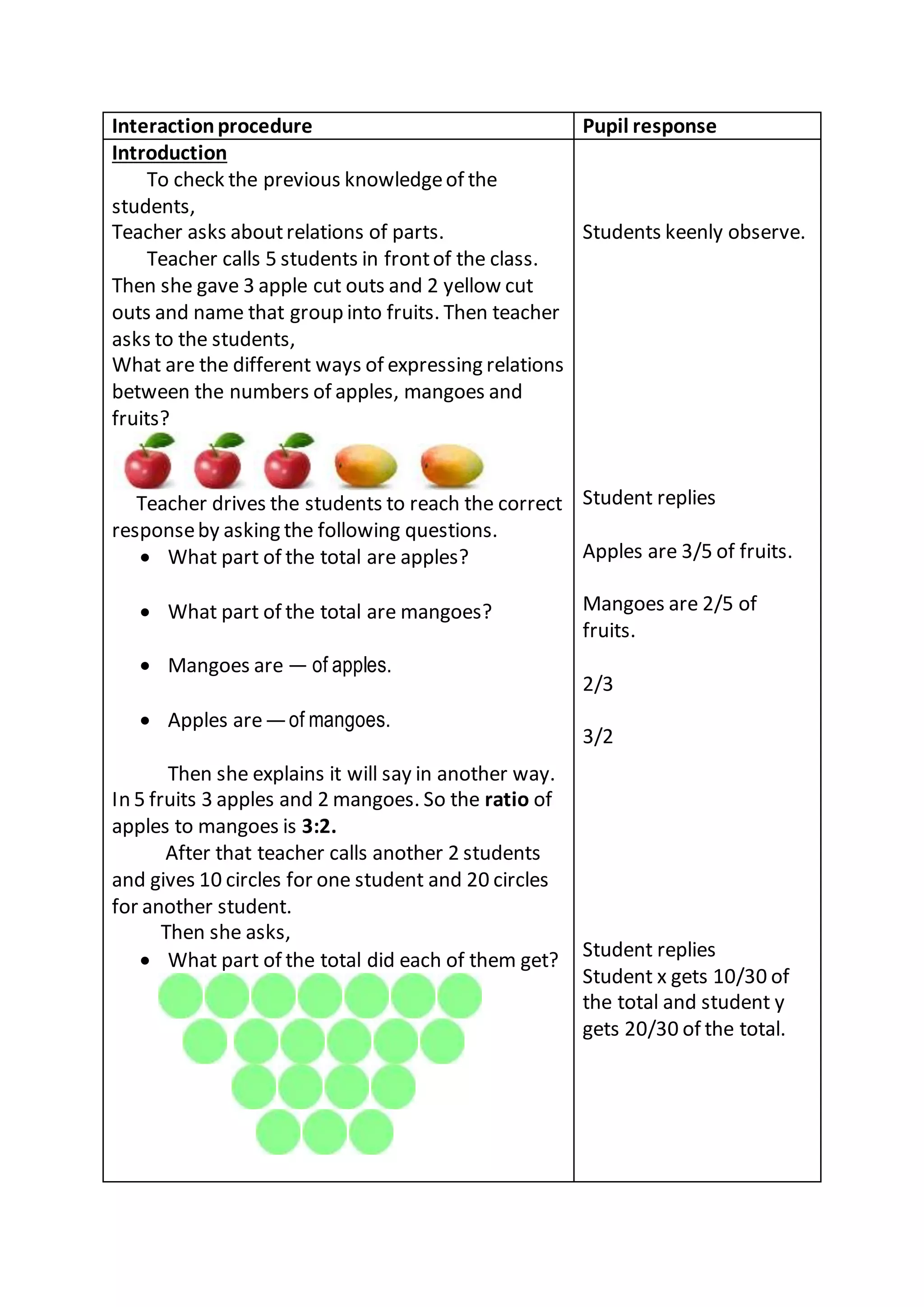
Then she gave 3 apple cut outs and 2 yellow cut 
outs and name that group into fruits. Then teacher 
asks to the students, 
What are the different ways of expressing relations 
between the numbers of apples, mangoes and 
fruits? 
Teacher drives the students to reach the correct 
response by asking the following questions. 
 What part of the total are apples? 
 What part of the total are mangoes? 
 Mangoes are — of apples. 
 Apples are — of mangoes. 
Then she explains it will say in another way. 
In 5 fruits 3 apples and 2 mangoes. So the ratio of 
apples to mangoes is 3:2. 
After that teacher calls another 2 students 
and gives 10 circles for one student and 20 circles 
for another student. 
Then she asks, 
 What part of the total did each of them get? 
Students keenly observe. 
Student replies 
Apples are 3/5 of fruits. 
Mangoes are 2/5 of 
fruits. 
2/3 
3/2 
Student replies 
Student x gets 10/30 of 
the total and student y 
gets 20/30 of the total.
Interaction procedure Pupil response 
Teacher explains once again 
Student x gets 10/30 of the total and 
student y gets 20/30 of the total that is 1/3 and 
2/3. Student x gets 1/2 times what student y gets. 
Student y gets 2/1 times what student x gets. 
The ratio of what student x and y got is 1:2 
To confirm the concept of ratio, teacher move on 
to the various activities. 
Class assignment 
Activity Ⅰ 
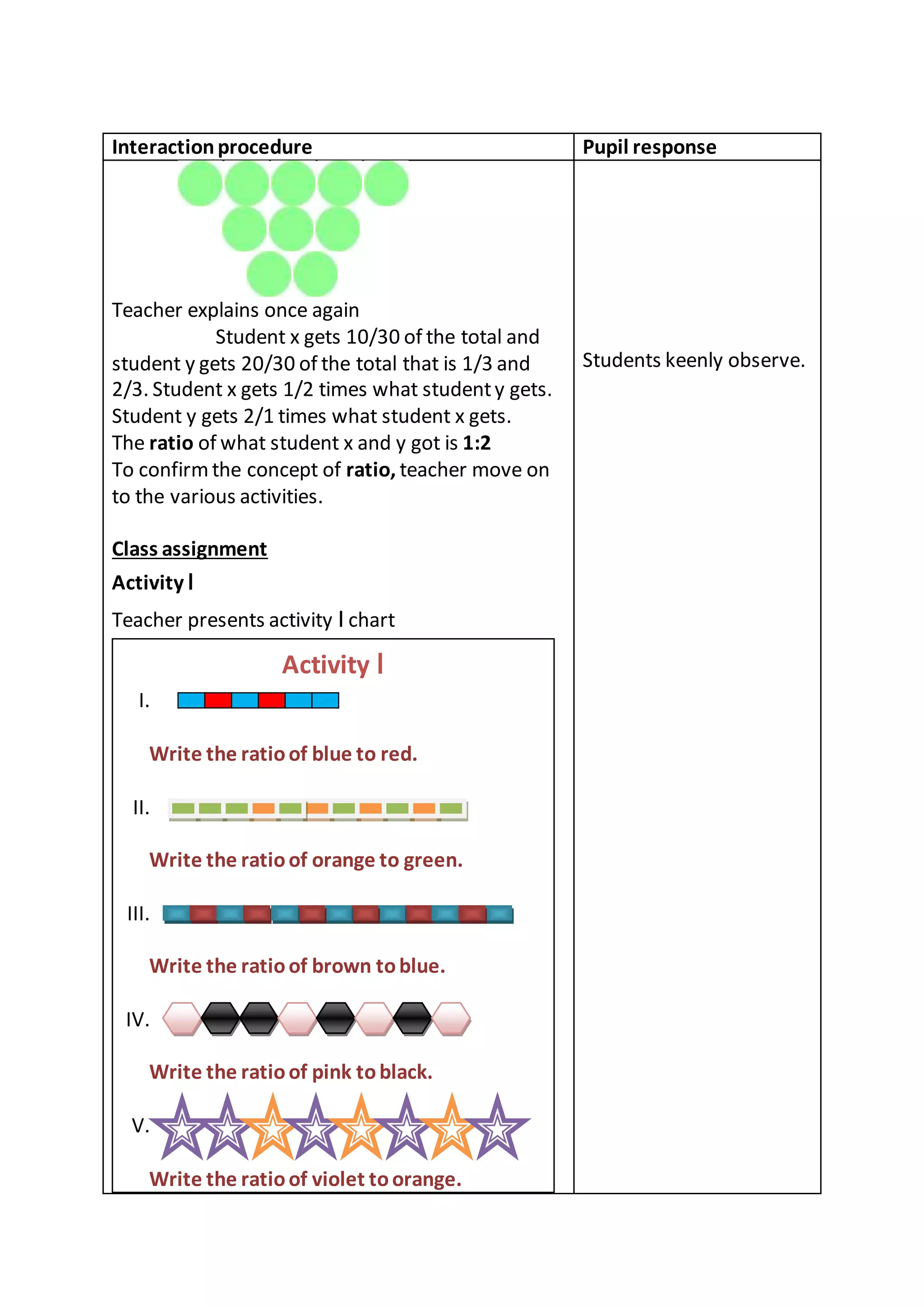
Teacher presents activity Ⅰ chart 
Activity Ⅰ 
I. 
Write the ratio of blue to red. 
II. 
Write the ratio of orange to green. 
III. 
Write the ratio of brown to blue. 
IV. 
Write the ratio of pink to black. 
V. 
Write the ratio of violet to orange. 
Students keenly observe.
Interaction procedure Pupil response 
Teacher calls one student from each group and 
tells to write the answer on blackboard. 
Activity Ⅱ 
Teacher presents activity Ⅱ chart. 
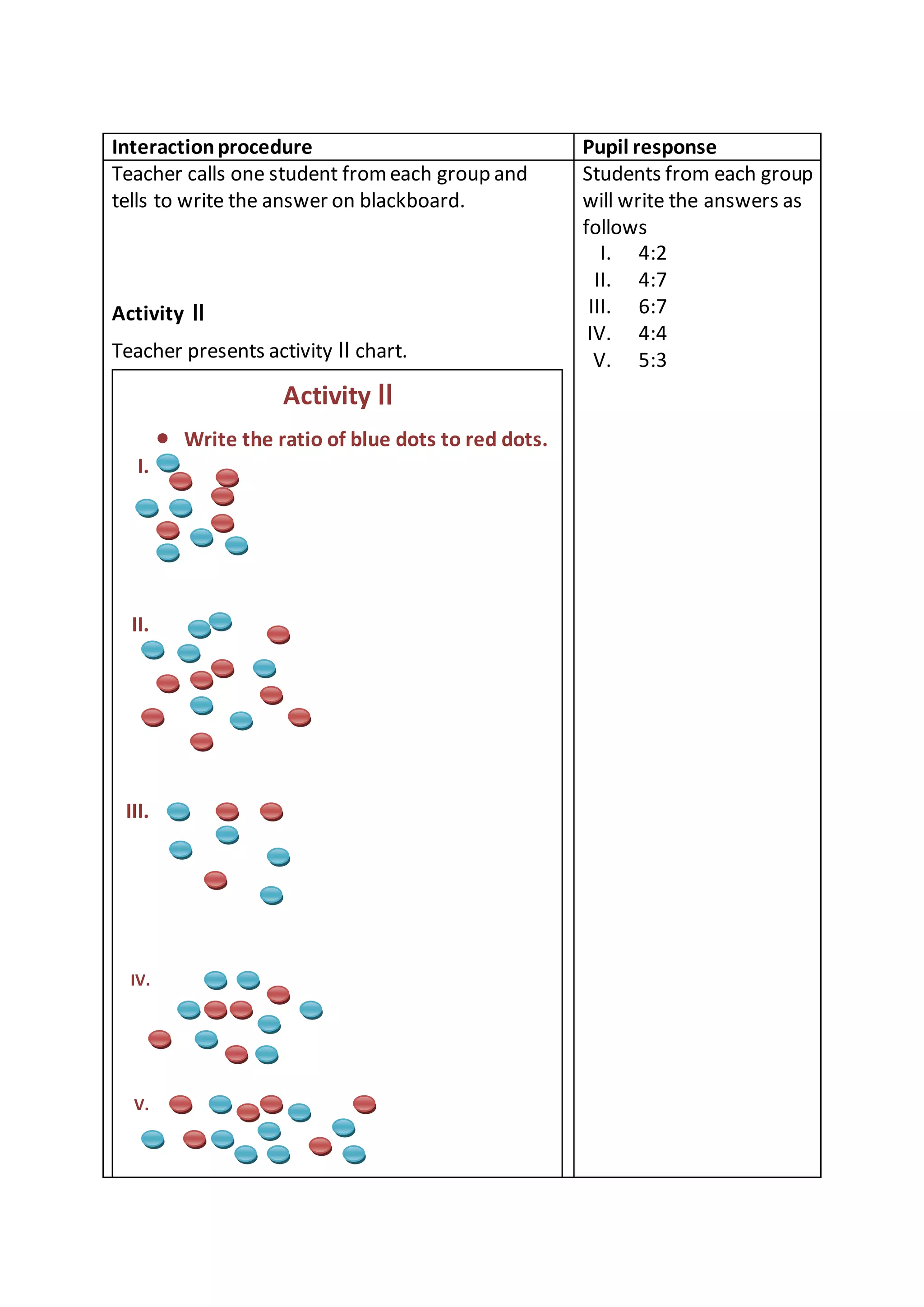
Activity Ⅱ 
 Write the ratio of blue dots to red dots. 
I. 
II. 
III. 
IV. 
V. 
Students from each group 
will write the answers as 
follows 
I. 4:2 
II. 4:7 
III. 6:7 
IV. 4:4 
V. 5:3
Interaction procedure Pupil response 
Teacher calls one student from each group and 
asks to write the answer on the blackboard. 
Activity Ⅲ 
Teacher presents activity Ⅲ chart. 
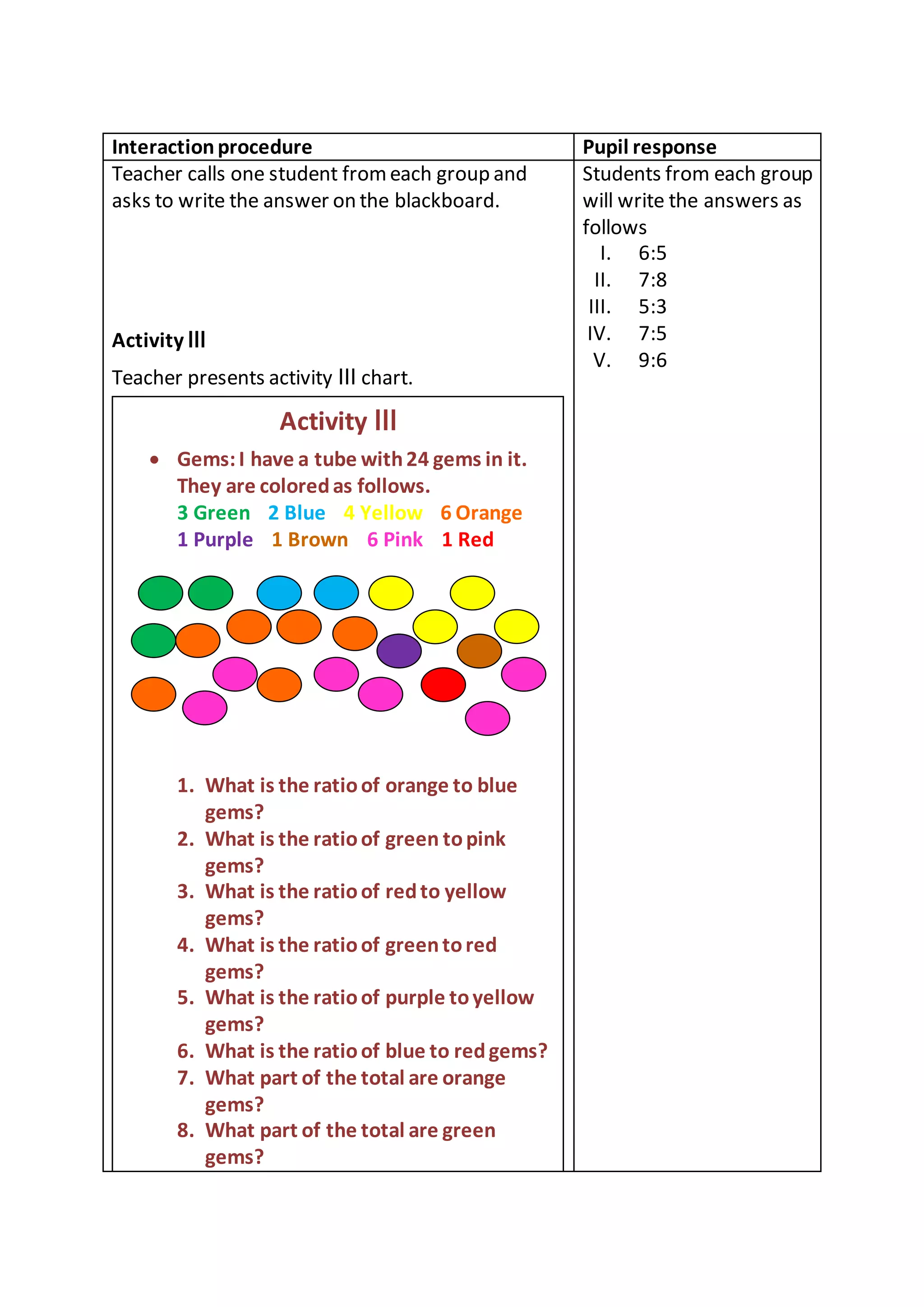
Activity Ⅲ 
 Gems: I have a tube with 24 gems in it. 
They are colored as follows. 
3 Green 2 Blue 4 Yellow 6 Orange 
1 Purple 1 Brown 6 Pink 1 Red 
1. What is the ratio of orange to blue 
gems? 
2. What is the ratio of green to pink 
gems? 
3. What is the ratio of red to yellow 
gems? 
4. What is the ratio of green to red 
gems? 
5. What is the ratio of purple to yellow 
gems? 
6. What is the ratio of blue to red gems? 
7. What part of the total are orange 
gems? 
8. What part of the total are green 
gems? 
Students from each group 
will write the answers as 
follows 
I. 6:5 
II. 7:8 
III. 5:3 
IV. 7:5 
V. 9:6
Interaction procedure Pupil response 
Teacher calls one student from each group and 
asks to write the answer on the blackboard. 
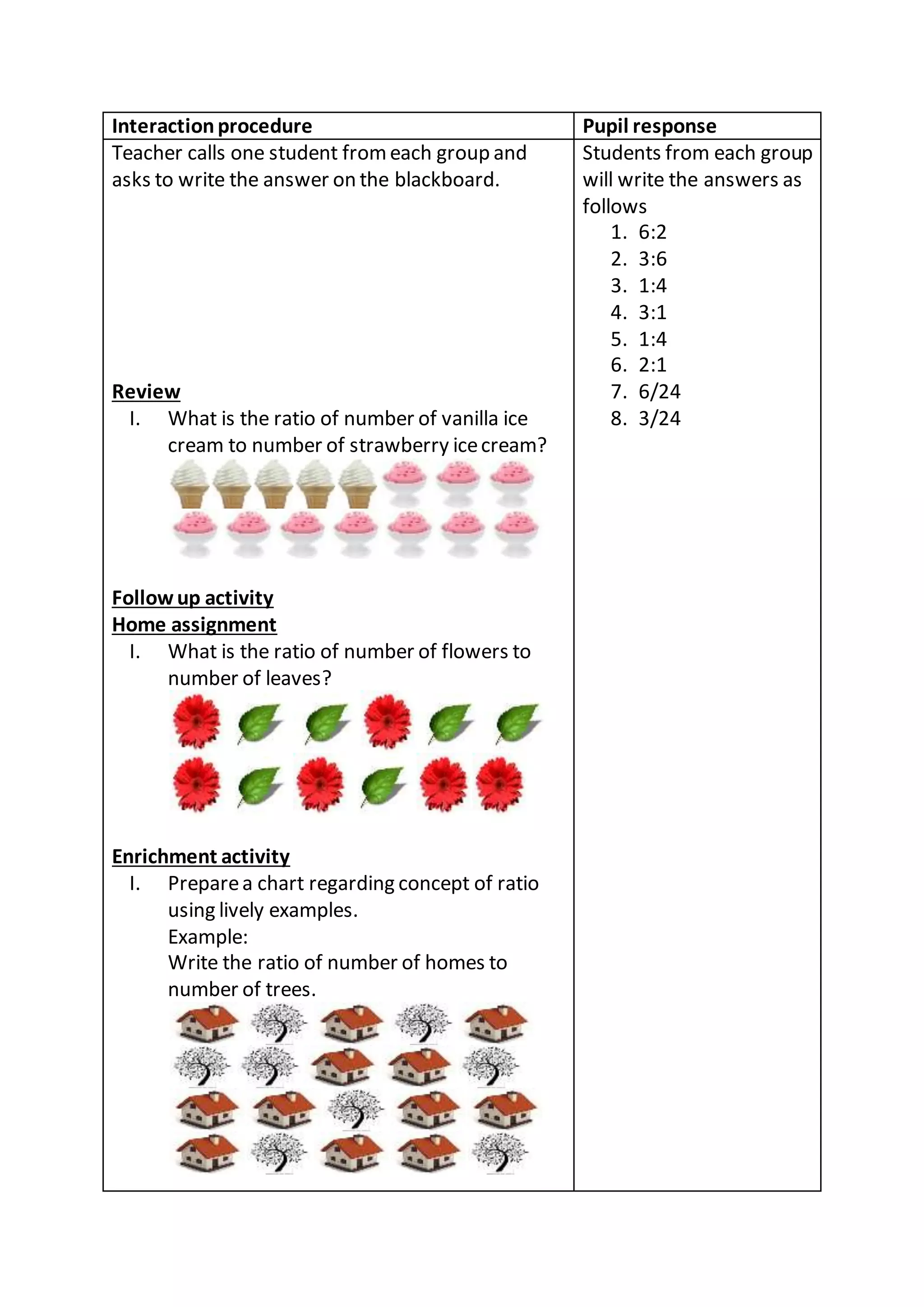
Review 
I. What is the ratio of number of vanilla ice 
cream to number of strawberry ice cream? 
Follow up activity 
Home assignment 
I. What is the ratio of number of flowers to 
number of leaves? 
Enrichment activity 
I. Prepare a chart regarding concept of ratio 
using lively examples. 
Example: 
Write the ratio of number of homes to 
number of trees. 
Students from each group 
will write the answers as 
follows 
1. 6:2 
2. 3:6 
3. 1:4 
4. 3:1 
5. 1:4 
6. 2:1 
7. 6/24 
8. 3/24
Introduction to ratios

Introduction to ratios

  • 1.
    Self designed innovativelesson Name of the teacher : Shefsyn. K. Y. Standard : Ⅷ Name of the school : St. Joseph’s. H. S. S. Division : E Subject : Mathematics Strength : 53 Unit : Ratio and proportion Date : 7/07/2014 Sub unit : Introduction – Ratio Time : 45 min Curricular Statement To learn about Ratios. Content analysis Terms : natural numbers, fraction, equal, relation, ratio. Facts : i. Ratio can be represented in fractional form. ii. Ratios are usually expressed in terms of natural numbers. iii. The quantitative relation between two amounts showing the number of times one value contains or is contained within the other are ratio. Concept : The concept of introduction to ratios. Definition : The quantitative relation between two amounts showing the number of times one value contains or is contained within the other are called ratios. Process : The process of teaching and learning the introduction to ratios. Process skill : comparing, calculating, generalizing, arriving at conclusion. Symbol : ∶ is to
  • 2.
    Learning outcomes Thepupil i. Remembers the facts and concepts related to ratio. ii. Develops understanding about ratio. iii. Discriminates the above facts and concepts related to ratio. iv. Detects the above facts and concepts related to ratio. v. Design a new idea related to ratio. vi. Applies the above facts and concepts in new and relevant situation. vii. Creates interest in the study of ratio. Pre requisites Idea about relations of parts. Learning aids Classroom equipments, charts, mango cut outs, apple cut outs, circle cut outs, roll up board. Learning Strategies Group discussion, group activity method.
  • 3.
    Interaction procedure Pupilresponse Introduction To check the previous knowledge of the students, Teacher asks about relations of parts. Teacher calls 5 students in front of the class. Then she gave 3 apple cut outs and 2 yellow cut outs and name that group into fruits. Then teacher asks to the students, What are the different ways of expressing relations between the numbers of apples, mangoes and fruits? Teacher drives the students to reach the correct response by asking the following questions.  What part of the total are apples?  What part of the total are mangoes?  Mangoes are — of apples.  Apples are — of mangoes. Then she explains it will say in another way. In 5 fruits 3 apples and 2 mangoes. So the ratio of apples to mangoes is 3:2. After that teacher calls another 2 students and gives 10 circles for one student and 20 circles for another student. Then she asks,  What part of the total did each of them get? Students keenly observe. Student replies Apples are 3/5 of fruits. Mangoes are 2/5 of fruits. 2/3 3/2 Student replies Student x gets 10/30 of the total and student y gets 20/30 of the total.
  • 4.
    Interaction procedure Pupilresponse Teacher explains once again Student x gets 10/30 of the total and student y gets 20/30 of the total that is 1/3 and 2/3. Student x gets 1/2 times what student y gets. Student y gets 2/1 times what student x gets. The ratio of what student x and y got is 1:2 To confirm the concept of ratio, teacher move on to the various activities. Class assignment Activity Ⅰ Teacher presents activity Ⅰ chart Activity Ⅰ I. Write the ratio of blue to red. II. Write the ratio of orange to green. III. Write the ratio of brown to blue. IV. Write the ratio of pink to black. V. Write the ratio of violet to orange. Students keenly observe.
  • 5.
    Interaction procedure Pupilresponse Teacher calls one student from each group and tells to write the answer on blackboard. Activity Ⅱ Teacher presents activity Ⅱ chart. Activity Ⅱ  Write the ratio of blue dots to red dots. I. II. III. IV. V. Students from each group will write the answers as follows I. 4:2 II. 4:7 III. 6:7 IV. 4:4 V. 5:3
  • 6.
    Interaction procedure Pupilresponse Teacher calls one student from each group and asks to write the answer on the blackboard. Activity Ⅲ Teacher presents activity Ⅲ chart. Activity Ⅲ  Gems: I have a tube with 24 gems in it. They are colored as follows. 3 Green 2 Blue 4 Yellow 6 Orange 1 Purple 1 Brown 6 Pink 1 Red 1. What is the ratio of orange to blue gems? 2. What is the ratio of green to pink gems? 3. What is the ratio of red to yellow gems? 4. What is the ratio of green to red gems? 5. What is the ratio of purple to yellow gems? 6. What is the ratio of blue to red gems? 7. What part of the total are orange gems? 8. What part of the total are green gems? Students from each group will write the answers as follows I. 6:5 II. 7:8 III. 5:3 IV. 7:5 V. 9:6
  • 7.
    Interaction procedure Pupilresponse Teacher calls one student from each group and asks to write the answer on the blackboard. Review I. What is the ratio of number of vanilla ice cream to number of strawberry ice cream? Follow up activity Home assignment I. What is the ratio of number of flowers to number of leaves? Enrichment activity I. Prepare a chart regarding concept of ratio using lively examples. Example: Write the ratio of number of homes to number of trees. Students from each group will write the answers as follows 1. 6:2 2. 3:6 3. 1:4 4. 3:1 5. 1:4 6. 2:1 7. 6/24 8. 3/24