Quadrilaterals Project
       By Kayti Rose
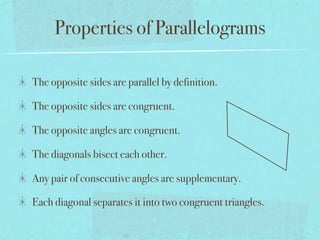
Properties of Parallelograms

The opposite sides are parallel by definition.

The opposite sides are congruent.

The opposite angles are congruent.

The diagonals bisect each other.

Any pair of consecutive angles are supplementary.

Each diagonal separates it into two congruent triangles.
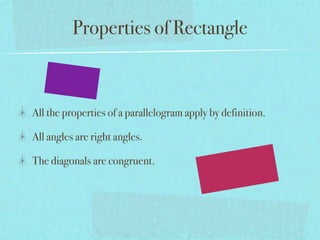
Properties of Rectangle


All the properties of a parallelogram apply by definition.

All angles are right angles.

The diagonals are congruent.
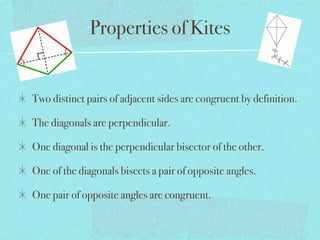
Properties of Kites


Two distinct pairs of adjacent sides are congruent by definition.

The diagonals are perpendicular.

One diagonal is the perpendicular bisector of the other.

One of the diagonals bisects a pair of opposite angles.

One pair of opposite angles are congruent.
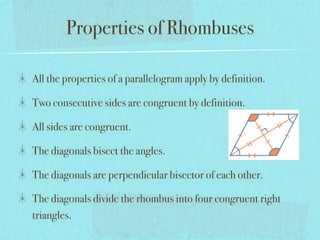
Properties of Rhombuses

All the properties of a parallelogram apply by definition.

Two consecutive sides are congruent by definition.

All sides are congruent.

The diagonals bisect the angles.

The diagonals are perpendicular bisector of each other.

The diagonals divide the rhombus into four congruent right
triangles.
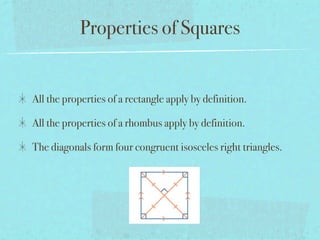
Properties of Squares


All the properties of a rectangle apply by definition.

All the properties of a rhombus apply by definition.

The diagonals form four congruent isosceles right triangles.
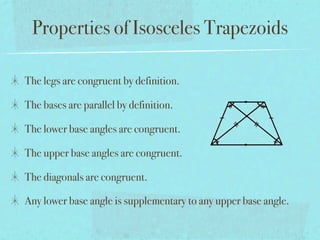
Properties of Isosceles Trapezoids

The legs are congruent by definition.

The bases are parallel by definition.

The lower base angles are congruent.

The upper base angles are congruent.

The diagonals are congruent.

Any lower base angle is supplementary to any upper base angle.
Proving that a Quadrilateral is a
              Parallelogram
If both pairs of opposite sides of a quadrilateral is a parallelogram (definition)

If both pairs of opposite sides of a quadrilateral are congruent, then it is a
parallelogram.

Fo two sides of a quadrilateral are both parallel and congruent, then it is a
parallelogram.

If the diagonals of a quadrilateral bisect each other, then it is a parallelogram.

If both pairs of opposite angles of a quadrilateral are congruent, then it is a
parallelogram.
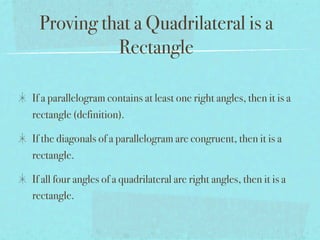
Proving that a Quadrilateral is a
           Rectangle

If a parallelogram contains at least one right angles, then it is a
rectangle (definition).

If the diagonals of a parallelogram are congruent, then it is a
rectangle.

If all four angles of a quadrilateral are right angles, then it is a
rectangle.
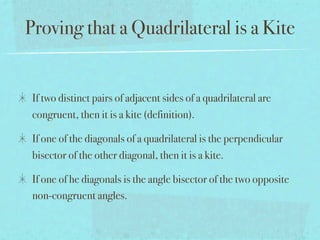
Proving that a Quadrilateral is a Kite


 If two distinct pairs of adjacent sides of a quadrilateral are
 congruent, then it is a kite (definition).

 If one of the diagonals of a quadrilateral is the perpendicular
 bisector of the other diagonal, then it is a kite.

 If one of he diagonals is the angle bisector of the two opposite
 non-congruent angles.
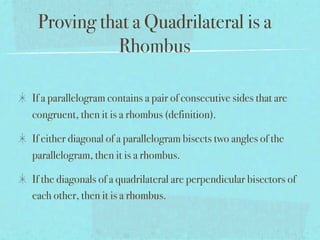
Proving that a Quadrilateral is a
           Rhombus

If a parallelogram contains a pair of consecutive sides that are
congruent, then it is a rhombus (definition).

If either diagonal of a parallelogram bisects two angles of the
parallelogram, then it is a rhombus.

If the diagonals of a quadrilateral are perpendicular bisectors of
each other, then it is a rhombus.
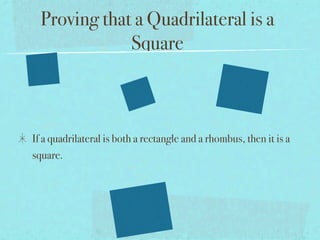
Proving that a Quadrilateral is a
              Square


If a quadrilateral is both a rectangle and a rhombus, then it is a
square.
Proving that a Trapezoid is an Isosceles
               Trapezoid

   If one nonparallel sides of a trapezoid are congruent, then it is
   isosceles (definition).

   If the lower or upper base angles of a trapezoid, then it is
   isosceles.

   If the diagonals of a trapezoid are congruent, then it is isosceles.
The End!

Quadrilaterals project

  • 1.
  • 2.
    Properties of Parallelograms Theopposite sides are parallel by definition. The opposite sides are congruent. The opposite angles are congruent. The diagonals bisect each other. Any pair of consecutive angles are supplementary. Each diagonal separates it into two congruent triangles.
  • 3.
    Properties of Rectangle Allthe properties of a parallelogram apply by definition. All angles are right angles. The diagonals are congruent.
  • 4.
    Properties of Kites Twodistinct pairs of adjacent sides are congruent by definition. The diagonals are perpendicular. One diagonal is the perpendicular bisector of the other. One of the diagonals bisects a pair of opposite angles. One pair of opposite angles are congruent.
  • 5.
    Properties of Rhombuses Allthe properties of a parallelogram apply by definition. Two consecutive sides are congruent by definition. All sides are congruent. The diagonals bisect the angles. The diagonals are perpendicular bisector of each other. The diagonals divide the rhombus into four congruent right triangles.
  • 6.
    Properties of Squares Allthe properties of a rectangle apply by definition. All the properties of a rhombus apply by definition. The diagonals form four congruent isosceles right triangles.
  • 7.
    Properties of IsoscelesTrapezoids The legs are congruent by definition. The bases are parallel by definition. The lower base angles are congruent. The upper base angles are congruent. The diagonals are congruent. Any lower base angle is supplementary to any upper base angle.
  • 8.
    Proving that aQuadrilateral is a Parallelogram If both pairs of opposite sides of a quadrilateral is a parallelogram (definition) If both pairs of opposite sides of a quadrilateral are congruent, then it is a parallelogram. Fo two sides of a quadrilateral are both parallel and congruent, then it is a parallelogram. If the diagonals of a quadrilateral bisect each other, then it is a parallelogram. If both pairs of opposite angles of a quadrilateral are congruent, then it is a parallelogram.
  • 9.
    Proving that aQuadrilateral is a Rectangle If a parallelogram contains at least one right angles, then it is a rectangle (definition). If the diagonals of a parallelogram are congruent, then it is a rectangle. If all four angles of a quadrilateral are right angles, then it is a rectangle.
  • 10.
    Proving that aQuadrilateral is a Kite If two distinct pairs of adjacent sides of a quadrilateral are congruent, then it is a kite (definition). If one of the diagonals of a quadrilateral is the perpendicular bisector of the other diagonal, then it is a kite. If one of he diagonals is the angle bisector of the two opposite non-congruent angles.
  • 11.
    Proving that aQuadrilateral is a Rhombus If a parallelogram contains a pair of consecutive sides that are congruent, then it is a rhombus (definition). If either diagonal of a parallelogram bisects two angles of the parallelogram, then it is a rhombus. If the diagonals of a quadrilateral are perpendicular bisectors of each other, then it is a rhombus.
  • 12.
    Proving that aQuadrilateral is a Square If a quadrilateral is both a rectangle and a rhombus, then it is a square.
  • 13.
    Proving that aTrapezoid is an Isosceles Trapezoid If one nonparallel sides of a trapezoid are congruent, then it is isosceles (definition). If the lower or upper base angles of a trapezoid, then it is isosceles. If the diagonals of a trapezoid are congruent, then it is isosceles.
  • 14.