Today’s Objective
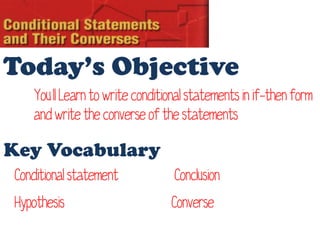
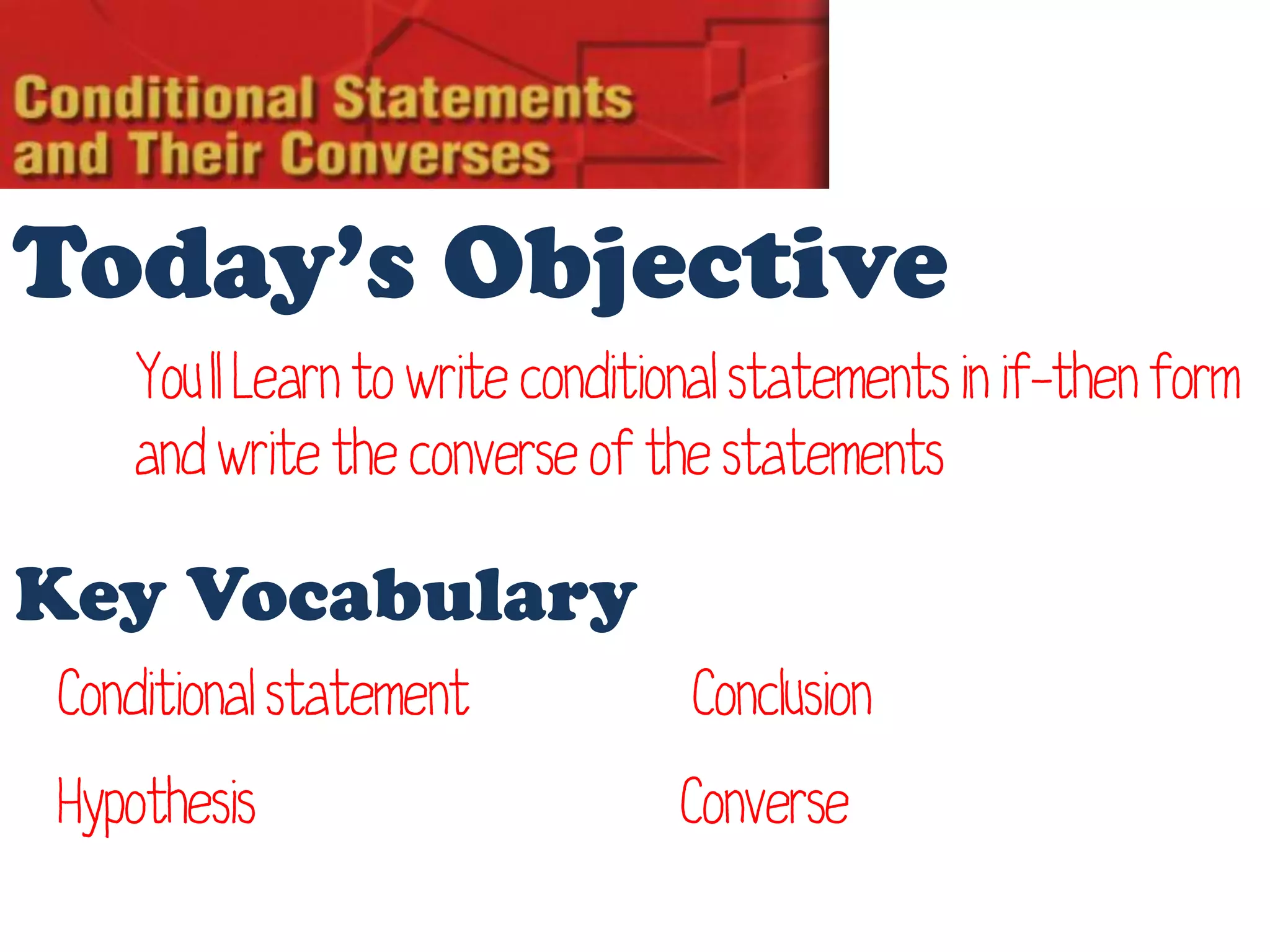
   You’ll Learn to write conditional statements in if-then form
   and write the converse of the statements

Key Vocabulary
Conditional statement            Conclusion
Hypothesis                      Converse
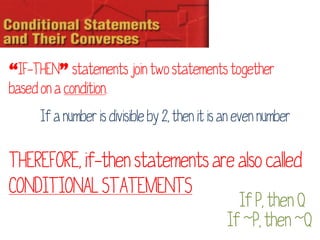
“IF-THEN” statements join two statements together
based on a condition.
     If a number is divisible by 2, then it is an even number

THEREFORE, if-then statements are also called
CONDITIONAL STATEMENTS
                                                If P, then Q
                                              If ~P, then ~Q
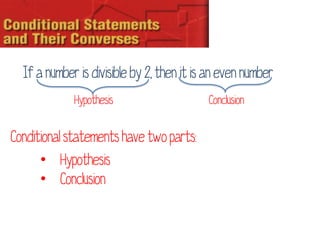
If a number is divisible by 2, then it is an even number
             Hypothesis                    Conclusion


Conditional statements have two parts:
      • Hypothesis
      • Conclusion
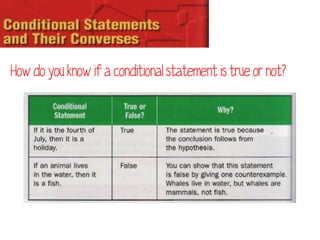
How do you know if a conditional statement is true or not?
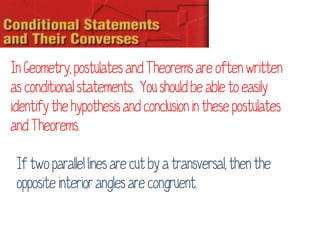
In Geometry, postulates and Theorems are often written
as conditional statements. You should be able to easily
identify the hypothesis and conclusion in these postulates
and Theorems.

 If two parallel lines are cut by a transversal, then the
 opposite interior angles are congruent.
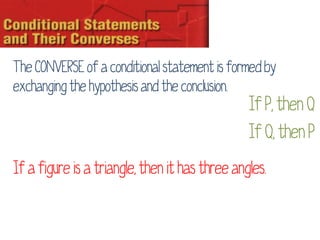
The CONVERSE of a conditional statement is formed by
exchanging the hypothesis and the conclusion.
                                                If P, then Q
                                                If Q, then P
If a figure is a triangle, then it has three angles.
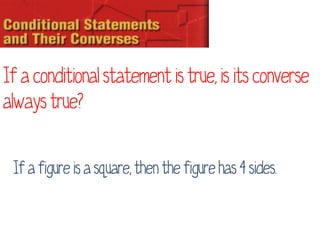
If a conditional statement is true, is its converse
always true?


 If a figure is a square, then the figure has 4 sides.
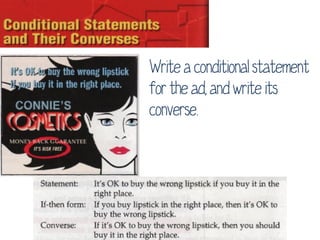
Write a conditional statement
for the ad, and write its
converse.

Geometry conditional statements and their converse

  • 1.
    Today’s Objective You’ll Learn to write conditional statements in if-then form and write the converse of the statements Key Vocabulary Conditional statement Conclusion Hypothesis Converse
  • 2.
    “IF-THEN” statements jointwo statements together based on a condition. If a number is divisible by 2, then it is an even number THEREFORE, if-then statements are also called CONDITIONAL STATEMENTS If P, then Q If ~P, then ~Q
  • 3.
    If a numberis divisible by 2, then it is an even number Hypothesis Conclusion Conditional statements have two parts: • Hypothesis • Conclusion
  • 4.
    How do youknow if a conditional statement is true or not?
  • 5.
    In Geometry, postulatesand Theorems are often written as conditional statements. You should be able to easily identify the hypothesis and conclusion in these postulates and Theorems. If two parallel lines are cut by a transversal, then the opposite interior angles are congruent.
  • 7.
    The CONVERSE ofa conditional statement is formed by exchanging the hypothesis and the conclusion. If P, then Q If Q, then P If a figure is a triangle, then it has three angles.
  • 9.
    If a conditionalstatement is true, is its converse always true? If a figure is a square, then the figure has 4 sides.
  • 10.
    Write a conditionalstatement for the ad, and write its converse.