A Web 2.0 nas bibliotecas espanholas Professional dimension of the social web Natalia Arroyo Vázquez | Fundación Germán Sánchez Ruipérez Videojogos e Web 2.0: desafios para a formação dos bibliotecários  Lisboa, 20 de maio de 2010
1. A changing environment 2. Keeping things in perspective 3. Lessons from Web 2.0 4. Some questions Table of contents 1. Ambente em mudança 2. Manter a perspectiva 3. Lições da Web 2.0 4. Algumas questões Conteúdo
1. A changing environment 1. Ambiente em mudança
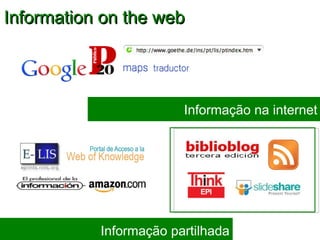
Information on the web Informação na internet Informação partilhada
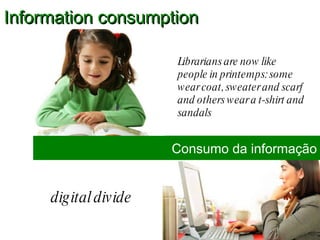
Information consumption Consumo da informação digital divide Librarians are now like people in printemps: some wear coat, sweater and scarf and others wear a t-shirt and sandals
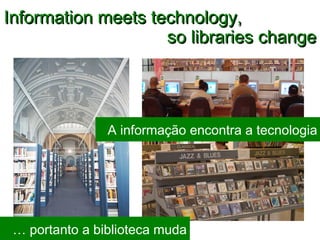
so libraries change A informação encontra a tecnologia Information meets technology, …  portanto a biblioteca muda
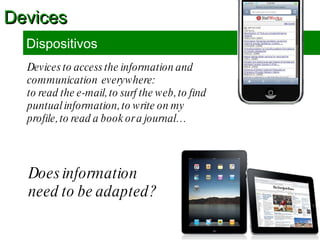
Devices to access the information and communication  everywhere:  to read the e-mail, to surf the web, to find puntual information, to write on my profile, to read a book or a journal… Devices Dispositivos Does information need to be adapted?
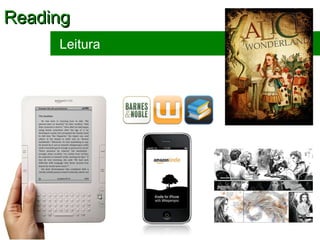
Reading Leitura
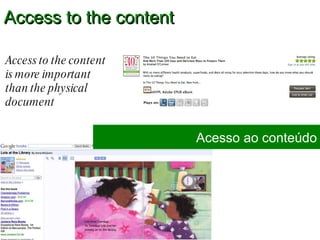
Access to the content Access to the content is more important  than the physical document Acesso ao conteúdo
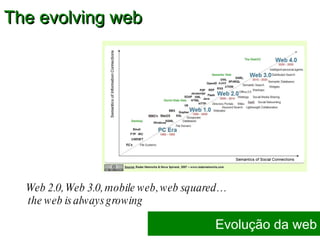
Web 2.0, Web 3.0, mobile web, web squared… the web is always growing The evolving web Evolução da web
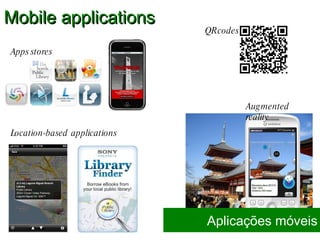
Location-based  applications Mobile applications QR codes Apps stores Augmented reality Aplicações móveis
2. Keeping things in perspective 2. Manter a perspectiva
The public library is the  local centre of information , making  all kinds of knowledge and information readily available  to its users.  The services of the public library are provided on the basis of  equality  of access for all, regardless of age, race, sex, religion, nationality, language or social status.  Specific services and materials  must be provided for those users who cannot use the regular services and materials UNESCO/IFLA  Public Library Manifesto, 1994 Manifesto da IFLA/UNESCO sobre bibliotecas públicas http://archive.ifla.org/VII/s8/unesco/manif.htm
Creating and strengthening reading habits Supporting education Promoting awareness of cultural heritage Fostering inter-cultural dialogue and favouring cultural diversity Ensuring access for citizens to all sorts of community information  Providing adequate information services Facilitating the development of information and computer literacy skills; Supporting and participating in literacy activities and programmes Manifesto da IFLA/UNESCO sobre bibliotecas públicas http://archive.ifla.org/VII/s8/unesco/manif.htm   UNESCO/IFLA  Public Library Manifesto, 1994
3. Lessons from Web 2.0 3. Lições da Web 2.0
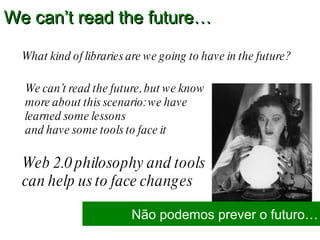
What kind of libraries are we going to have in the future?  We can’t read the future… Não podemos prever o futuro… Web 2.0 philosophy and tools can help us to face changes We can’t read the future, but we know more about this scenario: we have learned some lessons  and have some tools to face it
Lesson 1. Share Lição1. Partilhar Web 2.0 services are appropriate platforms to share information, resources and experiences with other professionals
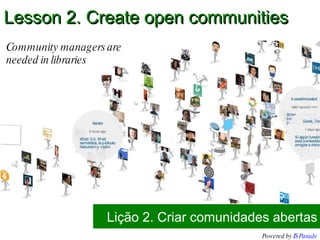
Lição 2. Criar comunidades abertas Lesson 2. Create open communities Community managers are needed in libraries Powered by  IS Parade
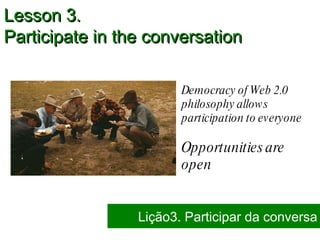
Democracy of Web 2.0 philosophy allows participation to everyone Opportunities are open Lesson 3.  Participate in the conversation Lição3. Participar da conversa
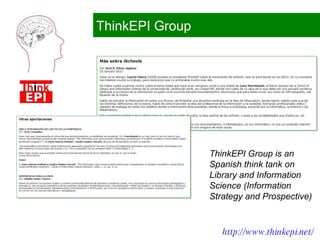
http://www.thinkepi.net/   ThinkEPI Group ThinkEPI Group is an Spanish think tank on Library and Information Science (Information Strategy and Prospective)
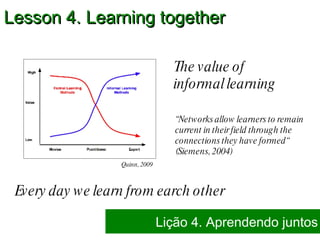
Lição 4. Aprendendo juntos Lesson 4. Learning together The value of informal learning Quinn, 2009 Every day we learn from earch other “ Networks allow learners to remain current in their field through the connections they have formed“ (Siemens, 2004)
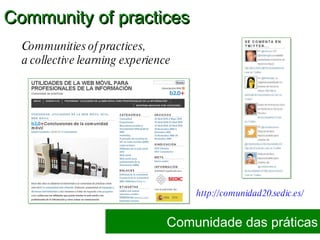
http://comunidad20.sedic.es/   Comunidade das práticas Community of practices Communities of practices,  a collective learning experience
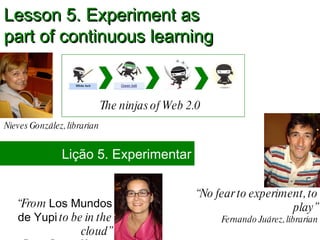
“ No fear to experiment, to play” Fernando Juárez, librarian Lesson 5. Experiment as  part of continuous learning The ninjas of Web 2.0 Nieves González, librarian Lição 5. Experimentar “ From  Los Mundos de Yupi  to be in the cloud” Catuxa Seoane, librarian
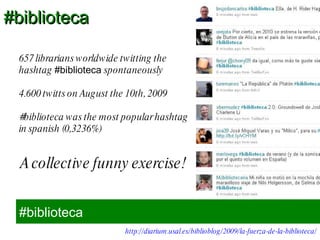
#biblioteca 657 librarians worldwide twitting the hashtag  #biblioteca  spontaneously 4.600 twitts on August the 10th, 2009 #biblioteca was the most popular hashtag in spanish (0,3236%) http://diarium.usal.es/biblioblog/2009/la-fuerza-de-la-biblioteca/ A collective funny exercise! #biblioteca
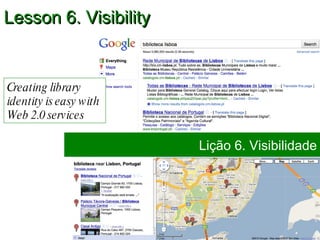
Lesson 6. Visibility Lição 6. Visibilidade Creating library identity is easy with Web 2.0 services
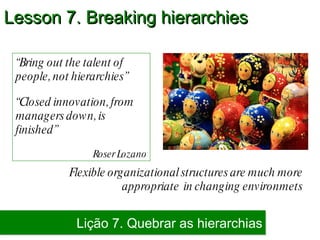
Flexible organizational structures are much more  appropriate  in changing environmets  Lição 7. Quebrar as hierarchias Lesson 7. Breaking hierarchies “ Bring out the talent of people, not hierarchies” “ Closed innovation, from managers down, is finished” Roser Lozano
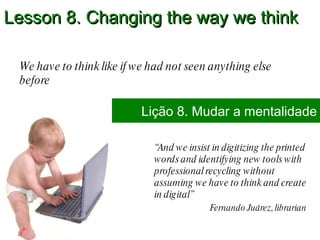
Lição 8. Mudar a mentalidade We have to think like if we had not seen anything else before  Lesson 8. Changing the way we think “ And we insist in digitizing the printed words and identifying new tools with professional recycling without assuming we have to think and create in digital” Fernando Juárez, librarian
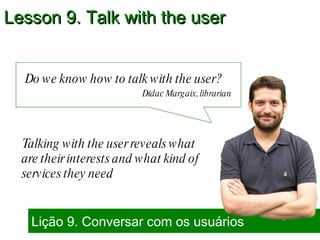
Do we know how to talk with the user?  Lição 9. Conversar com os usuários Lesson 9. Talk with the user Dídac Margaix, librarian Talking with the user reveals what are their interests and what kind of services they need
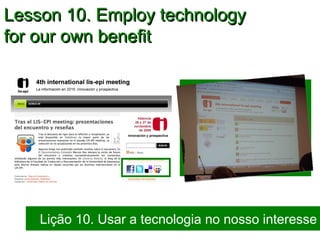
Lição 10. Usar a tecnologia no nosso interesse Lesson 10. Employ technology  for our own benefit
4. Some questions 4. Algumas questões
Employing web services is easy, but… are we really brave/prepared enough to assume Web 2.0 philosophy in our profession, untill the last consecuences?  What are the risks? Are librarians conscients of the importance of form communities?  Are we able to adapt our libraries as far as user’s needs in a technological era? Algumas questões Some questions
Muito obrigada pela atenção With a little help from my friend  Fran Villoldo in the portuguese language Thank you very much for your atention Biblioblog  http://diarium.usal.es/biblioblog/ Facebook  http://www.facebook.com/natalia.arroyo   Twitter  @narroyo e-mail  [email_address]
First Spanish Journal on Library Science and Documentation. Indexed by the most important bibliographical databases: ISI Social Science Citation Index and Scopus

Social Web in Spanish Libraries, by Natalia Arroyo

  • 1.
    A Web 2.0nas bibliotecas espanholas Professional dimension of the social web Natalia Arroyo Vázquez | Fundación Germán Sánchez Ruipérez Videojogos e Web 2.0: desafios para a formação dos bibliotecários Lisboa, 20 de maio de 2010
  • 2.
    1. A changingenvironment 2. Keeping things in perspective 3. Lessons from Web 2.0 4. Some questions Table of contents 1. Ambente em mudança 2. Manter a perspectiva 3. Lições da Web 2.0 4. Algumas questões Conteúdo
  • 3.
    1. A changingenvironment 1. Ambiente em mudança
  • 4.
    Information on theweb Informação na internet Informação partilhada
  • 5.
    Information consumption Consumoda informação digital divide Librarians are now like people in printemps: some wear coat, sweater and scarf and others wear a t-shirt and sandals
  • 6.
    so libraries changeA informação encontra a tecnologia Information meets technology, … portanto a biblioteca muda
  • 7.
    Devices to accessthe information and communication everywhere: to read the e-mail, to surf the web, to find puntual information, to write on my profile, to read a book or a journal… Devices Dispositivos Does information need to be adapted?
  • 8.
  • 9.
    Access to thecontent Access to the content is more important than the physical document Acesso ao conteúdo
  • 10.
    Web 2.0, Web3.0, mobile web, web squared… the web is always growing The evolving web Evolução da web
  • 11.
    Location-based applicationsMobile applications QR codes Apps stores Augmented reality Aplicações móveis
  • 12.
    2. Keeping thingsin perspective 2. Manter a perspectiva
  • 13.
    The public libraryis the local centre of information , making all kinds of knowledge and information readily available to its users. The services of the public library are provided on the basis of equality of access for all, regardless of age, race, sex, religion, nationality, language or social status. Specific services and materials must be provided for those users who cannot use the regular services and materials UNESCO/IFLA Public Library Manifesto, 1994 Manifesto da IFLA/UNESCO sobre bibliotecas públicas http://archive.ifla.org/VII/s8/unesco/manif.htm
  • 14.
    Creating and strengtheningreading habits Supporting education Promoting awareness of cultural heritage Fostering inter-cultural dialogue and favouring cultural diversity Ensuring access for citizens to all sorts of community information Providing adequate information services Facilitating the development of information and computer literacy skills; Supporting and participating in literacy activities and programmes Manifesto da IFLA/UNESCO sobre bibliotecas públicas http://archive.ifla.org/VII/s8/unesco/manif.htm UNESCO/IFLA Public Library Manifesto, 1994
  • 15.
    3. Lessons fromWeb 2.0 3. Lições da Web 2.0
  • 16.
    What kind oflibraries are we going to have in the future? We can’t read the future… Não podemos prever o futuro… Web 2.0 philosophy and tools can help us to face changes We can’t read the future, but we know more about this scenario: we have learned some lessons and have some tools to face it
  • 17.
    Lesson 1. ShareLição1. Partilhar Web 2.0 services are appropriate platforms to share information, resources and experiences with other professionals
  • 18.
    Lição 2. Criarcomunidades abertas Lesson 2. Create open communities Community managers are needed in libraries Powered by IS Parade
  • 19.
    Democracy of Web2.0 philosophy allows participation to everyone Opportunities are open Lesson 3. Participate in the conversation Lição3. Participar da conversa
  • 20.
    http://www.thinkepi.net/ ThinkEPI Group ThinkEPI Group is an Spanish think tank on Library and Information Science (Information Strategy and Prospective)
  • 21.
    Lição 4. Aprendendojuntos Lesson 4. Learning together The value of informal learning Quinn, 2009 Every day we learn from earch other “ Networks allow learners to remain current in their field through the connections they have formed“ (Siemens, 2004)
  • 22.
    http://comunidad20.sedic.es/ Comunidade das práticas Community of practices Communities of practices, a collective learning experience
  • 23.
    “ No fearto experiment, to play” Fernando Juárez, librarian Lesson 5. Experiment as part of continuous learning The ninjas of Web 2.0 Nieves González, librarian Lição 5. Experimentar “ From Los Mundos de Yupi to be in the cloud” Catuxa Seoane, librarian
  • 24.
    #biblioteca 657 librariansworldwide twitting the hashtag #biblioteca spontaneously 4.600 twitts on August the 10th, 2009 #biblioteca was the most popular hashtag in spanish (0,3236%) http://diarium.usal.es/biblioblog/2009/la-fuerza-de-la-biblioteca/ A collective funny exercise! #biblioteca
  • 25.
    Lesson 6. VisibilityLição 6. Visibilidade Creating library identity is easy with Web 2.0 services
  • 26.
    Flexible organizational structuresare much more appropriate in changing environmets Lição 7. Quebrar as hierarchias Lesson 7. Breaking hierarchies “ Bring out the talent of people, not hierarchies” “ Closed innovation, from managers down, is finished” Roser Lozano
  • 27.
    Lição 8. Mudara mentalidade We have to think like if we had not seen anything else before Lesson 8. Changing the way we think “ And we insist in digitizing the printed words and identifying new tools with professional recycling without assuming we have to think and create in digital” Fernando Juárez, librarian
  • 28.
    Do we knowhow to talk with the user? Lição 9. Conversar com os usuários Lesson 9. Talk with the user Dídac Margaix, librarian Talking with the user reveals what are their interests and what kind of services they need
  • 29.
    Lição 10. Usara tecnologia no nosso interesse Lesson 10. Employ technology for our own benefit
  • 30.
    4. Some questions4. Algumas questões
  • 31.
    Employing web servicesis easy, but… are we really brave/prepared enough to assume Web 2.0 philosophy in our profession, untill the last consecuences? What are the risks? Are librarians conscients of the importance of form communities? Are we able to adapt our libraries as far as user’s needs in a technological era? Algumas questões Some questions
  • 32.
    Muito obrigada pelaatenção With a little help from my friend Fran Villoldo in the portuguese language Thank you very much for your atention Biblioblog http://diarium.usal.es/biblioblog/ Facebook http://www.facebook.com/natalia.arroyo Twitter @narroyo e-mail [email_address]
  • 33.
    First Spanish Journalon Library Science and Documentation. Indexed by the most important bibliographical databases: ISI Social Science Citation Index and Scopus