Challenges in Spoken
Language Learning

October 2013
VISION

Empower people in under-served
segments through affordable mobile
education services that are
engaging, impactful, and lifechanging.
SUMMARY OF CHALLENGES
•
•
•
•
•
•
•
•
•

Lack of good curricula
Lack of relevant curricula
Inadequate time on task
Absence of timely, actionable feedback
Infrequent practice
High cost
Little objective data
Poor access to good instructors
Belief in too many myths
THE CURRICULA CHALLENGE
• Based on analysis of the wide variety of English curricula
used in Japan, Korea, and China, there is little evidence
that curricula has much impact on spoken English learning
• Is the content relevant to the students, whether in terms
of interest or needs of specific industries or jobs?
• Is the content engaging and interactive? The books are
not interactive, so that is one major hurdle.

Curricula does not demonstrate
significant influence on outcomes.
THE PROCESS CHALLENGE
•

Required frequent practice – daily or better – is extremely difficult to
deliver cost effectively.

•

Traditional schools do not collect data because it is expensive and they do
not have the systems

•

With no data, the teachers cannot provide feedback

•

Once-a-week delivers very little time on task and insignificant
opportunity for feedback

•

No matter how motivated the teacher and students are, typical language
once-a-week school delivers poor results. The model is systemically and
permanently flawed.

•

High levels of engagement are critical for success. Language schools and
books cannot deliver this.

Process is the most important factor
in excellent student outcomes.
THE MYTHS PROBLEM
•

Student’s fault – the students blame themselves when they do not
succeed. The once-a-week process is inherently flawed.

•

Going to the one-a-week language schools works. No evidence to
support the schools deliver substantial improvement.

•

Test scores are meaningful Typical English test scores have little
relationship to spoken English communication ability.

•

Curricula makes the major difference. No evidence to support such
statement.

•

Variety of content is important. Unsupported statement.

•

Immersive methods are best. Unsubstantiated. Increased stress on
brain and does not take advantage of cognitive functions.

•

Good teachers are sufficient. Only in small, frequent (daily or better)
classes.

Belief in the myths has lead people to
accept mediocrity for years.
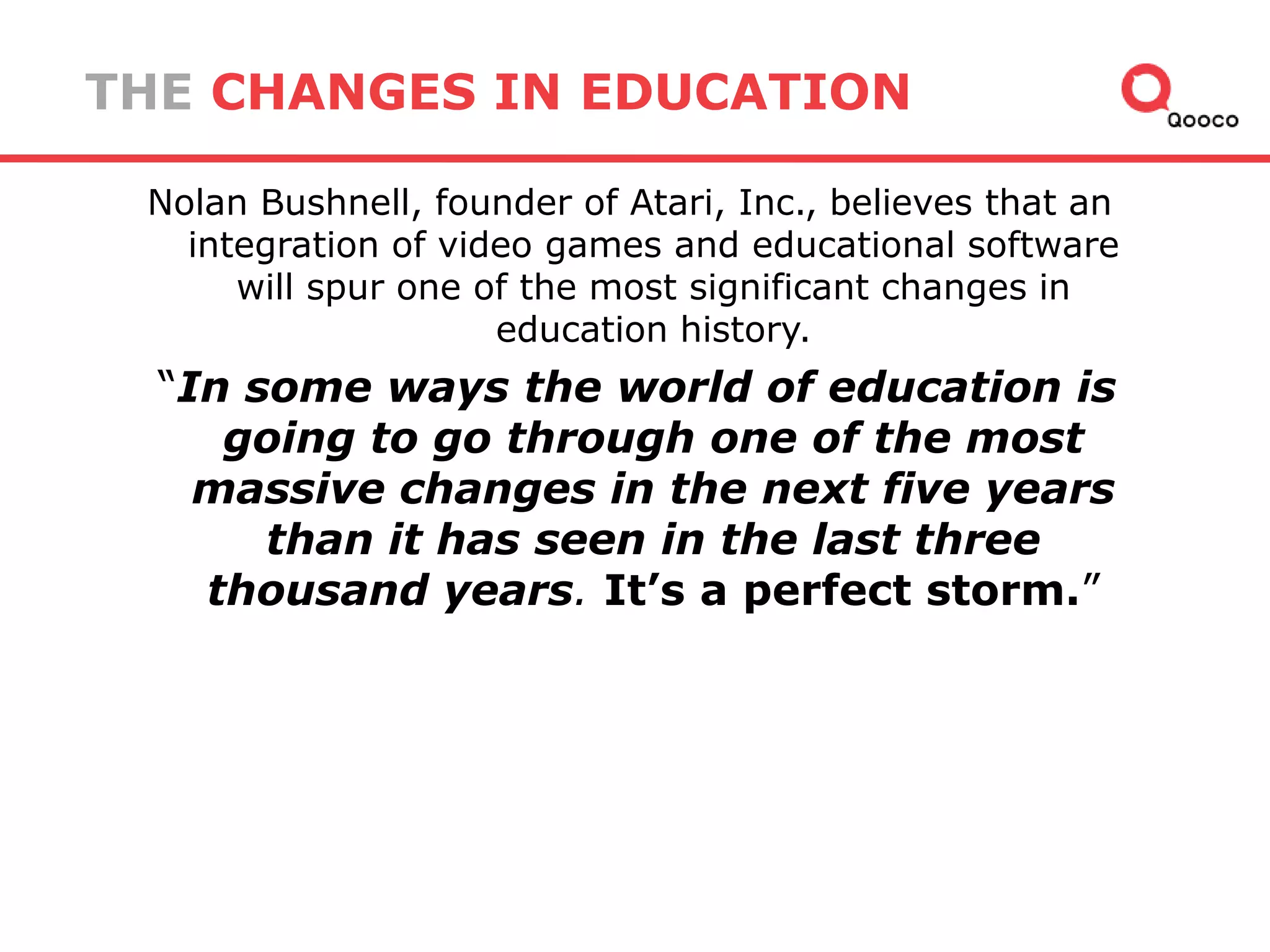
EDUCATION CHANGE IN 30 YEARS

1983

2013
THE CHANGES IN EDUCATION
Nolan Bushnell, founder of Atari, Inc., believes that an
integration of video games and educational software
will spur one of the most significant changes in
education history.

―In some ways the world of education is
going to go through one of the most
massive changes in the next five years
than it has seen in the last three
thousand years. It’s a perfect storm.‖
THE INDUSTRY PROBLEM
•

The language school business is built on a once-a-week system with
relatively inexperienced instructors

•

Language schools in Japan, Korea, and China have taken TENS OF
BILLIONS OF DOLLARS from students over the last few decades with very
show for the staggering expenditures

•

More of the same is not going to change anything

•

The best example of traditional systems that work are universities with
frequent (daily) small classes sizes (10 or fewer students per class) plus
substantial work outside the class for two years.

•

If universities could get results with larger classes or less frequent
classes, they would immediately to save costs

•

Why should anyone believe that language schools will deliver good
student results when they use less than 20% of the effort and far less
experienced instructors?

•

In the BIG DATA era, traditional schools have NO DATA.
Language schools have been producing
mute speakers for years.
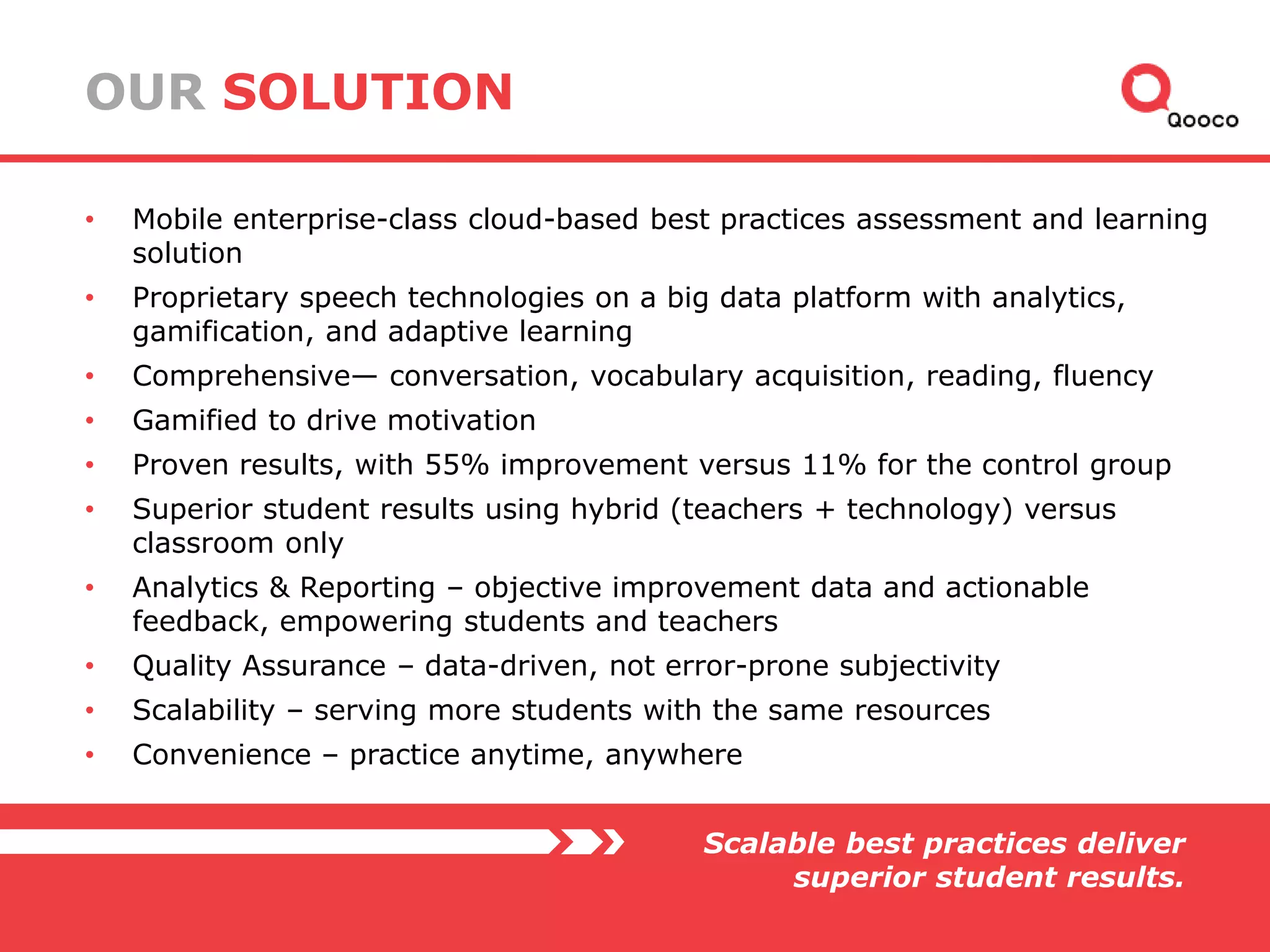
OUR SOLUTION
•

Mobile enterprise-class cloud-based best practices assessment and learning
solution

•

Proprietary speech technologies on a big data platform with analytics,
gamification, and adaptive learning

•

Comprehensive— conversation, vocabulary acquisition, reading, fluency

•

Gamified to drive motivation

•

Proven results, with 55% improvement versus 11% for the control group

•

Superior student results using hybrid (teachers + technology) versus
classroom only

•

Analytics & Reporting – objective improvement data and actionable
feedback, empowering students and teachers

•

Quality Assurance – data-driven, not error-prone subjectivity

•

Scalability – serving more students with the same resources

•

Convenience – practice anytime, anywhere
Scalable best practices deliver
superior student results.
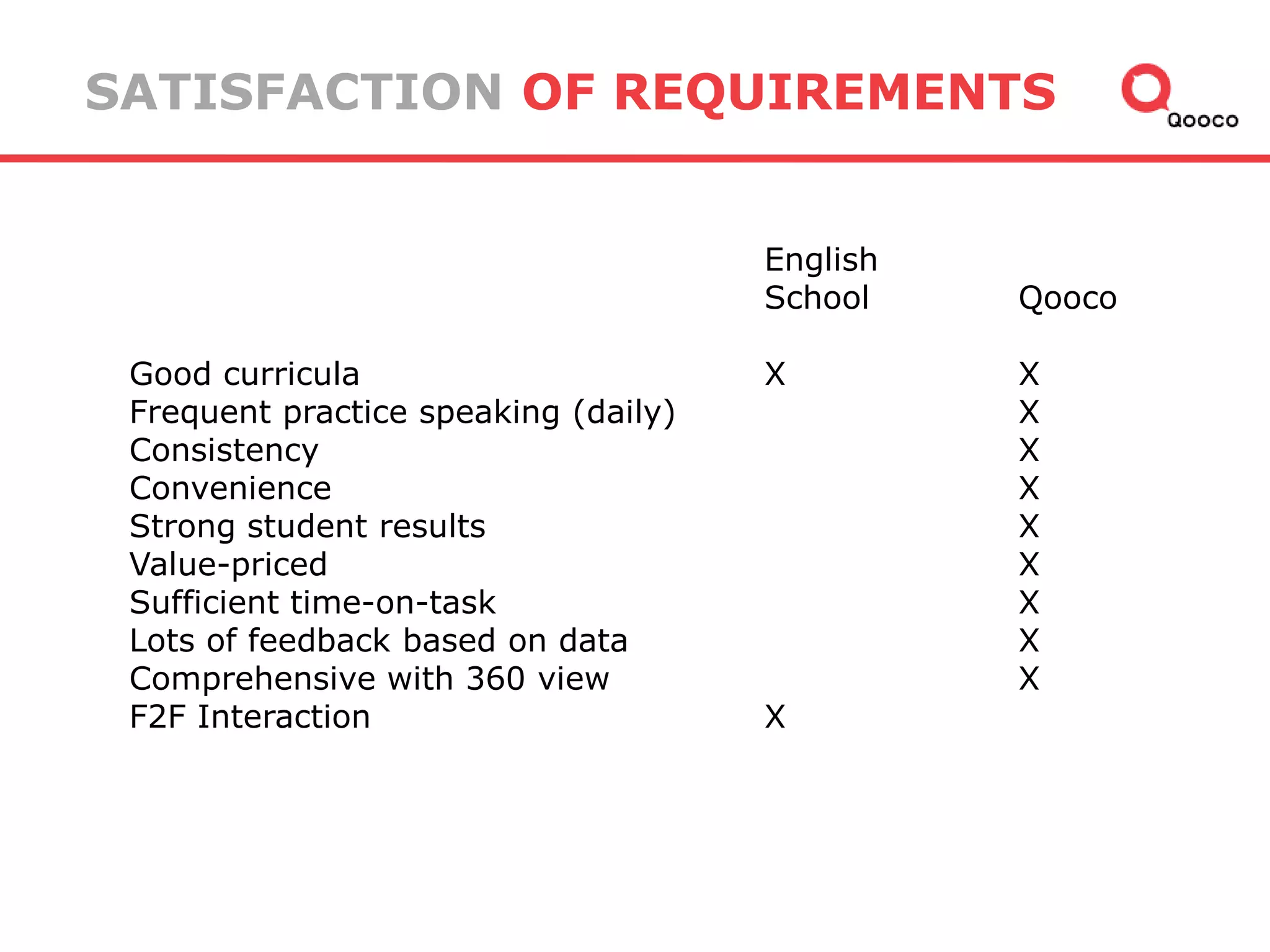
SATISFACTION OF REQUIREMENTS
English
School
Good curricula
Frequent practice speaking (daily)
Consistency
Convenience
Strong student results
Value-priced
Sufficient time-on-task
Lots of feedback based on data
Comprehensive with 360 view
F2F Interaction

X

X

Qooco
X
X
X
X
X
X
X
X
X
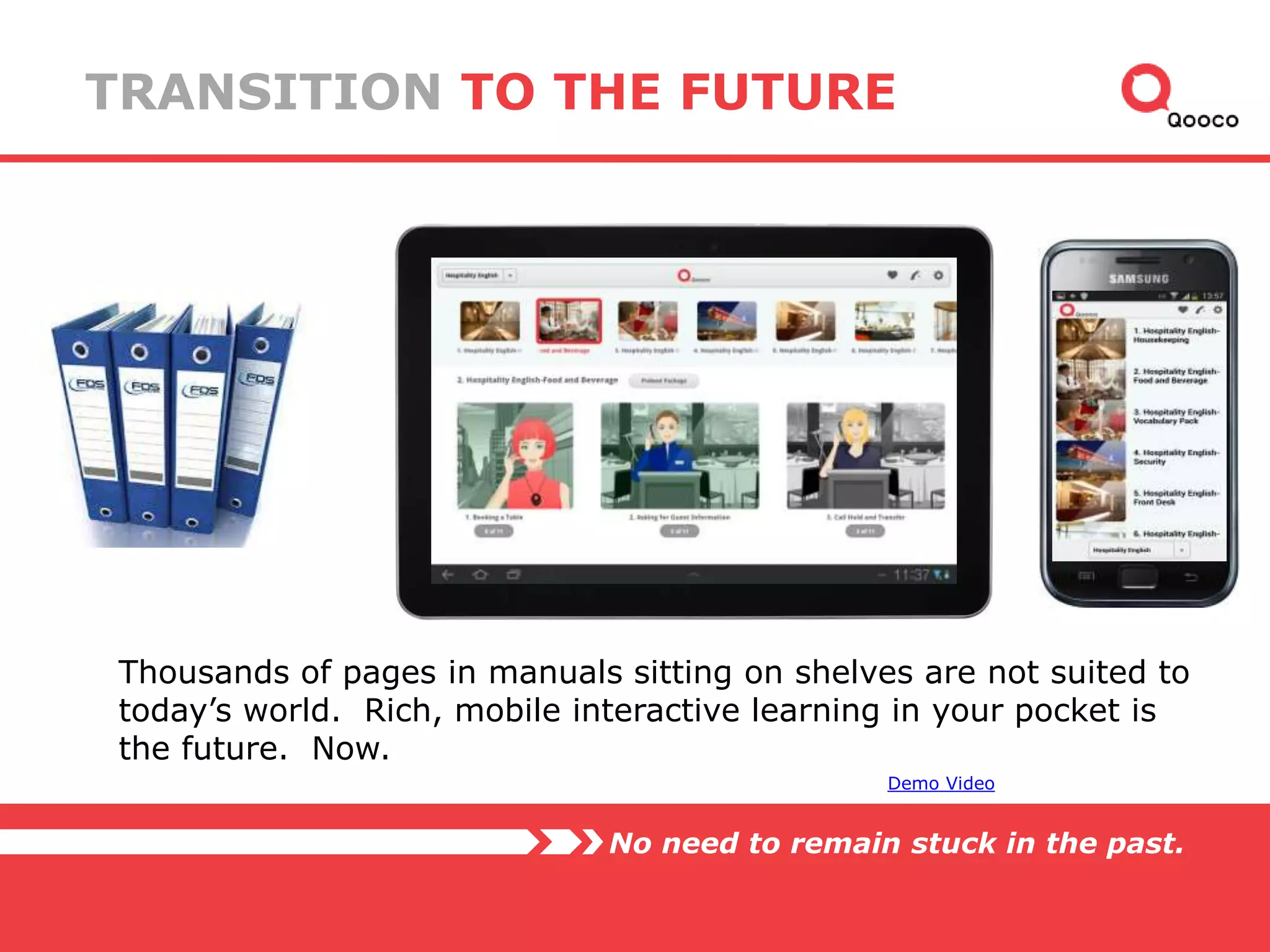
TRANSITION TO THE FUTURE

Thousands of pages in manuals sitting on shelves are not suited to
today’s world. Rich, mobile interactive learning in your pocket is
the future. Now.
Demo Video

No need to remain stuck in the past.
SUMMARY

Embrace the future. Embrace Mobile Learning.
Forget about the once-a-week schools.
Practice daily.
Open global opportunities.

Qooco - Language Learning Challenges

  • 1.
    Challenges in Spoken LanguageLearning October 2013
  • 2.
    VISION Empower people inunder-served segments through affordable mobile education services that are engaging, impactful, and lifechanging.
  • 3.
    SUMMARY OF CHALLENGES • • • • • • • • • Lackof good curricula Lack of relevant curricula Inadequate time on task Absence of timely, actionable feedback Infrequent practice High cost Little objective data Poor access to good instructors Belief in too many myths
  • 4.
    THE CURRICULA CHALLENGE •Based on analysis of the wide variety of English curricula used in Japan, Korea, and China, there is little evidence that curricula has much impact on spoken English learning • Is the content relevant to the students, whether in terms of interest or needs of specific industries or jobs? • Is the content engaging and interactive? The books are not interactive, so that is one major hurdle. Curricula does not demonstrate significant influence on outcomes.
  • 5.
    THE PROCESS CHALLENGE • Requiredfrequent practice – daily or better – is extremely difficult to deliver cost effectively. • Traditional schools do not collect data because it is expensive and they do not have the systems • With no data, the teachers cannot provide feedback • Once-a-week delivers very little time on task and insignificant opportunity for feedback • No matter how motivated the teacher and students are, typical language once-a-week school delivers poor results. The model is systemically and permanently flawed. • High levels of engagement are critical for success. Language schools and books cannot deliver this. Process is the most important factor in excellent student outcomes.
  • 6.
    THE MYTHS PROBLEM • Student’sfault – the students blame themselves when they do not succeed. The once-a-week process is inherently flawed. • Going to the one-a-week language schools works. No evidence to support the schools deliver substantial improvement. • Test scores are meaningful Typical English test scores have little relationship to spoken English communication ability. • Curricula makes the major difference. No evidence to support such statement. • Variety of content is important. Unsupported statement. • Immersive methods are best. Unsubstantiated. Increased stress on brain and does not take advantage of cognitive functions. • Good teachers are sufficient. Only in small, frequent (daily or better) classes. Belief in the myths has lead people to accept mediocrity for years.
  • 7.
    EDUCATION CHANGE IN30 YEARS 1983 2013
  • 8.
    THE CHANGES INEDUCATION Nolan Bushnell, founder of Atari, Inc., believes that an integration of video games and educational software will spur one of the most significant changes in education history. ―In some ways the world of education is going to go through one of the most massive changes in the next five years than it has seen in the last three thousand years. It’s a perfect storm.‖
  • 9.
    THE INDUSTRY PROBLEM • Thelanguage school business is built on a once-a-week system with relatively inexperienced instructors • Language schools in Japan, Korea, and China have taken TENS OF BILLIONS OF DOLLARS from students over the last few decades with very show for the staggering expenditures • More of the same is not going to change anything • The best example of traditional systems that work are universities with frequent (daily) small classes sizes (10 or fewer students per class) plus substantial work outside the class for two years. • If universities could get results with larger classes or less frequent classes, they would immediately to save costs • Why should anyone believe that language schools will deliver good student results when they use less than 20% of the effort and far less experienced instructors? • In the BIG DATA era, traditional schools have NO DATA. Language schools have been producing mute speakers for years.
  • 10.
    OUR SOLUTION • Mobile enterprise-classcloud-based best practices assessment and learning solution • Proprietary speech technologies on a big data platform with analytics, gamification, and adaptive learning • Comprehensive— conversation, vocabulary acquisition, reading, fluency • Gamified to drive motivation • Proven results, with 55% improvement versus 11% for the control group • Superior student results using hybrid (teachers + technology) versus classroom only • Analytics & Reporting – objective improvement data and actionable feedback, empowering students and teachers • Quality Assurance – data-driven, not error-prone subjectivity • Scalability – serving more students with the same resources • Convenience – practice anytime, anywhere Scalable best practices deliver superior student results.
  • 11.
    SATISFACTION OF REQUIREMENTS English School Goodcurricula Frequent practice speaking (daily) Consistency Convenience Strong student results Value-priced Sufficient time-on-task Lots of feedback based on data Comprehensive with 360 view F2F Interaction X X Qooco X X X X X X X X X
  • 12.
    TRANSITION TO THEFUTURE Thousands of pages in manuals sitting on shelves are not suited to today’s world. Rich, mobile interactive learning in your pocket is the future. Now. Demo Video No need to remain stuck in the past.
  • 13.
    SUMMARY Embrace the future.Embrace Mobile Learning. Forget about the once-a-week schools. Practice daily. Open global opportunities.