TEACHING READING m n RAJU
m n RAJU What is Reading? Why do we read? Habits of Good Readers
m n RAJU What is Reading? Reading is  not a simple, passive process  of linear reading of words and internalizing their meaning one at a time. Reading is a  complex interaction between the text and the reader  shaped by the reader’s prior knowledge and attitude, a process of language acquisition, communication and sharing information and ideas.
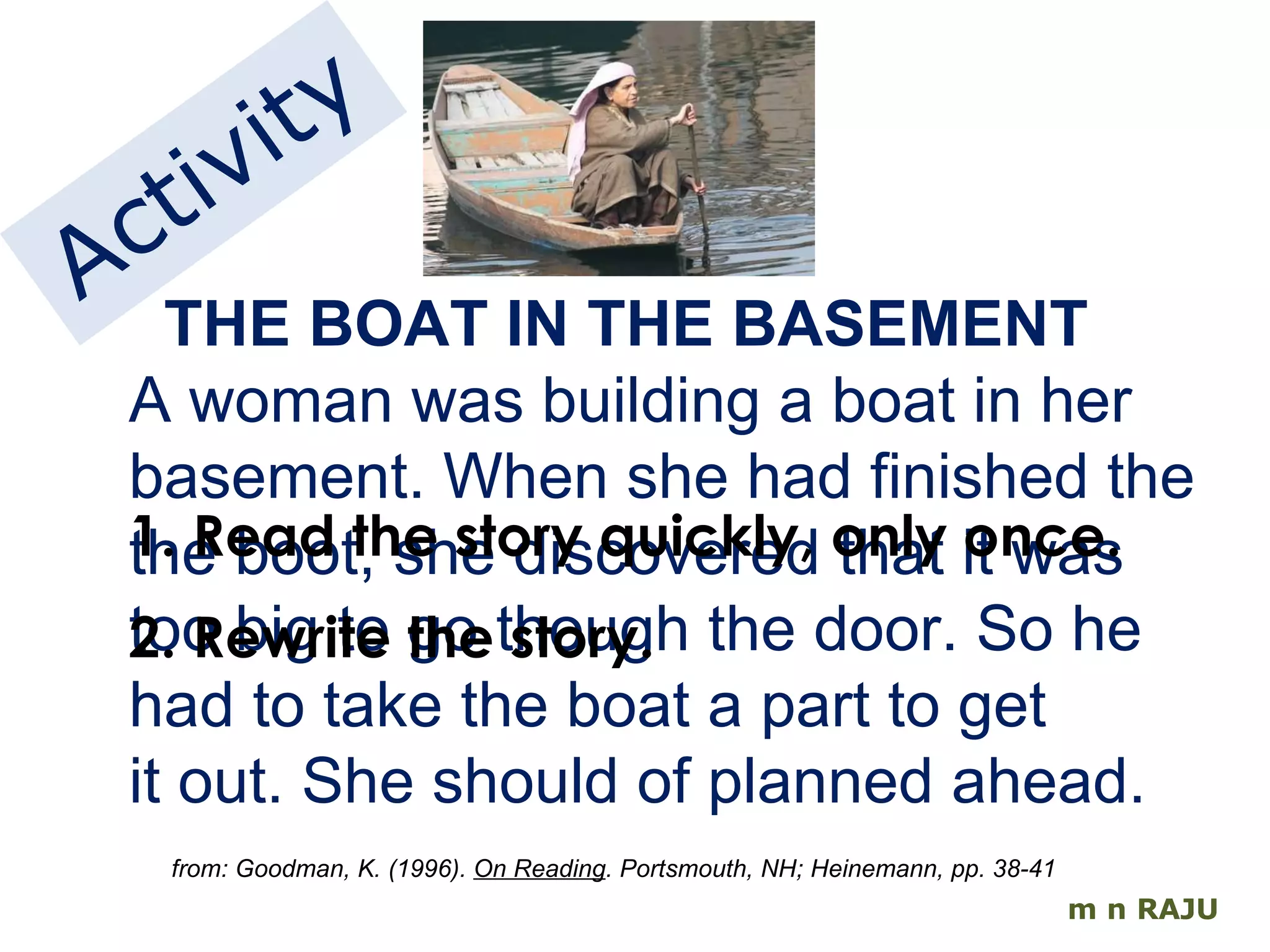
m n RAJU THE BOAT IN THE BASEMENT A woman was building a boat in her basement. When she had finished the the boot, she discovered that it was too big to go though the door. So he had to take the boat a part to get it out. She should of planned ahead. from: Goodman, K. (1996).  On Reading . Portsmouth, NH; Heinemann, pp. 38-41 Activity 1. Read the story quickly, only once. 2. Rewrite the story.
m n RAJU Why Do We Read? For information and awareness For recreation and enrichment To gain from others’ experience For higher order thinking skills To improve vocabulary & language Reading & writing - mutually supportive
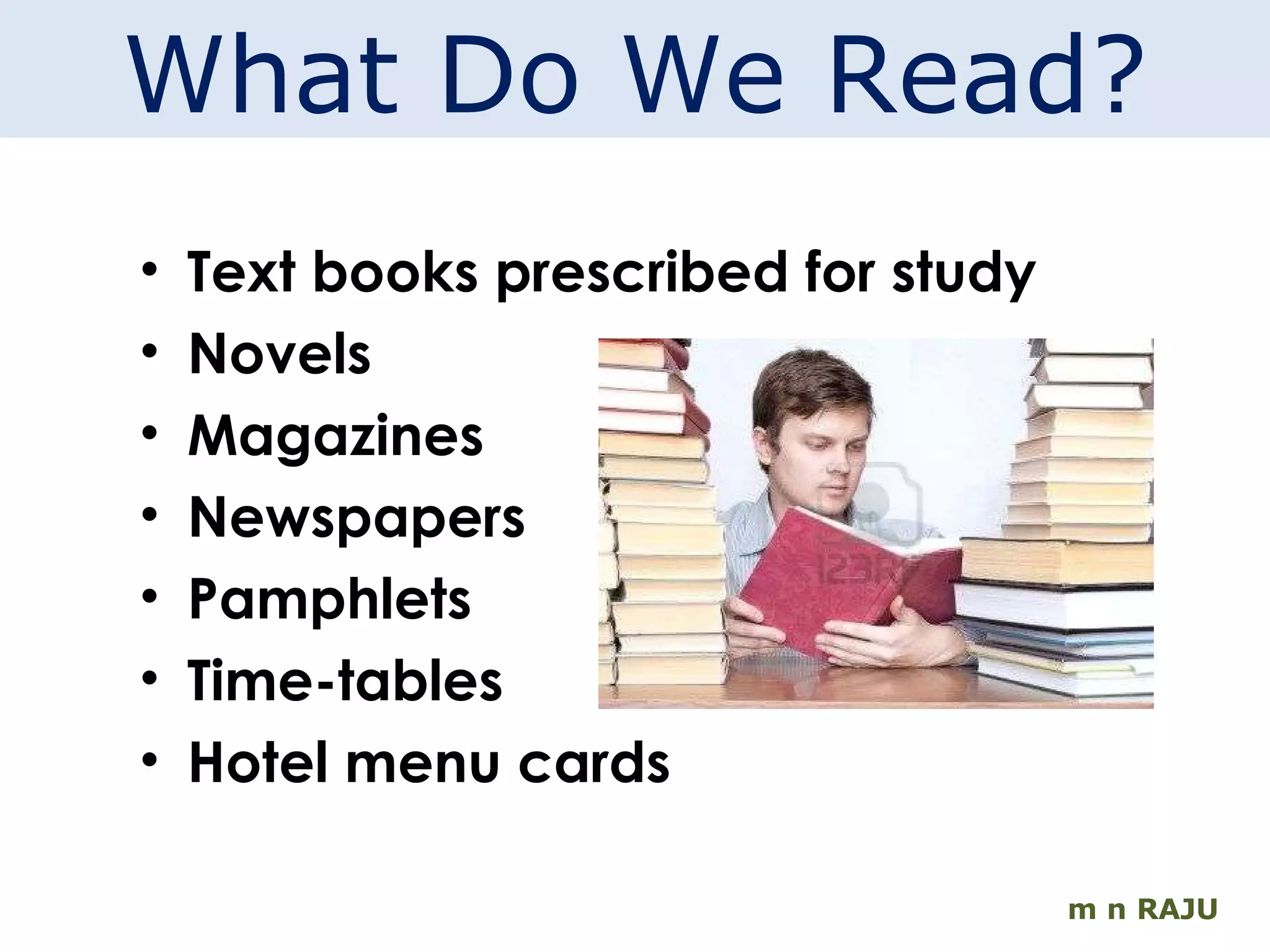
m n RAJU What Do We Read? Text books prescribed for study Novels Magazines Newspapers Pamphlets Time-tables Hotel menu cards
m n RAJU How Do We Read? A time-table / A tele directory  A hotel menu  A pamphlet A newspaper A novel A magazine A text book prescribed for study
m n RAJU Reading Questionnaire Do you like reading in English?  Why or why not? How often do you read in English? When and where do you read? What kind of books do you read in English? What do you like to read about in English?
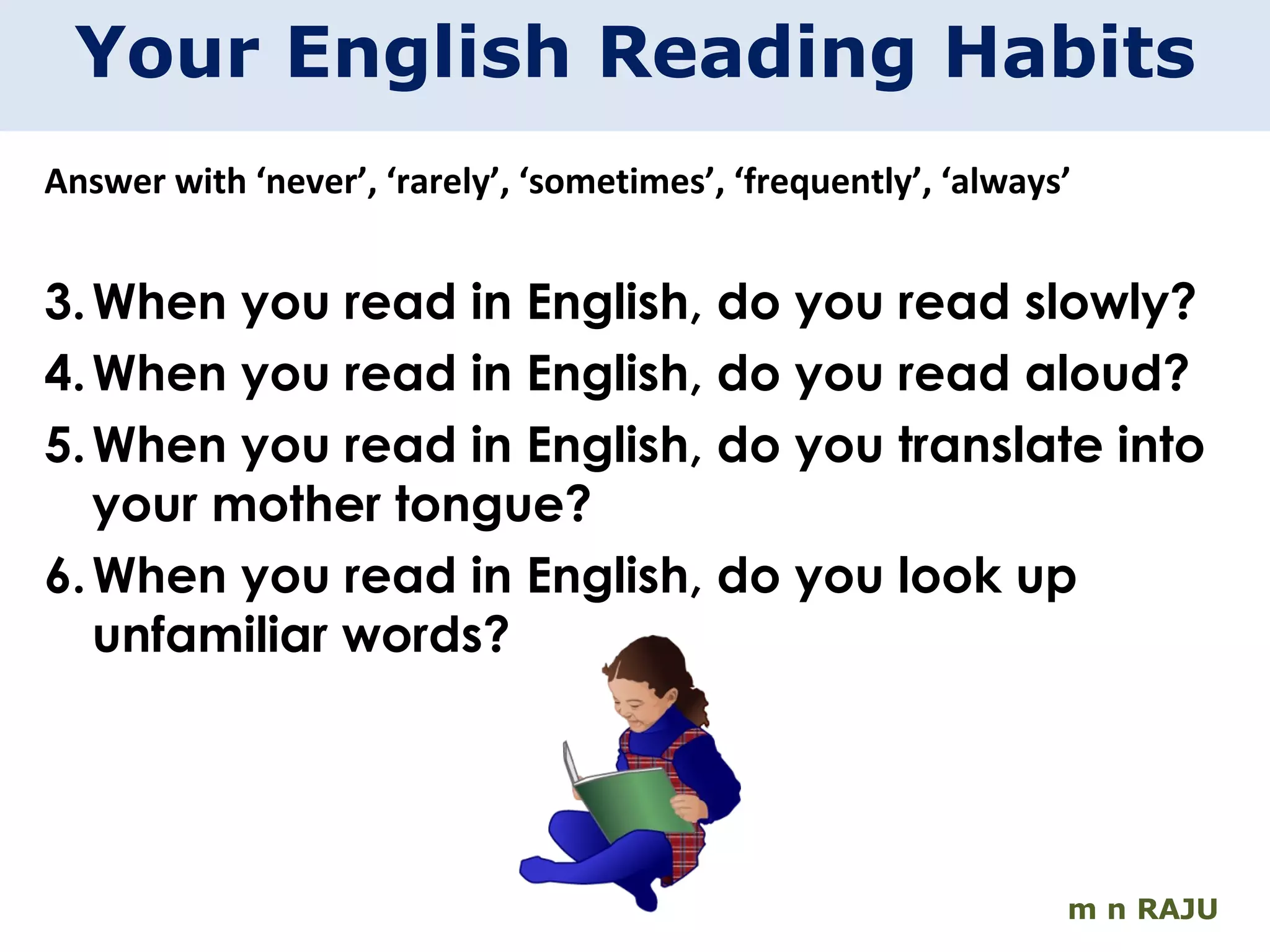
m n RAJU Your English Reading Habits Answer with ‘never’, ‘rarely’, ‘sometimes’, ‘frequently’, ‘always’ When you read in English, do you read slowly? When you read in English, do you read aloud?  When you read in English, do you translate into your mother tongue? When you read in English, do you look up unfamiliar words?
m n RAJU What are your reading strengths? What are you reading weaknesses? What are your reading opportunities? What reading ability do you like to improve? Activity
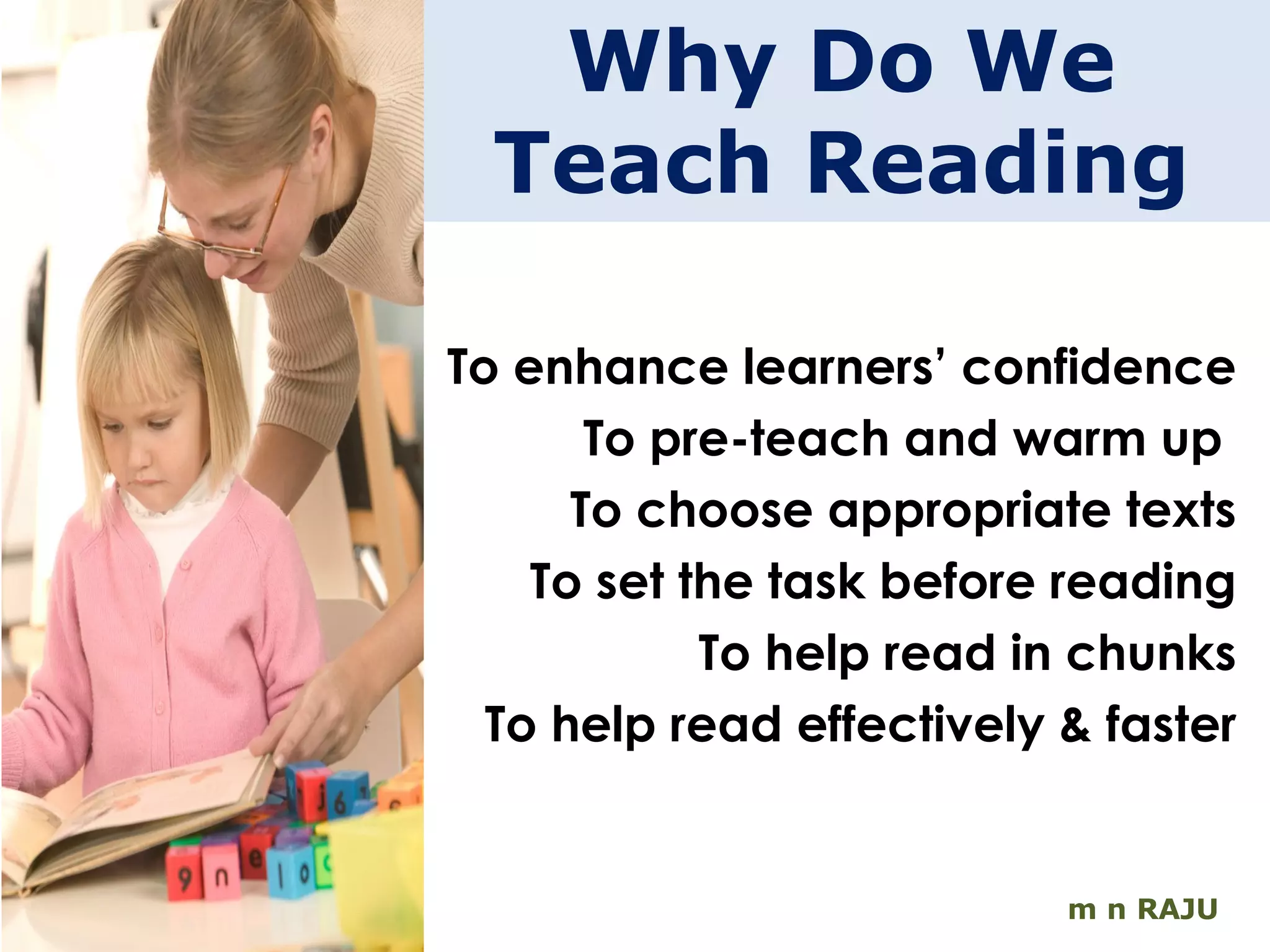
Why Do We Teach Reading m n RAJU To enhance learners’ confidence To pre-teach and warm up  To choose appropriate texts To set the task before reading To help read in chunks To help read effectively & faster
m n RAJU Parts of a Good  Reading Lesson Pre-reading To activate background knowledge To prepare the reader While-reading To hold interest, to aid comprehension To guide through the text Post-reading To develop additional reading skills such as reacting, critical thinking, accepting/rejecting
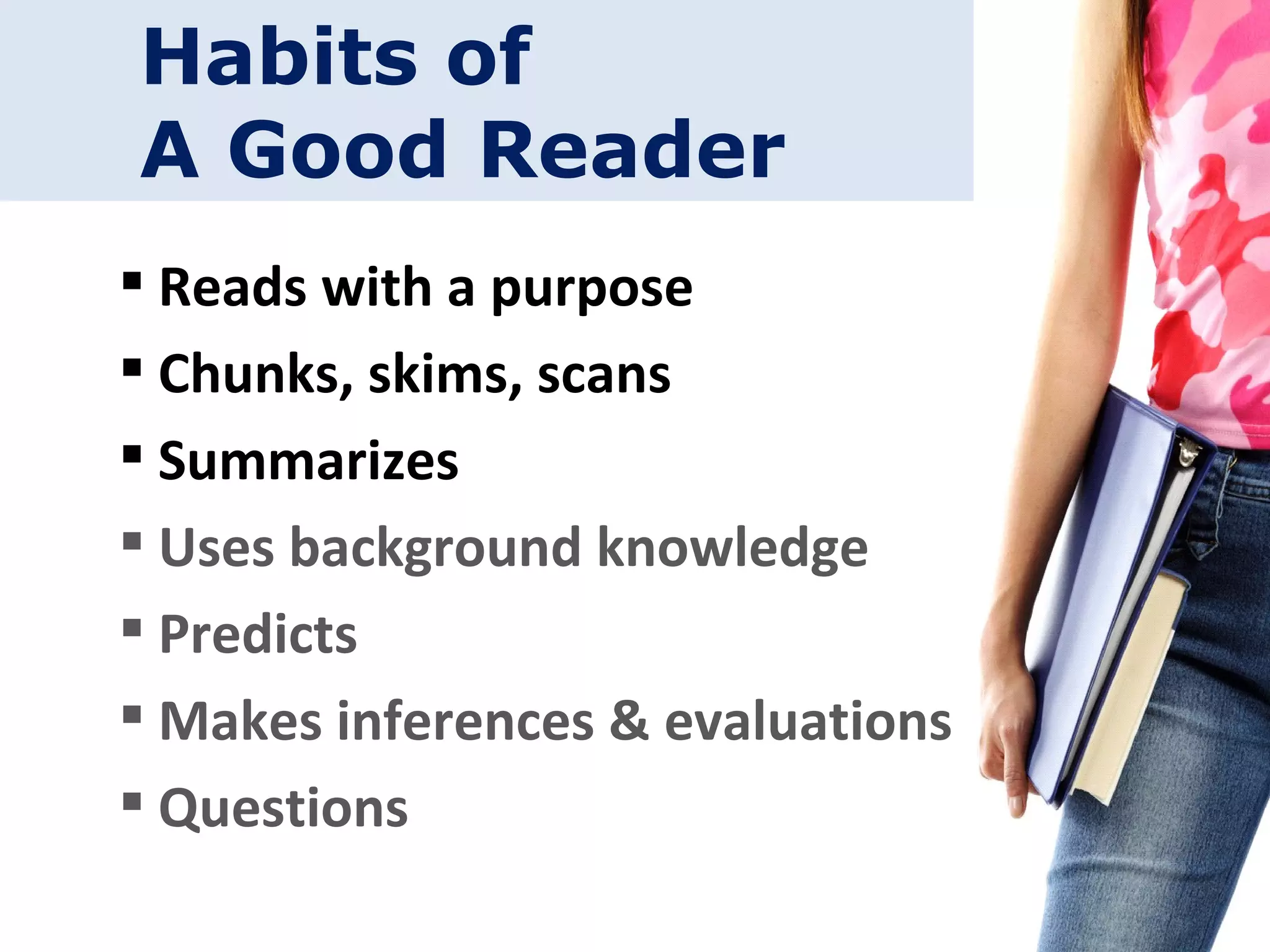
m n RAJU Habits of  A Good Reader Reads with a purpose Chunks, skims, scans Summarizes Uses background knowledge Predicts Makes inferences & evaluations Questions
m n RAJU Why am I reading? A clear reason for reading Awareness of what to gain Helps determine the strategy Habits of Good Readers Reading with Purpose
m n RAJU Prepare a few questions to elicit from your students  for what purpose they want to read  Rabindranath Tagore’s  ‘ Song 36’. Habits of Good Readers Reading with Purpose Activity
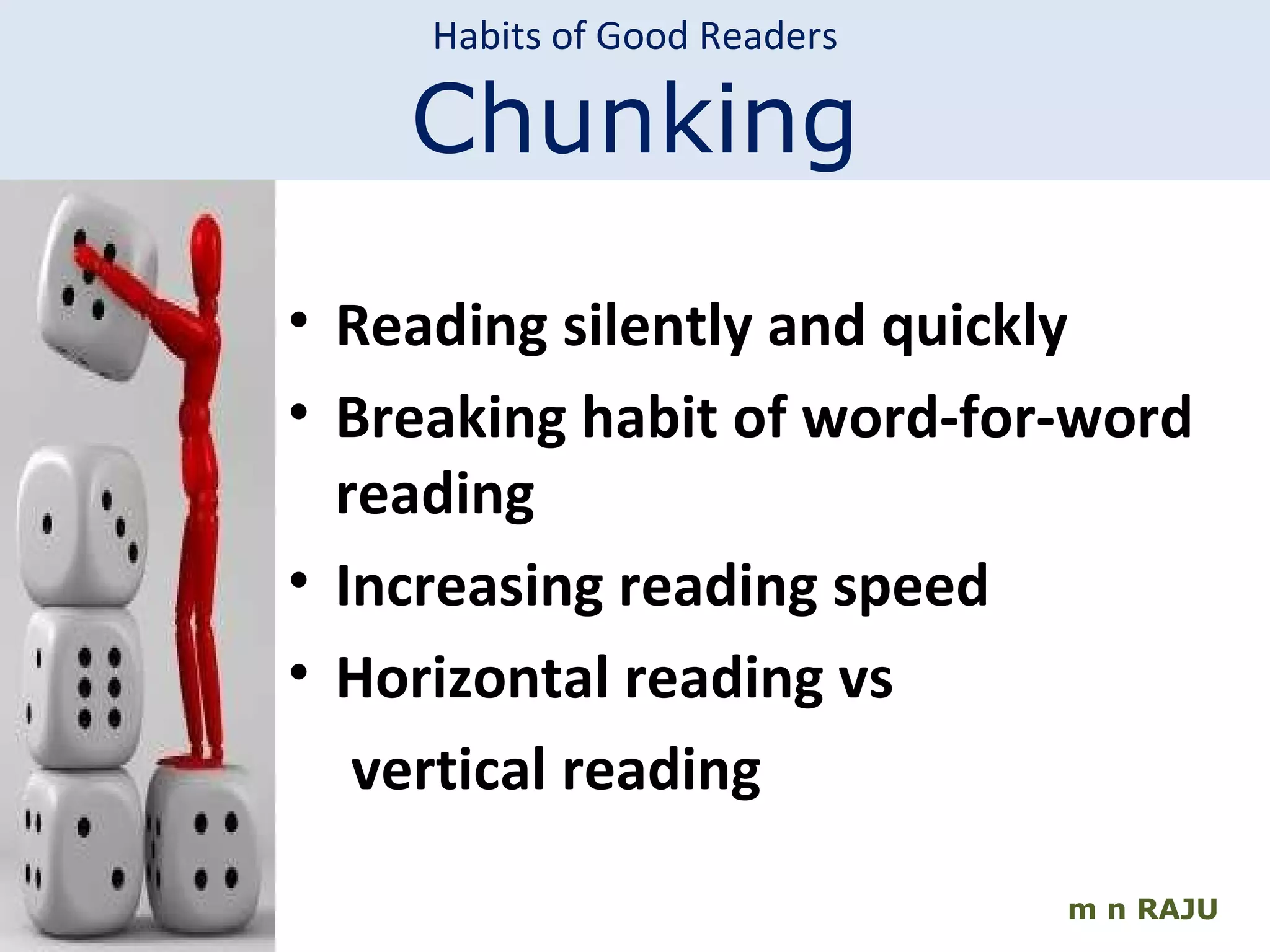
m n RAJU Reading silently and quickly Breaking habit of word-for-word reading Increasing reading speed Horizontal reading vs  vertical reading Habits of Good Readers Chunking
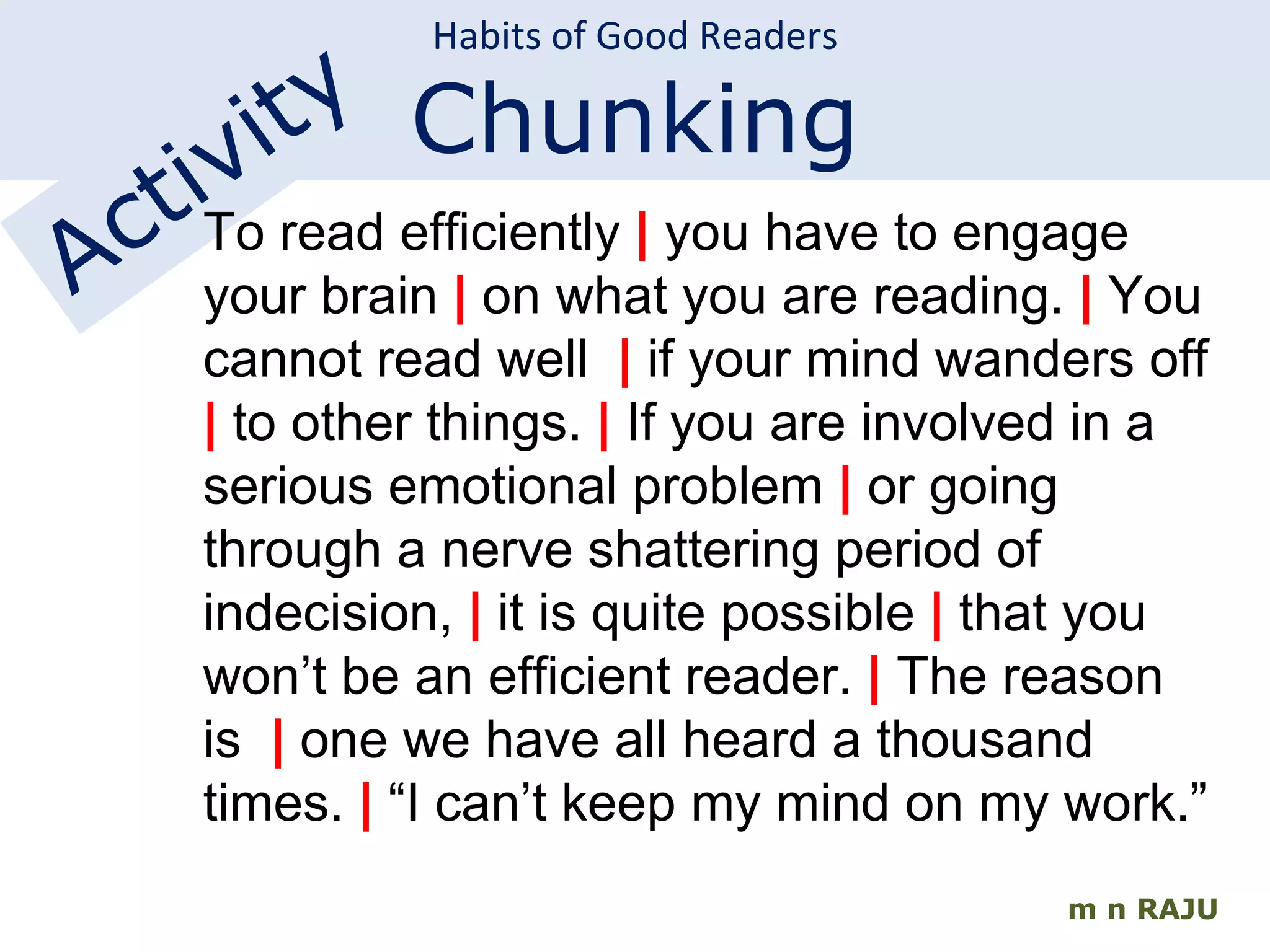
m n RAJU Habits of Good Readers Chunking Activity To read efficiently  |  you have to engage your brain  |  on what you are reading.  |  You cannot read well   |  if your mind wanders off  |  to other things.  |  If you are involved in a serious emotional problem  |  or going through a nerve shattering period of indecision,  |  it is quite possible  |  that you won’t be an efficient reader.  |  The reason is  |  one we have all heard a thousand times.  |  “I can’t keep my mind on my work.”
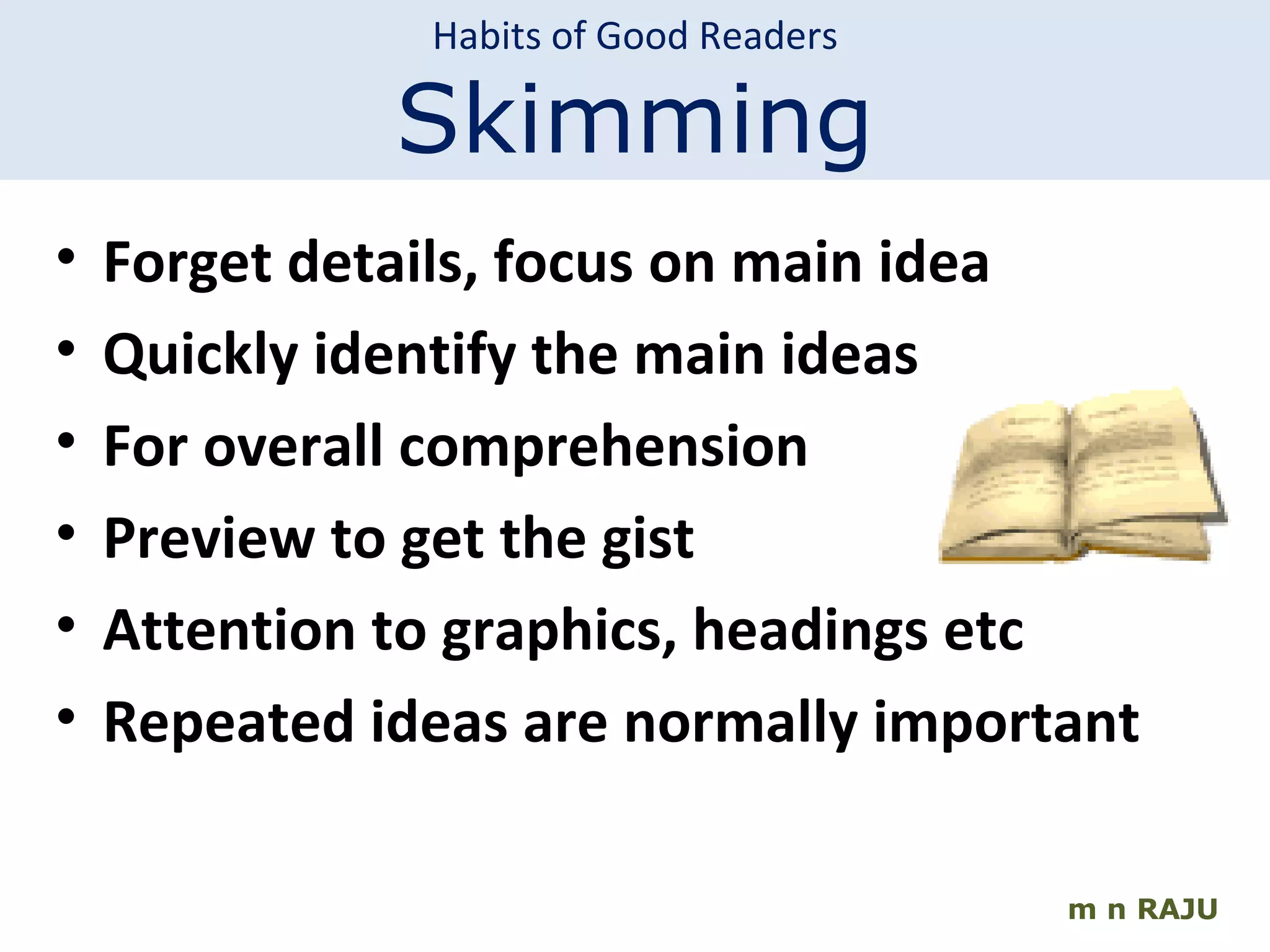
m n RAJU Forget details, focus on main idea Quickly identify the main ideas For overall comprehension Preview to get the gist Attention to graphics, headings etc Repeated ideas are normally important Habits of Good Readers Skimming
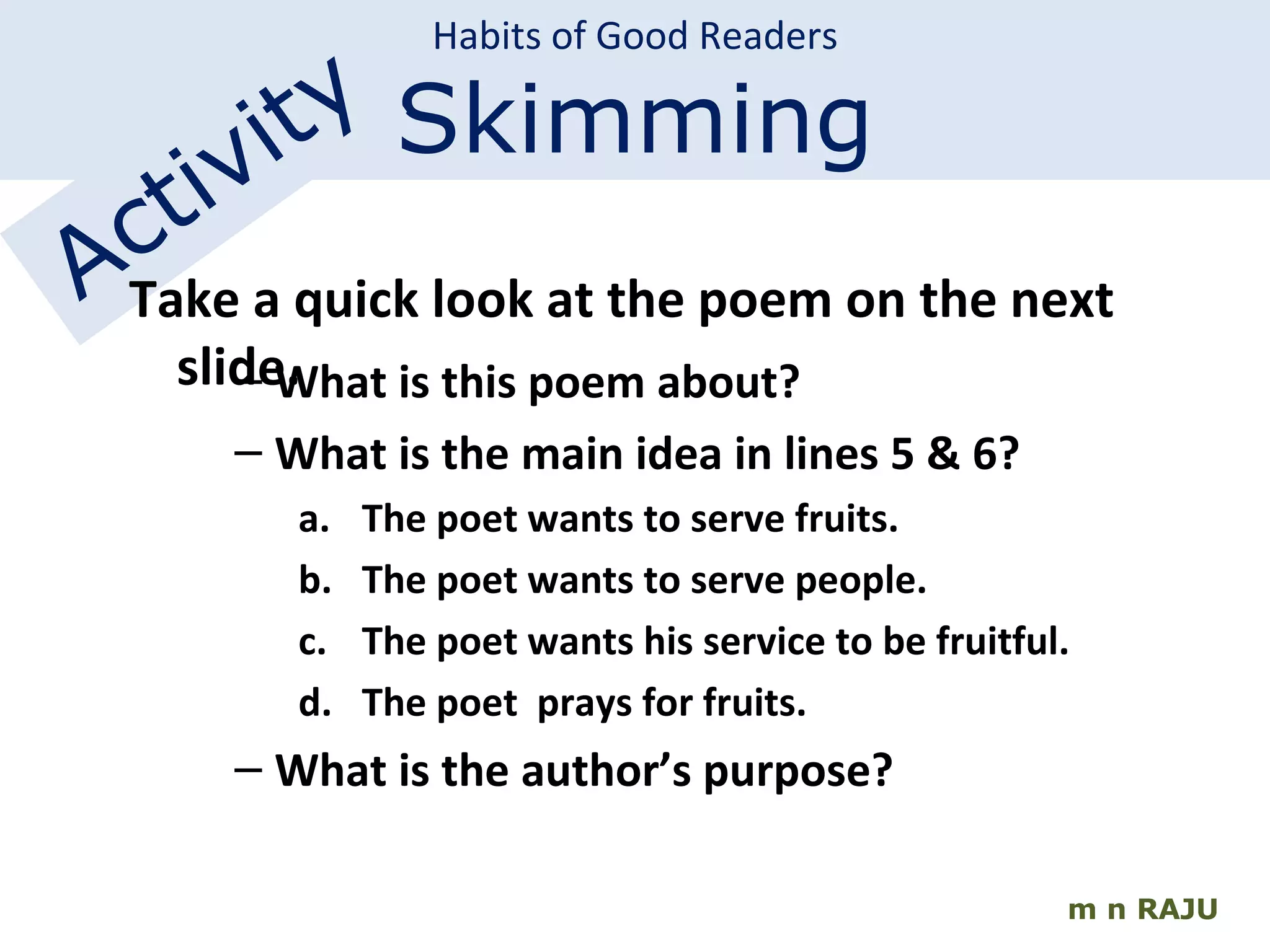
m n RAJU Habits of Good Readers Skimming Activity Take a quick look at the poem on the next slide. What is this poem about? What is the main idea in lines 5 & 6? The poet wants to serve fruits. The poet wants to serve people. The poet wants his service to be fruitful. The poet  prays for fruits. What is the author’s purpose?
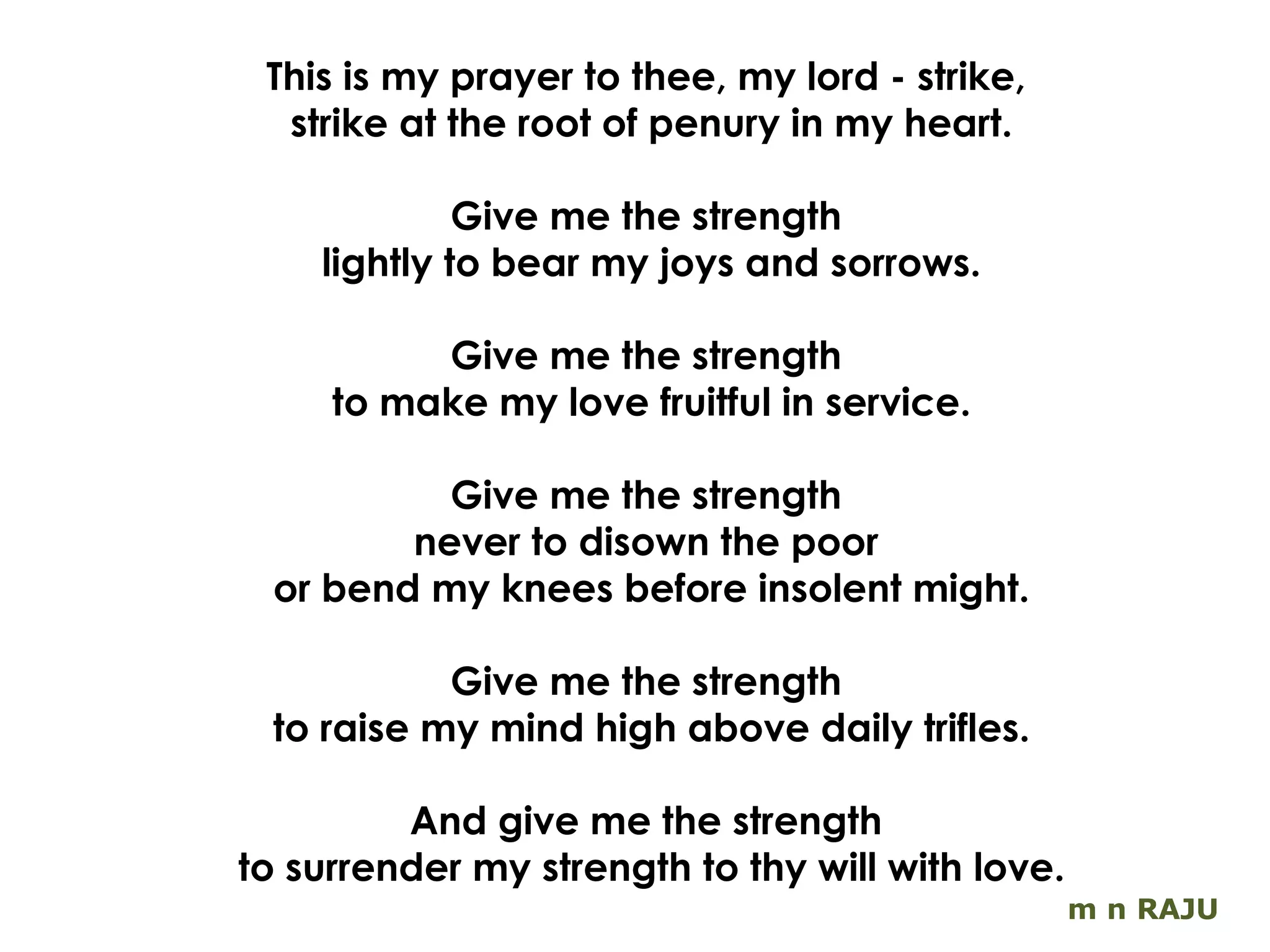
m n RAJU This is my prayer to thee, my lord - strike,  strike at the root of penury in my heart. Give me the strength  lightly to bear my joys and sorrows. Give me the strength  to make my love fruitful in service. Give me the strength  never to disown the poor  or bend my knees before insolent might. Give me the strength  to raise my mind high above daily trifles. And give me the strength  to surrender my strength to thy will with love.
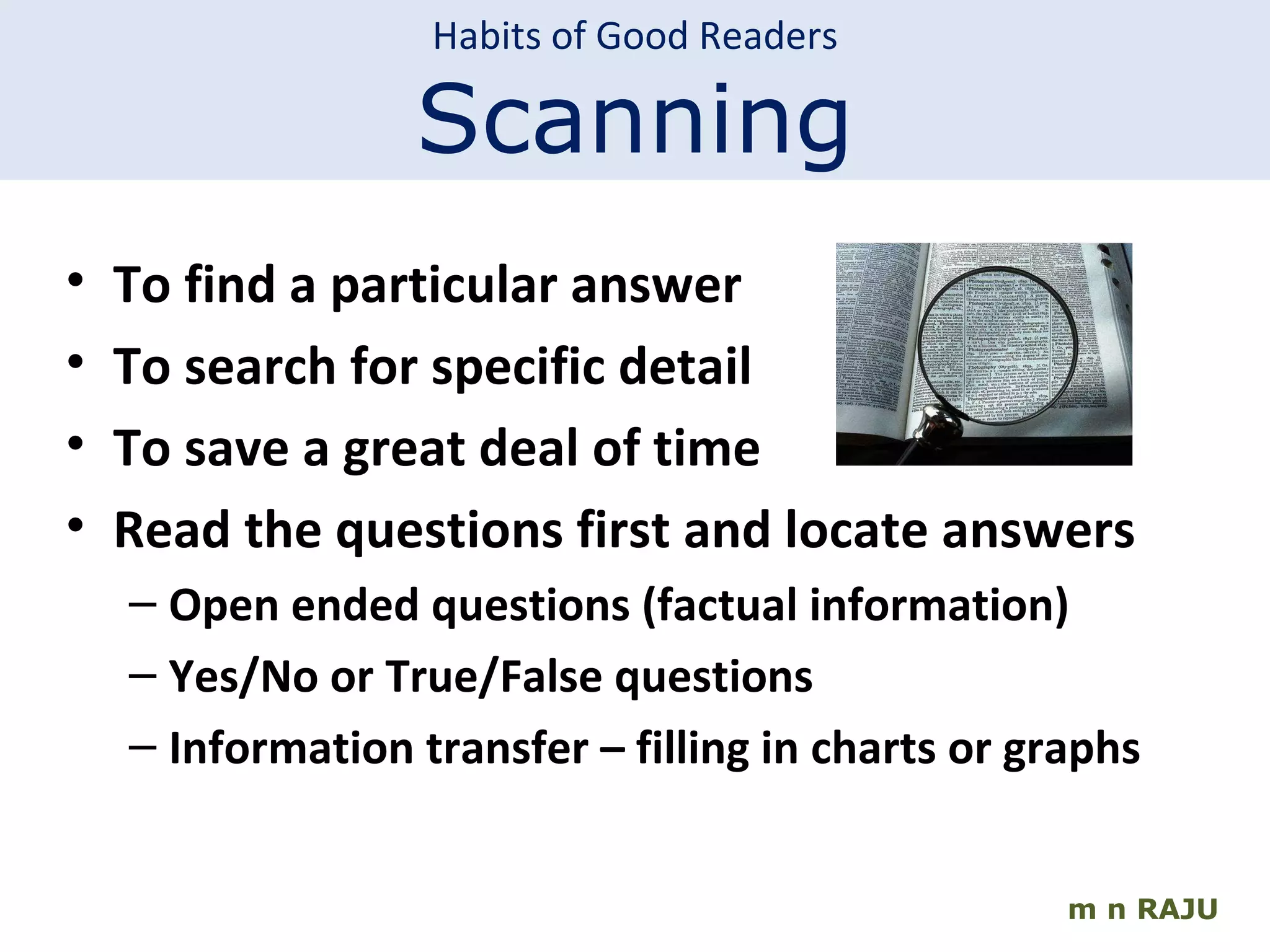
m n RAJU To find a particular answer To search for specific detail To save a great deal of time Read the questions first and locate answers Open ended questions (factual information) Yes/No or True/False questions Information transfer – filling in charts or graphs Habits of Good Readers Scanning
m n RAJU Habits of Good Readers Scanning Activity First read these questions and then take a look at the contents page of your text book to find the answers: Is there a lesson about making a good  investment? Pushpa is a fan of William Wordsworth.  Which poem will interest her? Is there an essay relating to India’s future?
Habits of Good Readers Reading for Gist m n RAJU Getting the main idea For overall understanding Without worrying much about detail
Habits of Good Readers Reading for Gist m n RAJU Activity Read the first sentence of each paragraph in the lesson  “ I Have a Dream.” Notice how reading these sentences gives you a good idea about the meaning of the text.
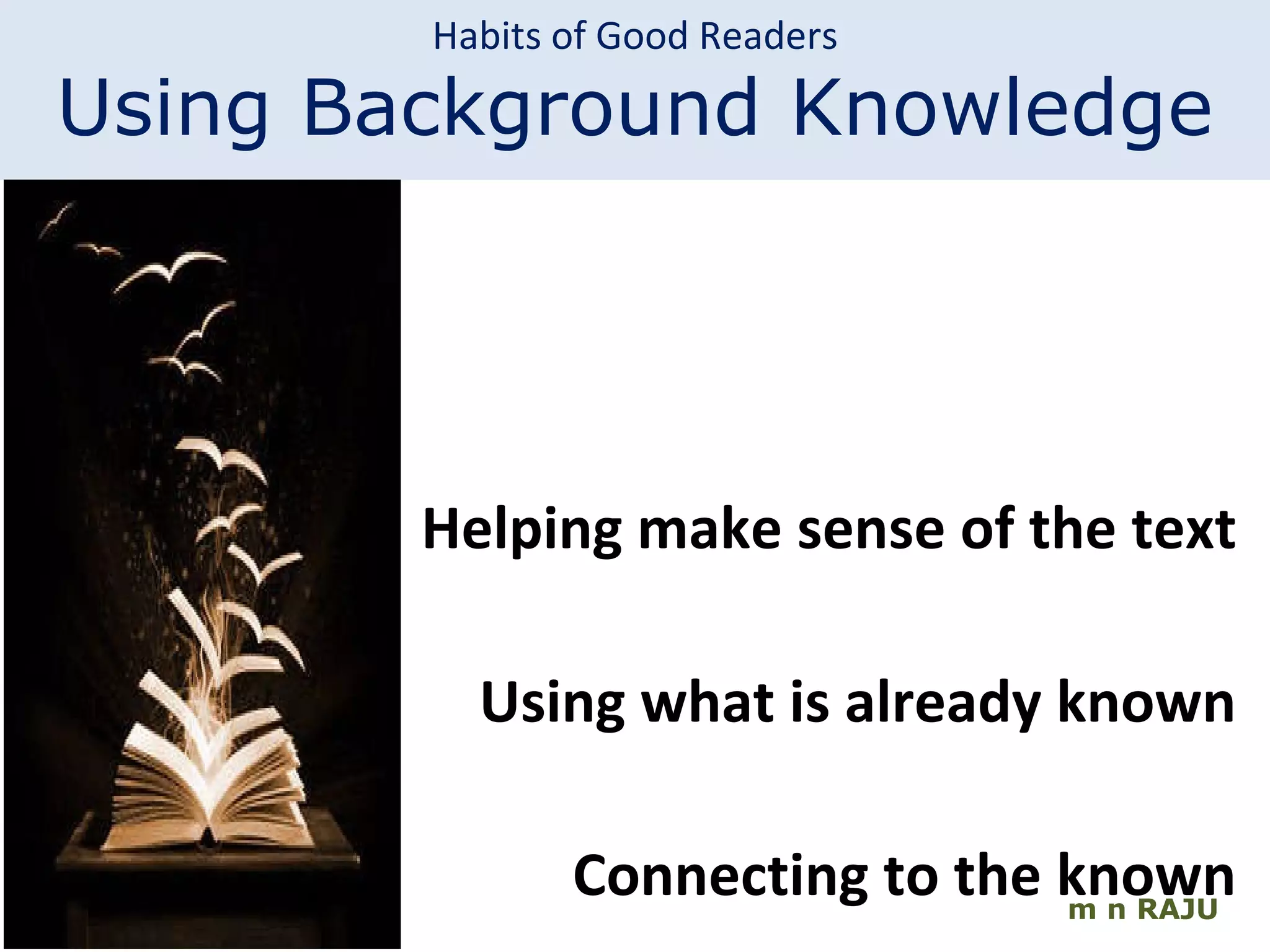
m n RAJU Helping make sense of the text Using what is already known Connecting to the known Habits of Good Readers Using Background Knowledge
m n RAJU Habits of Good Readers Predicting What do you think the text is going to be  about? What might come next? Either pre-reading or while-reading Read the main and sub headings Read the first sentence of each paragraph Use the known to guess the unknown
m n RAJU What is not explicitly stated Meaning of unknown words Habits of Good Readers Inferring
m n RAJU Do not believe everything you read Question what you read Interrogate the text Become a critical, resistant reader Compare with your beliefs & opinions Personal reflection Habits of Good Readers Evaluating & Questioning
m n RAJU Distinguish the main from the supporting State the main idea succinctly Write a precis Suggest a title Habits of Good Readers Summarizing
m n RAJU What we  k now What we  w ant to know What we have  l earned Habits of Good Readers Reading Tool – KWL Chart
m n RAJU Send your comments to [email_address] This slideshow is available at www.slideshare.net/lionnagaraju www.authorstream.com/tag/lionnagaraju

Teaching Reading to College Students

  • 1.
  • 2.
    m n RAJUWhat is Reading? Why do we read? Habits of Good Readers
  • 3.
    m n RAJUWhat is Reading? Reading is not a simple, passive process of linear reading of words and internalizing their meaning one at a time. Reading is a complex interaction between the text and the reader shaped by the reader’s prior knowledge and attitude, a process of language acquisition, communication and sharing information and ideas.
  • 4.
    m n RAJUTHE BOAT IN THE BASEMENT A woman was building a boat in her basement. When she had finished the the boot, she discovered that it was too big to go though the door. So he had to take the boat a part to get it out. She should of planned ahead. from: Goodman, K. (1996).  On Reading . Portsmouth, NH; Heinemann, pp. 38-41 Activity 1. Read the story quickly, only once. 2. Rewrite the story.
  • 5.
    m n RAJUWhy Do We Read? For information and awareness For recreation and enrichment To gain from others’ experience For higher order thinking skills To improve vocabulary & language Reading & writing - mutually supportive
  • 6.
    m n RAJUWhat Do We Read? Text books prescribed for study Novels Magazines Newspapers Pamphlets Time-tables Hotel menu cards
  • 7.
    m n RAJUHow Do We Read? A time-table / A tele directory A hotel menu A pamphlet A newspaper A novel A magazine A text book prescribed for study
  • 8.
    m n RAJUReading Questionnaire Do you like reading in English? Why or why not? How often do you read in English? When and where do you read? What kind of books do you read in English? What do you like to read about in English?
  • 9.
    m n RAJUYour English Reading Habits Answer with ‘never’, ‘rarely’, ‘sometimes’, ‘frequently’, ‘always’ When you read in English, do you read slowly? When you read in English, do you read aloud? When you read in English, do you translate into your mother tongue? When you read in English, do you look up unfamiliar words?
  • 10.
    m n RAJUWhat are your reading strengths? What are you reading weaknesses? What are your reading opportunities? What reading ability do you like to improve? Activity
  • 11.
    Why Do WeTeach Reading m n RAJU To enhance learners’ confidence To pre-teach and warm up To choose appropriate texts To set the task before reading To help read in chunks To help read effectively & faster
  • 12.
    m n RAJUParts of a Good Reading Lesson Pre-reading To activate background knowledge To prepare the reader While-reading To hold interest, to aid comprehension To guide through the text Post-reading To develop additional reading skills such as reacting, critical thinking, accepting/rejecting
  • 13.
    m n RAJUHabits of A Good Reader Reads with a purpose Chunks, skims, scans Summarizes Uses background knowledge Predicts Makes inferences & evaluations Questions
  • 14.
    m n RAJUWhy am I reading? A clear reason for reading Awareness of what to gain Helps determine the strategy Habits of Good Readers Reading with Purpose
  • 15.
    m n RAJUPrepare a few questions to elicit from your students for what purpose they want to read Rabindranath Tagore’s ‘ Song 36’. Habits of Good Readers Reading with Purpose Activity
  • 16.
    m n RAJUReading silently and quickly Breaking habit of word-for-word reading Increasing reading speed Horizontal reading vs vertical reading Habits of Good Readers Chunking
  • 17.
    m n RAJUHabits of Good Readers Chunking Activity To read efficiently | you have to engage your brain | on what you are reading. | You cannot read well | if your mind wanders off | to other things. | If you are involved in a serious emotional problem | or going through a nerve shattering period of indecision, | it is quite possible | that you won’t be an efficient reader. | The reason is | one we have all heard a thousand times. | “I can’t keep my mind on my work.”
  • 18.
    m n RAJUForget details, focus on main idea Quickly identify the main ideas For overall comprehension Preview to get the gist Attention to graphics, headings etc Repeated ideas are normally important Habits of Good Readers Skimming
  • 19.
    m n RAJUHabits of Good Readers Skimming Activity Take a quick look at the poem on the next slide. What is this poem about? What is the main idea in lines 5 & 6? The poet wants to serve fruits. The poet wants to serve people. The poet wants his service to be fruitful. The poet prays for fruits. What is the author’s purpose?
  • 20.
    m n RAJUThis is my prayer to thee, my lord - strike, strike at the root of penury in my heart. Give me the strength lightly to bear my joys and sorrows. Give me the strength to make my love fruitful in service. Give me the strength never to disown the poor or bend my knees before insolent might. Give me the strength to raise my mind high above daily trifles. And give me the strength to surrender my strength to thy will with love.
  • 21.
    m n RAJUTo find a particular answer To search for specific detail To save a great deal of time Read the questions first and locate answers Open ended questions (factual information) Yes/No or True/False questions Information transfer – filling in charts or graphs Habits of Good Readers Scanning
  • 22.
    m n RAJUHabits of Good Readers Scanning Activity First read these questions and then take a look at the contents page of your text book to find the answers: Is there a lesson about making a good investment? Pushpa is a fan of William Wordsworth. Which poem will interest her? Is there an essay relating to India’s future?
  • 23.
    Habits of GoodReaders Reading for Gist m n RAJU Getting the main idea For overall understanding Without worrying much about detail
  • 24.
    Habits of GoodReaders Reading for Gist m n RAJU Activity Read the first sentence of each paragraph in the lesson “ I Have a Dream.” Notice how reading these sentences gives you a good idea about the meaning of the text.
  • 25.
    m n RAJUHelping make sense of the text Using what is already known Connecting to the known Habits of Good Readers Using Background Knowledge
  • 26.
    m n RAJUHabits of Good Readers Predicting What do you think the text is going to be about? What might come next? Either pre-reading or while-reading Read the main and sub headings Read the first sentence of each paragraph Use the known to guess the unknown
  • 27.
    m n RAJUWhat is not explicitly stated Meaning of unknown words Habits of Good Readers Inferring
  • 28.
    m n RAJUDo not believe everything you read Question what you read Interrogate the text Become a critical, resistant reader Compare with your beliefs & opinions Personal reflection Habits of Good Readers Evaluating & Questioning
  • 29.
    m n RAJUDistinguish the main from the supporting State the main idea succinctly Write a precis Suggest a title Habits of Good Readers Summarizing
  • 30.
    m n RAJUWhat we k now What we w ant to know What we have l earned Habits of Good Readers Reading Tool – KWL Chart
  • 31.
    m n RAJUSend your comments to [email_address] This slideshow is available at www.slideshare.net/lionnagaraju www.authorstream.com/tag/lionnagaraju