Dr. Patricia (Pat) Reeves
Dr. Robert (Bob) Leneway
2
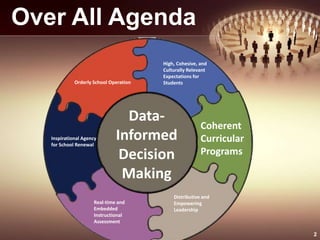
Over All Agenda
Inspirational Agency
for School Renewal
Orderly School Operation
High, Cohesive, and
Culturally Relevant
Expectations for
Students
Coherent
Curricular
Programs
Distributive and
Empowering
Leadership
Real-time and
Embedded
Instructional
Assessment
Data-
Informed
Decision
Making
Goals
Importance
Characteristics
Where are You?
Increased Learning
for Students
3
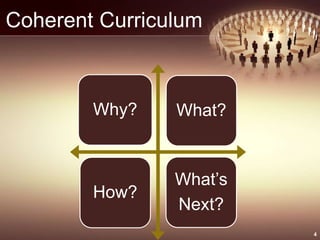
Coherent Curriculum
4
Why? What?
How?
What’s
Next?
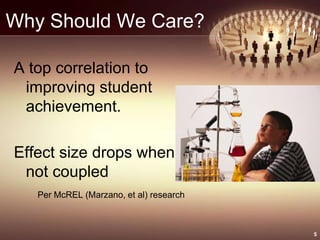
Why Should We Care?
A top correlation to
improving student
achievement.
Effect size drops when
not coupled
Per McREL (Marzano, et al) research
5
Markers?
• Core, essential, or “power
standards” aligned to state and/or
national standards.
• Horizontal and vertical alignment
• Aligned and student appropriate
learning resources (hard and
electronic).
6
Markers
• Clear and consistent
communication about learning
expectations and learning progress.
• Engaging & meaningful learning
experiences.
• Learning focused leadership
• Student participation in setting
personal learning goals. 7
Markers
• Aligned and effective
classroom instruction.
• Aligned and authentic curriculum
based assessments.
• Immediate and consistent feedback
• Continuous progress monitoring (for
every student/by every student).
8
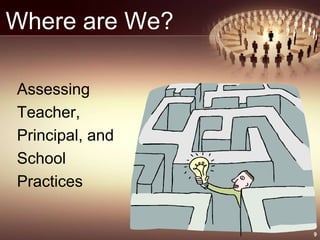
Where are We?
Assessing
Teacher,
Principal, and
School
Practices
9
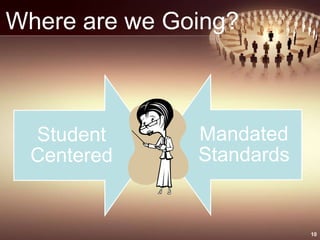
Where are we Going?
10
Student
Centered
Mandated
Standards
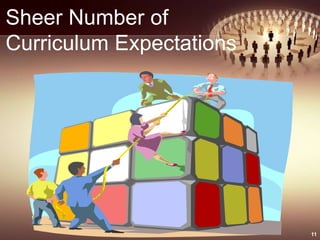
Sheer Number of
Curriculum Expectations
11
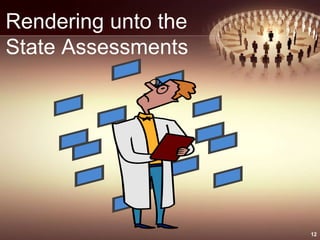
Rendering unto the
State Assessments
12
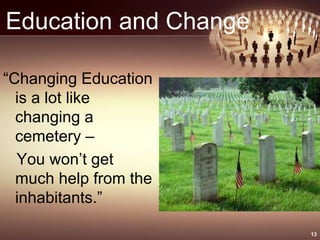
Education and Change
“Changing Education
is a lot like
changing a
cemetery –
You won’t get
much help from the
inhabitants.”
13
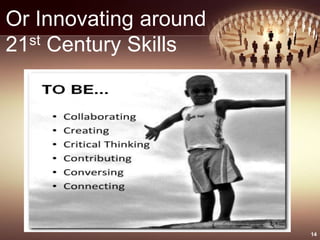
Or Innovating around
21st Century Skills
14
Are they Mutually
Exclusive?
Or Can Our Students Have the Best
of Both?
15
Local Control
Decisions to Avoid
17
Focus on the tests, giving short shrift to
the rest.
Decisions to Avoid
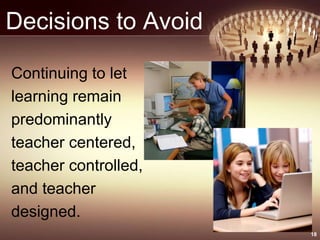
Continuing to let
learning remain
predominantly
teacher centered,
teacher controlled,
and teacher
designed.
18
Decisions to Avoid
Limiting learning to
traditional time slots,
traditional learning
resources, and
traditional learning
Activities; in fact,
limiting learning
at all!
19
Decisions to Consider
Make the Curriculum and Open Door to the World
20
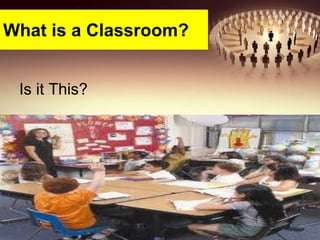
What is a Classroom?
Is it This?
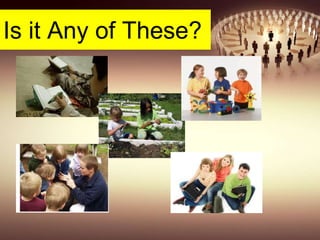
Is it Any of These?
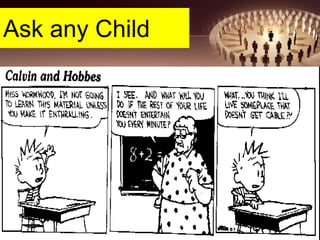
Ask any Child
What Would They Tell Us?
Decisions to Consider
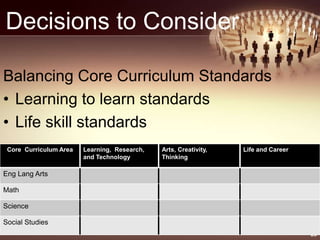
Balancing Core Curriculum Standards
• Learning to learn standards
• Life skill standards
25
Core Curriculum Area Learning, Research,
and Technology
Arts, Creativity,
Thinking
Life and Career
Eng Lang Arts
Math
Science
Social Studies
Decisions to Consider
• Learning through technology standards
26
Decisions To Consider
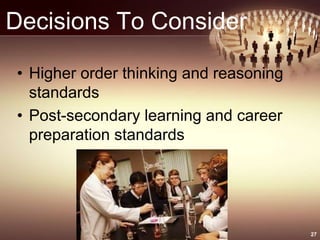
• Higher order thinking and reasoning
standards
• Post-secondary learning and career
preparation standards
27
Decisions To Consider
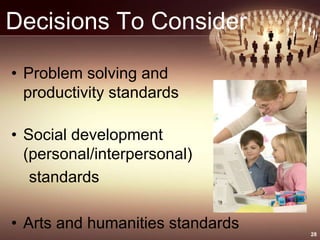
• Problem solving and
productivity standards
• Social development
(personal/interpersonal)
standards
• Arts and humanities standards 28
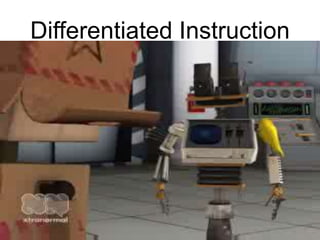
Differentiated Instruction
A 21st Century Vision
Harness the Power of
Technology
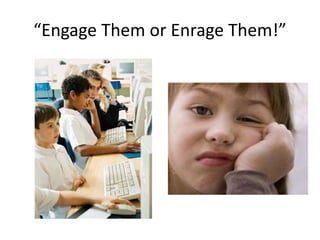
“Engage Them or Enrage Them!”
Give Them 21st
Century Skills
• 21st Century Technologies to support a
multi-dimensional learning system
• Personalized Learning and differentiated
instruction with on-demand access to
learning
• Empowered learners
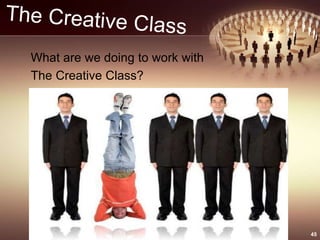
What are we doing to work with
The Creative Class?
45
When we unleash the power
of Technology…
http://www.masternewmedia.org/images/making-sense-of-media-and-technology-painting-clouds
New and
Different
Learning
The Real Learning
Problem
“If we continue to do things that we
already know aren’t working, we
have to consider just who really
has the learning problem.”
(Ian Jukes, 2010)
58
Power of Curriculum
Integration
Start with these research findings:
Students in any type of interdisciplinary
or integrative curriculum do as well as,
and often better than, students in a
conventional departmentalized
program. (National Association for Core
Curriculum, 2000; Vars, 1996, 1997; Arhar, 1997)
59
Power of Curriculum
Integration
• Now, how might curriculum
integration better serve
students?
60
Power of Curriculum
Integration
Give students an interesting text and the
chance to argue about the characters and
issues within it, and they will do the rest
(William 2007).
How might this be a clue to a more
student centered and integrated approach
to providing guaranteed and viable
curriculum experiences for all students?
61
Curriculum Integration
How might we use these nine high
impact instructional strategies
(Marzano, Pickering, & Pollack, 2001) to
improve curriculum integration?
62
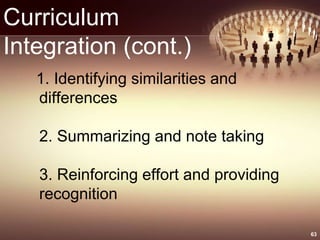
Curriculum
Integration (cont.)
1. Identifying similarities and
differences
2. Summarizing and note taking
3. Reinforcing effort and providing
recognition
63
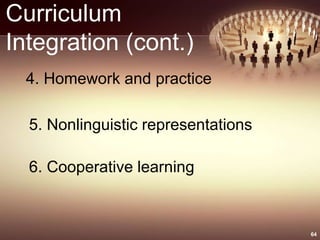
Curriculum
Integration (cont.)
4. Homework and practice
5. Nonlinguistic representations
6. Cooperative learning
64
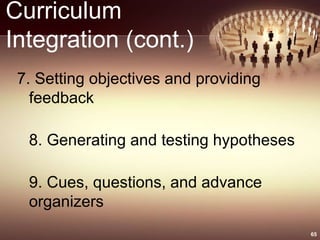
Curriculum
Integration (cont.)
7. Setting objectives and providing
feedback
8. Generating and testing hypotheses
9. Cues, questions, and advance
organizers
65
A Sad State of Affairs
• “Curricular chaos” — not coherence —
still prevails in most schools, a result of
our no-oversight, high autonomy culture
(Schmoker and Marzano 1999).
• Fortunately, many successful schools
have seen achievement levels soar after
developing coherent, high-quality curricula
— but only when they instituted monitoring
mechanisms for ensuring that it is taught.
66
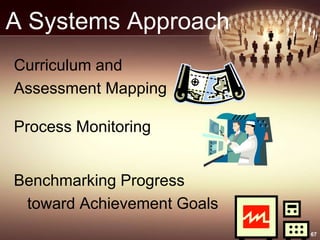
A Systems Approach
Curriculum and
Assessment Mapping
Process Monitoring
Benchmarking Progress
toward Achievement Goals
67
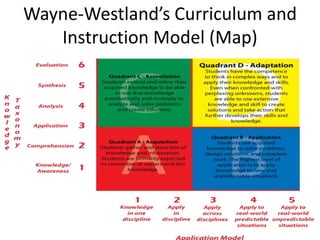
Wayne-Westland’s Curriculum and
Instruction Model (Map)
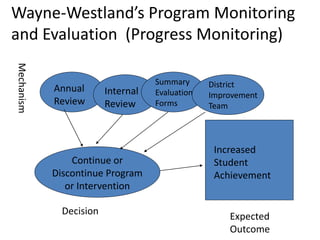
Wayne-Westland’s Program Monitoring
and Evaluation (Progress Monitoring)
Annual
Review
Internal
Review
Summary
Evaluation
Forms
District
Improvement
Team
Continue or
Discontinue Program
or Intervention
Increased
Student
Achievement
Mechanism
Decision
Expected
Outcome
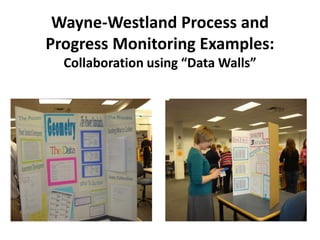
Wayne-Westland Process and
Progress Monitoring Examples:
Collaboration using “Data Walls”
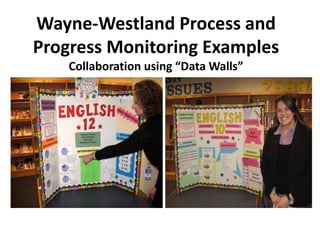
Wayne-Westland Process and
Progress Monitoring Examples
Collaboration using “Data Walls”
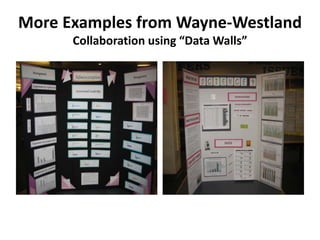
More Examples from Wayne-Westland
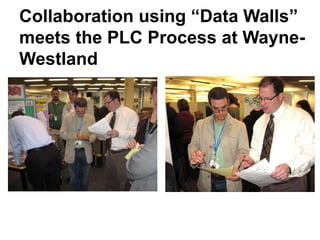
Collaboration using “Data Walls”
meets the PLC Process at Wayne-
Westland
Where do you Need to Go?
74
How are You
Going to Get
there?
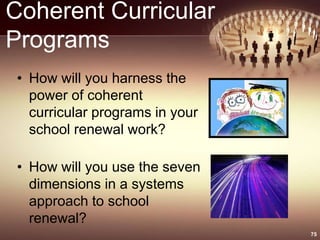
Coherent Curricular
Programs
• How will you harness the
power of coherent
curricular programs in your
school renewal work?
• How will you use the seven
dimensions in a systems
approach to school
renewal?
75
Final Thought
76

Coherent curriculum planning8513

Editor's Notes

  • #4 Explore the research supported importance of insuring that our schools offer Coherent Curricular Programs, i.e. Guaranteed and Viable Explore the research supported characteristics of Coherent Curricular Programs Examine the status of our own schools on the Dimension of Coherent Curricular Programs Explore possible ways to increase learning opportunity and learning results for our students by insuring Coherent Curricular Programs in our schools
  • #5 Frame the way we will move through the session; i.e. exploring why Coherent Curriculum Programs are important; Identifying what our schools need to focus on in order to provide Coherent Curricular Programs; Working together to identify ways to insure that our schools meet the markers for Coherent Curriculum Programs; Identify some next steps
  • #6 Per McREL research (Marzano, et al), Guaranteed and Viable Curriculum shows one of the highest correlations to improving student achievement Effect sizes for evidence based instructional strategies drop precipitously when not coupled with a guaranteed and viable curriculum
  • #10 Lead in to using the Assessing Teacher, Principal, and School Practices – Provide time to process Let’s look at one tool for understanding where we standing our schools when it comes to providing a Guaranteed and Viable Curriculum for all students
  • #11 Begin having participants discuss how they create a Guaranteed and Viable Curriculum that serves both priorities
  • #12 One research team estimates that it would take even a very competent student nine additional years in school to reach acceptable performance in all of the standards recommended by national organizations! Discuss the need to unpack our over packed state curricula and identify Core, Essential or Power Standards
  • #13 Begin the conversation about why this approach alone will only get the first margin of improvement in student results
  • #15 Begin the conversation about what schools might include in a guaranteed and viable curriculum beyond what the state and national assessments can or will measure.
  • #16 Get participants to discuss and share examples of how teachers are making sure that students do get the best of both
  • #17 Some might argue that doing curriculum development work at the district and/or school level is obsolete with the emphasis on state and national curriculum standards and assessments Have participants discuss why it is important to develop the local curriculum beyond state and national core curriculum standards
  • #21 Have participants discuss the difference between learning on demand (student centered) and learning by fiat (teacher centered) – why it is important – how to make it happen
  • #30 Video on Differentiated Instruction. Click image to start
  • #31  What is the most important reason for public schools in Michigan? http://www.polleverywhere.com/multiple_choice_polls/rbaIaRgwoyHiV4e
  • #32  Does your school focus on that reason? http://www.polleverywhere.com/multiple_choice_polls/JhatPqBzIz8LAyb
  • #34 Technology is always changing, and making our current concepts of curriculum obsolete, i.e. cursive writing.
  • #39 When we observe classrooms, what do we watch?
  • #42 Watch and discuss implications of this short video How will we make learning fit today’s learners? How will we give them the tools?
  • #50 Discuss using technology to create new and different learning experiences; not just replicate learning experiences traditionally done through print
  • #57 The NMC Horizon Report > 2013 K-12 Edition recognizes cloud computing and mobile learning as technologies expected to enter mainstream use in the first horizon of one year or less. Learning analytics and open content are seen in the second horizon of two to three years; and gameification.
  • #58 3D printing and virtual and remote laboratories emerged in the third horizon of four to five years.
  • #60 Open discussion on curriculum integration
  • #62 Discussion prompt
  • #63 Discussion prompt
  • #67 Raising level of concern
  • #68 Get them thinking systemically about their renewal work
  • #69 Share and discuss Wayne-Westland examples in this and following slides
  • #75 Have participants work together to plot their course and share with others.
  • #76 Final Questions to think about and consider
  • #77 Click on image to start 1 minute video.