Modern Approaches in
LanguageTeaching
This presentation explores the evolving landscape of language
pedagogy, highlighting key modern approaches that have reshaped
how we teach and learn languages. We will delve into paradigms that
prioritise communicative competence and foster learner autonomy,
alongside the crucial integration of technology and real-world contexts.
These methods aim to make language acquisition more effective,
engaging, and relevant for today's learners.
by Dilrabo Rakhmatullayeva
2.
Communicative Language Teaching(CLT)
Communicative Language Teaching (CLT) places a strong emphasis on meaningful communication and interaction as the primary means and end of language learning. Activities often include role-play, simulations, and information gap exercises, where learners
must use the target language to achieve a specific communicative outcome. The ultimate goal is to develop genuine fluency and pragmatic communicative competence, allowing learners to effectively engage in real-world conversations and situations. For instance,
a class might engage in a mock negotiation between businesses, requiring them to use appropriate language for persuasion, agreement, and compromise.
Mock Negotiation
Practising real-world business scenarios to enhance professional communication skills.
Role-Play Scenarios
Engaging in various roles to improve spontaneous conversation and social interaction.
Information Gap Activities
Solving puzzles or completing tasks by exchanging vital information with peers.
3.
Task-Based Language Teaching(TBLT)
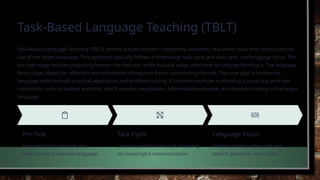
Task-Based Language Teaching (TBLT) centres around learners completing authentic, real-world tasks that necessitate the
use of the target language. This approach typically follows a three-stage task cycle: pre-task, task, and language focus. The
pre-task stage involves preparing learners for the task, while the task stage sees them actively performing it. The language
focus stage allows for reflection and refinement of linguistic forms used during the task. The core goal is to improve
language skills through practical application and problem-solving. A common example is planning a group trip with real
constraints, such as budget and time, which requires negotiation, information exchange, and decision-making in the target
language.
Pre-Task
Introduction to the task and
brainstorming relevant language.
Task Cycle
Learners perform the task, focusing
on meaningful communication.
Language Focus
Analysis of language used and
explicit grammar instruction.
4.
Cognitive Approach
The CognitiveApproach to language teaching places significant emphasis on the mental processes involved in language acquisition. This includes how
learners perceive, process, store, and retrieve linguistic information. Techniques employed often involve mnemonics for vocabulary retention, concept
mapping to visualise grammatical structures, and schema building to connect new information with existing knowledge. The primary goal is to enhance
learners' memory, attention, and problem-solving skills within the language context. For example, grammar might be taught through rule discovery
activities, where students analyse examples to deduce grammatical patterns themselves, fostering deeper understanding and retention.
Problem-Solving
Applying linguistic rules to new situations.
Concept Mapping
Visualising relationships between linguistic ideas.
Schema Building
Connecting new language to prior knowledge.
Mnemonics
Memory aids for vocabulary and grammatical rules.
5.
Constructivist Approach
The ConstructivistApproach posits that learners actively construct their own knowledge and understanding through experience and interaction with their
environment. This is often achieved through engaging activities such as project-based learning, where students collaborate on extended tasks, and collaborative
tasks that require group problem-solving. The aim is to promote critical thinking, creativity, and self-directed learning, empowering students to take ownership of
their educational journey. A practical application could be creating a class blog with student-generated content, where learners research, write, and edit posts in the
target language, providing authentic purpose and audience for their language use.
Key Elements
• Active knowledge construction
• Experience-based learning
• Collaborative tasks
• Critical thinking development
• Self-directed learning promotion
This approach fosters a dynamic learning environment where students are not
just passive recipients of information but active participants in their learning
journey.
6.
Humanistic Approach
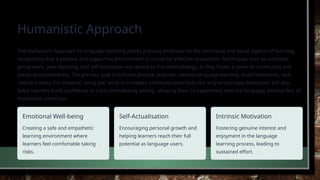
The HumanisticApproach to language teaching places a strong emphasis on the emotional and social aspects of learning,
recognising that a positive and supportive environment is crucial for effective acquisition. Techniques such as extensive
group work, peer teaching, and self-evaluation are central to this methodology, as they foster a sense of community and
personal responsibility. The primary goal is to foster positive attitudes towards language learning, build motivation, and
reduce anxiety. For instance, using pair work to complete communicative tasks not only encourages interaction but also
helps learners build confidence in a less intimidating setting, allowing them to experiment with the language without fear of
immediate correction.
Emotional Well-being
Creating a safe and empathetic
learning environment where
learners feel comfortable taking
risks.
Self-Actualisation
Encouraging personal growth and
helping learners reach their full
potential as language users.
Intrinsic Motivation
Fostering genuine interest and
enjoyment in the language
learning process, leading to
sustained effort.
7.
Technology-Enhanced Language Learning(TELL)
Technology-Enhanced Language Learning (TELL) involves the strategic integration of various technological tools into the
language teaching and learning process. This can include a wide array of resources such as interactive language learning
apps, comprehensive online platforms, multimedia content like videos and podcasts, and virtual reality experiences. The
main objective is to enhance engagement, provide access to a wealth of authentic materials, and offer personalised learning
experiences. A compelling example is the use of online language exchange platforms, allowing learners to practise with
native speakers from around the globe, providing invaluable real-time communication and cultural insights.
Language Apps
Interactive exercises and
vocabulary building on the
go.
Online Resources
Access to authentic materials
like news articles and videos.
Multimedia Content
Podcasts, songs, and films
for immersive listening and
viewing.
Language Exchange
Connecting with native
speakers for real-time
conversation.
8.
Conclusion: A HolisticApproach
The most effective modern language teaching often involves a holistic approach,
seamlessly combining elements from communicative, cognitive, constructivist, and
humanistic methodologies, alongside the strategic integration of technology. This
adaptive approach allows educators to tailor their methods to meet the diverse
needs, learning styles, and proficiency levels of their students. Continuous
professional development for teachers is paramount to stay abreast of new
research, innovative techniques, and emerging technologies, ensuring that
language education remains dynamic, relevant, and highly effective in preparing
learners for real-world communication.
Integration
Combining various pedagogical approaches for comprehensive learning.
Adaptation
Tailoring methods to suit individual learner needs and contexts.
Development
Continuous professional growth for educators in language pedagogy.