1 | P a g e
Symbiosis Centre for Management Studies, Noida
Batch: 2012-2015
Quality Management Assignment
Topic: USE OF DMADV METHODOLOGY TO CREATE A MARKETING
PROCESS FOR SMARTPHONES IN INDIA
Submitted to: Submitted by:
Nitin Malhotra Sheryl Mehra
Division-C
PRN No. 12021021102
2 | P a g e
USE OF DMADV METHODOLOGY TO CREATE A MARKETING
PROCESS FOR SMARTPHONES IN INDIA
The DMADV methodology can’t be better explained than by comparing it with DMAIC methodology
despite their fundamental differences. Take for example, the case of a traveling salesman who convinces a
customer to buy at the best price. After invoicing and collecting the shipping details, he discovers that
there is a problem with the packaging department which is unable to reduce the shipping volume as
desired by the customer. The salesman now remembers that nowadays, more and more customers are
demanding that their shipments’ volumes be reduced when packaged.
Now, the packaging department has a problem on their hands which they are unable to resolve unless
their rule books are rewritten. What should the project team evaluate now; DMAIC or DMADV
methodology?
The DMADV methodology should be applied:
1. when a non-existent product or process needs to be developed at a company and…
2. when an existing process or product already exists but still needs to meet a Six Sigma level or
customer specification.
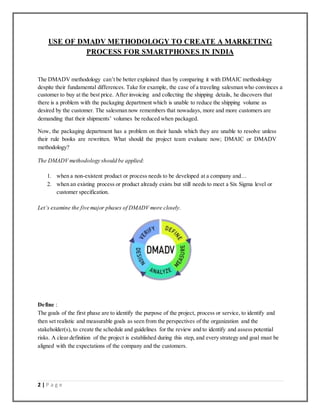
Let’s examine the five major phases of DMADV more closely.
Define :
The goals of the first phase are to identify the purpose of the project, process or service, to identify and
then set realistic and measurable goals as seen from the perspectives of the organization and the
stakeholder(s), to create the schedule and guidelines for the review and to identify and assess potential
risks. A clear definition of the project is established during this step, and every strategy and goal must be
aligned with the expectations of the company and the customers.
3 | P a g e
Measurement
Next comes measuring the factors that are critical to quality, or CTQs. Steps taken should include:
defining requirements and market segments, identifying the critical design parameters,designing
scorecards that will evaluate the design components more important to the quality, reassessing risk and
assessing the production process capability and product capability. Once the values for these factors are
known, then an effective approach can be taken to start the production process. It is important here to
determine which metrics are critical to the stakeholder and to translate the customer requirements into
clear project goals.
Analysis
Actions taken during this phase will include: developing design alternatives, identifying the optimal
combination of requirements to achieve value within constraints, developing conceptual designs,
evaluating then selecting the best components, then developing the best possible design. It is during this
stage that an estimate of the total life cycle cost of the design is determined. After thoroughly exploring
the different design alternatives, what is the best design option available for meeting the goals?
Design
This stage of DMADV includes both a detailed and high level design for the selected alternative. The
elements of the design are prioritized and from there a high level design is developed. Once this step is
complete, a more detailed model will be prototyped in order to identify where errors may occur and to
make necessary modifications.
Verify
In the final phase, the team validates that the design is acceptable to all stakeholders. Will the design be
effective in the realworld? Severalpilot and production runs will be necessary to ensure that the quality is
the highest possible. Here,expectations will be confirmed, deployment will be expanded and all lessons
learned will be documented. The Verify step also includes a plan to transition the product or service to a
routine operation and to ensure that this change is sustainable.
There is a new viewpoint in Six Sigma circles that DMADV is for designing new products and
services and that it may not be successfulon existing business processes and products. Although the
argument is valid to some extent, you would do well to notice that the I of DMAIC is not far removed
from the D of DMADV. You can easily say that design is an extended concept of improvement.
Difference BetweenDMADVAnd DMAIC
The difference, as one can see now, exists only in the way last two steps are handled. In DMADV,
instead of the Improve and Control steps which focuses on readjusting and controlling by one way or
other, deals with redesigning the process to fit customer needs.
4 | P a g e
Can You Use DMAIC In Place Of DMADV?
Let’s simply put it the other way around. You can implement DMADV when you don’t have an
existing product, which you are aiming to create from scratch. The second occasion when you can
think of using DMADV is when in actual practice, DMAIC hasn’t yielded the result you were looking
for despite best efforts to make improvements. In a nutshell, the latter reason can be summarized as:
use DMADV when process improvement either fails or doesn’t deliver to your expectations.
There are occasions when planned DMAIC has turned into DMADV ultimately. a Six Sigma Black Belt
must take credit for this, in my view, as this reflects their in-depth subject knowledge.
Marketing ProcessforSmart Phones in India
1. Firstly with the help of DMADV we will identify the needs and wants of the consumer and on the
basis of needs we will set goals and objective that we need to accomplish to increase the market
share and productivity by keeping in mind the optimum utilisation of resources and every strategy
and goal must be aligned with the expectations of the company and the customers.
Example: now-a-days consumer needs touch screen android phone with long lasting battery at low price
2. Secondly we will analyze the market opportunities likewise we will identify the customer
preference,type of market segment to be targeted,who are the anticipating competitors of the
same kind of product we are launching in the market, find out the risk involved in production
process.
Example:
 Youngster today wants a sleek, HD camera,3G & 4G supportable, 5.5inch screen with long
battery backup (customer preference) ,
 Competitor analysis should be done to know what our competitors are offering to be best in the
market like Samsung offers good customer service keep their customers happy.
3. Now we will Analyze the options, to determine the cause of error origination and evaluate
corrective measures to overcome that problem. In this stage we will develop conceptual designs,
evaluate them, select the best components, then developing the best possible design.
Example: We will create a 2 or 3 different design dummy model of our smartphone that we are going to
launch in market and then among them select the best design.
4. In this step a smart phone is manufactured keeping in mind customers preference, quality & price
of the product and then a check is made whether there is an error or not. Is it meet the needs of
our customers?
Example: Many companies provide their own product to their own employees to use them and tell their
reviews about the product before launching it in the market.
5 | P a g e
5. In the final Step, the team validates that the design is acceptable to all stakeholders. And the
product is ready to launch in the market to give customer their preference at low price but with
un-beatable quality.
Example: Error free product with customer service centers in all areas with properly trained employees,
unbreakable product due to hard back cover, some special offers like free after sales service, full damage
will be beared by company.

USE OF DMADV METHODOLOGY TO CREATE A MARKETING PROCESS FOR SMARTPHONES IN INDIA

  • 1.
    1 | Pa g e Symbiosis Centre for Management Studies, Noida Batch: 2012-2015 Quality Management Assignment Topic: USE OF DMADV METHODOLOGY TO CREATE A MARKETING PROCESS FOR SMARTPHONES IN INDIA Submitted to: Submitted by: Nitin Malhotra Sheryl Mehra Division-C PRN No. 12021021102
  • 2.
    2 | Pa g e USE OF DMADV METHODOLOGY TO CREATE A MARKETING PROCESS FOR SMARTPHONES IN INDIA The DMADV methodology can’t be better explained than by comparing it with DMAIC methodology despite their fundamental differences. Take for example, the case of a traveling salesman who convinces a customer to buy at the best price. After invoicing and collecting the shipping details, he discovers that there is a problem with the packaging department which is unable to reduce the shipping volume as desired by the customer. The salesman now remembers that nowadays, more and more customers are demanding that their shipments’ volumes be reduced when packaged. Now, the packaging department has a problem on their hands which they are unable to resolve unless their rule books are rewritten. What should the project team evaluate now; DMAIC or DMADV methodology? The DMADV methodology should be applied: 1. when a non-existent product or process needs to be developed at a company and… 2. when an existing process or product already exists but still needs to meet a Six Sigma level or customer specification. Let’s examine the five major phases of DMADV more closely. Define : The goals of the first phase are to identify the purpose of the project, process or service, to identify and then set realistic and measurable goals as seen from the perspectives of the organization and the stakeholder(s), to create the schedule and guidelines for the review and to identify and assess potential risks. A clear definition of the project is established during this step, and every strategy and goal must be aligned with the expectations of the company and the customers.
  • 3.
    3 | Pa g e Measurement Next comes measuring the factors that are critical to quality, or CTQs. Steps taken should include: defining requirements and market segments, identifying the critical design parameters,designing scorecards that will evaluate the design components more important to the quality, reassessing risk and assessing the production process capability and product capability. Once the values for these factors are known, then an effective approach can be taken to start the production process. It is important here to determine which metrics are critical to the stakeholder and to translate the customer requirements into clear project goals. Analysis Actions taken during this phase will include: developing design alternatives, identifying the optimal combination of requirements to achieve value within constraints, developing conceptual designs, evaluating then selecting the best components, then developing the best possible design. It is during this stage that an estimate of the total life cycle cost of the design is determined. After thoroughly exploring the different design alternatives, what is the best design option available for meeting the goals? Design This stage of DMADV includes both a detailed and high level design for the selected alternative. The elements of the design are prioritized and from there a high level design is developed. Once this step is complete, a more detailed model will be prototyped in order to identify where errors may occur and to make necessary modifications. Verify In the final phase, the team validates that the design is acceptable to all stakeholders. Will the design be effective in the realworld? Severalpilot and production runs will be necessary to ensure that the quality is the highest possible. Here,expectations will be confirmed, deployment will be expanded and all lessons learned will be documented. The Verify step also includes a plan to transition the product or service to a routine operation and to ensure that this change is sustainable. There is a new viewpoint in Six Sigma circles that DMADV is for designing new products and services and that it may not be successfulon existing business processes and products. Although the argument is valid to some extent, you would do well to notice that the I of DMAIC is not far removed from the D of DMADV. You can easily say that design is an extended concept of improvement. Difference BetweenDMADVAnd DMAIC The difference, as one can see now, exists only in the way last two steps are handled. In DMADV, instead of the Improve and Control steps which focuses on readjusting and controlling by one way or other, deals with redesigning the process to fit customer needs.
  • 4.
    4 | Pa g e Can You Use DMAIC In Place Of DMADV? Let’s simply put it the other way around. You can implement DMADV when you don’t have an existing product, which you are aiming to create from scratch. The second occasion when you can think of using DMADV is when in actual practice, DMAIC hasn’t yielded the result you were looking for despite best efforts to make improvements. In a nutshell, the latter reason can be summarized as: use DMADV when process improvement either fails or doesn’t deliver to your expectations. There are occasions when planned DMAIC has turned into DMADV ultimately. a Six Sigma Black Belt must take credit for this, in my view, as this reflects their in-depth subject knowledge. Marketing ProcessforSmart Phones in India 1. Firstly with the help of DMADV we will identify the needs and wants of the consumer and on the basis of needs we will set goals and objective that we need to accomplish to increase the market share and productivity by keeping in mind the optimum utilisation of resources and every strategy and goal must be aligned with the expectations of the company and the customers. Example: now-a-days consumer needs touch screen android phone with long lasting battery at low price 2. Secondly we will analyze the market opportunities likewise we will identify the customer preference,type of market segment to be targeted,who are the anticipating competitors of the same kind of product we are launching in the market, find out the risk involved in production process. Example:  Youngster today wants a sleek, HD camera,3G & 4G supportable, 5.5inch screen with long battery backup (customer preference) ,  Competitor analysis should be done to know what our competitors are offering to be best in the market like Samsung offers good customer service keep their customers happy. 3. Now we will Analyze the options, to determine the cause of error origination and evaluate corrective measures to overcome that problem. In this stage we will develop conceptual designs, evaluate them, select the best components, then developing the best possible design. Example: We will create a 2 or 3 different design dummy model of our smartphone that we are going to launch in market and then among them select the best design. 4. In this step a smart phone is manufactured keeping in mind customers preference, quality & price of the product and then a check is made whether there is an error or not. Is it meet the needs of our customers? Example: Many companies provide their own product to their own employees to use them and tell their reviews about the product before launching it in the market.
  • 5.
    5 | Pa g e 5. In the final Step, the team validates that the design is acceptable to all stakeholders. And the product is ready to launch in the market to give customer their preference at low price but with un-beatable quality. Example: Error free product with customer service centers in all areas with properly trained employees, unbreakable product due to hard back cover, some special offers like free after sales service, full damage will be beared by company.