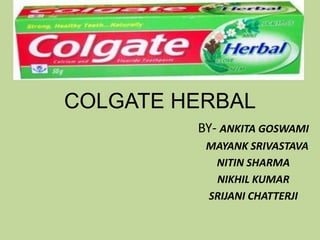
COLGATE HERBAL
BY- ANKITA GOSWAMI
MAYANK SRIVASTAVA
NITIN SHARMA
NIKHIL KUMAR
SRIJANI CHATTERJI
INTRODUCTION
• The brand name ‘Colgate’ is synonymous with
toothpaste. This world renowned brand is sold
in more than 200 countries.
• In India , the company has successfully
replicated the strong brand image &
awareness in the mind of consumer.
• Colgate India earns around 93% of its
revenues from the oral care segment.
BRIEF ON RURAL MARKETING
• Rural Marketing is defined as any marketing
activity in which the one dominant participant
is from a rural area. This implies that rural
marketing consists of marketing of inputs
(products or services) to the rural as well as
marketing of outputs from the rural markets
to other geographical areas.
WHY RURAL MARKETING IS
IMPORTANT
• The rural market is booming in terms of opportunities which they
give to the corporate sector. In total consumption of Fast Moving
Consumer Goods, Rural India has 55% share in it. From the year
1993 to 1998, Rural India had a growth of near about 14% per
annum.
• In India, the number of supermarkets (42,000) has exceeded the
number of retail stores (35000) in the United States.
• In the year 2001-2002, LIC sold 55% of its policies in the rural India.
• 50% of BSNL mobile phone connections are in rural India.
• The (KCC) Kisan Credit Cars(24 Million) issued in rural India has
certainly exceeded the Number of Debit plus credit cards (17.7
Million) issued in Urban areas.
• The number of higher and middle income families (Earning Rs.
70,000+ annually) in rural India (21.7 Million) and Urban India (24.2
Million)are almost same.
SWOT
STRENGTH

WEAKNESS

Distinctive competence
Strong financial resources
Cost of price leader
Strong brand name
Innovative skills
Skilled human resources
Loyal customers
Superior technological know how

No clear direction
Weak market-share
Weak distribution network
Weak market silage
Poor marketing competency
Lack of distinct competency
Absolute plant and facilities
Poor track record of strategic implementation

OPPORTUNITIES

THREATS

Growth in new market
New product development
Quality improvement
Expand product line
Vertical integration
Emerging customer needs

Entry of low cost
Competitors
Slow market growth
Substitute products
Change in technology
Adverse legislation
MARKETING APPROCAHES
•
•
•
•
•
•
•
•
•
•
•
•
•

Communication and change of perception
Proper communication in local languages
Target changing perception
Understanding social and cultural values
Fulfilling customer’s needs
Product promotion through celebrities
Indian association
Promotion through Indian sports teams
Communicating about Indians
Products for rural locations
Using Indian names
Indian brands
Media communication
PRODUCT MIX
•

•
•
•
•

•

Product variety – COLGATE HERBAL is the tooth paste which we are going to sell in the
rural market by applying different research methodologies and then applied different rural
marketing technique to sell this product in the near future The brand was launched in 2001
and is essentially targeted at traditional consumers who seek natural ingredients (such as in
semi-urban and rural towns)
Quality – Being a popular segment product and an offering by quality parameters are
thoroughly tested to ensure consumer satisfaction.
Features – COLGATE HERBAL White promises a ‘unique formula’ including a special
blend of eucalyptus, calcium and minerals and ;lemon extracts.
Brand Name – The use of Herbal in the brand name is self-explanatory. NEEM Herbal has
been highlighted to stress their brand proposition of ensuring ‘pearly white teeth’.
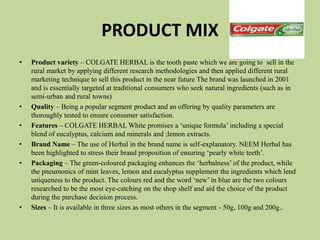
Packaging – The green-coloured packaging enhances the ‘herbalness’ of the product, while
the pneumonics of mint leaves, lemon and eucalyptus supplement the ingredients which lend
uniqueness to the product. The colours red and the word ‘new’ in blue are the two colours
researched to be the most eye-catching on the shop shelf and aid the choice of the product
during the purchase decision process.
Sizes – It is available in three sizes as most others in the segment - 50g, 100g and 200g..
PRICING
• List Price – The list price of the product is Rs.
12.50 for the 50g pack, Rs. For the 100g pack,
and Rs. For the 200g pack.
• Discounts/Allowances – No promotional
discounts are allowed for.
• Payment period/Credit terms – Being an offthe-shelf FMCG, in line with the category, no
credit is allowed by the company (though the
store allows credit on purchase of all items).
PROMOTION
•
•
•
•
•

Sales Promotion
Advertising
Sales Force
Public Relations
Direct Marketing
PLACE
• Channels – The products is sold in retail outlets like Karina stores,
supermarkets, medical shops, co-operative stores etc. It is
distributed through the supply chain of company distributor to
wholesaler to retailer to final consumers.
• Coverage – The product is available in the all-India market, including
semi-urban and rural markets which is their primary focus.
• Locations – The product is placed at just below eye-level at the
store surveyed among other brand clutter, unlike at most other
supermarkets, where product placement at eye level and near the
payment counter is generally preferred for such relatively lowinvolvement products, especially in the case of small packs which
might be impulse purchases on a trial basis.
• Inventory - The retailer stock varied by size. The store surveyed
contained 15 items as turnover of the product is not very high.
RECOMMDATION
• Colgate should use colorful paste to create
uniqueness.
• Colgate should emphasize on digital branding
i.e. online purchase.
• They should also increase their CSR activities
because they have very good image in market.
THANK
YOU

Colgate herbal

  • 1.
    COLGATE HERBAL BY- ANKITAGOSWAMI MAYANK SRIVASTAVA NITIN SHARMA NIKHIL KUMAR SRIJANI CHATTERJI
  • 2.
    INTRODUCTION • The brandname ‘Colgate’ is synonymous with toothpaste. This world renowned brand is sold in more than 200 countries. • In India , the company has successfully replicated the strong brand image & awareness in the mind of consumer. • Colgate India earns around 93% of its revenues from the oral care segment.
  • 3.
    BRIEF ON RURALMARKETING • Rural Marketing is defined as any marketing activity in which the one dominant participant is from a rural area. This implies that rural marketing consists of marketing of inputs (products or services) to the rural as well as marketing of outputs from the rural markets to other geographical areas.
  • 4.
    WHY RURAL MARKETINGIS IMPORTANT • The rural market is booming in terms of opportunities which they give to the corporate sector. In total consumption of Fast Moving Consumer Goods, Rural India has 55% share in it. From the year 1993 to 1998, Rural India had a growth of near about 14% per annum. • In India, the number of supermarkets (42,000) has exceeded the number of retail stores (35000) in the United States. • In the year 2001-2002, LIC sold 55% of its policies in the rural India. • 50% of BSNL mobile phone connections are in rural India. • The (KCC) Kisan Credit Cars(24 Million) issued in rural India has certainly exceeded the Number of Debit plus credit cards (17.7 Million) issued in Urban areas. • The number of higher and middle income families (Earning Rs. 70,000+ annually) in rural India (21.7 Million) and Urban India (24.2 Million)are almost same.
  • 5.
    SWOT STRENGTH WEAKNESS Distinctive competence Strong financialresources Cost of price leader Strong brand name Innovative skills Skilled human resources Loyal customers Superior technological know how No clear direction Weak market-share Weak distribution network Weak market silage Poor marketing competency Lack of distinct competency Absolute plant and facilities Poor track record of strategic implementation OPPORTUNITIES THREATS Growth in new market New product development Quality improvement Expand product line Vertical integration Emerging customer needs Entry of low cost Competitors Slow market growth Substitute products Change in technology Adverse legislation
  • 6.
    MARKETING APPROCAHES • • • • • • • • • • • • • Communication andchange of perception Proper communication in local languages Target changing perception Understanding social and cultural values Fulfilling customer’s needs Product promotion through celebrities Indian association Promotion through Indian sports teams Communicating about Indians Products for rural locations Using Indian names Indian brands Media communication
  • 7.
    PRODUCT MIX • • • • • • Product variety– COLGATE HERBAL is the tooth paste which we are going to sell in the rural market by applying different research methodologies and then applied different rural marketing technique to sell this product in the near future The brand was launched in 2001 and is essentially targeted at traditional consumers who seek natural ingredients (such as in semi-urban and rural towns) Quality – Being a popular segment product and an offering by quality parameters are thoroughly tested to ensure consumer satisfaction. Features – COLGATE HERBAL White promises a ‘unique formula’ including a special blend of eucalyptus, calcium and minerals and ;lemon extracts. Brand Name – The use of Herbal in the brand name is self-explanatory. NEEM Herbal has been highlighted to stress their brand proposition of ensuring ‘pearly white teeth’. Packaging – The green-coloured packaging enhances the ‘herbalness’ of the product, while the pneumonics of mint leaves, lemon and eucalyptus supplement the ingredients which lend uniqueness to the product. The colours red and the word ‘new’ in blue are the two colours researched to be the most eye-catching on the shop shelf and aid the choice of the product during the purchase decision process. Sizes – It is available in three sizes as most others in the segment - 50g, 100g and 200g..
  • 8.
    PRICING • List Price– The list price of the product is Rs. 12.50 for the 50g pack, Rs. For the 100g pack, and Rs. For the 200g pack. • Discounts/Allowances – No promotional discounts are allowed for. • Payment period/Credit terms – Being an offthe-shelf FMCG, in line with the category, no credit is allowed by the company (though the store allows credit on purchase of all items).
  • 9.
  • 10.
    PLACE • Channels –The products is sold in retail outlets like Karina stores, supermarkets, medical shops, co-operative stores etc. It is distributed through the supply chain of company distributor to wholesaler to retailer to final consumers. • Coverage – The product is available in the all-India market, including semi-urban and rural markets which is their primary focus. • Locations – The product is placed at just below eye-level at the store surveyed among other brand clutter, unlike at most other supermarkets, where product placement at eye level and near the payment counter is generally preferred for such relatively lowinvolvement products, especially in the case of small packs which might be impulse purchases on a trial basis. • Inventory - The retailer stock varied by size. The store surveyed contained 15 items as turnover of the product is not very high.
  • 11.
    RECOMMDATION • Colgate shoulduse colorful paste to create uniqueness. • Colgate should emphasize on digital branding i.e. online purchase. • They should also increase their CSR activities because they have very good image in market.
  • 12.